Rebuilding the Fourth Wall: Toward an Ontology of Vision in Trevor Paglen’s Adversarially Evolved Hallucinations

To think of vision as truth is to confuse perception with revelation. Every image born of pigment, photon, and pixel is already a technological interpretation (the #unfiltered hashtag is a lie). Artificial intelligence magnifies the primordial compulsion to externalize thought into form, mirroring our metaphysical anxieties in the intricacies of ocular logic. Yet when AI begins to dream, no longer are we the authors of representation but the represented. Instead of marveling at the shadows in Plato’s proverbial cave, we become the shadows themselves. Artist Trevor Paglen has turned this reversal into both method and critique, exposing a precarious ontology of vision.

In practical terms, AI is fundamentally trained to recognize faces, objects, and places with mundane equivalents. Paglen, however, decided to do something different by feeding AI “irrational” subjects like philosophy, history, and literature. Using a generative adversarial network (GAN), an AI model that creates images based on what it has analyzed and absorbed from existing datasets or “corpuses,” he wondered what might happen when AI hallucinates an image. As Paglen explains, the process involves two networks engaged in a kind of aesthetic duel: a “Generator,” which draws pictures, and a “Discriminator,” which evaluates them. The two AIs play a game of deception and refinement, cycling through thousands or even millions of iterations until the Generator produces images capable of fooling the Discriminator. The results of this strange symbiosis are entirely synthetic images with no real-world referent, yet both AIs believe them to be genuine.

Here, Paglen discusses the project in more detail:

The fruit of these efforts is Adversarially Evolved Hallucinations, an ongoing series begun in 2017 and documented in this book of the same name. Published by Sternberg Press as Volume 4 of the Research/Practice series, it features a conversation between Paglen and editor Anthony Downey, preceded by Downey’s essay, “The Return of the Uncanny: Artificial Intelligence and Estranged Futures.” Downey reminds us that because AI lacks embodied experience, it produces only “disquieting allegories of our world” at best. Its outputs expose the opaque workings of machine cognition, parallel to the brain’s own trial-and-error rehearsals toward getting something “right.” Here, the fourth wall is not merely broken but rebuilt in its own image. Downey asks whether AI is training us to see the world machinically, and whether we already do. Thus, Paglen’s series explores how machine learning “functions as a computational means to produce knowledge” and, in doing so, outs AI as a heuristic device, “capable, that is, of making sense of, if not predefining, how we perceive the world.”

Paglen draws on taxonomies of knowing akin to metaphorical or substitutive instruments of perception. His parameters constitute a cyclical echo chamber that nonetheless manages to step outside the bounds of acceptability while keeping one foot within them. He calls this “machine realism” because the images are recursive of the engine’s own hallucinations. As Downey observes, “the process is never totally predictable, nor is it reliable.” Then again, is reality itself reliable? Do we not also seek to document, catalog, and amplify that which defies predictability?

Because a GAN’s goal is to generate images that appear categorically relevant while simultaneously deceiving the system, its hallucinations blur distinctions between data and invention. Downey warns that such images, if treated as predictive, can easily become more real than real. For even though they do not exist, these errors and phantasms are not anomalies of image-processing models; they are their very foundation.

So, what does an AI hallucination look like? Take A Man (Corpus: The Humans):

At first, we recognize a human figure, yet the longer we gaze, the more the image unravels, raising a disquieting question: Is distorting coherence into chaos any different from coaxing coherence out of chaos? Is there a point at which the two converge?

This tension recalls the left panel of Francis Bacon’s Three Studies for Figures at the Base of a Crucifixion, where “inaccurate” men accompany flayed carcases:

Despite our aversion to inner flesh, it is the men, those still tenuously tethered to outward form, who disturb us most. When reduced to raw meat, we are more easily abstracted and dismissed; when nearing coherence, we ache for completion.

It is perhaps inevitable, then, that Paglen would venture into the supernatural. Angel (Corpus: Spheres of Heaven) borrows from Renaissance art but reassembles its tropes in a landscape unmoored from conventional metrics:

The context is blatantly parasitic, tugging at the figure with distillational aggression. Here, the “angel” is no divine messenger but an ambassador of categorial confusion.

The closer we get to the intimate, the darker the images become. In Vampire (Corpus: Monsters of Capitalism), the most legible face in the book is also the most “demonic”:

The vampire, parasite of parasites, stands as an agent of eternal torment. A Pale and Puffy Face (Corpus: The Interpretation of Dreams) elicits a similar flicker between attraction and horror that is just human enough to seem alive yet warped enough to feel forged:

Why, one wonders, do these visions feel not only unsettling but somehow sinister?

In anticipation of one possible answer, allow me to return momentarily to Bacon, whose Three Studies of George Dyer are a hallucinatory corpus in their own right:

These falsifications unsettle precisely because they start with a uniquely verifiable identity before marring it beyond recognition. Like a coroner’s report, they document the mutilation of everything we hold stable about the self.

Paglen’s systemic hallucinations similarly engage with another psychological touchpoint in the trauma of seeing and of being seen. Through trauma’s hallucinatory unfolding, bodies and landscapes become intertwined in a web of atrocity, where loss and recovery mirror one another. His images dwell in the rupture between memory and forgetting. 

A red thread through all this is the illusion of human control. Something nefarious always seems to pull the strings, an invisible force with its own agenda. Escape is made possible only through an existence maintained at great sacrifice. In this metaphysical tug-of-war, the line between the animating and the animated blurs; embodiment and disembodiment become indistinguishable.

Trauma, in this sense, fantasizes an impossible realization of recall, a form of omniscience forever out of reach. It is “locked away,” awaiting the right (read: wrong) invocation to bring it out in the open. But locked away where? In our will toward self-destruction? And what manifests that will more pervasively (if not perversely) than technology? David Lynch’s Twin Peaks: The Return, particularly Part 8, is a cinematic case in point. It reimagines the nuclear detonation of the Trinity Test as the birth of evil, a revisionist study in how atomic tampering channels the uncanny.

Lynch’s Inland Empire breeds like-minded logic when, in a moment of horrifying self-contamination, Laura Dern’s face is assaulted by the overlay of her nemesis, the so-called Phantom:

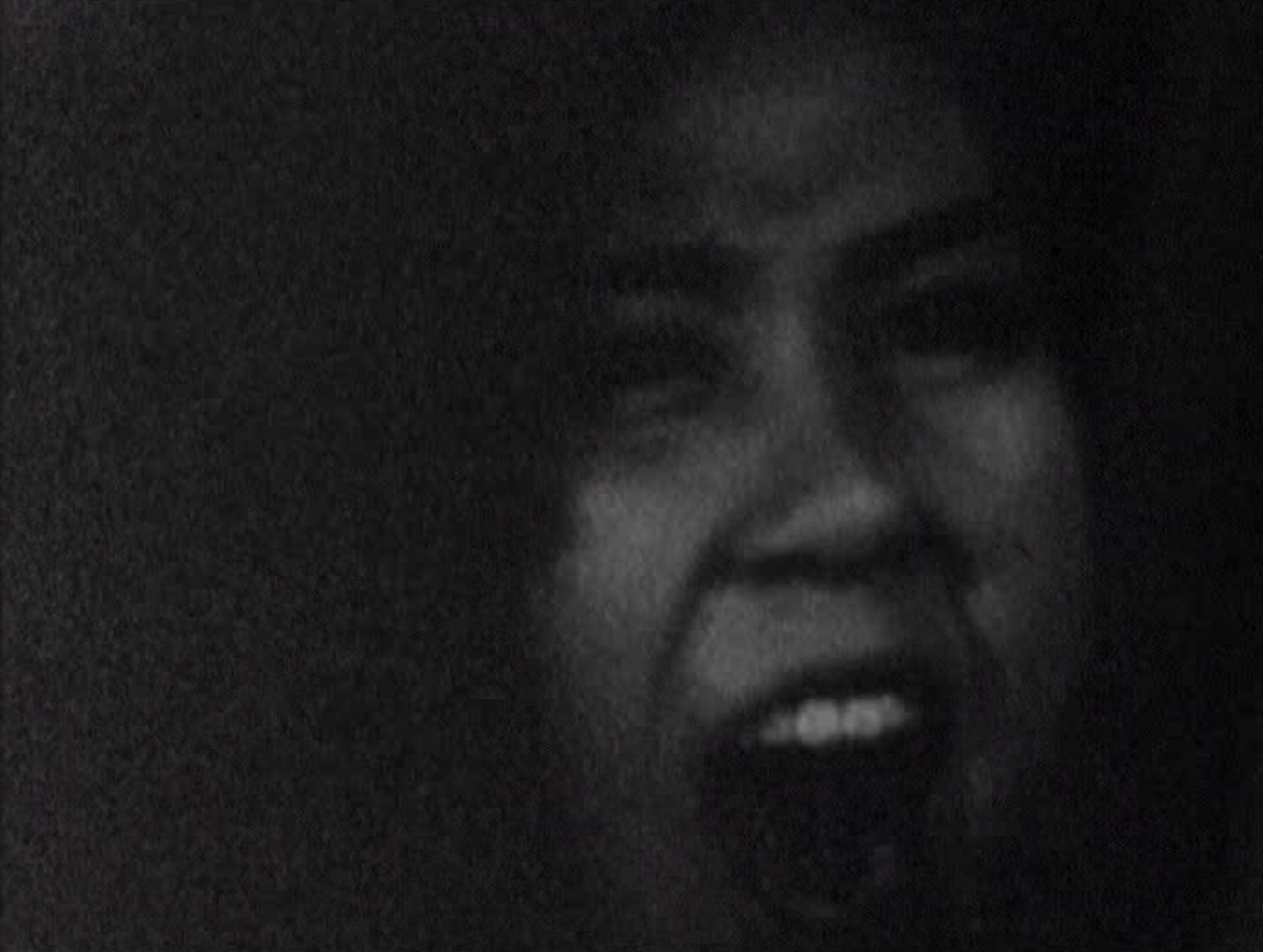
The film’s tagline, “A Woman in Trouble,” underscores her dissolution: corporeal integrity undone in a space of profound unrest. Similarly, Philippe Grandrieux’s La Vie nouvelle drags its characters through a ravaged Sarajevo, where language disintegrates and bodies seek reconciliation in ruin. The result is rebirth and a scream in which one finds only more broken sutures, anticipated by a terrifying night-vision interlude in which the human visage is excoriated of its sanctity.

Walter Benjamin’s dictum that “film is the first art form capable of demonstrating how matter plays tricks on man” has never been more apt. AI-generated imagery likewise gnaws at the barrier between the natural and the supernatural. Its manifestations of trauma without selfhood render the body a vessel of moral and perceptual violation. Displaced from domesticity, it reflects irresolvable turmoil, and the more autonomy it achieves, the more humanity we scramble to recover. This explains why AI’s creations feel so spectral: we have seen their kind before. The only difference is that, whereas once we regarded them only in the mind’s eye, now they are actualized with excruciating pervasiveness.

The premise that benign technologies might beget horror reveals our lack of control more than it restores harmony. These hybridizations of natural and unnatural law force us to question identity itself, ejecting us from human-centered hierarchies into a dialectic with entropic nature. Even something as simple as Paglen’s Comet (Corpus: Omens and Portents) conjures narratives of missiles and imminent annihilation.

We fear not that “evil was born,” as Grace Zabriskie so artfully intones in Inland Empire, but that it never needed to be born. It simply is. It predates us and will outlive us, feeding on forces that nevertheless make us who we are. And so, AI embodies its own eerie vitality, a dead signifier born from the narcissistic desire to reproduce life and deny death’s power. Its synthetic offspring thrive on replication, nursing at the breast of finitude.

Diving once again into Twin Peaks: The Return, we find faces opening into voids inhabited by unclean spirits, golden orbs, and infinite darkness, each a portal instead of a mirror:

In his dialogue with Downey, Paglen explains that the Adverserially Evolved Hallucinations project lets us see inside the “black box” of image-processing models and think from within them rather than be guided by them. This, he suggests, might help us move beyond the temptations of perception. “AI models,” he notes, “actively perform processes of manipulation; they want you to see something.” That desire is itself hallucinatory, as well as dangerous. Just as ChatGPT can invent a nonexistent citation, generative image models can fabricate surveillance realities indistinguishable from fact. The imposition of the fake upon the real becomes so seamless that we cease to question it.

Once something takes the form of an image, it acquires an aura of inevitability. Like a lyric we can’t imagine written differently, the hallucination becomes fixed. These interdimensional images seduce with the promise of infinite variation yet horrify with their fixation on wrongness. In leaning toward the actual through rudimentary shapes and gestures (what Paglen calls “primitives”), we find that the only truth worth protecting is that which resists us. Such is the paradox at the heart of all AI-generated imagery: the more real it appears, the more counterfeit it becomes.

Steve Tibbetts: Close (ECM 2858)

Steve Tibbetts
Close

Steve Tibbetts guitar, percussion, piano
Marc Anderson percussion, gongs, handpan, loops
JT Bates drums
Recorded 2021-2024 in St. Paul by Steve Tibbetts
Drums recorded at 8vb Studio, Minneapolis by JT Bates
Mastered by Greg Reierson at Rare Form Mastering
Cover photo: Joel and Norris Tibbetts
An ECM Production
Release date: October 24, 2025

“Music is a twilight language.
The job is to translate some shadow into sound.”
–Steve Tibbetts

On his 11th album for ECM, guitarist Steve Tibbetts returns with his ever-present ally, percussionist Marc Anderson, joined by drummer JT Bates for a session of immense intimacy. If long-standing classics like Exploded View and Big Map Idea have attuned your ears in a certain direction, you can safely put those expectations aside. This time around, Tibbetts offers us imploded views and small map ideas. And while these are meticulously yet organically crafted as per usual, to appreciate their full potential requires meditation, repeat listenings, and an openness to disconnecting oneself from the FOMO of our digital lives in service of something far more subliminal and enduring.

All the more appropriate, then, that the album should take its first steps with “We Begin,” wherein a deep and sinuous sound stretches from horizon to horizon. Like many of the pieces here, it unfolds in multiple numbered parts, each embodying an interlocking experience that builds on the last. In Part 2, for example, the introduction of hand drumming gives traction and earthiness to the proceedings, even as Tibbetts morphs from one register to the next, swapping terrains with the ease of a fox changing the color of its fur without even thinking. The seasons are his compass, trudging through the underbrush as winter approaches. The delicate patter of canine footsteps is audible now and then, marking the forest floor with rhythms older than all of us put together.

In “Away,” another tripartite wonder, hints of distant thunder begin to encroach on our audible view. Without an umbrella, Tibbetts constructs one out of the materials at hand: his strings provide the metal spines, the percussion the webbing between them, and the melodies themselves the rod and handle where they meet. And even though the rain never comes, that’s okay. The beauty was in the anticipation of the downpour.

Not all is ferns and fronds, as “Remember” offers some grittier textures, recalling the solo work of Andy Hawkins. What’s fascinating here is how the title can be read as a metaphor for listening: both require a certain sensitivity to sounds and movements beyond one’s control. There is a sense of flow that exists just outside of time, especially in the piano Tibbetts adds to Part 2, lending an even more nostalgic tinge to the whole.

“Somewhere,” “Anywhere,” and “Everywhere” are something of a triptych in their own right. Consisting mostly of short intakes of breath, they cradle within them the slowest of burns in Part 3 of “Somewhere.” (It’s also a literal burn, as the tubes in Tibbetts’s amp catch fire at the 4’06” mark—listen for their satisfying decay!) Beyond that, one encounters hints of whale song, death knells, and other dark turns, all finding their final rest in “We End.” It’s a flower without a vase, gifted instead to the water’s surface.

Throughout this mellifluous journey, we are guided by two distinct voices. One is the 12-string, which Tibbetts strings in double courses rather than the standard octaves; the other, his acoustic and electric six-strings, on which he drops the low A and E down to G and C, respectively. “There’s always a bass drone available,” he notes of the effect. “That tends to keep all the tunes in the same key. I’m comfortable with that, having spent some time around gamelan ensembles, Tibetan longhorns, court music from Java, Hardangar fiddle from Norway. Most of the world’s music stays in one key or another.” True, and all the more reason to appreciate the yearning, keening quality of his touch. Like the sitar, so much happens after contact has been made.

This is by far the most delicate of Tibbetts’s albums, but for that reason, it speaks more directly to the heart. There is something uniquely tensile here such as only he can articulate. He is a master of suspensions: even in silence, one feels the slack in his gut. The cumulative effect borders on an autonomous sensory meridian response, where the creaking of strings and frets makes the very spine of the universe tingle. A shooting star in slow motion, it possesses time-lapse qualities. And just when you think Tibbetts will lift off and leave you behind, he touches down back on the soil and ensures your safe travels.

Sokratis Sinopoulos/Yann Keerim: Topos (ECM 2847)

Sokratis Sinopoulos
Yann Keerim
Topos

Sokratis Sinopoulos lyra
Yann Keerim piano
Recorded February 2024
Sierra Studios, Athens
Engineer: Giorgos Kariotis
Cover photo: Jean-Marc Dellac
Produced by Manfred Eicher
Release date: October 17, 2025

There is nothing quite like the sound of the lyra when Sokratis Sinopoulos takes it in hand. The instrument exhales an ancient soul into the modern air, and few musicians draw from its strings such a fusion of myth and immediacy. From his quartet recordings, Eight Winds and Metamodal, this more intimate duo with pianist Yann Keerim distills their chemistry into an even deeper alchemy of tone and silence. Their collaboration of nearly twenty years has ripened into an art of pure intuition, where melody and freedom speak the same language.

At the album’s heart lies Béla Bartók, whose Romanian Folk Dances serve as both axis and atmosphere. Yet it is in “Vlachia,” one of four original pieces inspired by the Hungarian composer, where their vision truly unfolds, as melancholy and art relate like light through water. The piano’s chords rock gently, a cradle of memory, while the lyra hovers between waking and dreaming, resisting the lull of its own tenderness. “Valley,” by contrast, opens like a watercolor, the soul of the landscape awakening at dawn, when even the smallest stones remember their own luminosity. Between the modally inflected interlude “Mountain Path,” with its blues-tinted horizons, and the quietly breathing “Forest Glade,” the musicians walk among elderly oak, beech, and elm, each exhaling the voices of forgotten peoples, their songs hanging in the air.

The Romanian Folk Dances themselves are reimagined here as meditations on time’s elasticity. “In One Spot,” normally brief and fleeting, becomes a slow unfurling, each phrase examined as though through a magnifying glass instead of a telescope. What was once a dance is now an act of remembrance, a transmission through hands, hearts, and breath. Keerim’s improvisations shimmer with restraint, unveiling the dance as a living organism rather than a set of steps. “Sash Dance” begins like a gift being unwrapped, its introduction a flowering reverie, before the familiar theme emerges, tender as an heirloom passed from parent to child. Sinopoulos’s harmonic touch is radiant, his bow tracing lines that dissolve as soon as they are drawn, while Keerim decorates with the grace of rain gathering on the edge of a leaf.

A solo lyra ushers us into “Dance from Bucsum,” its lament carrying the weight of centuries. Gradually, it finds vitality again, as if memory itself were relearning its steps. The piano’s entrance is light breaking through foliage. “Romanian Polka” delights in this interplay, its bowings and pluckings coaxing the piano into a rhythmic embrace. The music feels rooted in the soil, yet perpetually on the verge of flight. “Fast Dance” is not so much quickened as transfigured. What was once earthy now becomes spectral, its pulse sifted through the mesh between moments.

“Stick Dance” closes the circle, beginning in abstraction before broadening into a spacious terrain of inspiration. There is such reverence here that one hesitates to call it an ending at all. In returning to the first of Bartók’s dances, the album folds time in upon itself, reviving what it has just allowed to rest. It becomes not a conclusion, but a threshold, suggesting that each listening might return us to the beginning with altered ears.

As Sinopoulos and Keerim write in the album’s booklet:

“Our Topos is where tradition meets the present, the Balkan Mountains meet urban space, the music of the countryside meets contemporary creation. Our Topos is where we meet and interact, shaping our individual and common identities.”

Indeed, Topos is less a location than a living field, a place where listening itself becomes part of the composition. Between the lines of melody and silence, we, too, are invited to breathe, to dwell, to remember. And as the final tone recedes, one wonders whether the music has ended at all or merely crossed into another realm, where echoes continue to shape the clouds, unseen but never lost.

Meredith Monk: Cellular Songs (ECM New Series 2751)

Meredith Monk
Cellular Songs

Meredith Monk & Vocal Ensemble
Ellen Fisher
Katie Geissinger
Joanna Lynn-Jacobs
Meredith Monk
Allison Sniffin
John Hollenbeck
Recorded January-March 2022 / March 2024
Power Station Studios, New York
Engineers: Kevin Killen (2022), Eli Walker (2024)
Assistant: Matthew Soares
Mixing: Eli Walker, Alexann Markus (assistant)
Cover photo: Julieta Cervantes
Recording producers: Meredith Monk and Allison Sniffin with John Hollenbeck
Executive producer: Manfred Eicher
Release date: October 17, 2025

All too often, women have been mythologically depicted as vindictive creatures who exist only to distract and destroy. Whether in the Sirens of the ancient Greeks or Tennyson’s Lady of Shalott, they sing, weave, and create in isolation, forbidden the pleasures of love, peace, and community. And while the work of singer and composer Meredith Monk has always been concerned with questions of agency, it was never made so clear to me as when the boxed set of her collected ECM recordings materialized in 2022. As the first album to appear since that watershed release, Cellular Songs doesn’t so much continue the journey as fold in upon itself, so that by the end, the listener is left with a compact flower of such potent expressivity that it seems capable of leading one’s ears in directions never thought possible yet which sound intimately familiar, as if remembered from a dream that preceded language.

Cellular Songs is the second part of a trilogy that began with On Behalf Of Nature, a work exploring our global ecosystem from a molecular vantage point. For Monk, the title names what is fundamental not only to life but to all of creation. “What is going on in the cell is so complex,” she writes, “and it’s a prototype of the possibility of what a society could be if you take those same principles and expand them.” As Bonnie Marranca suggests in her liner notes, composing and contemplation are synonymous, which makes Monk a meditator of worlds, one who reduces the act of communication to a microcosmic array of consonants, vowels, and blends. In this regard, it is difficult to imagine anything so biologically poetic as the opening “Click Song #3 Prologue,” in which Monk and her vocal ensemble (Ellen Fisher, Katie Geissinger, Joanna Lynn-Jacobs, Allison Sniffin, and Monk herself), with percussionist John Hollenbeck, get to the heart of things. Their tongue clicks are droplets in a distant cave, each carrying minerals and unfelt emotions until, over millennia, stalagmites rise as records of their passage. Like the three “Cell Trios” that follow, they constitute an internal code that locks into place. Flowing harmonies and dissonances encompass the breadth of life itself, a reality in which the voice is central, porous in its itinerant grace. 

Hollenbeck’s vibraphone appears organically in a handful of pieces, a trace element in the soil of this music. Whether documenting a universal grammar in the syllabically potent “Dyads,” playing alongside the piano in “Dive,” or bowing a glassy surface in “Melt,” it allies itself with the building blocks of existence, defying the horrific structures so often fashioned from them. It is the vein in every vocal leaf, seeking photosynthesis without flesh and treating entropy as the dissolution of time. Sniffin’s pianism is equally cathartic in “Lullaby for Lise,” where she joins Geissinger. Rather than leaning on lyricism to seek fantasy, it straddles the threshold between waking and dreaming, recognizing that lived experience is always a blend of both. I hear it as a song to a child not yet born, gestating and growing with all the possibilities of time in her blood and brain, opening her eyes at last in “Generation Dance.” Thus, she comes to know the vision of her mother and her mother’s mother, and as she exhales in “Breathstream,” Monk’s solo voice gives shape to inherited traumas, now able to be wielded in the name of healing.

In the unfolding of “Branching,” each voice becomes the first in an ever-multiplying lineage of wisdom. Speaking of rituals and sacrifices, their repetition serves not as comfort but as a catalyst born of a primeval, generative power. “Passing” finds those same figures trading off vocalizations with a precision that is open to nature’s chaos, while “Nyems” reveals the playfulness of communication for the ephemeral metaphor it truly is.

Given that nearly all of the work presented here is stripped of linguistic meaning, what a radical blessing to encounter the coherence of “Happy Woman.” Here, the feeling is one of transparency, yet also of quiet critique, an awareness of the many roles women inhabit, whether by choice or by force. The opening refrain and its variations (“I’m a happy woman,” “I’m a hungry woman,” “I’m a thinking woman,” etc.) are the stitches of a mother among mothers, quilting herself into the patchwork of history.

By the album’s end, the sacredness of vibration becomes paramount. From these humming atoms emerge animals, rivers, and clouds, leaving us to wonder where the so-called intellect fits into the larger picture. Because if a heartbeat is nothing without silence, then its divisions are where forgiveness begins.

Nik Bärtsch’s Ronin Live Review

These post-pandemic years have been slim for live concerts on my end, but a week ago, I had the great pleasure of seeing Nik Bärtsch’s Ronin much closer to home than usual in a very special concert with guest Sumie Kaneko on koto. Click the photo below (courtesy of MIT Video Productions) to read my review in full at All About Jazz.

Zehetmair Quartett: Johannes Brahms / op. 51 (ECM New Series 2765)

Zehetmair Quartett
Johannes Brahms / op. 51

Zehetmair Quartett
Thomas Zehetmair
 violin
Jakub Jakowicz violin
Ruth Killius viola
Christian Elliott violoncello
Recorded November 2021
Konzerthaus Blaibach
Engineer: Rainer Maillard
Recording supervision: Guido Gorna
Cover photo: Eberhard Ross
Produced by Manfred Eicher
Release date: October 17, 2025

After much-lauded recordings of works by Hindemith, Bartók, and Schumann, among others, the peerless Zehetmair Quartett returns to ECM to interpret Op. 51 of Johannes Brahms (1833-1897). In his liner notes for the album, Wolfgang Stähr characterizes the German composer as one who “wrote both much and little.” Cases in point are his string quartets, of which he quilled over 20 in his youth but later destroyed, leaving only the two featured on this recording, plus a third. As Brahms once related to his biographer, Max Kalbeck, “The boxes with those old manuscripts stood in Hamburg for ages. When I was there two or three years ago, I sat on the floor—entire walls were beautifully decorated with my scores, even the ceiling. I only had to lie on my back to admire my sonatas and quartets. It looked rather good, actually. But I tore it all down—better I do it than someone else!—and burned the rest along with it.” Work on these survivors began in the mid-1860s, but it was only in 1873 that his perfectionism conceded to the decision to call them complete. And so, we are left with, at best, mere intimations of what came before, shattered and reworked into collages of a mind slightly more in tune with its self-inflicted wounds.

The String Quartet No. 1 in C minor blossoms into exuberant life from the start, its gentle lead-in masking an almost volcanic energy beneath. This declamatory statement is not the setting of a tone but the breaking of it, snapping us out of a painful reverie into something more immediate—a real crisis rather than the arbitrary melancholy with which we tend to surround ourselves. The constant vacillation between urgency and resignation renders these proceedings a masterful exercise in tension and release. The sheer level of rhythmic and melodic invention is dazzling to behold, evolving into something beyond incidental. The Zhehetmair Quartett navigates every twist and turn with the precision of a film director who nevertheless allows his actors to make every scene leap from the screen.

Such heroism, however, is destined to fall, for even the romantic gestures of the second movement are not offered in hopes of fulfillment but rather in expectation of being forgotten. This undermining is what separates Brahms from the gigantry of such predecessors as Beethoven. He is uninterested in staid forms and inherited expectations. He speaks and lets his sentiments carry the day, rather than deferring to baskets with pretty little labels and easily identifiable contents.

In the third movement, a subdued yet altogether lively Allegretto, he unveils another facet of determination, all the more powerful for being caught in a web of its own making. A particularly gorgeous moment occurs when the quartet coalesces into a pizzicato dandelion, then blows its seeds far and wide. But if anything is left to wander offscreen, it is brought right back into focus with the final Allegro. Here, the camera zooms in, revealing every detail. It is a stunning conclusion that declares itself undeclarable.

While these quartets are quite violin-forward, as proven by the leading voices of Thomas Zehetmair and relative newcomer Jakub Jakowicz, violist Ruth Killius deserves admiration for providing the rudder that steers both vessels. Her sinewy strength is astonishingly present in the String Quartet No. 2 in A minor, of which the opening movement lets her sing with unbridled lyricism. The same must be said of cellist Christian Elliott, for whom this would be his last recording with the quartet before his untimely death earlier this year. His depth of color and texture is felt throughout, especially in the two central movements, where the instrument’s endurance is revealed in tonal breadth, muscular leaps of intuition, and smooth layers of binding energy.

In the finale, all signatures come to the fore, each a piece in a larger puzzle upon which light continues to fall. The violins are once again declamatory without feeling desperate, pointing instead to inspirations deeply internal and chaotic, funneled into a sound as interlocking as it is yearning to be free of its own design. Thus, the music leaves us behind, not with a sense of closure but of an ongoing trajectory, an arrow still in light. For in Brahms’s hands, drama has no fixed abode, only the upheavals of time itself, to which we all must ultimately succumb and from which, through performances such as this, we momentarily rise again.

Muthspiel/Colley/Blade: Tokyo (ECM 2857)

Wolfgang Muthspiel
Scott Colley
Brian Blade
Tokyo

Wolfgang Muthspiel guitars
Scott Colley double bass
Brian Blade drums
Recorded October 2024 at Studio Dede, Tokyo
Engineer: Akihito Yoshikawa
Assistant engineers: Ryuto Suzuki and Yo Inoue
Mixing: Michael Hinreiner (engineer), Manfred Eicher, and Wolfgang Muthspiel
Bavaria Musikstudios, Munich
Cover photo: Juan Hitters
Album produced by Manfred Eicher
Release date: September 26, 2025

For its third studio outing, the trio of guitarist Wolfgang Muthspiel, bassist Scott Colley, and drummer Brian Blade lays down its most complex and adventurous session yet, fittingly recorded amid the electric calm of its titular city. The band achieves simpatico liftoff from the start in its swinging take on Keith Jarrett’s “Lisbon Stomp.” With a forthright delicacy that is hard to come by these days, they make the music come alive with fluid precision, every note free yet placed right where it needs to be. The plane lands on a more unsettled note with Paul Motian’s “Abacus,” for which Muthspiel slips into echoing distortions for a crunchier sound. Blade taps directly into Motian’s painterly attention to detail, his wider palette eliciting a tactile commentary, while Colley’s solo unpacks every shadow he casts.

Between these two telephone poles, the filaments of Muthspiel’s originals stretch, each charged with varying intensities of voltage. The moods are as distinct as the writing is strong. From the lyrical balladry of “Pradela” to the tongue-in-cheek angularity of “Weill You Wait,” he evokes a spectrum’s worth of times, places, and moods. The latter piece, with its oddly captivating contours, shows just how deeply the guitarist is willing to dive to find his voice.

His wingspan feels broadest when the melody becomes a form of searching, reaching toward something far beyond what the eye can see. This is most evident in “Flight,” which turns the proverbial landscape below into a resonating instrument. Its aerodynamic theme rides one thermal to the next without so much as a wing flap. The blend of acoustic and electric signatures gives the track a rare three-dimensionality.

At just two and a half minutes, “Roll” is the album’s briefest cut but also among its liveliest. With a nod to Weather Report, it radiates that same exuberant sense of living in (and for) the moment. Like the album as a whole, it foregrounds Muthspiel’s talents without stepping on the toes of his bandmates. Colley and Blade are not accompanists but equal protagonists in a story that emerges chapter by chapter into a shared narrative.

“Christa’s Dream” lingers as the most haunting turn, full of transcendence and half-existence, visible yet intangible, like a ghost in the light of day. It gives way to “Diminished and Augmented,” wherein oblique acoustic stylings blossom with playful grace. There’s a hint of Ralph Towner in its balance of leaping precision and sliding ease.

“Traversia” ventures farthest into unconventional harmonies, taking cues from Messiaen’s bold colors while achieving near-Renaissance purity of tone through the use of a capo. Originally written on a children’s guitar, it retains an innocence even as it matures in real time, the arco bass weaving a thread of quiet majesty through it all.

The folk-inspired “Strumming” pays deference to Bob Dylan and Leonard Cohen, refracted through a seamless idiom. Muthspiel’s ember-infused guitar rides atop Blade’s locomotive brushes, creating a boundless sense of space where synthetic and human energies meet. It’s a song of rudimentary joy and quiet surrender, a reminder that sometimes the simplest gestures have the deepest resonance.

In the end, Tokyo feels less like a document and more like a meditation in motion of three travelers translating memories into sound. What Muthspiel, Colley, and Blade achieve here is an equilibrium between structure and spirit. It is jazz as weather: unpredictable, fleeting yet timeless.

A Stone in the Water: Tracing the Ripple Effects of Dostoevsky’s The Idiot

The highway of the upright is to depart from evil:
he that keepeth his way preserveth his soul.
–Proverbs 16:17

Most novels proceed as a river does—flowing from source to mouth, obedient to the order of time, accumulating its inevitable dams, docks, and diversions along the way. The Idiot, however, is no such river. Dostoevsky drops his protagonist into the current not to drift but to disturb, thus revealing the eddies and whirlpools that form around innocence when it trespasses into the murky waters of high society. That first drop lands Prince Lev Nikolaevich Myshkin—and by extension, the reader—on a train bound for Petersburg. He is fresh from a Swiss sanatorium, where for four years he has been treated for epilepsy. His fellow travelers—Parfyon Semyonovich Rogozhin, newly enriched and drunk on inheritance, and the gossiping Lukyan Timofeevich Lebedev—are the first to be caught in his wake. Rogozhin, with the tactless curiosity of a man ruled by appetite, asks whether the prince is a “fancier of the female sex.” When Myshkin denies it, Rogozhin replies, “[Y]ou come out as a holy fool, Prince, and God loves your kind!” Thus is the first stone cast into the still pond of Myshkin’s effect, its ripples reaching outward in mockery and awe alike.

Soon, the prince finds himself in the home of Ivan Fyodorovich Epanchin, though it is toward Epanchin’s wife, Elizaveta Prokofyevna, that his lineage tenuously connects him. Within moments, he becomes an object of curiosity, as if his very simplicity were some divine riddle. The Epanchins and their daughters draw near him not from affection but fascination; his every word seems to hang in the air long after it has been spoken. So begins the novel’s great fractal of human encounters, each scene branching into another with the stubborn logic of fate.

Translator Richard Pevear observes that, though The Idiot is unanchored to place, it is never abstract. Every room, every parlor and garden, serves as a shell into which the living organism of the narrative crawls. The spaces are cramped, yet within them Dostoevsky builds an architecture of the soul. Each wall is a moral boundary, each window a glimpse into depravity.

The most cavernous of these shells is Lizaveta Prokofyevna herself—“a hotheaded and passionate lady,” who, “without thinking long, would sometimes raise all anchors and set out for the open sea without checking the weather.” In her temperament, we glimpse the embryonic forms of her three daughters: the sensible Alexandra, the artistic Adelaida, and the beautiful, capricious Aglaya. Orbiting them are other satellites of this anxious universe: Rogozhin, the merchant whose newfound wealth becomes license for cruelty; Lebedev, the self-proclaimed “professor of the Antichrist,” who reads the signs of apocalypse in the iron veins of Europe’s railroads; and, most haunting of all, Nastasya Filippovna Barashkov, the fallen specter, whose trauma becomes the crucible of the entire tale. She is distance made flesh: adored by men, despised by women, yet pitied by both.

At the trembling center of this constellation burns Myshkin himself—a sun both fragile and inexhaustible. His presence exposes others as a mirror does, revealing the distortions they cannot bear to face. “I really came only so as to get to know people,” he says to the Epanchins, a confession so plain it becomes profound. In that aim to understand the human heart lies the novel’s central pulse.

From his first conversation, Myshkin unveils the spiritual burden of consciousness. He speaks of men awaiting execution, drawing on Dostoevsky’s own brush with the firing squad: “Take a soldier, put him right in front of a cannon during a battle, and shoot at him, and he’ll still keep hoping; but read that same soldier a sentence for certain, and he’ll lose his mind or start weeping.” The words tremble with prophetic weight, foreshadowing the undoing of characters condemned not by law but by their own desires.

Lizaveta and her daughters listen as if to a visitation. Myshkin, recalling his lonely youth, declares, “Nothing should be concealed from children on the pretext that they’re little and it’s too early for them to know. What a sad and unfortunate idea!” Yet the world he enters treats him precisely as such a child: harmless, ignorant, to be humored and dismissed. “The risen sun,” the narrator tells us, “softened and brightened everything for a moment,” and so it is with Myshkin: his light briefly transforms, though it cannot redeem.

When he first beholds Nastasya’s portrait, he perceives in her a soul both contemptuous and simple-hearted, “filled with suffering.” Her name, from anastasis (resurrection), bespeaks her torment: the lamb whose innocence was traded for the amusement of nonbelievers. Like him, she is called “crazy,” though her madness is but the logical end of a world that mistakes cruelty for sophistication.

Even Myshkin’s name bears contradiction: from mysh, meaning “mouse,” and Lev, or lion. In Dostoevsky’s notebooks, beside sketches of the novel, appear two words umbilically connected: “Prince-Christ.” And yet, Myshkin does not forgive sin; he merely reveals it by existing. To Nastasya, he says, “I am nothing, but you have suffered and have emerged pure from such a hell, and that is a lot.” Thus, he grants her what theology cannot: recognition.

His influence spreads like contagion. “I believe God brought you to Petersburg from Switzerland precisely for me,” exclaims Lizaveta, and though she speaks in self-interest, she unknowingly sheds veracity. Myshkin is brought not for one but for all. When he visits Rogozhin’s home, he beholds a copy of Hans Holbein the Younger’s Christ in the Tomb, that merciless painting of the dead Savior, devoid of light or transcendence. “A man could even lose his faith from that painting!” says the prince. Rogozhin, missing the irony, takes him at his word. Myshkin explains: “[H]owever many books I’ve read on the subject, it has always seemed to me that they were talking or writing books that were not at all about that.” He concludes that “the essence of religious feeling doesn’t fit in with any reasoning… there’s something else here… that atheisms will eternally glance off.” Dostoevsky thus holds up the Russian heart, trembling with contradictions, as both the disease and the cure: a heart that forgets the Father even as it cries out for Him.
If The Idiot has often been called satire, it is only because its realism is too acute to endure. It captures the narcissism of the upper classes with the precision of a surgeon and the patience of a saint. Myshkin’s self-awareness is his shield: “What sort of idiot am I now, when I myself understand that I’m considered an idiot?” he asks, deflating mockery by acknowledging it. Like Eminem’s self-flagellation in 8 Mile—if one may indulge a modern echo—he disarms his accusers through confession, transforming insult into revelation. What they cannot abide is not his foolishness but his love.

This love, however, is tested to absurdity. When an impostor by the name of Antip Burdovsky demands a share of the prince’s inheritance under false pretenses, Myshkin offers it anyway. Though exposed as a fraud, Burdovsky still receives the prince’s charity, for in Myshkin’s eyes, deceit and misfortune are twins. Such naivety is his virtue, his madness, and his crown of thorns.

In a later gathering, one Evgeny Pavlych recounts a murder trial in which the lawyer excuses the killer’s actions as “natural” under poverty. This comment provokes nods and murmurs of agreement among those assembled, to which Lizaveta responds by accusing them of being vainglorious madmen who have turned their back on God and Christ. She lambastes them for harping on the “woman question,” which haunts the novel with its articulation of women’s desires vis-à-vis the men in their lives: “You acknowledge that society is savage and inhuman because it disgraces a seduced girl… But if she’s been hurt, why, then, do you yourselves bring her out in front of that same society and demand that it not hurt her!” It is a sermon worthy of record, and yet it vanishes in the noise of polite indifference.

Among the assembled is Ippolit Terentyev, a dying youth whose intellect burns as his body fails. His “Necessary Explanation,” a swan song in letter form that he insists on reading aloud, is both confession and defiance. “People are created to torment each other,” he proclaims. Confronting the same Holbein painting, he asks, “[H]ow could they believe, looking at such a corpse, that this sufferer would resurrect?” and later, “Can something that has no image come as an image?” For Ippolit, faith is cruelty postponed. “Let consciousness be lit up by the will of a higher power,” he muses, “and let that power suddenly decree its annihilation… let it be so.” His despair is a dark parody of Myshkin’s compassion: both see too clearly to live comfortably among men.

Myshkin, whose “head worked quite distinctly, though his soul was sick,” stands apart. Love is denied him not by fate but by incompatibility with a world that feeds on contradiction. His tenderness for Aglaya withers into disillusion; his pity for Nastasya curdles into dread. Like a puzzle piece that almost fits, he must be left aside until the picture itself changes.

And what of the others? They collapse one by one under the weight of their vanity, leaving the prince almost alone, a gold-foiled icon among ruins.

In one of the novel’s most terrifying moments, Dostoevsky describes Myshkin’s seizure: “A dreadful, unimaginable scream, unlike anything, bursts from the breast… it may even seem as if someone else were screaming from inside the man.” The cry is metaphysical; it is the scream of all creation recognizing itself. To read The Idiot is to experience that seizure, to awaken, trembling, in the aftermath of one’s own delusions. Its absurdity, like its truth, is more real than reality itself. Dostoevsky does not offer resolution; he offers revelation. And when we close the book, the echo of that scream remains: terrible, holy, and alive.