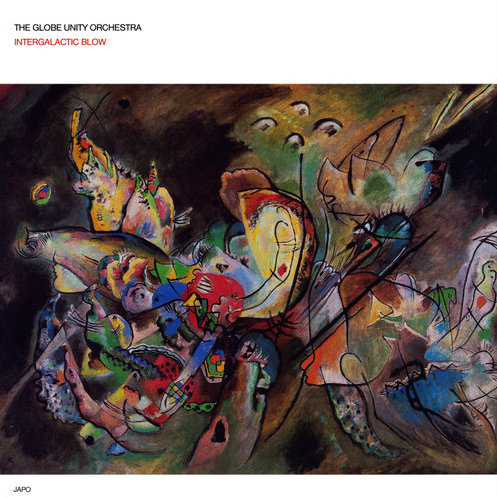
The Globe Unity Orchestra: Intergalactic Blow (JAPO 60039)

Intergalactic Blow

The Globe Unity Orchestra
Intergalactic Blow

Toshinori Kondo trumpet
Kenny Wheeler trumpet
Günter Christmann trombone
George Lewis trombone, effects
Albert Mangelsdorff trombone
Bob Stewart tuba
Gerd Dudek flute, soprano saxophone, tenor saxophone
Evan Parker soprano saxophone, tenor saxophone
Ernst-Ludwig Petrowsky flute, alto saxophone, baritone saxophone
Alexander von Schlippenbach piano
Alan Silva bass
Paul Lovens drums
Recorded June 4, 1982 at Studio 105, Radio France/Paris.
Recording engineer: Jean Deloron
Mixing engineer: Martin Wieland
Produced by Thomas Stöwsand

Beginning in 1966, the Globe Unity Orchestra sparked a four decades-long run that intersected with the JAPO label on three counts. For this, the group’s second for ECM’s sister label, founder Alexander von Schlippenbach hand-selected a set of free improvisations emitted in a Paris studio in June of 1982.

Even more noticeable this time around are the contributions of its brass players, especially trumpeters Kenny Wheeler and Toshinori Kondo (who takes the place of Manfred Schoof from the last record). Their methods of integration on the opening track, “Quasar,” set a tone that is dashed as quickly as it is established. From the farthest reaches of inner space, the musicians work their way to the front altar of the mind, where Ernst-Ludwig Petrowsky’s baritone files its utterances in living order. Tuba (Bob Stewart) and piano (von Schlippenbach) speak out of time—one from the future, the other for the past. Such is the ethos of the hour.

Even at its densest, Globe Unity makes sure to leave a door open for even the most transient listener, so that “Phase A” and “Phase B” feel no more connected by name than they are by process. It is their very incongruity that partners them in the album’s grander scheme, interpretable only after the fact. Their gestures are more jagged, turned from shining to brilliant by Evan Parker’s unmistakable soprano. Like the group as a whole, he takes rising levels of intensity as opportunities for sane reflection, thus allowing himself the strongest benefit of performance: being heard.

Drummer Paul Lovens is another master in this pool of many, adding to the 19-minute “Mond Im Skorpion” a scripture’s worth of microscopy. Amid this bramble of riffs and utterances, he treats every melodic branch as a fuse to be lit, and every lit fuse as a pathway toward new understanding of the improviser’s craft. Von Schlippenbach is again noteworthy for attuning to that same inner habitus, an environmental assemblage where one has to know where one has been in order to move toward the unknown. For even as reeds and brass elbow the horizon with the force of sunset, they hold the following morning in their chests. A snake-charming soprano seems to mock the wayward Orientalist who sees travel solely as a means of sticking another postcard in the scrapbook. Indeed, you will find no tourists here—only the artisans selling their wares on the outskirts of town, far from the crowded bazaar, where a cacophonous ending sings, proclaims, and teases every tether of dusk so that it might pull out another day from under our feet.

Globe Unity keeps everything clear and, thanks further to Thomas Stöwsand’s flawless production, ensures that every shout is also a whisper, and vice versa.

Contact Trio: New Marks (JAPO 60024)

New Marks

Contact Trio
New Marks

Evert Brettschneider acoustic and electric guitars
Aloys Kott bass
Michael Jüllich percussion, marimba, vibes
Recorded January 1978 at Tonstudio Bauer, Ludwigsburg
Engineer: Martin Wieland
Produced by Thomas Stöwsand

Along with Musik, the Contact Trio’s New Marks is another standout for ECM’s sister label, JAPO. Sharing with that later release frontmen Evert Brettschneider (acoustic and electric guitars) and Aloys Kott (fretless bass) but differing in the presence of Michael Jüllich (percussion, marimba, and vibes), this incarnation of the band charts vaster, even more palpable territory with a crystalline signature sound, for which we may also thank the late, great producer Thomas Stöwsand.

Brettschneider and Kott share composer credit. The former’s pen yields the album’s opener, “Happy,” which welcomes the listener appropriately with a smile. At first, Kott takes a page from the Eberhard Weber playbook—and, later, evokes the more experimental Bill Laswell—before ironing out his own distinct fabric. Jüllich, for his part, starches the outer layer with glowing cymbals. Guitarist and bassist trade harmonic arpeggios, foresting a temperate climate around Jüllich’s detail-oriented drumming. Kott’s “Circle” unfurls a likeminded mesh of marimba and vibes in support of Kott’s melodic overlay. This watery backdrop adds an ambient touch to the piece’s growth from conversation to prayer. Brettschneider’s electric shares starry crosstalk with Kott, then fades like a comet’s tail into a flanged midsection. This atmospheric shift wanders into what jazz might sound like if Steve Reich were to play it, mallet percussion and bass opening a window into the electric guitar’s virtuosic crunch.

“The Quick Brown Fox Jumps Over The Lazy Dog” begins the album’s second half of three tunes, each co-written by Brettschneider and Kott. It’s a frantic jazz crawl that reveals Jüllich at his finest, painting the night with a deluge of stars in his solo. “Stoned Tunes,” an album highlight, is a wintry duet of 12-string acoustic and bass, which segues into the title track’s freer language, a primer of both the band’s process and its imagistic leanings.

New Marks is worth tracking down in any form.

Dollar Brand: Ancient Africa (JAPO 60005)

Ancient Africa

Dollar Brand
Ancient Africa

Dollar Brand piano, flute
Recorded live June 1972, Jazzhus Montmartre, Copenhagen
Engineer: Lars Vester Petersen
Sound: Mantra Sound, Copenhagen

South African pianist Abdullah Ibrahim, known in a bygone era as Dollar Brand, is a soothsayer at the keyboard, and on this out-of-print JAPO release from 1974 he divines from the ebony and the ivory a lifetime’s worth of bones. Like its label predecessor, African Piano, this album was recorded live at the Jazzhus Montmartre in Copenhagen, but adds nearly three years of additional life experience to show for its mesmerizing rewards.

The original vinyl is a gorgeous thing in and of itself. Sleeved in a photograph of flaking, painted wood, it reads like a structure worn by time but which is also stronger for it. The performance consists of a long piano medley of original tunes plus an encore on flute. The bulk of the set opens, as did African Piano, with an extended take on “Bra Joe From Kilimanjaro,” a quintessential tune in Ibrahim’s personal archive. Its deep-set, rocking ostinato provides all the rachises he needs to strut with plumage burning bright. If not already obvious, Ibrahim is a brother of a different feather, one whose gifts are every bit as intuitive as those of Keith Jarrett, whose likeminded penchant for gospel-infused anthemism makes an early reveal before lighting a rocket into the jubilation of “Mamma.” Ibrahim’s lush comping fleshes out the atmosphere to its fullest, smoothing with bravado into the calmer “Tokai.” A joyful spread of chords flings us into the train ride of “Ilanga” with such traction that no tracks are required. As with so much of Ibrahim’s output, an underlying propulsion lends sanctity to the overarching message.

“Cherry” is a buoyant morsel of lyricism that sets us up for the heat of “African Sun,” which fades out of Side 1 and into Side 2. Both this and the following tune, “Tintinyana,” show an artist who understands the blues like few other contemporary pianists can. His take on the form is as nostalgic as a childhood tree, which continues to grow in mind even when its physical form succumbs to the axe of time. The roots of his left hand are so thick that every burst of foliage is like salt in the wounds of evil, for it knows that the divine await the righteous with open arms. In light of this, the romping swing of “Xaba” comes across as a purifying dance, an invitation to commune with exclusively musical worlds. The prayers of those worlds are to be found in “Peace – Salaam,” which ladders its way into the clouds as if they were puffs ejected from the pipe of history. Here we are invited to relax, unwind, and let our cares consume themselves into nothingness. A swell of applause brings us back to reality, and to the final “Air,” for which the keys are rested and the flute leaves the final word. And final it most certainly is, for it begins melancholy and finishes in a hunter’s dash, swift and sure.

Karen Mantler: Business Is Bad (XtraWATT/14)

Business Is Bad

Karen Mantler
Business Is Bad

Karen Mantler vocals, harmonica, piano
Doug Wieselman guitar, bass clarinet
Kato Hideki bass
Basic tracks recorded by Kato Hideki and Peter Karl at Peter Karl Studios, Brooklyn, NY, October 2012
Overdubs recorded by Kato Hideki at Dog Day Studio, Brooklyn, NY, November 2012
Mixed and mastered by Kato Hideki at Dog Day Studio, July-September 2013
Produced by Karen Mantler and Kato Hideki
Release date: June 13, 2014

Karen Mantler is more than the sum of her genetic parts. As the daughter of Michael Mantler and Carla Bley, one might expect her to be any number of things, but ultimately she has come into her own as a singer-songwriter of understated brilliance. It’s difficult to capture the profound simplicity, it not the simple profundity, of her lyrics, much less so the skeletal arrangements in which she couches them in trio with bassist Kato Hideki and Doug Wieselman on guitar and bass clarinet. There is an innocence and charm about these songs, but also a maturity that only comes with the ups and downs of life experience. Mantler focuses decidedly on the latter throughout Business Is Bad, which paints the portrait of an artist starving through deprivations at once social, linguistic, climatic, emotional, legal, artistic, and geographic. Practically dripping with self-awareness, each is a vignette of insight into the working mind of a mind at work.

Mantler Trio
(Photo by Carol Lipnik)

Whether taking on the plight of the homeless in “Catch As Catch Can” or lamenting airport closures caused by “That Damn Volcano” (which, one can only assume, refers to the eruption of Iceland’s Eyjafjallajökull in 2010), Mantler’s slack-jawed lyricism discloses a tongue in universal cheek that wags almost like a child’s, filtering out none of life’s pessimistic moments. With deadpan humor and the meticulous support of her bandmates, she comes across like bold print on the page, a DNA helix gone rogue.

Despite the album’s gloomy pall, there’s much whimsy to be savored, and much of it self-deprecating. The bossa nova skin of “My Magic Pencil (Wrote This Melody)” does little to conceal Mantler’s delightful frustrations over the wanderlust of her most ubiquitous compositional tool. “Speak French” conveys the disadvantages of being monolingual, seesawing English and French like a language instruction tape. On a subterranean level, however, it is a song about the musician’s desire to be heard—all the more ironic, because music is one of the very few languages that transcends such arbitrary barriers. Even when she sings of dead ends, lost causes, and a faithless system in “I Can’t Afford My Lawyer,” she makes as astute observation on the nature of art, which becomes little more than a profit machine built around people’s misfortunes. And in the nervous “My Solo,” in which she expresses a lack of confidence in playing exactly that, she nonetheless produces a songful harmonica solo in the album’s longest, and prettiest, instrumental section.

Between jazzier, diaristic observations (see “Wintertime” and the title track’s funkier blues) and the requisite breakup song (“Surviving You”), Mantler jumps from the quotidian to the philosophical in a single keystroke. If this is your first Mantler album, these extremes may either repel or enchant, but one thing is for sure: her songs are a gust of fresh air in a musical landscape gone dry.

AMM III: It Had Been An Ordinary Enough Day In Pueblo, Colorado (JAPO 60031)

AMM III

AMM III
It Had Been An Ordinary Enough Day In Pueblo, Colorado

Keith Rowe guitar, prepared guitar, transistor radio
Eddie Prévost drums
Recorded December 1979 at Tonstudio Bauer, Ludwigsburg
Engineer: Martin Wieland
Produced by Steve Lake and AM III

By the time this obscure JAPO album was released in 1980, AMM was 15 years old. The British free improvisation outfit, credited here as “AMM III,” was already an underground legend, and thankfully has stayed that way, even now preserving its integrity as an exploratory unit. For this brief incarnation, founding members Keith Rowe and Eddie Prévost set out as a duo, respectively combining guitar and percussion in a real-time evolution that fans of Evan Parker are sure to appreciate. Like Parker, Rowe and Prévost spend as much of their time listening as playing, soaking in the feeling of the surrounding soil before enriching it with just the right minerals.

“Radio Activity” is both mantra and anti-mantra. Rowe’s use of a transistor radio underscores the title as a method of operation, leaving behind its descriptive properties to shrivel in the sun of another day. The metallic details put forth by the two musicians, at once percussive and speech-oriented, seem to fold themselves like sheets of self-aware origami paper. The sounds of broadcasts moving through a flanged portal are complemented by an amorphous electric guitar, its ochre pigment drawing a halo without an angel. In this amphibious dronescape, valleys eventually turn into peaks as Rowe and Prévost lock into powerful, staccato interplay before compressing into a jam between molecules.

After the massive parentage of this first track, the ones that follow feel like its offspring. “Convergence” is the youngest sibling, a frail yet expertly tuned entity whose potential for strength is unlimited. The elasticity of “Kline” pegs it as the eldest child. Its swansong is written on parchment, a brittle medical document that is beyond the need for prescription. Frenzy ensues, throughout which Rowe treats the air like a pin cushion while Prévost shines a light through every eye like a star.

The two middle children are intersectional beings. “Spittlefields’ Slide” is exactly what one might expect it to be: a stuttering and warped chain of expectorations. It’s also a fine exercise in restraint that grows even as it flounders into dust. “For A” sounds as if the musicians dismantled a pay phone and made music with all the loose change gutted from within, faithfully documenting every snap of communication in a game of resuscitated conversations.

Your guess is as good as mine as to what any of the above to do with the album’s title, but I like to think that somewhere in Pueblo, Colorado there exists an echo of these soundings, ghostly yet content in its geographical prison.

The Swallow Quintet: Into The Woodwork (XtraWATT/13)

Into The Woodwork

The Swallow Quintet
Into The Woodwork

Steve Swallow bass
Chris Cheek tenor saxophone
Steve Cardenas guitar
Carla Bley organ
Jorge Rossy drums
Recorded November 15/16, 2011 and mixed and mastered at Studios La Buissonne, Pernes-les-Fontaines
Engineers: Gérard De Haro and Nicolas Baillard
Produced by Steve Swallow
Release date: June 14, 2013

Over a career spanning more than half a century, Steve Swallow has consistently redefined the electric bass as a jazz instrument. More importantly, he has taken any and every opportunity along the way to deepen his craft as a composer. His self-discipline in this regard has made every album seem at once a culmination and a stepping stone into greater futures. Into The Woodwork is no exception.

Swallow

For this latest incarnation of his quintet, Swallow has chosen a lineup worthy of the subtlety on which these 12 original tunes nourish themselves. The tenor of reedman Chris Cheek, who made a noticeable ECM appearance as part of the Paul Motian Band on Garden of Eden, brings the smoke before the fire in “From Whom It May Concern,” a ballad that tilts its own thematic mirror toward artful reflection. Cheek also plays beautifully in “Unnatural Causes,” from the paint-by-number simplicity of which he unpacks the robustness of an unexpected spectrum. This tune is further notable for the contributions of guitarist and fellow Motian associate Steve Cardenas, whose unforced geometries settle us into the album’s intimacies by way of “Sad Old Candle.” Cardenas, in fact, proves to be the quintet’s greatest converser, whether exchanging remarkable banter with Cheek (“The Butler Did It”) or playing in duet with Swallow (“Suitable For Framing”). His lyricism pairs well, too, with the organ of Carla Bley, whose own omnipresence reveals another defining mastery in tunes like “Never Know,” “Still There,” and “Grisly Business.” The latter’s gentle carnivalesque is ideally suited to her touch at the keys.

Drummer Jorge Rossy is a constant thread to which the band looks for guidance, but especially in the more energetic turns such as “Back In Action” and “Exit Stage Left.” His understated groove actualizes Swallow’s ethos of less as more, and demonstrates that self-assured music need never be arrogant. And then there’s Swallow himself, whose first true solo doesn’t come until the album’s ninth track, “Small Comfort” fans the embers. The edge of his new custom bass sounds already finely aged over this bed of organ and cymbals, exposing a little more of his inner workings as brushed snare and tenor pull back the curtain to clarity.

In contrast to the steadied pacing of Swallow’s ECM outings, many tunes on Into The Woodwork flow into the next without break, thus keeping his atmospheric integrity in constant check. Like the title track itself, the album as a whole finds balance between the grounded and the free, always keeping one arm around the listener’s shoulder. The fact that this music doesn’t overtly challenge is a challenge in and of itself to experience its strengths as givens. Like an old friend, it may not often surprise, but its comforts are exactly where they need to be.

Dreamers’ Circus review for RootsWorld

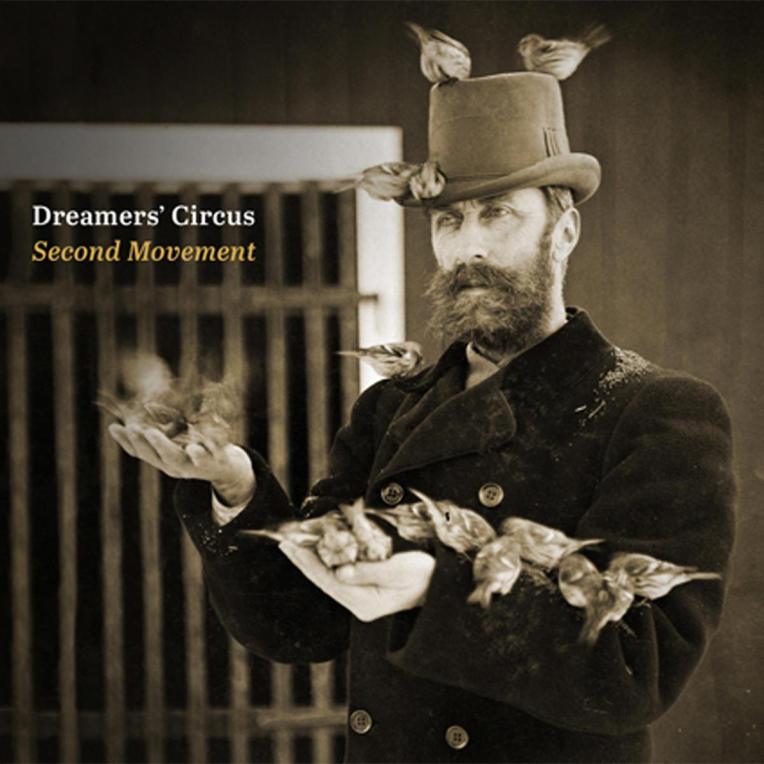
My latest review for RootsWorld online magazine looks at Second Movement, the sophomore album from Danish folk trio Dreamers’ Circus. This is sweeping, dreamlike music that should appeal to fans of Ale Möller. To read the review, click on the cover below. Also check out the live video below that to see the musicians in action.

Second Movement

Stephan Micus: Implosions (JAPO 60017)

Implosions

Stephan Micus
Implosions

Stephan Micus sitar, acoustic guitar, vocal, Bavarian zither, shakuhachi, shō, Thai flute, rabab
Recorded March 1977 at Tonstudio Bauer, Ludwigsburg
Engineer: Martin Wieland
Produced by Manfred Eicher

As of this month (August of 2015), ECM’s intrepid Stephan Micus has released his 21st album for the label, Nomad Songs. In recognition of this achievement, and of the prescience of that title, I thought it only appropriate to acknowledge Implosions, his first album for producer Manfred Eicher, released on the JAPO sub-label in 1977. What might the first-time listener have imagined when spreading roots into its soil? What fantasies or lamentations? What creeds or philosophies? Micus’s sound art, assembled as it is from a uniquely global perspective, is one in which such questions, but never their answers, reign supreme. Like the sitar solo which opens “As I Crossed A Bridge Of Dreams,” it contains many possible universes but yields only one. One sitar becomes three, and one instrument two as Micus adds an acoustic guitar, all the while spirographing this inner sanctum with the curvature of his singing. The two lap instruments reveal themselves to be indeed rooted in seated chakras, while the voice treads with more luminescent footprints to show for its passage. Crossing threshold after threshold, it shakes the sky out as if it were a laundered sheet, until the stars release their hands from prayer.

Although Micus has most often crafted albums at his home studio and sent them to Eicher for mixing and mastering, earlier ones such as this were recorded at Tonstudio Bauer in Ludwigsburg, Germany, where many of ECM’s formative releases were also realized. The studio dynamics imbue these travels with a rather different intimacy, one which brings its own climate and bounces back sunlight like the moon. Three Bavarian zithers, each with its own signature, form a dense and percussive bed for Micus’s singing in “Borkenkind.” His floating transpositions trail sutras of memory, spinning from them a yarn of forgetting. This becomes the sole purpose of the music: to detach oneself from the snares of fame and recognition until only the sound and the ear are left to dance unhindered. And indeed, when Micus sings again in “For M’schr And Djingis Khan,” accompanied by the uncut diamond of the rabab (Afghani lute), he balances on a tipping point into infinity, his mouth filled with empty pages.

Even when he doesn’t sing, his heart resounds through the four shakuhachi of “Amarchaj,” each chamber a bird with its own ritual warble, threading clouds to their shadows on earth below. This leaves only the Thai flute of “For The ‘Beautiful Changing Child’” to cast itself into an ocean without language. Lifted by three shō (Japanese mouth organs), it resists even these words struggling to catch it, riding the waves from one dawn to the next, waiting for my well to run dry.

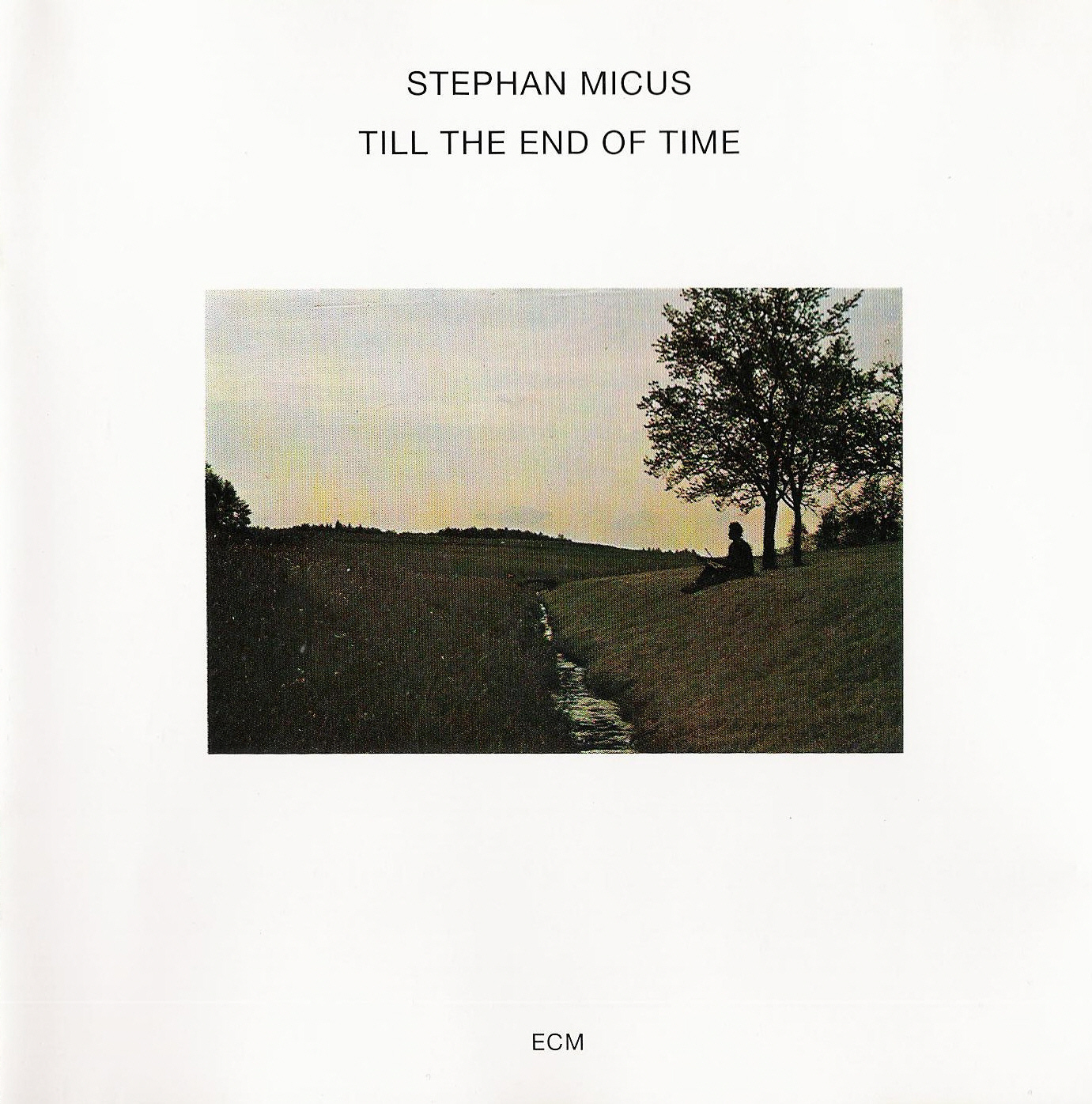
Stephan Micus: Till The End Of Time (JAPO 60026)

Till The End Of Time

Stephan Micus
Till The End Of Time

Stephan Micus table harp, kortholt, zither, guitar, vocal
Recorded June 1978 at Tonstudio Bauer, Ludwigsburg
Engineer: Martin Wieland
Produced by Manfred Eicher

Before migrating across the ECM continent, Stephan Micus outfitted some of his most formative expeditions in the territories of the JAPO sub-label. On these albums one hears Micus at his most elemental, turning every gesture into inter-spatial awareness. The album’s duration of 36 minutes only serves to deepen its intimacy as a space in which the listener might catch a cushion of meditation in a world of splinters.

Micus’s practice has always been to render the stem before the flower, and in the album’s title track a table harp provides that very illustrative function. Its dulcimer-like heart beats a rhythm at once ancient and fresh, curling as the scriptural page, its edges darkened from constant contact with the hands. Those same hands cradle a method of speech so musical that its melody is discernible only in the freedom of solitude. This is perhaps why Micus tends to work alone: so that he might open every angle honestly and uniquely, until the geometry of his life grows big enough to Venn-diagram into the listener’s own. Bowed zither expands the roots and gives way to a kortholt, a crumhorn-like reed from the Renaissance that pulls hidden colors from the sunlight. A classical guitar, which all but disappears from Micus’s later work, defines ethereal flesh through a worldly skeleton. Like the music itself, it is gut and wood and movement, drawing a string through immediate intellect to that of another time.

“For Wis And Ramin” is even more direct in its expressiveness, triangulating guitar and zither with Micus’s imagined singing. Imagined, because no words would do justice to the palette from which he draws, one that harbors not the barest pigment of politics. After the opening classical guitar solo connects its geometric touch-points, only a throated language can bring to the light that which is born in the dark. Micus is thus a troubadour who seeks love not only on earth but also from heaven, so that when the zither walks in the voice’s path, we must also feel the soles of our feet pressing their outlines into planes of stardust, refuges of forgotten pollen.