

Remember thy creator before the silver cord be loosed, or the golden bowl be broken or the pitcher shattered at the fountain or the wheel broken at the well. Then shall the dust return to the earth as it was and the spirit shall return unto God who gave it.
–Kirill, Andrei Rublev
Bernard Oglesby is a quiet crafter. He works his trade like a night boatman, oaring creative waters with a carriage of intuition that can only come with repetition. More than the realization of experience, such action translates into the experience of realization. It can be no surprise, then, that Oglesby should cite “The Ontology of the Photographic Image” as a cornerstone of his personal expression. To one who works across media, André Bazin’s seminal 1960 essay addresses a core truth of representation that resonates through his principled output. “It is perhaps the interrelationship of past, present, and future,” explains Oglesby, “that best characterizes my underlying philosophy and it is in Bazin that I find the clearest indicator for my whole practice: that of the ‘mummy complex,’ where time is slowed and preserved through a process of embalming—or, in my case, recording—in order to transcend death.” His relationship, as of any artist, to acts of transcendence is not one of seeking and achievement, but rather of bloodletting and enmeshment. For to see the self as fallible is to necessitate unfolding into light itself.
Alongside his establishment in the fields of photography and painting, Oglesby has submerged his hands in currents of filmmaking and music. In some ways, his films are more musical than they are visual, while his music is decidedly filmic. His 2011 Mandrel, for instance, is on the surface a detail-oriented montage of foundry workers’ tasks shot in crisp black and white. But it is the incidental rhythms of said tasks that make its composition such a fine one for the senses.
The relationship between his imagistic and sonic practices is, I daresay, indivisible. “I am convinced that music is the most visual of all art forms,” Oglesby agrees, “and by its nature, nonhierarchical in its direct ability to connect with people on many personal and social levels. It was with Andrei Tarkovsky’s Andrei Rublev and the score by Vyacheslav Ovchinnikov that I began to experience and understand just how life-changing the relationship between visual art and music could be.” Yet where Tarkovsky sought to show through that classic film the artist as a hub of worldly creation, Oglesby in his own compositions is concerned with the spokes emanating from it. Like rays to a sun, each can be traced to a generative source.
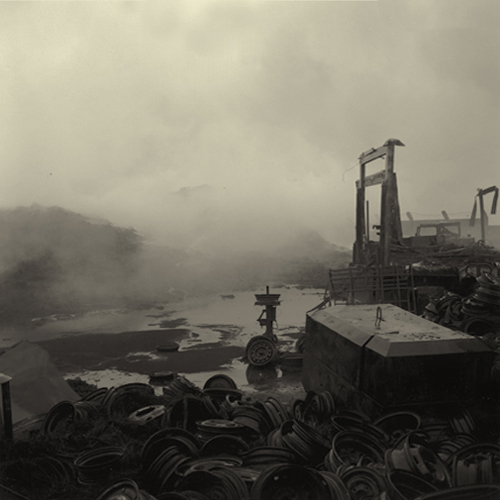
Without End (Levenshulme, 2003) Silver Gelatin Print
Mapping his musical evolution is a likeminded task and finds the young Oglesby seeking priesthood at a Franciscan monastery, where a different path was revealed to him on the cusp of retreat: “I left to become a church window designer,” he recalls, “before attending art school, where I failed my degree. It’s clear now that music formed a very important subconscious role and experience for me, as I come from a musical background with many of my forefathers and current family involved as musicians, singers, and producers.” Despite the constant evidence of music at home, and skipping over the obvious recovery from his nominal “failure,” Oglesby showed no direct interest in music early on. Film soundtracks, however, had what he terms a “deep and permanent register” in his growth as a listener, the scores of James Bernard and Bernard Herrmann being held in his highest esteem. Since then, his ears have subsisted on a contemplative diet of Frédéric Chopin, Valentin Silvestrov, and G. I. Gurdjieff. It is to the latter we might draw the darkest vein of kinship, wherein pulses a notecraft as vivid as his painted photographs.

Aubergine (Manchester 2010) Archival Pigment Print
I asked Oglesby how he came to the staves:
“Writing music does not come easily or naturally to me. My hand was forced as a composer, as I found the process of working with other composers extremely difficult and unproductive. A film project I was working on about the sinking of the ship Mefkure required a score to be written and produced. Unfortunately the composer for the project had very different ideas regarding the score and we constantly banged heads. At the time the production team dared me to write the score, so I did. It took 18 months locked in my studio. I approached the task as a novice and initially began learning to use a keyboard as an immediate point of entry into writing and composition. Quickly apparent was a disconnect between my practice as a visual artist and a composer, and the only way for me to reconcile this dislocation was to embrace music solely as a visual language. At this revelatory point my approach to music composition changed, as I no longer looked to the traditional structures of score writing and began to create a visual code to which I could assign sound, expression, pitch, and percussion. Since my early experiments with the Mefkure score, I have established a working method that involves extensive research centered around each project. This research includes making sound recordings, collecting stories, making short films, taking photographs, then using this material and mute boards to map out the form and context of each composition.”
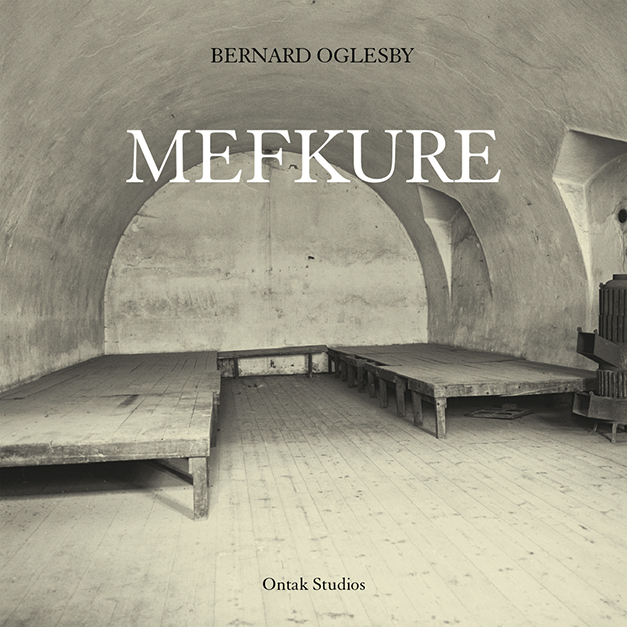
Mefkure (2012) was actually the second in a trilogy built around the words of Ovidiu Nimigean (b. 1962), to whose poetry Oglesby was introduced while making a short film about Romanian immigrants digging for scrap metal just to get by: “Principally, it is his ability to invest descriptive fact with deep emotional content about the strain of death and dislocation,” says Oglesby of the Romanian writer. The minimal nature of the music is like the pitch to every gaseous ball of sentiment and finds its genesis in the forested pathos of Departe (2012).

Side projects such as Torah (2013), a collection of solo piano works paralleling Erik Satie’s The Gymnopédies, and Jannah (2013), a suite for string quartet and keyboard written around the concept of original sin, followed, each appearing like an inexplicable line in a fingernail and representing a major leap inward toward the realization of compositional identity. Over the progress of that identity, Oglesby is still unresolved: “What I am clear about, however, is that those early unconscious moments, as a child, were seminal in priming me for my current creative output.” To be sure, the formative albums feel like a hermit’s sketches, their primary audience a congregation of shadows along cave walls. But with the 2015 release Roumania he has yielded a finished painting. For the composer, it “represents a moment of pure clarity, when all the elements of gestation, encompassing 15 years, come together and speak with elegance, economy, and stillness about slow time and its moral implication. The earlier, fledgling works had more of a narrative structure and graphic framework as I began to explore and test my theories about the relationship between image and sound.” The present recording furthermore completes the Nimigean trilogy.
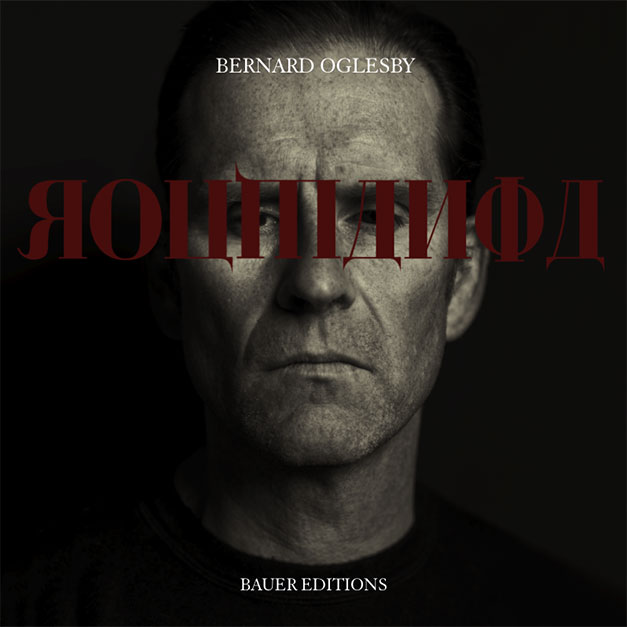
Roumania is as much a musical construction as conversation, in this instance of and with the beloved “Ballad” for violin and piano by Romanian composer Ciprian Porumbescu (1853-1883). The original work engages the doina, a traditional improvisational form with Arabic roots. The mood of the doina is contextually dependent, and takes on devotional textures in Oglesby’s reimagining. The album’s heart pumps in a fair share of its nourishment from pieces for solo piano and prepared twin pianos scattered throughout. The musicians in question, Anton Heart and Marracha Ward, approach the playing with as much solemnity as went into the writing. At once long-tailed and close enough to hear it breathe, the music drags chains of heavy memory as it washes its own skin and hangs it to dry in a wind of reflection. There is a mental substance to its labor, which finds grayest acumen in “The 4th Way,” the title of which makes reference to Gurdjieff’s anti-institutional path to spiritual awakening. Its pigments are notes incarnate, as are those of “In Deep Silence,” which like Arvo Pärt’s Spiegel im Spiegel speaks to the untethered mind.
Roumania also makes use of field recordings. Originally taken as research for the aforementioned Mefkure but shelved for a film that never materialized, they were gathered by the composer and Janez Hovec in the lower Carpathians and Black Sea. Their addition triangulates the axes of sound and image with that of space. Lapping waves (“Night Roumania”) disguise the piano as rocky shoreline, while cries of birds (“The Black Gulls”) dislocate us from the light of dawn. Like a Theo Angelopoulos film or Eleni Karaindrou soundtrack thereof, these environments sing for time, out of time, and with a strength that cares little for numbers. In “He who loves and leaves,” vocalist Mija Aleksiss and cellist Ontak Ayer join Ward at the keyboard to mark the waters of trauma with multiple voices, each a buoy signal of vivid light.
Two pieces—“Laegan” and “From Abroad”—feature the otherworld of spoken word. In the first, Romanian poet Ana Blandiana, who is responsible for introducing Oglesby to Nimigean, reads concavely, as if her language were a cinematic fade. The piano blends into view, while holding on to the rhythms and patterns of that speech. It strikes up a chord, a dance past midnight, a melancholy that lingers whenever one can’t sleep for the dead. The second is Nimigean himself, whose lo-fi aesthetics breed hi-fi effects. He steps through a door, taking the listener outside of all clothing and shelter, until the only language left is that of breath without song.


 Between Sound and Space: ECM Records and Beyond