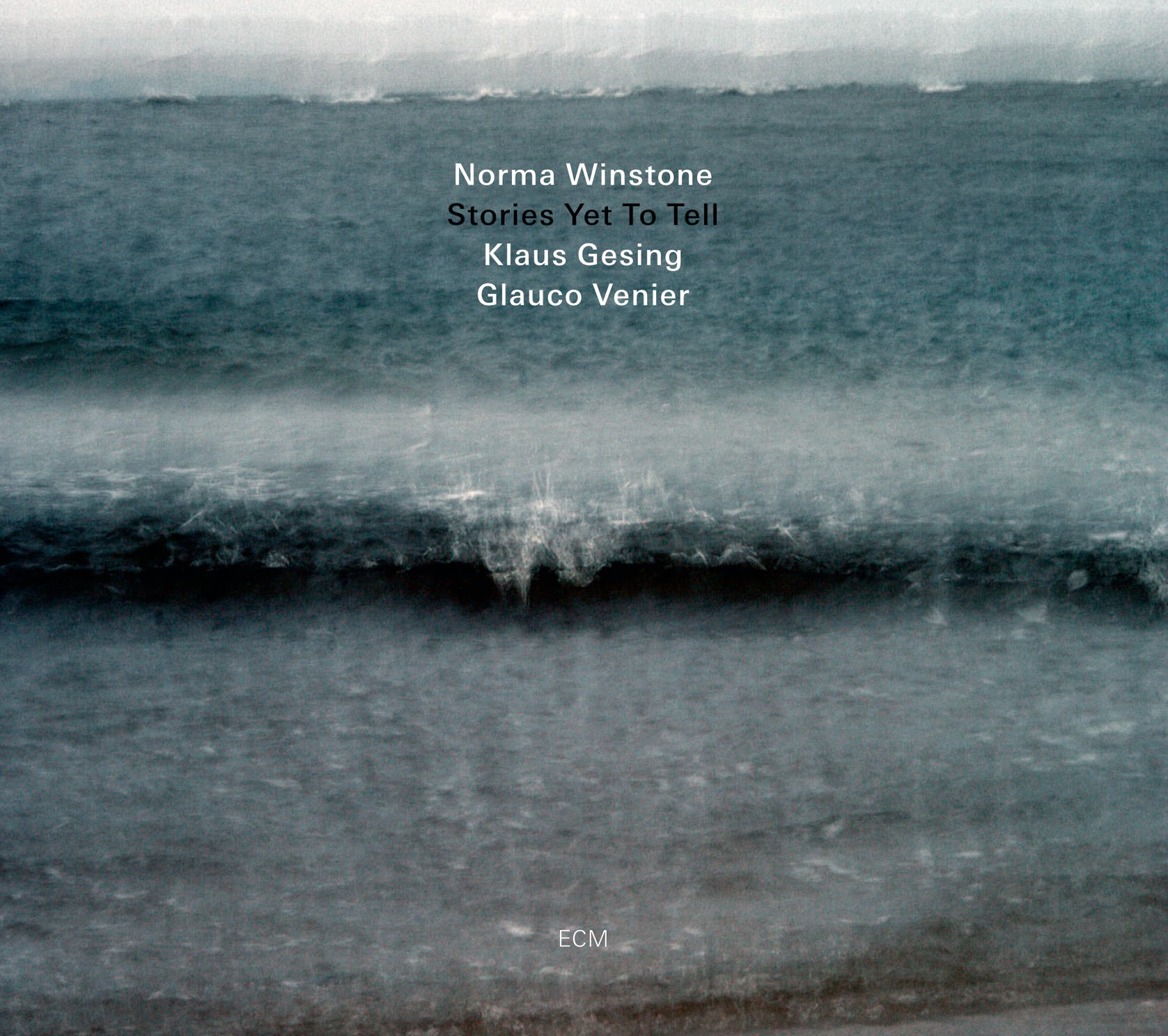
Norma Winstone: Stories Yet To Tell (ECM 2158)

Stories Yet To Tell

Norma Winstone
Stories Yet To Tell

Norma Winstone voice
Klaus Gesing bass clarinet, soprano saxophone
Glauco Venier piano
Recorded December 2009 at Arte Suono Studio, Udine
Engineer: Stefano Amerio
Produced by Manfred Eicher

While walking home on 8 October 2014, I was listening to Norma Winstone’s Stories Yet To Tell on my iPod. The opening song, “Just Sometimes,” had already enchanted me with its tender traversal of the heart’s shadowed chambers. Its bittersweet emotions lingered on in my mind as the second track, “Sisyphus,” held my ears captive. Named for the Corinthian king of Greek mythology forced to endlessly roll a giant boulder up a hill, the song evokes the curse of repetition in Glauco Venier’s pianism and the vain hope of breaking free in the tension of Klaus Gesing’s bass clarinet. While immersed in the atmosphere of this music, I felt a tap on my shoulder. I pressed PAUSE, removed my headphones, and turned to see my friend Andy, who had terrible news: our dear mutual friend Taylan had committed suicide that morning.

In the weeks following this tragedy, my iPod remained stuck halfway through “Sisyphus,” stymied like my desire for listening. By the time I returned to the song, I couldn’t help read the myth into Taylan’s untimely end. His life, it seemed, had thrown one boulder too many in his path, and he’d grown tired of rolling them upward in vain. While learning to cope with my grief, I was also comforted by the album’s title. It was a gentle reminder that, although he was gone, stories of Taylan’s legacy as a musician (he was an electronics genius for whom Evan Parker’s The Eleventh Hour was a life-changing record) had yet to be told. It was only a month later that I had the courage to continue where I’d left off in “Sisyphus,” which will forever be for me an elegy.

It’s not entirely morbid, however, to read a certain understanding of mortality into Winstone’s craft, singing as she so often does of moments that are fleeting, captured only through imagination. In the sadness of “Among The Clouds,” the retrograde of “Goddess,” and the wordless farewell of “En mort d’En Joan de Cucanh,” Winstone and her attuned trio understand that directions below are written in scripts above. Each song searches for meaning in a world that so often denies the divinity of simplicity. Furthermore, Winstone’s lyrics, especially in “Rush” and “The Titles,” linger on impermanence and, like the second, break down the theatrical stage of experience into its component parts.

In a few tracks, Winstone uses her voice as wordless instrument, employing melodic flight paths in the service of folk songs and lullabies. And even when she does inhabit the domicile of language, as in the tender “Like A Lover,” she does so with an insightful balance of coarse action and empty heroism, all the while keeping fear at bay with the shapes of her mouthing. She demonstrates that those of us still living must recognize that death is not an end but the first sentence in a story waiting for the spark of remembrance to reveal its narrative arc.

(To hear samples of Stories Yet To Tell, click here.)

Taylan
Taylan Cihan
(June 13, 1978 – October 8, 2014)

Edmondo Romano for RootsWorld

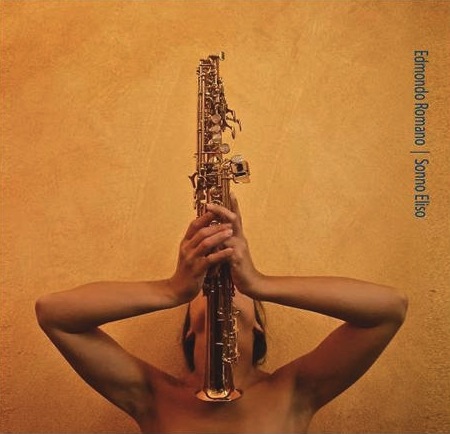
My latest review for RootsWorld online magazine is of the first two parts in a trilogy by Edmondo Romano. Rightly praised by Paolo Fresu for his de-territorializing approach to music, the Italian multi-instrumentalist and composer is a worthy departure for ECM enthusiasts. Click the cover to discover!

Sonno Eliso

Tafelmusik Brings Otherworldly Sound to Cornell

??????????
Tafelmusik
The Galileo Project: Music of the Spheres
Bailey Hall, Cornell University
November 15, 2014
8:00pm

English physicist Norman Robert Campbell once wrote, “Science would not be what it is if there had not been a Galileo, a Newton or a Lavoisier, any more than music would be what it is if Bach, Beethoven and Wagner had never lived.” This statement has rarely been so obvious as it was on Saturday night, when Toronto-based Tafelmusik proved distinction as one of the world’s finest Baroque ensembles with its presentation of The Galileo Project. The orchestra’s double-bass player, Alison Mackay, conceived the program when she was invited to commemorate the 400th anniversary of Galileo Galilei’s astronomical telescope. The result could hardly have been more apt, for the Italian astronomer’s love of physics was known to extend almost as deeply into the heart of music as to the heavens that set it beating. Father Vincenzo, in fact, passed on to his son a love for the lute, an instrument Galileo continued to play throughout his final years, blind though he was and under house arrest for heresy by order of the Inquisition.

Tafelmusik’s performance—last of the fall Cornell Concert Series—was a master class in pastiche, shuffling evocative readings (courtesy of actor Shaun Smyth) of Shakespeare, Ovid, Kepler and Galileo himself, among others, into a contemporaneous playlist, all while images from the Hubble and tasteful computer-generated sequences were being projected onto a circle suspended at stage rear. Even more delightful was the fact that Tafelmusik played without scores. Originally a logistical necessity brought on by the low lighting required for the visuals, this dynamic liberated the 17-member orchestra—save for its bench-bound harpsichordist—in remarkably creative ways. Choreographic variations grew organically out of sonic ones and found the musicians sometimes among the audience, playing in the wings of the hall, or ambulating about the stage in veritable planetary orbits. These movements further translated into conversational banter, which on occasion threw the two cellists into intense dialogues or, as in the case of the Vivaldi concerto that opened the program, goaded the violin soloists with syllogistic zeal. The musical infrastructure was thus pillared by its most popular culls, by which was served a delectable assortment of incidental music by Lully, Monteverdi, Purcell and Rameau, all leading to the glorious sinfonia from J. S. Bach’s 29th cantata.

Central to the program’s conceptual integrity, however, was something quantifiable by no mere intersection of sound and science. It was, for lack of a more effective connotation, the timeless “spirit” of invention, observation and revolution that made every note sing. In this respect, some of the darkest moments of the concert were also its most compelling, as when a narrative description about the death of Galileo’s beloved daughter gave way to a toccata for solo lute composed by his younger brother Michelangelo. The intimacy of this downtime said more about celestial mysteries than the numbers employed to explain them.

Tafelmusik’s slogan may be “World-renowned, Future-bound,” but The Galileo Project showcased an unbreakable bondage to the past in kind. The end effect continues to reverberate in this reviewer’s mind, which nevertheless labors to return the favor in these constellations of words and hopes that, somewhere in the universe, Mr. Galilei was listening.

(See this article as it originally appeared in The Cornell Daily Sun here.)

Steve Kuhn Trio: Wisteria (ECM 2257)

Wisteria

Steve Kuhn Trio
Wisteria

Steve Kuhn piano
Steve Swallow bass
Joey Baron drums
Recorded Sptember 2011 at Avatar Studios, New York
Engineer: James A. Farber
Assistant: Tim Marchiafava
Produced by Manfred Eicher

Pianist Steve Kuhn, bassist Steve Swallow, and drummer Joey Baron make sweet music together, for sure, but an unquantifiable feel for that music is what sets this dream trio apart, and nowhere so clearly as in the lion’s share of Kuhn’s tunes presented on Wisteria. The complexities thereof become more readily apparent in these core settings. Above all, “Adagio” reveals a triangle within a triangle within a triangle. First is Baron’s sparkling pool, next bordered by Swallow’s equilateral bassing, all molded by Kuhn’s resounding redraws, and with a multi-dimensional sound enhanced to crystalline effect by engineer James Farber, fewer geometries could be more sublime. Further gems last heard on Promises Kept include the study in contrasts that is “Morning Dew,” the lyrical “Pastorale” (then again, when is Kuhn not lyrical?), and that album’s title cut, which achieves here even greater densities than in the former’s orchestral couch.

Wisteria is not without its groovier moments (cf. “A Likely Story”), but tends toward the softer end of the spectrum whenever possible. This only serves to gel the intensity of emotion throughout. Exemplary in this regard is the album’s opener, “Chalet,” in which the trio’s mesh sets a unified tone. It also reveals the inimitable presence of Swallow, whose early solo unlocks much of the joy about to ensue, and whose two contributions—“Dark Glasses” and “Good Lookin’ Rookie”—span the horizon from solemn to ecstatic, sunset ochre to raindrop blue, with class.

Three standalone tracks complete the set. Carla Bley’s “Permanent Wave” lays on the nostalgia so thick that you’ll swear you heard it a long time ago, with a drink in hand and only a memory to keep you company. “Romance” (by Brazilian singer-songwriter Dory Caymmi) brims with blind affection and proves yet again just how masterfully Kuhn approaches the art of the finish. And then there is the title track by Art Farmer, in whose band Kuhn and Swallow played half a century ago. This shadow-swept reverie says it all with so little.

Wisteria is about as positive as jazz gets. So much so that one can feel the smiles rippling all around as one pebble after another is dropped into the sacred font of improvisation from which each of these musicians so artfully drinks, and with enough tenderness to go around for even the most resilient soul.

(To hear samples of Wisteria, click here.)