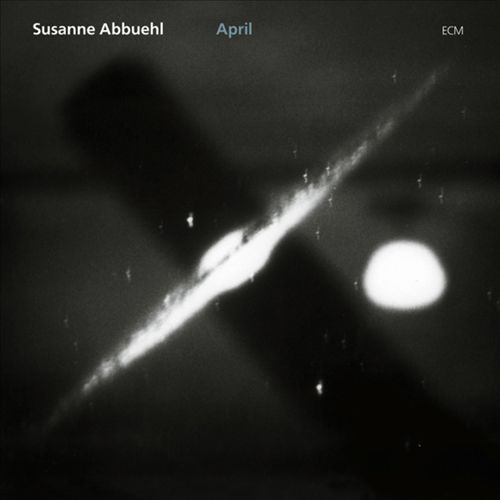
Susanne Abbuehl: April (ECM 1766)

April

Susanne Abbuehl
April

Susanne Abbuehl voice
Wolfert Brederode piano, harmonium, melodica
Christof May clarinet, bass clarinet
Samuel Rohrer drums, percussion
Recorded November 2000 at Rainbow Studio, Oslo
Engineer: Jan Erik Kongshaug
Produced by Manfred Eicher

All night the sound had
come back again,
and again falls
This quiet, persistent rain.
–Robert Creeley (1926-2005)

The ECM debut of Susanne Abbuehl is a verdant introductory résumé for which the Swiss singer-composer presents settings of poems by e. e. cummings and sets her own to the music of Carla Bley. Abbuehl comes from a long line of idiosyncratic chanteuses to have passed through ECM’s hallowed halls—including Sidsel Endresen, Norma Winstone, and Annette Peacock—and has left behind a veritable wing of artwork to admire at length. April carves out perhaps the most distinct of these exhibitions, and with “yes is a pleasant country” introduces us not only to her nesting textu(r)al approach, but also to the poetry of her synergistic band. Pianist Wolfert Brederode (who has since gone on to record leader dates for ECM), drummer Samuel Rohrer (also of Brederode’s quartet), and clarinetist Christof May together grow, needle by needle, the Christmas tree from which Abbuehl hangs her vocal ornaments. The simpatico between singer and sung is further palpable in her braiding with melodica and clarinet in “all i need,” for which its love guides her indigo words far into the heavens. “skies may be blue” and “yes” form a bonded pair. One is a meditation on spring, the other a field of rolling hills painted in wordcraft. Brederode’s composing and playing are exquisite in “maggie and milly and molly and may,” a litany of fleeting memories in which his pianism overshadows with a vocal quality all its own. The final cummings tribute comes in “since feeling is first.” This Abbuehl sings solo, a tribute to the poet’s later disavowals of punctuation.

Bley’s classic “Ida Lupino” gets a lyrical makeover, bringing out just one of countless stories hidden in its pathways: astute, a touch dark, and emotionally forthcoming. Brederode is something of a sage here, navigating the whimsical images therein: a tiger in the snow, a waning eye, a folding of the self into another’s embrace. “Closer” and “A.I.R. (All India Radio)” pitch more cargo onto the S.S. Bley, set adrift on moonlit waters. Beyond Abbuehl’s “together-colored moment,” precious jewels shine in anticipation. The air is as wistful as one’s naming of it, yet promises eternity in the bass clarinet’s deep pocket. The latter tune processes by virtue of Rohrer’s understated timekeeping. Among the more seamless weddings of voice and music the album has to offer, one can easily get lost in its wordless circumscriptions. (It also foreshadows the album’s closer.) Bley gets one last nod in “Seven,” for which Abbuehl places spoken verse—in her words: petal by petal, yet deeper than all roses—upon the heart’s altar.

Yet there is perhaps nothing so beguiling here than her re-imagining of “’Round Midnight.” Accompanied only by Brederode on harmonium, the tune creeps out from the darkness and shivers the very marrow. “Mane na” concludes the session by paying homage to Abbuehl’s Hindustani vocal training with a raga compressed to the scope of a teardrop.

Although barely acknowledged above, Rohrer’s delicate infusions haunt the landscape throughout, reaching, as Abbuehl recites, “somewhere I have never travelled, gladly beyond…” In those rhythms is a heart made of pages, thirsty for the next scratch of pen.

An auspicious label debut.

<< Christoph Poppen/The Hilliard Ensemble: Morimur (ECM 1765 NS)
>> Giya Kancheli: In l’istesso tempo (
ECM 1767 NS)

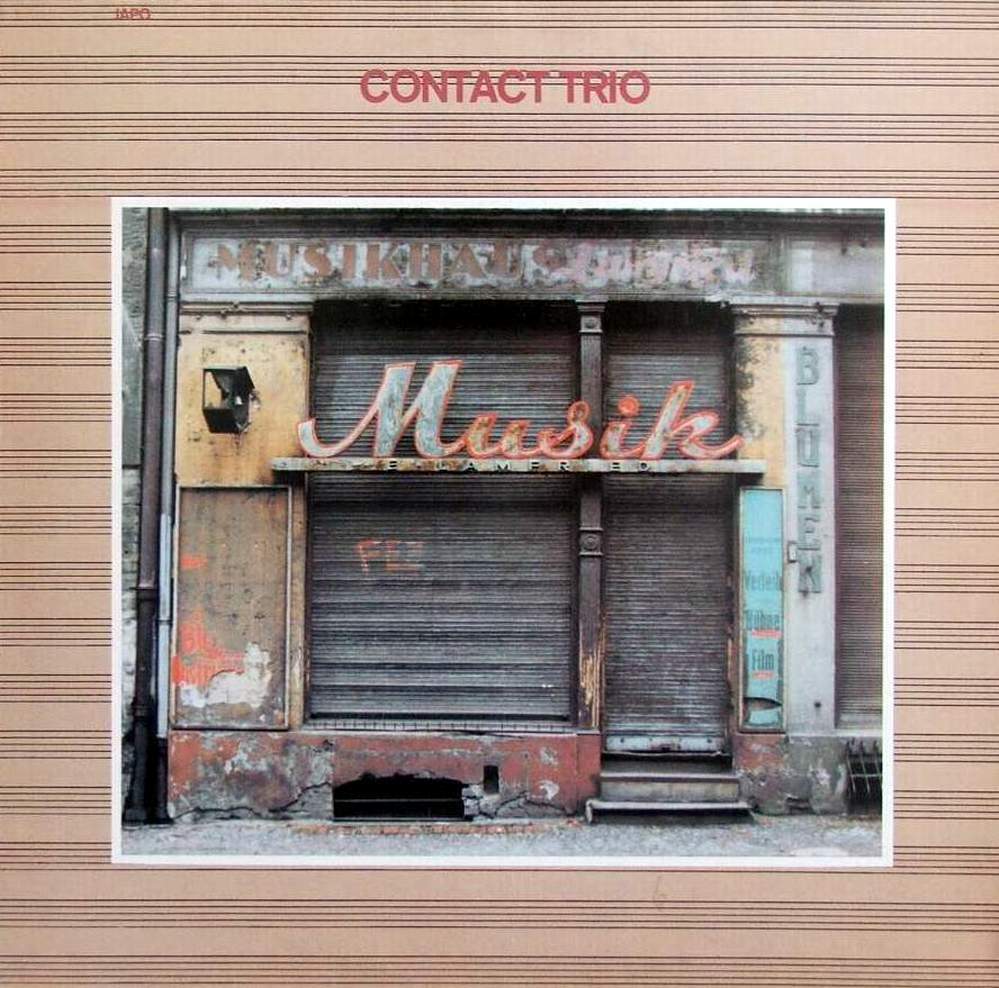
Contact Trio: Musik (JAPO 60036)

Musik

Contact Trio
Musik

Evert Brettschneider electric and acoustic guitars
Aloys Kott electric and acoustic basses
Peter Eisold drums, percussion
Recorded October 1980 at Tonstudio Bauer, Ludwigsburg
Engineer: Martin Wieland
Produced by Thomas Stöwsand

Musik was the second effort by the Contact Trio for ECM’s sister JAPO label. Inspired by the atmospheric developments of Wolfgang Dauner (see, for example, Output) and heavily invested in the softening distinctions between rock and jazz, the trio had by now perfected its rhizomatic sound in what was to be its final record. Here Peter Eisold takes the place of drummer Michael Jüllich, and the result is a truly aerobic experience.

The warm-up
The echoing guitar of “Air Lines” opens the session by straddling extremes of register and sharpness, and starts a snowball rolling down the bass’s equally resonant hill. Strangely, the ball doesn’t pick up speed for some time, but paces itself in a journey of textured reflection, tracing from each icy particle a possible trajectory of flight. Eisold’s unique percussive language is thus apparent. And then: traction as the rhythm section hurls the guitar to tell its story in anticipation of an untimely end.

The stretch
Muscles and tendons glow with flexion in “String Games.” Acoustic in hand, Brettschneider reflects on a past in which the only truth was a broken mirror. There is a feeling of dedication here, a deference to time at large for providing this opportunity to luxuriate in the creation of music. Like the first, this track hooks on to something more propulsive in the final minutes, only now running through the backstreets of a small Spanish town, chasing after a melody.

Lower body
“Daddy Longleg” is an invigorating turn featuring two overdubbed electric guitars and electric basses, each relaying torch light in palpitating dialogue with the other. Eisold again shines with colorful cymbal work that evokes nocturnal footfalls in the walls.

Core
From its title alone, “Simple Symphony” would seem to be an allusion to Britten’s work of the same name. The music provides an entirely different experience. From Brettschneider’s throbbing beats and elastic chording to the groovy trio unity achieved thereafter, it climbs every tree in its way like a squirrel on a mission. The rhythm section positively shines in gorgeous geometries, sliding from one signature to the next with the ease and comfort of a fountain pen.

Back
The spine gets is due attention in “Silence,” which curves in a protracted arch. Stained guitar and arco bass lead into a plunking dream of youthful flexibility, edging a ghost town with its metal detector until it finds two rusted guns from a shootout, long forgotten…

Chest and arms
“Elbow Dance” completes this full-body workout with a slog through cement that finds resolution and strange comfort in the hardening.

At the risk of belaboring all of this analogizing, Musik is an intensely physical record. Not only in the sense that it feels weighted and animate, but also for its permeable compositions. Each is a thoughtful assemblage of lines that no longer has need for points of origin. Together, these lines leave the listener with a lasting meta-statement of harmless transgression.

A gem in ECM’s apocryphal bin.

Laurie Anderson: An Instrument Unto Herself

Laurie

Laurie Anderson
State Theatre (Ithaca, New York)
September 21, 2013
8:00 pm

Laurie Anderson has been called many things: raconteur of the mundane, pop culture critic, electronics wizard, musician and composer. Yet, do not be mistaken: She is not a performance artist, but an artist of performance. Having placed some of the most harrowing social turns of the past four decades under her microscope, Anderson proves that individuals are not the constants of historical change. Rather, history attains a cyclical consistency, the agents and subjects of which are anomalies. The twenty-first century stands before us like a divining pool into which she cannot help but cast her soothing critiques to see how our reflections change. Her crafting of words thus reveals a cinematic imagination in the truest sense. As she once confessed in an interview: “I try to make records that are cinematic, movies that are musical.” The seen and the heard come from the same place.

Anderson is no stranger to central/upstate New York. Her stage debut, following a string of formative gallery exhibitions and writings on art, took place a stone’s throw away in Rochester where, in 1972, she premiered her outdoor symphony for car horns in The Afternoon of Automotive Transmission. Since then, her interest in the relationships between matter and space — specifically violin and voice, self and projection, microphone and venue — has come to define her role as a darling of the underground. Press surrounding Anderson has been rife with such characterizations, all the while ignoring the fact that she has been working above ground from the start. Firmly embedded in the goings on of society at large, her instincts have borne idiosyncratic approaches to language, multimedia  and sampling. Despite these innovations, she boasts no avant-garde badge — she is content to wander nomadically, solitarily, dropping crumbs for the weary.

As the title of her seminal 1982 record Big Science suggests, Anderson is no stranger to her right brain, a point invoked before Saturday night’s performance of her recent multimedia work, Dirtday! at The State Theatre. In his introduction, Museum of the Earth director Warren D. Allmon stressed the interconnectedness of art and science and championed Anderson for skirting the boundary between the two and softening that boundary along the way. That said, as the opening washes of her electric violin filled the hall, clearly something bigger than science was happening — an overt awareness of, and engagement with, the broader contexts in which her data streams multiply. Concertgoers presumably saw bits of themselves in those streams, swimming against the current in an effort to stand out. In this way, Anderson’s work lacks a clear center and allows listeners to anchor its assembly differently every time, and to be involved in its eternal unfolding.

Fascinating though Anderson’s musical details may be, more so are the here and now of the messages in which she is enmeshed, and the futures bought and sold along her avenues of thought. For the latter image we can thank Fenway Bergamot, the male alter ego Anderson has long cultivated on stage and in the studio. To achieve the transformation to Bergamot, she bends the pitch of her voice by electronic means to that of a masculine register in a process she calls “audio drag.” It is not an adoption of a character for her, but a coming into being (the inflections and pauses of that voice are distinctly her own). Over the years, Mr. Bergamot has grown into a less confident observer, one who questions the self by questioning others. The chisel of time has chipped away at his resolve, leaving him world-weary and mistrustful. His memories are fuzzier, his dreams murkier than ever before. As an integral narrator of the evening, he was also a harbinger of memory, his voice creaking like the floorboards in a house of regret.

Fenway
Fenway Bergamot, as depicted on the cover of Homeland

Topics covered in Saturday night’s show were even more diverse than the vocal registers Anderson utilized to articulate them. Everything from SIDS to New Jersey tent cities, from governmental scare tactics to reflections on Darwinian anxiety — even a video appearance by her artistically inclined Rat Terrier, Lolabelle, was fair game. Couched in a lush sound mix of distant thunders, beats and loops, the “everydayness” of her philosophies breathed earthiness into the most cosmic moments. Impossible childhood dreams shared the air with an array of electronic gadgetry, each unit a means to a beginning. Passages of analogue warmth butted up against sharper denouements, broken intermittently by her bow. The violin was at once her empty cup and an overflowing vessel, an omniscient presence that hovered at the edge of total integration with its performer’s body — a fantasy made reality when toward the end of the show Anderson placed a pillow speaker into her mouth and turned herself into a live instrument.

In her magnum opus United States, Anderson de-scribes a night drive, concluding, “Eventually it starts to get light and you look out and you realize you have absolutely no idea where you are.” It’s a haunting image, a quintessential moment of confusion in her archive. And yet, sitting there in Ithaca’s historic State Theatre in a sea of flesh, gray matter and mutual regard, it was difficult to imagine ever becoming lost in a world where true solitude has become a chimera. Bathed in soundscapes as affecting as they were constructed, we knew exactly where we were.

(See this article as it originally appeared in the Cornell Daily Sun.)

Jiří Stivín/Rudolf Dašek: System Tandem (JAPO 60008)

System Tandem

System Tandem

Jiří Stivín alto sax, soprano sax, flute, alto flute, recorder
Rudolf Dašek guitar
Recorded May 1974

Jiří Stivín is a true renaissance man. Widely involved as a classical musician in especially early and Baroque music circles, the flutist and composer is also one of the most highly regarded jazzmen of the Czech Republic. The son of an actress and an inventor, he has absorbed both of his parents’ talents, combining their passion for expression and utility in an immediately recognizable style. On System Tandem, he joins guitarist Rudolf Dašek, a partner in crime since 1971. This out-of-print session owes its verve to time spent at London’s Royal Academy of Music, which put Stivín in touch with the exciting jazz-rock fusions proliferating in the late sixties, and found him in the midst of Cornelius Cardew’s legendary Scratch Orchestra. His project with Dašek—probably the most successful jazz outfit to emerge from his homeland—enjoyed great festival circuit success on the continent and abroad. System Tandem came on the heels of a collaboration with bassist Barre Phillips, and the latter’s balance of form and spontaneity is certainly in the air. Dašek, who passed away in 2013 at the age of 79, was another stalwart of the Czech jazz scene known for crossing the genre divide. From his trio with George Mraz and Laco Tropp (among other drummers) to work as soloist before the Prague RSO, his dedication to new music was unflagging. Together, he and Stivín stayed true to that exploratory spirit, working alongside Pierre Favre and Tony Scott, big bands, and countless other configurations.

For its second album (following a debut on RCA Victor in Finland), System Tandem focuses the integrity of the music. Stivín pens the first cut and arranges the second. “Puddle On The Muddle” shows off the duo’s sense of light and shadow in a steely combination of registers. The lively interplay and ping-ponging of ideas allows Stivín to veer down wilder paths of squealing abandon in a robust opening gambit. The Moravian folk song that follows, “Forman Going Down The Valley” is the first of a few pairings of flute and guitar. The theme here is mountainous, painterly, and segues into the album’s remainder, all of which bears Dašek’s stamp. “Hey, Man (Let’s Play Something About Spain)” is the first standout and deepens the fluted streams of its predecessor. Buoyed by echoes of “Hasta Siempre” and quasi-flamenco touches, Stivín jumps into the deep end in another inspired solo turn. He speaks in tongues, becoming more vocal by the moment, for stretches abandoning the flute altogether. “What’s Your Story” mark’s the flute’s last appearance in a forlorn piece of restrained melodic shape. As it progresses, the virtuosity adjusts its sights a few clicks to the left. Stivín breaks out the soprano for “Shepherd Song,” evoking a dance party of undomesticated wildlife. This leaves us with the album’s pièce de résistance, “Puzzle Game.” For this marvelous foray into Baroque territory, Stivín plays a dizzying recorder against an invigorating Django Reinhardt rhythm. Dašek’s finger picking works wonders in the final stretch.

This rare gem is due for reissue not only for its content, but also because the lackluster engineering could do with an overhaul. At many points throughout, the guitar’s audibility is torn to shreds by Stivín’s sharp edges. This is especially true in “Hey, Man” and “What’s Your Story.” It’s as if Dašek were playing with his back to the listener, which makes him feel not so present and obscures his contributions. Thankfully, the recording levels are more graciously tweaked in the final track. Engineering caveats aside, the perks of System Tandem are in its well-muscled compositions. Building enough emotional resonance to undermine the need for a rhythm section is no easy trick for any unconventional duo, but Stivín and Dašek have no problems pulling the rabbit out of the hat.

To all you vinyl collectors, I say: Seek this one out.

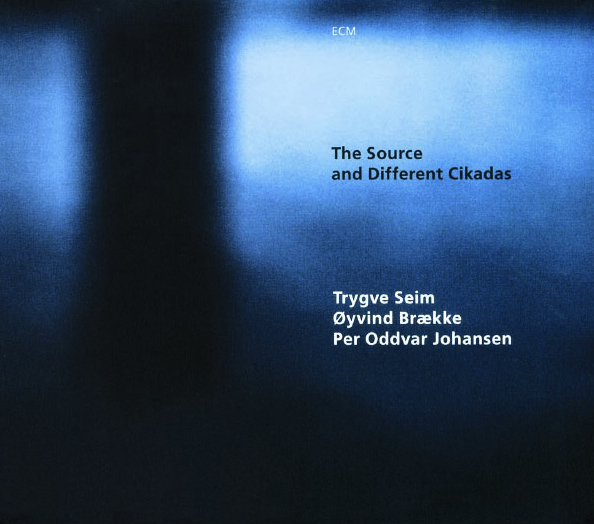
Seim/Brække/Johansen: The Source and Different Cikadas (ECM 1764)

The Source and DIfferent Cikadas

Trygve Seim
Øyvind Brække
Per Oddvar Johansen
The Source and Different Cikadas

Øyvind Brække trombone
Trygve Seim tenor and soprano saxophones, clarophone
Per Oddvar Johansen drums
Henrik Hannisdal violin
Odd Hannisdal violin
Marek Konstantynowicz viola
Morten Hannisdal cello
Frode Haltli accordion
Arve Henriksen trumpet
Christian Wallumrød piano
Finn Guttormsen bass
Recorded November 2000 at Rainbow Studio, Oslo
Engineer: Jan Erik Kongshaug
Produced by Manfred Eicher

Norwegian saxophonist Trygve Seim presents another facet of his musical diamond with the Source, a band he leads with trombonist Oyvind Brække and drummer Per Oddvar Johansen. Notable for bringing together the Cikada Quartet, of which cellist Morten Hannisdal had already played with Seim on Different Rivers and Sangam, and pianist Christian Wallumrød, along with mainstays Arve Henriksen on trumpet and Frode Haltli on accordion, the present session draws out music of a spongier texture, something more prone to dances than to rituals.

The compositional credits are fairly well distributed, with four coming from Seim’s pen. Generally, his are viscous, pathos-rich becomings. “Organismus Vitalis” puts the world under a microscope and revels in all that wriggles in its enlightening circle. In this regard, and by virtue of its floating sensibilities, one might easily connect the dots to Terje Rypdal’s chamber pieces or even to the diffuse scenography of David Darling’s solo ventures—such are its darkly inflected beauties. The Cikadas ebb and keep on ebbing, inching ever closer to shoreline structures as Johansen’s nuanced descriptions ever so barely edge the frame. An auspicious, postludinal beginning to an album of rich variety.

Seim’s thematic voice achieves deeper traction in such tunes as “Bhavana” and “Obecni Dum.” In both, the strings play a vital role in shaping the contexts in which, respectively, saxophone and accordion find purchase. Whether the slide of Seim’s earthy song or the moth-like pursuit of Haltli’s accordioning, there is in all of it something sacred. Even the restless “Fort-Jazz” brings with it a consistency of atmosphere, a fox hibernating in want of rampant spring.

Johansen brings that thaw with three pieces of starkly agitated character. In both “Mmball” and “Deluxe,” his drums are front and center. The latter especially recalls Hal Russell’s exuberant storytelling, all the while heightening the strings’ integration. Bisecting them is “Funebre,” an excerpt from Witold Lutosławski’s 1964 String Quartet that breathes with much the same looseness of structural integrity. This leaves “Uten Forbindelse,” a jazz spring ever on the verge of uncoiling toward infinity. Brække is the clear winner here, spawning as he does an outpouring of spirited exchanges and merging with Seim until the final trill sets them free.

The trombonist, in fact, edges past his co-leaders with five pieces to his name. Brække’s work lies somewhere between that of Seim and Johnansen, balancing the former’s weathered sound with the latter’s spontaneity to varying degrees. Notables include the whimsical “Flipper,” which takes full advantage of the group’s sound colors, and “Plukk,” which charts a subtle interplay of light drumming, pianism, and pizzicato filigree. “Sen Kjellertango” is another eye-opener, a slinky groove anchored by cello and punctuated by soprano saxophone, trumpet, accordion, and drums to dazzling effect.

Two free improvisations round out the set list. Wallumrød and Johansen touch off “Number Eleven” with their patience, overturning stone after stone, until the promise of subterranean force pushes through like a bud. The surrender is tender and blends into surrounding forest like a hunter. “Tutti Free” brings us back to a winter wilderness, dotted by fresh footprints of escape.

Those who enjoyed Bent Sørensen’s Birds and Bells may want to give this one a test spin. The scenography Seim has constructed here is of the highest integrity and practically assures the bending of a curious ear.

<< Alexander Knaifel: Svete Tikhiy (ECM 1763 NS)
>> Christoph Poppen/The Hilliard Ensemble: Morimur (
ECM 1765 NS)

Alexander Knaifel: Svete Tikhiy (ECM New Series 1763)

Svete Tikhiy

Alexander Knaifel
Svete Tikhiy

Keller Quartett
András Keller
 violin
János Pilz violin
Zoltán Gál viola
Judit Szabó cello
Oleg Malov piano
Tatiana Melentieva soprano
Andrei Siegle sampler
In Air Clear and Unseen recorded October 2000 at Radio Studio DRS, Zürich
Engineer: Peter Laenger
Svete Tikhiy recorded1994/95 at Film Studio Lenfilm and 1997 at St. Petersburg Recording Studio
Engineers: Mikhail Shemarov, Victor Dinov, and Andrei Siegle
Produced by Manfred Eicher

Nature is not as you imagine her:
She’s not a mold, nor yet a soulless mask—
She is made up of soul and freedom
She is made up of love and speech…
–Fyodor Ivanovich Tyutchev (1803-1873)

For its first conspectus of St. Petersburg-based composer Alexander Knaifel, ECM presents  Svete Tikhiy (O Gladsome Light). Side by the side, the program’s two works—each a triptych—seem vastly different in scope. And perhaps they are on the surface. But they are also part of an ongoing braid of interest on the part of the composer in what is lifted from the score and held in the spirit of the performers to whom he entrusts interpretation: in essence, the reading of the word. For this recording, the word comes to us both lower- and uppercased.

The former flexes its waking hour throughout In Air Clear and Unseen (1994) for piano and string quartet, peeking from behind the Orthodox veil through which Knaifel’s music is often so diffused. Steeped in the poetry of Fyodor Tyutchev, each tableau reads through gestures of slowly measured time. “In Some Exhausted Reverie” begins in Silvestrov-like fashion: with a piano postlude. It touches the ether with a delicacy so organic it almost falls away by merely being gazed upon. Its stillness may be illusory, but the potential emotional connection it makes with the listener flows into the ribcage and finds room to conform.

If encouraged to compare, one could cite Pärt’s Alina as an analogous atmosphere, if only for its breathing room. Distinct here is the feeling of something titanic, as if an entire history were being grappled with in a single note. All of which makes the opposite point: that there is never just one note, for each is a combination of many more, and those of still others. The air is unseen, yes, but it can be felt. It is a field of touch. Hence the tactility of Knaifel’s performers, whose own lives are filtered through their contact with the music. Instructed as they are to intone that which is ultimately “unvoiced,” the instrumentalists embrace each living moment with their entire being, itself a resounding instrument of warmth and illumination.

The central section, “An Autumn Evening” (for string quartet), finds a more distant analogue to the music of Tavener, whose The Last Sleep of the Virgin is also of Byzantine cast (and, coincidentally enough, composed the same year as the accompanying work on this disc). The lucidities of both shimmer in slow motion. Unique to Knaifel’s aesthetic is the unity of the assembly: the quartet is one flesh, a portrait of humanity drawn through what he calls “chain breathing.” The combination becomes something of a filter through which death renews life. It is the dreamed-of ribbon still in hand upon waking. The final section marries these two impulses, pulling childhood memories like a hood against blasphemy and lighting many candles from a single, originary flame.
The title composition, Song of the Most Holy Theotokos, is composed for soprano Tatiana Melentieva and sequencer. The eponymous hymn, which appears only at the end of the piece, is among the oldest Christian hymns, a folding of light into Christ and both into the world. It is force of life, but also agency of solace. Here the self-reflexivity of the replenished soul is expressed in the electronic manipulations and multi-tracking of Melentieva’s voice. The result is a ponderous, overtly crafted chorus of the self, giving way to echoing caverns of implosion. These, in turn, impart life to the openness of God. From mantra-like quivers and resonant tongues to the rounded grace of the central unaffected voice, it turns lullabies into dust and dust into starlight. And as the final fragments blur skyward, worship becomes a shroud for the ears.

On the whole, Svete Tikhiy is also a master class in engineering. Were the content not afforded the spaciousness it deserves, its inner voices might never reach us. This is not to say that technology adds something not already there, only that it brings out inherent tendencies toward infinite expression. The echo becomes a primary signifier of its referent, but also something more: a reference in and of itself to yet another echo, ad infinitum.

<< Anders Jormin: Xieyi (ECM 1762)
>> Seim/Brække/Johansen: The Source and Different Cikadas (
ECM 1764)

Skimming the Lake: A Conversation with ECM’s Undercover Producer

Put on an Evan Parker record. Now, put on a Hilliard Ensemble record. The difference is huge. Or is it? Such a question is both arbitrary and fascinating to consider. On the one hand, our fetishistic relationship with genre already precludes the possibility of approaching such disparate streams as anything else, while on the other we may just as easily ignore the perlocutionary category as a means of liberating ourselves into some universal sonic experience. The truth is far simpler than this quandary would suggest: The impulse that moves them is one and the same.

Such philosophy should feel like old hat to the veteran ECM listener, a listener who presumably understands the value of softening boundaries, if not sidestepping them altogether—surely a characterization befitting of a label that has forever changed the modern soundscape with its seriousness, integrity, and artfulness. At the same time, through the heart of it all has run an electric, vivacious, and at times whimsical thread. In the latter vein we have musicians like the late Hal Russell, whose latter-day documents are particularly enjoyable flings with a life-affirming timelessness. It is for these and more that we can thank Steve Lake. Having been a public voice of ECM for decades, the prolific wordsmith and former journalist has also moonlighted as a producer of striking vision and taste. Would we know the Maneris or the Russells of this world without him? I dare say some of us would not. From the Trevor Watts/Moiré Music Drum Orchestra collaboration A Wider Embrace to, most recently, Judith Berkson’s Oylam, the depth of his interests can be matched only by the label on which his productions have found a stable home.

My first encounter with Lake the producer was by way of the Joe Maneri Quartet’s In Full Cry. A perplexing yet mesmerizing experience, and one that took some years of investigative listening to worthily parse. Yet once I had learned to diagram the peerless language it was espousing, there was no turning back: by then I was caught in its web. It is in this vein of shared appreciation for hermetic talent that I began a conversation with Mr. Lake as a means of unfolding the hidden contributions he has over the years so selflessly brought to light.

Tyran Grillo: How would you describe artists such as Hal Russell, Joe/Mat Maneri, and the Bley/Parker/Phillips trio (personal favorites among those you’ve produced) to those who have never heard them?

Steve Lake: Independent spirits. Mad inventors. Geniuses.

What were your gut reactions when you first encountered these visionaries?

I have to go back a very long way to try and recall. The Bley/Parker/Phillips trio was formed in the studio to record Time Will Tell in 1994, but I’d known the three participants much longer. I’ve been listening to Evan Parker’s music, for instance, for 45 years, and bought his first recording, Karyobin with the Spontaneous Music Ensemble, while still a school kid. I was hungry for the strangest stuff available and luckily there was no shortage of it in the late 1960s. This meant, however, that I heard a lot of free jazz before listening closely to the unfree variety, which I found harder to follow at first. To naive and inexperienced ears, bebop could seem more cryptic than the collective sound-and-texture explorations of the free players.

I can sympathize with this. I also entered jazz through the back door, so to speak: starting out with John Zorn, Anthony Braxton, and Peter Brötzmann, not to mention the wealth of European artists introduced to me via ECM—Barre Phillips comes to mind—before ever stepping foot into a Duke Ellington joint. By no means a regression, of course, but certainly a new direction for me with its own learning curve.

Barre Phillips’s solo bass album Unaccompanied Barre on the Music Man label amazed me with its inventiveness…I used to listen to it on my little Dansette LP player until practically hypnotized by it. I loved Barre also in The Trio with John Surman and Stu Martin, one of the greatest groups of the late 60s/early 70s. Their double-disc white album was better than the Beatles’.

Evan Parker I checked out every chance I could. I’ve heard him play so often that I’m no longer sure what the first occasion was—I think probably in duo with John Stevens, around 1968. When I lived in London I’d see him play several times each month in contexts from the joyfully leaping African jazz of Chris McGregor’s Brotherhood of Breath to the confrontationally experimental duo with Paul Lytton—like two dervishes whirling in a junkyard—to a casual ad hoc gig in a pub somewhere, usually with John Stevens involved. Evan made artistic decisions to focus on specific sound areas in his own work, but he can play anything.

Paul Bley I first heard on his most uncharacteristic recordings, the ones where he’s doing battle with early analog synthesizers while Annette Peacock purrs suggestively through a ring modulator. Who wouldn’t appreciate that? John Stevens insisted I listen to specific Bley trio albums, and bought me a secondhand copy of Footloose with Steve Swallow and Pete La Rocca at the Record & Tape Exchange shop in Notting Hill. And Evan made me aware of the Jimmy Giuffre Trio with Bley and Swallow. I remember listening to Free Fall for the first time in his house in Twickenham in the early 70s. This gentler end of the free spectrum which the Bley and Giuffre trios represented was scarcely talked about in the music press at that time, but Footloose and Free Fall were key records for a number of London musicians. Big influences on Manfred Eicher and ECM, also, as I later found out.

When the Jimmy Giuffre Trio was revived and played some gigs in Germany in 1992, I went to a few of them, and spent some time talking to Paul Bley. Or the other way around—Paul is the master talker, a man of few notes and many words. Turn on your tape recorder and Paul can effortlessly talk you a book (several such available already on Amazon). In the course of his soliloquies he said several times that the only genuinely new music he’d heard in decades was being made in Boston by an elderly sax-playing professor whose son accompanied him on electric violin. Of course this made me curious. Did they have any records out? “No.” After some months I was able to get a tape from Radio Canada of a Bley concert in Montreal where Joe and Mat Maneri had joined Paul for a set. It was a very odd performance and obviously polarized the audience. Boos amongst the cheers on the tape, always a sign that something lively is happening. But it took me a while to make up my mind about it. The Bley/Maneri team-up wasn’t entirely compatible musically and the Maneris were so unlike anything else in improvisation it was as if they’d beamed themselves down from the moon. I breathed the air of another planet, and was puzzled.

The Three Men Walking trio was born out of email exchanges with guitarist Joe Morris. Morris and Mat Maneri had been playing together and father Joe jammed occasionally. I said make it a band and maybe it could be an ECM album. Morris sent some really promising rehearsal tapes which completely convinced me and helped persuade Albert Mangelsdorff to bring the trio to the Berlin Jazz Festival, where they made their debut. That was a fantastic break, and gave us the opportunity to take the group into the studio while they were in Europe. Live, Joe Maneri’s personal charisma overrode the superficial “difficulties” of the music: he sort of charmed and loved the audience into submission, irrespective of their views on microtonal improvising. A beaming Buddha with a saxophone.

Hal Russell caught me by surprise. I didn’t know him or the NRG Ensemble until their Moers Festival appearance in 1990, where they played before Einstürzende Neubauten. My first thought, looking at Hal in his business suit and Mars Williams in his psychedelic cowboy regalia, was: “This can’t possibly be a band,” but they were terrific. I hadn’t encountered a comparable combination of anarchy and humour and tightness and typhoon-strength free blowing since the heyday of the Willem Breuker Kollektief.

What do we lose sight of by shelving them under “avant-garde” or some such category?

I don’t know. What do you think? My favourite musicians don’t always fit too neatly into the genres yet we need I suppose some kind of approximate shorthand terminology to be able to talk about the stuff at all.

Yes, practicality typically wins out over idealism. As I see it, the term “avant-garde” is a double-edged sword. It pigeonholes its referent as being on the outside, and therefore “abnormal.” As such, it becomes at worst an annoyance, better a guilty pleasure, and at best a way of life. “Experimental” doesn’t seem to do the trick, either. Both terms fall flat for their inability to magnify the physical process of, in this case, fringe music. An avant-garde art is an embodied art, and at its best one can feel that presence as if the listener (or viewer, reader, etc.) were a network of sympathetic strings. In any case, how has such music pushed and/or enhanced ECM’s evolution as a label?

I haven’t given it much thought. In my first period of work at ECM, 1978-1980, Manfred Eicher encouraged me to do some production for JAPO, ECM’s sister label. So I did, inviting artists including Howard Riley/Trevor Watts/Barry Guy/John Stevens, Takashi Kako, Elton Dean, Eddie Prévost/Keith Rowe, etc., and at that time I was concerned that ECM’s beginnings in free improvising should have a continuation. Early ECM records like the Music Improvisation Company album, Marion Brown’s Afternoon of a Georgia Faun, and Circle’s Paris Concert were important to me as a young listener. And I liked the idea of careful recordings of improvisation rather than rough and ready recordings which were and are the norm elsewhere. Somewhere along the line, though, I stopped worrying about it. ECM has always maintained an experimental component as part of the whole picture, with or without my particular efforts.

How would you characterize your role as a producer?

Mostly it’s been about helping a project towards a result, helping a musician get heard. It feels to me like a natural extension of my job as journalist. A step forward from writing “you have to listen to this artist” by doing something concrete to make his or her work available. But writing/producing/promoting all seems part of the same impetus—an expression of enthusiasm. I hope that the character of the musicians comes through on the albums; I’m interested in them as individuals, as well in their ideas about music-making—the two things are interwoven. I don’t have any overriding sound ideal. And although I have learned also by watching Manfred Eicher in action, I wouldn’t presume to try and imitate his work. As you know, he’s perpetually producing recordings. I can cheerfully go for years without any studio work. But then I’ll hear something special or unique and think, Oh this should really be documented. And off we go again.

When do you get involved, and when do you step back?

It differs. Generally, I get involved early, and step back late. Some projects have felt like campaigning for a cause. The Hal Russell and Joe Maneri projects, the Evan Parker Electro-Acoustic projects, and also the Robin Williamson projects all had this flavour for me. In the 1990s I had a little tour-booking agency with my then-wife Caroline Mähl, and we found gigs around Europe for Hal and NRG, the Maneris, Trevor Watts, Krakatau and others, just trying to put the word out there—this also was an extension of “production,” at least in my mind. For sure, the work doesn’t stop when the studio door closes.

In terms of involvement in the individual projects there’s been no pattern. There might be no preparation for a given session, while sometimes a production begins a year before we get to the recording. Or there might be a mixture of preparation and risk-taking. I think for instance of Robin Williamson’s Skirting The River Road, which is a particular favourite of mine. We’d already made the solo album based on Dylan Thomas texts (The Seed-at-Zero) and were looking towards another poetry-related project. Over a period of many months Robin was developing the idea of “poetry of visions” as a theme and we were both researching this. I was mailing big packages to Cardiff of poetry which I thought he might like to sing. Then it was narrowed down to three poets—William Blake, Walt Whitman and Henry Vaughan—inspiring and enjoyable reading, of course, and we made a pre-selection of text material. I assembled the band for the project—with Mat Maneri, Paul Dunmall, Mick Hutton and Ale Möller. Robin knew none of the musicians previously, and they didn’t know each other, and we all went to the Gateway Studio in Kingston in England, with Steve Lowe as engineer, and improvised. Everything fell into place. The whole process unfolded like a dream. There was instant rapport between the players, and top-flight creativity from the first moment.


Anders Jormin: Xieyi (ECM 1762)

Xieyi

Anders Jormin
Xieyi

Anders Jormin double-bass
Robin Rydqvist trumpet, flugelhorn
Krister Petersson french horn
Lars-Göran Carlsson trombone
Niclas Rydh bass trombone
Recorded December 17, 1999 at Artisten, Göteborg
Engineer: Johannes Lundberg
Produced by Manfred Eicher

The Chinese title of Anders Jormin’s Xieyi (寫意) means, literally, “to write one’s intentions.” It also names a style of ink painting. Both conceptions—the linguistic and the visual—adequately describe the Swedish bassist’s attempts to sing with his instrument. The result is a session of quiet drama that purges expectations in favor of in-the-moment expressivity. Emerging here on his own after successful ECM tenures with Charles Lloyd, Bobo Stenson, Tomasz Stanko, and Don Cherry, Jormin dips us into a unique world of robust tension, for what began as a solo bass project soon grew, at producer Manfred Eicher’s suggestion, to incorporate morsels for brass quartet. The latter begin, end, and dot the program with cellular interludes, each mobilizing a general reflective theme. These passionate, moveable cores constitute the printing press of all the verbal excursions that occur between them.

The accompanying CD booklet informs us that Xieyi was recorded in one swoop on a rainy December evening. Yet the music is anything but compressed or dank. Rather, it soothes with a warm respect for the many sources recalled at Jormin’s fingertips. From Sibelius to Ornette Coleman and Violetta Parra, Swedish tone poems to children’s songs and improvisations, the sequencing carries us through a globetrotting journey, crystallizing in that single instrument.

Jormin’s unpretentious ability to pluck out the melody behind the melody (listen, for instance, to his harmonic-infused take on Parra’s “Gracias a la vida”) establishes and upholds a strong corporeal presence. Rounded and emotionally descriptive, his musculature acts out every story at hand with interlocking grace. Like teeth biting the edge of a coin, it tests every note for its integrity. At times he folds private shapes from the mind’s origami paper (as in “Idas sommarvisa”), while at others he flings open notions of love like church doors to the world at large. The spontaneous notecraft of tracks such as “Decimas” and “Tenk” further connect ideas by dividing them, thus appreciating their individuality by means of an emerging collective effect. Animated gestures intertwine with winged reciprocation, marking time with glissandi and gaping sluices, through which the trickle of things melodiously passes…

Jormin presents two pieces by composer Stefan Forssén. “Och kanske är det natt” is the album’s most lyrical, a gnarled thing of beauty steeped in nature. “Sonett till Cornelis” is another gem, a recitation of invisible texts. Jormin then pairs his own “Scents” with the ornamental language of “Fragancia” by composer Evert Taube. Its slow trills and deep returns lend plenty of wonder to the scenery. And in that scenery the clearest figure takes shape in the jazz touchstone that is “War Orphans,” realized here with arco brilliance as a dirge of infinite wisdom under the close watch of finitude.

One look at the album’s cover should tell you what this is like: a swath of ever-changing monochrome across which hymns and songs leave their intermittent trail.

<< Harald Bergmann: Scardanelli (ECM 1761 NS)
>> Alexander Knaifel: Svete Tikhiy (
ECM 1763 NS)