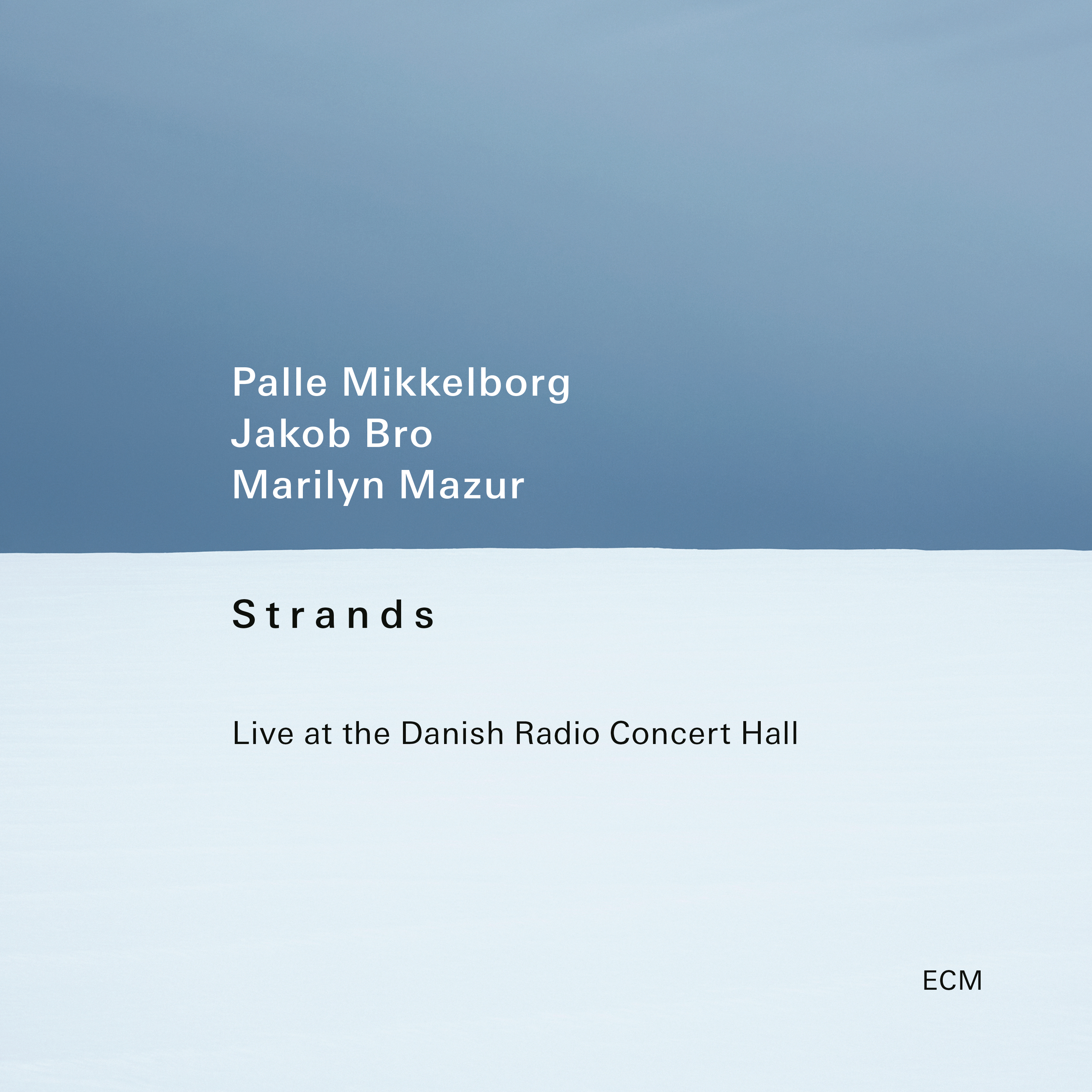
Arve Henriksen/Harmen Fraanje: Touch of Time (ECM 2794)

Arve Henriksen/Harmen Fraanje
Touch of Time

Arve Henriksen trumpet, electronics
Harmen Fraanje piano
Recorded January 2023 at Auditorio Stelio Molo RSI, Lugano
Engineer: Stefano Amerio
Cover photo: Max Franosch
Produced by Manfred Eicher
Release date: January 26, 2024

Touch of Time marks the debut of a duo project from Norwegian trumpeter Arve Henriksen and Dutch pianist Harmen Fraanje. Their alchemy of original material, yielding equal parts silver and gold, may just be the finest ECM album of 2024.

A slightly metallic drone runs through the spinal cord of “Melancholia,” where Henriksen’s keening sensibilities and Fraanje’s edgework coalesce into a time-lapse portrait from multiple angles. Through this canvas, we are introduced to a nostalgia that runs deeper than the memories of a single lifetime. Rather, the encounter feels multi-generational and shields its candle against the gusts of history without so much as a flicker of doubt. This truth holds throughout the session, culminating in the searching movements of “Passing On The Past.”

Going one step further into these concentric pieces brings us to “The Beauty Of Sundays,” in which the creative signatures of these two sonic greats are so enmeshed that picking apart where one ends and the other begins grows more difficult as the melodies unfold. Even in “Red And Black,” which is largely pianistic, one feels pieces of each in the other.

All the tunes herein are living photographs. “Redream” is a decidedly familial one that arrives at a gong-like interior. “Winter Haze” suggests an externally manifested yet internally understood landscape, as much rural as it is urban.

Whereas in “The Dark Light,” Henriksen plays chordally through the trumpet with electronic shrouds dissolving to reveal an eddy of piano, the title track unleashes an ocean in which sand castles are dissolved by the tide of mortality. 

“What All This Is” and “Mirror Images” comprise the central dyad. Between the former’s soft textures (a sensitivity that turns stone into feathers) and the latter’s technological swirl, there is so much light that we can only close our eyes against the dawn and be grateful for all that brought us to these moments.

This is music that looks in the mirror until it slips through the glass to take the place of its own reflection.

Matthieu Bordenave: The Blue Land (ECM 2783)

Matthiew Bordenave
The Blue Land

Matthieu Bordenave tenor and soprano saxphones
Florian Weber piano
Patrice Moret double bass
James Maddren drums
Recorded October 2022 at Studios La Buissonne, Pernes-les-Fontaines
Engineer: Gérard de Haro
Cover: Fidel Sclavo
Produced by Manfred Eicher
Release date: January 26, 2024

In this follow-up to 2020’s La traversée, saxophonist Matthieu Bordenave again joins subtle forces with pianist Florian Weber and bassist Patrice Moret, now adding drummer James Maddren. The result is a new songbook written by the bandleader for the group at hand.

Weber paints with the broadest brush, taking account of every bristle in his articulations of time and space. His protracted intro to “La Porte Entrouverte” sets a vivid scene, only to dismantle and rebuild it over and over again, until Bordenave’s soprano populates it with his own shadow, along with those of Moret and Maddren in tow. This understated foundation allows brief yet virtuosic flights to grace the air with their murmurations. The title track is a more abstract wonder that dabs its brush into a palette of even finer details. Dampened pianism weaves through caressed drums and a distant tenor before the bass drops its harmonic stones into the water.

When speaking of a band’s cohesive sound, one often means to imply that the musicians fill in one another’s gaps. Here, however, they open one another’s gaps so intuition might have more leeway for self-development. Even when taking on John Coltrane’s “Compassion,” the set’s only apocryphal tune, their penchant for freer expression (note the spiritedness of Weber’s solo) takes precedence over any notions of faithfulness. “Cyrus” is likewise a masterclass in letting an atmosphere speak for itself. The title is descriptive, conjuring images of clouds and the peace one derives from watching them drift by. Its guiding arpeggios carry us without force into the darker caves of “Refraction” before light welcomes us at the other end with “Distance,” laying down a bespoke groove that keeps us on our toes.

“Three Four” does something one doesn’t often hear in jazz by sounding simultaneously nocturnal and diurnal, leaving us suspended somewhere in the middle. “Timbre” features needle-threading sopranism and is a highlight for its breathy transparency. The final word belongs to “Three Peaks,” affording an aerial view of a place we can only dream of—if only because it is so real. Thus, what seems to be a contradiction on the surface becomes an entity unto itself, ever traveling onward without a GPS.

Florian Weber: Imaginary Cycle (ECM 2782)

Florian Weber
Imaginary Cycle

Florian Weber piano, composition
Anna-Lena Schnabel flute
Michel Godard tuba, serpent
Quatuor Opus 333
Corentin Morvan
 euphonium
Jean Daufresne euphonium
Patrick Wibart euphonium
Vianney Desplantes euphonium
Lisa Stick trombone
Sonja Beeh trombone
Victoria Rose Davey trombone
Maxine Troglauer bass trombone
Recorded July 2022 at Sendesaal, Bremen
Engineer: Markus Heiland
Mixed March 2023
by Manfred Eicher, Florian Weber, and Michael Hinreiner (engineer)
at Bavaria Musikstudios, Munich
Project coordinator: Thomas Herr
Cover photo: Fotini Potamia
Produced by Manfred Eicher
Release date: September 13, 2024

Florian Weber returns to ECM with something transcendent in Imaginary Cycle. This suite for piano, brass ensemble and flute began with conversations between the German pianist and producer Manfred Eicher, whose shared pictorial imagination lit a fire that continues to burn long after the listening experience is through. Thus, the title precisely expresses where the music lives, breathes, and congregates. Divided into four main parts—“Opening,” “Word,” “Sacrifice,” and “Blessing”—themselves consisting of four subsections, and bookended by a Prelude and Epilogue, the result is one of the most heartfelt creations to grace the label in years.

With its somewhat abstract and fleeting atmosphere, the decidedly pianistic intro is the dust from which the Adam and Eve of what transpires are fashioned. As he plays, Weber sings softly in counterpoint (channeling Keith Jarrett at his most tender) before shifting into an arpeggiated architecture. From here, he imagines a liturgical structure in what Friedrich Kunzmann in his liner notes calls “a transfigured Mass, stripped of its dogmatic structure and expanded with the improvisational language of more modern designs” and further echoed by the call and response of piano and brass.

The same path of development repeats itself, the sonic equivalent of italics for emphasis, as the horns arise once again from beneath the floorboards. Tense chromatic strains bleed through the shroud of time as if in search of a chalice in which to be collected and held high. Meanwhile, stepwise gestures in the piano trace the contours of prayer.

With the addition of flutist Anna-Lena Schnabel, we encounter echoes of Heinz Holliger (especially his Scardanelli-Zyklus). Like a shakuhachi mimicking a crane, her instrument steps carefully in the water, trying not to disturb its own reflection. Here is also where tuba player Michel Godard brings inner voices to the fore, while the others wail in slow motion. These transubstantiations culminate in “Sacrifice,” which reaches for that unarticulable line where cloud and firmament kiss each other. The rarely heard brass instrument known as the serpent (also played by Godard) slithers into view, cradled by its more attuned offspring. Its contrast with the flute evokes the glint of moonlight on a tepid pond. Both rely on the surface tension between them, culminating in two profound duets with Weber.

Schnabel and Godard (now on tuba) start the final benediction as a duo, laying the foundation for runs across a weathered keyboard. There is a brightness here that sings. The sounds of wind through noteless brass follow, leading to a jazzy burst of joy in Weber’s solo. With heavy emotion but a light touch, he sets up the ending as a new beginning.

As idiosyncratic as it is non-idiomatic, Imaginary Cycle is undeniably special and belongs at the right hand of classics like Officium, which Weber cites as a key inspiration (along with composers Carlo Gesualdo and Orlando di Lasso). What we have, then, is the mind of a translator turned into a Book of Hours, marking our passage from life to death and back again. Would that such restorations were not so often silenced in today’s world.

Sinikka Langeland: Wind And Sun (ECM 2776)

Sinikka Langeland
WInd And Sun

Sinikka Langeland vocals, kantele, Jew’s harp
Mathias Eick trumpet
Trygve Seim tenor and soprano saxophones
Mats Eilertsen double bass
Thomas Strønen drums
Recorded June 2022 at Rainbow Studio, Oslo
Engineer: Martin Abrahamsen
Mixed at Bavaria Musikstudios, Munich
by Sinikka Langeland, Guido Gorna, and Michael Hinreiner
Cover photo: Dag Alveng
Produced by Guido Gorna
Release date: September 15, 2023

It walks and walks
and all the dead are with us
the dead too walk and walk
in us

–Jon Fosse

Sinikka Langeland has given breath to lungs far beyond the inner sanctum of the body, both through her salt-of-the-earth singing and unmatched touch of the kantele. And while she is ever an unfettered soul, unafraid to cross physical and metaphysical borders, there’s something particularly special about the assembly of musicians on Wind And Sun. With trumpeter Mathias Eick, saxophonist Trygve Seim, bassist Mats Eilertsen, and drummer Thomas Strønen, she brings life to the poetry of Jon Fosse as if it were the most natural process in the world—and perhaps, for her, it is. 

“Row My Ocean” sets a mood of sound and spirit. Its image of pushing against the water to move forward is the band’s modus operandi. It takes the rhythm of the waves not as a challenge to overcome but as a guiding heartbeat. This underlying pulse continues in the title track, an understated yet no less powerful instrumental that shines its way into fantasy and, in a later sung version, reveals secrets of the sea with maternal urgency.

The feet of Langeland’s composing fit perfectly in the shoes of Fosse’s verses. Her fluid yet pointillistic approach to “It Walks And Walks” echoes the poem’s dark yet life-affirming slant. As the gravity of land replaces the freedom of the waves, we feel the weight in our legs and feet and stumble into “Boat in Darkness,” where solitude becomes a path to resolution. Meanwhile, “Hands That Held” snakes and wanders as if accustomed to the uncertainty of living in the moment, unfolding in the album’s most haunting melody. Even “A Child Who Exists” (co-written with Geirr Tveitt) suffers no loss of space in being accompanied only by Seim. Neither does “Wind Song,” in which Jew’s harp and kantele dance as their own light source in the night.

Langeland’s kantele playing seems to get more enchanting with every release, and in “When The Heart Is A Moon,” we hear just how masterfully delicate her contact can be. It sparkles without offending the eye and takes our ear by the hand. The band is also locked into a faithful unity with the listener. Even Eick’s rising solo, a bird in low flight, never loses sight of its shadow throughout “I Want To Listen To The Angels,” while Eilertsen’s arco streaks and Strønen’s brushes evoke a subtle blues in “A Window Tells” and “The Love,” respectively. Band unity is on full display in the triptych of “You Hear My Heart Come” / “These Inner Days” / “Let The Rain Breathe,” where a single note needs forcing. Like the journey as a whole, every twist and turn speaks freely from the heart in the fullness of knowing that the destination is already behind us.

Maciej Obara Quartet: Frozen Silence (ECM 2778)

Maciej Obara Quartet
Frozen Silence

Maciej Obara alto saxophone
Dominik Wania piano
Ole Marten Vågan double bass
Gard Nilssen drums
Recorded June 2022 at Rainbow Studio, Oslo
Engineer: Martin Abrahamsen
Mixing: Michael Hinreiner (engineer), Manfred Eicher, Maciej Obara, and Dominik Wania
Cover photo: Thomas Wunsch
Produced by Manfred Eicher
Release date: September 8, 2023

For his third quartet outing for ECM, alto saxophonist Maciej Obara brings an ever-searching sound to bear on the foreground of a continuously shifting diorama. With him again are pianist Dominik Wania, bassist Ole Marten Vågan, and drummer Gard Nilssen. The tunes were inspired by Obara’s solitary travels in the natural scenery of southwest Poland, where he found himself wandering during the pandemic lockdowns. Such details work their way into many of the track names, starting with “Dry Mountain,” which lobs skyward before dipping down to touch the snowy surface of things. The ice is always moving, tectonic and ancient, even as the overall shape remains. (As in the later “High Stone,” the musicians are acutely aware of one another’s presence. With a grand sense of space, they reach far across tundra and time.) In the subsequent “Black Cauldron,” we encounter a brew of memories and impressions, a recipe as old as time yet with ingredients as fresh as the air we breathe.

The title cut has a delicate underlying groove, sewn into place by the precise needlework of Nilssen’s cymbals, while the glint of sunlight on a landscape brought to stillness by a world screeching to a halt speaks of brighter days ahead. The atmosphere is exciting in its possibilities, as if being alone were the only way to appreciate having others around. Vågan is gorgeously fluid here, lending so much humanity to the sound, the unerringly forward motion of nature continuing around him. Wania’s solo brings the touch of longed-for interaction, even as Obara’s flights keep their shadows in check.

Other notable turns of phrase include “Twilight,” a lullaby that unfolds with understated virtuosity and spotlights Obara’s talents as an improviser like few tracks before it, and “Waves of Glyma.” The latter recalls time spent on south Crete, populating the memory with joyful revelry, fearless camaraderie, and a feeling that life might never end. Amid the phenomenally upbeat rhythm section, Wania holds tight to the ethos of the hour.

One surprise inclusion in the set is “Rainbow Leaves,” a leftover from the bandleader’s Concerto for saxophone, piano and chamber orchestra, co-composed with Nikola Kołodziejczyk but now refashioned as an improvisatory seed. Obara is fiercely (yet never aggressively) beholden to wherever the melody wants to go, letting us tag along six feet behind.

Bobo Stenson Trio: Sphere (ECM 2775)

Bobo Stenson Trio
Sphere

Bobo Stenson piano
Anders Jormin double bass
Jon Fält drums
Recorded April 2022 at Auditorio Studio Molo RSI, Lugano
Engineer: Stefano Amerio
Cover photo: Woong Chul An
Produced by Manfred Eicher
Release date: March 17, 2023

For this fourth ECM outing from pianist Bobo Stenson, bassist Anders Jormin, and drummer Jon Fält, one of the most formidable yet humble jazz trios on the planet explores mostly Scandinavian material. And what more logical place than with the simple act of “You shall plant a tree,” courtesy of Per Nørgård. The present rendition unfolds itself into the creased map of its inner self—proof that this trio, nearly 20 years in fellowship, is committed to a spirit that values emotions like oxygen. As the title indicates, each branch contributes equally to the shape of the whole. Two tunes by Sven-Erik Bäck expand upon this hymnody. The crystalline thaw of “Spring” and the deconstructions of “Communion psalm” reveal a grander instrument at play.

Jormin throws two coins of his own into this font. Where “Unquestioned answer – Charles Ives in memoriam” shimmers like a distant sun, weaving a naked language for the illumination of the ears, “Kingdom of coldness” (last heard on Pasado en claro in starkly different form) has its own story to tell. Between Jormin’s arco helix, Fält’s mineral-rich percussion, and Stenson’s streetlit chord changes, we get a slice of time laid out in physical form.

“Ky and beautiful madame Ky” by Alfred Janson takes a more observational turn. The way in which the musicians are never settled yet somehow cohere shows their deference to wherever the sound wants to go. Jean Sibelius’s “Valsette op. 40/1” paints in subtler shades, snaking through the landscape into the depths of a home built by time. This is childhood coming full circle in old age.

An especially notable piece of the puzzle is “The red flower” by Jung-Hee Woo. Shrouded in late-night jazz club vibes, it begs us to close our eyes, hear the rustle of whispered conversation, and inhale the tang of dry martinis.

The set ends with a variation of “You shall plant a tree.” What was once the trunk is now the seed, looking ever inward to the genesis of all things.

If anything is certain about the ethos of this trio, it’s that nothing is.

Wolfgang Muthspiel: Dance of the Elders (ECM 2772)

Wolfgang Muthspiel
Dance of the Elders

Wolfgang Muthspiel guitars
Scott Colley double bass
Brian Blade drums
Recorded February 2022 at 25th Street Recording, Oakland, California
Engineer: Jeff Cressman
Mixing: Gérard de Haro (engineer), Manfred Eicher, and Wolfgang Muthspiel
Studios La Buissonne
Cover photo: Woong Chul An
Album produced by Manfred Eicher
Release date: September 29, 2023

After clearing a giant swath of land throughout 2020’s Angular Blues, guitarist Wolfgang Muthspiel, bassist Scott Colley, and drummer Brian Blade now construct a series of interlocking structures across it. With “Invocation,” we find ourselves immersed in a sound that is both familiar and forward-seeking. As the mist of spider-webbed guitar and glistening chimes resolves to reveal Colley’s blessing, the trio’s meditations offer glimpses of parallel dimensions before Muthspiel dips into a chord-slung melody, allowing us some oxygen in a suffocating world.

While we might expect a groove from this seeking spirit, more slow building awaits in “Prelude to Bach.” This vaporous studio improvisation surrounds us with memories, each unable to be captured for long before the next takes its place. Before we know it, we’ve morphed into the Bach choral “O Sacred Head, Now Wounded,” which holds together like a fresco and touches the soul with equal lucidity. As inevitable as it was unplanned, it cups a candle whose flame has stood the test of time.

Muthspiel has a natural ability to twist the blinds to let in a different configuration of light at every turn. The polyrhythmic title track likewise changes faces as fluidly as one’s reflection in a disturbed pond’s surface. The acoustic guitar speaks with sagacity and love. Before the final act, Muthspiel and Colley recede into hand claps while Blade applies gold foil to the frame.

“Liebeslied” is one of two cover songs (this from Kurt Weill’s The Threepenny Opera). Muthspiel draws a tessellated swing from within the tune’s many-chambered heart. Colley renders his solo in charcoal while the guitarist sketches in quieter pencil in the background before switching to pastel for a final say.

“Folksong” takes inspiration from Keith Jarrett’s vamp-prone improvisations in the pianist’s Belonging period, exploring a chord progression to the point of melodic bursting, with Americana touches and hints of countless side quests. Muthspiel’s acoustic shows its breadth and cohesion, so much so that Colley’s gestures feel like an extension of the same instrument, giving us that sunlit joy of the mid-1970s when Jarrett was at his most exploratory. “Cantus Bradus” pays homage to pianist Brad Mehldau, last heard with Muthspiel on 2018’s Where The River Goes, and whose chromatism shines as a guiding light through spectral improvisations.

Not a single note feels wasted at Muthspiel’s fingertips. Whether caught up in a dance or bearing down directly on a virtuosic motif, he stands at the edge of a proverbial cliff without ever feeling the need to jump. Instead, he takes in the view and shares it with us all. This is nowhere so clear as in his rendition of Joni Mitchell’s “Amelia,” which closes the set with minimal expansion. Even absent of words, it speaks to the heart. The electric guitar is the softer brush in his artistic toolkit, allowing every bristle to sing. Colley and Blade are his tender allies, each a bearer of melodic and atmospheric truths for posterity.

Thomas Strønen: Relations (ECM 2771)

Thomas Strønen
Relations

Thomas Strønen drums, percussion
Craig Taborn piano
Chris Potter
 soprano and tenor saxophones
Sinikka Langeland kantele, voice
Jorge Rossy piano
This album was recorded and assembled between 2018 and 2022, with Thomas Strønen, the project’s initiator, inviting the featured musicians to join him from different locations across Europe and the US.
Thomas Strønen, Lugano
Craig Taborn, New York
Chris Potter, New York
Sinikka Langeland, Oslo
Jorge Rossy, Basel
Engineers: Lara Persia, Martin Abrahamsen, and Patrik Zosso
Mixed February 2023 by Manfred Eicher, Thomas Strønen, and Michael Hinreiner (engineer)
at Bavaria Musikstudios, Munich
Photo: Dániel Vass
Album produced by Manfred Eicher
Release date: November 29, 2024

Four years in the making, Thomas Strønen’s Relations locates the drummer in virtual duets with Craig Taborn and Jorge Rossy on piano, Chris Potter on soprano and tenor saxophones, and Sinikka Langeland on kantele and voice. After recording Bayou, producer Manfred Eicher invited Strønen to play solo percussion for the remaining studio time. Taking a decidedly classical approach (one might easily recognize shades of Edgard Varèse in here), and already being in the Lugano space where the Orchestra della Svizzera italiana is based, he was able to expand his usual drum kit with a variety of instruments—the only stipulation being that he could not have worked with them before. In response to the pandemic, he sent tracks to other musicians for long-distance collaboration. After a final mix, the result was an album of striking intimacy, timely messaging, and understated humanity.

We open with “Confronting Silence,” one of two tracks featuring Strønen alone (the other being the more sparkling “Arc For Drums”). The initiatory gong sounds nothing like the kickstart of commerce, the welcoming of royalty, or even the peace of meditation. It sings for no other reason than to be a vibration for all creation. Meanwhile, the gran casa rumbles within the soul of things.

Following this is “The Axiom Of Equality,” for which he is virtually joined by Taborn (as also in the diurnal “Pentagonal Garden”). The cellular metamorphosis between them is astonishing for being rendered from opposite sides of the pond, each motif a love letter to the ether.

Because Strønen often leaves moments of pause, letting others dialogue with him and populate the gaps with complementary grammar feels effortless. This is especially true of the tracks with Potter, whose tenor is a voice in the night in “Weaving Loom,” while in “Ephemeral,” he expresses himself internally despite the extroverted and free-wheeling playing, diving with humility into every moment for all it’s worth.

The more we immerse ourselves in the unique sound of this record, the more we settle into the illusion that every duo configuration is in the same room. Strønen’s three dances with Langeland are especially vivid in this regard. In “Koyasan,” the kantele is somehow not an extension of the percussion but the other way around, while in “Beginners Guide To Simplicity,” Langeland’s voice is a call to heart. And in “Nemesis,” brushed drums added an earthy texture that perfectly matches the aural surroundings.

Rossy also joins for three outings, examining linguistic morphologies in “Nonduality” and dropping stones into the waters of “Ishi.” Last is “KMJ,” the most melodic of the set. Every gesture between them is as clear as one’s reflection in a newly polished mirror, and Strønen’s heightened awareness leaves palpable traces behind for us to cross-hatch with the instrument of our listening.

2022 Generation Black: The Future Is Past

Drawing inspiration from a trip to Qatar in 2012, perfumer Stephane Humbert Lucas imagined a symphony of tinctures representing the city’s bridging of ancestral traditions and modern deconstructions one decade later. The result is 2022 Generation Black, a fragrance that lives boldly between these realms of cultural expression: on the one hand, safe and familiar, while on the other, daring and forward-looking. Such is the energy he brings to one of the most stimulating scents I’ve ever put my nose on.

The fragrance is a spiral of self-reflection with distinctly extroverted qualities. At first, this might seem contradictory, but upon further wearing, it settles into the skin’s natural chemistry, taking on the unique signatures of warmth and coolness as it seesaws between the two. Despite never harmonizing completely (assuming they were ever meant to), they speak of the self’s contradictory nature, at once physical and metaphysical.

When describing this fragrance, the initial flash of yuzu zest, black currant, and mint means that brightness lives at the tip of the tongue. The combination is so rich with life that one can hardly articulate the breadth of its embrace. There is an almost metallic sheen to it as if one were digging into the heart of the soil and tasting the very ore within. This is the outward dimension, fresh and inviting in its spectrum of flavors. But beyond that, there is a feeling that this isn’t just fun and games. Rather, there is a serious, even contemplative underpinning to it all waiting to be known.

Thus, it transforms itself to reveal a heart of Cambodian oud, where some inexorable truth makes itself known in an ongoing exhalation of sensual touch. Just knowing it’s there is enough to take comfort in every inhalation we offer in balance. Going one layer deeper reveals a darker nest of precious oud (a blend of agarwood, rose, and other florals), spices, and balsamic notes. It is here where we find rest as this olfactory journey comes to an end. Although not the longest-lasting of its kind, there’s something special about the ephemerality of its intensity that begs repeat wearings—and fresh discoveries.