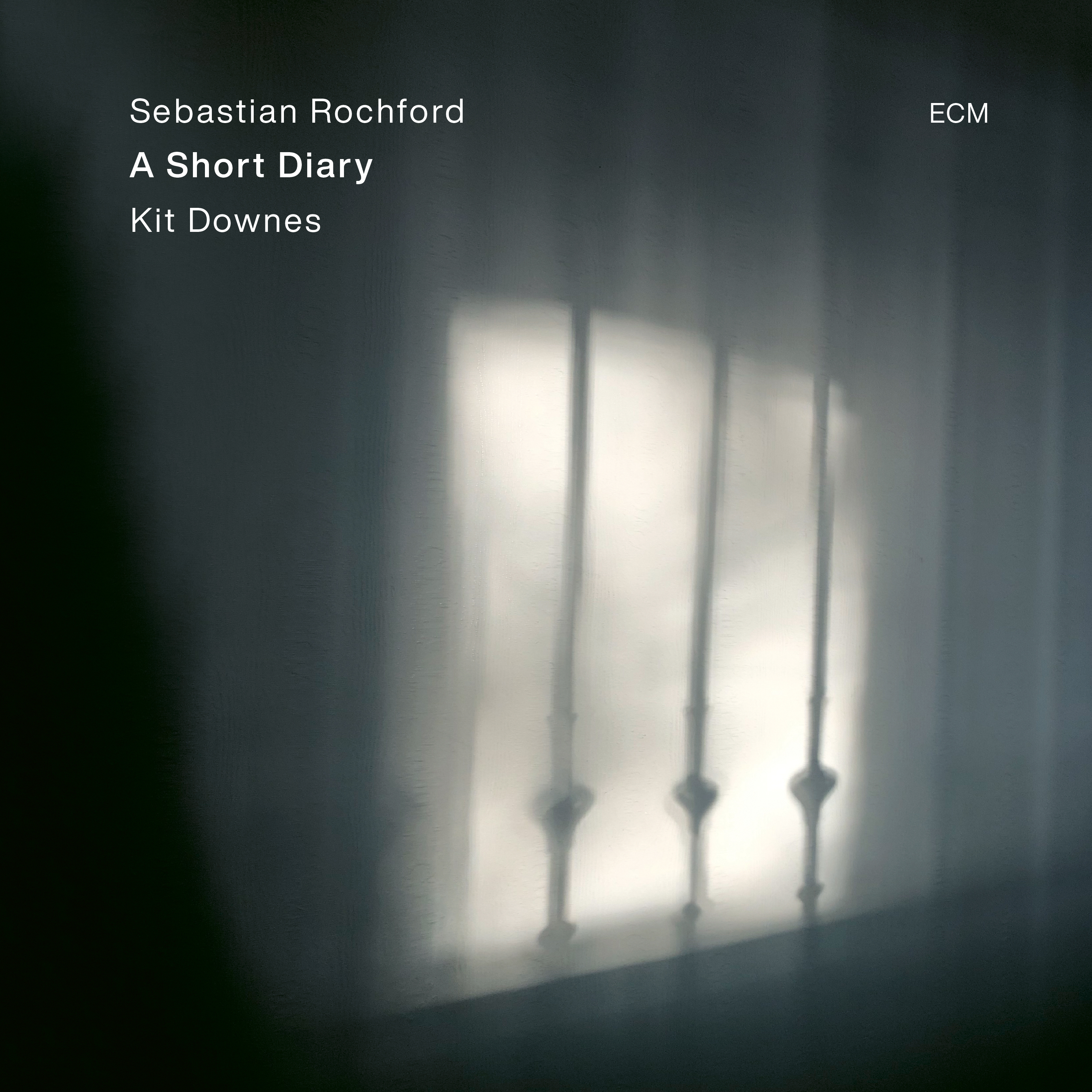
Seb Rochford composition, drums Kit Downes piano Recorded at Waverley, Aberdeen Recording engineer: Alex Bonney Mixed by Manfred Eicher Michael Hinreiner, engineer Cover photo: Clare Rochford Album produced by Sebastian Rochford and Manfred Eicher Release date: January 20, 2023
In 2019, Sebastian Rochford, who previously intersected with ECM on Andy Sheppard’s Trio Libero(2012), Surrounded By Sea (2015), and Romaria(2018), lost his father, Aberdeen poet Gerard Rochford. While mourning, the drummer found himself unable to staunch the melodies welling up from within. Recorded in collaboration with pianist Kit Downes at his childhood home in Scotland, A Short Diary reapproaches that music in dedication to his family and the man whose absence left an unfillable chasm. He then approached producer Manfred Eicher, who mixed and brought the album to fruition.
Despite the heartache that permeates “This Tune Your Ears Will Never Hear,” it opens with bursts of light as if to fight off the darkness of death. This feeling continues throughout, even in titles one might not expect, such as “Night Of Quiet.” Rather than slumbering away peacefully, it sits lucidly awake, opening the curtain of memory to reveal the sunlit scenes of “Love You Grampa,” wherein a tender nostalgia takes over, expressed in interlocking pianism and sewn by needle (snare) and threads (cymbals). Downes opens one photo album after another, discovering as much as Rochford about his history. “Silver Light” is the most poignant, its underlying pulse brushing past as an elusive reflection in the window.
In those asides where Downes is alone (namely, “Communal Decisions” and “Our Time Is Still”), the walls of the room close in. Like a mobile turning above a crib by the force of a baby’s breath, he moves in concert with life itself. This feeling is most foregrounded in “Ten Of Us” (a reference to Rochford and his nine siblings). Its slightly dissonant staircase leads us into the attic, drawn to the histories buried in its chests of toys, boxes of old books, and piles of clothes. Trying his best not to unsettle the dust with his footfalls, Rochford builds a gentle yet mountingly declarative hymn of survival.
Everything funnels into “Even Now I Think Of Her.” Rochford explains: “It’s a tune my dad had sung into his phone and sent me. I forwarded this to Kit. He listened, and then we started.” This swing hangs from a tree, overlooking a windswept field as the last remnant of green after cataclysm. It weeps, closing hands around nothing notions of what could have been. Thus baptized by mortality, lowered into a font of stillness, it gives up the ghost and shreds the present into countless pieces.
Throughout A Short Diary, each note births the possibility of others waiting to be heard. As one of the most touching recordings to come out on ECM this century, it is pure, sonic humanity. Despite (if not because of) being so personal, I dare say you could pull on any thread sticking out from it and find one in your own heart that matches.
Anja Lechner violoncello Recorded May 2023, Himmelfahrtskirche, Munich Engineer: Peter Laenger Cover photo: Sam Harfouche Produced by Manfred Eicher Release date: October 18, 2024
A solo program is never a solitary endeavor. While it may nominally include a lone performer—in this case, cellist Anja Lechner, in her first such recording—it is ultimately a conversation with the music, engineer, producer, and oneself. And in the trifecta of composers assembled here, we are included in that conversation. Throughout the opening swoon of A Question, one among a handful from former Scottish mercenary Tobias Hume (c. 1579-1645), and its companion piece, An Answer, the beginning and the ending become indistinguishable. (I also like to think that the answer comes unintentionally in the snatch of bird song heard at the end of the latter track.) Harke, Harke features pizzicato colorations and bow tapping—and may, in fact, be the first score to feature a col legno instruction—for delectable contrast. These pieces are from Hume’s 1605 collection of dances and miniatures, “The First Part of Ayres,” welcoming us into a sound-world that begs uninterrupted listening.
German pre-Classicalist Carl Friedrich Abel (1723-1787), another viol master who returned to the form a century and a half later, yields two vignettes in d minor. Where his Arpeggio is an enchantment, shining across the strings in refracted sunrise, the Adagio is a piece of paper blown down a cobbled street by the wind of an oncoming storm.
Against this backdrop, the Cello Suite No. 1 of Johann Sebastian Bach (1685-1750) is a piece of a fallen star. In the Prélude, there is enough shadow to remind us that even the most joyful discoveries depend on sorrows, rendering their contours all the more pleasurable to behold. Lechner wields her bow as the weaver does a shuttle. From where she sits, the frays of the tapestry’s backside are within reach, while from our perspective, it is richly and coherently patterned. As the Allemande shapes the clouds and sky, the Courante and Sarabande populate the valley below with equal measures of vibrance and infirmity. In the Menuet, we encounter the tinge of old age, where eyes still sparkle with the naivety of youth even as they are tempered by the cataracts of regret. The final Gigue frees the soul from its cage.
Given how heartfully Lechner renders all of this, moment by precious moment, how can one not reflect upon her spirit of exploration and improvisation through a career as varied as her repertoire? We are all the more blessed by her ability to pull life from her instrument as one draws water from a well. Like the composer himself, even when repeating the same format in the Cello Suite No. 2, she holds the power of variation incarnate. This Prélude is a drop of ink preserved in water, holding its color and identity no matter how much the Allemande may jostle it. Lechner maintains a level voice, holding firm to the horizon so that the occasional flight toward the sun or dive toward the ocean floor feels all the more novel. In that sense, the Courante is as vivacious as the Sarabande is funereal, each a stage setter for the final footwork.
Further aphorisms from Hume, each addressing a different facet of the human condition, conclude the recital. By turns playful and sensual, they delight with such titles as Hit It In The Middle and Touch Me Lightly. The strongest musculature is reserved for A Polish Ayre, which reminds us of just how physical the cello can be. Throughout these interpretations, Lechner is ever the shaft of light to its prism, splitting a spectrum of mastery that can only flourish behind closed eyes. The result is an act of great intimacy built over years of trust with ECM and its listeners, giving her soil to plant a variegated garden of nourishment. She has the dirt under her nails to prove it. Let the water of our high regard be its rain.
Evgueni Galperine electronics, sampling Sergei Nakariakov trumpet Sébastien Hurtaud violoncello Maria Vasyukova voice Recorded 2021/21, Studio EGP, Paris Engineer: Aymeric Létoquart Mixed November 2021, Les Studios de la Seine, Paris by Evgueni Galperine, Manfred Eicher, and Aymeric Létoquart Cover painting: Lorenzo Recio Album produced by Manfred Eicher Release date: October 21, 2022
If a composer is an author, then Evgueni Galperine is one who allows characters, actions, and places to speak themselves into logical corners, then breaks those corners to let the vacuum of space have a say. Based in Paris since 1990, the Russian/Ukrainian composer cites the language of cinema as his creative crucible. His first project in that regard was Andrey Zvyagintsev’s Loveless, a soundtrack he wrote sight unseen. (ECM listeners may remember another Zvyagintsev film, The Return, and its music by Andrey Dergatchev.) In the present program, Galperine tears his mise-en-scène from the pages of life itself. Whether reworking prerecorded material or responding to instruments in the moment, this “augmented reality of acoustic instruments” connects events of importance in his life. Aided by the contributions of Sergei Nakariakov (trumpet), Sébastien Hurtaud (cello), and Maria Vasyukova (voice), he breaks the electro-acoustic mold as he defines it, careful not to step on any shards left by the process to regard the partial reflections they offer.
Much of the work is personal, giving us glimpses into the experiences that have shaped his movements in the world. The most poignant is “This Town Will Burn Before Dawn,” for which Galperine imagined himself combing through the rubble of a destroyed futuristic city. “This simple idea took on a whole new meaning with the invasion of Ukraine,” he says, “the land of my father and of my childhood.” And while hope is found, it is unreachable. A cello stretches its arms but finds no contact in return, only an imagining of light amid ringing bells. Like “Soudain, le vide” later in the album, it is a requiem as much for the living as the dead. The flesh, it seems to whisper, is inseparable from shadow. “Oumuamua, Space Wanderings” is a more ambitious but no less intimate self-examination. Inspired by the oblong asteroid that enchanted the world with possibilities of interstellar contact in 2017, it writes its origin story with a Jon Hassell-esque morphology, nestled in an overlay of bright digital signatures and a seeking spirit.
With other influences ranging from Claude Debussy and Dmitri Shostakovich to György Ligeti and Arvo Pärt, a listening mind is clearly at work. Having such a list at hand prompts me to seek other paths of connection. The bellowing of low horns in “Cold Front” evokes the dawn-kissed expanse of Hans Zimmer, while the trumpet of “After The Storm” exhales like the foggy tropes of Ingram Marshall. To be sure, the high strings and beautiful dreams of “La lettre d’un disparu” make for an easy parallel with Pärt’s Tabula rasa. But they also bring me back to my first encounter with Three Pieces in the Olden Style by Henryk Górecki. If anything, my deep kinship with the Polish composer’s broad oeuvre rings truest for me throughout Theory of Becoming. I feel it in the translucent veil of “Kaddish” and the unrelenting textures of “The Wheel Has Come Full Circle”—not simply in terms of structure but in Galperine’s sense of time. It’s like he stretched out Old Polish Music thin enough to see the sun through without letting it rip, giving us a diffuse lens through which to regard the precariousness of our existence.
Even when the inspirations are of a more imaginative persuasion, they feel no less real. A childlike wonder reigns supreme in “Don’t Tell.” This melange of whistling, percussive clicks, trembling strings, and celesta is a record spinning backward. It cradles a flute like a newborn sibling, ending in a unified song of well-being. Lastly, “Loplop im Wald” refers to the magical bird solely capable of traversing Max Ernst’s mysterious painted forests. Tenser and moonlit, its Morse code trails ever outward into a calling of escape, hoping nature won’t come crashing down on itself before the journey can be completed.
With such a profoundly familiar sense of imagination to regard, we are left with only ourselves as companions, conversing until we implode as sound itself.
If I were to dump out a puzzle from its box and ask you to put it together, you’d likely start with the edge pieces, as we’ve all been taught to do. Recently, however, while watching my seven-year-old assemble one of his own, I realized this isn’t necessarily the best strategy. The puzzle he was working on was circular, and the circumference was uniformly white, surrounding a clear design in the center. From his perspective, it only made sense to start with what was fully articulated and work outward from there.
Arvo Pärt had the same effect on me.
Before encountering his Te Deum decades ago, I used to approach listening from the periphery, tracing the container from without before diving into the matter within. That blending of voices and strings, anchored by piano and wind harp, did not make its skin immediately obvious. Rather, it offered its heart front and center before veins, bones, and garments emerged through years of regard.
And now, Joonas Sildre’s Between Two Sounds: Arvo Pärt’s Journey to His Musical Languagedoes the same for the Estonian composer who didn’t so much redefine modernism as turn it inside out to remind us of where it originates.
I recently spoke with Sildre, who had the following to say when I asked him about the genesis of this project:
“During the early 2000s, I became a huge fan and admirer of Pärt’s music through a friend who had gifted me a CD ‘mixtape’ of his music. At the time, I was also on a spiritual journey in the early phases of Christianity. This certainly heightened my admiration of this music, which became the soundtrack of that journey. I was never very interested in Pärt as a person because I had learned that if you like someone’s music, their personality (or the availability of that information) does not add much to it. In 2005, it became apparent that this was the opposite in the case of Pärt: There was a 15-part radio show on Estonian Classical radio about his life (made by Immo Mihkelson). Listening to it and him talking about life, art, and spirituality, I recognized these topics to be dear to my heart, but rarely did I hear anyone expressing these things in union. At the time, in the early 2000s, I was looking for a story to tell in graphic novel format—when hearing Pärt’s radio interview, things clicked for me. There was no question of a different format.”
Immersed in the result of that journey, I am reminded of my own spiritual awakening, for which Pärt’s music was always a leitmotif, a call (at times clarion, at others whispered) that inspired sympathetic resonance into my very core. It’s only natural, then, that Sildre’s book should proceed in a musical manner.
As a visual composition, Between Two Sounds proceeds like something Pärt himself might have constructed (and how can I not smile at the similarity with my blog’s title?). We meet the composer in the dark, walking a line from eternity to eternity, his musings floating almost unrealistically in space. It takes effort to admit that the words have meaning and are not tricks of draft and debris across the unswept floor of time.
Golgotha, a place of the skull, the hill where death for one offered life to all, reminds us of the dark well from which God draws light. Directing the gaze and ears thusward seeds a relationship between flesh and spirit that can only be articulated through art.
Beyond these introspections, which stipple the larger narrative with resounding grace, we leap through Pärt’s chronological development. From his birth in Paide and early childhood in Rakvere to his confrontations with Soviet censorship and flourishing under the tutelage of Heino Eller at the Tallinn Conservatory, we are gifted a dynamic biography that seems to leap from the page, if not sometimes also sink into it. While that story is astonishing in and of itself (a particularly tense scene finds Pärt nearly losing his scores and tapes on the verge of his emigration to Europe), key moments speak across the years and geographical borders to my heart.
In doing his research for the biographical angle of the book, I wonder how it changed Sildre’s perception of the man himself as they came to know each other from acquaintances to friends:
“Pärt talks of another level where the music comes from. I’d like to think that connections and friendships also happen on that level, and there, we were friends even before I met him personally. During the years the work took, of course, I learned much more about him as a person, his life, music, and spirituality. I saw Pärt as a regular human, yet he always remained ‘not regular’ to me. He could be very simple and very deep at the same time (or at different times)—I guess this is almost a scientific definition of a genius. What surprised me is that Pärt, whom I had seen and learned from his music and his words, was actually himself, not some projection as it usually happens to be among public personas. Like he says (paraphrasing): In order to put Tintinnabuli music to paper, he actually had to change as a human being.”
That change develops through listening in Pärt’s early years. As a boy who learned on a broken piano, he comes to seek an upright language in a fallen world:
The line between “public” and “private” disappears in these moments of abandon, much to the humor of those around him. And yet, he reveres the notes on their terms, allowing their credo to suffice for what passes as communication in his immediate environment. The more he hears, the more he and everything around him pass into silhouette, not so much under the loudspeaker as a part of it.
The graphic novel is filled with novel graphics. Most remarkable among them is Sildre’s explicit visualization of notes.
Despite the apparent aggressiveness of their passage through the air, theirs is not so much a spirit of confrontation as of enlightenment. With the premiere of each new work, those fortunate enough to have been present are shaken to the core by a thrum to which they had, until then, turned a muffled ear:
“I did not want to use notes as they are a specific language for musicians; regular people cannot read and understand them. If I used them, even in a decorative way, the average readers would always feel that maybe they were missing something. So, I needed to step away from that language, but not too far. I ended up with the ‘dot and line’ method that I developed throughout the book. The look of these symbols would hint at the emotion and content of any given musical piece. With dots, I could use many design language tricks: size, placement, quantity, light and dark value, and context. Lines would symbolize the time but also the emotion: jagged lines versus smooth lines. A circle had an extra feature. It could also be used as a speech bubble or thought. So, overall, this small invention became very handy for telling that story. It became an intuitively understandable visual language.”
Sildre creates a tapestry with blank patches that can only be filled through hearing. Perhaps the longest thread running through this tapestry is one of religion, as Pärt’s conversion to the Greek Orthodox faith unfolds in a chain of snow and spring. His composition Sarah Was Ninety Years Old is a recurring stitch, beginning with his first exposure to his grandmother’s Bible and continuing throughout his life. The drums are the rhythm of salvation, the rapping of Christ’s knuckles on the heart’s splintered door.
And so, we are invited to close our eyes, open our ears, and release ourselves from the bondage of our sins. Although everything we think and do is imperfect, Pärt seems to say, we should never stop reaching for perfection. Because there is One who is perfect, and every song we sing must fill the footprints He left behind.
Sildre echoes this sentiment:
“Upon meeting Pärt, I had a feeling that he had so much old cultural heritage in him; he felt almost like he was from the ancient world. I had never met a person who would have so many ties to the old. At the same time, as time passed, I was pondering that the mentality and love Pärt expresses must be the future of humankind. So, he is from the past and future at the same time! It may sound strange, but this is still my strong feeling about him as a person.”
All of which connects to his aspiration for the book:
“I hope that the people who have not heard Pärt’s music will find it. And I hope that people who know his music will learn that there is a miraculous story behind the miraculous music.”
If there is any miracle to be found here, it is in knowing that human beings are capable of glimpsing the divine, however temporarily, all the while knowing that eternity is the only altar on which our humility can be laid with blessed assurance.
Claudia Barainsky soprano Adrian Pinzaru violin Andreas Moscho violin Lara Albesano viola Hendrik Blumenroth violoncello Mikhail Timoshenko baritone Matthias Lingenfelder second viola Andreas Arndt second violoncello Recorded October 2021, Abtei Marienmünster, Konzertsaal Engineer: Friedrich Wilhelm Rödding Cover photo: Woong Chul An Album produced by Guido Gorna Release date: June 21, 2024
Im wachen Traume tells an old story in new terms. The title (“In a waking dream”) references Frauenliebe und Leben, op. 42, by Robert Schumann (1810-1856), whose eight-part song cycle serves as the program’s centerpiece. This setting of eight poems by Adelbert von Chamisso (1781-1838) about a woman’s tragic fate is arranged for soprano and string quartet by late composer Aribert Reimann (1936-2024) for those performing it here—another clue to the album’s name. In 2018, while drifting off to sleep, Reimann heard the song cycle in his head with a string quartet instead of a piano. Unable to relinquish the idea, he completed the present version in under two months.
In his liner notes, violinist Andreas Moscho describes a dual theme of love and death. “None of the works selected here,” he observes, “were originally conceived for string quartet. In all of them, however, the string quartet seems to return home.” Reimann enhances the score with careful yet natural adornments, rendered telepathically by the Delian Quartett and soprano Claudia Barainsky. “Helft mir, ihr Schwestern” (Help me, my sisters) and “Süßer Freund, du blickest” (Sweet friend, you look) lend themselves so organically to the format that one can hardly imagine them any other way. Highlights include the chordal exchanges and trembling cello of “Er, der Herrlichste von allen” (He, the most wonderful of all), the pizzicato accents of “Ich kann’s nicht fassen, nicht glauben” (I cannot grasp it, believe it), and the glassy harmonics of “An meinem Herzen, an meiner Brust” (On my heart, at my breast). Barainsky emotes with a seasoned charm that feels utterly genuine. She is an embodied vocalist who understands that texts must be first spoken to be sung.
The one poem not included by Schumann is Chamisso’s ninth, “Traum der eignen Tage” (Dream of my own days), in which the wisdom of old age is offered as a gift to one whose life still lies ahead. Perhaps no more fitting connection could be made to the works by William Byrd (c. 1543-1623) and Henry Purcell (1659-1695) pillowing this Schumannic gem. While these luminaries of Renaissance and Baroque eras might seem unlikely companions, one can hardly deny that the Venn diagram of their shared interest in worldly things makes their spiritual complements stand out all the more.
As the music of Byrd, in arrangements by Stefano Pierini, demonstrates, this dichotomy is crucial. Diametric vignettes like “Sing joyfully” and “Ave verum corpus” are proof positive of the Delians’ uncanny sympathy, while “Jhon come kisse me now” (a bawdy lyric reconstructed from Byrd’s own harpsichord variations) drips with honey from Barainsky’s lips. Meanwhile, the latter’s rendering of “Out of the orient, crystal skies” shines in its telling of the nativity, while the strings evoke the humility of the manger. In the tender “Lullaby, my sweet little baby,” Barainsky is joined by baritone Mikhail Timoshenko to rebuke King Herod’s tragic decree (represented in vocalise) from the point of view of the Virgin Mary.
The two singers join forces further back in time for Purcell’s “Hear my prayer, O Lord.” With Matthias Lingenfelder and Andreas Arndt seconding on viola and cello, respectively, they create a wordless but no less ecclesiastical sense of grandeur. Preceding them are the Pavane and Chaconne, both in G minor, each an interlocking canvas of pastel and charcoal, and between them, “When I am laid in earth” from the opera Dido and Aeneas (also arranged by Pierini). Barainsky lays bare her respect for the tragedy, nevertheless finding beauty in it. And is that not how we survive?
Wolfert Brederode piano Matangi Quartet Maria-Paula Majoor violin Daniel Torrico Menacho violin Karsten Kleijer viola Arno van der Vuurst violoncello Joost Lijbaart drums, percussion Recorded August 2021 at Sendesaal, Bremen Engineer: Stefano Amerio Cover: Mayo Bucher Produced by Manfred Eicher Release date: September 23, 2022
For his fourth ECM album as leader, Wolfert Brederode returns with Ruins and Remains. This suite for piano, string quartet, and percussion, the result of a commission marking the 100th anniversary of the end of World War I, telescopes the seemingly insurmountable distance between horror and hope.
While such a backstory might seem a pivot for the Dutch pianist, thematic connections are drawable to his past work. From the association-rich wanderings of Currents to the patient grooves of Black Ice, he has consistently demonstrated an awareness of time as a physical substance. In Post Scriptum between them, he was already exploring suite-like structures around questions of the human condition.
The present record takes elements from all that came before and bonds them with something so intangible that only a microphone can capture and amplify it: history. To that end, he ticks our path with four signposts entitled “Ruins.” With their cold expanse and cautious navigations, they trace the movements of those who have fallen in places where hands cannot reach and only the heart may tread.
In “Swallow,” Brederode and his fellow musicians sift through the rubble for something salvageable: a ring, a photograph, perhaps a gold-capped tooth that once served as a runway for speech. The Matangi Quartet speaks in the language of the past, dreaming of better times when violence was something one only read about in storybooks. Meanwhile, percussionist Joost Lijbaart reveals glints of the future. Along the way, Brederode emotes very much in the present, holding close to lessons on the verge of fading. With these in mind, titles like “Cloudless” and “Dissolve” feel as much like descriptors of what we hear as what they evoke. The resonance of these passages tells stories in which we can have no part, each walking a bridge that must collapse. In this regard, “Retrouvailles” comes across as a false promise, a moment in time expanded to show the scars it would otherwise gloss over.
Although musical details rise into prominence, including the plucked piano strings of “Ka,” the rolling snare of “Nothing for Granted,” and the cello’s sagacious presence across the waves, a holistic mise-en-scène pervades. Like the blush of “Duhra,” it strikes a glow where mostly darkness has taken hold, a film without a screen.
The music’s openness to change is part of what makes it real. As death becomes written and rewritten, our souls adapt to its language. And as it heeds the horizon’s beckoning, we are given a choice: follow or turn away.
Dominic Miller guitar Jacob Karlzon piano, keyboard Nicolas Fiszman bass Ziv Ravitz drums Recorded April 2021 at Studio La Buissonne, Pernes-les-Fontaines Engineer: Gérard de Haro Mastering: Nicolas Baillard Cover photo: Fotini Potamia Produced by Manfred Eicher Release date: April 21, 2023
For his third ECM outing, guitarist Dominic Miller brings quiet ferocity and lyrical precision to this quartet setting with pianist Jacob Karlzon, bassist Nicolas Fiszman, and drummer Ziv Ravitz, opening our ears to newer and even deeper terrains across a set of eight original itineraries.
In a statement for the album’s press release, he says, “Thanks to the amazing singers I’ve worked with over the years, I see myself more as an instrumental songwriter. And as they do, I see it my mission to surround myself with the best musicians who understand the narratives in the ‘songs.’ I’m happy to have assembled the right lineup here with Vagabond.” And in “All Change,” we hear that ethos played out. The rhythm section opens itself to Miller’s acoustic timekeeping while the piano smoothes the waters to ensure this vessel sails uninterrupted until it reaches its first port of call. Miller’s overlay brings fresh intimacy, capturing frames of a stop-motion memory.
Across the cinematic horizon of “Cruel But Fair,” an underlying breath of synthesizer kindles the hearth of Miller’s acoustic. A collective atmosphere reigns supreme, each musician contributing to a scene as it curls into shape around people, places, and things. Such associations collaborate in the music as much as those assembled in the studio to articulate them. Miller himself points to southern France, which he has called home in recent years, for inspiration. Whereas “Vaugines” refers to a small village he has frequented on his walks, “Clandestin” is a hidden bar where stories abound. The latter’s interplay reveals the most space between instruments, allowing for an unguarded swagger. To my ears, it feels anything but covert.
Such is the ability of Vagabond to open its borders to our psychological refugees. For example, while “Open Heart” is easily interpreted as an image of generosity, to me, it evokes the darkly inward period I faced when my father suffered a nearly fatal heart attack in December of 2023 (the main reason why I’ve posted so little since then). All the more fitting, then, that Miller should include an ode to his own father, “Mi Viejo,” an unaccompanied offering of intimate magnitude.
The delicacy of this music is also its strength. A case in point is “Altea,” the airy underpinnings of which give the trio plenty of fertilizer to work into the soil. What grows from it is lush yet variegated enough to let those precious rays of sunlight through. Lastly, “Lone Waltz” moves from stasis to momentum. Like a boat chasing the setting sun, it finds solace in the waves.
If we started with the notion of having to get somewhere, we end without quite knowing where that might be.
Heinz Holliger oboe, oboe d’amore Anton Kernjak piano Alice Belugou harp Recorded October 2021 at Radiostudio Zürich Engineer: Andreas Werner Cover: Fidel Sclavo Co-production ECM Records / Radio SRF 2 Kultur Release date: September 22, 2023
Dear dreamer, help me to take off Into my pathless, pure delight By always holding in your glove My wing, a thin pretence of flight.
The vocalise is a form that, by modern definition, refers to a singing exercise focusing on melody over meaning. If it begs the need for words, it is only because we are accustomed to the notion that songs require them. In this instrumental program, oboist Heinz Holliger deconstructs the concept and reassembles it with apocryphal gems and other building materials from the 20th century. Pianist Anton Kernjak (last heard on Holliger’s Aschenmusik) leads as much as he follows in their co-search for lyrical forms.
It is Kernjak who introduces us to a forest of snow-covered trees in Maurice Ravel’s Pièce en forme de Habanera (1907). Holliger’s oboe is the wanderer who sings only when no one else is around, leaving behind a trail of crumbs not to be found but in the hopes they will bear fruit come spring. Thus, we are shown a way forward. The Sonate op. 166 (1921) of Camille Saint-Saëns, one of his last pieces, cuts across the grain of Romanticism with blades of light. From measured frolic to a march across time, it might just be his truer swan song.
A freshness as of twilight brushes Against you as you flutter me, And each imprisoned wing-beat pushes Back the horizon tenderly.
From André Jolivet, who Holliger cites as the genuine successor to Edgar Varèse, we get the mysterious Controversia (1968). Originally dedicated to Heinz and Ursula Holliger, it replaces the latter with Alice Belugou on the harp. The relationship between the two instruments is one of tension without release. The oboe trembles, and the harp writhes, their dance a language unto itself. Belugou’s harmonics point toward points of starlight, while the double reed takes solace in tracing them for want of images. Holliger’s tone is unparalleled; his window racks but never shatters, offering a kaleidoscopic point of view.
It’s dizzying: shivers run through space Like an enormous kiss, which, mad At being born for no one’s face, Can not discharge, nor yet subside.
The Vocalise-Étude (1935) of Olivier Messiaen offers yet another perspective. Holliger once played it in the composer’s presence while rehearsing for a performance of Des canyons aux étoiles he was to conduct. As the story goes, Messiaen’s enthusiasm led him to include it in the Concert à quatre, dedicated to Holliger, Yvonne Loriot, Catherine Cantin, Myung-Whun Chung, and Mstislav Rostropovich. As magical as it is brief, it breathes alongside the Morceau de lecture(1942), an etude for the oboe sight-reading exam at the Conservatoire National de Paris later expanded upon in the song cycle Harawi (“L’Amour de Piroutcha”).
Ravel’s Kaddisch (1914), from Deux mélodies hébraïques, sets the Jewish prayer for the dead. Although it wears a shawl to cover the eyes and mouth, it grasps delicately at light. Its companion is the Vocalise-Étude «Air» op. 105. Written in 1928 by Darius Milhaud, a student of Charles Koechlin, it is a veritable haiku.
Don’t you feel heaven is shy? It slips, Blushing, a piece of laughter stifled, Down by the corner of your lips To hide in my concerted fold.
Syrinx (1913) by Claude Debussy takes on a new guise here. Originally a flute solo, it no longer feels “incidental” (as it was originally played off stage as an interval to a stage production) and dances on its own terms. Holliger chooses the oboe d’amore for this interpretation, as he also does for Koechlin’s Le repos de Tityre op. 216/10 (1948). If one is bone, the other is flesh. Following this dyad are further vignettes by Jolivet, Debussy, and Saint-Saëns, whose Le rossignol (1892)—quoted in the second movement of the late oboe sonata heard earlier—carves its own vessel.
This sceptre rules the banks of rose And pools of evening’s golden mire, This flying whiteness that you close And land beside a bracelet’s fire.
Holliger and Kernjak save the best for last in the Sonate op. 23 (1936) of Robert Casadesus. Better known as a pianist, he remains lesser known as the fairly prolific torch bearer of Fauré and Ravel that he was. As Holliger recounts in the liner notes, he received this hidden treasure in autograph copy form from his teacher, Émile Cassagnaud. Though now in print, it is rarely performed. The piano writing alone is astounding. Airy in feel yet overflowing with imagery, it leans into jazz without ever losing its footing. From the cinematic middle movement to the rousing Allegro vivo that finishes, one cannot help but feel a new emotional horizon being drawn.
Incidentally, the album’s title comes from the poem “Another Fan” (Autre Éventail) by Stéphane Mallarmé, interspersed throughout this review. Like the spines that give the object its shape, these carefully chosen pieces allow the musicians to stretch their projection screens, each the first frame of a biography yet to be told.
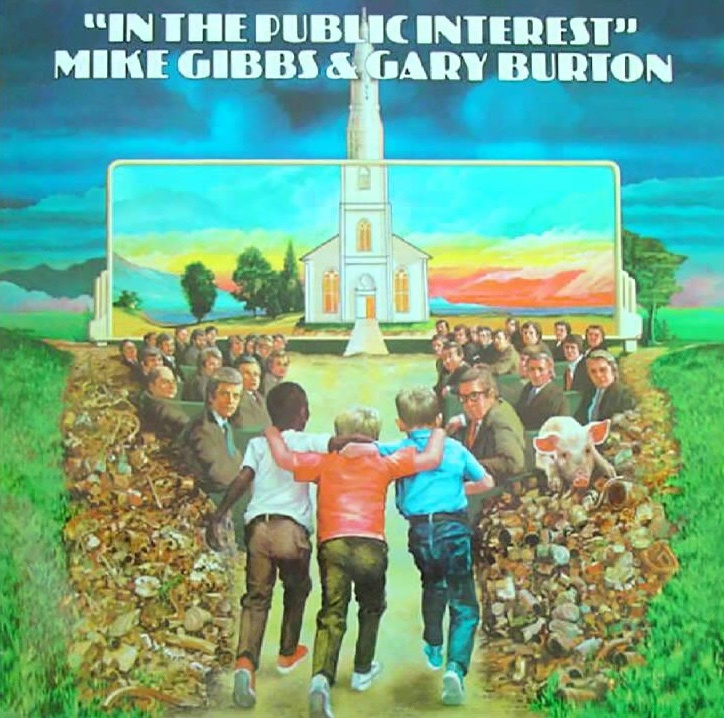
Michael Gibbs composer, arranged, conducted, producer Gary Burton vibraphone, producer Randy Brecker trumpet, flugelhorn Marvin Stamm trumpet, flugelhorn Pat Stout trumpet, flugelhorn Jeff Stout trumpet, flugelhorn Michael Brecker tenor and soprano saxophones Harvey Wainapel alto and soprano saxophones Paul Moen tenor and soprano saxophones, flute Bill Watrous trombone Wayne Andre trombone Paul Falise bass trombone Dave Taylor bass trombone, tuba George Ricci cello (1,2,3) Alan Schulman cello (4,5,6,7) Pat Rebillot electric piano, organ Allan Zavod piano, electric piano Mick Goodrick guitar Steve Swallow bass Warren Smith percussion Harry Blazer drums (1,2,3) Bob Moses drums (4,5,6,7) Recorded at Electric Lady Studios, NY, June 25/26, 1973 Engineer: Dave Palmer Mixed at Tonstudio Bauer, Ludwigsburg, West Germany, August 20/21, 1973 Mixing engineers: Kurt Rapp and Martin Wieland Recording supervisor: Manfred Eicher
It has been well over a year since I’ve had enough time and energy to devote to this site. Now that I am back to posting regularly, in addition to catching up on ECM’s latest releases, I am resuming my quest to review every rarity I can find that may intrigue fans of the label. In that spirit, my readers sometimes do the finding for me, bringing things to my attention that I might otherwise have missed completely. Case in point is this out-of-print gem by way of Detrik, who dropped it in the comments, where it lingered for nine months before I gave it a spin. At last, I can offer my own.
Recorded in the summer of 1973 at Electric Lady Studios in New York and released a year later on Polydor, it bears the fingerprints of contemporaneous ECM productions. Manfred Eicher supervised the recording, which was mixed at Tonstudio Bauer by Kurt Rapp and Martin Wieland, the dream team behind Music From Two Basses. In this session, they render a rounded yet punchy sound.
Written, produced, and conducted by Mike Gibbs, In the Public Interest features a 21-piece band consisting of a robust brass section flanked by such heavyweights as saxophonist Mike Brecker, bassist Steve Swallow, guitarist Mick Goodrick, and drummer Bob Moses.
The A side begins appropriately with “The Start of Something Similar.” As the piano and vibes play in unison, dissonant brass gives rise to the theme before drifting into an atmospheric lull and back again. From this, one might expect a dreamier experience, but with “Four or Less,” it becomes obvious that reality abounds even when the musicians are at their most cerebral. Prominent now is the cello of George Ricci, who puts one rock into this stone soup for every two vegetables floating on top, Goodrick and pianist Allan Zavod stoking the fire until it all boils over in a free-for-all. Next is “Dance: Blue,” where groove is the name of the game. The horns evoke the colors of a 70s TV show (and all the associations that might come to mind with that image). Their carefree, youthful, seamless sound mellows as it goes, building a restrained strength in stretching out the theme.
After such a workout, it’s only fair that we are given a breather as we turn over to the B side, where “To Lady Mac: In Memory” awaits our ears.
A blistering flower of evocation, it features a soprano saxophone fluttering through heat waves of vibraphone on the way to “Family Joy, Oh Boy.” With weighty exuberance, this album highlight spotlights Burton in world-class form, navigating the maze laid out for him so adroitly by Swallow and Moses, who also share a savory dialogue. Lastly, the title tune, with its gentle carpet of vibraphone, electric piano, and cello, and “To Lady Mac: In Sympathy,” with its blushing skin, make for an easy offramp into contemplation.
In the Public Interest is an album of witty contrasts, thoughtful execution, confident melodies, and great charm. Listen to it here:




 Between Sound and Space: ECM Records and Beyond