Benjamin Lackner piano Mathias Eick trumpet Jérôme Regard double bass Manu Katché drums Recorded September 2021 at Studios La Buissonne, Pernes-les-Fontaines Engineer: Gérard de Haro Mastering: Nicolas Baillard Cover photo: Woong Chul An Produced by Manfred Eicher Release date: October 14, 2022
Benjamin Lackner makes a soft yet profound splash on Last Decade, his ECM debut. With Mathias Eick on trumpet, Jérôme Regard on bass, and Manu Katché on drums, the German-American pianist lays the groundwork for a quartet of wide imagination, forging a new relationship that is sure to grow over the next decade.
Lackner’s compositions are fertile ground for his bandmates. “Where Do We Go From Here” plants rows of seeds from the start, watering them in the same breath. Eick’s lyricism is given plenty of breathing room while the rhythm section snakes its way along like a shadow over rock and river. This mood (and mode) will be familiar to many ECM listeners, taking two steps inward for each outward.
But then, something happens as Katché’s groove in “Circular Confidence” opens up a much wider vista. Trading introspection for charity, it imbues Regard’s bassing with a lithe spirit as Lackner flips the landscape like the page of a book to reveal side quests galore. Foremost among them in Eick’s sojourn into distant cities and towns. Rather than bring us souvenirs, he returns with a travelogue. More tractions await in the enigmatically titled “Hung Up On That Ghost,” wherein Katché and Regard tessellate with unforced enchantment. Lackner and Eick give faith to form, the latter’s wordless vocals emblematic of a larger unity at play.
Although Lackner is more accustomed to solo and trio settings, Eick keeps in step as a natural ally. Lifting and lowering throughout “Camino Cielo,” he paints their relationship in streaks of gold and silver, his light as much a partner in the music as what is obscured by proxy. The title track is another collective journey marked by subtly daring harmonies and family memories. So, too, is the closing “My People.” Its staggered 11/4 time signature gives the listener plenty to meditate on.
Between them are three briefer excursions. Whereas “Remember This” is for the trio alone and finds Katché exchanging delicacies, “Open Minds Lost” offers the band’s fullest statement. All that remains is “Émile,” a freely improvised solo from Regard named after his son. Like the album as a whole, it pulls at the threads of life and weaves from them a tapestry of stories to be preserved for those who will outlive us.
Lee Konitz alto and soprano saxophones Bill Frisell guitar Jakob Bro guitar Jason Moran piano Thomas Morgan double bass Andrew Cyrille drums Recorded March 2014 at Avatar Studios, NY Engineer: James A. Farber Mixed August 2024 by Thomas Vang (engineer) and Jakob Bro at The Village Recording Studio, Copenhagen Cover design: Sascha Kleis Album produced by Manfred Eicher Release date: November 29, 2024
When I put this album into my computer, iTunes mistakenly named it “Exuding.” Then again, maybe the algorithm was trying to tell me something. As introspective as the music of Jakob Bro is often thought to be, it also chambers a creative fire that indeed exudes waves of inspiration. In this Copenhagen session, recorded in 2014 but given to the world a decade later, we encounter Bro in a mode of fearless exploration whereby coal is compressed into raw diamonds. Joining him are guitarist Bill Frisell, pianist Jason Moran, bassist Thomas Morgan, and drummer Andrew Cyrille.
At this point, except for Moran, Bro had shared a stage and/or studio with all the musicians gathered here. For example, his association with Lee Konitz goes back to 2008, when Paul Motian recommended that the two collaborate. And yet, as most under-the-skin jazz usually does, the all-original set glistens with the first-time-ness of its possibilities, especially given its delayed release.
From the initial stirrings of “Black Is All Colors At Once,” it’s obvious that the notion of taking turns is subjective and at the whim of every moment. Its airy yet substantial sound takes an inch of history and gives a pound of cure, hiding its soul in places light cannot reach. If Konitz is a voice to be heard here, how much more so in his rare turn on soprano in “Haiti.” Alongside Cyrille’s cinematic cymbals and Bro and Frisell’s dialogism, there’s plenty of sun to go around.
“Milford Sound” is the band’s dreamiest calling card. The title, which references both Milford Graves and a fjord in New Zealand’s South Island, proves a revelatory beacon for Moran, who finds his stride band like a sole to its shoe. The unforced language of the guitars questions as much as it answers, Morgan and Cyrille trading periods and commas with perfect fluency all the while. Other reference points include New York’s Chinatown in “Pearl River” and memories of Argentina in “Mar Del Plata.”
The music also invites us to make our own associations. When listening to “Aarhus,” for example, I cannot help but remember my time in the city’s ARoS art museum. One note, and I am back strolling through its rainbow-colored rotunda, starting in the deepest reds and working toward indigo. Meanwhile, “Peninsula” suggests the liminal geographies that so often attract me, eschewing groove in favor of what speaks clearly enough through flow and circumstance.
These are travelers who have circled the world (and then some) whose paths have not only crossed here but become one for a while. How privileged that we should be invited to join them on this leg of the journey.
Kjiv Chamber Choir Mykola Hobdych conductor Recorded 2016 St. Michael’s Cathedral, Kjiv Engineer: Andrij Mokrystkij Cover photo: private collection Recording produced by Kjiv Choir Productions Release date: September 30, 2022
At the core of German existentialist Martin Heidegger’s philosophy was a concept he called “thrownness” (Geworfenheit). Although he meant it to express the uncontrollable immanence of being born into a specific time and place, it has since taken on connotations of suffering and hardship, without which life would never be defined. On Maidan, Valentin Silvestrov’s third all-choral program for ECM New Series, we witness the composer thrown from his private spiritual light into secular shadow.
Sung once again by the Kjiv Chamber Choir under the conduction of Mykola Hobdych, Silvestrov’s writing takes on a political layer he never wished it to have. The title refers to the “Euromaidan,” or the “Revolution of Dignity,” as it is known in Ukraine, signaling the government’s refusal to associate itself with the European Union in 2014 and a precursor to Russia’s invasion on February 24, 2022. Witnessing these events unfold, Silvestrov, then 84, took solace in song. With the alarm bells of St. Michael’s Cathedral sounding a rare alarm in the background, he reclothed the naked body of nationalism with verses from Ukrainian poet Taras Shevchenko (1814-1861) and liturgical texts.
The album’s bulk is reserved for Maidan 2014, a “cycle of cycles,” which melts the words of the Ukrainian national anthem (penned by Pavlo Chubynsky) into five different molds. Its opening proclamation—“Ukraine’s freedom has not yet perished, nor has her glory…”—takes on more of its intended meaning than ever, crying in the wilderness against the onslaught of a regime surrounding itself in self-fulfilling icons.
In response to such inflations of power, much of what fleshes out the remaining spaces is scriptural in origin. “Give Rest, O Christ, to Thy Servants,” for example, speaks with the voice of the Savior on the cross, who forgave his enemies as he died by their hand. We feel surrounded by the spears of those who would deem him a blasphemer and usurper of authority. Individual singers and choir mirror this dynamic, balancing the alto-led vigil of “The Lord’s Prayer” with the Belarusian folk song-inspired “Lullaby.” These embody the same contradiction of “Lacrimosa,” which awaits a blessed hope in the thorns of a world without it. Like the soloist in “Holy God,” giving praise, honor, and glory to the one on high, they understand that no evil can ultimately overcome the power of faith. Even the wordless “Elegy” makes its deference palpable.
Few composers articulate silence with sound (and vice versa) like Silvestrov, as demonstrated by three collections from 2014 (Four Songs), 2015 (Triptych), and 2016 (Diptych). These settings of Shevchenko range from robust (“The Might Dnieper”) and reproachful (“Come to Your Senses”) to fable-like (“A Cherry Orchard by the House”) and altruistic (“To Little Mariana”), reaching their darkest resignations in “My Testament,” in which the narrator requests, “When I am dead, bury me / In my beloved Ukraine.” Thus, the music suggests that wickedness in high places is truer than we care to admit.
Since Silvestrov now sees the world as Maidan, releasing this music to a wider audience feels appropriate. No longer is it chained to the narrow vision of a particular historical moment but rather the delicate swan song of something dying in all of us lest we fail to have room for hope when the chance arises. “After all,” he says, “the louder the mortars and canons roar, the softer the music becomes.” Therefore, his goal is not to evoke the chaos of war; he is a shield for peace, standing his ground in its storm.
Tomasz Stanko trumpet Marcin Wasilewski piano Slawomir Kurkiewicz double bass Michal Miskiewicz drums Concert recording, September 9, 2004 at Muffathalle, Munich Mixing: Manfred Eicher, Marcin Wasilewski, and Stefano Amerio (engineer)At Bavaria Musikstudios, Munich Cover photo: Caterina Di Perri Produced by Manfred Eicher Release date: June 21, 2024
Recorded on September 9, 2004, at Munich’s Muffathalle, this surprise from the archives reveals as much about the late trumpeter Tomasz Stanko as it obscures. The live session finds him in the company of pianist Marcin Wasilewski, bassist Slawomir Kurkiewicz, and drummer Michal Miskiewicz, the trio with whom he shared stages from 1993 to 2017. “We were growing by his side, and he was watching us,” Wasilewski recalls about working with the man who was their mentor in every sense. “Every concert we played with him was important—the most important, almost as if it was the last one. That’s the approach he taught us: ‘When you play music, play it at a thousand percent!’” One hears that ethos revived throughout September Night, making it a vital document that deserves to wrap its arms around the shoulders of Suspended Night and Lontano, where it chronologically lands between.
I will never forget seeing Stanko with his New York Quartet in 2013. I still get whiffs of that octane now and then in the brain. But listening to “Hermento’s Mood,” which opens this all-original set, I am reminded of the ethereality he was uniquely capable of—a continuation of the song he held inside. Like “Elegant Piece” later in the show, it’s a flower that blooms only in moonlight.
Stanko’s ability to jump from exuberance to the depths of the soul never ceased to amaze. “Song For Sarah” is a prime example, just as comfortable grazing the bottom of the ocean in search of treasures long forgotten (of which this recording is one) as “Celina” is at home throwing its slow-motion strike across the proverbial plate. Even the freely improvised “Kaetano” cannot help but flirt with contradiction, shifting from urban meandering to a scenic train ride conducted by the rhythm section and exposited by Wasilewski.
Lest we forget the brilliance of Stanko’s backing band and the enmeshment of which they continue to be humble champions, we need only point to “Euforila” as a beacon of their craft. Opening with a lacy bass solo, it finds the band doing what it does best: knitting itself together while allowing plenty of open space between every instrument. As a determined body of water, they work around everything in their way without skipping a beat. Wasileswki is bright and joyful, while Stanko’s delicate punch of a solo is hot to the touch. Yet nothing can stop Miskiewicz from making the biggest waves below, crashing and roaring into the conclusion. Contrasting this is the closing “Theatrical,” which casts its ring into the fires of Mordor and walks away unscathed.
Incidentally, this concert was part of the “Unforeseen” symposium, co-curated by Munich’s Kulturreferat and the musicology department of the Ludwig Maximillian University, a week-long event that yielded two further ECM live albums: Evan Parker’s Boustrophedon and Roscoe Mitchell’s Composition/Improvisation Nos. 1, 2 & 3. If such companions feel radically different, it’s because freedom assumes a bespoke form here. Whereas Parker leaps skyward and Mitchell digs into the earth, Stanko is most comfortable riding that indefinable horizon between them.
Gianluigi Trovesi piccolo clarinet, alto clarinet, alto Saxophone Stefano Montanari concertmaster Stefano Rossi second violin Claudio Andriani viola Francesco Galligioni violoncello Luca Bandini double bass Emiliano Rodolfi oboe Pryska Comploi second oboe Alberto Guerra bassoon, dulciana Riccardo Balbinutti percussion Ivano Zanenghi archlute Valeria Montanari harpsichord Fulvio Maras percussion, electronics Recorded January 2014 at Sala musicale giardino, Cremona Engineer: Roberto Chinellato Mixed September 2021 at Artesuono Studio, Udine by Gianluigi Trovesi, Stefano Montanari, Guido Gorna, and Stefano Amerio (engineer) Cover photo: Luciano Rossetti An ECM Production Release date: February 24, 2023
Italian reed virtuoso Gianluigi Trovesi and baroque violinist Stefano Montanari (doubling here as concertmaster) lead an ensemble of period instruments for a fresh take on the music of the 15th through 17th centuries. Meshing melodies from towering figures of the Renaissance and Baroque with equally visionary interpretations, the program manages to carve new initials into old pillars without marring their beauty. Some new compositions by Trovesi, plus a couple of improvisations with Fulvio Maras (percussion, electronics), complete the mix.
The album’s title, which translates as “consonant extravagances,” offers an accurate description of what is happening sonically, creatively, and even spiritually. “The Witches’ Dance” (from Henry Purcell’s opera Dido and Aeneas) leads off on a courtly foot. Purcell makes a handful of appearances throughout, most gorgeously as a motivic inspiration for Trovesi’s “For a While.” Like all of his pieces, it benefits from the robustness of Corrado Guarino’s arrangements, which take advantage of the period instrument ensemble under Montanari’s charge. The latter brings the crispness of strings to “Consonanze stravaganti” by Giovanni Maria Trabaci (an influence on Girolamo Frescobaldi), Guillaume Dufay’s Missa L’homme armé, and a sonata by Giovanni Battista Buonamente. Whether threading his alto through Andrea Falconieri’s “La suave melodia” or revealing his compositional wonders in “L’ometto disarmato” and the alto clarinet jaunt of “Bergheim,” Trovesi is a force of nature shapeshifting between song and cry on the turn of a dime. If the past is alive in his sound, then so is the future.
(This review originally appeared in the January 2024 edition of The New York City Jazz Record, a full PDF of which is available here.)
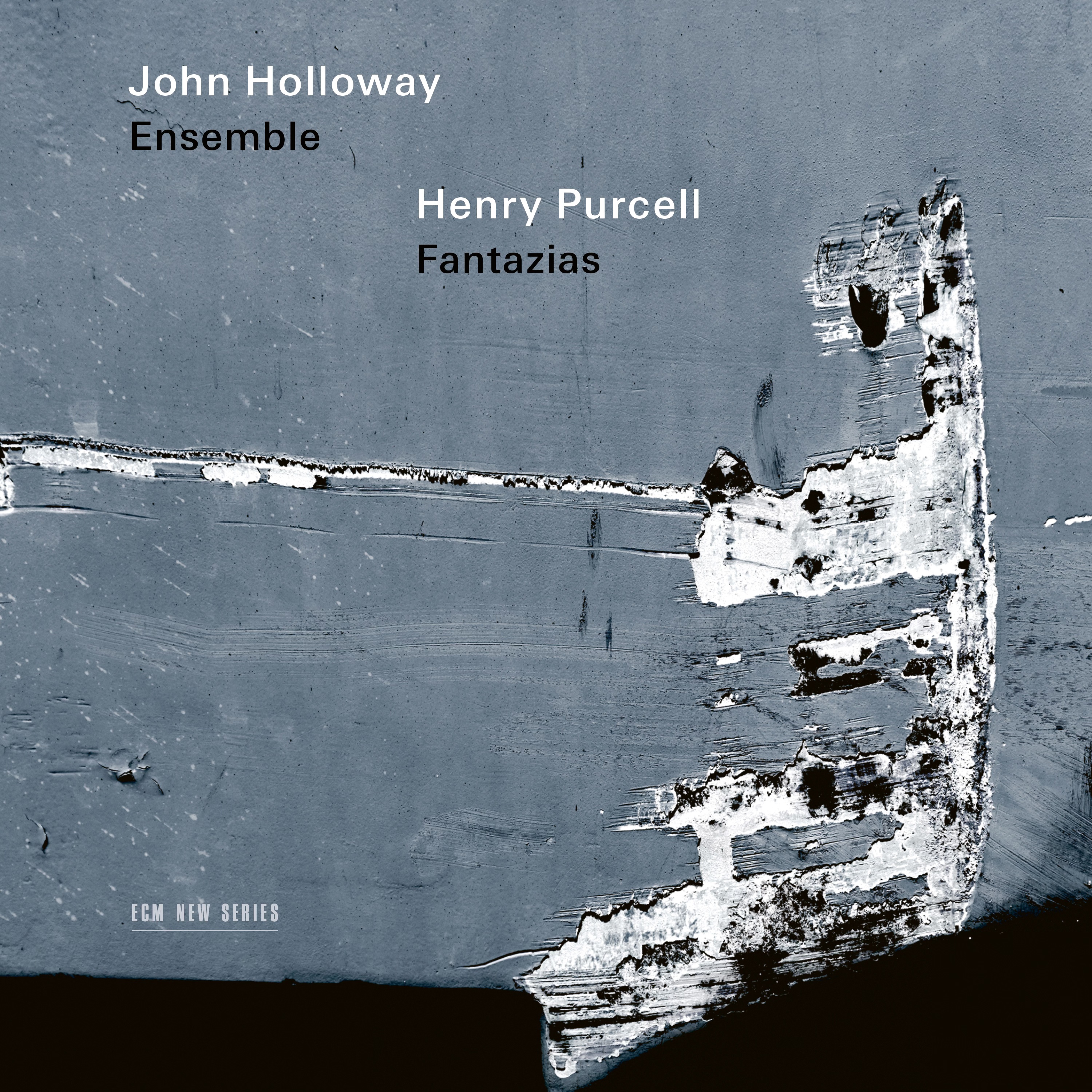
John Holloway violin Monika Beer viola Renate Steinmann viola Martin Zeller violoncello Recorded March 2015 at Radiostudio DRS, Zürich Engineer: Stephan Schellmann Cover photo: Thomas Wunsch Produced by Manfred Eicher An ECM/SRF2 Kultur coproduction Executive producer (SRF): Roland Wächter Release date: September 22, 2023
Henry Purcell (1659-1695), best known for his operas, was no less a formidable composer of instrumental music. His Fantazias are the pinnacle of the form, rich in their intermingling of counterpoint and polyphony. By the time Purcell put these to paper in 1680, the fantasia was over a century old. Despite being honed into a science by such estimable predecessors as William Byrd, William Lawes, John Jenkins, and Matthew Locke (whom Purcell replaced as “composer in ordinary with fee for the violin to his Majesty,” Charles II), it had fallen out of favor. Violinist John Holloway calls the present collection “a personal farewell to a kind of music, which in Purcell’s own chamber music would soon be superseded by sonatas.”
Leading an ensemble that includes violists Monika Beer and Renate Steinmann and cellist Martin Zeller, Holloway regards these 12 gems through a jeweler’s glass, cherishing every occlusion as a testament to its crafting through time. We encounter them here out of sequence, beginning with the river’s flow of No. 10. The sound is both creamy and metallic, sometimes allowing dreams to peek above the surface while at others pushing them into the mysteries of the current. Like No. 4, it affords a special sort of grace, pivoting from a seamless introduction into an intricate unfolding without changing skins. The ensemble matches with a palette that is equal parts shimmer and shadow.
Indeed, while these strings owe much of their grace to the composing, one cannot discount the players’ lifeblood. Like actors in a stage play, they embody these “characters” from within. In No. 6, for instance, Holloway’s violin laments like an agent of mourning while the others cross-hatch that inward focus with extroverted streaks of illumination. This dynamic reverses as the urgency heightens, and Holloway grabs hold of the future while the lower strings keep vigil to avoid forgetting the past. No. 9 is its companion in spirit: Even when it dances, it casts hedonism into the fire. Nos. 7 and 8 are equally wondrous in their contrasts, and their slips into dissonance reveal an improvisatory heritage, making them feel spontaneous, raw, and passionate.
In his liner notes, Holloway says, regarding the English composer’s handling of the form, that Johann Sebastian Bach “would certainly have acknowledged it as equal to his finest achievements in this art.” This is perhaps nowhere more obvious than in No. 5, the knotwork of which immediately suggests The Art of Fugue. Sitting on its right hand and left are Nos. 11 and 12. As translucent as they are viscous, they constitute a trinity of resolution that begs for more yet offers salvation only through silence.
While the above pieces are in four parts, Nos. 1-3 are in three. More intimate in form but no less expansive in scope, each is a dip into the heart of a creator whose font ran dry too soon.
Robert Levin fortepiano Recorded February 2017 and Feburary 2018 Großer Saal, Salzburg Mozarteum Foundation Engineer: Markus Heiland Cover: Fidel Sclavo Produced by Manfred Eicher Release date: September 16, 2022
Wolfgang Amadeus Mozart (1756-1791) is as much an enigma as an indelible emblem of what it means to be “classical.” In this seven-disc boxed set, a monumental achievement dedicated to one whose own achievements were nothing less than monumental, pianist Robert Levin offers a conspectus of the piano sonatas on the very fortepiano Mozart played from 1785 until his death and on which he composed The Magic Flute and his Requiem. Built by Anton Gabriel Walter in 1782, it speaks as one traveling out of time with a message of space.
Like much of Mozart’s writing, the music in these sonatas resulted from improvisations he later noted from memory—a spirit that Levin captures with charming honesty. The pianist’s historically informed approach heightens this effect, seeking to, in his own words, “revive a documented tradition” of embellishing repeats that goes back to C.P.E. Bach, whom Mozart greatly admired. Despite a fixed tripartite architecture across the board, there is great variation in mood, scope, and difficulty.
While Mozart is often cast as a poster child of vivaciousness, each sonata is best savored for its rich, sweet center. In these slower movements, genius bobs above and below the surface of a mind whose depths we can only begin to comprehend. We get a hint of this already in the Sonata No. 1 in C major, of which the Andante, nestled in neo-Baroque surroundings, is the music box of a childhood we’ve long forgotten.
Should that metaphor hint at immaturity, let such an illusion be shattered by a vision of the prodigy it manifests and which steps boldly into the foreground in the Sonata No. 2 in F major, cradling an Adagio that is the sonic equivalent of a precious stone. Even the Sonata No. 3 in B-flat major, with its lockstep opener and one-two punch of a conclusion, cannot steal the quiet thunder of the central movement between them. Such controlled ferocity must have been obvious to the composer himself when beginning his Piano Sonata No. 4 in E-flat major with an Adagio, pointing to the influence of Joseph Haydn, whose own sonatas he had then recently discovered.
Over the next four sonatas, expositions of stateliness and pastoralism bow to the dynamic brilliance of the Sonata No. 6. This D-major triptych is a stage drama in concentrated form, culminating in the final theme and variations. Spanning 15 minutes, they comprise the collection’s longest stretch, suggesting an orchestral sensibility.
This brings us to the pinnacle of Mozart’s engagement with the form: the Sonata No. 9 in A minor. Written in 1778, soon after the death of his mother, Anna Maria, its first movement sits on the throne of the collection. Morphing from extroversion to introversion and back again, its changes nourish Levin’s insights as a performer. The Andante here is the most holistic. Bursting into moments of passion but always returning to baseline, it sets up the concluding Presto and leaves us where we started: in wondrous anticipation. Along with its younger sibling, the Sonata No. 10 in C major, this is the form perfected.
Even “greatest hits,” including the Sonata No. 11 in A major, reemerge as hidden gems. The universally known Alla Turca lends itself to listening without prejudice, the familiar becoming new under Levin’s fingertips. Whether in the famous Allegretto grazioso of the Sonata No. 13 in B-flat major or the opening of the Sonata No. 16 in C major, Levin goes straight to the heart of these pieces so that we can feel them on their terms again.
The Adagio of the Sonata No. 12 in F major is a revelation, as is the Fantasia in C minor. Both soar in the present recording. The Sonata No. 18 in D major is among the shortest of the set, nevertheless a depth charge in its own right. The closing Allegretto is especially savory, and Levin handles it as an organic farmer would his finest crop.
Sprinkled throughout are unfinished sonata fragments newly completed by Levin and informed by his scholarly and creative approach to idiom. The sonata movement in C major is a pluralistic wonder. Another in B-flat major reveals a shimmering and ambitious architecture, while the last in G minor proceeds boldly from impressionism to realism. All three are a testament to what makes Mozart so comforting—namely, that he always has the destination in mind before his first step hits the ground.
What a gift for the seasoned and unseasoned alike, as fresh as the day it leaped forth from the soul of a life that, though cut short, was destined to resonate for all ages.
I appreciate your patience as I navigate some life changes (some negative, ultimately positive), which have taken much of my time away from listening and reviewing. I do hope to return to the ECM fold soon enough, as the universe allows.
Those who’ve been following me for a while may know I’ve been known to moonlight as an academic, and my latest book is a testament to all the hard work that went into earning my Ph.D. Here is the cover, and a description, for those interested:
In Fuzzy Traumas, Tyran Grillo critically examines the portrayal of companion animals in Japanese literature in the wake of the 1990s “pet boom.” Blurring the binary between human and nonhuman, Grillo draws on Japanese science fiction, horror, guide-dog stories, and a notorious essay on euthanasia, treating each work as a case study of human-animal relationships gone somehow awry. He makes an unprecedented case for Japan’s pet boom and how the country’s sudden interest in companion animals points to watershed examples of “productive errors” that provide necessary catalysts for change.
Examining symbiotic concepts of “humanity” and “animality,” Grillo challenges negative views of anthropomorphism as something unethical, redefining it as a necessary rupture in, not a bandage on, the thick skin of the human ego. Fuzzy Traumas concludes by introducing the paradigm shift of “postanimalism” as a detour from the current traffic jam of animal-centered philosophies, arguing that humanity cannot move past anthropocentricism until we reflect honestly on what it means for the human condition.
In his 1969 novella, Il castello dei destini incrociati (The Castle of Crossed Destinies), Italo Calvino presents a series of vignettes introduced by a nameless narrator who finds himself, after trials and tribulations, at the titular castle, which upon entering he realizes is a meeting place for wayward souls. Inside, a congregation sits around a table. Bound by a mysterious silence and with only a tarot deck at their disposal, these disembodied travelers proceed to lay down series of cards by means of which the protagonist interprets the life story of each. When at last comes time for Calvino’s alter-ego to tell his own story, he does so in a testimony concerned with space and time. He waxes expertly about mid-Renaissance hagiography, particularly St. Augustine in His Study. Painted in 1502 by Vittore Carpaccio, it depicts Augustine’s vision of St. Jerome:
“Also in the study where there reigns meditative serenity, concentration, ease,” our guide continues, “a high-tension current passes: the scattered books left open turn their pages on their own, the hanging sphere sways, the light falls obliquely through the window, the dog raises his nose. Within the interior space there hovers the announcement of an earthquake: the harmonious intellectual geometry grazes the borderline of paranoid obsession. Or is it the explosions outside that shake the windows? As only the city gives a meaning to the bleak landscape of the hermit, so the study, with its silence and its order, is simply the place where the oscillations of the seismographs are recorded.”
Calvino sets up a symbiotic relationship between what is visible and invisible in the painting through the final sentence quoted above. To make sense of it, one must be in two places at once. Both city and study are inhabitable manifestations of knowledge. The study is a storehouse of thought, a worldly archive in which the prominent thinker is but one of many animate tools. Whether the earthquake is imagined or actual, it is a failure of structural integrity, collapsing time into a measurable event.
Vittore Carpaccio, St. Augustine in His Study (1502)
The painting’s special affordance points to what Giorgio Agamben, lifting from Martin Heidegger, calls being “open to a closedness”—which is to say, knowing one’s finitude. Agamben frames this attainment of self-awareness not as something to which our species accedes but from which we distance ourselves. Where does that leave the artist? As Calvino avers, “the job of writing makes individual lives uniform”—another piece of bark to chew on.
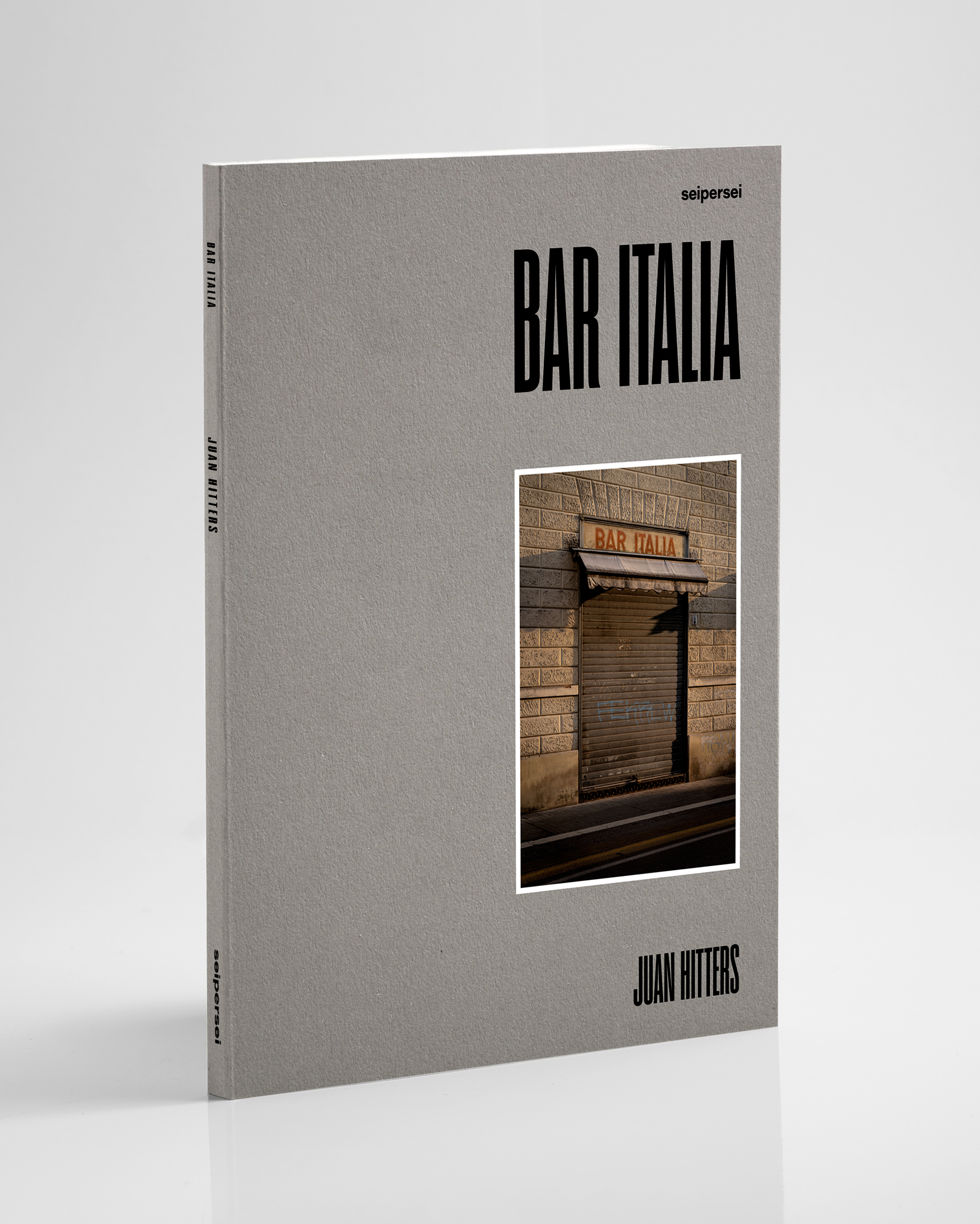
I stay with Calvino a bit longer, if only because in the same chunk of text he establishes the intellectual wager echoed throughout Bar Italia, the first monograph from Argentine-born photographer Juan Hitters. Calvino’s interest in the earthquake, an upsetting of the scene’s “harmonious intellectual geometry,” informs my approach as a viewer. When he wonders, for instance, “Or is it the explosions outside that shake the windows?” Calvino is questioning the very apparatuses of interpretation by bringing out the pulse of a nominally static scene. And just as his narrator can only infer the full story from selected images, we are left with a photographic trail of breadcrumbs that quietly acknowledges its own closedness. Any subsequent embellishment is our own.
Is the camera that much different from the animal sitting stage right in Carpaccio’s painting, taking it all in emotionlessly yet with such grace as to render any reaction other than faith incomplete? Resting on an ever-present tripod to capture as much resolution as possible, and like the mind activating the shutter behind it in moments of captivation, Hitters’ instrument exists not to praise the wonders of the self but to show us the world by way of it. As for what that world contains, one need only flip to any page as one might spin a globe to land their finger on a land mass of interest. In the case of Bar Italia, that land mass is Emilia-Romagna, specifically the lesser-explored areas around its capital city of Bologna, which he has called home for the past four years.
“What I’m trying to convey are experiences,” he tells me over Zoom. “Finding myself as I do in a new place, I have to inhabit it. Inhabiting is a very active process of understanding the logic behind a place, making yourself known to a small group of people so that you can smile at them every morning and vice versa. Adaptation is crucial. It is how you accept your surroundings and affect them. This book shows an active way of inhabiting this new land, where I felt completely at home from the very beginning.”
Taking the train almost daily to explore nearby towns, Hitters expanded his cartographic reach, the lens always in tow. Along the way, home became about more than finding himself enamored with quotidian comforts. It was something ineffable in the air, a spirit that welcomed rather than rejected this new pair of lungs sharing its breathing space. Having tapped the heart within, he wanted to know more about the veins and arteries feeding it from without. Settling in also gave him a sense of safety:
“Italy reminded me so much of my childhood. I felt myself going back in time, visiting the old Argentina. Living in a huge city like Buenos Aires, one learns to be alert. But in Bologna, a much smaller city, it’s easy to walk around, which helps me enjoy this process.”
It may be no coincidence that one can always feel Hitters standing somehow in every scene he photographs, not only because his fingertip activates the shutter but also because his mere presence gives the light undeniable quality. On that note, he was struck by the region’s many porticoes, where the sun produced a “magical chiaroscuro” amid variations of reds and yellows. Even then, the immediately discernible magic of this interplay was only the beginning of his testimony, every bit as hidden as Carpaccio’s:
“Photography is all about light. I use reality as an excuse to photograph light. Light doesn’t exist in itself; it has to be enveloping a three-dimensional piece of matter to be noticed.”
This insight echoes the introductory essay by Alessandro Curti, who speaks of the “intricate anthropological interconnection” found in this work that “allows us to get in touch with his soul and experience an unusual Italy.” The operative word here is “unusual.” In fact, the Old French root word usuel means “current.” Thus, unusual denotes “not current”—which is to say, out of time.
And while we may muse poetically about the origins of light, it touches things with an undeniable materiality. In the context of Bar Italia, said materiality splashes itself across dilapidating walls, obscured windows, cobblestone alleyways, and the soft song of afternoon transitions. Did I say song? Indeed, because the book is as much about sound as light. This is to be expected, given that Hitters has contributed to album covers for ECM Records and Deutsche Grammophon, among other legendary music labels: “The way light works on these surfaces is poetry, just as sheer sound is poetry for John Cage. If sound is light, then shadow is silence. Bar Italia is my first album, in the musical sense.”
Like any great piece of music, there are shifts in mood and focus. And just as the same musical score will sound different at the hands of every individual musician, so do these places echo with the gaze put upon them. Their symphony of cloth, textures, doorways, walls, and covered vehicles is the product of meticulously curated sequencing, arrangement, printing, paper selection, and file optimization. Even its color scheme—which opens with warm overtures, followed by a slow movement of cooler spectrums, and ends in near-black and white—suggests a concerto. Calvino’s earthquake has now become a quickening heartbeat born of discovery.
One cannot help but notice, too, the orientation of it all:
“I have discovered that vertical is an extremely arbitrary format that helps me make very tight compositions. We are getting rid of this big problem of the horizon. I always compose during the photo shoot, without cropping. I think this way of seeing is what impressed the editor Stefano Vigni from Seipersei Edizioni, who liked the severe presentation of elements.”
In her foreword for the book, Luz Hitters talks about her father’s work in likeminded terms: “Harsh frames, somehow unforgiving, yet holding within them a compassionate gaze that unveils an improbable beauty.” This embrace of starkness lends the work a sense of integrity into which we are never intruders but rather co-observers. Just as Hitters lends himself to every scene, so are we invited to do the same…
In accepting that invitation, three moments stand out for their stoicism.
First is this image of an unoccupied seat:
Something about the sheer vacancy of its framing fills me with a sense of longing, motivated by no other desire than to be there if only to exist somewhere far removed. The composition speaks of a fascination with monochromatic color palettes, demonstrating how forthright Hitters is in showing things as they are: “It has to do with degradation, the discourse of what nature does to things over time. The more abstract it is, the more real it is. I am happy to tell small stories.” While these stories may be small, their impacts may live grandly in our minds.
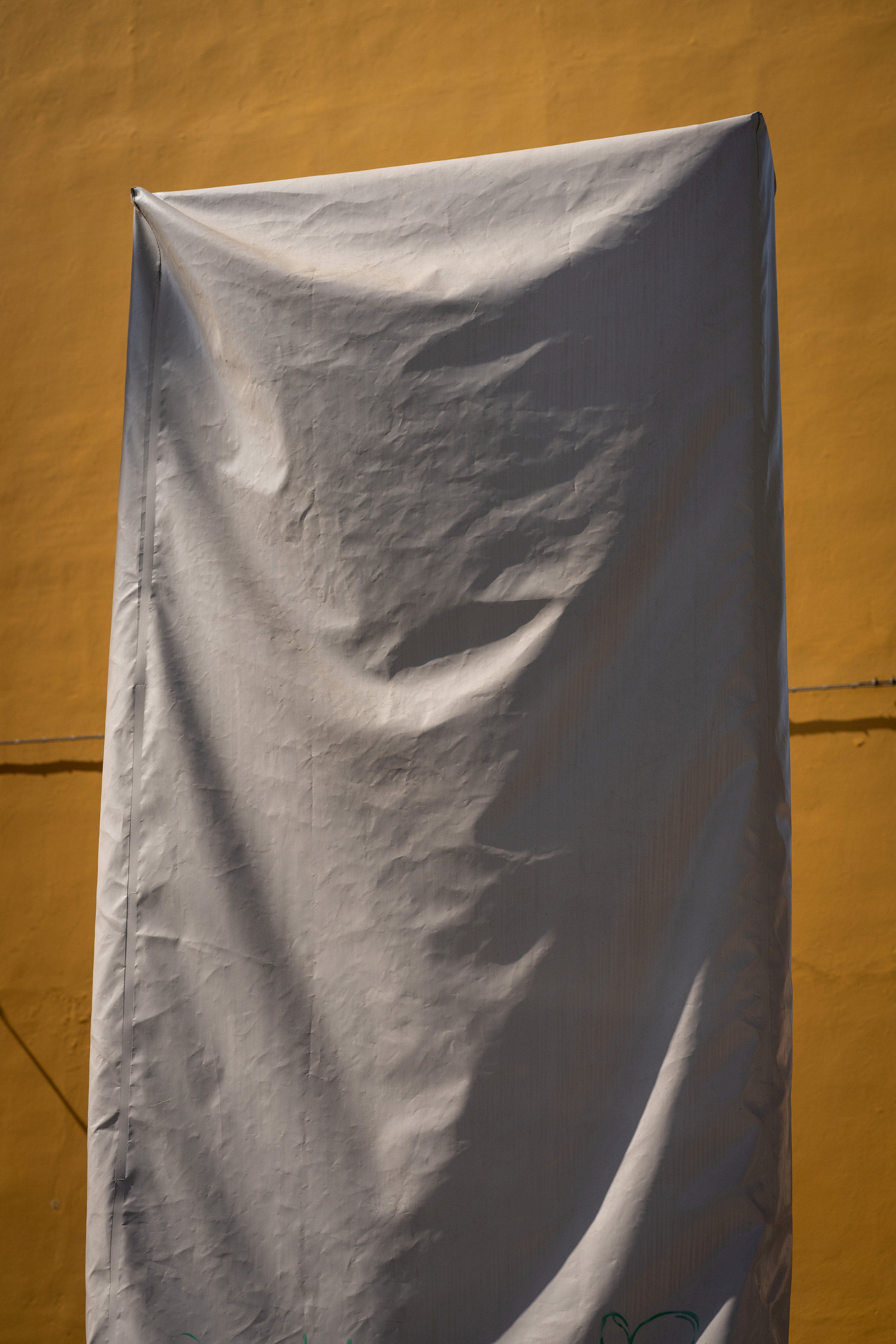
Second is the recurring theme of drapes, of which the following instance is a quintessential one for me:
For while we cannot see what is behind the curtain, we see everything we need to see. It is explicit in its obscurity, a portal only the imagination can open. I ask Hitters what attracts him to this motif. His response:
“I like the suggestive nature of never telling something directly. I am always looking for mystery. These drapes provide that idea. It’s the same with the doors that take you to strange settings you don’t know. I have no ethical problems with those who manufacture a certain reality (Gregory Crewdson, David LaChapelle, Marcos López), but being a photographer, it’s difficult for me not to see all the setup. I prefer to make the photos as direct as possible. Oscar Pintor, Humberto Rivas, William Eggleston, Luigi Ghirri, and Stephen Shore are more my cup of tea.”
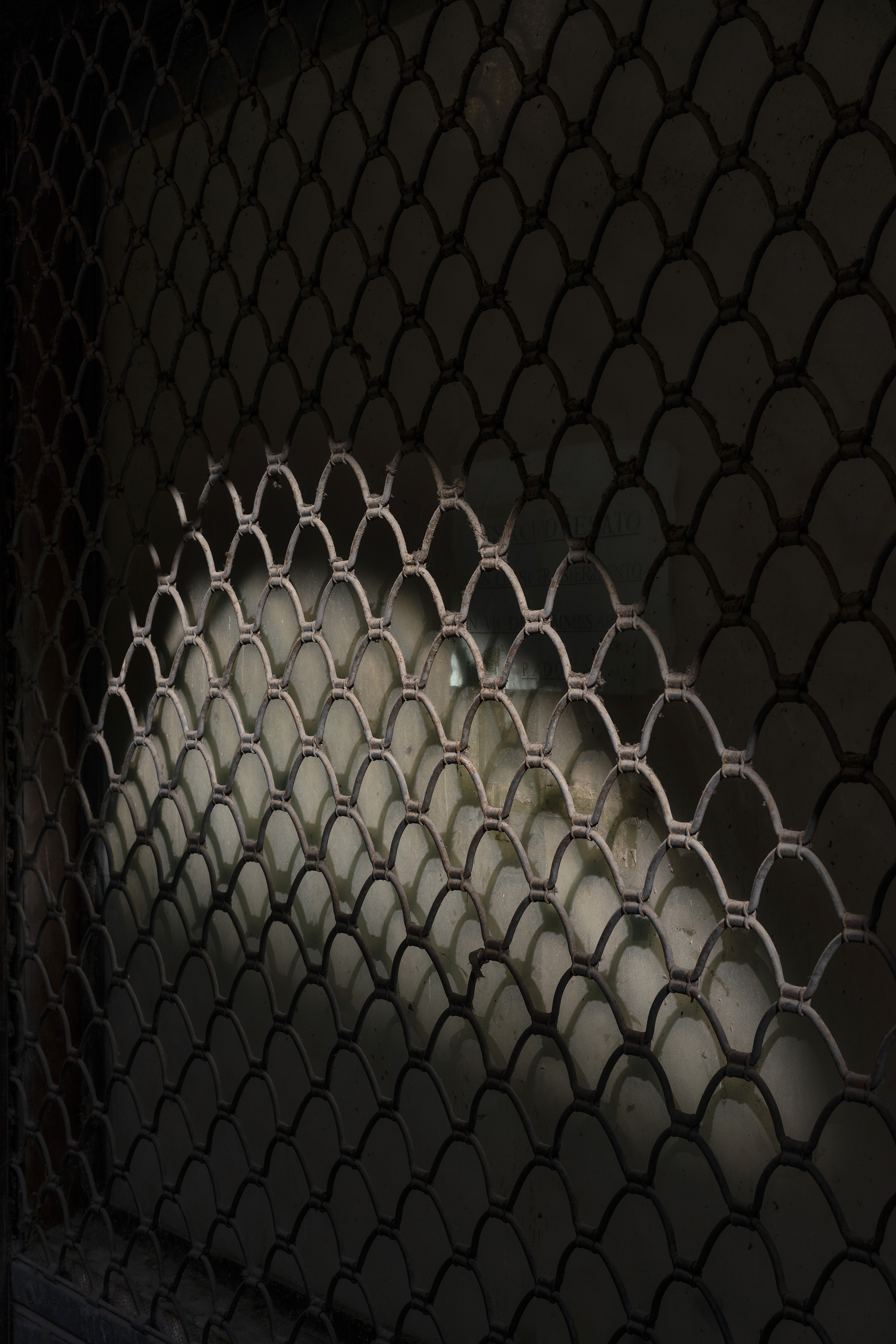
Third is the book’s final photo, which lends a hopeful air:
Here, the shadows aren’t so much silent as accompaniment to the light’s slow cadenza, working its way along every curve of metal fashioned in the image of security. So is it that he has come to see his own life.
And what of the book’s title?
“Every city in Italy has a Bar Italia. It’s something of a national cliché. The name has a strong relationship with pleasure and ordinary things that I find attractive. These are simple things—not beautiful, per se—but the way the sun hits them is special. Stefano and I didn’t want to make it romantic because many photographers have fallen into the Italy of the 50s and 60s, whereas we wanted to distance ourselves from that banality—which isn’t easy since Italy is so beautiful.”
Even so, Hitters has shown us there is beauty in the banal. Or maybe it’s because he has lost none of his passion for photography over a decades-long career. “I always pick up my camera with a smile,” he admits, also with a smile. In these photos, however, that smile often feels bittersweet, mourning a world ignoring the beauty of decay in favor of a streamlined here and now. In gifting us these slices of color, he opens a path forward because, ultimately, light is about time. It clutches our paltry chronologies like a handkerchief, wiping away tears over transient things, forever moving until it finds another place to land that we might never see with the naked eye.
Bar Italia is available in a beautifully printed edition from Seipersei Edizioni here. You may also purchase copies directly from Hitters by contacting him via his website or Instagram. The level of detail in this production, from the 150-gram GardaPat KLASSICA pages to the Fedrigoni Materica Clay cardstock binding that surrounds them, makes it worthy of the most discerning art enthusiasts. Stefano Vigni and the Seipersei team have handcrafted a unique work of art unto itself that belongs in your collection.
Juan Hitters signing copies of Bar Italia at the Fotografia Europea Festival, Reggio Emilia, April 28, 2024. (Photo credit: Luz Hitters)









 Between Sound and Space: ECM Records and Beyond