Danish String Quartet: PRISM III (ECM New Series 2563)

Danish String Quartet
PRISM III

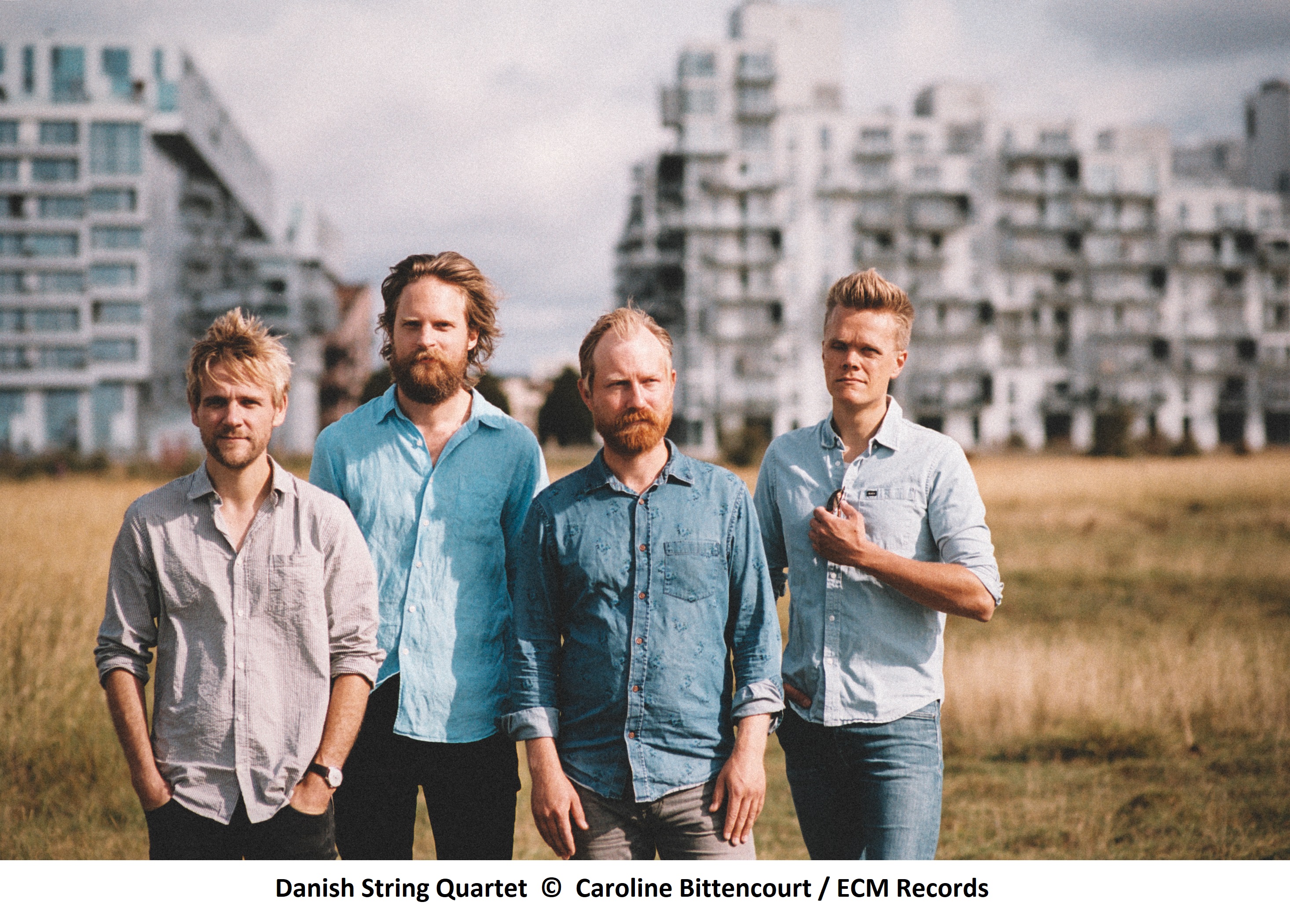
Danish String Quartet
Frederik Øland violin
Rune Tonsgaard Sørensen violin
Asbjørn Nørgaard viola
Fredrik Schøyen Sjölin violoncello
Recorded November 2017, Reitstadel Neumarkt
Engineer: Markus Heiland
Cover: Eberhard Ross
Produced by Manfred Eicher
Release date: March 12, 2021

Ludwig van Beethoven’s five late quartets must be reckoned with. In the words of the Danish String Quartet, presenting the String Quartet No. 14 in C-sharp minor of 1826, they “changed the game.” In saying as much, we might very well ask ourselves: What was the game to begin with? How far back does it go? With whom did it start? Augmenting the famous profession that “all roads lead back to Bach,” this recording charts as many paths forward as it does retrospectively. As for the game itself, we can say that it involves not only musical idioms but also hints of visual art, literature, religion, war, migration, and, dare I say, hope.

To know Beethoven’s Op. 131 is to take a full view of humanity, with all its triumphs and tragedies. The opening Adagio, the first of seven movements, spins fibers of tenderness into a muscle that flexes in tune with emotional suspensions, thus emphasizing the DSQ’s fitness as much as the composer’s. The Allegro that follows surprises with dance-like energies but may just as easily be interpreted as a coping mechanism against the grief that preceded it. Its extroversions are deeply entwined with introversion. Other movements, like the lively Presto, share their secrets more openly, taking on a litheness of clarity rarely heard in other renditions. The closing Allegro wears its heart on its sleeve just as securely, emboldening (not flaunting) its awareness as a modus operandi of exposition. But it’s in the gargantuan fourth movement, a nearly 15-minute Andante, where most of this vessel’s cargo is tallied in its keep. What begins as a spider’s thread of narrative sweetness morphs, as if in answer to the subtle insistence of the cello’s pizzicato, into a fog of impressions that resolves itself into a dew of urgent memories. All the more fitting that this quartet was never performed in the composer’s lifetime. For while its mixed receptions have morphed into high regard, the music reminds us of the necessarily contrasting organs in its body. As these meticulous musicians remind us, none will function on its own but only when connected to the larger whole.
For his String Quartet No. 1, op. 7, Sz. 40 (1909), Béla Bartók took inspiration from Beethoven’s opus 131. Both open in lament. That said, Bartók evokes a distinct shade of darkness made modern not only by its tonality but also in the interpretation so lovingly given here. The DSQ enhances the piece’s metallic sheen without neglecting the patina it already had when first composed. When the viola announces itself in the opening Lento, it does so not out of desperation but infirmity. At this point, the heart is already so weakened that beating its drum feels like an uphill climb. Somehow, Bartók affords us a view of the valley to show that achievement means nothing without hardship. Even the Allegretto that follows emerges hesitantly, an animal out of hibernation before proclaiming its heritage. The digging cello of the Introduzione that follows sets up the storytelling of an Allegro for the ages. The atmosphere is chiseled in something more durable than stone: an alloy of reinforcement made possible only by the laying of human hands on natural materials. Forgoing any illusion of permanence (everything decays), Bartók recognizes that imperfection is always a reliable receptacle for creative ideas. As the strings move—sometimes in unison, mostly apart—they prove that cohesion isn’t always obvious or visible. Rather, it is born through the message of interpretation. Every gesture of insistence in the violins gives way to glorious resolution, jumping from the edge of a collective inhalation. Is this triumph or just a return to baseline? You decide.

Because Beethoven was deeply inspired by Johann Sebastian Bach’s The Well-Tempered Clavier, it only makes sense to include a fugue (this one in C-sharp minor, the very key signature used in Beethoven’s 14th quartet), as arranged by Emanuel Aloys Förster. Its tessellated configuration is a breath of higher origin, smoothing over the postmodern cracks with a reminder of what makes beauty earn its name: the scars of our destitution.

Tord Gustavsen Trio: Opening (ECM 2742)

Tord Gustavsen Trio
Opening

Tord Gustavsen piano, electronics
Steinar Raknes double bass, electronics
Jarle Vespestad drums
Recorded October 2021
Auditorio Stelio Molo RSI, Lugano
Engineer: Stefano Amerio
Cover photo: Thomas Wunsch
Produced by Manfred Eicher
Release date: April 4, 2022

A new Tord Gustavsen Trio album is cause for quiet celebration. In that regard, ECM’s characteristic five seconds of opening silence feel most appropriate, at once an obstacle to and a cushion for our expectations. With the introduction of new bassist Steinar Raknes, the feeling of revival is palpable.

Melodies are treated as structural suggestions rather than prescriptions, allowing them to travel as a cartographer would, knowing the general layout of the land but never the details until they fall under foot. Being invited along for the journey is an honor I do not take for granted. Neither do these introspective artisans take the creative act for granted, as “The Circle” proves with open arms. It is the embrace of a friend we haven’t seen since the world became socially distanced yet whose presence never left, our ears receiving the kiss of something wondrous. Despite the slight reshuffling of personnel, the communication between Gustavsen and his bandmates is as organic as ever, each signature floating in and out of focus with an overall coherence.

The pianist’s writing is once again the center of this solar system, its light shining brightest on “The Longing.” In only two and a half minutes, this anthemic interlude charts an album’s worth of space and is the epitome of what this trio can accomplish. Other peaks in the proverbial valley include “Shepherd Song” and “Stream,” where soloing is always connected by a wind of regard. Just when it seems Gustavsen might fly off on his own, he reunites with his earthly shadow, never losing sight of home. In the latter tune, I cannot help but feel mourning for the late Harald Johnsen, who once stood where Raknes stands now. Like the Forest Spirit in Princess Mononoke, Raknes leaves slow explosions of floral life, fading as quickly as they blossom. What’s astonishing is how he, Gustavsen, and Vesepstad do all of this in real time, patiently crafting (if not letting themselves be crafted by) a gentle tug of war between echoing and foreshadowing. Such is the progression of life. Raknes must also be commended for bringing electronic enhancements to “Helensburgh Tango” and “Ritual,” in which his bow evokes the guitar of Terje Rypdal à la The Sea (in that same vein, Vespestad’s rolling snare and cymbals nod deeply to Jon Christensen). What sounds more aggressive on the surface, however, bleeds internally with humility.

A few improvised pieces keep us centered while revealing older inspirations and traditions. From the initial examinations of “Findings,” for instance, emerges the Swedish folk song “Visa från Rättvik,” while the album’s title track cloaks itself in a Gurdjieff-esque meditation. Both tracks have their counterparts, offering plenty of carpet on which to step, and not a hardwood floor in sight.

The final two tracks are the only ones not written by Gustavsen. Geirr Tveitt’s “Fløytelåt” (The Flute) takes us into a folkish vastness, widening the path for the metaphysical denouement of “Vær sterk, min sjel,” a Norwegian hymn by Egil Hovland. A conservative yet wholly appropriate statement on which to end, it moves in unison of steps. Here, the widest door is opened, even if the musicians feel no obligation to tell us what’s on the other side. That’s for them to know and us to find out.

Andrew Cyrille Quartet: The News (ECM 2681)

Andrew Cyrille Quartet
The News

Andrew Cyrille drums
Bill Frisell guitar
David Virelles piano, synthesizer
Ben Street double bass
Recorded August 2019 at Sound on Sound, New Jersey
Engineer: Rick Kwan
Assistant engineer: Christopher Gold
Mastering: Christoph Stickel
Cover photo: Caterina Di Perri
Produced by Sun Chung
Release date: August 27, 2021

The News convenes drummer Andrew Cyrille, guitarist Bill Frisell, pianist David Virelles, and bassist Ben Street. One would never guess the ad hoc nature of the quartet (Virelles was a last-minute substitute for Richard Teitelbaum, who bowed out over illness) in light of the cohesions that abound from note one of “Mountain.” Its compassionate declarations describe a peak of sub-equatorial verdancy. Awaiting us at the top is not snow but a clear and sunlit promontory from which to gaze upon the path we are about to follow in subsequent tracks. This is also the first of three tunes by Frisell, whose “Go Happy Lucky” is rendered as an object of dark fascination in Virelles’s pianism, leaving “Baby” to shine for its continuity. As the epitome of this band’s approach to time and space, it glistens with the purity of a virgin spring.

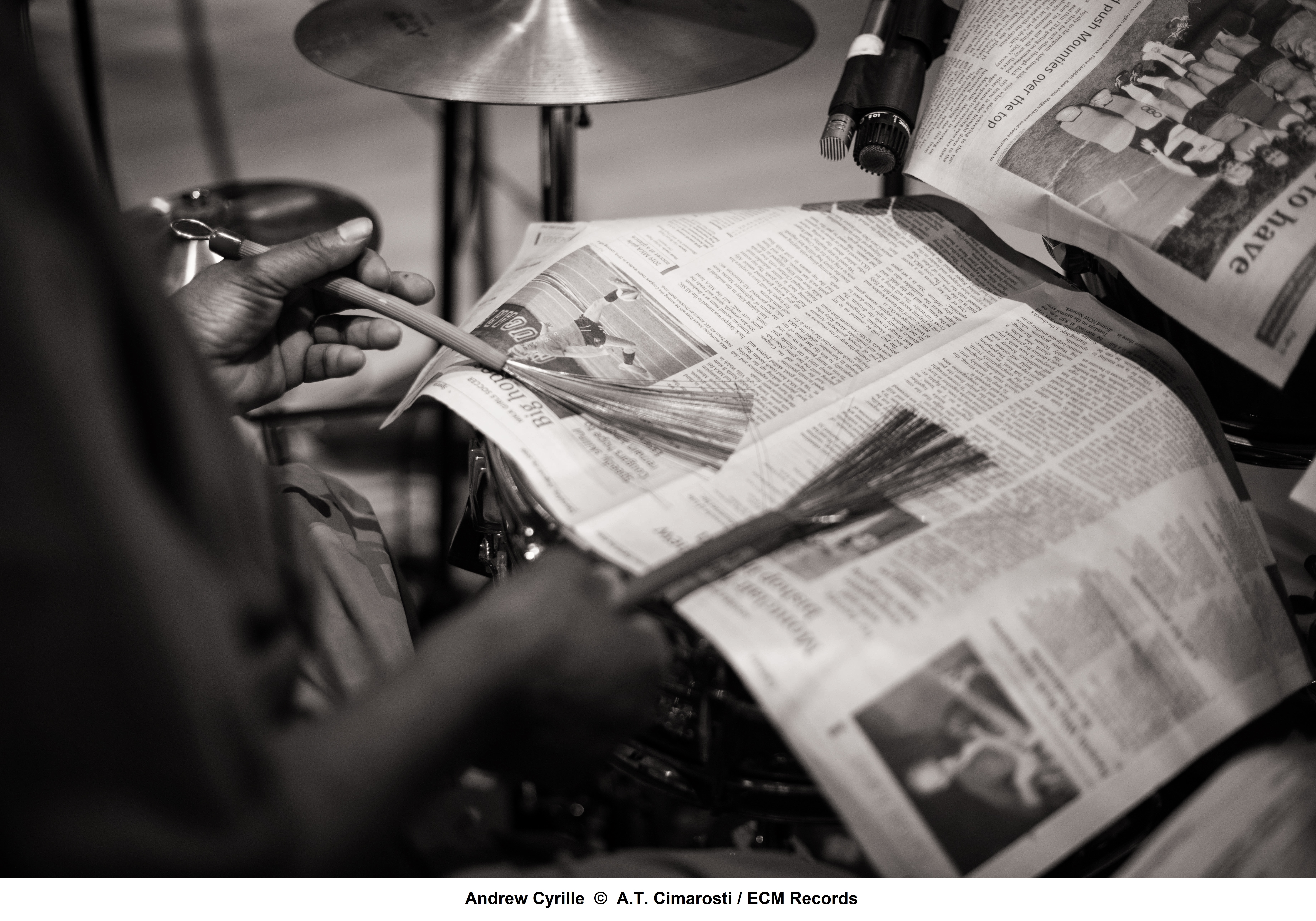
The title track by Cyrille dates back to the late 1970s and involves a newspaper-covered snare drum with rhizomatic touches from his bandmates. This brilliant turn hints at melody but sidesteps the commonality of expectation for the rewards of each unraveling moment. The bandleader further offers his balladic “With You in Mind,” which opens in spoken word. This sets up a late-night feeling from piano and bass, then shifts into Frisell’s meticulous speech-songs as warm organ undercurrents embody a respiration of the soul. Cyrille and Virelles detach in the improvised “Dance of the Nuances,” a delicate web of communication.

Where the pianist thinks outside the box in his playing, he shows restraint in the original “Incienso.” Along with “Leaving East of Java” (by AACM advocate Adegoke Steve Colson), it paints with flowers. In the latter, Cyrille’s cymbals work itinerant wonders as Street’s bass holds a steady watch in the background.

This production from Sun Chung (who has since left ECM to start Red Hook Records) is a masterclass in how jazz should sound when left to define a space. The recording is shaped by the languages we hear, translated out of—and back into—a universal tongue and the great equalizer of all things: nothing less than music itself.

Jon Balke/Siwan: Hafla (ECM 2726)

Jon Balke
Siwan
Hafla

Mona Boutchebak vocals, kwitra
Derya Turkan kemençe
Bjarte Eike Baroque violin, leader
Helge Norbakken percussion
Pedram Khavar Zamini tombak
Per Buhre vocals, viola
Jon Balke keyboards, electronics, tombak
Barokksolistene
Recorded May/June 2021
The Village Recording, Copenhagen
Engineer: Thomas Vang
Recording producer: Jon Balke
Mastering: Christoph Stickel
Cover photo: Sarah Murtaja
Executive producer: Manfred Eicher
Release date: April 22, 2022

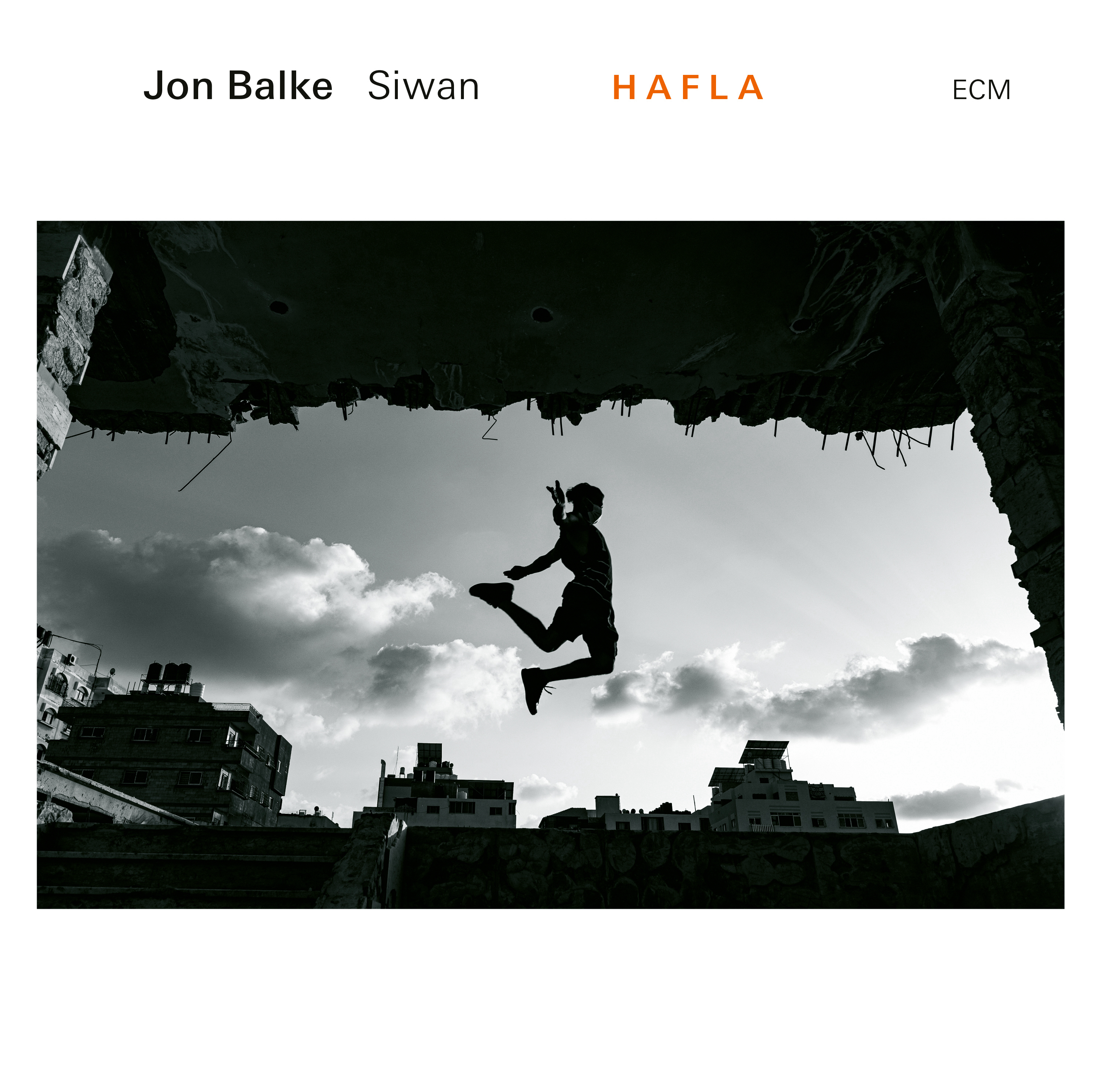
Hafla is the third go-around for keyboardist-composer Jan Balke and his group, Siwan. Taking inspiration from the cultural melting pot that was al-Andalus yet retying those threads into a friendship bracelet of striking originality, Balke and company retain the character of each idiom while achieving an overall design. Through the talents of Algerian singer Mona Boutchebak, Turkish kamancheh virtuoso Derya Turkan, Iranian tombak master Pedram Khavar Zamini, Norwegian percussionist Helge Norbakken, and violinist Bjarte Eike and his Barokksolistine, Balke summons the utmost familiarity from places and times that far outweigh our experiences as citizens of the 21st century. And while coronavirus restrictions prevented the ensemble from recording in the studio all at once, one would never guess the cutting and pasting required to bring the album to its present form in light of its hermetic coherence.

Balke’s compositions constitute the entire program, save for Boutchebak’s “Mirada Furtiva,” recalling a love so strong that it can never overstep the boundaries of modesty that keep it from consuming itself. Setting the poetry of Ibn Zaydun (1003-1071), the singer accompanies herself on the kwitra (Algerian lute), joined by low stirrings of wires and bows. Zaydun’s lover and the Ummayad princess of Córdoba, Wallada bint al-Mustakfi (1010-1091), is the verbal force behind the program’s opener, “Tarraquab” (Visit). Its lilting character immediately transports us into a cinematic world of strings and percussion. Boutchebak evokes flowing transpositions of bodies into spirits and back again, scenting the evening air with yearnings for touch.

Other poets who find themselves redrawn beneath the Siwan overlay include Ibn Sara As-Santarini (Santarém, 1043-1123), Ibn Sa’id al-Maghribi (Alcalá la Real, 1213-1286), Abu Bakr al-Turtushi (Tortosa, 1059-1126 or 1127), and Ibn Hazm (Córdoba, 994-1064), all of whom express an intimate relationship with that most sensuous interim before the dawn. Whether in the bright harmonies of “La Estrella Fugaz” (The Shooting Star) or the gentle strength of “Diálogo en la Noche” (Dialogue in the Night), we encounter selves divided by pining and expectation. And in “Enamorado de Júpiter” (In Love with Jupiter), the gloom of unrequited affections unfurls a canvas for the brush of a pained lyric:

Knowing well that I am the full moon in the clear sky,
You fell in love with Jupiter, the darkest planet.

Braiding the invisible forces of “Arrihu Aqwadu Ma Yakunu Li-Annaha” and the seeking qualities of “Uquállibu” (Absence), Boutchebak attaches threads of continuity between burning hearts that have only the moon as their messenger. Even the two instrumental interludes, “Línea Oscura” and “Saeta,” seem to communicate in verse, so that when images as powerful as those expressed throughout “Wadadtu” (Is There No Way), in which the desire to become one with another achieves fiery tension, rise to the surface, it is all we can do to hold on to the rhythms for assurance of reaching the shore. As violist Per Buhre sings this song in English against a wash of strings and kamancheh to bid us farewell, the linguistic change of clothing starches the ears, making us realize just how far our tongues have yet to travel.

Enrico Rava: Edizione Speciale (ECM 2672)

Enrico Rava
Edizione Speciale

Enrico Rava flugelhorn
Francesco Bearzatti tenor saxophone
Francesco Diodati guitar
Giovanni Guidi piano
Gabriele Evangelista double bass
Enrico Morello drums
Recorded live August 18, 2019
at Jazz Middelheim, Antwerp
by VRT-Vlaamse Radio en Televisie
Engineers: Peter Préal and Maarten Heynderickx
Mastering: Christoph Stickel
Cover design: Sascha Kleis
Executive producer: Manfred Eicher
Release date: October 29, 2021

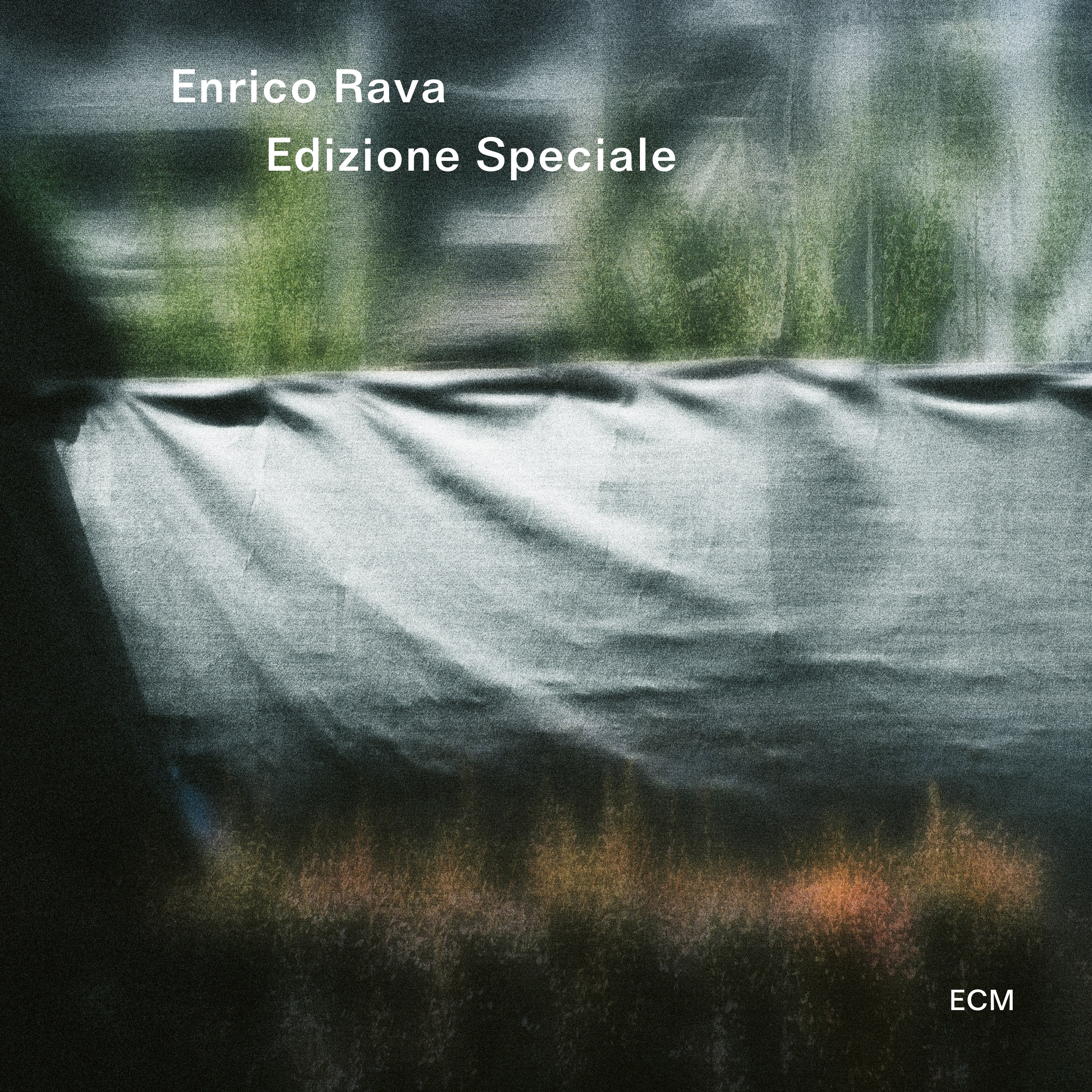
Recorded live at Antwerp’s Jazz Middelheim festival in 2019, the aptly named Edizione Speciale brings flugelhorn maestro Enrico Rava to the stage with tenor saxophonist Francesco Bearzatti, guitarist Francesco Diodati, pianist Giovanni Guidi, bassist Gabriele Evangelista, and drummer Enrico Morello. That many of these musicians are Rava’s mentees is obvious given the level of communication achieved in this performance. As Rava notes in the album’s press release, trust is at the core of everything this band does.

Pure excitement ignites the night as “Infant” hits the air. Its maximalism leaps into the listener’s heart, especially through the stellar guitar work and the detail-oriented drumming. Guidi further energizes the congregation while Evangelista gilds the frame with strong patterns of recognition. Bearzatti, too, grabs a prime patch of spotlight to strut his stuff. After only a brief introductory statement, the bandleader recedes to let his entourage do the talking on this 13-minute juggernaut. 

Michel Legrand’s “Once Upon A Summertime” and Rava’s “Theme For Jessica Tatum” make for solid company. Rava opens with the lyricism of classic cinema before Bearzatti paves the way for Guidi’s solo delicacies over a spirited rhythm section that harks to Rava’s second home of South America, where Brazilian vibes seep freshly through the mesh of time. After a round of solos, Bearzatti and Rava trading diary entries along the way, Evangelista puts a finer point on things. 

The sprawling introduction of “Wild Dance” (from Rava’s 2015 record of the same name) leads to Diodati’s surreal monologue, which Rava turns into an intermittent conversation. Electronic abrasions add a new face to this repertoire. After a fearless morph into “The Fearless Five,” of which Evangelista’s bass is the wick to the candle, “Le Solite Cose” finds the horns charging into a sparkling take on “Diva” (also heard on Wild Dance). As Rava re-enters the picture, joy abounds and carries over into the Cuban tune “Quizás, Quizás, Quizás” (previously heard on Guidi’s This Is The Day). This one rolls off the proverbial tongue with ease. Its pianistic undercurrent gives rise to artful rhythming from Morello and an ecstatic round of input. With us as vessels, the music is assured of a home worthy of its robustness and love for life.

John Scofield: s/t (ECM 2727)

John Scofield

John Scofield electric guitar and looper
Recorded August 2021
Top Story Studio, Katonah, NY
Engineer: Tyler McDiarmid
Mastering: Christoph Stickel
Cover photo: Luciano Rossetti
Executive producer: Manfred Eicher
Release date: May 6, 2022

John Scofield’s latest for ECM features a set of solo guitar tunes backed by a looper, which he uses to establish progressions and contexts for his adroit picking. This long-awaited project, one that fans thought might never come, offers plenty of variety to meet that expectation. It all begins with a second-nature take on Keith Jarrett’s “Coral.” Launching into an improvisational spirit from the first breath and shifting into the melody only at the end, this interpretation features all of Scofield’s hallmarks: forthright expression, clear lines, and enough rough edges to guarantee authenticity. This is edible music.

Among all that follows, my ears are drawn immediately to Scofield’s originals. From the finely sculpted “Honest I Do” and the more whimsical “Since You Asked” to the emotionally charged “Mrs. Scofield’s Waltz,” he proves an uncanny ability to unravel moments of life into stories with beginnings, middles, and endings. The bluesy “Elder Dance” is a highlight. Scofield’s description says it all: “I picture older people (like me) doing a kind of lindy hop. I can picture it but I can’t do it.” This and the vibrant “Trance du Jour” make their recorded debut. Both are genuine pleasures to hear.

“It Could Happen to You” is the first among a handful of jazz standards. While recognizable from the start, it adds Scofield’s idiosyncratic touches, by turns fluid and angular. Even “Danny Boy” feels spontaneous in his brilliant hands, while the prison song “Junco Partner” bows its head in honor of the wrongfully incarcerated. Whereas “My Old Flame” and Buddy Holly’s “Not Fade Away” favor message over medium, others, like “There Will Never Be Another You,” add new levels of interest to the tried and true. We end with the Hank Williams classic, “You Win Again,” speaking in the language of experience.

Despite my appreciation for all that transpires here, this isn’t my favorite of ECM’s 2022 releases. Scofield is, of course, a master who could sound like no one but himself. And while I dig the easygoing, unrushed quality of the playing, I find relatively little to chew on in the standards. On the other hand, there’s plenty to enjoy in Scofield’s originals, which gift these ears with fresh, honest sounds. I just wish we’d been given nothing but, especially for a self-titled record from an artist whose contributions to the art of jazz are every bit as flavorful as the old chestnuts he has roasted here. Many will disagree with this assessment, so don’t let me discourage you from enjoying an album that might very well grow more than show.

Heinz Holliger: Lunea (ECM New Series 2622)

Heinz Holliger
Lunea

Christian Gerhaher baritone
Julian Banse soprano
Ivan Ludlow baritone
Sarah Maria Sun soprano
Annette Schönmüller soprano
Philharmonia Zürich
Basler Madrigalisten

Heinz Holliger conductor
Recorded live March 2018
Opernhaus Zürich
Recording producer and editing: Andreas Werner
Recording engineer: Stefan Hächler
Assistant engineers: Alice Fischer and Philip Erdin
Cover sketches by Heinz Holliger / photo by Thomas Wunsch
Executive producer: Manfred Eicher
Co-production of ECM Records/Opera Zurich/SRF 2 Kultur
Release date: April 22, 2022

I am my own echo, but one eternally rigid and pinned down.
An echo nailed to the rock.

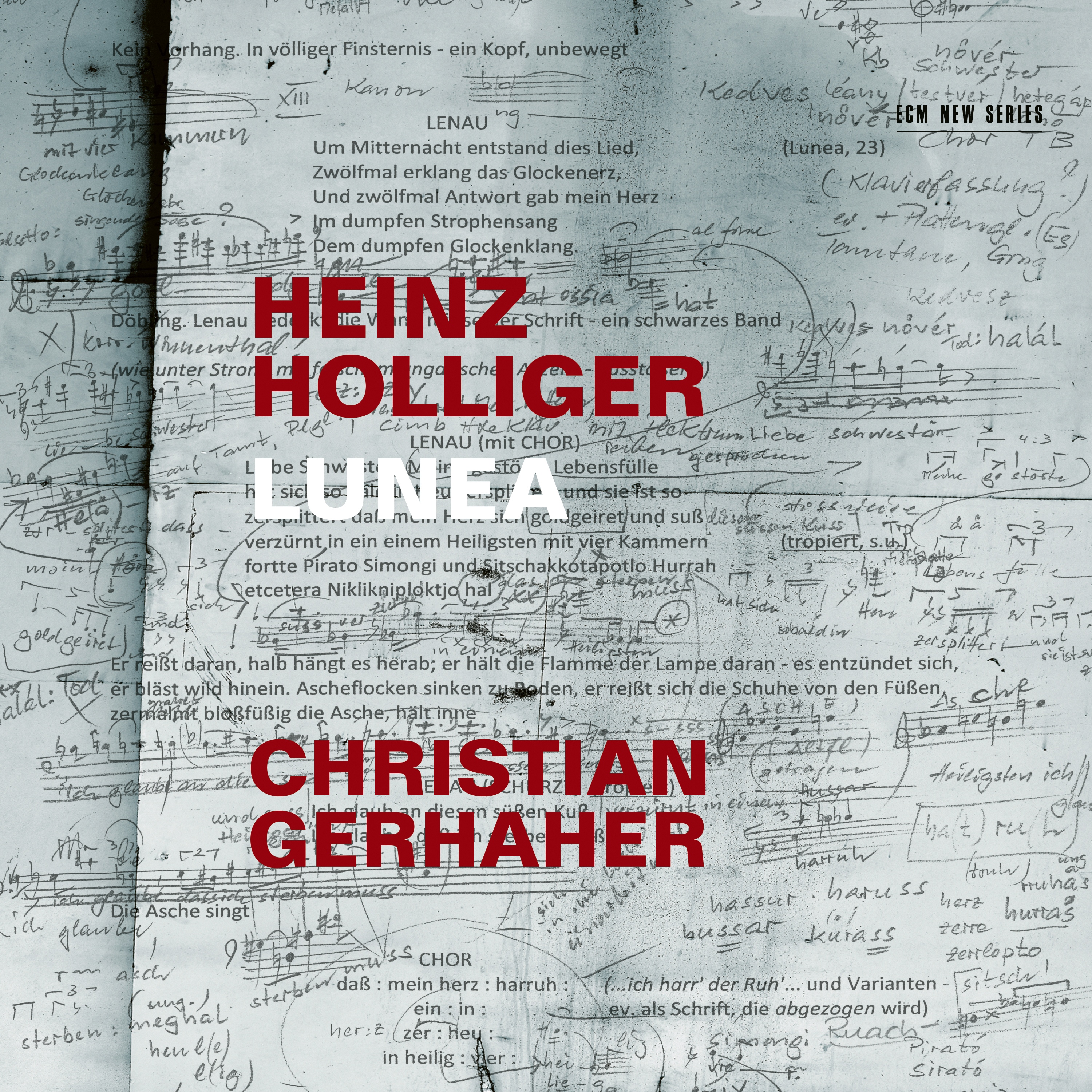
Heinz Holliger’s Lunea, described by the Swiss composer as his “dream opera,” grew out of a song cycle of the same name for baritone and piano. By 2017, Holliger had reworked it into its present form for the stage. Based on the demise of Nikolaus Lenau (1802-1850), who scribbled down outbursts during his years in an asylum, Lunea anagrams his name as a way of illuminating his poetic psychosis, thus hinting at the linguistic fragmentations we will encounter. As noted by baritone Christian Gerhaher, who seems born to sing this role: “Holliger presents these attempts on the part of the stricken poet to record his indescribable yet exquisitely traversed suffering—frightful and vivid experiences incapable of being communicated to another being.” And yet, communicate he does through a characteristically exquisite ear for nuance.

Whether by instinct or design, all of the artists of Holliger’s incidental interest, from Friedrich Hölderlin to Robert Schumann, are bound by the tattered thread of mental illness. His willingness to give them a mouthpiece through the score, of which language is a key instrument, finds a willing accomplice in Händl Klaus, whose libretto contextualizes 23 “leaves” in a space without linear order. Holliger’s approach to the text is microscopic in spirit but grand in scope. And yet, as Roman Brotbeck observes, “[N]othing is blurred; everything is as clear as glass and laid out by Holliger with maximum lucidity.” 

Holliger and Klaus pieced the opera together through fragments written on paper slips, glued with phrases (both musical and oral-motor) into shape. In doing so, they sought to resolve each sentence (or even word within it) through interpretation. If any plot can be discerned in all of this, it is embodied in the character of Lenau himself, whose cogent coterie of family members and acquaintances populates a bare environment like projections of his many sides. Lenau’s alter ego is Anton Xaver Schurz (1794-1859), a constant companion throughout his illness who also married his sister and published a nearly 800-page biography of Lenau in 1855. The women in Lenau’s life, including Sophie von Löwenthal (a platonic lover), Marie Behrends (his fiancée), and sister Therese, lend worldliness (if not also wordiness) to his isolation.

Holliger’s love for speech abounds, as when he incorporates the character of Justinus Kerner, a physician and close friend who, in 1850 (the year of Lenau’s death) began making what he called “klecksographs”—inkblot pictures mirrored by folding pieces of paper into symmetrical images. Following this, the opera is symmetrically arranged around the stroke Lenau experienced in September 29, 1844. Long before that, the opening speaks is as if through a layer of rice paper. Low reeds and an intoning chorus give way to Lenau’s amorous deteriorations. This is the asylum, a space in which the mind has free reign even as the body is contained. Such is the contradiction of operatic space: a stage that delineates mise-en-scène while opening our hearts to its inner flames. Holliger understands this in both the most traditional and postmodern sense.

For Lenau, “Man is a beachcomber at the sea of eternity,” and so might we call the instruments, among which the violin, cimbalom (Hungarian dulcimer), and bassoon move as characters in their own right. Each slices mortality at a different angle, offering us unrepeatable cross-sections of emotional sediment. As waves of utterances and choral echoes navigate the scrapheap of a broken mind, we are privy to glimpses of recovery and tension in kind. Some of the most profound moments are shared between Lenau and Sophie. Their wordless breathing in the Fourth Leaf palpitates the ears. And it is Sophie who, in Leaf Nine, brings the most hopeful beauties into focus. Such respite is brief and occasional, as in the skyward harmonies of the Sixth Leaf, whereas the most powerful interruptions (such as that by Sophie again in the Eleventh Leaf) make the morbid grays and charcoals of the opera’s fulcrum that much more morose.

In one key scene, played out in the Fourteenth Leaf, Lenau leaps from the window in desperation before bowing the violin in a cathartic dance of healing. What follows from here to the end is a reversion into childhood (Fifteenth Leaf) before solitary madness sets in. Turning as a revolving door from one state of mind to another, the chorus voices the multiplicity of his demise. The final part is a gravelly expression of death borders that burrows into the reptilian brain.

While Lunea is a chain of intimate fascinations as only Holliger can link, it is best appreciated with the booklet in hand, ready to absorb the fragments at hand and assemble them into your own whole. Its brilliance comes to life through the heartbeat of its concepts. Then again, the disorientation of not knowing where our ears might land next is appropriate enough when scrutinizing a mind that might never have demanded more. Hence the significance of Gerhaher being the only singer who doesn’t perform multiple rolls, at once emphasizing Lenau’s splintered cognizance and his insistence on maintaining an identity through it all. For a man who saw the moon as “a luminous, drifting tomb,” death was, perhaps, the only certainty.

Ferenc Snétberger/Keller Quartett: Hallgató (ECM New Series 2653)

Ferenc Snétberger
Keller Quartett
Hallgató

Ferenc Snétberger guitar
András KellerZsófia Környei violin
Gábor Homoki viola
László Fenyő violoncello
Gyula Lázár double bass
Concert recording, December 2018
Liszt Academy, Grand Hall, Budapest
Engineers: Stefano Amerio and Gergely Lakatos
Cover photo: Atilla Kleb
Produced by Manfred Eicher
Release date: February 12, 2021

After making his ECM debut with the live recording In Concert and the jazzier follow-up Titok, guitarist Ferenc Snétberger returns to the label with Hallgató. Recorded live in December of 2018, it positions his strings amid those of the Keller Quartett and Gyula Lázár on double bass. The focus this time is on Snétberger as a composer, with three of his works standing as pillars of the program. His Concerto for Guitar and Orchestra (1994/95; arr. 2008) spans three substantial movements. Subtitled “In Memory of My People” and written for the 50th anniversary of the end of the Holocaust, it balances precise notation with liberating cadenzas. “Hallgató” (a somewhat ambiguous word meaning “listener”) sets the scene with guitar alone before the quintet’s entrance, feeling out the landscape upon which we are about to walk with these fine musicians as our guides. “Emlékek” (memories) is our first waystation. Romantic yet devoid of excess, its nourishment fortifies us for the fancier footwork of “Tánc” (dance), in which the catharsis we have been seeking is realized, reminding us of what vibrancy feels like. Snétberger’s Rhapsody No. 1 for Guitar and Orchestra (2005; arr. 2008) is equally dynamic, if less angular. Like a figure sashaying between historical buildings, it navigates city streets with the nostalgia of experience on its shoulders. In the journey between them, we come across Your Smile for solo guitar, a timely song without words.

Works from other composers fill in the gaps with vital organs. Two songs from John Dowland (1563-1626) are the subject of astonishing arrangements by David Warin Solomons. “I saw my lady weep” and “Flow, my tears,” both from 1600, show the undying spirit of this music, the guitar adding a lute-like touch to the backdrop while strings weave their tapestry in its light. The latter tune, a duet for guitar and cello, speaks in an unmistakable nocturnal tongue. The program takes its deepest breaths in the String Quartet No. 8 in C minor of Dmitri Shostakovich (1906-1975). Written in 1960 for victims of fascism and war, its opening and closing Largos are played crosswise, lending a graceful urgency to their differences. The second movement, by contrast, is delicate without pulling the punches of its traumatic reveals, while the Allegretto dazzles with its rougher qualities. The Adagio for Strings by Samuel Barber (1910-1981), taken from the String Quartet, op. 11, of 1936, is also included, rendered with a vocal quality I’ve rarely heard.

All told, this is a superb program from world-class artists. More than the performances, however, Snétberger’s writing scintillates. Such cinema requires no camera and only the heart as a projection screen. What begins with a yearning for peace opens into dance-like wonder, but only briefly before lowering the head in slumber to chase resolutions behind closed eyes. Because, in the end, memories may be nothing more than dreams we haven’t yet forgotten.

Tigran Mansurian: Con anima (ECM New Series 2687)

Tigran Mansurian
Con anima

Varty Manouelian violin
Boris Allakhverdyan clarinet
Michael Kaufman violoncello
Steven Vanhauwaert piano
Kim Kashkashian viola
Tatevik Mokatsian piano
Movses Pogossian violin
Teng Li viola
Karen Ouzounian violoncello
Recorded January-April 2019
Evelyn and Mo Ostin Music Center
of the UCLA Herb Alpert School of Music, Los Angeles
Recording engineer: Benjamin Maas
Cover photo: Jean-Christophe Béchet
Mastering: Christoph Stickel
Executive producer: Manfred Eicher
Release date: November 6, 2020

Although “refined” has taken on elitist nuances over the years, Armenian composer Tigran Mansurian cuts to the root by following the true etymology of the word as a return to purity. In this all-chamber program, conceived as an 80th birthday gift by violinist Movses Pogossian and violist Kim Kashkashian, Mansurian’s combination of Armenian and European influences, sacred and secular alike, changes form as if viewed through a kaleidoscope turned in methodical wonder.

In the Agnus Dei of 2006, interpreted here by violinist Varty Manouelian, clarinetist Boris Allakhverdyan, cellist Michael Kaufman, and pianist Steven Vanhauwaert, one can almost feel his presence in the room. The simultaneous awareness of separation and overlap in the composing and the performing allows listeners to take the opening movement in many ways: as a mirror or opaque surface, liquid or solid, past or future. The clarinet is the glue that binds this scripture, the strings dialects, and the piano keys the pages they call home. The second movement indicates stirrings within, cradling dark exultation, while the third movement barely exceeds a whisper. As in the sonic architecture of Alexander Knaifel, the instruments humble themselves at the feet of the Spirit.

The Sonata da Chiesa (2015) bears a dedication to the priest and composer Komitas Vardapet (1869-1935), whose quiet legacy has permeated a range of previous ECM recordings, not least of all Mansurian’s own. In the hands of Kashkashian and pianist Tatevik Mokatsian, the first movement suspends itself before writhing with historical awareness. Kashkashian’s sincerity and Mokatsian’s energetic approach to even the most delicate gestures draws two lines of flight that gradually become one in the second movement. Like hope and reality, they are distant until something sacred finds commonality in them.

The title piece (2006-2007) is scored for two violins (Pogossian and Manouelian), violas (Kashkashian and Teng Li), and cellos (Karen Ouzounian and Kaufman). Being a meditation on Shostakovich’s String Quartet No. 13, the viola is of liturgical importance. Incredibly, the higher the tones, the darker the sky grows over its catharsis. Next are the String Trio (2008) and String Quartet No. 3 (1993). If Con anima was closer in mood to Shostakovich, the trio is closer in form, moving ever closer to the shaded drawl of its final movement, while the quartet assumes an inverted progression from subterranean fields to aboveground terrains. Finally, Die Tänzerin for violin and viola (2014) shines a light on Armenian folk dance, bringing Bartók to mind.

As convenient as the above comparisons may be, they do nothing to capture the atmosphere of this music. Mansurian, by self-characterization, creates a crossroads of speech and silence that cannot necessarily be articulated by either. Given the honesty and truth with which he fills his cup, not every question he poses demands an answer. Searching without finding becomes its own gift in a world hell-bent on exploiting destinations.