Turtle Island Quartet: Bird’s Eye View

Bird's Eye View

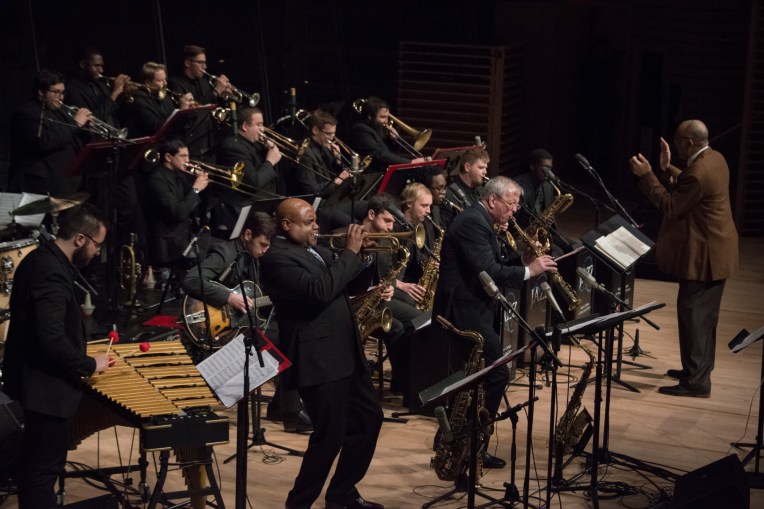
The Turtle Island Quartet presents a new program centered on the spirit of Charlie Parker. Although only one of his tunes is included, these four impeccable musicians share Bird’s penchant for expanding parameters and the results of their alchemy are just as golden. Like the other jazzy ingots herein—namely, “Subconscious-Lee” (Lee Konitz) and “Miles Ahead” (Miles Davis)—“Dewey Square” makes artful use of extended techniques. Violinist/founder David Balakrishnan employs scratch tones for a delightfully percussive effect while cellist Malcolm Parson (who, along with violinist Alex Hargreaves, is new to the group) plays the role of bassist via robust pizzicato. The in-house arrangements alone boast of interdisciplinary genius at play, allowing for plenty of improvisation to show the quartet’s combinatory properties.

The Modern Jazz Quartet’s “Django” gets a welcome spin and in its central section evokes the fluidity of Stéphane Grappelli, whom Balakrishnan calls a “patron saint” of the quartet. Yet Balakrishnan’s own compositions are the support beams of this soundly engineered structure. They sometimes reveal an underlying quirkiness, as in his “Rebirth of the Holy Fool,” which puns on Davis’s Birth of the Cool, and “Squawk,” taking its inspiration from a mysterious incident in 2011 when the town of Beebe, Arkansas awoke on New Year’s Day to find that 5,000 dead blackbirds had fallen from the sky. The composer navigates these images with delicate rigor. His “Aeroelasticity: Harmonies of Impermanence,” however, is the album’s centerpiece. A multivalent suite in four movements, it hums with the very propulsive energies that inspired it. Influences range from Indian classical music to mathematical properties (the piece is, after all, dedicated to his father, a UCLA professor of engineering), bringing solid returns on his emotional investments. There’s a backwater charm lurking within and a feeling of memory tying it all together. Violist Benjamin von Gutzeit’s “Propeller” is something of a sister piece, as it deals equally with mechanisms in motion, if on a more intimate scale. Its balance of curves and straights is emblematic of what this quartet is capable of at its finest.

(This review originally appeared in the March 2018 issue of The New York City Jazz Record, a full PDF of which is available here.)
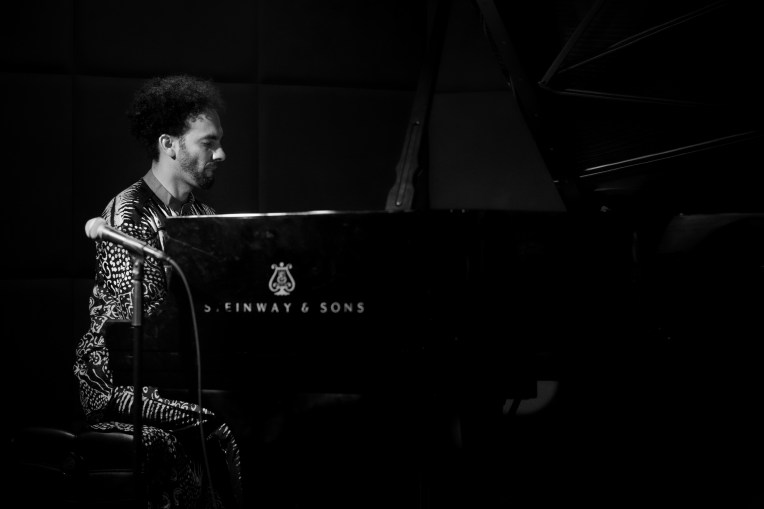
Amao Quartet review for All About Jazz

My latest CD review for All About Jazz is of the Amao Quartet’s self-produced Improcreations. A beautiful example of free improvisation (here featuring four Brazilian electric guitarists) that is neither overbearing nor confrontational. Click on the cover to discover!

improcreations_cover_art

Jazz photography

As some of my readers may be aware, I’ve been photographing semi-professionally for a few years. Only recently, however, have I begun to photograph musicians. Below is a slideshow of recent images. Hope you enjoy them.

This slideshow requires JavaScript.

On Broken Ice with Alicia Hall Moran

On 11 January 2018, singer Alicia Hall Moran took to the Bank of America Winter Village Rink in New York City as part of the 2018 Prototype Festival to stage her latest vocal experience. Breaking Ice examines the mythology behind what came to be known as the “Battle of the Carmens,” when skaters Katarina Witt and Debi Thomas coincidentally chose Bizet’s Carmen as the music for their long routines at the 1988 Winter Olympics. For this 20-minute piece, offered under cover of burnished clouds and surrounded by the skeletal trees of Bryant Park, Moran was joined on the ice by Kaoru Watanabe on taiko drum and Maria Grand on saxophone, along with skaters Elisa Angeli and Jordan Cowan. Drawing upon her own experience as a figure skater, Moran turned the rink into a personal concert space. With microphone in one hand and blood-red bouquet of roses in the other, she was compass, vessel, and map in one.

DSC00754-Edit-Edit

Songs from her new album (see my full review for All About Jazz here), including the poignant original “Not Today” and a “Habañera” mash-up of Stevie Wonder’s “Signed, Sealed, Delivered,” threaded by passages of improvisation and vocalese, delivered a mood and message that was distinctly Moran’s own. But that was only the surface.

Here’s what was going on underneath.

First, one must consider the space itself as an extension of its sonic foci. Before a single note flew, Moran made the rink her own by marking off its center, almost ritually, with a circle of orange and green traffic cones. Although suggestive of Christmas, if only by association with the enormous tree behind, they were first and foremost a sign and signal of self-containment. This was her circle, and the act of laying it out reminded us of all-too-rare a thing in this historical moment. At a time when politics (and the words that constitute their violence) have become so fragmented that it’s all we can do to keep from getting slivers, Moran showed us that the orthography of change will be written not on walls but across open borders. Still, despite the porosity of her circle, in communion with the drums she was bound by no other rules but her own.

DSC00752-Edit-Edit

Even as the circle was an invitation, it was also a warning, symbolically drawn as much to keep herself protected as others from invading. In this reversal of colonial power play, she threw her voice like a net—to see not what she could catch but how much she could filter out. This was the heart of each moment: to see and feel the audience breathing through all those things that let us through. Just as the wind found no purchase in the branches above her, so did she pass without contact through the tangle of flesh and blades that was her gypsy forest.

DSC00800-Edit-Edit

Before she strapped on her skates, ice was already speaking. The Bryant Park fountain had frozen to a crisp, its flow ephemerally memorialized as a drip too ponderous to visualize as movement. Not unlike Moran’s songcraft, which in any context slows the march of time so that we may examine its soldiers in much the same way, that which is frozen is open to the possibilities of interpretation.

DSC00741-Edit-Edit

The rink, too, was its own reflective surface, distorting the cityscape before a single note was sung: a heart of urban ventricles and an aorta honed in glass unfolded across a flat plane.

DSC00743-Edit

By the end, Moran had sent us back into the cold with a morsel of warmth, and in so doing showed us that the power of a song lies not only in what goes into it but also where it is unleashed. A song is nothing to ignore, but something to be reckoned with and, from the open hands of her delivery, proves that a language of one must be a language of all.

DSC00811-Edit

Amine & Hamza review for RootsWorld

Amine & Hamza are an oud and kanun duo from Tunisia. Their album Fertile Paradoxes is the subject of my latest review for RootsWorld online magazine. Fans of Anouar Brahem: do not pass this one up. Brahem himself calls the new album “a spell-binding repertoire of new compositions full of emotions. We are taken on a delicious trip of intoxicating rhythms and subtle, yet powerful melodies. Far from being run-down clichés, we are struck by its strength of suggestion and the modernity of its arrangements. There is a strong sense of being on a voyage of surprising passages and undiscovered timbres. Fertile Paradoxes owns the evident and natural qualities which are the hallmarks of an authentically inspired work. A beautiful success!”

Click the cover below to read my full review and hear sample tracks.

Fertile Paradoxes

Ben Monder: Amorphe (ECM 2421)

Amorphae

Ben Monder
Amorphae

Ben Monder electric guitar, electric baritone guitar, Fender Bass VI
Pete Rende synthesizer
Andrew Cyrille drums
Paul Motian drums
“Oh, What a Beautiful Morning,” “Triffids,” and “Dinosaur Skies” recorded October 2010 at Sear Sound
Engineer: James A. Farber
“Tendrils,” “Tumid Cenobite,” “Gamma Crucis,” “Zythum,” and “Hematophagy” recorded December 2013 at Brooklyn Recording
Engineer: Rick Kwan
Mixing Engineer: Rick Kwan
Produced by Sun Chung
U.S. release date: October 30, 2015

For his ECM leader debut, New York guitarist Ben Monder brings his improvisational destinations to fruition with respect for every musical step in reaching them. The album’s circle is opened and closed by two solo arcs: “Tendrils” and “Dinosaur Skies.” Where the former comes out of the woodwork as if after a long and melodic hibernation, the latter is a dragon’s breath turned into music.

Constellations fill the spectrum between as Monder sings through a variety of guitars and tunings. “Gamma Crucis” and “Zythum” triangulate with Pete Rende on synthesizer and Andrew Cyrille on drums. Both pieces are geological surveys of highest order. Monder and Rende release so much likeminded stardust, it’s all they can do to clarify that they’re two nebulae working independently of time. Cyrille’s tracery is the dark matter between them, a dimension in which concrete rhythms have no gravity.

Guitarist and drummer make art as duo on “Hematophagy” and “Tumid Cenobite.” In the absence of electronics, their language feels closer to home, each his own weather front blending into collaboration. Although the landscape below them is desolate, it wavers with memories of rivers and greenery. Monder’s stirrings are like those of a creature in the leaves of Cyrille’s reforesting. With each sunrise, they dissolve dust into breathable air.

Monder Trio

Poignantly, late drummer Paul Motian joins Monder for two further duets. First is a starlit take on the Rodgers and Hammerstein classic “Oh, What a Beautiful Morning.” It’s beautiful indeed to hear Motian’s brushes, pulled as if from beyond some mortal curtain, springing to vibrant life of their own impulse. There’s something fully alive about this music—not only because of the tune, but also because of the way it rolls off the musicians’ proverbial tongues like a psalm. Recognition is not a precondition for enjoyment, however, as Monder’s ambience forges new relationships using familiar actors. His searing explosions make steam of ocean water, leaving lost cities exposed to sunlight for the first time in eons. Then there is “Triffids,” a spontaneous blush of tenderness that eludes capture by microphone and digitization. It is, rather, a force that knows us before we may consciously seek it out in the listening. Motian’s feel for internal rhythm is profound.

Motian

Monder navigates the paths before him with confidence because he defines them as he goes along. Leaving behind uncertainty, he uses gentility as fuel for a strong spirit. It’s perhaps no coincidence that the track titles recall the histrionic wordplay of the Cocteau Twins, for with likeminded boldness he does away with consensus articulations in favor of the emotional resonances beneath.