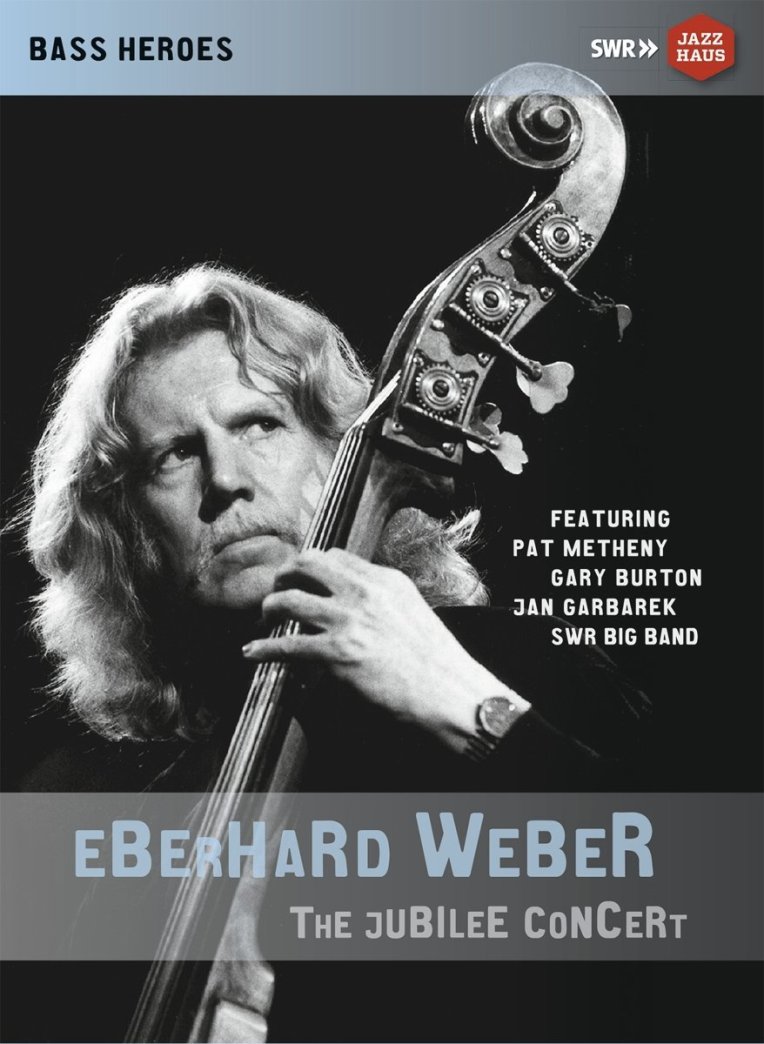
At the summit of a prosperous career on stage and, following a decades-long stint with ECM Records, German bassist Eberhard Weber suffered a stroke and has not played since 2007. In October of 2015 (a year in which he also received the Landesjazzpreis Baden-Württemberg, a lifetime achievement award), jubilee concerts were held at the Theaterhaus in Weber’s hometown of Stuttgart to honor his 75th birthday and contributions to jazz.
This DVD of that same event features the SWR Big Band conducted in turns by Helge Sunde and Michael Gibbs, along with guests Jan Garbarek (saxophone), Gary Burton (vibraphone), Paul McCandless (reeds) and, returning to the fold, Pat Metheny (guitar). The latter’s “Hommage” is the centerpiece—a sprawling 30-minute composition built around archival video footage of Weber from the 1980s. More than any other musician on the roster, Metheny bottles the Weber-ian spirit like the lightning that it is.
In contrast to the sprightly figure on screen, the first image of the concert is of an aged Weber hobbling to his seat of honor by aid of a cane. Following this, his “Résumé” finds Garbarek improvising over a more recent audio recording. It’s a fitting way to start, given that Weber was such a fixture of Garbarek’s quartet. Much of what follows reflects almost somberly on a touching career. Arrangements by Ralf Schmid and Rainer Tempel of classic tunes from Weber’s golden age are showcases for Burton and McCandless while those by Gibbs rejuvenate “Maurizius” (from the 1982 album Later that Evening) and Benny Golson’s “Killer Joe.” But it’s the jovial energies of Libor Šíma, who reimagines “Street Scenes” and “Notes After An Evening” (both from 1993’s Pendulum), which win the day.
In the liner notes for Hommage à Eberhard Weber, the 2016 ECM album culled from this same event, Metheny waxes indebtedly about Weber’s “sonic fingerprint that even all these years later remains as uniquely identifiable and fresh as it was on first hearing back then.” As this landmark performance shows, Weber continues to innovate, even without strings at his fingertips.
(This article originally appeared in the September 2016 issue of The New York City Jazz Record, of which a full PDF is available here.)
Coming up on four decades as composer and performer, New York’s Downtown deacon Elliott Sharp is at a creative peak. Tranzience documents four semi-recent chamber pieces, the earliest being Approaching the Arches of Corti (1997). Scored for four soprano saxophones (the New Thread Quartet of Geoffrey Landman, Kristen McKeon, Erin Rogers and Zach Herchen) and making use of Steve Lacy’s “leg-mute” technique, it sounds at times like a congregation of geese, at others a pipe organ running out of air, and leans nicely into 2008’s Homage Leroy Jenkins. Alongside clarinetist Joshua Rubin and pianist Jenny Lin, violinist Rachel Golub evokes the scrapes and squeals of the legendary dedicatee, whom Sharp counts, along with the larger AACM family, among his early influences. Venus & Jupiter (2012) features the ensemble Either/Or conducted by Richard Carrick and Sharp himself on electroacoustic guitar. Around a pulsing piano, this largely improvised masterwork spins a drone of strings, brass, winds and percussion drawing even more explicitly from the AACM well. The 2013 title composition features the JACK Quartet (Chris Otto, violin; Austin Wulliman, violin; John Pickford Richards, viola; Jay Campbell, cello), who recently brought their talents to bear on The Boreal (Starkland, 2015). Where that recording employed bows strung with ball-bearing chains, here the musicians use so-called “tube bows” fashioned from aluminum in addition to the standard hair. The music is consistently inventive across its 28-minute duration and inhabits a sound world that can only be described as nanotechnological.
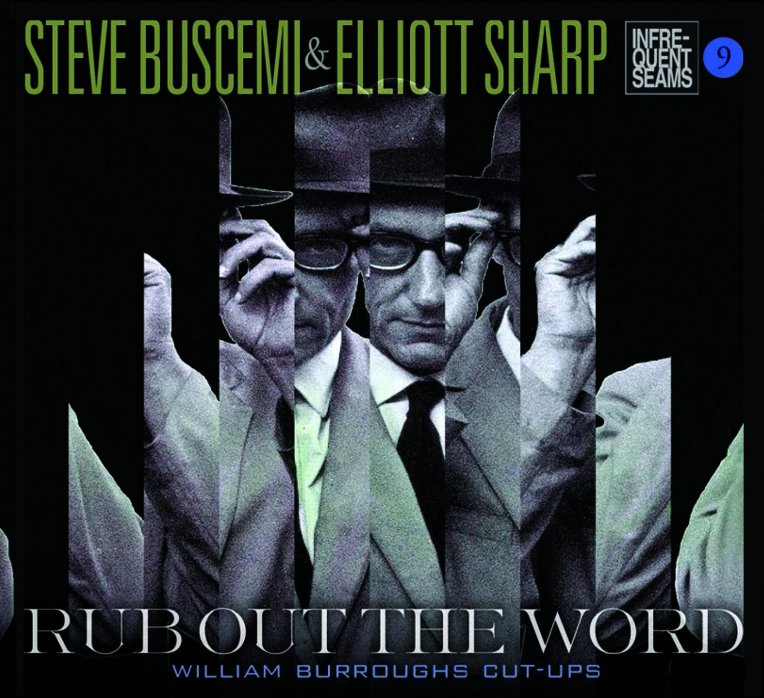
To this solar system, Rub Out The Word may seem like a distant satellite, but its heart shares the same blood. Here Sharp (on guitar and electronics) joins actor Steve Buscemi (of Reservoir Dogs and Fargo fame) to celebrate the writings of Beat Generation guru William S. Burroughs in one of the most delicious spoken word recordings to come out in recent memory. Not only for Burroughs, who managed to make even the most abstract streams of consciousness feel coherent, but also for Buscemi’s adenoidal charm and Sharp’s accompaniment, which, like the words, evokes a viral network that responds to, even as it anticipates, hidden messages in the texts. Said texts are quintessential Burroughs, threading needles of incontrovertible (if sometimes perverse) cynicism through a social cloth he understood in ways few others of his generation did. “The use of cut-up is a key,” narrates Buscemi and one can’t help but feel that he and Sharp embody this very aesthetic in their collaboration. What follows is a string of meditations on writing, obsession, evil, bureaucracy, war, morality, human interactions and the occasional nod to silence thrown in for good measure. This is no naked lunch, but a fully clothed dinner after which dessert is served raw and dripping. And while it may not appeal to straightahead jazz heads, anyone who has enjoyed Sharp’s fantastic voyage (no small task with a discography of over 300 albums) for any length of time is sure to be enthralled.
(This article originally appeared in the September 2016 issue of The New York City Jazz Record, of which a full PDF is available here.)
Muriel Cantoreggi viola Geneviève Strosser viola Jürg Dähler viola The Hilliard Ensemble David James countertenor Rogers Covey-Crump tenor Steven Harrold tenor Gordon Jones baritone
Recorded November 2010, Radio Studio DRS, Zürich
Engineer: Andreas Werner
Executive producer: Manfred Eicher
U.S. release date: November 6, 2015
To the eye, go, to the moist— hurricanes, hurricanes, from wherever, particle drift, the other, you know the one, we read it in the book, it was meaning. –Paul Celan, “Stretto”
Whether as composer, oboist, or conductor, Heinz Holliger never ceases to delight and surprise. His commitment to classical music has produced some of the most enduring documents on ECM’s New Series, including one of that imprint’s indisputable masterpieces, the Scardanelli-Zyklus. Here we have yet another turnaround, one that speaks with the open style in which Holliger has become so fluent. Featuring a host of accomplished interpreters—including the now-defunct Hilliard Ensemble—bringing to life a 21st-century cycle of works around the 14th-century French composer Guillaume de Machaut, the Machaut-Transkriptionen (2001-09) represent nearly a decade’s worth of thinking and rethinking through the past in a language of the future. Scored for an unusual combination of four voices and three violas, it weaves direct transcriptions of Machaut into Holliger’s idiosyncratic odes to the same.
This is one of those distinctively ECM projects, which, like Ricercar, unravels the avant-garde core of centuries-old music. The compact macramé, for example, that is Machaut’s hallmark is on full display in the program’s introductory Biaute qui toutes autre pere, wherein something more than ink and paper have convened to elicit vital sounds. If the feeling of this balladry is loving and sincere, even more so is Holliger’s enhancement of its rules in his own Ballade IV for three violins. More than ever before, Holliger has built his cathedral out of transparent stone, blacking out the windows, so that the sunlight might be its dominant form of expression. In this sense, Holliger is engaging with Machaut not as the target of an homage, but as the living force of an artist whose music breathes in the winds that shake his boughs. Use of untempered harmonics, transcribed note for note from the original, allows incidental commentary in this regard to seep through.
A second diptych, this time around Machaut’s Ballade XXVI: Donnez, Seigneur, transforms the gently sloping path of the original—in which countertenor David James at once renders the skin and the heart keeping it alive—into the wilder detours traced by the present recasting. And while the latter may seem more oblique in its structure, it also shares with its referent a clarity of expression. Both are neural mappings, very much alive in and beyond the confines of a single recorded performance. Even the wordless Hoquetus David of Machaut and Holliger’s responsory Triple Hoquet feel more like pieces of the same puzzle than distant cousins separated by time. Holliger gives us something of a granular synthesis of the former, an embodiment of Celan’s hurricane in the fullest sense.
A single voice retains the melody of Machaut’s Lay VII in a standalone arrangement, while guided improvisations flesh out its branches with unpredictable fruit. The Hilliards are best equipped to handle this flower without damaging a single petal. A beautiful piece that challenges not through its dissonances but through its consonances, as does its analogous In(ter)ventio a 3 und Plor- / Prol- / Or- atio for three violins, which from recitative beginnings morphs into a staggered prolation of time signatures, based on the Complainte of Machaut’s Remede de Fortune. That same piece lingers on in the final statement, in which it is combined with an “Epilogue” that unites voices and strings in quadrilateral fashion, distilled until only friction remains.
In a universe of countless musical systems, Holliger and his celestial body of work have always charted unprecedented orbits through the space-time continuum. Given the way in which he has refracted himself through Machaut, the sublimity of their intersection is clear, for both have stumbled on the fragility of human contact, tracing its origins just shy of rupture.
Anthony de Mare piano
All pieces were commissioned expressly for The Liaisons Project, Rachel Colbert and Anthony de Mare, Producers.
Producer for The Liaisons Project: Rachel Colbert
Recording producer and engineer: Judy Sherman
Additional engineer and editing assistant: Jeanne Velonis
Recorded 2010-2014 at the American Academy of Arts and Letters, New York, and Greenfield Recital Hall, Manhattan School of Music, New York.
Backing tracks for “Birds of Victorian England” engineered by Kevin Boutote
“Johanna In Space” backing track provided by Duncan Sheik
Mastering: Christoph Stickel and Steve Lake at MSM Studios, Munich
An ECM Production
Listen to that old piano roll play. When I hear that old piano roll play, I just gotta dance, And what I mean is dance with you.
In her exhaustive biography, Stephen Sondheim: A Life, Meryle Secrest shares the story of an adolescent Sondheim’s encounter with the 1945 film Hangover Square, and within it a piano concerto written by scorer Bernard Herrmann. The music’s bold mix of romanticism and Americana captured Sondheim’s imagination and was to become part of the origins of his intersections with the dramatic stage.
Sondheim has always composed at the keyboard, charting out his scores in great detail, to be orchestrated by (since 1970) esteemed collaborator Jonathan Tunick. Broadway has relied on this formula, which over the decades the duo funneled into surefire productions, but the project lovingly packaged in this three-disc collection from ECM takes Sondheimania to a new level through the intervention of rigorously trained note-smiths, each occupying a band along a spectrum of collaborations from a distance.
The roster of composers, who the behest of new music champion Anthony de Mare wrote new variations on the theme of Sondheim, reveals a depth and variety equaled by the songs they have re-imagined, as William Bolcom, Nico Mulhy, Steve Reich, David Rakowski, Eve Beglarian, Jason Robert Brown, Duncan Sheik, Eric Rockwell, Wynton Marsalis, Derek Bermel, Fred Hersch, Annie Gosfield, Jake Heggie, Kenjie Bunch, Ethan Iverson, Ricardo Lorenz, Paul Moravic, Frederic Rzewski, David Shire, John Musto, Mark-Anthony Turnage, Phil Kline, Bernadette Speach, Daniel Bernard Roumain, Andy Akiho, Ricky Ian Gordon, Nils Vigeland, Rodney Sharman, Gabriel Kahane, Thomas Newman, Jherek Bischoff, Mary Ellen Childs, Peter Golub, Tania Leon, and de Mare himself put a personal spin on the Sondheim songbook that is as true to life as it is to art.
Though Sondheim has historically been averse to being interviewed, in this collection we hear him speaking through the hearts of every composer who has felt his influential hand. In an album note, he himself describes these pieces not as “decorations” but “fantasias” of his songs. Indeed, Sondheim’s recognizable voice has been reworked with such fidelity—one original inspiring other originals to create new originals—that one need hardly peel away any layers of obfuscation to find him. Above all, however, it’s his scarcely rivaled gift for pastiche that resonates by virtue of de Mare’s encyclopedic flair.
According to Mark Eden Horowitz’s extensive liner text, the composers chose their songs based more on the lyrics and their stories than the melodies sung around them. And so, one can listen assured that de Mare’s consummate touch makes room on his metaphorical suitcase to display every sonic sticker of his travels. His dramatic, romping, emotional rollercoaster ride through A Funny Thing Happened on the Way to the Forum (1962), Anyone Can Whistle (1964), Company (1970), Follies (1971), A Little Night Music (1973), Pacific Overtures (1976), Sweeney Todd (1979), Merrily We Roll Along (1981), Sunday in the Park with George (1984), Into the Woods (1987), Assassins (1991), and Passion (1994) accordingly dwells as much on differences as similarities, bringing to fruition a “global” sound.
Not surprisingly, Sondheim’s masterpiece Sweeney Todd gets the most nods of the program, in addition to yielding a lion’s share of its highlights. One of those is Sheik’s “Johanna in Space.” This atmospheric gem opens with the chimes of a clock emulated on the piano and stretches itself over an electronic backdrop à la Tim Story. Todd’s ill-fated daughter is further subject of Brown’s “Birds of Victorian England,” which requires no small amount of heavy lifting from de Mare. As can be expected, Sweeney Todd engenders ample opportunity for over-the-top dynamics, epitomized in the spiraling density and fluent outcries of Bunch’s “The Demon Barber.” Other fine examples of the protagonist’s crushing pessimism abound, whether through the intimate knowledge of Newman’s “Not While I’m Around” or, in a satirical turn, Lorenz’s “The Worst [Empanadas] in London.” The latter requires a performer of de Mare’s chops to pull off the feel for rhythm and energy on which it subsists. De Mare welcomes the listener by shouting, “A customer!” as if in throwback to the speaking-singing pianist genre of which he was such a foundational proponent through his premiere of Rzewski’s De Profundis. It’s only natural, then, that Rzewski should have a piece included: the elegiac “I’m Still Here.” This and other selections from Follies, such as Wynton Marsalis’s Jelly Roll Morton-infused take on “That Old Piano Roll”, imply a bygone age with plenty of style to spare.
Company inspires a handful of homages as well, including Rakowski’s impressionistic “The Ladies Who Lunch,” through which Sondheim’s love for Ravel shines (as also in Bermel’s “Sorry/Grateful”); Rockwell’s tangible “You Could Drive a Person Crazy,” in which the composer “imagined a pianist trying desperately to catch the attention of rowdy patrons at a cabaret with as wide ranging a series of pastiches as possible”; and Roumain’s “Another Hundred People,” which invokes the troubled crooning of a Kurt Cobain or Thom Yorke.
A Little Night Music lifts its story from the Ingmar Bergman comedy Smiles of a Summer Night, and its comic touches are duly noticeable in Speach’s “In and Out of Love” (a personal album favorite), which shuffles the harmonies of “Send in the Clowns” (see also Iverson’s whimsical take on the same) into a balladic “Liaisons.”
Sunday in the Park gives us Muhly’s minimal yet expansive “Color and Light,” which embodies the pointillism that so fascinated the play’s subject, Georges Seurat. Muhly’s feel for the piano as a textural toolbox translates superbly. Reich’s more compact “Finishing the Hat” is scored for two pianos (de Mare multi-tracks himself) and links a brief yet persistent chain of chords. Sharman’s “Notes on ‘Beautiful,’” on the other hand, originally a duet between Seurat and his mother, no becomes a conversation between the living composer and his deceased mother. De Mare’s rendition of “Sunday in the Park – Passages (encore)” opens a lifeline to possibilities, and makes us feel connected to our own.
Shire’s “Love is in the Air” puts a delightful spin on the original opening number of A Funny Thing Happened on the Way to the Forum, underscoring de Mare’s abilities to evoke the past in a language of the future, while Bolcom’s “A Little Night Fughetta” references Anyone Can Whistle, pushing Bach through a jazzy filter of development. Pacific Overture is another of the less represented but no less effective source texts. Gosfield’s “A Bowler Hat” displays a meticulous feel for deconstruction, while Kline’s “Paraphrase (Someone in a Tree)” paints the first meeting between American and Japanese officials in 1853 with unexpected colors. Merrily We Roll Along gives us León’s “going…gone,” another remarkable highlight that, along with Akiho’s “Into the Woods” is perhaps the most technically demanding of the program. Hersch’s “No One is Alone” is another ode to Into the Woods, this one pentatonic and alliterative. And let me not neglect Beglarian, who pays tribute to Passion in her “Perpetual Happiness.” This striking piece is as real as the music gets on Liaisons, and builds its wings one feather at a time, until flight is achieved.
Doing justice to all of the composers and pieces represented here would be a futile, wordy exercise. Suffice it to say there isn’t a single sour note to be found, and as a whole the album demonstrates that, while Sondheim’s music may sometimes play hard to get, it will love you through and through if you let it, because that’s all it wants to do.
Colin Dayan does a rare thing at the crossroads of humanism and animalism by treating each as a reflection of the other. She engages the malleability of either tropism, stepping over the stalemated kings of corporeal and moral rights—which too often shunt their pawns to better enjoy the sound of their own echoes—and into a philosophical realm for which all life partakes equally of vulnerability. Such a project will not sit well with some readers. Neither is it meant to, for the uneasiness brought to life, and death, across the book’s 208 pages is a necessary encounter. In this respect, Dayan is the closest we have to a torchbearer of Vicki Hearne, whose classic Adam’s Task: Calling Animals by Name comes readily and repeatedly to mind as I read this worthy successor.
In her introduction, too, Dayan sidesteps convention by doing very little of the encapsulations to which academics are encouraged to accede. Rather, she sets up a fledged narrative through a call to action that is harder than it looks. In asking us to do nothing more than sit on the equals sign of the equation between Self and Other she is so artfully devising, she invites a “radical change in perspective: not only in how we see the world but also in how we read a story” (p. xiii). And so, while for her this is a book of tales, it is also a tale unto itself, an entity whose parts share ligaments with too many of our own to pass off as intellectual navel-gazing.
On the surface of Dayan’s theory-planet, dogs would seem to occupy a range of metaphorical terrains. They are, by virtue of variation, at once bridges between opposing states of sentience and being, bearers of revelation, personal property, “non-human persons,” and, in the most sweeping of Hearne-isms, language incarnate. Closer inspection, however, reveals these as more than cloak-and-dagger tricks of a talented wordsmith, but instead as markers of lived realities. For this reason, Dayan is far more interested in the “oscillation between the categories that bind” (p. xiv) than in the binding of oscillation into categories, and in destabilization of human positionality as the capstone of a worldview pyramid. She outs the project of judgment as one of collective privilege, reveals the empathetic precedent of ethical action, and the power of “mutual discomfort” (p. 110) to bring all into a truer sense of community.
From this emerges a tripartite concerto for canine soloists fronting an orchestra of conundrums. Part I, “Like a Dog,” is that concerto’s Allegro, and as such sifts passionately yet accessibly through autobiographical recollections of dogs living and non. “We are living in a time of extinctions,” she observes (p. 2), a central point she takes care to reiterate in the book’s EPK, and one which points to the harsh truths unraveling therefrom. And not only a time of extinctions, but of killings sanctioned by a society bent on devaluing dogs and other animals to the status of criminals.
Dayan reminds a missing piece in recent national conversations around police brutality: treatment of racialized humans as animals walks hand in hand with treatment of animals as racialized humans, and allows an indulgence of taboos normally relegated to the annals of private exploitation. And so, a discussion of pit bulls banned from low-income housing in New York City, for instance, not only discloses the absurdity of fears around specified breeds, but also sobers us to the sheer publicity of blatant discriminations and our acceptance of their ubiquity. While most, I think, can see that racial typing often revolves around the animalization of designated groups of human beings, forgotten is the humanization of designated species of animals. Which is why Dayan recognizes the all-too-common shootings of pit bulls as a national habit or, more viscerally, “a ritual that reminds citizens of the reach of lawful predation” (p. 9). It is with these dynamics in mind that she thinks back to the earliest dogs in her life, the necessity of their warm-blooded bodies against her own. An especially poignant discovery of a childhood photograph reminds her of a dog she never remembered, and whose anchorage draws light through the prism of this book as a magnet would iron filings.
In continued service of my musical analogy, I would characterize Part II, “When Law Comes to Visit,” as the central Largo. For while its rhythms might seem more furious and jagged, its carefully measured effect suggests the ponderousness of that very time signature. Here dogs unfold as sociopolitical animals, each subject to fatal blows of the law. Hypocrisies abound in such stories as that of Floyd Boudreaux, a breeder of American pit bull terriers who was erroneously accused of being a dog fighting kingpin and, once deemed as such, had to suffer the extermination of his entire line. By such acts, the warmongering tendencies of the state become a primary network in which worthiness of life comes to be determined (only the moral elite can kill dogs without being deemed cruel). Regardless of the motivations, be they financial or political, the fact is that the law legitimizes imagined threats and sanctifies animal exterminations through illusions of compassion (Boudreaux’s dogs were being done a favor, as the script goes, by being removed from danger to others and themselves). Pit bulls in this regard suffer the particular brunt of an historical amnesia in the United States, and have become the unfortunate collateral of stigmatization.
Part III, “Pariah Dogs,” is the concluding Vivace. In it, Dayan explores the expendability and vitality in kind of cinematic dogs, who on the one hand serve as mascots of loss, while on the other burst with so much awareness of things that it is all we can do to match their levels of understanding. “The fullness of a dog’s loyalty or commitment,” Dayan avers, “can be understood only as counter to the merely intellectual acceptance of a doctrine” (p. 159), and as such the dog comes to embody an unattainable state, so that “to position oneself in this way, even if tenuously, both inside and outside a human background, is to let our bond with dogs count for something momentous” (p. 162). So yes, Dayan has invited us to sit alongside her, with dogs, at the edge of life, but also to contemplate what happens when those same dogs are pushed off that edge. And where would they exist in our memories if not for brave writers like her to document their receding gaze with such honest fortitude?
And because the bricks of such a book might topple without the mortar of its personal experiences, I can’t help but end with one of my own, remembering a dog I met on the streets of Beijing who responded to constant harassment from local shop owners with a heaving sigh. I think of this image when Dayan writes, “Dogs have infinite patience” (p. 144), reading into those darkly set eyes nothing less than that very patience, which sees through my camera lens and into the heart of the one cradling it like the relic it will one day become.
My latest review for All About Jazz is of the third self-titled album by Les Rhinocéros for the Tzadik label. A band so unusual and intriguing, John Zorn was inspired to create a new “Spotlight Series” in honor of their precedent. Click the cover to discover!
My latest review for RootsWorld online magazine is of an atmospheric collaboration centered around kamancheh virtuoso Kayhan Kalhor, who ECM listeners may recognize as half of Ghazala. This album is sure to be of particular interest to ECM fans. Click the cover to read more and hear samples.
In his 2013 monograph, The Wind from Vulture Peak: The Buddhification of Japanese Waka in the Heian Period, Stephen D. Miller takes readers on a cordial walk through a transition in Japan’s flourishing Heian period (794-1185), when poetry of the imperial court, known as waka, welcomed Buddhist concepts into its folds. Miller’s central argument—that, approaching and inclusive of the twelfth century, Japanese wordsmiths incorporated conspicuous Buddhist principles into the composition of their waka—may be easy to understand in theory, but requires just the sort of meticulous analysis Miller brings to his interpretations of said poetry, and the social cycles of which it came to be a part, to see with clarity.
While noble poet Fujiwara no Shunzei (1114-1204) is, in existing scholarship, upheld as a pioneer of this devotional sea change, Miller finds him representing a “culmination” of interdisciplinary motivations dating back as far as the Nara period (710-784). The uniqueness of waka as a venue for such a turn lies in the fact that it was (stereo)typically associated with love (or, more often, lack thereof), seasonal aesthetics, and nature, and that it seems as unlikely a conduit as any for the soteriological—that is, salvation-oriented—thrust of Buddhist doctrine. The eternity of enlightenment beckons in stark contrast to the fleeting secularism of orthodox waka. At the same time, Miller goes to great lengths to, in his words, “look carefully at the kinds of poems Japanese poets considered Buddhist—or compiled in such ways as to become Buddhist—as a means of elucidating how the Japanese came to regard the waka as holding salvific power” (p. 4). The em-dashed point is an important one, as it affirms the power of narrative infused into poetry by the very act of compilation, by which new interrelationships may be teased from the very suggestion of their correlation.
When continental Buddhism was introduced to Japan in 538, it existed apart from any sort of poetic tradition on the archipelago, and would not combine with it until five centuries later. It was only gradually that worlds of religious and courtly life expanded as two lungs in the same poetic chest. Yet religious poems, Miller avers, have spiritual and social origins, and as such must be taken in their wider contexts, whenever known. Even in absence of clear evidence, the sequencing of poems may reveal just as much about the intentions behind their creation. Poetry thus becomes something of a divine force in and of itself, at once ecumenical in its regard for earthly things and doctrinally specific to its intended audience. Indeed, if spiritual development can be a vehicle for poetry, so can poetry be a vehicle for spiritual development.
All of the above is easily grasped from Miller’s robust introduction, the meatiest of the book’s courses. What follows it is a deep reading of the Buddhist poems, translated in collaboration with poet Patrick Donnelly, from five major imperial anthologies. In chapter two, Miller explores the notion of what defines Buddhist poetry, and makes a clear distinction between that which can be called overtly Buddhist (shakkyō-ka) and that worthier of the euphemism “Buddhistic.” The last of his anthologies of interest is therefore most significant, for it is the first to contain a book dedicated entirely to shakkyō-ka. Miller cites a constellation of factors behind this evolution, notably the increasing overlap between certain Buddhist institutions and the imperial court itself, and in the use of poetry by monks and their acolytes as an active tool of devotion.
Chapter three holds a magnifying glass to the Shūishū of 1005-1007, in which Buddhist-inflected versification reads with less religiosity than later counterparts, even as it retains a salvific tinge. Still, what these poems may lack in contemplation they make up for in their combination of the social (read: material) and the unsocial (read: abstract), resulting in what Miller calls “religio-literary artifact[s]” (p. 119). One of my favorite exchanges (pp. 96-97), in fact, appears in the same Shūishū, wherein Ōnakatomi no Yoshinobu sends the following elegiac poem to an anonymous nun:
the “I” who grieves thought I was the only one to put on black—
but did you too give your back to a world of hurt?
Her reply switches out some of Yoshinobu’s spice for her own:
my reason “to put on black” may seem different—
but believe me: we wear that color together
Though the above exchange might seem vague in comparison to future developments in Buddhist poetry, Miller validates the foundational nature of their appearance in the Shūishū.
The Goshūishū is the subject of chapter 4, where the term shakkyō-ka warrants formal application, due to the nineteen poems’ sub-categorical designation as such in the 1086 anthology. Miller again sets the stage by connecting the collection to a number of social and political catalysts, not least of all the rising importance of mappō (the Latter Days of the Law), a period in which the teachings of the historical Buddha were seen to be under threat by human perversion. The Goshūishū further distinguishes itself by engaging sūtras, as opposed to the social gleanings prevalent in the Shūishū. Even these seem preparatory for the larger hit of Buddhist poetry in the Kin’yōshū of 1127 and subsequent drop in the Shikashū (ca. 1151), both the subjects of chapter 5. That the relevant poems in the Kin’yōshū are not explicitly tagged as Buddhist, relegated instead to a miscellany at the end, lends them a certain mystical quality.
All of these sentiments and more come to a head in the Senzaishū of 1187, the backdrop of which shimmers in all its turbulence and uncertainty in chapter 6 before yielding its poetic morsels in chapter 7, in which Miller unpacks the shakkyō-ka therefrom. In this case, blatantly scriptural examples are more prevalent, and play out in chronological order.
Historical rigor aside, Vulture Peak offers an inimitable reading experience in the form of its delectable translations. Miller and Donnelly, as they do in life, make a formidable team, and the combination of their forces allows an indulgence rarely attainable in the translation of classical Japanese poetry. Their efforts won them the 2015-2016 Japan-US Friendship Commission Prize, and deservedly so. (So enjoyable are their renderings that even those with little to no interest in the stratagems of academic writing would do well to have this book on their shelves if they should profess any interest in poetic form.) In light of their accomplishment, holding theirs against any number of other eminent translations feels like parsing diamonds from cubic zirconia: to most they are equally captivating, but upon further inspection by trained eyes reveal different balances of occlusion and preciousness. Take, for instance, the following poem by Sei Shōnagon (of Pillow Book fame) from the Senzaishū:
having come this far to find the real
do you think I’d run back to the sad world
and toss away the blessing dew on this lotus
Compare this to R. Keller Kimbrough’s version, as it appears in his book Preachers, Poets, Women, and the Way: Izumi Shikibu and the Buddhist Literature of Medieval Japan:
Beckon as you may, the dew has come to rest upon the lotus. So how could I return to this world of sorrow?
It would not be fair to say that one is “better” than the other, as this would discount the mental energies expended in the creation of either, but the sheer embodiment of the former sets it apart. It is no longer just a translation, but a viable poetic entity in and of itself, circulating its own life force, beyond the constraints of time. And it’s not only the poems but Miller’s pacing of them, both visually and philosophically, throughout the book that reveals a compiler’s instinct in himself.
For these very reasons, one needn’t identify as Buddhist or even be interested in Buddhism as a way of life in order to appreciate the subtlety of his analytical timeline. For while his chosen waka might very well be read as embodying the Buddhist michi or “way,” they also are a path unto themselves, molecules that exist only to be digested through the mind and squeezed into single neutrons by the heart’s tender beating. Words are forgotten only so that they might be remembered, each a stepping-stone toward detachment, as best expressed in the following poem by Priest Kenshō:
when I ladled the valley water—
who spent a thousand years becoming my friends—
only my reflection?
And who are we if not Kenshō, scooping up the universe in a cup, only to watch it evaporate into the empty air like so much breath?
Rachel Cordasco of the website Speculative Fiction in Translation, interviewed me about my translation of Japanese author Yusaku Kitano’s science fiction masterpiece, Mr. Turtle. Click the cover below to read!





 Between Sound and Space: ECM Records and Beyond