Anna Gourari: Paul Hindemith/Alfred Schnittke (ECM 2752 NS)

Anna Gourari
Paul Hindemith/Alfred Schnittke

Anna Gourari piano
Orchestra della Svizzera italiana
Markus Poschner
 conductor
Recorded December 2021, Auditorio Stelio Molo RSI, Lugano
Engineer: Wolfgang Müller (RSI)
Mixed January 2023 by Wolfgang Müller and Manfred Eicher
Cover photo: Fotini Potamia
Produced by Manfred Eicher
Release date: June 14, 2024

Since making her ECM debut with Canto Oscuro in 2012, Tatarstan-born pianist Anna Gourari has tread a distinct path. On that and two subsequent solo recitals, the breadth of her vision as a musician is matched only by her choice of repertoire, spanning the gamut from Bach and Chopin to Medtner and Kancheli. For the present program, she gives deference to two beacons whose light has often shined at her fingertips.

The Composers

In this program notes, Roman Brotbeck describes Alfred Schnittke (1934-1998) as a listener above all. As “one of the most idiosyncratic and enigmatic composers of the 20th century,” he was a resolute soul who didn’t so much search for sounds that were new but rather expressive of a higher power. In addition to his symphonies, choral works, and various configurations for orchestras and soloists, he wrote prolifically for film, seesawing throughout his life between his German roots and Russian upbringing, all the while examining a deepening Orthodox faith. As well versed in idioms as he was in subverting them, he operated like a linguist parsing morphemes to explore how they might be connected across seemingly insurmountable barriers of genre, style, and historicity. From his early days at the Moscow Conservatory to his later years in Hamburg, Germany, he was as much a polyglot as a polystylist who organically defied categorization.

“The reactions music evokes are not feelings, but they are the images, memories of feelings.” So wrote Paul Hindemith (1895-1963) in his 1952 collection of lectures, A Composer’s World. Like Schnittke, music was a field where he planted two sacred ideas for every secular. He was also a concert violinist/violist, an author, and a committed teacher. His composing was as much a reflection of extroversion as his daily life was of privacy. After studying at the Hoch Conservatory in Frankfurt, he served in the Imperial German Army, diving headlong into composing upon his return to civilian life. Fleeing the scourge of Nazism, he founded the Ankara State Conservatory at the behest of the Turkish government, thereafter arriving in America in 1940, where he taught at Yale and Cornell, among other institutions of higher learning, before living out the rest of his life in Switzerland and his native Germany. Throughout his steadfast career, he explored the tonal landscape with fortitude and creative boldness. He also greatly influenced the young Schnittke, whose side of the Venn diagram overlaps Hindemith’s by 29 years.

The Music

Schnittke’s Concerto for Piano and Strings (1979) has a special place in my heart. As a teenager, I discovered his music through the BIS recording label. This piece was featured on my favorite of the series (CD-377), where it was paired with the Concerto Grosso I of 1977 and the Concerto for Oboe, Harp, and String Orchestra of 1971. It wasn’t long before I learned of his death via my local classical radio station.

The opening piano of this gargantuan piece is an exercise not in contrasts but in constructs; the gentle stirrings morphing into giant broken triads and the ethereal entrance of strings are as cohesive as they are episodic. Over 23 minutes, this mashup of, in the composer’s words, “surrealistic shreds of sunrise from orthodox church music” and “a false burst of Prokofievian energy and a blues nightmare” succeeds with an uncanny beauty. As the orchestra attempts to engulf the piano in an almost Purcell-like wave of drama, the struggle feels as real as rain. In the end, the B-A-C-H motif emerges like a blush of red across bare skin, a comet frozen in time, a scar where the light of God shows through.

During the second half of his composing career, Hindemith became firmly entrenched in robust harmonic structures that overshadowed the expressionism of his youth even as they drew from it. In response to Hitler’s growing shadow, he wrote his opera, Mathis der Maler, in which the titular protagonist, Renaissance painter Matthias Grünewald, sought refuge in his art from the German Peasants’ War of 1524-25. During that period, Grünewald painted the Isenheim Altarpiece in Colmar, and it was this Hindemith expressed in musical form in this symphonic distillation from 1934. First is the “Angel Concert,” which takes the medieval song “Es sungen drei Engel” (Three angels were singing”) as its central motif. Its tripartite structure is just one echo of the Trinity. Like Schnittke’s own angelic concert, the music is richly varied yet utterly cohesive, if more accessible to lay ears. Next is the “Grablegung” (Entombment), which depicts the mother Mary, Mary Magdalene, and the apostle John mourning the death of their Savior. But that darkness is short-lived as the glory of Christ’s resurrection crashes into the foreground. Lastly, the “Versuchung des heiligen Antonius” (Temptation of Saint Anthony) nestles the patron saint from Padua (and contemporary of St. Francis) in a gaggle of monstrous creatures. Dissonance makes itself known, rendering the marching valiance of its unfolding all the more powerful. Brotbeck notes the significance of this movement’s subtitle (“Where were you, good Jesus, where were you? Why were you not there to heal my wounds?”) as painted into Grünewald’s portrait of Antonius: “Hindemith’s reference to this exclamation shows the autobiographical aspect of the symphony, as Antonius, who withdraws from society and is exposed to satanic temptations as a desert hermit, also reflects Hindemith’s personal situation in Nazi Germany.” Said temptations play out with churning drama.

After fleeing to the US, Hindemith came to write his ballet score, The Four Temperaments, in 1940 for George Balanchine. However, this theme and variations for piano and string orchestra never received its intended premiere, as the sinking of the Hood of Britain by the Bismarck of Germany cast a pall over composers of the latter persuasion. Nevertheless, we find another space in which politics seems even farther away. Here, we encounter a more metaphysical realm. Whereas the first variation flirts with melancholy and the fourth with jagged relief, the constellations between them blend concerto-like impulses with sonata-esque spirit. Duos, trios, and other combinations abound, each reaching for something familiar.

The Performers

Gourari approaches Schnittke with incredible drive and reflection. In a particularly dramatic middle section, she digs into the piano’s most nutrient-rich dirt, finding equilibrium even amid the drunken sway of violins struggling to maintain their own. She treats the instrument as an extension of herself, ever searching for a means to speak through its many intermediary mechanisms. From jazzy slurs to neoclassical aphorisms, medieval chants to postmodern geographies, she navigates it all with a compass that adapts to every shift of current.

The Orchestra della Svizzera italiana and conductor Markus Poschner work through the fleshly struggles of Hindemith’s Mathis der Maler with appropriate tension. They take stock of flesh and spirit equally, treating them as substances to render the compositional impulse as clay in the potter’s hands. There is a sense of having been somewhere tragic, carrying fragments of some tattered book or relic on the way to a church down to its last candle.

The Four Temperaments combines all of the above. In the second movement (first variation), Robert Kowalski’s solo violin lends a sense of mournful whimsy. Gourari is deeply in character throughout. The orchestra doesn’t act as a massive unit for which the piano is a mere decoration or accompaniment. Rather, it serves as a wellspring of material inspirations from which every key may be gathered.
Alfred Schnittke: Psalms of Repentance (ECM New Series 1583)

Alfred Schnittke
Psalms of Repentance

Swedish Radio Choir
Tõnu Kaljuste conductor
Recorded at Högalidskyrkan, Stockholm, Sweden by P2 Swedish Broadcasting Corporation in February 1996
Engineer: Ian Cederholm
Produced by Manfred Eicher

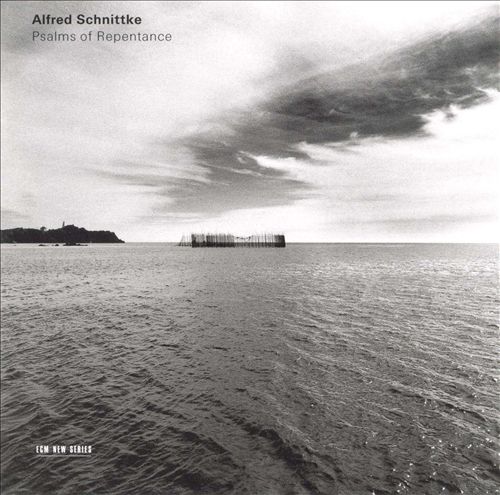
There is a coastal town in Japan, documented by video and performance artist Yamashiro Chikako, where a neglected gate runs off the land and into the sea (not unlike the cover for First Avenue). As the camera tracks its crooked slats and sagging wire, we watch it being swallowed by the waters, marking a border that no longer has any physical meaning. Alfred Schnittke’s Psalms of Repentance are very much like that indefinable territory: the border is there, and at one time provided utilitarian purpose, but has now transcended itself into the realm of the abstract, where it survives only in memory. Because repentance also requires a conception of time and the emotional projections that bind us to its passage, charting one’s hardships in the printed score becomes an exercise in faith, whereby divinity is converted into audible form.

These settings of fifteenth-century poetry were composed to mark the millennial anniversary of Russia’s Christianization. While not known for a cappella choral music, Schnittke unravels himself in these pieces like no other. Each numbered section is its own flower in a plot that only expands with each listen, pollinating the life (and death) of its totality. The heartfelt tenor solo in II, for example, strips us to our core with its solemn insistence, marking the earth like farmland: regular scars gouged into the skin of the earth, from which arise the flora of regret. Dark swaths of orthodox atmosphere and glorious resolutions make IV one of the album’s profoundest sections, and give us the clearest picture of their composer’s distresses and affirmations alike. Women’s voices often gather in dissonant streams of commentary, such as can be heard in VI, while VIII floats from transparency to opacity. There is a quality to these shifts and to this music that can only be described in simile. Like a bolt of light from between the clouds, it is but a blink of cosmic eyes that stills the heart because one cannot think of anything else upon witnessing it. The final Psalm is a singular implosion to behold, its subdued insights melting into a sinful world, a river running through the gorges of a landscape chiseled in the likeness of history.

The instrumentally minded arrangements are sensitive to their texts, while also drawing out inner relationships with such weight that one remains immobile. The album’s recording level is low, thereby necessitating a quiet space for listening, and heightening its more declamatory moments. Conductor Tõnu Kaljuste lends his leading hands to the Swedish Radio Choir, whose earthen sound drips with energy. This is contemplative music at its finest from a composer who continues to enchant, now and forever.

<< Egberto Gismonti Trio: ZigZag (ECM 1582)
>> Pierre Favre: Window Steps (ECM 1584)

Schnittke/Raskatov: Symphony No. 9/Nunc dimittis (ECM New Series 2025)


Alfred Schnittke
Alexander Raskatov
Symphony No. 9/Nunc dimittis

Dresdner Philharmonie
Dennis Russell Davies conductor
Elena Vassilieva mezzo-soprano
The Hilliard Ensemble
Recorded January 2008, Lukaskirche, Dresden
Engineers: Markus Heiland and Peter Laenger
Produced by Manfred Eicher

“It seems that the ninth is a limit. He who wants to go beyond it must pass away…. Those who have written a Ninth stood too close to the hereafter.”
–Arnold Schoenberg

Alfred Schnittke (1934-1998) is another in a long line of composers who have fallen to the so-called “curse of the ninth.” And while in Schnittke’s case the curse doesn’t quite hold water (it is, technically, his Tenth when one takes his Symphony No. 0 into account), the circumstances of its completion are prime material for the lore that surrounds such configurations of creative output. Regardless of how much we believe in the numerical significance of Schnittke’s Ninth, it was the last work he ever committed to paper. That he mustered the ability to do so after suffering four strokes, which had left his right side paralyzed, makes the work’s existence all the more enigmatic. Said debilitation forced Schnittke to write with his non-dominant hand, making for a virtually unreadable score. Famed Schnittke conductor Gennady Rozhdestvensky subsequently prepared, under apparently spurious authority, a “performing edition,” which Schnittke vehemently rejected upon hearing a tape of its performance. Following his death soon thereafter, the score was entrusted by widow Irina to one Nikolai Korndorf, a fellow composer who sadly died of a brain tumor before he was able to do anything with it. Irina then passed the work along to Alexander Raskatov, who felt so moved in his attempts to provide a more definitive manuscript that he added an elegiac fourth movement of sorts to Schnittke’s already monumental three in the form of the Nunc dimittis (“Lord, let thy servant now depart into thy promis’d rest”) that rounds out this landmark recording.

The visceral Andante that opens the Ninth—which, in Raskatov’s estimation, acts as a “voice from beyond”—is like a string of blocks sagging over time. Harmonies move from consonance and dissonance in fluid sweeps, their ambiguity neither inviting nor repelling us. If anything, they signal a maturity that accepts those experiences that embolden us through their difficulty as well as those that refashion us through their proverbial beauty. Schnittke preserves his special sensitivity for the orchestra, treating it at times as a solo instrument, as if each section were its own string, and at others as if those voices were so distinct that they existed only through the vast spaces that separate them. It is this constant balancing act that makes the Schnittke experience so alive with nuance, easily adapting to our changing temperaments. In such a world of sound there is no self yet stable enough to hold on to for a lifetime. There is only the constant negotiation of our own musicality and the indeterminacy that binds it. And so, when the timpani announces itself at last, it sounds less like a declamatory statement and more like the heartbeat of a feeble and weary body. The addition of a harpsichord in the Moderato as a sort of tangential continuo of times past is a perfect example of Schnittke’s asymptotic grace. It also gives the symphony a concerto-like pathos, ever offset by a cryptic aftertaste and recumbent winds. As a whole, the Ninth is dominated by scales, which take a most blatant turn at the tail end of the Moderato, during which a trumpet runs through a chromatic line (perhaps in acknowledgment of its pedagogical roots?) as a lead-in to the final Presto, where we hear this modal motif echoed in the strings, and again in the lone oboe that welcomes the harpsichord’s unassuming return. Such fundamental utterances are, I think, keys into the piece’s inner energies, and prepare us for the gentle letting down of its cessation.

Raskatov’s intriguing companion piece, written in memoriam, is scored for mezzo-soprano, men’s voices and orchestra. It opens with verses by Joseph Brodsky, a favorite poet of Schnittke’s, and imparts its remaining attentions to a text by hesychast Staretz Silouan (who ECM listeners will recognize as a name of interest on Arvo Pärt’s Te Deum). Raskatov delves deeper into Schnittke’s symphonic territory, trail-marking it with voices along the way. Brief outbursts from harpsichord and marimba, along with some Ligeti-inspired vocal articulations, lend a ceremonial cast to the glowing mood. Dense brass swellings recall Górecki’s Old Polish Music, while a watery gong and shadowy electric guitar work their way into an ending that is but a mirror image of its own intentions.

A professor once told me: “Only a fool would think the answer is the most important part of the question.” Such a statement suits the music at hand, if only because the death(s) it circumscribes are as inexpressible as my unworthy attempts to relate it to the silent reader. In this regard, the present recording may be a give and take for the Schnittke admirer. On the one hand, it lacks the conviction of, say, his often-hailed Eighth. On the other, listeners will delight in the familiar presence of his beloved harpsichord and mellifluous scoring. By far one of the most stunning ECM New Series entries, this album is a more than fitting testament to a glorious composer and an opportune introduction for another who, though not so well known, walks humbly in his shadow.

Giya Kancheli/Alfred Schnittke: Works for Viola and Orchestra (ECM New Series 1471)

Kancheli/Schnittke
Works for viola and orchestra

Kim Kashkashian viola
Orchester der Beethovenhalle Bonn
Rundfunk Sinfonie-Orchester Saarbrücken
Dennis Russell Davies conductor
Recorded November 1991, Beethovenhalle, Bonn (Kancheli)
Engineer: Peter Laenger
Recorded May 1986, Saarländischer Rundfunk, Saarbrücken (Schnittke)
Engineer: Helmut David
Remixed by Peter Laenger and Manfred Eicher
Produced by Manfred Eicher

This powerful record brings together two of the most seminal works for viola and orchestra of the twentieth century. Although these pieces are as different as they are similar, together they form a distinct balance of sentiment and execution.

Giya Kancheli: Vom Winde beweint (Mourned by the Wind)
Kancheli’s self-styled “liturgy” is an exercise in patience and surrender. Its opening slam of piano chords is a big bang in and of itself, and sets the stage for the soloist’s epic journey. Wilfred Mellers, in his liner notes, posits the viola’s emergence from such chaos as the “birth of consciousness.” And indeed, one can extrapolate from its startling abruptness the inklings of a life yet lived, fresh and devoid of self-awareness in the greater void of silence. The orchestra skirts the periphery, gradually uniting with the soloist. This contrast mimics the arbitrary stability of human values—at once sacred and mutable—so that moments of resolution always tread a downward slope. Luminous winds, a cosmic harpsichord, and trails of harmonics characterize the first movement. Brief horn blasts introduce the second, throughout which the viola wanders without fortitude into a minefield of piano and timpani, singing without carrying a tune. The harpsichord again works its galactic magic, feeding stardust into the viola’s arterial core. A passage of intense and sustained volume leads into an epic swan song. The third movement is brought forth on the strings of the harpsichord, the viola a mere flit of wings in the surrounding air. An oboe threads the hesitation like the beginning of an incomplete statement. The fourth movement is a violent implosion and balances out the first with its selfish gaze. As with seemingly every Kancheli composition, it ends as quietly as an evening breeze. One hears the rustling of leaves in the distance, only to find that it was a trick of the ears all along. Vom Winde beweint is rich with sharp dynamic peaks that are short-lived and sporadic, the hallmarks of an ode to process over progress.

Alfred Schnittke: Konzert für Viola und Orchester
For this monumental work, Schnittke has chosen to invert the standard concerto form, sandwiching an Allegro Molto between two Largos. The piece opens with a viola solo held aloft by shimmering orchestral waves. Every melodic line is like the root of an ever-growing tree of voices. In the second movement, the viola skips across a landscape of consonances and dissonances at the behest of a passively insistent harpsichord. Schnittke maintains the fascinating sense of rhythm and energy that distinguishes his faster turns, scratching at the surface of a larger unfathomable world. Harpsichord, flute, and viola congregate in a Mozartean danse macabre at the movement’s center. The strangely wooden pizzicato toward the end haunts as the piano jumps impatiently on its lower notes. The last movement gives the viola a demanding solo, which is eventually overtaken by horns and winds. A deep pause marks a change in intent. The harpsichord once again comes to the fore, the final cameo of a strong orchestral cast, before bowing to a beautifully dissonant double stop from the viola.

Schnittke would suffer a stroke just ten days after completing the score for his concerto.* Said the composer: “Like a premonition of what was to come, the music took on the character of a restless chase through life (in the second movement) and that of a slow and sad overview of life on the threshold of death (in the third movement).” Such narrative approaches to one’s own work speak of a pragmatic mind that seeks order in the flow of a creative life. Yet rather than a premonition, I experience the concerto as an affirmation of what one already knows. If Kancheli’s is an unanswered question, Schnittke’s is an unquestioned answer.

This is a profoundly emotional album, by turns confrontational and mournfully resplendent. Kashkashian brings her usual heartrending strength to even the subtlest gestures and is never afraid to betray the fragility of her pitch. The orchestras, under the direction of Dennis Russell Davies, are forces to be reckoned with that scintillate in a slightly distanced mix. A benchmark recording in all respects.

*My thanks to Christopher Culver for the correction.

<< Dmitri Shostakovich: 24 Preludes and Fugues (ECM 1469/70 NS)
>> Heinz Holliger: Scardanelli-Zyklus (ECM 1472/73 NS)