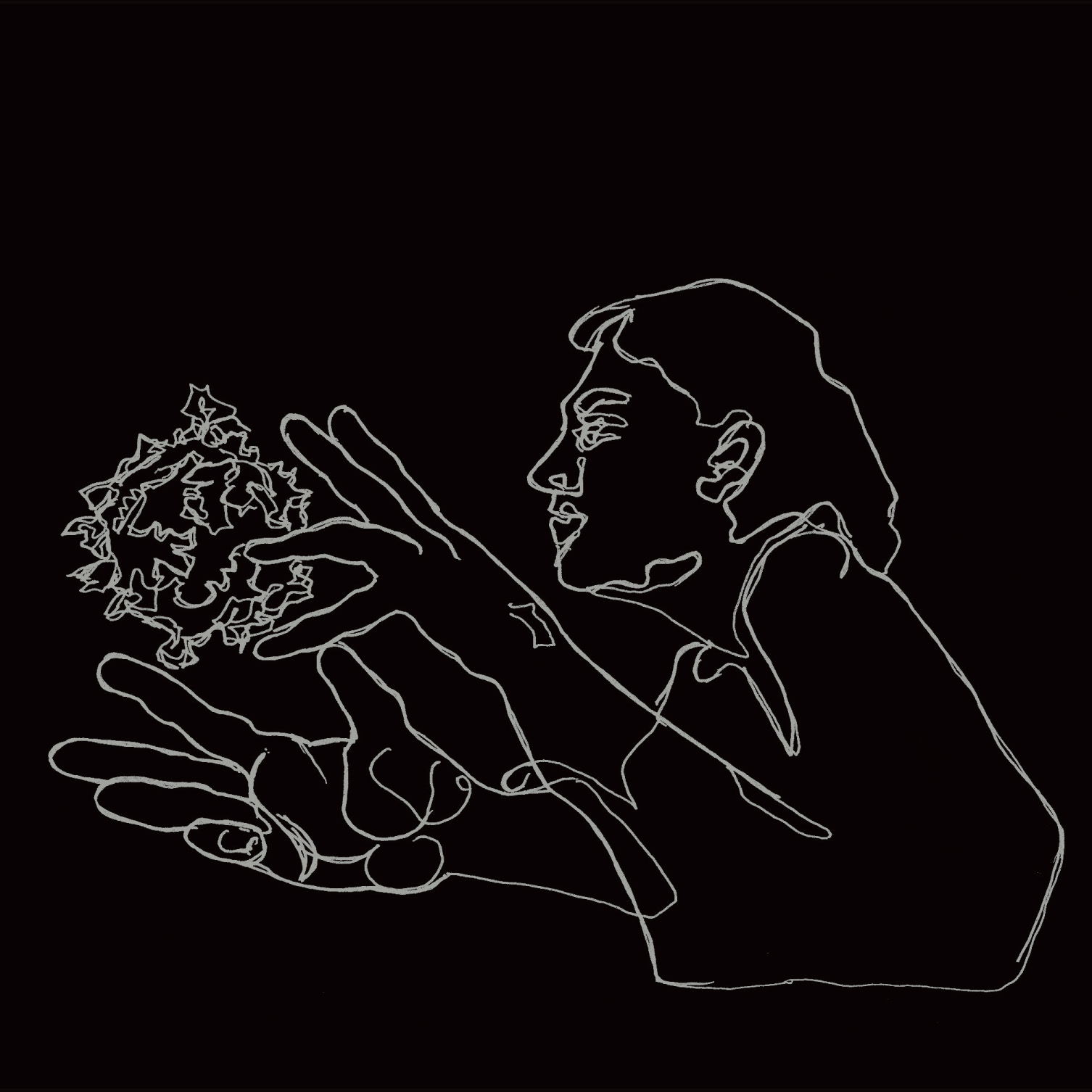
Alexander Berne & The Abandoned Orchestra: Flickers of Mime / Death of Memes

outside cover.indd

Alexander Berne is a world unto himself. Although this double album nominally features him and “The Abandoned Orchestra,” the latter is no more—and no less—than an expansion of self through the art of multi-tracking. Emoting through a variety of wind instruments, piano, percussion, and electronic treatments, he crafts brooding soundscapes for the discerning ambient listener. But don’t let the word “ambient” fool you. This is music that burrows with its own bronze sheen into the darkest corners of the soul and by that light inscribes reams of verses from makeshift biological desks.

Flickers of Mime is in eleven parts and is one of Berne’s most focused atmospheres yet. There is a magical consistency at work in the near-continual drone of Flickers I through IV, bleeding through psychological lattice with the persistence of solitude. Flicker V, however, transgresses a different skin altogether with its persistent, swirling luminescence. And yet, it doesn’t mark a turning point so much as a turning, period—a metamorphosis, if you will, of the self into an alternate signature. Overtly classical inflections speak not of earthly art but of an intergalactic pigment, whereby the unknown becomes the only frame of reference. By Flicker VIII we are caught in the machinery of linearly bound time. The electro-acoustic blend of crunchy break beats and organic breath forge enough heat in their center to turn dark matter into diamond. The flock of piano and reeds that is Flicker X gives glimpse into every occlusion, while the unconsummated matrix of the final Flicker gives rise to sinking.

Death of Memes is in nine parts. Its title comes from poet Michael Bonine’s sonnet sequence “August 12th, 1996.” There is indeed a feeling of raw poetry in the more industrial textures at play. From an introduction I can only describe as “comatose grunge,” it compresses anarchy into a single drop of ink and unfurls its dragon’s tail in a glass of water. This far more contemplative collection of impressions feeds on nutrients of the forgotten, the left-behind, the ruinous. Like the early tape loops of William Basinski, it embraces the aesthetic of decay as the only path toward completion. The sounds here are less locatable, more of a piece with outer spaces than with inner logics. In Meme VI the architecture begins to vibrate so intensely that it bends to the limits of its structural integrity. The droning textures are filled with promise, leaving the piano to resurface in Meme VIII like a floating dream, so that only in the final hour can angels touch their own ears.

This is asylum in sound. Welcome to your hermitage.

For more information on ordering, click here.

Alexander Berne & The Abandoned Orchestra: Composed and Performed by Alexander Berne

Composed and Performed by Alexander Berne

Although the word “enigma” refers to hidden meanings and messages, the music of composer-instrumentalist Alexander Berne discloses itself in starkness, not darkness. Nowhere so clearly as in this triptych of albums released in 2010 on the progressive Innova Recordings. Closest in spirit to the multi-tracked worlds of Stephan Micus, Berne’s universe expands well beyond the binary of flesh and spirit into geometries of neither.

The Soprano Saxophone Choir

The Soprano Saxophone Choir opens this 158-minute path by slowly melting away any obscuring hinges of expectation until the door falls away, leaving the listener between the infinity of two opposing mirrors. The ensuing soundscape unfolds a variety of topographical textures, each suited to its theme like light to color. The initiatory “Shores,” for example, paints miles of coastline with a minimal palette, evoking waters and coastlines with a fisherman’s intuition. It doesn’t so much tell as comport its story, as a dancer would favor gesture over pen. Yet it is not only bodies but environments themselves which move with mammalian self-awareness, moving stealthily through the sun and groundswell of “Gardens” and picking the “Hyacinth” that grows in its soil. What follows is a spectrum of nodes, moving from the isolationist jewel that is “Eschaton,” through the science fiction scope of “Reaches” and the ritual motifs of “Uhm,” and linking to the cellular origins of “Magic,” where modal poetry glows like desert canopy.

The Saduk

The Saduk takes its title from an instrument of Berne’s own invention. Something of a cross between a saxophone and a duduk but of a sphere all its own, it unfolds the very map charted on the first disc and adds names to its rivers, mountains, and geographical regions. The “Aubade” is a morning love song by name, a migration of geese and cranes reflected in sunlit waters that sets a viscerally focused tone, by which the tenderness of Berne’s performance sheds skin to reveal a syncopation free of clots in “Wanderer,” whereby the itinerant body reveals the lessons of its calluses and sunburns as if they were scripture. In contrast to this arid passage, “Clepsydra” (Greek for “water clock”) pours its liquid song from one vessel to another and back again in a droning piece that absorbs brief rhythmic elements to count the seconds. Filling the chasm framed by the eternal golden braid of “Sirens” (wherein one can hear the inner beauties of the saduk in all their glory) is Christo Nicholoudis, who provides vocals on two tracks: “Tridoula” and “Supernal.” His presence subtracts a feeling of architecture and substitutes cavernous breathing in its place. A stirring at the biological level.

The Abandoned Orchestra

The Abandoned Orchestra is Berne’s self-styled refraction, an expression of self that finds union in multiplicity. “Plumescent” is the first of seven steps into this more colorful anatomy. Pulses provide requisite traction, but feel almost accidental in their flips of grace. “Lustening” dips into Muslimgauze territory with its distorted break beat and fading reed lines, while “Kenosis” (another Greek word, this referring to the processes by which one empties the self to receive divine will) diffuses a mind interrupted by its own vocal desires. “Najash” refers to the snake in the Garden of Eden, enchanting with charmer’s croon but disappearing into the self-replicating spiral of “Arise” before being blasted into strands of infinity by the soprano saxophone in “Auriga.” Named for the constellation better known as the Charioteer, the latter does indeed pull its charge from one night to the next, unrelenting in its quest for fire.

Standing out like facial features along the way are three “Chronicles,” each a summary of what came before that treats every lilting line with the care of a mother bird warming her eggs. Averaging at 16.5 minutes each, they constitute a nomadic horizon at various stages of recession, and leave us wondering just how long it will take for our shadows to stretch until we step on our own heads.

For more information on ordering, click here.