Bill Frisell/Kit Downes/Andrew Cyrille: Breaking the Shell

With Breaking the Shell, the sixth release from the groundbreaking Red Hook label, producer Sun Chung has offered not merely a trio but a quietly seismic realignment of possibility. Electric guitar (Bill Frisell), pipe organ (Kit Downes), and drums (Andrew Cyrille) form a constellation that feels, paradoxically, at once unprecedented and long familiar, like discovering a new moon only to realize its gravity has pulled our tides all along. Chung, having cultivated relationships with all three musicians through previous ECM projects, sensed a convergence before any of the participants could name it. As Philip Watson writes in his liner notes, the trio exists “in a deep state of not-knowing,” a phrase that might just as easily describe the listener’s condition of being suspended between recognition and estrangement.

Recorded at St. Luke in the Fields in New York’s Greenwich Village, the music bears the acoustics of a space built for a resonance of spiritual persuasion. Here, sound doesn’t merely travel outward but returns, circling back like a question that grows more meaningful the farther it wanders. The trio treads honestly without ever falling over, even as it allows trips and stumbles to become part of its gait. There is no fear of imbalance. Instead, there is trust in the materials of the moment. And while one could easily linger on the rare combo or the grandeur of hearing the pipe organ in a chamber-like setting, once the album begins, such considerations dissolve. The instruments become porous vessels for a collective intuition.

The opening track, “May 4th,” emerges in a slow-rolling fog, the organ releasing a detuned drone that tilts gently against the ear. Higher notes graze the air with the soft certainty of fingertips tracing an old, half-forgotten symbol. Frisell and Cyrille enter as if waking from the same dream, their gestures swelling and receding in a space where time loops back on itself. The music feels exploratory—not in the sense of searching for what is missing but in allowing what is already present to unfold without resistance.

From there, the trio slips into “Untitled 23,” a meditation that cycles through scenes like a zoetrope, each revolution shifting character just enough to remind us of the fragile illusions we call continuity. The trio invites the imagination to wander alongside them, not as spectators, but as co-conspirators in the act of making sense of the flickering.

The journey then turns extraterrestrial with “Kasei Valles,” named for the vast valley system etched across the Martian surface. The music reaches outward with similar breadth: Downes’s organ stretches into horizonless zones while Frisell’s guitar, distorted into an adventurous rasp, scratches the underbelly of atmosphere. One can almost sense distance itself, not only as measurement but as emotional terrain.

On “El,” cellist Lucy Railton joins the ensemble, her tone a shaded river cutting through the organ’s cathedral-like glow. The track breathes with the warmth of a melody as an offered hand rather than a distant signal. Cyrille’s brushes sketch spontaneous star paths, while Frisell’s detailing elicits messages whispered from within.

The mood deepens further with “Southern Body,” perhaps the album’s most quietly radiant piece. It is an earth swell of potential energy, the sound of something enormous choosing rest over detonation. Downes releases ocarina-like tones from the organ’s upper registers that seem to summon the wildness nestled in even the most domesticated corners of ourselves.

The first of two traditionals, “Sjung Herte Sjung,” arrives as a turning point. Translating from the Norwegian as “Sing Heart Sing,” it mirrors the ethos animating the entire project: a willingness to let the voice rise unforced. Frisell’s modal wanderings feel like steps taken along an ancient footpath, one that continues to reshape itself beneath each traveler.

Between these landmarks lie hints of discovery, including the swirling interplay of “Two Twins,” whose energies braid together like strands of DNA before dissolving in a delicately percussive fade. “July 2nd” is a drifting lantern, its tender, fluttering textures slipping briefly into an electronic-sounding mirage, as if a synthesizer were dreaming of being an organ, or vice versa.

Cyrille’s own “Proximity” appears near the album’s end, its tender-footed steps guided by the composer’s trademark sensitivity. The brushes move not to clear a path but to reveal it. Finally, another traditional, “Este a Székelyeknél” (“Evening in Transylvania”), closes the circle. Its Hungarian melody (one that passed under Bartók’s orchestrating hand) dissolves into the trio’s shared air, a cultural imprint carried forward not by preservation but by transformation.

By the end of Breaking the Shell, the title reveals its shape. What breaks is not the world but the hard surface of clinging to familiar forms. Frisell, Downes, and Cyrille do not present answers, nor do they ask us to seek them. Instead, they remind us that unknowing can be a place of shelter, and that music—when allowed to move through its players rather than be moved by them—can form a thematic circle in which every beginning contains its end, and every ending nods softly back to the beginning.

Here, in this luminous setting, the shell breaks not with force, but with attention. And what slips out feels like truth.

Qasim Naqvi/Wadada Leo Smith/Andrew Cyrille: Two Centuries

Two Centuries is the second album from former ECM producer Sun Chung’s Red Hook label and may one day be regarded as its most defining release. As electronic musician Qasim Naqvi, trumpeter Wadada Leo Smith and drummer Andrew Cyrille put 11 of Naqvi’s tunes under their triangular microscope, the cells of our listening are magnified.

“For D.F.” opens with a political charge. Written for Darnella Frazier, who captured George Floyd’s murder, it uses distortions to evoke the white noise of our collective trauma. As subtle as this music is, with its near-comforting swells and honest lyricism, it offers not a moment of reflection but the reflection of a moment, a vivid gaze at a life lost on the brink of a society in turmoil. This is, perhaps, the deepest nuance of the titular centuries, the dividing line of which is drawn not numerically but on the shifting sands of justice.

What follows is a veritable tilling of melodies made possible as much through listening as playing. The foundation is often forged between Cyrille’s tools and Naqvi’s febrile choices of color. In fortifying each for harvest, they dip into disparate references. Hear, for example, the influence of Bryn Jones in “Sadden Upbeat,” while “Tympanic” recalls Sofia Gubaidulina’s String Quartet No. 4.

Contrasts in mood abound, ranging from sunlit (“Palaver”) to brooding (“Wraith”). “Bypass Decay” is of special note, chugging like a train against (and ultimately losing to) an encroaching night. Throughout, Smith speaks (e.g., “Spiritual is 150”) and sings (e.g., “Organum”) in equal measure, but always with a message to convey in the role of griot, reminding us of something spiritual, though severed from any particular tradition. As is evident in “Orion Ave,” where the free-floating hymn reigns supreme, faith walks these empty streets alone, trailing its shadow like a burden of care.

Andrew Cyrille Quartet: The News (ECM 2681)

Andrew Cyrille Quartet
The News

Andrew Cyrille drums
Bill Frisell guitar
David Virelles piano, synthesizer
Ben Street double bass
Recorded August 2019 at Sound on Sound, New Jersey
Engineer: Rick Kwan
Assistant engineer: Christopher Gold
Mastering: Christoph Stickel
Cover photo: Caterina Di Perri
Produced by Sun Chung
Release date: August 27, 2021

The News convenes drummer Andrew Cyrille, guitarist Bill Frisell, pianist David Virelles, and bassist Ben Street. One would never guess the ad hoc nature of the quartet (Virelles was a last-minute substitute for Richard Teitelbaum, who bowed out over illness) in light of the cohesions that abound from note one of “Mountain.” Its compassionate declarations describe a peak of sub-equatorial verdancy. Awaiting us at the top is not snow but a clear and sunlit promontory from which to gaze upon the path we are about to follow in subsequent tracks. This is also the first of three tunes by Frisell, whose “Go Happy Lucky” is rendered as an object of dark fascination in Virelles’s pianism, leaving “Baby” to shine for its continuity. As the epitome of this band’s approach to time and space, it glistens with the purity of a virgin spring.

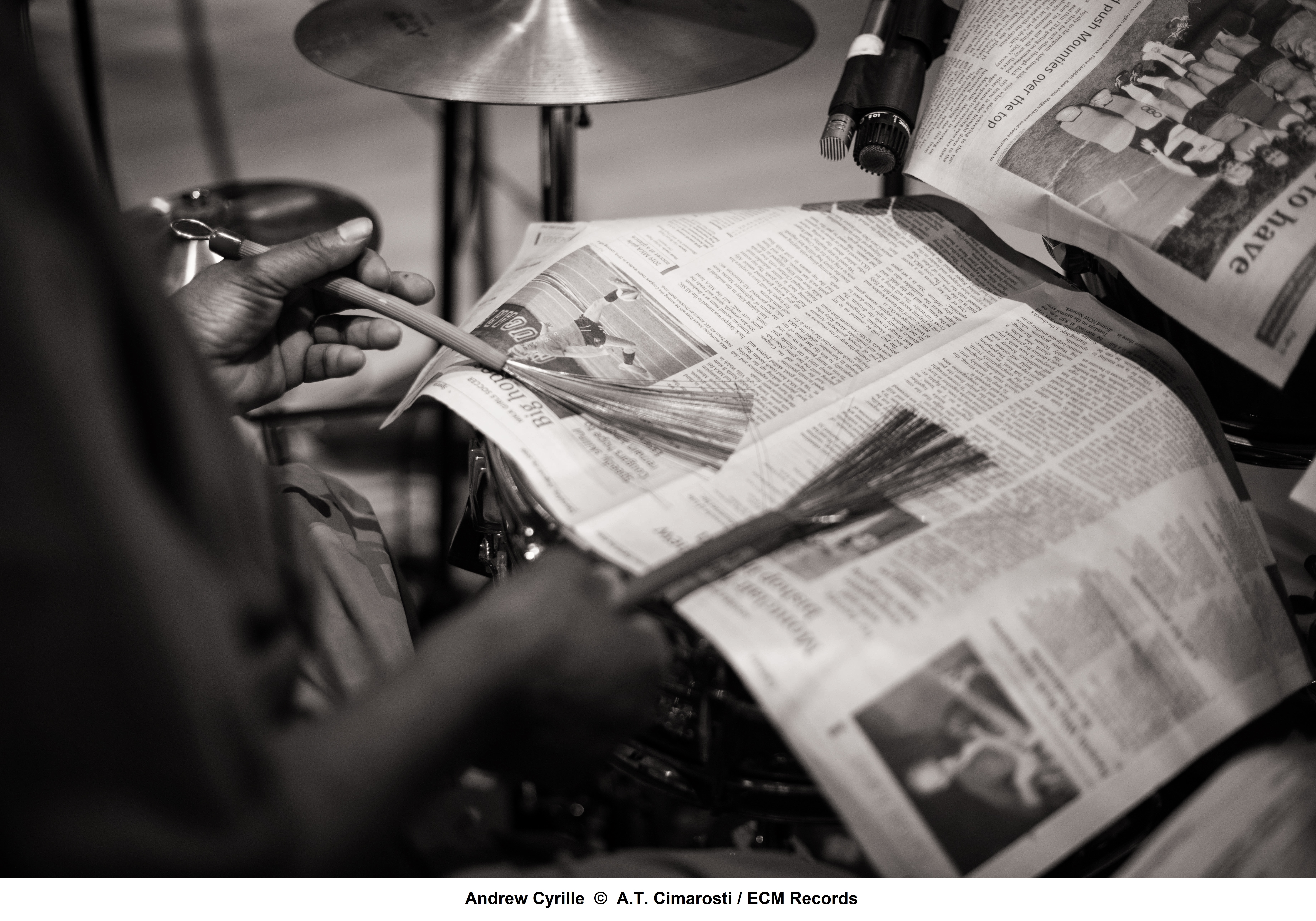
The title track by Cyrille dates back to the late 1970s and involves a newspaper-covered snare drum with rhizomatic touches from his bandmates. This brilliant turn hints at melody but sidesteps the commonality of expectation for the rewards of each unraveling moment. The bandleader further offers his balladic “With You in Mind,” which opens in spoken word. This sets up a late-night feeling from piano and bass, then shifts into Frisell’s meticulous speech-songs as warm organ undercurrents embody a respiration of the soul. Cyrille and Virelles detach in the improvised “Dance of the Nuances,” a delicate web of communication.

Where the pianist thinks outside the box in his playing, he shows restraint in the original “Incienso.” Along with “Leaving East of Java” (by AACM advocate Adegoke Steve Colson), it paints with flowers. In the latter, Cyrille’s cymbals work itinerant wonders as Street’s bass holds a steady watch in the background.

This production from Sun Chung (who has since left ECM to start Red Hook Records) is a masterclass in how jazz should sound when left to define a space. The recording is shaped by the languages we hear, translated out of—and back into—a universal tongue and the great equalizer of all things: nothing less than music itself.

Andrew Cyrille: Lebroba (ECM 2589)

Lebroba.jpg

Andrew Cyrille
Lebroba

Wadada Leo Smith trumpet
Bill Frisell guitar
Andrew Cyrille drums
Recorded July 2017 at Reservoir Studios, New York
Engineer: Rick Kwan
Produced by Sun Chung
Release date: November 2, 2018

When drummer Andrew Cyrille broke tension with The Declaration of Musical Independence in 2016, the universe seemed to beg for more. And so, with producer Sun Chung at the helm, he stepped into the studio again, this time retaining guitarist Bill Frisell and adding only trumpeter Wadada Leo Smith to the mix. Then again, “mix” is far from the appropriate word here, as the trio unifies under the influence of processes far beyond the stirring of some proverbial pot would imply.

Among the many excitations of Lebroba is the fact that it marks the first occasion for Frisell and Smith to record together. “Worried Woman” almost makes one lament this fact, as the two are clearly suited for each other, especially when bonded by Cyrille’s chemical reactions. This opening tune, written by the guitarist, is architected as preface to Smith’s four-part tribute to Alice Coltrane. Taking her spiritual presence as inspiration, and prompting the musicians via both graphic scores and standard notation, he leads as comfortably as he recedes, pushing terrain beneath him as an earthly treadmill. Frisell and Cyrille, meanwhile, deepen their cosmic relationship without the merest flicker of predetermination, opting instead for a freer correspondence within boundaries before breaking down the set to drums alone: a master class in psychosomatic response.

The bandleader’s title track, a fractured blues for the 21st century, reveals its treasures just enough to sense their shine yet without letting on the nature of their constitution. As in his “Pretty Beauty,” which ends things as they began, it erases as many words as it writes across a palimpsest of self-awareness. Between them is the spontaneously created “TGD,” which sounds like the autopsy of a laser gun performed by someone who’s taught the procedure a thousand times before. Its forensic qualities are superseded only by an overwhelming delicacy of intuition, which now more than ever touches the ears with unerring relevance.

Andrew Cyrille Quartet: The Declaration of Musical Independence (ECM 2430)

The Declaration of Musical Independence

Andrew Cyrille Quartet
The Declaration of Musical Independence

Bill Frisell guitar
Richard Teitelbaum synthesizer, piano
Ben Street double bass
Andrew Cyrille drums, percussion
Recorded July 2014 at Brooklyn Recording
Engineer: Rick Kwan
Mixing engineer: Rick Kwan
Produced by Sun Chung
Release date: September 23, 2016

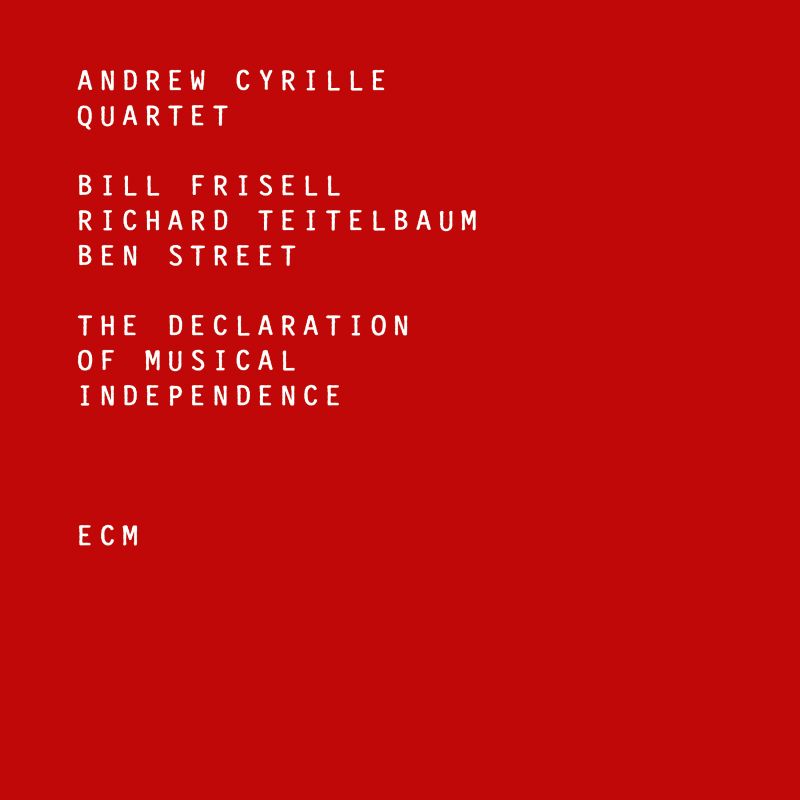
The Declaration of Musical Independence is more than drummer Andrew Cyrille’s ECM leader debut. It’s a veritable document thrown into the living waters of jazz history. Eschewing expectations by means of the very kit that courts them, he welcomes guitarist Bill Frisell, keyboardist Richard Teitelbaum, and bassist Ben Street for a faithful reading of his emergent articles.

Article 1: Centeredness is a Way of Life

John Coltrane’s “Coltrane Time” is match-lit helium in slow motion, treating the core as spinal. Cyrille sets the stage with his playful take on this Trane rhythm, threading it like a bead along invisible wire. Invisible, that is, until Frisell’s distortions flower like a tree of nerve impulses drawn with an anatomist’s attention to detail. It’s a feeling carried over in the guitarist’s own “Kaddish,” which by quiet dint turns brainwaves into melody.

Article 2: Understanding the Moment Means Understanding Each Other

This tenet is unquenchably expressed in three freer excursions. Where “Sanctuary” and “Manfred” look simultaneously within and without in order to braid connections of molecular value, “Dazzling (Percchordally Yours)” takes Cyrille’s own chordal suggestions as cues for spontaneous composition. Here, Teitelbaum’s textural approach to the synthesizer possesses the studio like a ghost in search of bodies through which to voice messages from some great beyond, only to end up the other way around: with instruments piercing its translucent skin by grace of sonic needlepoint.

Article 3: Treat Echoes Not as Symptoms but as Causes

Ben Street’s “Say” is the album’s one dose of symmetry. A riveting combination of liquid guitar, fulcrumed bassing, and drums so anciently brushed they feel like cave drawings, it eats resonance as if survival were otherwise impossible. Teitelbaum likewise divides his own “Herky Jerky” along bipartisan lines, engendering a rougher blush of purpose.

Article 4: Look Back to Listen Forward

The remaining pieces, both by Frisell, speak to this truth most deeply. Whether in the solo dream that is “Begin” or the concluding quartet of “Song for Andrew No. 1,” a philosophy of continuity prevails, drinking air like water, and filling producer Sun Chung’s masterful cast with diurnal plaster. All of which makes for one of the profoundest statements to fall under ECM’s purview in years.

Marion Brown: Afternoon Of A Georgia Faun (ECM 1004)

1004

Marion Brown
Afternoon Of A Georgia Faun

Marion Brown alto saxophone, zomari, percussion
Anthony Braxton alto and soprano saxophones, clarinet, contrabass clarinet, Chinese musette, flute, percussion
Bennie Maupin tenor saxophone, alto flute, bass clarinet, acorn, bells, wooden flute, percussion
Chick Corea piano, bells, gong, percussion
Andrew Cyrille percussion
Jeanne Lee voice, percussion
Jack Gregg bass, percussion
Gayle Palmoré voice, piano, percussion
William Green top o’lin, percussion
Billy Malone African drum
Larry Curtis percussion
Recorded August 10, 1970 at Sound Ideas Studio, New York City
Engineer: George Klabin
Produced by Manfred Eicher
Release date: November 15, 1971

A subtle congregation of clicks, pops, breaths, and whistles eases us into this challenging yet rewarding recording from a mobile group of musicians, many of whom—Jeanne Lee, Anthony Braxton, Chick Corea, Bennie Maupin, and Marion Brown himself—are now household names in the avant-garde circuit. Over 35 minutes we are treated to a distilled experience that jumps, flies, and slithers its way through a forest of sounds. The arrangements are heavy on reeds and percussion, with star turns from one severely abused piano and a smattering of aphasic human voices who seem bent on reducing all communication to wit and circumstance. The music is indeterminate and uncompromising and unleashes its full torrent only in the second movement, “Djinji’s Corner.” Slide whistles, snares, and bass join in the cacophony as a voice intones, “Listen to me. Can you hear?”—at last giving us some vocabulary to latch on to as we suffocate under a voracious avalanche.


Original cover

Not an album for the faint of heart, Afternoon is indicative of the brave decisions ECM was already making on its fourth release, and on it one begins to hear inklings of the space for which ECM would soon come to be known. It is also meticulously recorded. Every detail comes through (for example, when a percussionist picks up bell and rings it, we clearly hear it being returned to a cloth-dampened surface). Describing the sound of this album is, I imagine, as difficult as it was to lay it down in the studio. The sheer range of implied space is impressive, made all the more so for its organic textures. A masterpiece of free jazz and well worth the chance for the adventurous listener.

<< Paul Bley Trio: Paul Bley with Gary Peacock (ECM 1003)
>> The Music Improvisation Company: s/t (ECM 1005)