

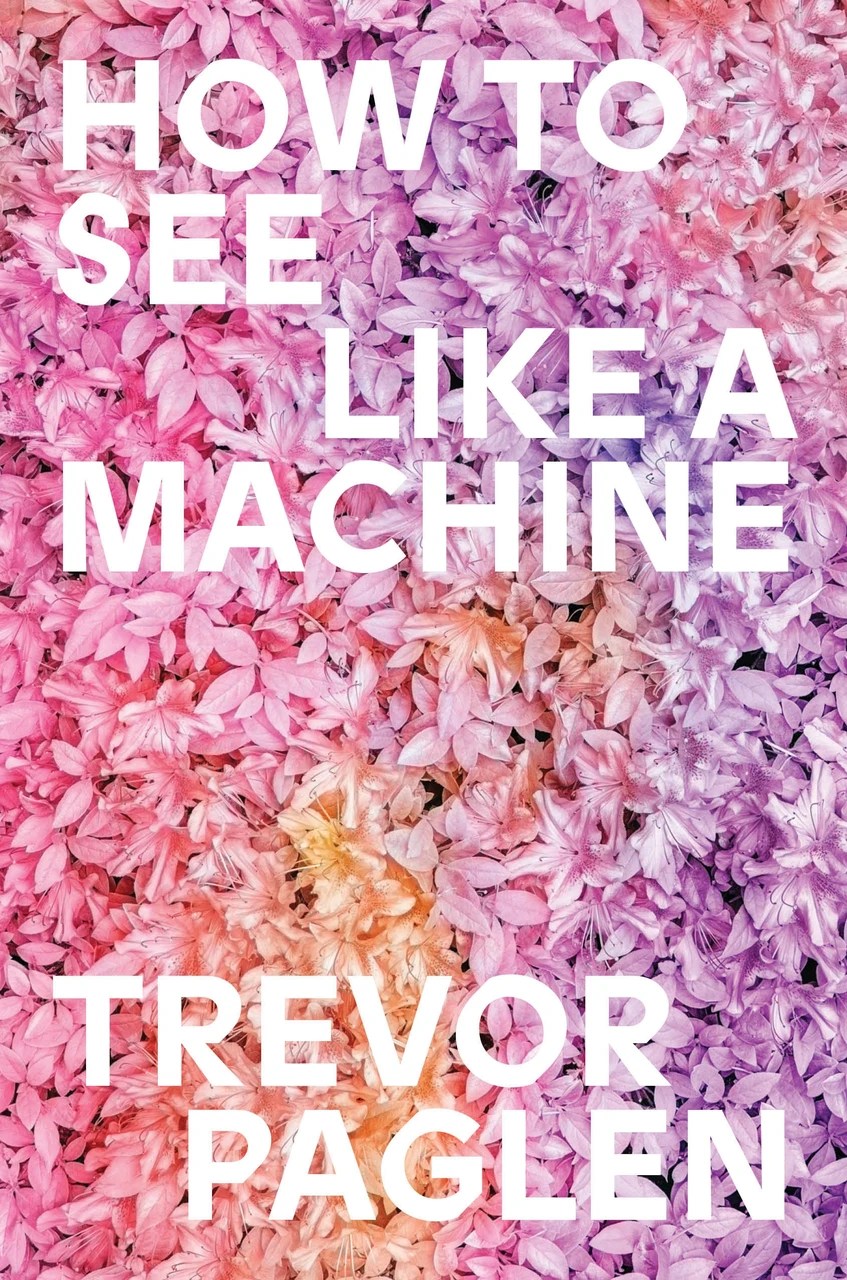
“There are now more cameras on planet Earth than human beings.” A curious arithmetic, given how thoroughly the eye has been enthroned as the guarantor of experience. For centuries, to see meant that someone was there, even if that someone could only be imagined through the image left behind. Now vision takes place without the consolations of a witness. A photograph can pass directly into coordinate data, then find its way back to the world as an instruction. The picture may never appear before a pair of human eyes, yet it can determine whose face opens a door or whose body invites suspicion. Somewhere between capture and consequence, seeing has detached itself from sight. Trevor Paglen’s How to See Like a Machine: Images After AI enters this dislocation with the curiosity of an artist and the suspicion of someone who has learned that even suspicion can be engineered. His central provocation concerns the fate of images after they cease to require spectators. Behind it lurks an even stranger question: When we speak of the inner workings of an algorithm, what qualifies as an inner? There is no private chamber in which the machine contemplates its findings, no secret eyelid folding over a remembered world. Yet something happens beyond our immediate access, and that interval has become one of the most consequential territories of contemporary life. We have built a new interior without inhabitants, then mistaken its opacity for neutrality.
Paglen arrives here by way of a computer vision framework called Chair, developed with collaborators in the early 2010s. A camera aimed through a studio window rendered streets and buildings into a mobile architecture of green lines. Cars acquired bounding boxes while faces dissolved into calculable expressions. The familiar scene was being quietly disassembled into a universe of features no pedestrian could inhabit. It recalls Jakob von Uexküll’s Umwelt, the meaningful surround constituted through the capacities and needs of an organism. A tick does not encounter the forest we admire. It finds a world articulated by warmth and the chemical trace of its next meal. Such worlds are neither incomplete copies of an objective landscape nor private hallucinations floating free of matter. They are modes of relation. Paglen extends this thought to machines, arguing that the sensors we construct establish the terms on which their environments become legible. Yet there is a philosophical splinter lodged inside the analogy. An organism lives the consequences of its perceptual limits. Can a classifier be said to have a world when it has no bodily vulnerability or stake in its own continuance? Perhaps its Umwelt belongs less to the machine than to the institution that designs it. The algorithm’s apparent interior would then be a delegated intention, a borrowed organ of attention through which distant authorities touch the surface of things.
James J. Gibson’s theory of affordances complicates the picture further. An environment offers possibilities for action relative to a perceiver’s capacities. A ledge affords sitting to one body and an impassable barrier to another. Perception, understood in these ecological terms, already harbors an incipient verb. Paglen’s machines radicalize that insight by severing affordance from the reciprocity of embodied life. For a facial recognition network, a face affords identification. For a license plate reader, the fleeting passage of a vehicle affords registration and a future knock on the door. Their worlds are assembled around authorized operations, with every feature waiting to become a task. What makes this arrangement so uncanny is that we occupy these constructed environments without necessarily perceiving their invitations. An innocuous patch of pavement may afford a camera an encounter that the person walking across it cannot refuse. The machine’s field of possible actions overlays ours, a second geography draped across the first, transparent only to those permitted to read its maps. To ask how a machine sees is therefore to ask whose purposes have been installed inside seeing, and who bears the cost when the world answers back.
The book’s decisive conceptual movement follows from this asymmetry. Paglen urges us to exchange representation for activation, abandoning the comfortable assumption that an image primarily stands for something. A digital photograph is fundamentally machine-readable. Before it becomes a luminous arrangement on a screen, it can exist as a file available to automated inspection and manipulation. The screen is an optional detour. In the vast circuitry of social platforms and industrial surveillance, images have become operational events, setting other processes in motion without ever needing to be understood as pictures. Here the old grammar of the gaze turns inside out. We no longer simply look at images. Images look at us, or, more exactly, systems enlist images to extract information about the people passing through them. The photograph in an album once preserved a moment against disappearance. Its contemporary descendant may follow that moment into the future, adding another entry to a dossier that changes what opportunities its subject receives. The image becomes a small administrative afterlife, an unfinished sentence whose final verb is conjugated elsewhere. And because its action can remain invisible, the usual politics of visibility offers scant protection. How does one contest a picture one has never seen, taken by an eye that has never needed to acknowledge one’s presence?
To understand the metaphysics of this arrangement, Paglen stages a mischievous encounter with René Magritte’s Ceci n’est pas une pomme. Magritte’s photorealistic apple refuses the equivalence of object and image, allowing meaning to proliferate in the gap between a painted thing and a linguistic declaration. A computer classifier, fed the painting, announces an apple with an assurance untroubled by surrealism. Paglen calls the resulting disposition machine realism. The machine’s declaration seems hilariously impoverished beside Magritte’s provocation, but that apparent foolishness conceals a formidable power. A classifier does not need to solve the riddle of representation to serve an automated sorting system. It needs only to place an input within a category that triggers the appropriate response. The philosophical complication comes afterward, when we realize that its certainty has material consequences. An apple rejected by an inspection camera may be diverted from the supermarket. A human face assigned to a category may be scrutinized or priced differently. Magritte’s cultivated ambiguity has entered a factory whose conveyor belts cannot wait for an answer. The joke turns on us. Our insistence that the machine has missed the point may itself miss the point of the machine.
Every classifier inherits a cosmology from its training set. Paglen’s account of ImageNet, assembled from millions of internet photographs and the nested categories of WordNet, makes the architecture of this inheritance unusually tangible. A taxonomy presents itself as an innocent solution to the problem of naming, yet its structure quietly decides which differences deserve recognition and which forms of life may be folded into the same drawer. Within ImageNet’s historical classification scheme, people were dispersed across racial designations and derogatory moral caricatures, while intimate identities appeared under demeaning labels. Such categories reveal an apparatus trained on culture’s sedimented injuries and granted the authority of measurement. The Japanese Female Facial Expression dataset offers a smaller, equally telling example. A handful of posed faces are used to construct a theory of recognizable emotion. Each photograph is assigned to a supposedly stable feeling, as though a woman’s expression could be detached from circumstance and reproduced as a universal psychological unit. Paglen’s point is not exhausted by the familiar warning that biased data yield biased results. The prior violence lies in the wager that reality comes furnished with fixed compartments awaiting discovery. Classification manufactures the stability it claims merely to record. To call a category universal is often to forget who had the power to write its definition.
This is why the book’s critique of machine vision moves so persuasively beyond the laboratory. Paglen follows automated license plate recognition into the municipal economy, where police departments and private contractors turn passing vehicles into continuously harvestable data. In his account of Vigilant Solutions, an ostensibly objective technical service becomes entangled with the collection of court debts and the extraction of money from vulnerable communities. The camera registers a plate. A database matches it to an outstanding fee. A local government discovers a revenue stream inside what had previously been an unmonetized instant of transit. Behind the frictionless interface is a deeply selective politics. People are individualized through exquisitely granular profiles, then treated as interchangeable instances of a bureaucratic type. Their specificity makes generalized discipline more efficient. The same logic enters delivery vehicles and retail stores, among other environments where movement becomes a metric and attention an asset. One begins to suspect that the alleged objectivity of automated sight has always been a costume for profit-driven appetites. What the camera sees with such miraculous accuracy is often whatever can be turned into a transaction. Far from merely describing the world, machine realism carves it into surfaces more easily seized.
Yet the book resists settling into a critique of databases. The deeper and more disquieting movement takes us into the alleged interior of images themselves. Early experiments in visual neuroscience suggested that cortical neurons respond to elementary orientations and patterns, from which increasingly complex perceptions might be assembled. Paglen recounts the notorious experiments of David Hubel and Torsten Wiesel, then Colin Blakemore’s work with kittens raised amid restricted visual stimuli. A kitten deprived of vertical lines could later struggle to perceive them. Sight emerged as an acquired choreography of neural responsiveness rather than a window installed at birth. These studies helped inspire a technological imagination in which computers might learn to recognize objects by detecting elementary features and building toward more intricate configurations. From AlexNet’s breakthrough in image recognition to the adversarial networks that began generating their own uncanny visual formations, the machine’s education was written in the borrowed vocabulary of nerves. The comparison remains illuminating only if we remember its limits. Contemporary neural networks are neither digital kittens nor transparent reproductions of biological sight, and the theory of perception itself has evolved far beyond those early experiments. The force of Paglen’s argument resides elsewhere, in the possibility that our images increasingly address the nervous system through its vulnerabilities rather than our judgment through its reasons.
The route from visual recognition to neural intervention gives Paglen some of his most startling pages. If images help activate patterns of response before conscious interpretation has finished its work, then the older dream of persuading someone through coherent messages begins to look quaint. The contemporary feed learns from hesitation and the fingers’ barely registered movements, refining its offerings around a portrait of desire that its subject never agreed to sit for. Paglen’s comparison with Nacho Cheese Doritos is both comic and exacting. Industrial snack food is engineered to recruit the senses beyond the modest business of nourishment. Networked images can be engineered toward an analogous excess, their textures and emotional cues calibrated for engagement rather than contemplation. He names the more aggressive possibility a cognitive injection attack, in which media exploit perceptual tendencies to elicit responses that evade deliberate reflection. The term risks lending too much coherence to a dispersed landscape of research and commercial experimentation. Still, it gives a troubling name to a familiar experience. We reach for the device before knowing what we hoped to find. We are the kittens, Paglen suggests, raised in perceptual enclosures whose narrow openings come to define the imaginable. Where, then, does the manipulated image end and the habituated mind begin? If the circuits that seize attention also educate the organ of attention, media have entered the very composition of the self.
Paglen’s excursion into magic reveals that this invasion of perception has a surprisingly elaborate prehistory. The stage magician John Mulholland, later recruited into the CIA’s MKUltra orbit, understood that deception succeeds by exploiting what an audience has already learned to overlook. An empty hand is effective because attention has been directed toward the other one. The secret of the trick resides in the spectator’s confidence that the visible sequence contains everything worth seeing. Mulholland translated these insights into covert techniques, while other researchers explored attempts to influence behavior through direct stimulation of the nervous system. Nearby in Paglen’s account stands ELIZA, Joseph Weizenbaum’s early chatbot, whose simple prompts led users to attribute feeling and intention to an arrangement of conversational rules. The magician and the programmer meet at a peculiar threshold. Both produce an apparent someone from a carefully arranged absence. Their effects depend upon an audience willing to complete the apparition from within. We tend to imagine the black box concealing a more sophisticated intellect than the visible output can disclose. Sometimes the supposed intelligence is our own, recruited without acknowledgment to animate the device. An algorithm can acquire the semblance of inwardness through the human habit of granting agency to whatever answers. The machine’s most intimate chamber may turn out to be the imagination we bring to its door.
That possibility becomes a political nightmare in the book’s extraordinary detour through UFOs and intelligence operations. Paglen revisits Richard Doty’s alleged disinformation campaigns around Paul Bennewitz, whose suspicions of extraterrestrial activity could be intensified by fabricated evidence and carefully staged corroboration. He also recounts Cold War experiments in electronic deception, including the Palladium program, designed to make adversarial sensors register apparitions that were never present in the form their instruments reported. The proposition is chilling in its simplicity. Make a system see what you want it to see, then allow its own authority to ratify the fiction. The dream of making anything appear as anything had entered the electromagnetic spectrum. UFOs become the ideal emissaries of this logic, hovering where a failure of evidence can always be converted into evidence of concealment. Paglen is most compelling when he treats these episodes as histories of managed perception rather than proof of some master conspiracy. His assemblage nevertheless requires a discriminating reader. Technical deception documented in government records is not evidentially equivalent to retrospective testimony or speculative interpretation. The book occasionally enjoys their proximity so much that the differences begin to shimmer. Yet this instability also exposes the dilemma it investigates. The better a manufactured revelation accommodates the desires of its audience, the more easily doubt becomes part of its sustaining mythology. Disbelief itself can be trained to serve belief.
Photography once seemed to offer an escape from this labyrinth through the authority of light. A photograph traditionally testified to a physical encounter between the world and a sensitive surface, claiming a material warrant that painting could never guarantee. While its indexical gesture could never claim innocence, the idea of a trace allowed an uneasy agreement between perception and external reality. Paglen brings this technological faith into contact with the suspicion of graven images in the Hebrew Bible. The prohibition recognizes how readily an image can usurp the authority of what it depicts, while prophetic tradition invests the divine Voice with the capacity to establish what must be believed. The camera, in modernity, appears to reverse that hierarchy. Seeing acquires a privilege formerly assigned to revelation. Yet the reversal may be less complete than it seems. Photographs have always required a surrounding apparatus of testimony and trust, an interpretive community willing to grant the trace significance. An image from Abu Ghraib can furnish evidence of atrocity, while its grotesque resemblance to religious iconography generates meanings no sensor could certify. The luminous record both exceeds and depends upon the circumstances of its making. Paglen’s account of generative AI unsettles this fragile covenant by permitting images to reproduce the aesthetic signs of photographic evidence without having passed through an equivalent encounter. Light survives as a style after losing its privileged role as witness. Its old authority remains available for counterfeit use.
The final chapter finds a remarkable laboratory for this crisis in the Archives of the Impossible at Rice University, where accounts of extraordinary encounters coexist with painstaking attempts to verify them. Paglen moves between the elaborate inventions of UFO claimant Billy Meier and the empirical archive of scientist Richard Haines, whose investigations seek a stable account of anomalous aerial phenomena. The photograph occupies the uncertain ground between them. It offers an apparent piece of the world while inviting belief to complete whatever the frame withholds. Paglen calls this condition superpositional, borrowing a term from quantum physics to describe images that remain suspended between competing possibilities until some act of interpretation fixes their significance. A photograph can sustain incompatible stories because no image delivers its own rules of interpretation. Generative media radicalize that condition, multiplying plausible appearances while weakening the tacit promise that a camera stood before the depicted event. The UFO photograph becomes a strange ancestor of the AI portrait, each carrying a claim on the real that exceeds what its visible marks can secure. An archive intended to preserve marginal histories begins to resemble a rehearsal space for ordinary experience. We have all become custodians of images that might testify or simply ask to be believed.
The book’s great achievement is to refuse the comforting notion that such uncertainty concerns images alone. Paglen’s examples repeatedly return us to the feedback circuit between perception and the institutions shaping its habits. An AI-generated photograph of a suffering child can circulate as evidence of a disaster that never took place, yet provoke actual donations or outrage. The image becomes consequential through the reality of the responses it solicits. Political actors need no longer persuade an audience that every detail is verifiable if an image confirms an emotional world already held to be true. Here the distinction between authenticity and efficacy suffers a devastating separation. Something may be demonstrably false in origin and nevertheless function as an engine of social fact. This is the darkest extension of Paglen’s movement from representation to activation. The image need not win an argument with reality when it can help rearrange the conditions under which reality is encountered. But the book also leaves room for a necessary objection. If every image is understood chiefly through the actions it triggers, we risk granting manipulation the status of a complete theory of seeing. The same perceptual openness that makes us vulnerable enables surprise and the recognition of another person’s suffering. Art can interrupt an inherited category rather than reinforce it. Ambiguity need not be a weakness awaiting exploitation but can be the beginning of ethical attention.
Perhaps this is what it would finally mean to learn to see as a machine sees. Such learning asks us to identify the procedures through which a living world is rendered operational, then recover what those procedures are designed to discard. We must recognize the machine’s immense power without attributing to it a consciousness whose absence conveniently absolves its makers. We must also resist the fantasy of returning to a pristine human eye, for perception has never stood outside mediation. As Bruce Wexler’s neurological account suggests in Paglen’s retelling, media help flesh out the beings who encounter them. We are permeable to the very instruments we devise, and our capacity to imagine alternatives begins inside that permeability. The most radical gesture may therefore be an interruption of automatic legibility, an insistence upon the unclassified remainder that refuses conversion into an action signal. Such a remainder includes hesitation and contradiction, along with solidarities that cannot be inferred from a face or priced from a pattern of movement. Paglen concludes by reminding us that material existence does not wait for our consent: “Fires, floods, hurricanes, collapsing ice shelves, and mass extinctions do not care at all whether we believe in them or not. Some superpositions cannot be sustained.” This sentiment restores a necessary resistance to a world seemingly made of prompts. Reality can be wounded without being persuaded. What haunts this book, finally, is the prospect of an eye so perfectly trained to act that it can no longer encounter anything beyond its instructions. To see otherwise may require us to preserve a faculty machines cannot be commanded to value, the capacity to be changed by what we have failed to recognize.

