

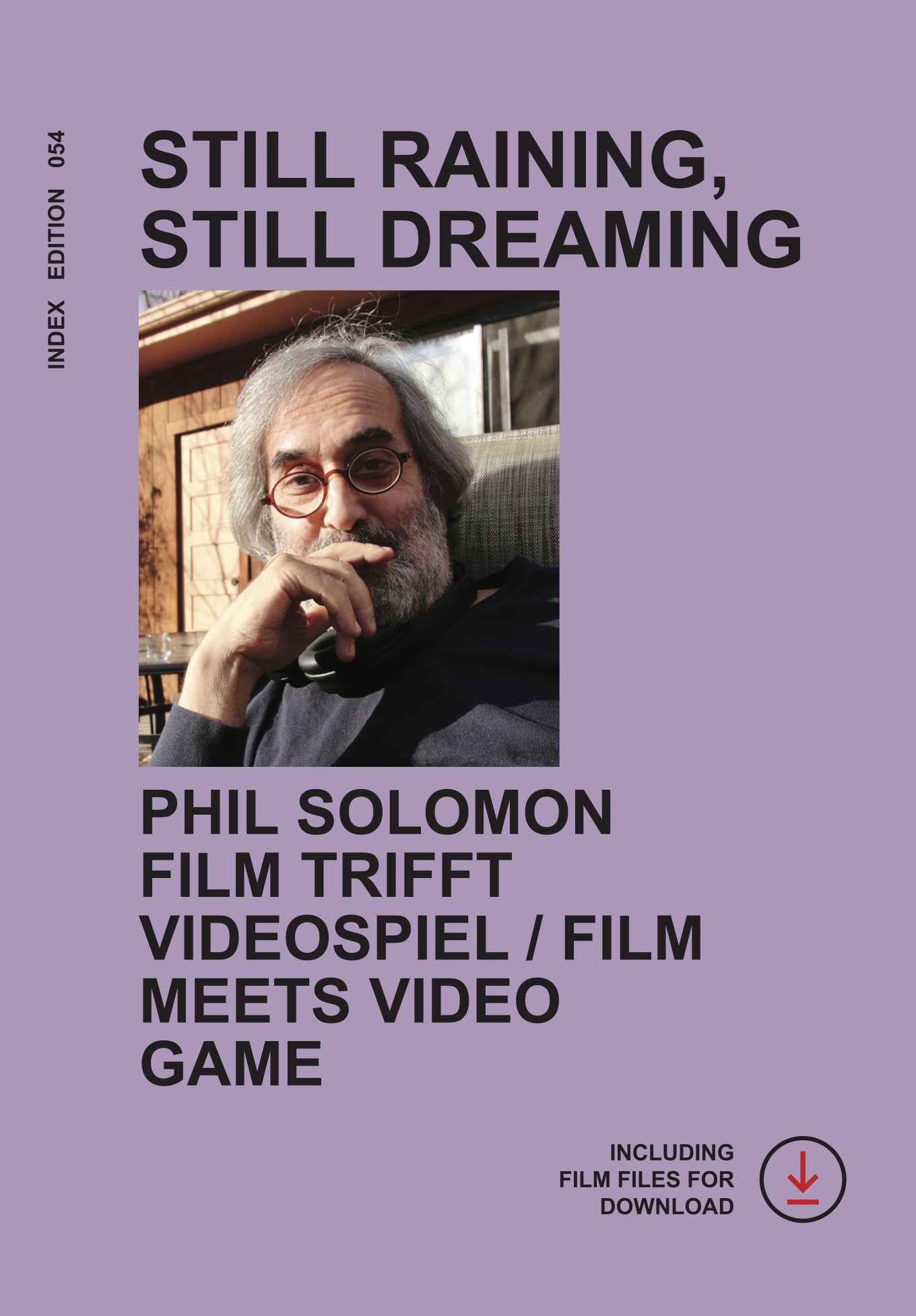
It is tempting, almost reflexive, to speak of an artist’s output as a body of work, as though its existence depends on assembly, arrangement, and, ultimately, externalization. Meanwhile, Phil Solomon’s cinema metabolizes audiovisuality at its most internal. His films are residues of contact, impressions left where perception has brushed against the world and recoiled. They seep from life, haunted by the fragile choreography between presence and disappearance.
Born in 1954, Solomon came of age artistically at SUNY Binghamton in the 1970s, studying under figures such as Ken Jacobs and Peter Kubelka, whose engagements with the materiality of film left an indelible mark. His own sensibility, however, slips beyond questions of influence. It pursues a kind of inverse archaeology, digging toward a vanishing point of the medium. Though often associated with found footage, even that term falters under scrutiny. As Eve Heller suggests, what he found remained inseparable from what had already been lost. His images carry the weight of retrieval, though never restoration. They arrive wounded, already slipping away.
This INDEX edition, gathering his final works, reveals a fascination with largely digital environments while remaining tethered to the tactile ghosts of celluloid. Solomon’s engagement with video games, particularly the Grand Theft Auto franchise, delineates sites of profound reorientation. These virtual landscapes, designed for velocity and spectacle, are slowed, hollowed, and made to mourn what he once called “the inevitable ineffable,” a phrase that captures a peculiar sort of alchemy. Seemingly disparate elements coalesce into something uncannily coherent, insofar as it exerts pressure toward a center that cannot be named.
Crossroad (2005) inaugurates this phase with an unresolved chord. GTA’s protagonist, CJ, drifts through rain and foliage, accompanied by an impossibly floating bouquet of flowers devoid of recipient. Everything hums faintly around him. Thunder cracks. A train sounds in the distance. Nothing answers his movement. He runs, stops, waits, stretches his limbs as if testing the fact of his own existence. The environment offers only indifferent signals. A bird crosses the sky. A plane cuts overhead. These nods to continuity are almost cruel, reminders that life persists elsewhere, just beyond reach.
Solomon’s collaborator for this project was his dear friend Mark LaPore, who died suddenly shortly after its completion. What follows in In Memoriam (Mark LaPore) unfolds as an extended meditation, stretched across three works drawing deeper from the well they tapped in GTA. In Rehearsals for Retirement, the digital realm saturates with grief. Rain falls with unnatural persistence. Acts are interrupted, deferred, dissolved into blackness before they can resolve into purpose. A hearse glides through fields where wheat stalks pierce its interior, a glitch that reads less like error and more like revelation. The laws of nature bend, fracture, and rearrange themselves, yet death remains unaltered, immovable, the single constant in a system otherwise given to distortion.
Last Days in a Lonely Place expands this desolation outward, layering fragments of dialogue from Rebel Without a Causeagainst a world emptied of its inhabitants. The cosmos looms with indifferent permanence. A cinema marquee stands blank, awaiting spectators who will never return. Figures drift toward one another but never meet, their trajectories misaligned by forces that remain unseen. Machines operate without operators. Vehicles sink without resistance. The environment continues going through the motions, stripped of intention. Meaning has migrated elsewhere, leaving behind a mere scaffolding of function.
In Still Raining, Still Dreaming, Solomon turns his gaze toward the overlooked margins of the game’s architecture. Spaces designed to be passed through become sites of prolonged attention. A magician performs for no one. Pedestrians move without identity, their individuality folded into patterns without flesh. Sound drifts in and out of earshot, marking an internal logic that resists interpretation yet insists on affect. What players once bypassed in pursuit of action becomes, under Solomon’s eye, the true locus of experience.
John Powers writes that these works mourn not only LaPore but also the passing of film as a material form, the replacement of chemistry with code. Solomon’s digital skins nevertheless bear the scars of physical media, their anomalies echoing the traumatic memory of scratches and burns in bygone emulsion layers. An underlying inquiry remains: What does it mean to fend for oneself in a context already at odds with itself?
This question finds a different articulation in Psalm IV: Valley of the Shadow (2013), where Solomon turns to the Elder Scrolls universe of Skyrim, stripping away characters to leave behind a landscape without bloodshed. The voiceover, drawn from John Huston’s adaptation of James Joyce’s “The Dead,” drapes the eyes and ears in inexorable meditations. Snow falls. Mist gathers. A lone figure moves through a forest that seems to recede the more it is perceived. An icon whispering to itself, an object of contemplation that resists interpretation even as it invites it.
The Emblazoned Apparitions returns to analog processes, though not as a gesture of nostalgia. Here, a molecular transformation implodes, turning the familiar into abstraction (and vice versa). The tunnel motif recurs, suggestive of both passage and enclosure, a space that leads forward while folding inward. Film reveals itself as an artifact of entropy that documents what it records along with its own disintegration. Technology thus becomes inseparable from mortality, each frame a testament to impermanence.
Across these works, Solomon’s cinema resists containment. It offers no conventional narratives, yet it avoids pure abstraction. It occupies an unstable territory between states, hovering on the brink of recognition and dissolution. His legacy lies in a mode of attention, an insistence on lingering where others would move on, on dwelling within the unresolved.
To encounter these films is to be drawn into a space where time loosens its grip, where cause and effect give way to something more diffuse. In this sense, Solomon’s work persists as a kind of afterimage, a presence that remains even after the screen goes dark. Perhaps it resides there, in a space where seeing becomes indistinguishable from remembering, and remembering from forgetting, until even those distinctions dissolve into something more elemental, a flicker without origin, a trace without end.

