

Ayumi Tanaka: Windflower (ECM 2859)

Ayumi Tanaka
Windflower

Ayumi Tanaka piano
Thomas Morgan double bass
Thomas Strønen drums
Recorded May 2025, Studios La Buissonne
Engineer: Gérard de Haro
Mixed by Manfred Eicher and Michael Hinreiner (engineer)
in Munich, 2026
Cover photo: Nadia F. Romanini
Produced by Manfred Eicher
Release date: August 21, 2026

The central tension on Windflower arises from our instinct to separate composition from improvisation, a distinction the music quietly renders distant. Japanese pianist Ayumi Tanaka is joined by American bassist Thomas Morgan, while Norwegian drummer Thomas Strønen completes a trio new in configuration yet deeply immersed in a shared exploratory language. Their pieces carry the poise of chamber music without surrendering jazz’s reflexive instincts. Each sound enters as a proposal whose meaning depends upon the answer it receives. Eight tracks were created spontaneously, while the bandleader’s “La Source” is opened like a book being read for the second time.

The title track gathers itself from fragrance and air, an entity whose roots appear to descend into a realm just beyond sight. The musicians stretch the frame until its concealed margins become visible. Strønen’s broad percussive sweep clears a path for Morgan, whose bass advances with the grave patience of footsteps crossing an abandoned interior. Tanaka occupies the unstable space between them. Her notes become shadows cast by objects that have not yet entered the room, and time loses its familiar sequence beneath her touch. Human narrative briefly falls short of consummation, leaving an opening through which another consciousness might discover the courage to live without inherited conclusions.

“La Source” enters that opening and converts it into a wellspring. Tanaka moves through a landscape of paper and ink, revealing the literary temperament at the center of her playing. Her phrases possess character development without characters; their plots become aware of themselves midway through unfolding and quietly revise the conditions of their existence. The trio moves as one body, viscous enough to retain memory yet open enough to admit illumination. Morgan gives the music a subterranean grammar, while Strønen punctuates its margins with marks written in disappearing ink. Above them, Tanaka touches the bellies of clouds only briefly, allowing us to experience descent as a slow-motion revelation.

The arboreal density of “From Us, To You” initially complicates the generosity promised by its title. Its canopy has grown thick with intervals and crosscurrents, yet nothing within it feels oppressive. The track offers shelter through bewilderment, inviting the listener to relinquish the fantasy that clarity must precede belonging. Strønen brushes against the bark of the piece, Morgan works among its roots, and Tanaka sends new shoots into an unseen height. Their revelry remains disciplined by an almost ceremonial attentiveness. When the ending bends toward the blues, it offers a secret door inside an old wound.

“Tree of Stars” passes through that door and discovers the canopy opening onto a vast celestial field. The title collapses the distance between root and constellation, giving the heavens a dark trunk through which their light can travel. Morgan’s sleepwalking bass acquires an oneiric eloquence, wandering without losing the invisible thread that binds it to the ensemble. Tanaka offers the melodic calm of a lullaby remembered by someone who never heard it in childhood. Along the periphery, Strønen’s accents shape time through delicate pressure, preventing repose from becoming stasis. The trio seems to understand that tenderness requires structure, since even a dream needs a body sturdy enough to contain its impossible architecture.

“Weaving” carries this architecture into finer and stranger materials. Its web refuses symmetry, behaving instead as a stained-glass window whose only pigment is air. There is no fixed center. Meaning travels across the strands whenever an opportunity for nourishment draws the whole design into sudden focus. Strønen’s delicate yet restless brushing becomes the vibration of a trapped insect transmitting distress through an instrument of extraordinary beauty. Within that signal lies a stubborn promise of life. Tanaka answers with fragments that catch the light, while Morgan lends anchorage to a structure built from near-weightlessness. The performance turns fragility into a method of perception: what trembles most intensely may also be what understands its surroundings best.

That sensitivity reaches a more turbulent form in “The Sea Is Still.” Strønen’s gift for color and texture rises to the surface, inspiring richly unsettled pianism from Tanaka. The title’s stillness becomes an irony too immense to remain verbal. Every wave appears to contain its own disappearance, and Tanaka follows each crest toward the point where motion begins to erase its maker. Morgan descends beneath the agitation, sounding out depths the piano can reveal only through pressure. The waters eventually yield treasure without value, an object freed from commerce because no language can decide what it is.

“Spring” turns the album’s flowing imagery toward ambiguity. Its title hovers between season and source, while the music inhabits both meanings without selecting one. Renewal emerges as pressure beneath the surface, a force searching for the smallest fissure through which to become visible. Tanaka’s phrases rise with lucid delicacy, then disperse before their outlines can be claimed. Morgan and Strønen give the piece an earthen resistance, ensuring that every emergence retains some knowledge of what confined it. In the final droplets, a rock formation appears bereft of foothold. Suspension becomes a destination in its own right, a ledge constructed from the absence of ground.

“Driftwood” begins with Morgan’s lumbering bass calling the other instruments into earshot. The image develops at the pace of an old film learning to adapt to new projectors. Energy accumulates until a nearly grooving current takes hold, though settlement remains impossible. Tanaka wanders across it with sovereign uncertainty, resisting every invitation to make the track more obedient than it wishes to be. Her independence never fractures the ensemble. Instead, it gives the shared motion a deeper integrity, since togetherness here depends upon each musician preserving the solitude from which genuine response becomes possible. Driftwood carries a history of forests without remaining a tree. The trio similarly allows form to remember its origins while releasing any obligation to return to them.

“The Dissolving Sun” brings the album’s inquiry into its most tender and unsettling light. Tanaka’s beautifully angular pianism loosens by degrees. A forlorn finality hovers at the fringe of consciousness, prepared to extinguish itself before the moon can formulate an objection. Morgan gives the vanishing body a final gravity, while Strønen traces the delicate perimeter where radiance relinquishes its name. Yet dissolution here carries no promise of transcendence. Instead, it must give itself over to the possibility that its veracity depends on another’s awareness.

In that surrender, Windflower reveals an ethical dimension within. Improvisation becomes the practice of entering another person’s uncertainty without colonizing it, while composition offers a structure strong enough to protect that encounter. Perhaps every life arrives as written material and survives through the ways others decline to play it exactly. The trio’s deepest lesson concerns neither freedom nor fate alone, but the care required to touch an incomplete statement without deciding how it must end.
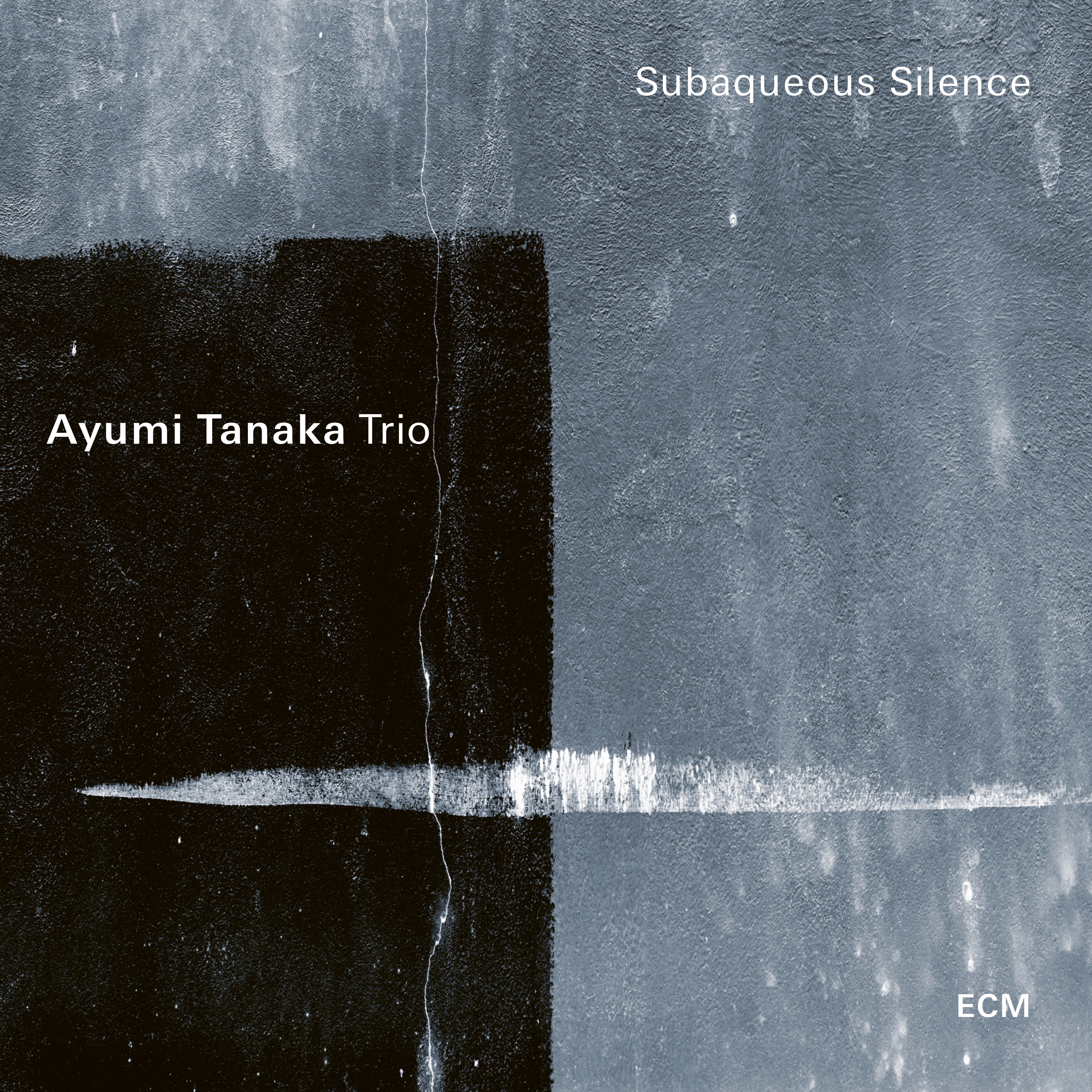
Ayumi Tanaka Trio: Subaqueous Silence (ECM 2675)

Ayumi Tanaka Trio
Subaqueous Silence

Ayumi Tanaka piano
Christian Meaas Svendsen double bass
Per Oddvar Johansen drums
Recorded June 2019, Nasjonal Jazzscene Victoria, Oslo
Engineers: Daniel Wold, Ingar Hunskaar (mix)
Cover photo: Thomas Wunsch
Mastering: Stefano Amerio
Album produced by Manfred Eicher
Release date: October 29, 2021

Following her introduction to the ECM constellation via Thomas Strønen’s Time Is A Blind Guide, and more recently in her appearance alongside the drummer and clarinetist Marthe Lea in Bayou, pianist Ayumi Tanaka shines her starlight as leader across a spectrum of humbling atmospheres. In the hands of her bandmates, bassist Christian Meaas Svendsen and drummer Per Oddvar Johansen, Tanaka’s music for trio introverts the form in a way that makes us feel subcutaneously placed as listeners. Thus, we can immediately detect her appreciation for molecularity. Any ECM admirer will understand that this concept is suited to the label, where suspending articulation in favor of physics is an almost sacred leitmotif. I asked Tanaka in an email interview whether her approach to space is a conscious decision:

“In the process of making this album, I always aimed to answer my fundamental question: ‘What would I like to hear?’ As a result, the music has space to invite silence, allowing us to hear sound surrounding and within us, and take note of musical sound more deeply, when it arrives.”

That image of arrival is a profound one to consider in the album’s opener, “Ruins.” For while it does take precedence by virtue of being our doorway into Tanaka’s sound-world, it has been singing long before we encountered it, as it will continue to when we leave it. For now, we have its attention, sharing a room as lines with neither beginnings nor endings invite us to float somewhere between inhalation and exhalation. Brushed drums and understated bass evoke creaking trees and winter-kissed leaves while the piano speaks in the language of silhouettes before shaking the boughs of their snowy dusting and moving into the future with echoes of the past in its arms. Holding these images in mind, I ask about Tanaka’s connection with the natural world:

“Since I was a child, I always enjoyed being in nature and listening to its sounds. When I am in the forest, listening to the birds, water dripping, the trees shaking in the breeze, I feel that it is more perfect than music—everything is harmonized. I am trying to learn from the sound of nature. I would like to create music that would resonate with nature.”

We hear this as much in “Ruins II” as in “Zephyr.” Both speak of landscapes vaster than can be expressed under a single title. The depth soundings of the latter improvisation for piano and malleted drums evoke the debris of human action, swirling like so much dust in the winds of collective memory. Hence “Black Rain,” a picture of time’s ablution against the wrongs of our political missteps. While the title, for me, evokes the postwar novel by Ibuse Masuji, Tanaka sees it as about more than Hiroshima and Nagasaki:

“There are things we need to learn from the past and need to carry with us to end and avoid more wars and conflicts.”

This message of hope wavers in every shadow of Subaqueous Silence. Its purpose is indeed broader than specific tragedies would have us believe; it is a formulation of the human condition written in the ink of experiential harmonies. These are the underlying tensions of “Ichi.” Here is the singularity of existence unrolled like a scroll on which a single human life has been recorded with varying levels of realism. Where one moment might find a flash of childhood rendered in vivid clarity, the next only hints at an experience too painful to bear with whispering brushwork. In that sense, I find myself wondering how (and whether) aesthetic considerations are central to the flow at hand. Given that Tanaka was born and raised in Japan and has lived and worked in Oslo for the past decade, it would be easy to draw bicultural conclusions along those lines. This characterization, however, may be far too concrete to inject into the processes documented here:

“I am not sure if I want to have an aesthetic of my music at this point in my life because I want to discover something in each moment. Being in the moment and dedicated to the music is something I am always trying to do. ‘Find your own voice’ is something that Misha Alperin, an amazing pianist and my mentor, was always saying to me. It stays in my mind and I am always seeking that. All my experiences in Norway definitely had a big influence on my musical expression. On the other hand, since I moved to Norway, the more I have sought my own approach and the more I have started to realize my deep Japanese roots and to appreciate the beauty of Japanese culture, especially in art and music. Delving into two such different cultural environments is a gift that has shaped my musical expression.”

By way of example, “Towards the Sea” teaches us that a journey is nothing but a chain of small ones linked to form a retrospective trajectory. Every gesture tells a story within a story until only single words are left to stand in for memories. This implies, too, that music is a universal language and an appropriate medium through which to explore these modalities. Tanaka agrees:

“Since I was 15 years old, I have seen music as a ‘universal’ language. When I was invited to perform my compositions in Germany, I was very moved by this experience because I felt that universal language at work. Music is a gift. It consoles us, questions us, gives recognition of something within us. I am hoping that people experience my music in their own way. I hope I will be able to give something to someone through music because music has helped me in life.”

The title track is the culmination of all of this and more: gestures born in climates, geographies, and eras that are as much drawn together as pushed away by the distances that separate them. With a heavying presence and biological self-awareness, it works its percussive prayers in the sunlight of a future age when dreams are the only things that will be real. This is the music of aftermath and new beginnings wrought in earth, stone, and wood. It searches, unafraid to share its discoveries so that we might know the honesty in which they were embraced, then freed. Instrumental highlights abound, but their cohesiveness goes against the spotlighting of “solos” or moments of interest. Surely, this connectivity cannot exist without the trust of her bandmates and producer?

“I am very lucky to have the trio members who have built trust and respect over the years. I think Christian and Per Oddvar are really good listeners, not only musically but also in general. They are open-minded and flexible in their capacity of accepting things in each moment. Christian and I were studying at the Norwegian Academy of Music at the same time, and Per Oddvar is the musician who we had been listening to. Given our common education in improvised music in Norway, I think we naturally evolved a mutual understanding. In addition to that, we happen to have common interests in ancient Japanese music, arts, and culture. It reflects on the way we play the music together. Also, the music Manfred has produced is one of the strongest reasons I am here now. I deeply appreciate his trust and confidence in my music. That personal recognition is something I carry with me.”

Said extends to the listener who, while not present during the recording, is retroactively invited to absorb every reaction as it emerges. Such intimacy is rarely given and primes our ears as pages for inscription. And so, in the wake of these expressions, I find myself returning to the question of finding one’s voice:

“Facing myself is often hard, especially when I am working alone, but it is rewarding. The joyful element is when I find my voice through collaboration with others. I think it’s natural that our voices change because we are changing all the time through all the experiences we have. I am working on finding my own voice with the hope that my musical expression becomes deeper and deeper every day.”

Let this be the first step of that staircase.