

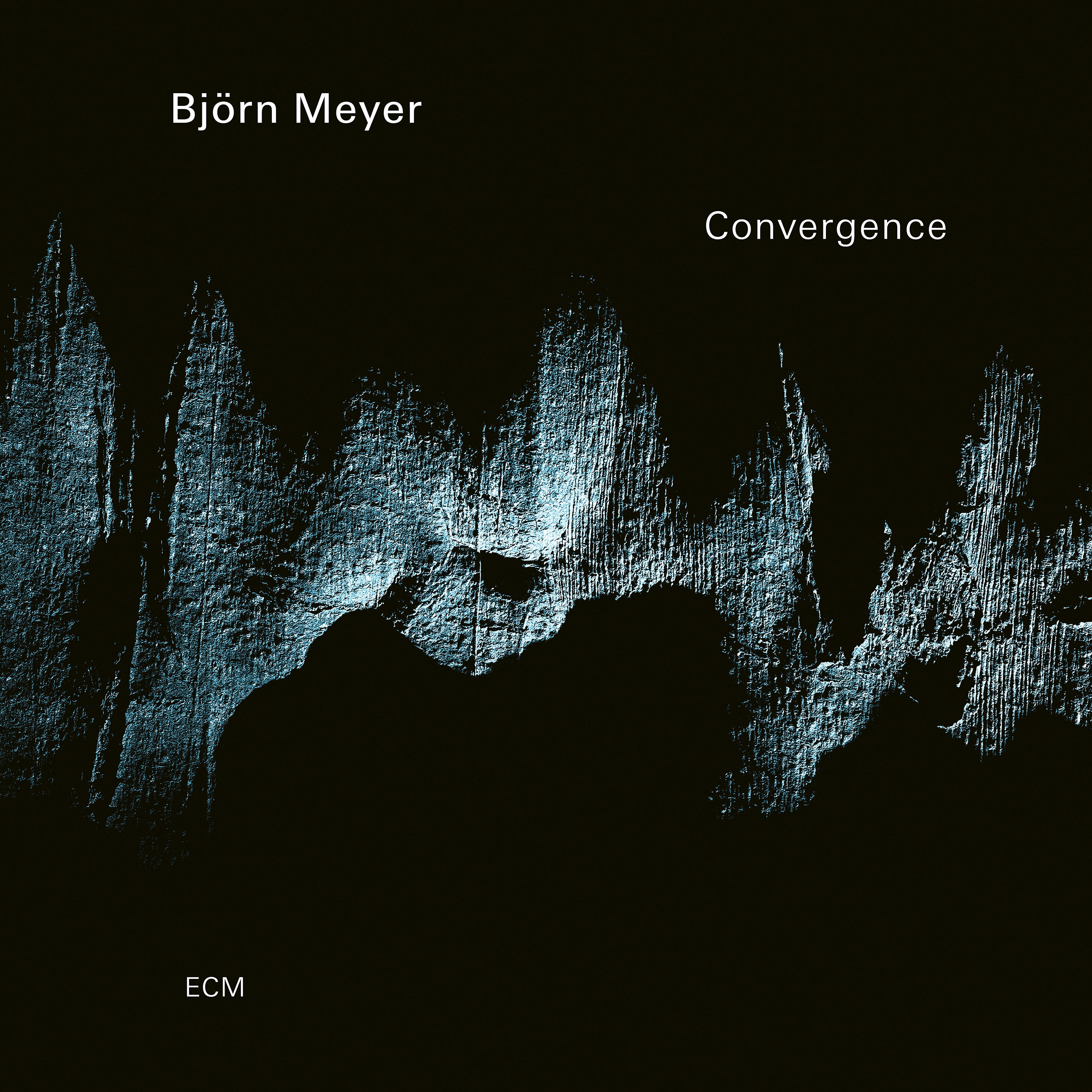
Björn Meyer
Convergence
Björn Meyer 6-string electric bass
Recorded September 2024
Bavaria Musikstudios, München
Engineer: Michael Hinreiner
Cover photo: Jan Kricke
Produced by Manfred Eicher
In the wake of 2017’s Provenance, Björn Meyer widens his territorial reach on the six-string electric bass with a second solo album that feels less concerned with claiming ground than with listening for its contours. His ever-deepening attunement to space and the forms that allow it to exist becomes the true subject here, and his skills are offered not as a display of mastery but as the slow emergence of a language still discovering its grammar. What might initially register as post-production illusion reveals itself, upon closer attention, to be articulated in real time through a deft choreography of live effects. Magnets prepare the instrument for unfamiliar conversations, finger tapping redraws its internal architecture, and entire washes of sound are permitted to overtake the listener in search of calm.
The album opens with its title track, setting a narrative in motion while refusing to pin it down. Each encounter reshapes the story, rearranging its implications without altering its essence. A fuzzy tone carries a gentle spirit within it, one that moves the way sediment drifts and resettles after a glass of wine has been swirled. Notes surface in reverse order, establishing a tonal context in which the debris of this slow-motion tornado can be articulated through pointillism. The resulting shape and flavor recall Steve Reich’s Electric Counterpoint, though here the patterning feels provisional, animated by a restless urge to stray just as readily as it returns. Deeper strums and higher callings exchange roles, and the sky above the music darkens by degrees, one shade at a time.
As the climate of “Hiver” briefly brightens the scene, it emits a particular quality of light, the muted radiance that arrives under an overcast sky on the verge of snowfall. In this moment, it becomes clear that the narrative forming across the album is inward-facing. This is not the documentation of a journey so much as the journey undertaken by the one who documents. When the echoing bird calls of “Drift” begin to tug at the soul, they do not ask for permission. Direction is accepted without resistance, and the listener seeps further into the flow of time, less a passenger than a dissolving witness. “Gravity” resists the comfort of arrival altogether, suspending any promise of destination in favor of an elliptical song that bends back on itself. Meyer’s guitaristic approach draws a rose’s worth of texture and fragrance from the bass, unfolding petal by petal until only the stem remains. In “Motion,” it becomes a receiver tuned to a distant transmission. Subtle glitches and pulses trace the heartbeat of another time, and when that signal falls silent, only an echo remains to confirm it ever existed.
With “On Hope,” fluttering wings and a tactile fuselage lend lift to the album’s vessel, suggesting ascent without insisting upon it. Just as the cusp seems within reach, a malfunction intervenes, pulling everything back into the improvisational clang and hum of “Rewired.” The interruption does not feel punitive but necessary, a reminder that flight depends on friction as much as flow. When the circuitry is restored and life resumes its forward momentum, “Magnétique” extends the promise of repair. Its circular motifs and palpable sense of contact arrive as a blessing to worn ears, sound reconnecting with touch. That promise finds its fulfillment in “Nesodden,” which lowers itself not into sleep but into a state of awakening, discovering tenderness in the act of becoming and allowing that discovery to stand on its own.
This music reaches us only after its initial blaze has already passed, its transient glory having dispersed into silence somewhere beyond our reach. What remains is not absence but residue, an ember glow that warms the present without explaining itself. To listen is to accept that distance, to recognize that meaning does not diminish as it travels, and to sit quietly with the feeling that something vast has chosen, briefly and generously, to make itself known.

 Between Sound and Space: ECM Records and Beyond