BIRD by Christina Rauh Fishburne (Book Review)

Between the covers of BIRD, Christina Rauh Fishburne offers a chapbook of moving images and emotional tableaux using words as her pigment and a keen sense of observation as her brush. Her prose poems are stories just beginning to petal open in the light of a reader’s eyes, each as fragrant with densely packed information as a human cell.

The scenes are as distinct as the verses describing them. While there are plenty of aerial views to take in, Fishburne dives ever inward as the pages flip by. From a scarecrow-stuck field and private garden to a dressing room and mollusk’s shell, she combines just enough ingredients to make a meal of the lesson at hand and consume it before moving on to the next.

Personalities plant their stakes along the way. Whether in the crow’s stark altruism, the albatross’s maritime legacy, or the barn owl’s untranslatable scream, the indifference of bare life to examined life renders our concerns at once universal and meaningless. This doesn’t mean we are always looking through nonhuman eyes; it does mean we are asked to consider how that gnaws at the ego.

Whereas impossibilities feel organic (“The sun was still and straight as a cowboy”), renderings of the quotidian and the agricultural (there is, for example, repeated mention of barley) feel starkly out of place, as if nature were only a construction of those who infringe upon it with the cutting of blades, the striking of matches, and the pulling of roots.

While the mood is generally retrospective, sometimes regretful, a certain resilience shines through with mounting clarity. Even darker passages like “Pheasant” embalm a youthful wonder that never seems to burnish. “Oyster Catcher” is a masterstroke of parental anxieties (“My child will be born quite soon. I receive her messages in sudden desperate grasping. She must be like me. She doesn’t like to be inside”) and confinement. In it, the pearl—for us, a sign of beauty and value—is a natural irritant, a bauble of sacrifice and forced honor that never quite reflects the visage of its wearer. 

Signposting our journey are four “takes” on the gull. Their encounters with wounded yet resilient souls court the temptation to exaggerate or revise personal narratives. Fishburne continually seeks such hypocrisies, throwing intimate spotlights on them to ward us away. Elemental touchpoints also throw the occasional roof over our heads. Of these, “Water” gets at the heart of the collection’s worship of transfiguration. We take a lot of turns together yet come out the other end with scars to show for our survival.

The animal, insofar as it reflects the human, has more self-awareness and investment in the world than we might think. The human, insofar as it reflects the animal, loses itself in rote survival. “There’s nothing worse than a flightless bird,” Fishburne tells us, giving us hope to build wings of our own from the scraps of lived experience.

Bird is available directly from Kattywompus Press here.

Brian Evenson: Father of Lies (Book Review)

In chapter 3 of Genesis, Satan makes his first cameo. By that point, God has commanded Adam to eat freely of every tree in the garden, with one proviso: “But of the tree of the knowledge of good and evil, thou shalt not eat of it: for in the day that thou eatest thereof thou shalt surely die.” Appearing as a serpent, Satan approaches Eve instead, echoing those fateful words on his forked tongue, “Yea, hath God said, ‘Ye shall not eat of every tree of the garden?’” So begins a chain of doubts and deceptions, tethering itself eventually to Father of Lies, the first novel by Brian Evenson.

Eldon Fochs is base but not basic. As a provost representing the local “Bloodite” Mormons, he commands respect, trust, and honor within his community. Yet the serpent’s voice rings in his ears like the vibrations of an empty skull. Empty is the operative word to describe Fochs, who serves as a willing vessel for that most ancient of mariners, steering the flesh into one fatal port of call before the winds of protection fluff his sails onward to the next.

Monitoring his disembodied crew of “loud thoughts”—not voices, he insists—is therapist Alexander Feshtig, at whose urging he unravels some of the fray of his childhood, passing off acts of violence as “dreams” and lightening his dark load in the face of uncertain accountability. Feshtig’s notes and battle of letters with his superiors (all of whom have a stake in keeping allegations of child abuse and murder under wraps), along with Fochs’s self-indulgent accounts in the first person, make for a morbid compass, the magnetic north of which points directly to the alter ego Fochs calls “Bloody-Head.” The latter’s interventions guide him into territories so wicked that he cannot help but come full circle into correction—or so he tells himself whenever the quotidian world seems poised to catch up with his perversions. Bloody-Head is neither a consequence of dissociative disturbances nor a projection of internal desires. He is, instead, the great tempter whose name and visage have been rendered for millennia on rock walls, stretched canvases, and human skin. And once he’s settled, no one dictates how long he can stay.

As a character study, Evenson’s narrative is a half-step removed from lived experience. His debut short story collection, Altmann’s Tongue (1994), prompted a critical response from his own Mormon leaders, who felt its frank sexual and thematic material went against the grain of doctrinal propriety. Refusing to succumb to their pressure to stop writing, he left a teaching job at Brigham Young University and the religious organization it represented. Although the seed of Father of Lies was already planted, this turn of events seems to have provided the increase. Here, he returns to those broken pieces, scrutinizing them in the light of retrospection and fashioning a catharsis of fiercely intimate proportion.

Seeing how far the church will gladly protect Fochs, lying to avoid soiling the undergarments of the Faith, hits close to home for me, too, as a survivor of spiritual abuse. When Fochs insists, “I know sin inside and out,” I believe him, if only because he is able to engage in that most horrific of illusions whereby he simultaneously swerves the wheels of innocent lives into oncoming traffic and sits behind the headlights that blind them moments before death.

Turning the secret into the sacred—or, if you prefer, treating the wrong as if it were right—is the only method of forgiveness by which Fochs can operate. Every killing is a “favor” to save a wandering sheep from reprobation, an act of such profound sacrifice that only a man of his supposed courage can bury the conscience so deep that its voice is muffled beyond recognition. And even when flowers of truth begin to bud from the rot, they are robbed of their fragrance before being given a chance to bloom. Thus, Fochs’s place on Earth is assured by the dint of a metaphysical contract. He knows his destination. Might as well destroy as many lives as possible on his way down. Feshtig puts it best: “Hell is crammed full of godly men.”

There’s no surprise in the ending, if only because we’ve seen it play out too many times in reality. The only spoiler here is Fochs, whose actions touch upon a sobering truth of the human experience: our addiction to crisis. Ignoring all the little (and not so little) signs that something is off gives us an excuse to swoop in as the savior when our complicity hits the proverbial fan. Therefore, what on the surface appears to be a slow burn of Mormonism soon forges a mirror in which we are asked to regard ourselves accordingly. Killing the body is one thing, killing the soul quite another—and how often we deny our readiness to flirt with that second sin!

The end effect of our time with Fochs is a scar. Whether in the anger one feels over the shuffling of apostolic cards or a child’s cry for salvation finding only the ears of her perpetrating father, the royal flush of revelation will abrade your heart as the conclusion lays its winning hand. After all, at the betting table of life, there’s nothing more frightening than a dealer who thinks himself righteous beyond reproach.

Paul Griffiths: Mr. Beethoven (Book Review)

If fiction is the art of revivification, then let Mr. Beethoven be one of the most self-aware products of its wonders. The 2021 novel from Paul Griffiths grafts archival leaves to branches of nourishing speculation to imagine a journey the German composer might have taken in 1833 (six years after his death) to America to finish an oratorio on the Biblical figure of Job.

Although the Handel and Haydn Society of Boston indeed considered commissioning such a work, the only motif of it we will ever know may be articulated in the mind’s ear as we read of its stumbling fruition and premiere. Written in a narratively and stylistically episodic style and using only statements recorded as having been uttered by Der Spagnol, it unfolds not unlike his Ninth Symphony, building a dome’s worth of clouds one wisp at a time until the light of something divine pushes its way through to illuminate the ground at our feet anew.

If any of this sounds too good to be true, that’s because it’s too true to be good. Whereas the “real” Beethoven—as if the persona of that name weren’t already enigmatized by our constant recapitulations—reads to us today like the quintessential poète maudit, he marks the zoetrope of this book in moments of pandering frustration but also, more importantly, cadenzas of openheartedness, interpersonal profundity, and sheer delight.

Hints of a holistic portrait shade the opening act, wherein we encounter Beethoven as an enigma aboard a ship in the Atlantic bound for New England. He is a figure rendered by charcoal in intercontinental candlelight rather than oil in the Roman sun. “A stare, from a stranger,” we are told, “can be a flooding of humanity through whatever dams of difference.” Thus, we see and feel through the eyes of characters as fleeting as their target’s evergreen status. Such moments point to one of the novel’s most brilliant aggregations of historical impulse in Griffiths’s ability to articulate Beethoven before his place in the canon, itself in flux at this point, was assured by the validation of hindsight. By the same token, it emphasizes the unique disjointedness of place one experiences at sea before making landfall in realms of emotional economy. Says the muse of takeaways: Recognition is never universal.

By the time he gets to Boston, Beethoven’s dishevelment reads not like a caricature of the man but as the ravages of a harrowing journey. When encountering subsequent dramatis personae, we view them as he does: in his polite disinterest in Lowell Mason (responsible for the commission), in his enjoyment of Quincy under the auspices of hostess Mrs. Hannah Hill (a widow in whose company the bee legs of his heart collect no small amount of pollen), in his disappointment with the Reverend Ballou (a dismal librettist whose failures end up provoking a textual revival), and in his enchantment with Thankful (a sign language teacher and interpreter variously dubbed his “ear” and “amanuensis”). Every instance in which Herr Beethoven shakes a hand, exchanges words, or consumes a morsel of food reinforces the illusion that the music is imminent.

Each chapter is a composition unto itself. Whether in his iridescent vignette on the Fourth of July or in the careful construction of possible yet unprovable interactions, Griffiths sews his story with a leitmotif of concerns that make it clear he is wrestling as much as we are with the implications of his reality. While Chapter 32 is almost entirely footnotes, 33 only dialogue with dynamic markings, and 38 a single run-on sentence, these artifices never feel out of place or contrived. Each is a libretto unto itself for a musical work yet to be written.

From the selection of voices to travails with the local punditry, the story arc is pulled like a shuttle through looms marked by clefs instead of wooden frames, culminating in a virtuoso performance from musicians and Griffiths alike, as the author provides a full text for the oratorio, interleaved with reflections such as:

“To this Boston audience, the music is untoward, beyond familiar reference points, and yet at the same time wondrous, perhaps most of all in its successions of harmonies, how they float, swerve or dive while also proceeding forward inexorably, how they keep their sights on that one sure path while sometimes veering to the side or soaring high above, carrying their first listeners into new air.”

The book’s constant fourth-wall breaking may be its greatest pleasure. At one point, Griffiths even invites us to call him out on his conceit, only to retreat further into its fascinating depths. Hanging on what-might-have-beens (“it could all so easily have gone a different way,” “Scraps of paper might have survived,” etc.), he is content to vary his approach to the theme at hand as a seasoned improviser at the keyboard.

Among the many things to adore about Mr. Beethoven is that it sidesteps the trap of forcing a creative swoon. Unlike The Agony and the Ecstasy, whose Michelangelo rhapsodizes in the presence of unhewn marble, itself a cipher for escape, we get none of the romantic privilege of the artist at work. Hints of influences, witting or not, also make this a joyful effort. Top notes of James Cowan’s A Mapmaker’s Dream and Thomas Pynchon’s Mason & Dixon and a splash of Umberto Eco in the middle make way for a powerful dry down that leaves plenty of room for Griffiths’s base notes to settle in the nose for the long haul. In the latter vein, nods to his own work (“Let me tell you,” says Mrs. Hill at one point, naming his Ophelia novel) remind us of who is telling the story. Setting aside such comparisons leaves us with a three-dimensional object to regard in the light of our hopeful imaginations. The more we turn the key, the more it can sing when we let go. 

Like the composer, we hear nothing yet feel every note.

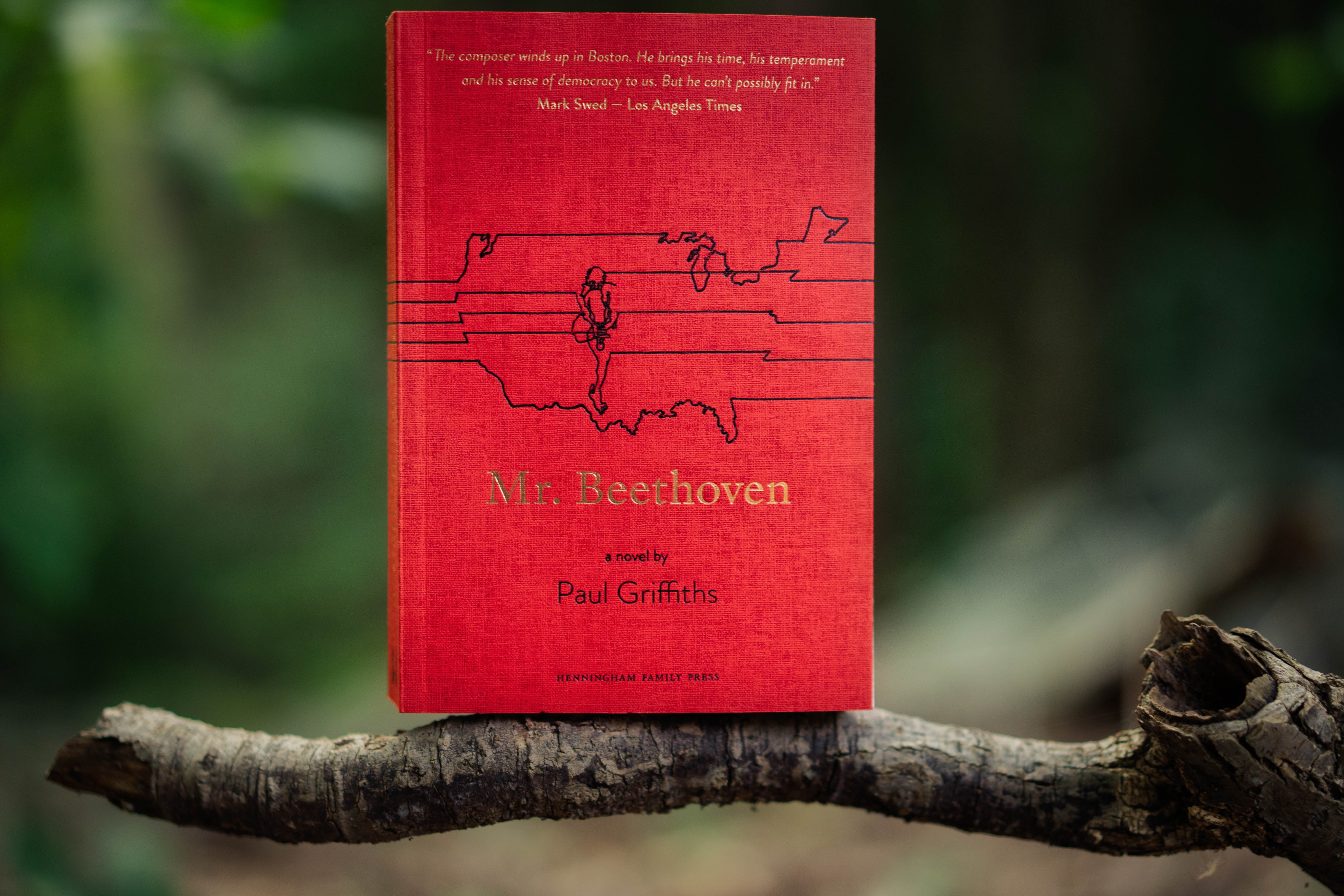
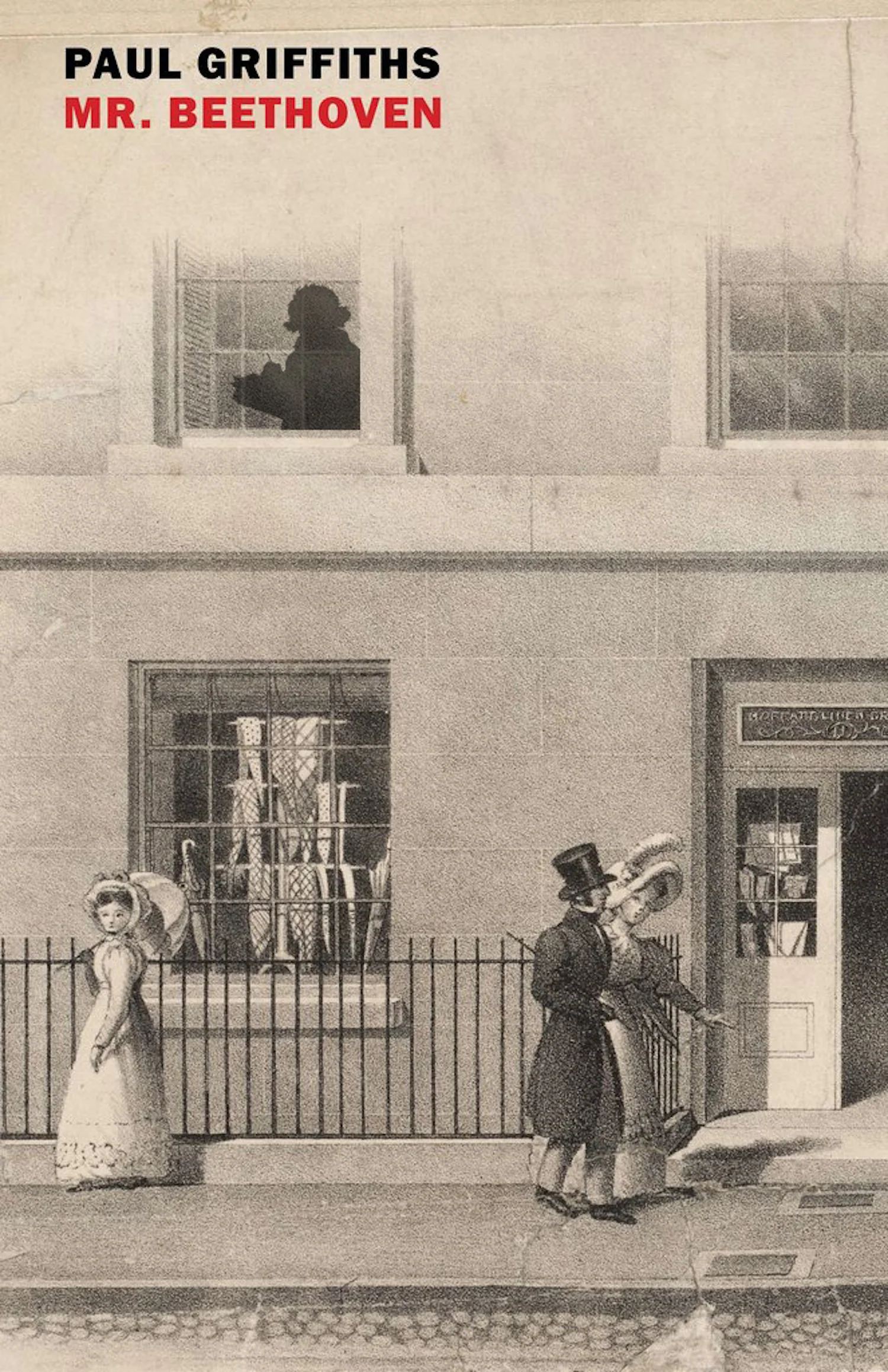
Mr. Beethoven is available from New York Review Books (pictured below) for those in the U.S. or from Henningham Family Press (pictured above) for those in Europe.

Ana Reyes: The House in the Pines (Book Review)

It was as if they had opened a valve and all the pain, fear, and anger of those days had issued from their chests and rolled onto the street, rising into a terrible shout to the thick black clouds above.
–Isabel Allende, The House of the Spirits

Trauma wears a coat of iron. It trips into the body when one least expects it, wrapping itself on the way down in a protective layer so soundproof that it becomes unknowable even to the self. With time, however, its minor key drifts within earshot, begging for the major strains of a token anthem known as “Moving On.” Such prefab resolutions to the pain we carry inside feel intensely tailored to individual circumstances until we realize they bear the scars of ancestors whose breath still hangs heavy in the air. Although their voices are lost to the burial ground of history, we continue to exhume them in the hopes of putting their bones back together. But without the flesh to connect them, they fall into piles of dust the moment we let go.

When destruction befalls an entire race of people, even before the word “genocide” enters our collective vocabulary, its wickedness thrives in the shadow of our unwillingness to accept it. And yet, something lingers, a sundial’s shadow following the same slow arc across a stone marked by the positions of celestial bodies. Except now the stone is a page, its shadow the ink it has absorbed to convey stories of ourselves. This is the essence of literature. And so, let us begin to imagine that one page becomes ten, that ten becomes hundreds, and that a cover and a name whorl into shape. The leaves part, and the light angles itself just so, hinting at what is to transpire.

An Outward Look

“Deep in the woods, there is a house that’s easy to miss.” So begins The House in the Pines, the debut novel from Ana Reyes. Like the titular house, itself a major character whose lungs inhale the emotions of her protagonists and antagonists and exhale the distillations of their overlapping traumas with the depth of a fireplace in its capacity for memory, she holds the key. Thus, Reyes points to a core construction not only of her conceit but also of fiction as a contract between author and reader. In building these things one element at a time, she clues us in on her piecing together of personalities and the world they inhabit.

Our guide, once removed from omniscience, is Maya, a 25-year-old graduate of BU who works at a gardening center while her partner, Dan, pushes his way through law school. As a couple, they are typical and atypical. The former in the sense that they want what most people in love want (to make a home together, find meaning in each other, and build a future to replace the past), the latter insofar as Dan’s unabashed honesty—a rarity in her lived experience—is a mirror she has yet to find elsewhere. Its reflection at once repels and attracts her, illuminating vices that may or may not be within her control. For the time being, things are relatively stable—that is, until she encounters a mysterious piece of security camera footage online in which a young woman drops dead inexplicably. Disturbing in and of itself, if not unusual in viral fare, what grabs Maya’s attention is the man in the video, Frank Bellamy, an ex whose face might have remained subconscious had not its unmistakable features courted her memories from the screen.

Even before this interruption, Maya has been papering over the cracks. Like an eggshell, the structural integrity of her life relies on equal pressure applied to opposite ends. Any maldistribution thereof means she is at risk of breaking. Wracked by sleepless nights, she “could easily draw from memory the shape of every water stain on the ceiling,” indicating a dichotomy of comfort and monotony stemming from the same source. Through flashbacks, we witness her friendship with Aubrey, who also happened to die in Frank’s presence seven years ago.

A further scan of the surface of things reveals other details amiss. Maya’s struggle with antidepressants is clarified early on, as is her insistence that Frank is somehow responsible for the death of Aubrey and the girl in the video. That no one believes her encourages a cycle of doubt that keeps one foot on the hamster wheel of justification. If we are going to trust Maya, we must first seek the evidence cobwebbed in the darkest recesses of her mind.

She returns to her hometown hoping to learn more about this second death and the enigmatic Frank, whose involvement, she maintains, is more than coincidental. She has set herself on a path toward a truth that even she might not be prepared to wield as her own. The rest is for you to discover.

An Inward Look

One sign of any honest work of literature is not how well you understand it but how well it understands you. In this respect, The House in the Pines succeeds with hard-won beauty through two disparate yet intertwined internal mechanisms.

The first is an unfinished novel by Maya’s father, a latter-day victim of Guatemala’s Silent Holocaust, whose typed manuscript is a leitmotif in her life. It also brings her and Frank together, as her intent reading of it pings his interest. After striking up a conversation, they embark on a relationship as intense as it is cut short by Aubrey’s untimely death. Beyond this nominal mystery, the violence of Maya’s family history looms as the central horror of this novel, the outer skin of which serves as a canvas for the tattoos of its denouement.

Here, storytelling is a catalyst and repository for struggle. Through regular references to children’s books, literary classics, and Greek mythology (over which Maya and Dan bond after her skip in the record of life with Frank), Reyes gives us at least two out of three combination lock numbers for the emotional baggage Maya carries at any given moment. Suffice it to say that death has always been her stage set, whether in the aunt she never knew or the grandmother whose funeral brings her to Guatemala and puts the father’s pages in her hands.

The other psychological trigger is the cabin itself, which Frank has lovingly crafted as a haven away from a troubled (and troubling) childhood, which becomes clearer as Maya’s current investigation unfolds. In this respect, the cabin is a storehouse of memory, if only because it is the missing link in the emotional evolutions of those its presence has affected.

The centrality of its forested location further confirms the thriller narrative as a coping strategy. As Reyes puts it, “Maya’s life was divided into a Before and After” the turning point of her best friend’s sudden expiration. Any subsequent grief opens a void to be filled by words other than hers. All the while, Maya struggles with the dilemma that many victims face: to protect her own words by holding them all inside or risk others’ perversions by turning them into a story.

Either way, writing fixes memories in time, reminding us that things happened. This is why, for me, The House in the Pines is ultimately about books as objects of intimacy and vulnerability. Read it that way, and it may just hand you a key far more liberating than the one its title cross-hatches. 

The Fragrance of Fiction

It’s not often a novel gets its own fragrance, but that’s precisely what Gold & Palms Atelier set out to change with Deep Woods. Directly inspired by The House in the Pines, it combines the innocence and foreboding of the forest in a robust pyramid that will surely immerse the multisensory reader.

In its top notes of smoke and fir needle, one feels the vestiges of human activity as if encountering a once-inhabited place long since abandoned. The whiff of ashes is a sign of life, while the greenery gives us a sense of nature’s quiet indifference. The middle notes of sandalwood and cardamom lend a sense of distant times and places, perhaps even of an unrequited love. One can easily read Maya and Frank into their dance, vacillating between harmony and separation. Finally, the base notes of oud, vanilla amber, and (most prominently) tree sap indicate a mystery among the trunks and their receding lines.

While pine is no stranger to the world of perfumery, among the bottles I’ve put a nose on, Deep Woods reminds me most of Mriga from the niche brand Prin (a pungent blend of conifer resins, sandalwood, and oud), minus the animalic edge of deer musk. The softer tones of Gold & Palms Atelier’s take on this constellation make for a more wearable experience, such that you can almost feel yourself blending into the wood, losing all sense of time…

Not only is this the fragrance of fiction; it is also the fiction of fragrance to transport us to places that exist only in our minds. The overlap here is profound enough to add layers to a novel intent on peeling them. Still, there is hope because we have an anchor to hold on to. Scents may fade, but the memories of which they are spun continue to flex until we drop from view.

Colin Dayan: With Dogs at the Edge of Life (Book Review)

With Dogs at the Edge of Life

Colin Dayan does a rare thing at the crossroads of humanism and animalism by treating each as a reflection of the other. She engages the malleability of either tropism, stepping over the stalemated kings of corporeal and moral rights—which too often shunt their pawns to better enjoy the sound of their own echoes—and into a philosophical realm for which all life partakes equally of vulnerability. Such a project will not sit well with some readers. Neither is it meant to, for the uneasiness brought to life, and death, across the book’s 208 pages is a necessary encounter. In this respect, Dayan is the closest we have to a torchbearer of Vicki Hearne, whose classic Adam’s Task: Calling Animals by Name comes readily and repeatedly to mind as I read this worthy successor.

In her introduction, too, Dayan sidesteps convention by doing very little of the encapsulations to which academics are encouraged to accede. Rather, she sets up a fledged narrative through a call to action that is harder than it looks. In asking us to do nothing more than sit on the equals sign of the equation between Self and Other she is so artfully devising, she invites a “radical change in perspective: not only in how we see the world but also in how we read a story” (p. xiii). And so, while for her this is a book of tales, it is also a tale unto itself, an entity whose parts share ligaments with too many of our own to pass off as intellectual navel-gazing.

On the surface of Dayan’s theory-planet, dogs would seem to occupy a range of metaphorical terrains. They are, by virtue of variation, at once bridges between opposing states of sentience and being, bearers of revelation, personal property, “non-human persons,” and, in the most sweeping of Hearne-isms, language incarnate. Closer inspection, however, reveals these as more than cloak-and-dagger tricks of a talented wordsmith, but instead as markers of lived realities. For this reason, Dayan is far more interested in the “oscillation between the categories that bind” (p. xiv) than in the binding of oscillation into categories, and in destabilization of human positionality as the capstone of a worldview pyramid. She outs the project of judgment as one of collective privilege, reveals the empathetic precedent of ethical action, and the power of “mutual discomfort” (p. 110) to bring all into a truer sense of community.

From this emerges a tripartite concerto for canine soloists fronting an orchestra of conundrums. Part I, “Like a Dog,” is that concerto’s Allegro, and as such sifts passionately yet accessibly through autobiographical recollections of dogs living and non. “We are living in a time of extinctions,” she observes (p. 2), a central point she takes care to reiterate in the book’s EPK, and one which points to the harsh truths unraveling therefrom. And not only a time of extinctions, but of killings sanctioned by a society bent on devaluing dogs and other animals to the status of criminals.

Dayan reminds a missing piece in recent national conversations around police brutality: treatment of racialized humans as animals walks hand in hand with treatment of animals as racialized humans, and allows an indulgence of taboos normally relegated to the annals of private exploitation. And so, a discussion of pit bulls banned from low-income housing in New York City, for instance, not only discloses the absurdity of fears around specified breeds, but also sobers us to the sheer publicity of blatant discriminations and our acceptance of their ubiquity. While most, I think, can see that racial typing often revolves around the animalization of designated groups of human beings, forgotten is the humanization of designated species of animals. Which is why Dayan recognizes the all-too-common shootings of pit bulls as a national habit or, more viscerally, “a ritual that reminds citizens of the reach of lawful predation” (p. 9). It is with these dynamics in mind that she thinks back to the earliest dogs in her life, the necessity of their warm-blooded bodies against her own. An especially poignant discovery of a childhood photograph reminds her of a dog she never remembered, and whose anchorage draws light through the prism of this book as a magnet would iron filings.

In continued service of my musical analogy, I would characterize Part II, “When Law Comes to Visit,” as the central Largo. For while its rhythms might seem more furious and jagged, its carefully measured effect suggests the ponderousness of that very time signature. Here dogs unfold as sociopolitical animals, each subject to fatal blows of the law. Hypocrisies abound in such stories as that of Floyd Boudreaux, a breeder of American pit bull terriers who was erroneously accused of being a dog fighting kingpin and, once deemed as such, had to suffer the extermination of his entire line. By such acts, the warmongering tendencies of the state become a primary network in which worthiness of life comes to be determined (only the moral elite can kill dogs without being deemed cruel). Regardless of the motivations, be they financial or political, the fact is that the law legitimizes imagined threats and sanctifies animal exterminations through illusions of compassion (Boudreaux’s dogs were being done a favor, as the script goes, by being removed from danger to others and themselves). Pit bulls in this regard suffer the particular brunt of an historical amnesia in the United States, and have become the unfortunate collateral of stigmatization.

Part III, “Pariah Dogs,” is the concluding Vivace. In it, Dayan explores the expendability and vitality in kind of cinematic dogs, who on the one hand serve as mascots of loss, while on the other burst with so much awareness of things that it is all we can do to match their levels of understanding. “The fullness of a dog’s loyalty or commitment,” Dayan avers, “can be understood only as counter to the merely intellectual acceptance of a doctrine” (p. 159), and as such the dog comes to embody an unattainable state, so that “to position oneself in this way, even if tenuously, both inside and outside a human background, is to let our bond with dogs count for something momentous” (p. 162). So yes, Dayan has invited us to sit alongside her, with dogs, at the edge of life, but also to contemplate what happens when those same dogs are pushed off that edge. And where would they exist in our memories if not for brave writers like her to document their receding gaze with such honest fortitude?

And because the bricks of such a book might topple without the mortar of its personal experiences, I can’t help but end with one of my own, remembering a dog I met on the streets of Beijing who responded to constant harassment from local shop owners with a heaving sigh. I think of this image when Dayan writes, “Dogs have infinite patience” (p. 144), reading into those darkly set eyes nothing less than that very patience, which sees through my camera lens and into the heart of the one cradling it like the relic it will one day become.

China Dogs

Stephen D. Miller: The Wind from Vulture Peak (Book Review)

The Wind from Vulture Peak

In his 2013 monograph, The Wind from Vulture Peak: The Buddhification of Japanese Waka in the Heian Period, Stephen D. Miller takes readers on a cordial walk through a transition in Japan’s flourishing Heian period (794-1185), when poetry of the imperial court, known as waka, welcomed Buddhist concepts into its folds. Miller’s central argument—that, approaching and inclusive of the twelfth century, Japanese wordsmiths incorporated conspicuous Buddhist principles into the composition of their waka—may be easy to understand in theory, but requires just the sort of meticulous analysis Miller brings to his interpretations of said poetry, and the social cycles of which it came to be a part, to see with clarity.

While noble poet Fujiwara no Shunzei (1114-1204) is, in existing scholarship, upheld as a pioneer of this devotional sea change, Miller finds him representing a “culmination” of interdisciplinary motivations dating back as far as the Nara period (710-784). The uniqueness of waka as a venue for such a turn lies in the fact that it was (stereo)typically associated with love (or, more often, lack thereof), seasonal aesthetics, and nature, and that it seems as unlikely a conduit as any for the soteriological—that is, salvation-oriented—thrust of Buddhist doctrine. The eternity of enlightenment beckons in stark contrast to the fleeting secularism of orthodox waka. At the same time, Miller goes to great lengths to, in his words, “look carefully at the kinds of poems Japanese poets considered Buddhist—or compiled in such ways as to become Buddhist—as a means of elucidating how the Japanese came to regard the waka as holding salvific power” (p. 4). The em-dashed point is an important one, as it affirms the power of narrative infused into poetry by the very act of compilation, by which new interrelationships may be teased from the very suggestion of their correlation.

When continental Buddhism was introduced to Japan in 538, it existed apart from any sort of poetic tradition on the archipelago, and would not combine with it until five centuries later. It was only gradually that worlds of religious and courtly life expanded as two lungs in the same poetic chest. Yet religious poems, Miller avers, have spiritual and social origins, and as such must be taken in their wider contexts, whenever known. Even in absence of clear evidence, the sequencing of poems may reveal just as much about the intentions behind their creation. Poetry thus becomes something of a divine force in and of itself, at once ecumenical in its regard for earthly things and doctrinally specific to its intended audience. Indeed, if spiritual development can be a vehicle for poetry, so can poetry be a vehicle for spiritual development.

All of the above is easily grasped from Miller’s robust introduction, the meatiest of the book’s courses. What follows it is a deep reading of the Buddhist poems, translated in collaboration with poet Patrick Donnelly, from five major imperial anthologies. In chapter two, Miller explores the notion of what defines Buddhist poetry, and makes a clear distinction between that which can be called overtly Buddhist (shakkyō-ka) and that worthier of the euphemism “Buddhistic.” The last of his anthologies of interest is therefore most significant, for it is the first to contain a book dedicated entirely to shakkyō-ka. Miller cites a constellation of factors behind this evolution, notably the increasing overlap between certain Buddhist institutions and the imperial court itself, and in the use of poetry by monks and their acolytes as an active tool of devotion.

Chapter three holds a magnifying glass to the Shūishū of 1005-1007, in which Buddhist-inflected versification reads with less religiosity than later counterparts, even as it retains a salvific tinge. Still, what these poems may lack in contemplation they make up for in their combination of the social (read: material) and the unsocial (read: abstract), resulting in what Miller calls “religio-literary artifact[s]” (p. 119). One of my favorite exchanges (pp. 96-97), in fact, appears in the same Shūishū, wherein Ōnakatomi no Yoshinobu sends the following elegiac poem to an anonymous nun:

the “I” who grieves
thought I was the only one
to put on black—

but did you too
give your back
to a world of hurt?

Her reply switches out some of Yoshinobu’s spice for her own:

my reason
“to put on black”
may seem different—

but believe me:
we wear that color
together

Though the above exchange might seem vague in comparison to future developments in Buddhist poetry, Miller validates the foundational nature of their appearance in the Shūishū.

The Goshūishū is the subject of chapter 4, where the term shakkyō-ka warrants formal application, due to the nineteen poems’ sub-categorical designation as such in the 1086 anthology. Miller again sets the stage by connecting the collection to a number of social and political catalysts, not least of all the rising importance of mappō (the Latter Days of the Law), a period in which the teachings of the historical Buddha were seen to be under threat by human perversion. The Goshūishū further distinguishes itself by engaging sūtras, as opposed to the social gleanings prevalent in the Shūishū. Even these seem preparatory for the larger hit of Buddhist poetry in the Kin’yōshū of 1127 and subsequent drop in the Shikashū (ca. 1151), both the subjects of chapter 5. That the relevant poems in the Kin’yōshū are not explicitly tagged as Buddhist, relegated instead to a miscellany at the end, lends them a certain mystical quality.

All of these sentiments and more come to a head in the Senzaishū of 1187, the backdrop of which shimmers in all its turbulence and uncertainty in chapter 6 before yielding its poetic morsels in chapter 7, in which Miller unpacks the shakkyō-ka therefrom. In this case, blatantly scriptural examples are more prevalent, and play out in chronological order.

Historical rigor aside, Vulture Peak offers an inimitable reading experience in the form of its delectable translations. Miller and Donnelly, as they do in life, make a formidable team, and the combination of their forces allows an indulgence rarely attainable in the translation of classical Japanese poetry. Their efforts won them the 2015-2016 Japan-US Friendship Commission Prize, and deservedly so. (So enjoyable are their renderings that even those with little to no interest in the stratagems of academic writing would do well to have this book on their shelves if they should profess any interest in poetic form.) In light of their accomplishment, holding theirs against any number of other eminent translations feels like parsing diamonds from cubic zirconia: to most they are equally captivating, but upon further inspection by trained eyes reveal different balances of occlusion and preciousness. Take, for instance, the following poem by Sei Shōnagon (of Pillow Book fame) from the Senzaishū:

having come this far
to find the real

 do you think I’d run
back to the sad world

 and toss away the blessing
dew on this lotus

Compare this to R. Keller Kimbrough’s version, as it appears in his book Preachers, Poets, Women, and the Way: Izumi Shikibu and the Buddhist Literature of Medieval Japan:

Beckon as you may,
the dew has come to rest
upon the lotus.
So how could I return
to this world of sorrow?

It would not be fair to say that one is “better” than the other, as this would discount the mental energies expended in the creation of either, but the sheer embodiment of the former sets it apart. It is no longer just a translation, but a viable poetic entity in and of itself, circulating its own life force, beyond the constraints of time. And it’s not only the poems but Miller’s pacing of them, both visually and philosophically, throughout the book that reveals a compiler’s instinct in himself.

For these very reasons, one needn’t identify as Buddhist or even be interested in Buddhism as a way of life in order to appreciate the subtlety of his analytical timeline. For while his chosen waka might very well be read as embodying the Buddhist michi or “way,” they also are a path unto themselves, molecules that exist only to be digested through the mind and squeezed into single neutrons by the heart’s tender beating. Words are forgotten only so that they might be remembered, each a stepping-stone toward detachment, as best expressed in the following poem by Priest Kenshō:

when I ladled the valley water—

who
spent a thousand years
becoming my friends—

only my reflection?

And who are we if not Kenshō, scooping up the universe in a cup, only to watch it evaporate into the empty air like so much breath?

Charlie Jane Anders: All the Birds in the Sky (Book Review)

Print

In her 2016 novel, All the Birds in the Sky, Charlie Jane Anders explores relationships between humans, nature, and machines, along with the allegiances and deceptions dotting their radar screens. Toward unwrapping the narrative candies hidden within this grab bag, Anders lures us into the worlds of two very different, yet complementary, child protagonists. Patricia Delfine—described at one point as both an “antisocial weirdo” and someone with “unlimited gentleness for people when they needed it”—is a solitary girl whose attempts at saving a wounded bird awaken magical abilities she never knew she had. This encounter allows not only Patricia the discovery of a gift; it allows Anders the indulgence of wordcraft, as when Patricia cradles her charge in a plastic bucket:

Rays of the afternoon sun came at the bucket horizontally, bathing the bird in red light so it looked radioactive.

Not unlike the light through said bucket, Anders imbues nearly every page with color. Her attention to atmospheric integrity ensures that a certain degree of adhesion keeps the reader attached to even the most mundane scenes (of which there are but few). The prodigious Laurence Armstead, for his part, is developing an interest in computers and coding. His first achievement is a wrist-worn time machine that jumps forward all of two seconds, allowing him to briefly “leave reality behind and reappear for the aftermath.” A small comfort for an insular soul.

In middle school, Patricia feels the call of witch-hood. Her mutation, if you will, tugs her by the heart into a relationship no crystal ball could have foreseen when she runs into Laurence at school—literally—and breaks his time machine. In the process, she cracks open an eternity of possible futures. Patricia is intrigued by Laurence because he can actually affect the physical world around him with his machines, leaving her feeling helpless to do anything with the kinesis locked inside her.

Meanwhile, an assassin by the Biblically inflected name of Theodolphus Rose has had a vision of a man and woman inciting a war between science and magic. A pariah among his own kind for killing children, he has no compunctions posing as Patricia and Laurence’s guidance counselor in a morbid quest for peace. Where Laurence controls nature, Patricia must serve it, and the oil and water of their end goals stands to challenge every character at the molecular level, so that Rose must wage war within himself in order to achieve his own. Variations in abilities between the two protagonists reveal the destructive potential of their combination, as a budding romance threatens to activate much more than hormonal explosions.

Within this triangle, hero(in)es and nemeses comingle in familiar ways, even as they detour off well-worn paths of expectation. While Patricia is for all intents a witch, going so far as to treat the new family kitten as her familiar (sort of), she must grapple with the surety of being an outsider in a layperson’s world. The difficulties of self-imagining make Patricia a primary target of Rose’s schemes. He confides full knowledge of her inherency and assures her that Laurence must die by her hand if the world is to be saved from certain doom.

The narrative sky spread before the reader from this point onward grows to be about as populated as the book’s cover, which only hints at the many inspirations seeping into Anders’s timely fable. “I actually ended up not thinking of it so much as a genre mash-up,” she tells me in an e-mail interview:

“That was the idea early on, but the more I worked on it, the more I thought of it as a relationship story in which magic and science represent two different ways of looking at the world. A lot of the absurdism drew on Douglas Adams and Kurt Vonnegut. The biggest influence, however, was probably Doris Lessing, whose 1960s and 1970s novels combine some really biting examinations of human nature and relationships with bold uses of speculative ideas.”

The author’s jigsaw solution to this trove of witting and unwitting influence was to focus on characters, letting the world of the novel reveal itself through them. The matter-of-factness with which she depicts the story’s fantasy elements—magical and technological alike—is one of its fluent charms, and was of utmost importance to get just right:

“I was determined to make the magic feel grounded, like something with its own history and logic, which could exist in our world. Something that felt real to the characters, not something to be winked about. And the science had to be ‘mad science,’ but still connected to real science enough to feel plausible. So I spent a lot of time thinking about the history of magic in my world, and also talking to scientists about the various bits of science in the story.”

To that end, Anders went to great lengths—if not also widths and depths—to ensure that even those things we already know about humanity may be just as confounding. When, for instance, Laurence has an internal dialogue about whether to believe Patricia’s admissions of witchcraft, he concludes that, in a world in which the slam of puberty is universal, something like witchcraft might not be so farfetched after all.

As fate works its twisted smile into the foreground, life drives a wedge between Patricia and Laurence, and that wedge bears the name of Rose. Our erstwhile counselor has convinced the boy’s parents that he needs military school, and his relocation to that very place breeds some of Laurence’s most artful discontent. These developments get us into the novel’s most fantastical element of all: the fact that no one in any position of authority is willing to hear the children’s side of the story. This, too, points to fabulist inclinations:

“To some extent, this was just how the story made sense to me. I saw this as a story of two people who are misunderstood as children, and then grow into their respective abilities and find where they really belong. A big part of the structure of the book, with childhood followed by adulthood, was to show how the ‘coming of age’ story never really ends. And I wanted to capture that thing where you spend your childhood thinking that once you’re an adult, you can be around other people like yourself and find the place where you belong, and everything will be perfect—but once you’re a grown-up, even if you get to be surrounded by people who understand you, you still have huge problems. So I guess their childhoods needed to put them through some real darkness—and that darkness also forces them to come into their power and discover their abilities. And I guess a lot of the absurdism in the book comes from looking at the ugly side of human nature—a few people have compared the childhood sections to Roald Dahl, and I definitely think he was an influence.”

As Patricia herself tells Laurence years later, “My life plan involves never understanding my parents,” and from this we glean that lack of communication goes both ways. The effect is such that she must look beyond social hierarchies into intimate simulacra thereof. When we meet up with our couple-in-denial as adults, she is living as a hippie in San Francisco, working odd jobs to make ends meet. (A magic academy degree, it seems, is about as useful as a Bachelor’s to those less enchanted.) Happening to meet Laurence at a party, she encounters a man with something of a superhero complex, one who strives toward singularity of humans and machines. Patricia is jealous of Laurence for flaunting his talents, while she must hide her own, discreetly healing the sick and cursing criminals as she does away from the prying eyes of her colleagues.

Patricia is the reader’s link to an even grander vision of the story, by which one can see that gentrification is killing nature, and that magic is manifesting itself as a natural defense against unwanted intervention. Which makes the spark between our lovelorn duo all the more manic. It’s clear they need each other more than ever, even if it means ending humanity. In one amusing sequence, Laurence accidentally sends an associate’s girlfriend into another dimension and must rely on Patricia’s magic to mend his error. “Probably the most frustrating aspect,” says Anders of such scenes, “was trying to get the tone right—the humor was way too much in parts of the book, and I had to keep dialing it back so the characters could come across. The most gratifying thing was when I felt like I succeeded—after like 30 rewrites on a particular scene—in making the humor serve the characters rather than the other way around. Not that I’m claiming I nailed that all the way through, but I at least groped my way to an understanding of how I wanted that to work.”

But it really does work, because humor functions in the novel as a salve against trauma. It’s with this in mind that one can hardly reach the end of All the Birds in the Sky without feeling moved by its crazy-beautiful optimism. “I definitely wanted the novel to end with an optimistic feeling,” Anders admits. She goes on:

“Especially after all that darkness and those moments of absurdism. I never want to lecture the reader, or force-feed a particular idea or theme to anyone, but at the same time, I am a big believer in intentionality—so I thought endlessly about the meeting of magic and science, and what those things say about nature and technology. My biggest hope for the ending was that it would feel earned, but my second biggest hope was that this could be one of those books that leaves people with something to think about. Not answers, but questions. I hoped.”

That said, Anders has provided a simple yet profound answer to one of those lingering questions: It’s not that love is the greatest magic, but that the greatest magic is love.