

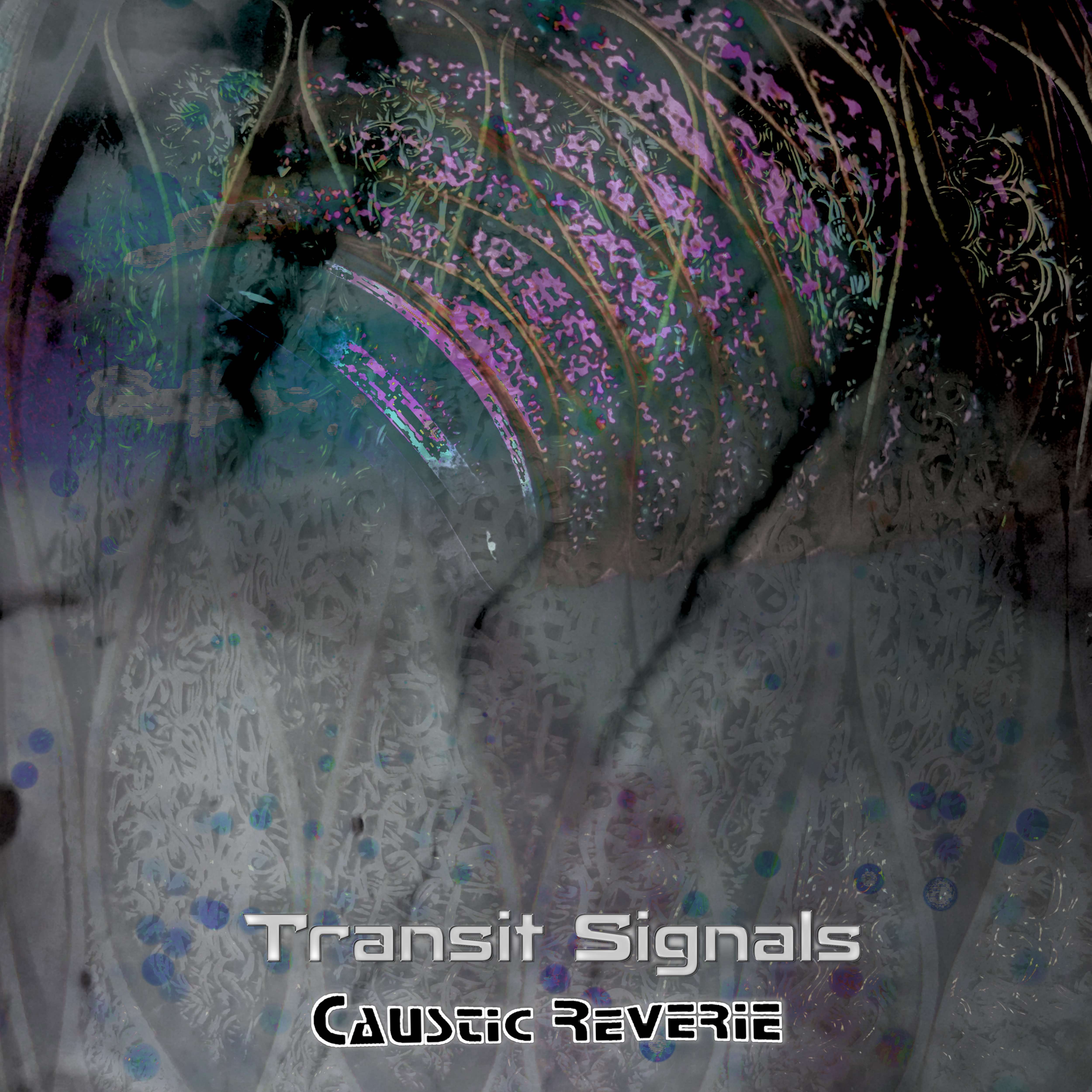
For his 27th transmission under the moniker Caustic Reverie, Bryn Schurman opens a pressure hatch beneath the psyche and invites us to descend without a tether. The result is a series of gravitational events, each bending perception until the mind forgets which way is inward.
“Transit of Iapetus” arrives like an eclipse that has forgotten its sun. The opening tones hover in a suspended hush, as if sound itself has chosen to kneel before crossing a forbidden threshold. Its frequencies seem older than the idea of time as a straight line. They move with the patience of tectonic thought, burrowing into the private chambers of awareness where instinct hovers, dormant and luminous.
Listening becomes an act of exposure. We realize how fragile the architecture of the self truly is. We exist beneath the illusion of coherence, believing ourselves to be stable forms in a navigable cosmos, yet Schurman reveals the dreamlike viscosity of our movements. Each gesture lingers longer than its intention. Each emotional tremor sends ripples beyond the horizon of consequence. We are stretched thin across existence, a filament of atoms trembling between dimensions, radiant and precarious.
“PSR B1913+16” widens the aperture. It pulses with distant radiance, the kind that travels for millennia before grazing the skin of perception. A single ray of light becomes a biography of exile. By the time it touches us, it has been severed from its birthplace, orphaned by distance and duration. We cradle that light without knowing its original name. In this way, we are less observers than vessels of matter waiting to be kissed by something that has wandered across impossible expanses.
Schurman’s digital hush carries a deceptive serenity. On the surface, the textures shimmer with tranquil restraint. Beneath that calm lies a compressed ferocity, a spirit capable of eruption yet choosing to remain coiled in discipline. It is the silence before a supernova that never announces itself, intensity distilled to a whisper that vibrates the bones more profoundly than any roar.
The album suggests that perception itself is a narrow corridor carved through an immeasurable field. We are granted only slivers of pattern, fragments of constellations, hints of geometry in the sky. “Quantum Interference Lensing” pushes further into distortion, where refraction becomes revelation. What appears solid in illustration evaporates in lived experience. The unseen becomes essential, the safety net of oxygen, gravity, and coherence, all taken for granted until absence tightens around the throat. Schurman seems to argue that catastrophe is rarely loud. It is incremental, almost tender. A slow forgetting of the forces that sustain us. A quiet suffocation within our own assumptions.
When “Collapse of Rigel” surges into the foreground, hope does not vanish in spectacle. It erodes. The track drifts like debris expelled from an airlock, spinning in a silence too vast for prayer. This is not drama. It is inevitability. The requiem is not sung for a single body but for the idea of permanence itself. Reflection multiplies reflection until identity becomes a hall of mirrors stripped of silver. We stare into ourselves and find watercolor remnants, pigment drained from the page, form barely clinging to contour.
Yet within this apparent desolation lies a fierce philosophical clarity. If we are only momentary configurations of dust and algorithm, then our fragility is our miracle. We are the brief interval in which the universe becomes aware of its own turbulence.
Instead of delivering us back to ourselves, the album performs a subtler transmutation. It suggests that consciousness is a corridor of stellar residues in which the act of listening is synonymous with curiosity. In that realization, the terror of insignificance collapses into astonishment. We are not stranded in the dark. We are the dark learning to articulate itself in flashes of awareness.
 Between Sound and Space: ECM Records and Beyond