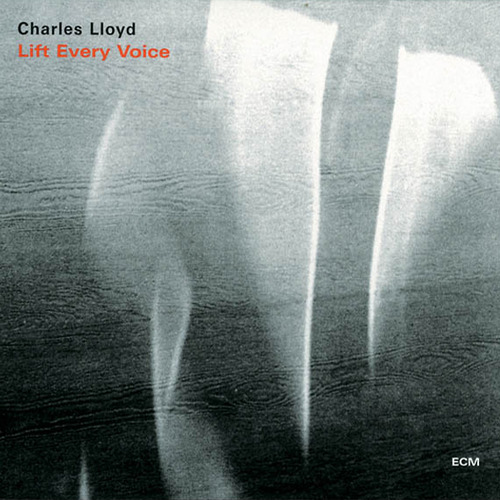
Charles Lloyd: Lift Every Voice (ECM 1832/33)

Lift Every Voice

Charles Lloyd
Lift Every Voice

Charles Lloyd tenor saxophone, flute, taragato
Geri Allen piano
John Abercrombie guitar
Marc Johnson double-bass
Larry Grenadier double-bass
Billy Hart drums
Recorded January and February 2002 at Oceanway and Cello Studios, Los Angeles
Engineer: Michael C. Ross
Assistants: Robert Reid and Brian Vibettes
Sound: Joe Harley
Mastering: Bernie Grundman
Produced by Charles Lloyd and Dorothy Darr
Executive producer: Manfred Eicher

“Truth is One, sages call it by various names.”
Rig Veda

On the night of September 11, 2001, Charles Lloyd was scheduled to appear at New York’s Blue Note jazz club. In the wake of that morning’s unforgettable tragedy, he took the concert’s postponement as an opportunity to meditate on a response. Out of this impulse came Lift Every Voice, which in spite of the events that provoked it is more spiritual than political, opting for a message born in words yet conveyed without them.

Lloyd has been shepherding trusting flocks with the crook of his bell for many decades, yet perhaps none so solemn as the one gathered here. Joined by pianist Geri Allen, guitarist John Abercrombie, bassists Marc Johnson and Larry Grenadier, and drummer Billy Hart, he enacts a sonic prayer that only two CDs can contain: one for each hand in supplication. Looking at the final tracks of both discs, we find such balance achieved. Where “Hafez, Shattered Heart” ends the first disc with a profound tárogató solo, opening a dream of desert to reveal another of water, the second concludes on a high note with “Prayer, The Crossing.” The latter’s visceral energy is the key to all that moves between it and the opening “Hymn to the Mother,” another Lloyd original that expands the session’s reach to the stars and back.

Lloyd’s material is the strongest—or, more precisely, is of an altogether different strength than the standards, hymns, and spirituals with which it shares breath—for it is also his most selfless. Whether it’s the bluesy Abercrombie vehicle “East Virginia, West Memphis,” the autumnal colors of “Angel Oak,” or the Allen-focused nostalgia trips “Beyond Darkness” and “Nocturne,” Lloyd finds his voice through the attunement of his band. He finds it further in the darkened fields and pathways left behind by those—named and nameless—who are no longer with us. Marvin Gaye flickers between realms in a distinct arrangement of “What’s Going On,” smooth as a northern light. The intimate repose of “Amazing Grace” (Lloyd plays this as if for the first time) and “You Are So Beautiful” defies all associations, flowering behind closed eyes and open heart. The lyrical cartilage of his support system follows every step as he flutters through the changes, a moth courting the flame.

Noteworthy also are the Duke Ellington tune “I’m Afraid,” a quintessential display of Lloyd’s tonal prowess, and Billy Strayhorn’s “Blood Count,” by far one of the most touching five minutes Lloyd has ever recorded. Two pieces by Cuban protest singer Silvio Rodríguez, “Te Amaré” and “Rabo de Nube,” thicken the pot with some heartfelt craft, both highlights not to be missed. They quiver at slightest contact, cups filled to the brim. All of which infuses eternal flowers like “Go Gown Moses” and the title hymn with constellations galore.

Terror is the soil of togetherness, and in chaotic times the sunflowers are our singers. In their company and by their guidance we open our mouths to the sky. Lloyd is one such singer. Yet he does not lift his voice. Rather, he lets the high notes crack, lest they distract us from the healing taking place beneath them. Thus he gives attention to the impermanence of things. A philosophical move, perhaps, but an inevitable one that reminds us of music’s fragile architecture. He is neither leader nor follower, but a border without countries. He is an artist who stands before us, poised to weep as the world weeps around him.
Serving the Music: Going Astral with Charles Lloyd

Charles Lloyd New Quartet and Friends
with Special Guest Maria Farantouri
March 15, 2013
7:00 pm
Met Museum, NYC

Charles Lloyd tenor saxophone, flute, tárogató
Maria Farantouri voice
Alicia Hall Moran voice
Jason Moran piano
Reuben Rogers bass
Eric Harland drums
Socratis Sinopoulos lyra

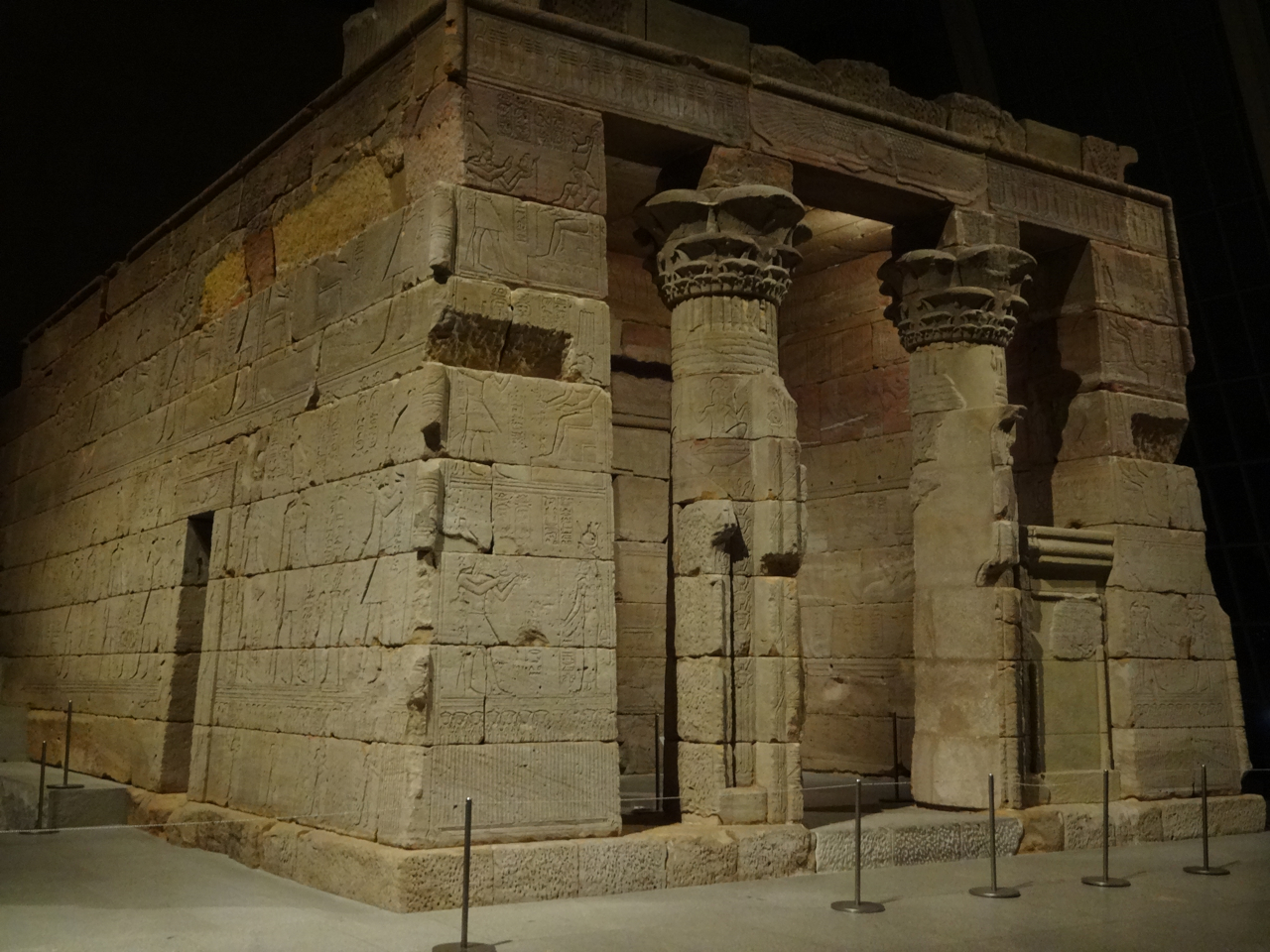
Temple of Dendur

Blessed. That was how Charles Lloyd expressed what it felt like to stand before the Temple of Dendur at New York’s Metropolitan Museum, nodding to the fortune of making a life in music, that torch of never-ending flame. The celebration was nominally in honor of Lloyd’s 75th birthday. Spiritually, however, it was in celebration of all creation, offering as it did the greatest gift of all: beauty. Like the Egyptian temple itself, each tune was transported and rebuilt, stone by stone, until its architecture stood by whim of its own gravity, channeling an energy that flows through rivers wide and narrow. Lloyd’s fingers thirsted for that water, gathering its holistic power in the vessel of his horn until the particles sang.

Strayhorn and Ellington loomed intimate in his opening gambit with Jason Moran at the keys. That unmistakable tenor filled a reverberant space with soul, soul, and more soul. Every run was a flutter of the heart, every split high note a distant supernova. Moran’s quiet flow brought the sound homeward, chiming the ashen bells of recollection until their surfaces glistened afresh. He brought with him a jagged array, sewing ragtime shadows to his Peter Pan feet and running through patchwork fields.

The duo’s brief exhale of “Abide With Me” welcomed the rhythm section to the stage. With a drum roll and a splash the band jumped into raging waters. So began the New Quartet portion of the evening, wherein fire and ice embraced their differences and found peace in aquatic compromise. A solo from bassist Reuben Rogers drew a sidewinder’s path in the dunes, turning heat into nourishment. Lloyd and his band not only rode the train, but also laid the tracks, stoked the fire, and wound through glowing thematic tunnels. Drummer Eric Harland left an ephemeral trail of steam, soloing with the strength of a thousand signal flares. Rogers further pinholed the darkness with constellations to the tune of Moran’s twenty-fingered chording.

From behind his sleek shades, Lloyd turned day into night with every lick, keeping the sandman at bay and digging low only occasionally for effect. It was in this context that his gentle dream-weaving over a Saharan beat provided as yielding a surface as was needed to welcome Alicia Hall Moran into the mix for a spirited “Go Down Moses.” With its serpentine refrain of “Let my people go,” her operatic contralto painted the sheltering sky with prophecy. A gentle cascade from Moran trickled into Lloyd’s “New Anthem,” moving through rhapsodic changes reminiscent of Barber’s Knoxville: Summer of 1915. Fly, songbird, fly.

Yet it was Greek singer Maria Farantouri who spread the richest wings of the concert. Joined by lyra master Socratis Sinopoulos, she assumed a vast presence in her rendition of the Greek Suite from the Athens Concert album. A lone improvisation from Sinopoulos served to emphasize the holiness of the space. Farantouri was the twilight itself, an Adriatic dream realized before the ears. Lloyd and Farantouri always seem to bring out the best in each other, and on this stage the vibe was no different. Traveling down the River Styx and back again, Moran appending thoughtful diacritics along the way, the group inscribed its journey with nary a backward glance. Harland wound a fantastical roll to whisper strength, the lyra tracing a perfect horizon line.

After this two-hour tour de force, Farantouri lightened the mood by singing “Happy Birthday” to Lloyd before encoring with the joyous “Yanni Mou,” thus signing off on a living résumé of the saxophonist’s legacy and influence.

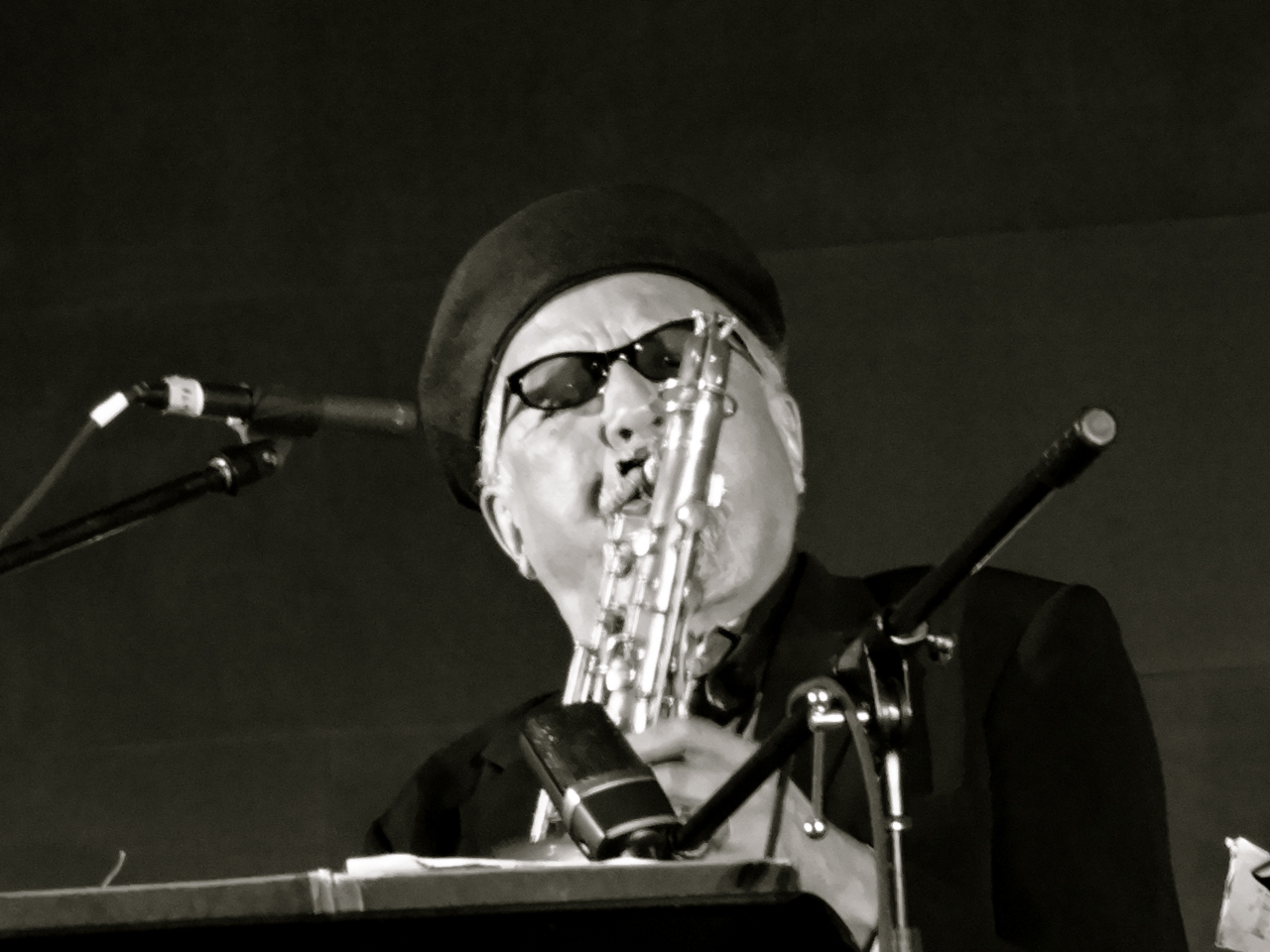
Lloyd live

The morning following the concert found me well rested and in Lloyd’s hotel room, where the star of the hour was anything but. “After I play,” he explained, “I’m exhausted but exhilarated, so I can’t go to sleep. Two, three, four, five in the morning I go to sleep, and now I’ve got to recuperate.” Being the inquisitive soul that he is, he first took more interest in me, my wife, and our new son, asking about our family histories, how we met, the values that drew us together. By the time I got around to my brief questions, I forewent those I’d written down and went with the flow. I asked first about Hagar’s Song, for I’d noticed after listening to the album a few times, and having just heard him and Jason start the concert with some of its material, that a feeling of history far beyond music was coming through. “I can’t get over someone taking this 10-year-old child and wrenching her from her parents and then impregnating the daughter at 14,” Lloyd responded, referring to the great-great-grandmother to whom the album is dedicated, and whose history of enslavement only recently became clear to him. “It’s sick. But here’s the thing about that recording. It’s all part of that fabric. I don’t know why people are trying to separate them. ‘Why did you insert this into these beautiful ballads?’ Some people have asked me that.”

Well, the real question is: How do you take it out?

Right. That came to me, that information, and it was like a wall for me.

What impressed me—and I think this bears testament to the power of music, and the human spirit more broadly—is that an undeniable core of joy comes out in the music. And I’m wondering if that’s something you saw in her spirit as having been passed down through the story. She survived, she gave that feeling…

She’s obviously a beautiful soul. All I can do is reinvent the world. My thing is about beauty. There’s all that ugliness out there. I’m trying to wipe it out with beauty. I’ve always been trying to do that. I can’t change my stripes now. I’m an idealist and dreamer. My dreams are still bigger than my memories. Maybe that’s why I don’t succumb to age or polarities, lines of demarcation…. I’m not the one for that stuff. Obviously, to me she’s very beautiful and I wanted to enfold that. I started out with Strayhorn’s “Pretty Girl” because there was this flower and I don’t know how to not do what I do. Things just happen along the way. These things, they’re all my world.

Did you feel anything different this time around recording a duo album with Jason as opposed to the quartet, or is it all part of the same fabric?

Yeah, you’re naked. We made that sound. It’s a homemade pancake.

Can you talk more about that sound and how your relationship with ECM has built it?

I like the idea of being in one place for a long time and developing something. When I recorded Fish Out Of Water, I just went in and played. Some of the big companies have come to me, but I have a home here. I always knew that ECM made great sound, hermetically sealed, but I need what I need, because I’m a sound seeker.

Maybe sound seeks you as well.

What you’re looking for is looking for you.

On that premature note, it was time for us to go. Before leaving the hotel room, subject to whatever might be looking for us, my wife and I said our goodbyes, but not before Lloyd laid a hand on my son and said a prayer for him. The silent wonder in the boy’s eyes as life began to take shape in them was as inspirational as anything we’d heard the night before. Blessed indeed.

(To watch the concert in full, click here.)

Breaking down the set

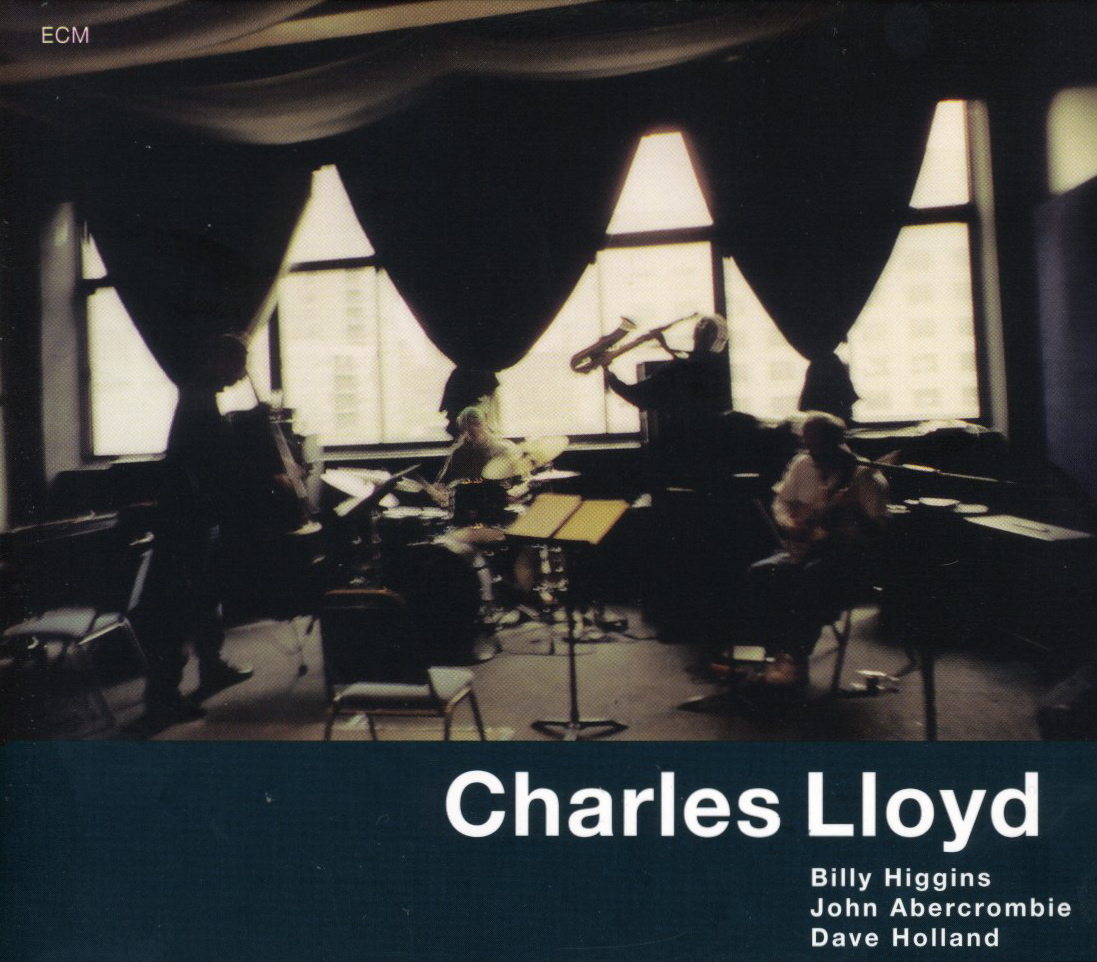
Charles Lloyd: Voice In The Night (ECM 1674)

Voice In The Night

Charles Lloyd
Voice In The Night

Charles Lloyd tenor saxophone
John Abercrombie guitar
Dave Holland double-bass
Billy Higgins drums
Recorded May 1998 at Avatar Studio, New York
Engineer: James Farber
Produced by Manfred Eicher

First loves never die. When it comes to jazz, Voice In The Night was mine. Not only was it the first proper jazz album I ever purchased, but it also introduced me to a tenor sound that had me at note one and has yet to let go. Memphis-born but California-spirited, Charles Lloyd has expanded the sweep of his instrument in incalculable ways by means of an unerring willingness to surmount every obstacle that stands in his way. After jumping the pond for a handful of (re)defining sessions, including the unmissable All My Relations and Canto, this fish out of water kept stateside, recording in New York’s Avatar Studios with a crew of new and old alike. By the time of this record, he and drummer Billy Higgins had had a history stretching back to the mid-1950s. Bassist Dave Holland and guitarist John Abercrombie were mixed recruits—Holland having shared a festival stage or two with Lloyd, Abercrombie fresh on the boat. Abercrombie had been especially astonished by Lloyd’s depth and phrasing, and the introduction of the former to the latter’s milieu was a masterstroke.

This album bears prime witness both to Lloyd’s songcraft and to the wonders it inspires in his band mates. His restless arpeggios are more than just that. Like emotional tics he can’t (and need never) shake, they constitute a grammar all their own, each a subtle unpacking. They flow throughout the title opener with such soul-to-soul intrepidity as to turn each gesture into a different shade of charcoal. With said charcoal this intensely laid-back quartet draws a bold landscape of shadows and dreams. Some ring more fancifully, such as a topflight rendition of the Elvis Costello/Burt Bacharach tune “God Give Me Strength,” given here a full and chromatic treatment that pushes Higgins into the foreground with the inevitability of April wind. Lines of the eponymous tune reverberate in the playing:

And I don’t have anything to share
That I won’t throw away into the air

If Lloyd is the voice in the night, Abercrombie brings out the stars, calling forth a fluid artistry in what just might be his best date since Timeless. His soft, midrange-heavy tone flows like rain down a window. Standout moments abound in “Requiem” and in “Homage,” the second a hip display of acrobatic proportions. With fingers flying and solos enchanting (the homage can only be to Coltrane), in addition to a bubbling drum solo at the fulcrum, there’s much to savor in repeated listening.

Other dreams, such as “Dorotea’s Studio,” read more impressionistically. Abercrombie’s extended solo here inspires the rhythm section to build the melodic frame into which Lloyd eases his way and dances amid a collection of artifacts. Carved wood, painted canvas, developing film: these vestiges of impulse come to life in the absence of their creators. This is an emblematic track for its unforgettable vamp and organic shifts in key, all working toward a flick of an ending, abrupt and sincere.

Lloyd is so known for his personal reflections, and in this regard “Island Blues Suite” represents a return to roots. This multifaceted track blends backyard jam aesthetics and weaves through them, by way of Abercrombie’s strings, a chain of uninhibited dances. Subtle soloing from Holland and a keening guitar are icing on the cake. Lloyd takes the deepest dip into his canon with a newly re-imagined “Forest Flower” (this one goes back to the 1967 live album of the same name). The bossa nova undercurrent sets Abercrombie on a fruitful improvisatory path, while Holland’s whispers reveal the set’s dynamic charge. These interactions smooth into a long play-out before Billy Strayhorn’s melodic strength blossoms in “A Flower Is A Lovesome Thing,” in which Lloyd lays heavy tenderness over a Saharan pulse until earth and sky change places.

As a whole, the band maintains a steady river without the need for waterfalls. The fact that Voice is also a melodic tour de force for Lloyd in particular only sweetens the pot. His is a clarifying presence that brings lucidity to the current with so much vision, it’s almost blinding. James Farber’s rounded engineering gives us the clearest sense possible of the importance of space in the tenorist’s songcraft. The result is lyrical music-making at its best. Classic to the bone.

Charles Lloyd/Jason Moran: Hagar’s Song (ECM 2311)

Hagar's Song

Hagar’s Song

Charles Lloyd alto and tenor saxophone, alto and bass flute
Jason Moran piano, tambourine
Produced by Charles Lloyd and Dorothy Darr
Recorded April 2012 at Santa Barbara Sound Design
Engineer: Dominic Camardella
Mastering: Bernie Grundman
Executive producer: Manfred Eicher

Speaking of an ECM production in terms of engineering is like speaking of a Van Gogh painting in terms of brushstrokes: the two are so intimately connected as to make their parsing arbitrary. Still, it bears mentioning that with Hagar’s Song the label has taken a fresh direction due to the insistence of its artists on a naked sound. We hear it from breath one in Billy Strayhorn’s “Pretty Girl,” which under the fingers of the album’s protagonists—saxophonist Charles Lloyd and pianist Jason Moran—awakens to a new dawn. We hear it in the close miking of that unmistakable tenor, in Moran’s pillow of chords filling the recording space with the close-knit statements befitting of the duo dynamic. Let this be a cue, then, to witness the growth of these kindred hearts, whose cause is just getting warmed up. So begins a helping of Lloyd’s personal favorites, which include many familiar tunes re-spun by the patina of his lyrical edge. His bold evocation of every theme reveals an artist funneling his attentions into hard-won integrity.

Charles and Jason
(Photograph by Dorothy Darr)

Lloyd’s notecraft is a spectrum of infatuation and rests comfortably in Moran’s edgy blend of styles. To characterize the latter as a blend of the old and the new, however, gets us off on the wrong foot. His nostalgia is of a different order. The feeling of entrenchment intensifies the more he works with Lloyd, who gives him both a context and the freedom to run around it. Moran’s balance is one of seeking and restraint, of plangent cry and heartfelt whisper. Whether in the old-time swing of Ellington’s “Mood Indigo” or the haunting manifestations of the Gershwin classic “Bess, You Is My Woman Now,” his roots remain strong and attract all sorts of wonders from the horn that inspires him. This would seem to inspire Lloyd in return. From the way he frames an octave before dropping into it all sorts of knots to be untangled to the skirting poetics of his angular original, “Pictogram,” his artistry gazes, bare and unblinking. For a concise summary of that very evolution, listen no further than “All About Ronnie.” Here: a prism with its own light.

We do a disservice in calling these renditions “soulful,” as if the tunes were not already so. Their timeless inherency is already set, leaving the patient duo to build whatever spontaneity is needed to bring their messages home. We hear this especially in “You’ve Changed,” which from the lips of Lady Day to George Michael has over the years settled in our bones, and for which Lloyd carries a unwavering torch of freedom through the forest of Moran’s discipleship. You’ll find no stone in this “Rosetta” (Earl Hines), because no translation is needed when caught up in the swing of things.

The session’s centerpiece, the five-part “Hagar Suite,” is dedicated to Lloyd’s great-great-grandmother. Taken from her parents and thrown into slavery at age 10, she was one of countless nameless faces in a river that has yet to dry. In Lloyd’s flute resides the quivering of her undying heart. It is the seed of protest, quiet, known only to those in whom it grows. The winds of change fan it like a flame, jumping from one ribcage to another until it sings. Like Moses in his basket, its melodies come from a land of fragments, of bodies broken and rejoined by the power of will. Moran matches Lloyd’s power of incantation with a ceremonial tambourine, which he plays in the hands or, in the painful lyricism of Part III, “Alone,” lays on the piano’s lower strings. It is the tinkling of a faraway dream, a cicada calling to the sands as if every granule were an eye. Through a veil of patience, the duo molds soil into something upright, that it might wander of its own volition from sea to shining sea in search of the wisdom of age…if not the age of wisdom.

If “Hagar Suite” is the album’s multi-chambered heart, then “I Shall Be Released” is its blood. The genius of this Bob Dylan tune has never run so thick as it does here. The same holds true for “God Only Knows.” This insightful look into the mind of Brian Wilson pays homage to Lloyd’s session work with the Beach Boys in a spatial epilogue that carries us far over the horizon to a place where children are forever safe and their parents shed tears only by way of joy, knowing they have everything they need in each other.

Because of the nature of this project, talking about the musicianship in terms of “solos” is moot. Lloyd and Moran are two pans of the same scale, the chain of which hangs from a tall, tall hand of justice. Hagar’s Song not only shows great technical intuition, but also a multifarious instinct for programming. In assembling this set, they have handpicked from the best and added to it, living in the shadows of the originals as much as in their light, and through it all with a love clear as sky.

This is jazz at its most embryonic, the fulfillment of wishes standing the test of time. Like Lloyd’s offshoots, it never strays from the core of what needs to be said. No room for poker faces; only the genuine rake it in.

(To hear samples of Hagar’s Song, click here.)

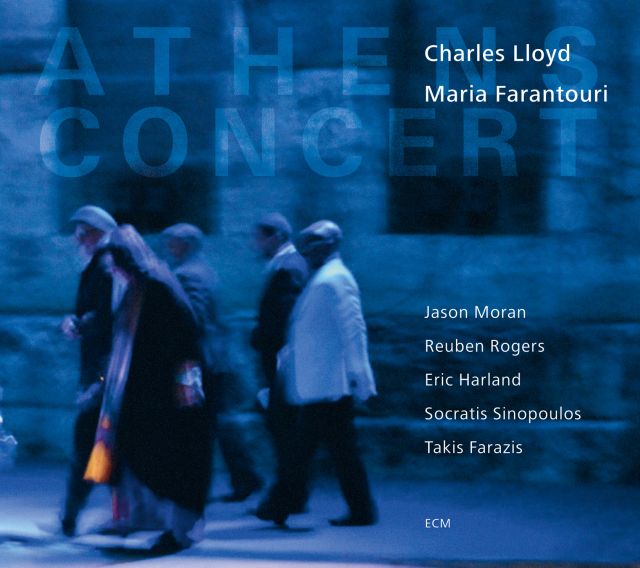
Charles Lloyd/Maria Farantouri: Athens Concert (ECM 2205/06)

Athens Concert

Charles Lloyd
Maria Farantouri
Athens Concert

Charles Lloyd tenor saxophone, flute, tárogató
Maria Farantouri voice
Jason Moran piano
Reuben Rogers double-bass
Eric Harland drums
Socratis Sinopoulos lyra
Takis Farazis piano
Recorded in concert June 2010 at Herod Atticus Odeon, Athens
Recording engineer: Nikos Espialidis
Assistant engineer: Kostas Kyriakidis
Equipment by Logothetis Music
Mixed by Manfred Eicher and Jan Erik Kongshaug at Rainbow Studio, Oslo
Produced by Manfred Eicher and Dorothy Darr

Where are we
that the wind won’t blow?

“The human voice can capture the heart more swiftly and directly than any other instrument,” writes Charles Lloyd in the liner notes for Athens Concert, an historic live event given the permanence it more than deserves through this landmark recording. Lloyd goes on to relate how, as a child growing up in Memphis, he would fall asleep to the sound of Billy Holiday’s voice from the radio under his pillow, and how years later that same magic revealed itself in contralto Maria Farantouri (Greece’s Edith Piaf, if you will), who he later befriended and who introduced him to the songs of Mikis Theodorakis after he’d invited her to sing one of his own. Farantouri’s heart is ancient, and her desire to introduce Lloyd to her culture is manifest in the depth of his playing. She characterizes the tenor master as “a shaman of jazz who dominates the stage with the power of the mystic and the innocence of a child. The sound of his music can have the weight of a stone or the lightness of the air. With his improvisations he weaves an imaginary but so familiar world, a mirage constantly disintegrating and reforming.” We might say, then, that Lloyd is a singer, channeling his breath through a weathered metallic throat and bidding the very stars to dance. The bridging of these two worlds spawns a third, one where voices of time sing like parents to a child.

And what is “Kratissa ti zoi mou” (I Kept Hold of My Life), which opens the program, if not a voice churning in the tide of darkness from which we all are born? George Seferis’s words (from the poem, “Epiphany, 1937”) blossom from an unmistakable tenor branch, smooth yet weighted as if by the buckshot of self-awareness and sliding like honey down an enviable backdrop: Jason Moran on piano, Reuben Rogers on bass, and Eric Harland on drums. Curtains part to reveal Farantouri’s husky swirls. Moran elicits sweet noise, mixing Ketil Bjørnstad-like textures with idiosyncratic spectral twists. An emblematic introduction into this forested sound-world, it is the concert’s Rosetta Stone. Lloyd’s classic “Dream Weaver” continues in the same flowing vein, his remarkably sunlit reed gathering enough thread to make even the most sedentary marionette nod in a groovy and somehow freer turn. Harland is also notable here, buoying a rich solo from Moran, who maintains epic contrast between the left and right hands throughout. Lloyd brings a classic edge to the denouement, further picked up by Rogers with intimacy. Our bandleader continues to regale us with his storytelling in “Blow Wind.” The original song finds Farantouri channeling Sheila Jordan, the lyrical star to an instrumental sky. Her voice indeed blows off into the distance, leaving Lloyd to shape those tendrils of dust left in her wake before she returns to stir them anew. Lloyd also pens “Prayer,” which features still more wonders from Moran. Farantouri’s full-throated, wordless song emerges from the bass, reedy like the muse that calls to her. A click away finds Lloyd setting words by politicist Agathi Dimitrouka in “Requiem.” A surprisingly buttery song that finds groove in the tragic, in it Farantouri’s tenderness clears the way for Moran’s more diffuse considerations, as microscopic as pollen and just as fragrant. The music of ECM mainstay Eleni Karaindrou also makes an appearance with “Taxidi sta Kythera” (Voyage to Cythera), which against a low and sultry swing allows gorgeous exchanges between the two bill headers, their voices filling the same crucible with variations of the same alloy.

LM 1

Pianist Takis Farazis joins for the performance’s remainder: the three-part Greek Suite, which he also arranged. Part I is the most ancient, shifting the sands with “Hymnos stin Ayia Triada,” an early Byzantine hymn to the Holy Trinity. Interweaving Lloyd’s flute and Farantouri’s flutedness, its song is its vow. “Epano sto xero homa” (In the Dry Soil) and “Messa Stous paradissious kipous” (In the Pradise Gardens) come from The Sun and Time by Theodorakis and as such unearth the greatest strengths of Farantouri’s gifts. Yet it is only when the strains of the lyra, played by Karaindrou regular Socratis Sinopoulos, touch the sky in Part II that the clouds weep rain. Amid its assortment of traditional tunes, “Thalassaki Mou” (My Little Sea) stands out to me. Although quite different from the version I grew up on the timeless Songs of the Earth by The Pennywhistlers, it nevertheless brings its own enchantment and stirs the musicians to invigorating levels. Part III boasts tunes from the Epirus region. Among the more moving are “Epirotiko Meroloi,” a lament of war and death told from a mother’s point of view, so well evoked by Lloyd’s uncanny intro and by the jangling folkways that ensue, and the intuitive digressions of lovesick souls in “Mori kontoula lemonia” (Little Lemon Tree). Harland grabs his fair share of the spotlight in “Alismono kae haeromae” (I Forget and I Am Glad), as does Sinopoulos in “Tou hel’ to kastron” (The Castle of the Sun), a traditional song from the Black Sea that is the band at its most attuned.

The encore also comes from a mother’s lips, as love pours through “Yanni Mou” (My Yanni) with more permanence than the bravery it mourns. The stichomythia between Farantouri and Lloyd discloses an oceanic world where the rhythms of fins and tails are the only music that remains. And if its mournful cast seems a somber note on which to end, it is only because the invigorations leading up to it linger like a childhood that refuses to let go. Such is the power of this music: it is memory incarnate.

(To hear samples of Athens Concert, click here or watch the video below.)

Charles Lloyd Quartet: Mirror (ECM 2176)


Charles Lloyd Quartet
Mirror

Charles Lloyd tenor, alto saxophone, voice
Jason Moran piano
Reuben Rogers double bass
Eric Harland drums
Recorded December 2009 at Santa Barbara Sound Design
Engineer: Dominic Camardella
Produced by Charles Lloyd, Dorothy Darr, and Manfred Eicher

Charles Lloyd is that rare artist who one can say truly grows with every recording, and I would venture that Mirror finds him at one of many pinnacles in a career that thankfully shows no signs of abating. As part of the same quartet that wowed us on the live recording Rabo de Nube, Lloyd is joined by Jason Moran on piano, Rueben Rogers on double bass, and Eric Harland on drums for the outfit’s first studio session.

The title of this latest studio effort is no accident. As Lloyd himself once said in an interview with Greg Burk of his musical break between 1969 and 1989, “I went to work on myself, so that I would be more equipped to serve the Creator and music and mankind, and I had to face the mirror of my own inadequacies.” And indeed on this date we hear him contemplating his own reflection, the ways in which it speaks back to him with the unmistakable voice of that Tennessee tenor.

As has become increasingly clear through the years, Lloyd’s heart lies in tradition. We hear this not only in the affect of his presence, but also in his interpretation of standard repertoire. Beyond the obvious technical abilities required to pull this off with the consistency that he does, he also posses the uncanny talent to compress every tune into his marrow and live it before ever putting reed to lips. And through this handful of traditions he carries us from the mosaic of beautiful fragments in “Lift Every Voice And Sing,” where Moran’s stained glass solo glows by Harland’s feathered light, and into “The Water Is Wide,” where Moran shines again in a fully loaded groove: the exuberance of a gospel singer with head thrown back in glory, stitching the pathos of faith one patch at a time. Lloyd’s delicacy in “Go Down Moses” is duly inspiring and leaps into well-trodden arenas of stratospheric wisdom as the quartet achieves an enviable coalescence, the percussion especially colorful. Yet for me the session’s jewel drops into our hands in “La Llorona,” a stepwise lament in which Lloyd allows himself to falter at carefully placed expectorations, cracking like a tear-ridden voice in prayer. Stunning.

“I Fall in Love Too Easily” opens the doors widest to a field planted by Moran’s petal-by-petal profusion, and leaves us well primed for two Thelonious Monk joints. Where Lloyd flits like a butterfly possessed in “Monk’s Mood” (against the smoothest pianism of the set, no less), he turns like an oblong waterwheel through a river of affection in “Ruby, My Dear,” a more rubato affair in which Moran’s octave splits ring heartfelt and true. “Caroline, No” gives us a taste of the Beach Boys years, drawing its motif at an angle while Lloyd soliloquizes on the pleasures of contortion. And let us not forget the wellspring of his own pen. From the depths of “Desolation Sound” to the magic of “Being And Becoming, Road To Dakshineswar With Sangeeta,” Lloyd the composer regales us with wordless incantations—that is, until the the nine-minute “Tagi,” for which he blesses the studio with a retelling of Bhagavad Gita scripture (the title is “Gita” reversed and means “sacrifice”) before tracing a line up to the sun.

Lloyd always begins and ends with the breath, tracing a circle of life. His is energy classic, wood-grained yet with a fine metallic sheen. Like the cover photograph, this is music that has nothing to hide regarding the means of its creation, lays it all out in the oneness of things, where light and shadow share a thematic dance. Let this album be your mirror, and your story will begin the moment you open your soul and look.