
Charles Mingus bass and voice
John Handy alto saxophone, tenor on “Goodbye Pork Pie Hat” and clarinet on “Pussy Cat Dues”
Booker Ervin tenor saxophone
Shafi Hadi alto and tenor saxophones
Jimmy Knepper trombone (May 5, except “Bird Calls”)
Willie Dennis trombone (May 12, except “Goodbye Pork Pie Hat”)
Horace Parlan piano
Dannie Richmond drums
All compositions by Charles Mingus
Recorded May 5 and 12, 1959, at Columbia 30th Street Studio, New York
Engineered by Ray Moore and Fred Plaut
Produced by Teo Macero
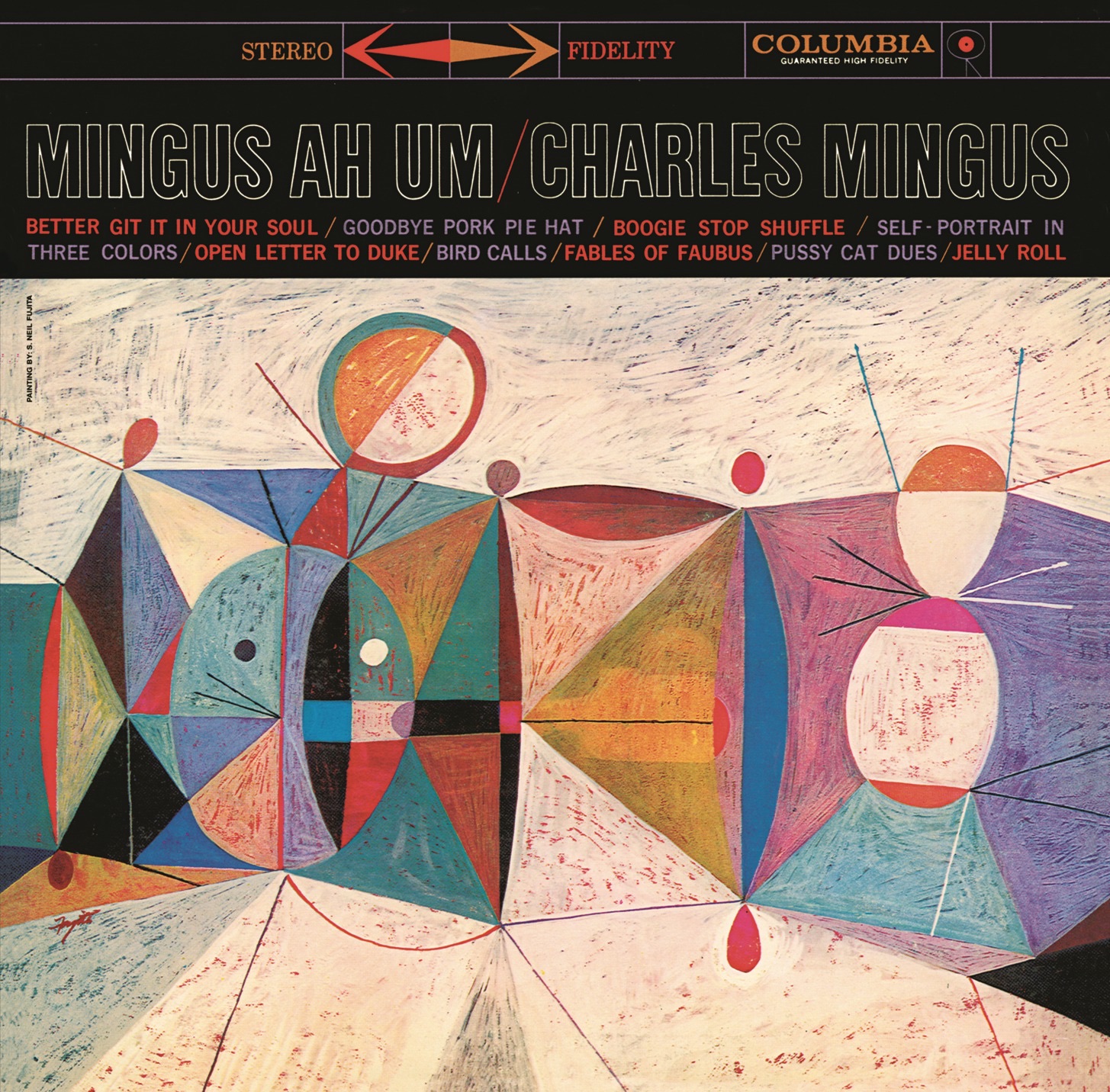
Cover painting by S. Neil Fujita
Released in 1959 by Columbia Records (CL 1370 mono, CS 8171 stereo)
John Handy recalls being on the bandstand at New York’s Half Note one night in March 1959 when word came that Lester Young had died. Charles Mingus took up a slow blues in C minor and gave Handy the first solo, urging him on until the tune had taken considerably longer to tell than the news itself. By May he had written “Goodbye Pork Pie Hat,” a quiet centerpiece of the album at hand.
Mingus began recording Mingus Ah Um, his first Columbia record, on May 5 at 30th Street Studio, where Miles Davis had finished Kind of Blue just thirteen days prior. Teo Macero, who had played saxophone with Mingus in the Jazz Composers Workshop, produced the sessions. The leader brought in his working band and called on musicians who already knew how to fit into his puzzle. As quoted in Diane Dorr-Dorynek’s liner notes, he describes laying out the framework at the piano, part by part, and giving each player a different set of notes to draw from over a chord.
In the Watts neighborhood of Los Angeles, Mingus’s stepmother Mamie used to take him to Holiness services, where an answer to the preacher could come from anywhere, and this spirit is alive and well in the congregational sound of the band. There’s a lovely slink to the bass at the opening of “Better Git It in Your Soul,” and when Dannie Richmond gets hold of the six-eight, the whole ensemble seems to land on the upstroke of Mingus’s hand. His cries rise through the horn voicings as an introductory catharsis. The first saxophone solo pushes away from Richmond’s accents and gets its bearing from them, while a recurring moan in the arrangement comes, as Dorr-Dorynek tells it, from something Horace Parlan played in a solo. In the stretch of Booker Ervin’s tenoring where the handclaps carry the beat, all the distance from the pulpit to the last pew fits between two palms. The words in the title travel in the other direction, all the way to the person lowering the needle.
Handy and Ervin open “Goodbye Pork Pie Hat” in unison on tenor, the instrument Young played with Count Basie, and their intimacy is easy to mistake for solitude. On the second pass through the tune, restored on later issues, the two horns separate by an octave and for a minute the melody has an upstairs and a downstairs. There’s extraordinary patience in Handy’s solo, in the time he gives even a single note to show its grain as he works the tip of his tongue against the reed to make a tremolo, a motion he thought of in terms of bowing a string. Mingus answers with his fingers on the bass, and for a few bars the vibration seems to pass between them without crossing the air.
In At the Vanguard of Vinyl, Darren Mueller counts just over eleven minutes cut from six performances for the 1959 LP. Five of the uncut takes appeared on Columbia’s Nostalgia in Times Square in 1979, and Mosaic issued the complete elegy in 1993. The 1998 Columbia/Legacy CD gathered all nine at full length, in the original order. By the time the Library of Congress added the album to the National Recording Registry in 2003, two different accounts of 1959 could be bought under the same title. The opening riff of “Boogie Stop Shuffle” comes from down from on high, and Mingus and Richmond are so exactly in each other’s time that not even a sheet of paper could be slipped between them. The horns throw their accents against Ervin without his disturbing its footing, and Parlan’s turn at the piano rubs a little ochre into the spectrum. Handy’s alto solo, excised from the LP, takes such tight corners in that minor blues that the room seems to go out of square. Toward the end Richmond gives the ensemble figures a new edge each time they come around.
After all that motion, “Self-Portrait in Three Colors” angles the light differently. Dorr-Dorynek traces the piece to Mingus’s work on John Cassavetes’s Shadows, and each pass through the theme brings out another line, deepening the image without moving the camera. One feeling passes through several bodies at a pace slow enough to make out where it changes hands, until a brief tenor coda has to carry the shape of the group on its own. That Mingus called this a self-portrait seems entirely natural in a band where trusted allies can bring a feature of your face into focus.
Mingus first heard Duke Ellington on his father’s crystal set and briefly played in the orchestra in 1953. In “Open Letter to Duke,” Ervin’s tenor comes out at full stretch, with the whole band able to turn beneath him, and in the restored alto solo Handy is unhurried. The music then eases into a ballad, its reeds bending enough to fit more than one shade of a pitch into the same syllable while Willie Dennis’s trombone surfaces beneath them. That melody had an earlier life in “Duke’s Choice,” recorded for Bethlehem in 1957 with Shafi Hadi and Richmond already in the room. In 1962, Mingus and Max Roach would make Money Jungle with Ellington. For now, Mingus could address him directly and send a copy home with everybody who bought the record.
The other side begins with cries that overlap in free time, and for a few seconds the ear has to decide how many creatures are speaking. Mingus said he had actual birds in mind for the opening of “Bird Calls,” but the language of bebop it breeds is decidedly human. Ervin’s tenor goes first, with Parlan’s compact piano figures taking over between his flight and the darting turns of Handy on alto. Mueller points out two places in the full take where a horn comes in early with the theme, once as Handy yields to Richmond and again near the end of the drum solo. The original LP cuts both entrances along with the whole drum solo and much of the preceding improvisation.
Once the flock scatters, the low horns of “Fables of Faubus” enter with the pomp of a parade whose route keeps buckling under its feet. An alto briefly appears before Parlan’s piano carries the lurch of the march into a quicker pulse. Under Ervin’s tenor is the satisfying slap of Mingus’s strings against the fingerboard, the sound of a piece of wood being made to testify. The title is one of Mingus’s most loaded, as on September 2, 1957, Orval Faubus interrupted a local broadcast of I Love Lucy to announce that he had called out the Arkansas National Guard, which he used to bar Black students from Little Rock’s Central High School. The Little Rock Nine attended under federal protection, and the following September Faubus closed the city’s four public high schools. On May 5, 1959, the day Mingus recorded the piece, segregationists on the school board voted against renewing the contracts of forty-four school employees they regarded as sympathetic to integration. Mingus later said Columbia had kept the lyrics off the record, and in October 1960 he recorded them for Candid as “Original Faubus Fables,” with Ted Curson and Eric Dolphy in the band.
The slow New Orleans blues of “Pussy Cat Dues” arrives at a sideways amble, with Jimmy Knepper’s trombone the first voice to strut its stuff in style. One cannot fail to notice the elasticity of Mingus’s soloing here, the way he can pull a beat far out of its resting shape and let it come back without leaving a crease. The closing tenor is Ervin’s, and when he leans into double time the slow pulse goes on around him, wide enough now to admit two different speeds of thought.
Knepper is out front again on “Jelly Roll,” sliding into a chorus over the old New Orleans two-beat while Mingus slaps the strings. The tribute to Jelly Roll Morton is said to have taken shape in the studio when Mingus reversed the direction of two lines from his earlier “My Jelly Roll Soul.” You can hear the pleasure of that inversion in the way the trombone goes up through the space the reeds make by coming down. The rhythm opens into four during the alto solo, and Parlan slips a phrase of Sonny Rollins’s “Sonnymoon for Two” into his piano solo. As Mueller notes, a splice on the first LP catches Ervin’s descending tenor line just short of its last note. The full performance gives him his landing and Mingus two choruses. The jouissance of the tag is in the way Mingus counts aloud and comes back at himself on the bass, with Richmond there to keep the two of him talking.
There is another roll I find myself thinking about, the one a teacher calls by reading down the left side of a page. When Little Rock’s public high schools reopened in August 1959, Carlotta Walls and Jefferson Thomas went back to Central for their senior year. The box beside a name in an attendance book can be covered with a fingertip. I imagine the teacher’s pencil hovering above it while Walls draws breath to say “here,” a single syllable crossing the space the Arkansas National Guard had once been sent to occupy. This music carries their agency not as tokens but as lights of image-bearers whose lives matter.

