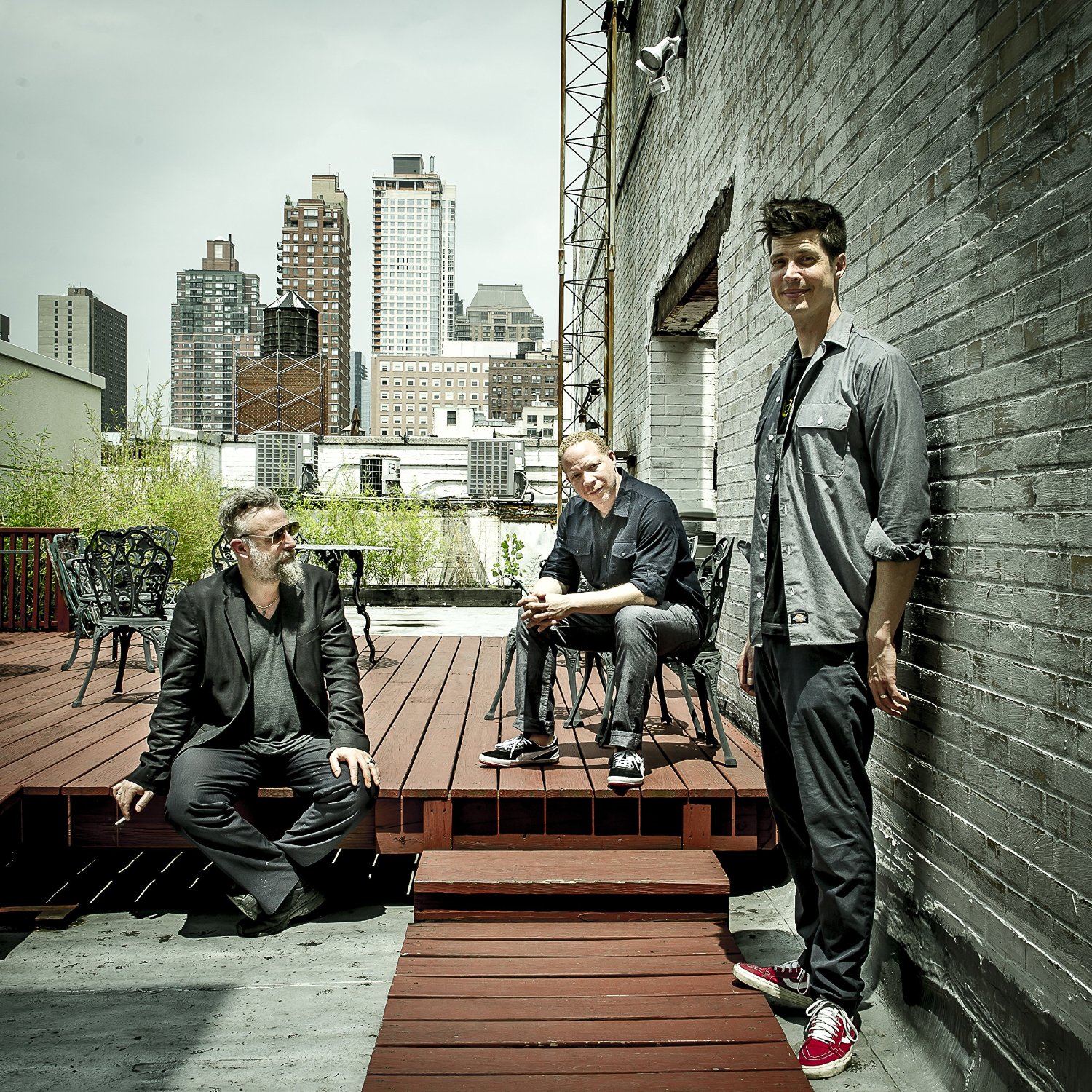
Craig Taborn/Tomeka Reid/Ches Smith: Dream Archives (ECM 2833)

Craig Taborn
Tomeka Reid
Ches Smith
Dream Archives

Craig Taborn piano, keyboard, electronics
Tomeka Reid violoncello
Ches Smith drums, vibraphone, percussion, electronics
Recorded January 2024
Firehouse 12, New Haven
Engineer: Nick Lloyd
Mixed by Craig Taborn, Manfred Eicher, and Michael Hinreiner (engineer)
Bavaria Musikstudios, München, July 2025
Cover photo: Thomas Wunsch
Album produced by Manfred Eicher
Release date: January 16, 2026

After beguiling audiences during their 2025 German tour in anticipation of the album at hand, pianist Craig Taborn, cellist Tomeka Reid, and percussionist Ches Smith align their trio for ECM’s first release of 2026. The title, Dream Archives, frames the music in the most charming of contradictions. Does it propose a vault where dreams can be stored, catalogued, and retrieved at will, filed away under emotional subject headings? Or does it imply that dreams themselves function as archives, containing versions of ourselves we would never dare to perform while awake? The answer seems to flicker between both states, never settling, always indexing something just out of reach.
 
The opening lines of “Coordinates For The Absent” lean toward the former interpretation through their careful laying down of intent. Subtle electronic signals hang in the air, suspended as if awaiting authorization, and the piece offers itself as a puzzle box of possibility, one that opens only when the correct sequence of ambient gestures is entered. Each removal reveals another chamber until a nexus of musicianship appears that feels parthenogenetic. What unfolds is a system waking up, blinking itself into awareness.
 
From this tender pile of ashes rises “Feeding Maps To The Fire,” a phoenix song rendered with turn-on-a-dime precision and lightning-fast cognition. Reid circles the square, squaring the circle even, granting Taborn and Smith a territory they can claim equally with hands and feet. Her transitions from declaration to sublimation arrive with uncanny grace, functioning as a single conductive wire of intention that transmits thought across the studio in real time. Direction is fed directly into combustion here, and nothing burns without learning something new about its own heat.
 
“Dream Archive” opens with Smith on vibraphone doubling Taborn while Reid recalibrates the internal circuitry with a quiet furiosity that hums beneath the surface. Some of the session’s most intimate connections are forged in this space. An intelligent system comes online, discovering its cellular reality one line of musical code at a time. Still, the music never forgets the hand that writes the algorithm. There is a constant searching for connections that only breath, skin, and intention can provide. Motifs bend themselves into a twisted ballad before being pushed off a cliff, tumbling across jagged terrain, landing improbably intact, scuffed but smiling.
 
“Enchant” turns the night sky inside out and offers it as a writable surface, a palimpsest of the heart rendered in constellation and groove. Reid’s ostinato summons further digital traces, as though the hairs of her bow were the threads to which these signals cling, pulled magnetically toward a pulse that knows how to moonwalk away from expectation.
 
Set within this sea of Taborn originals are pieces by two of his guiding lights. Geri Allen’s “When Kabuya Dances” blossoms with the utmost delicacy, unfolding as a textile woven from shadow and intention. It searches for illumination in Taborn’s pianism and finds it as Reid and Smith combine their energies into ground, horizon, and sky. A stomping denouement introduces phenomenally geometric trio work, Reid on pizzicato assuming the role of bassist while Smith’s drumming speaks in joyful, articulated angles. The music smiles openly here, happiness not hinted at but announced, stamped, and joyfully notarized.
 
Paul Motian’s “Mumbo Jumbo” continues that spirit of play, revealing a compositional singularity in which Taborn clearly recognizes a kindred mind. Its angular melody opens the door to some of the trio’s most delicately adventurous exchanges. The tune carries a faint echo of Tchaikovsky’s “Dance of the Sugar Plum Fairy,” refracted through beat poetry, stripped of words, and filtered back into breath and wood and skin. Smith’s use of gong and timpani lends a ceremonial grandeur that never tips into pretension, offering Reid a tender surface upon which to draw her confident, decisive lines.
 
Ultimately, the dreamlike quality of Dream Archives does not arise from its unpredictability, nor from the way it renders the surreal inevitable. It emerges instead from the album’s theatrical intelligence. These performances understand that dreaming is an act, one that requires commitment, timing, and a willingness to forget oneself mid-gesture. The trio performs with the concentration of method actors who never break character because the character is the moment itself. In doing so, they blur the line between performer and listener, pulling us into their private syntax of meaning.
 
By the album’s close, the archive no longer feels like a place of storage but a living institution, one that rewrites itself each time it is entered. The dreams here are not preserved so much as rehearsed, practiced until they become fluent. When the final notes fade, it feels less as though the music has ended than as though we have woken up holding fragments we cannot fully explain. These are the kinds of dreams that follow you into daylight, that annotate your memory without permission, that insist on being remembered even as they refuse full recall. In that sense, we are reminded of how to keep dreaming with our eyes open, filing experience under wonder, and leaving the cabinet unlocked.
Sun of Goldfinger: Congratulations to You

Most of the material on this record was captured at the first performance in 2010 by David Torn (guitars and electronics), Tim Berne (alto and baritone saxophones) and Ches Smith (drums and electronics). Known since then as Sun of Goldfinger, this power trio opened a sonic can of worms to be reckoned with that’s only now seeing the light of aural day.

Featuring three tracks of hefty proportion, the album opens with “Bat Tears,” in which alto, sampled in real time and cast into the active volcano that is Torn’s looping guitar, gives way to a skronky baritone, ending in a mix of drone and catharsis. Following this, “Coco Tangle” dances as if its pants were on fire (though, to be sure, this is honest music rendered in tough love). Sampling does the trick again this time around while arpeggiators and percussive accents from Smith fill in every pothole. That said, no roads herein stay smooth for too long and even the thickest tires of expectation will find themselves beautifully compromised by the terrain ahead.

Despite the fact that Sun of Goldfinger can break out the big guns when it feels so inclined, there’s a distinctly meditative heart beating at the center of it all. One hears this especially in the final and title track, where a train crossing signal-like guitar stretches over head-nodding drums before alto kicks in the door bearing gifts of awakening. The sheer depth of coherence that ensues is a balm to behold in these wounded times.

(This article, in its original form, appeared in the September 2020 issue of The New York City Jazz Record, a full PDF of which is available here.)

Torn/Berne/Smith: Sun Of Goldfinger (ECM 2613)

Sun Of Goldfinger

Sun Of Goldfinger

David Torn electric guitar, live-looping, electronics
Tim Berne alto saxophone
Ches Smith drums, electronics, tanbou
Craig Taborn electronics, piano
Scorchio Quartet
Amy Kimball violin
Rachel Golub violin
Martha Mooke viola
Leah Coloff cello
Mike Baggetta guitar
Ryan Ferreira guitar
Recorded September 2015 and August 2018 at The Bunker, Brooklyn Recording, EMPAC & Isokon Studios
Engineer: Daniel James Goodwin
Assistants: Adam Tilzer and Nolas Thies
Mixing: David Torn
Produced by David Torn
Release date: March 1, 2019

The trio featured on Sun Of Goldfinger coalesced in 2010, by which time guitarist David Torn and saxophonist Tim Berne had shared many years of collaborative experience between them, but to whom percussionist Ches Smith was a name as fresh as his talent. Over the next seven years, they opened themselves to the evolutionary potential of their collective body, to the point where they began laying down the tracks that would one day yield this self-titled debut.

The album opens and closes with two free improvisations, although not in the traditional sense of spontaneous creation. Rather, they are a product of mixing longer freak-outs into coherent mosaics. The result of what Torn calls this “gigantic reveal” is a sound-world bent on tattooing itself with permanence even as it dissolves in its own acid.

A hyperaware guitar licks the sky with flame in “Eye Meddle,” its electronic chemtrails a blissful grid of emotional circumstance. Smith’s own digital ephemera likewise render spaces larger than one might expect from a mere trio, as Berne cuts horizontally across their rising thermals of parthenogenesis. While Torn and Smith weave a sonic tapestry that is as much stratospheric as it is subterranean, Berne grafts on to dark matter of a highly different order, linking chains of notes in warped circularity. So committed is Berne to fighting a kneejerk fall into traction that he drops out of the matrix almost in protest when Smith drops his drum-and-bass groove. Berne struggles against its draw, adding fuel to the fire as Torn’s sun burns itself into a lightless dwarf of its former glory.

“Soften The Blow” opens more bloodshot eyes, itching along the edges of consciousness. This a deeper and darker pit of despair that nevertheless touches its reflection with childlike curiosity and opens the window to possibilities never before entertained. That said, one might draw filament influences to early Painkiller (saxophonist John Zorn’s power trio with bassist Bill Laswell and drummer Mick Harris), the only outfit I would dare to draw comparison. For while their sound and imagery occupy spaces of their own, there’s a kindred spirit of creation going on here that speaks its own will to power.

SOG
(Photo credit: Robert Lewis)

The album’s molten core is “Spartan, Before It Hit,” a piece conceived and constructed by Torn, who adds a string quartet, two guitarists (Mike Baggetta and Ryan Ferreira), and pianist Craig Taborn to the mix. What begins in arco bliss spills out across an arid plane of ancient caravan beats. Torn’s guitar has its day, shining brighter than our nearest star as if to bleach out the universe. The axis tilts, one dramatic degree at a time, until polarities are reversed on their way toward returning to neutral. It’s a process that’s both mournful and ecstatic: a sense of corporeal lust transforming into light.

Smith/Taborn/Maneri: The Bell (ECM 2474)

The Bell

The Bell

Ches Smith drums, vibraphone, timpani
Craig Taborn piano
Mat Maneri viola
Recorded June 2015 at Avatar Studios, New York
Engineer: James A. Farber
Assistant: Akihiro Nishimura
Produced by Manfred Eicher
U.S. release date: January 15, 2016

After sideman appearances with Robin Williamson and Tim Berne’s Snakeoil, percussionist Ches Smith presents a bounty of original compositions on his first ECM album as leader. In the hands of his cosmically capable bandmates and label stalwarts—pianist Craig Taborn and violist Mat Maneri—Smith’s material behaves as exactly that: a substance to be formed and reformed with cymatic detail.

The title track opens the album, appropriately enough, with chimes. Microtonal harmonies from Taborn and barest caress of viola strings build anticipation over resonant vibraphone touches. From the piano arises a sweeping cinematic landscape as the mist resolves into clearer bow lines and forceful drumming. This piece shares breath with other such delicacies as “Isn’t It Over?” and “I Think.” In both, Smith treats grooves like rocks in his shoe—which is to say, as ephemeral yet memorable. And in these metallic core samples, striations of exactitude are unnecessary. As if in response to an underlying declaration of freedom, Maneri works his songcraft like a master boatman who has lost his oar but not his sense of propulsion, moving along the water with ease by power of thought instead. The effect is such that by the time Smith brings traction, the shoreline has already been confirmed as an illusion. Whether in the microscopy of “It’s Always Winter (Somewhere)” or the angular reverie of “For Days,” each member of this trio paints a halo of deference around the others’ heads, so that even the mischievous “Wacken Open Air” emits a near-palpable blast of respect.

The Bell Trio
(Photo credit: Caterina di Perri)

“Barely Intervallic” is the first of the album’s two deepest wells. This one is Maneri’s knot to unravel. The combinatory textures of Smith and Taborn allow every note from the violist a chance to speak. The monochromatic color scheme of “I’ll See You On The Dark Side Of The Earth,” on the other hand, is Taborn’s chamber of intimacy. Maneri and Smith are minimal here, the latter’s tracery is especially poignant as a lunatic origami ensues at the fringes of cohesion. In this medieval blues, distilled from the future to meet in the blessing of the here and now, Smith and his bandmates forge new understandings that suggest themselves by their very coexistence.

As in my review of Avishai Cohen’s Into The Silence, I feel compelled to note the beauty of seeing this trio at the 2016 New York City Winter Jazzfest, and how much more attuned I felt experiencing its wonders in a live setting. Perhaps it’s the blush of first exposure, but I would encourage anyone reading this to seek out the trio in person wherever and whenever possible. Not that the studio album is unworthy—just that, like a perfume, there’s only so much you can learn about its scent through the hearsay of this or any other review before getting a bottle of it to your nose.