
Christina Rauh Fishburne: The Bridge That Would Not Burn – A Pardonsburg Novella (Book Review)

In the Washington, DC, of 1880, the past has rented a room upstairs. It descends into the parlor bearing the countenance of a former Confederate soldier, and Charlotte Worthington must decide how much of its troubled eloquence she will admit into her life. Christina Rauh Fishburne’s The Bridge That Would Not Burn makes historical fiction an intimate predicament: preservation acquires a voice, then addresses a woman whose own words rarely survive her hearth. Between them, the distance separating an event from its aftermath begins to buckle. For readers today, accustomed to encountering the past as an argument already furnished with conclusions, such proximity offers a useful discomposure. We enter a room where the consequences are still taking shape. First issued in installments and now fully illustrated, this novella occupies a passage between A Pardonsburg Songbook (Sabr Tooth Tiger Press, 2026) and the as-yet-unpublished Ballad, carrying its unfinished human reckonings into a larger imaginative country.

Charlotte is someone who consigns her words to flames, pressing ink into page but never capitulating to the allure of permanence. There is a curious sovereignty in this practice. Her thoughts may exist without becoming evidence against her, and the fire grants her a privacy that the social world would scarcely know how to honor. She tolerates the hobnobbery of that world only by the skin of her teeth, enduring it for the company of her sole friend. Beneath that impatience resides the difficulty of possessing an inward life while being perpetually available for outward appraisal. Charlotte represents a consciousness trying to reserve some portion of itself from the arrangements made on its behalf. At a magic show, she is taken into new directions of self-inquiry by a diversion beyond the stage: Lieutenant Thomas Atchison, an associate of her father and the lodger upstairs, whose enigmatic presence has landed within orbit more often than she would wish. The performance lends an apt frame to an acquaintance in which attention itself becomes a questionable art.

Not long after, she encounters him reading a book in her home’s parlor, where their conversation assumes the potentially fatal tapdance of predator and prey feeling each other out. Charlotte is both intrigued and severely put off by his countenance. Her misgivings have a bodily intelligence; curiosity, meanwhile, advances with the mortifying confidence of an uninvited guest who already knows where the silver is kept. As she talks to him more, those machinations of interest begin to loosen their hold. Fishburne attends to this yielding without rendering Charlotte’s resistance foolish. The very effort of interpreting Atchison brings her into closer acquaintance with her own desires, whose obscurity may be as vexing as his. Atchison’s speech and mannerisms are just as tactile as Charlotte’s, bringing vivid color to the novella’s already-rich atmosphere. Their exchanges give thought a surface upon which it can bruise.

Little by little, Atchison picks up shards of his traumatic war experiences, turns them in his mind’s hands, and reveals them to Charlotte. His unnamed illness lends further uncertainty to a presence whose legendary past has already preceded him into the room. Yet legend is a poor vessel for the broken particularity of memory. The man Charlotte privately calls the Mysterious Irritant carries experiences that resist the finish of a well-told anecdote, and his revelations disturb the composure with which the household might otherwise accommodate him. His Confederate past gives this intimacy an uneasy historical weight. Sympathy encounters a moral stumbling block here: suffering may invite tenderness while leaving the cause in whose service it was endured answerable to judgment. Atchison can thus be read as an embodiment of history’s troublesome persistence within private affection. Through him, the old war reaches into Charlotte’s present, asking for a response she cannot borrow from the etiquette of the parlor.

Some parts of her hold on to indifference, while others fling themselves into surrender. At one point, we are told, “She tried to read his face, but she never did have an eye or ear for other languages.” The remark catches the strangeness of an intimacy conducted in a tongue neither participant can confidently translate. As Charlotte finds herself knee-deeper in the muck of social propriety, especially during a pivotal Christmas party, the sheer, overwhelming familiarity of her life grows into a massive entity of ennui that threatens to consume her. One imagines its enormous body folded impossibly into the room, feeding upon every gesture that has been performed before. When she shares a dance with Atchison, that life takes on a newness she had previously caught only in glimpses. The movement affords her a momentary experience of possibility, though the question of what that possibility will cost remains suspended between them.

With multiple potential suitors in view, Charlotte has a war of her own to wage across the battlefield of her stubborn heart. Her eventual verbal showdown with Atchison takes on a Bennet-Darcy-esque tit for tat, although the pleasure of their antagonism rests upon more than verbal agility. Each risks allowing the other’s interpretation to become authoritative. Charlotte’s tenacity protects her against that surrender even as it complicates her pursuit of understanding. Emotions continue to stew within as divisions take shape without, until a series of dramatic events, the rollercoaster of which I will leave for the reader to ride, changes the game significantly for both parties and beyond. The widening consequences prevent their courtship, if courtship it is, from becoming a sealed chamber whose occupants can mistake their feelings for the whole world.

The chimney sweep girl accused of stealing from the Worthington home is especially consequential to that widening. Her precarious place beside Charlotte’s more sheltered uncertainty brings questions of credibility into the same house as questions of desire. Who receives the leisure of being furtive? Whose obscurity becomes grounds for accusation? Such disparities lend the historical setting a pressure that readers today can readily recognize, particularly when reputation is allowed to stand in for knowledge. As Charlotte seeks to untangle secrets in the shadows of the world she thought she knew, she begins to realize her place in it. Troubles gather there with arms coiled and ready to strike, serpents inhabiting the dark recesses of an accustomed dwelling. The vagaries of human folly, in some of its most wicked and deceptive forms, leave us wondering what might have been. That speculation also exposes how much of anyone’s life depends upon the stories others have the power to make credible.

Fishburne’s gift for language seems almost to have arrived from another time. Her words follow the discipline of a fine recipe, balancing umami and proper mouthfeel with the utmost attention to the reader’s palate. The pleasure has substance: the texture of a phrase can make an inward hesitation perceptible before even its speaker has understood it. Historical fiction acquires its relevance through just such acts of attention, restoring uncertainty to lives that hindsight is forever threatening to simplify. Charlotte’s burning pages offer a final, stranger consideration. We ask the past to yield its testimony, yet she claims the right to withdraw hers; her little furnace unsettles our appetite for possession. Perhaps a bridge that would not burn must bear something beyond the weight of remembrance. It might carry the permission to cease repeating what has been inherited, leading toward a country whose absence from every map is its first promise: a future in which our descendants owe us nothing.

Charlie Rauh: Simply, Patiently, Quietly (Book Review)

It would be easy to say that guitarist, composer, and producer Charlie Rauh charts a territory all his own. But to fall into that cliché would risk eliding the tender graces that have fueled his endeavors from the beginning. He averts his eyes from the road less traveled, setting his heart instead on that still bearing the footprints of ancestors related either by blood or artistic heritage. Whether tuning his guitar like a microscope to the poetry of Phillis Wheatley or Anne and Emily Brontë or flipping it around like a telescope in the warmth of such albums as Viriditas and Hiraeth, he never lets go of the human condition as a central concern.

This debut musical treatise bears the subtitle “An Approach to Creating Intentional Music.” And yet, what is so refreshing about the narrative offered in these pages is that you need not be a musician, intentional or otherwise, to benefit from its insights. Central among them is that we tend to back down from the passion projects we hold dear in our youth. As time tempers these into rote platitudes (“hobbies at best, hidden out of embarrassment at worst,” he notes in the Foreword), we treat their recession as inevitable. This is, perhaps, one reason why literary works and all the paratextual experiences they entail have been integral to his oeuvre for so long. In that sense, he is as much a translator as a composer.

In the first section, “Simply,” he reflects on his time studying improvisation with jazz pianist Connie Crothers. Instead of bowing to the (relatively recent) convention that tells us simplicity is a bad thing, he embraces it as “a pure distillation of identifiable quality” that allows complexity to breathe. I cannot help but liken it to a line drawing of a wing versus a massive Baroque painting filled with saints and cherubim. The burden of proof on the creator of the former is deeper in the sense that every line speaks nakedly on the page, whereas in the latter, the margin for self-indulgence is greater yet more easily concealed. What Rauh realized at a key turning point in his growth as a musician was that complicating matters with business wasn’t the end goal. It was tapping into the childlike curiosity that such veneers, fragile as they are, do a surprisingly good job of hiding. This does not mean that one must “devolve” but that one must be willing to be vulnerable. And when we are vulnerable, we confront the question of who we are in spite of ourselves.

“Patiently” brings us into the spiritual weeds, through which every glimpse of sunshine becomes a tether to hope. More than that, it is the ultimate expression of love (think, for example, of the long-suffering God who stays his hand so that we might learn from our mistakes). And so, patience is not about proving your limits of tolerance but about faith as the evidence of things unseen. As Rauh humbly admits, “This is easier said than done, and despite my best wishes, I cannot claim that I am fully in tune with the concept as it applies to my life.” Amen, and amen.

Patience, too, is a mode of healing. It is the promise of strength fulfilled and renewed through the perseverance of the human (and animal) spirit. By tempering our fears, it gives room to stretch out our egos and cut them into millions of pieces. On the practical side, patience makes it “not only acceptable but optimal to leave spaces in your workflow.” Without those spaces, we lose sight of ourselves and what we are capable of. The moment we say we have arrived is probably when we need to check our assurance at the door and start singing again for its own sake.

The book’s third act, “Quietly,” is where the soul comes most readily into play. That said, quietude isn’t some mystical state of being in which one achieves unity with the universe but rather a recognition that the melodies of our lives need volition to seek one another out. And that is where the youthful essence from which we have distanced ourselves must be fished from within. Children are nothing if not intentional, and such clarity of expression is where we get our profoundest ideas. To be silent is to see ourselves no longer through the filters of camera lenses and computer screens but rather in the naked truth of the proverbial mirror. In so doing, we realize just how noisy we are inside.

I am reminded of an anecdote involving John Cage, who stepped into an anechoic chamber with the intention of experiencing true silence, only to discover that the faint sounds of his circulating blood and nervous system rendered that concept moot. This experience happened to be the inspiration behind his infamous composition 4’33”, for which the performer sits quietly in front of a piano for the titular duration without playing a single note. In hindsight, what was so disturbing about the piece’s premiere wasn’t necessarily that Cage was poking fun at the academy or even philosophically questioning the very definition of music; it was the fact that the performer ceased to matter. Thus, to experience 4’33” live is to be flooded with all sorts of internal voices. In wrestling with this same tension, Rauh concludes that the result of quiet music isn’t boredom or relaxation but power. It also tests our mettle as listeners and clues us in on the creed of patience. “When the rest falls away,” he observes, “all that is left is all we can give.”

No review of this superbly rendered meta-statement would be complete without mentioning the contributions of his sister, Christina Rauh Fishburne, whose illustrations are the glue that binds. By turns whimsical and contemplative, they work in counterpoint to the text without ever intruding. One in particular, which appears on page 24, speaks to the nostalgia of this reader/viewer. Its depiction of curiosity, stripped of all the baggage that adults bring to this impulse, teeters on the edge of interpretation. It is also the first of a sequence of images that home in on key aspects of the words preceding them.

Whether in the domestic comforts of a life without clear and present dangers or in the wider view of time and its inevitable entropy, Fishburne’s ability to pull out memories we never knew we had is a blessing and a comfort. As a segue into the scores included herein, they are denizens of a time capsule that is itself the curio of another time capsule. Of said scores, the musically inclined among us get access to a swath of moods. From lullabies to choral settings, they offer plenty of soil in which to plant and water seeds of communion, assuring us that we can rest our heads on pillows of wonder every night, knowing there is only more to come when day breaks.

BIRD by Christina Rauh Fishburne (Book Review)

Between the covers of BIRD, Christina Rauh Fishburne offers a chapbook of moving images and emotional tableaux using words as her pigment and a keen sense of observation as her brush. Her prose poems are stories just beginning to petal open in the light of a reader’s eyes, each as fragrant with densely packed information as a human cell.

The scenes are as distinct as the verses describing them. While there are plenty of aerial views to take in, Fishburne dives ever inward as the pages flip by. From a scarecrow-stuck field and private garden to a dressing room and mollusk’s shell, she combines just enough ingredients to make a meal of the lesson at hand and consume it before moving on to the next.

Personalities plant their stakes along the way. Whether in the crow’s stark altruism, the albatross’s maritime legacy, or the barn owl’s untranslatable scream, the indifference of bare life to examined life renders our concerns at once universal and meaningless. This doesn’t mean we are always looking through nonhuman eyes; it does mean we are asked to consider how that gnaws at the ego.

Whereas impossibilities feel organic (“The sun was still and straight as a cowboy”), renderings of the quotidian and the agricultural (there is, for example, repeated mention of barley) feel starkly out of place, as if nature were only a construction of those who infringe upon it with the cutting of blades, the striking of matches, and the pulling of roots.

While the mood is generally retrospective, sometimes regretful, a certain resilience shines through with mounting clarity. Even darker passages like “Pheasant” embalm a youthful wonder that never seems to burnish. “Oyster Catcher” is a masterstroke of parental anxieties (“My child will be born quite soon. I receive her messages in sudden desperate grasping. She must be like me. She doesn’t like to be inside”) and confinement. In it, the pearl—for us, a sign of beauty and value—is a natural irritant, a bauble of sacrifice and forced honor that never quite reflects the visage of its wearer. 

Signposting our journey are four “takes” on the gull. Their encounters with wounded yet resilient souls court the temptation to exaggerate or revise personal narratives. Fishburne continually seeks such hypocrisies, throwing intimate spotlights on them to ward us away. Elemental touchpoints also throw the occasional roof over our heads. Of these, “Water” gets at the heart of the collection’s worship of transfiguration. We take a lot of turns together yet come out the other end with scars to show for our survival.

The animal, insofar as it reflects the human, has more self-awareness and investment in the world than we might think. The human, insofar as it reflects the animal, loses itself in rote survival. “There’s nothing worse than a flightless bird,” Fishburne tells us, giving us hope to build wings of our own from the scraps of lived experience.

Bird is available directly from Kattywompus Press here.

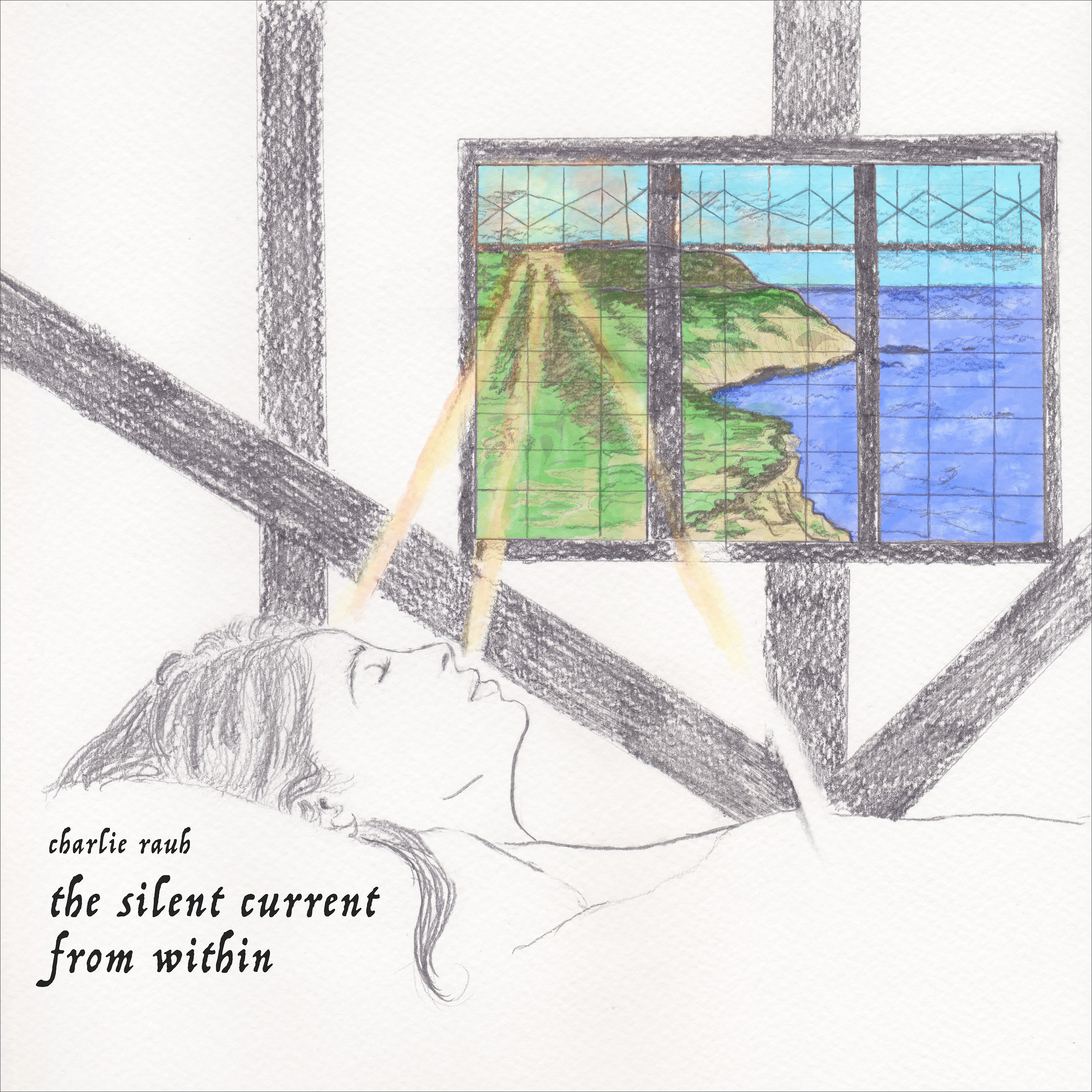
Charlie Rauh: The Silent Current From Within

If Life must be so full of care,
Then call me soon to Thee;
Or give me strength enough to bear
My load of misery.
–Anne Brontë, “If This Be All”

In the soft yet indelible wake of The Bluebell, an acoustic solo album articulated around echoes of the Brontë sisters, guitarist Charlie Rauh reclaims a kindred power in his latest musical web, The Silent Current From Within, now joined by vocalist Ess See, drummer Ken Coomer, and bassist Jonah Kraut. Spinning his radii of inspiration via sister Christina Rauh Fishburne, Canadian poet Anne Carson, and Anne Brontë, whose words take nonverbal form through the capture spiral of these expanded readings, Rauh positions the listener as the anchor point of a pattern that has left its glyphs of fatigue on all of us in these times of social isolation.

The project at hand emerged when Coomer reached out to Rauh for a long-distance collaboration, adding Kraut for good measure as the songs took on new life. Thus were born three pieces around themes found in the work of Fishburne and Carson, each lending its own shade to the protracted dawn that is the album as a whole. The brush of a morning breeze is audibly felt in “A Marked And Mended Sign,” over the course of which the sun raises its eyebrow just high enough to clear a distant mountain range, while “Until The Charm Fades” crafts its light into a pair of hands pulling vegetation from the soil. “As Simple As Water” nourishes that crop with emotional nutrients, opening the sky like a heart primed to receive wisdom unfettered by the acrobatics of dead philosophies. Likewise, in these contexts, Kraut’s bassing and Coomer’s drumming don’t merely add to Rauh’s guitar, but rather draw out fruit from within it.

All of this is framed by the voice of Ess See, who guides an unaccompanied thread of improvisation through the title track and a multitracked choir with Rauh’s fretwork in the concluding “If This Be All.” In the latter, she unleashes cries at once born from and at odds with nature. She seems to question the tragedy of the pandemic even while bowing to its biological sovereignty. Such conflicts are central to the human condition, each standing like an abandoned building through which these songs have passed and left their fragrance, thus bidding the ears to inhale the incense of what came before. 

Temporally speaking, these are vignettes, the longest of which falls shy of the three-minute mark. Spatially speaking, however, these are vast oceans in which vessels of possibility sail in every direction a compass can imagine. The only question that remains: Will we burn our bridges or rebuild them before they fall?

The Silent Current From Within is scheduled for a March 12, 2021 release on Destiny Records.