Craig Taborn/Tomeka Reid/Ches Smith: Dream Archives (ECM 2833)

Craig Taborn
Tomeka Reid
Ches Smith
Dream Archives

Craig Taborn piano, keyboard, electronics
Tomeka Reid violoncello
Ches Smith drums, vibraphone, percussion, electronics
Recorded January 2024
Firehouse 12, New Haven
Engineer: Nick Lloyd
Mixed by Craig Taborn, Manfred Eicher, and Michael Hinreiner (engineer)
Bavaria Musikstudios, München, July 2025
Cover photo: Thomas Wunsch
Album produced by Manfred Eicher
Release date: January 16, 2026

After beguiling audiences during their 2025 German tour in anticipation of the album at hand, pianist Craig Taborn, cellist Tomeka Reid, and percussionist Ches Smith align their trio for ECM’s first release of 2026. The title, Dream Archives, frames the music in the most charming of contradictions. Does it propose a vault where dreams can be stored, catalogued, and retrieved at will, filed away under emotional subject headings? Or does it imply that dreams themselves function as archives, containing versions of ourselves we would never dare to perform while awake? The answer seems to flicker between both states, never settling, always indexing something just out of reach.
 
The opening lines of “Coordinates For The Absent” lean toward the former interpretation through their careful laying down of intent. Subtle electronic signals hang in the air, suspended as if awaiting authorization, and the piece offers itself as a puzzle box of possibility, one that opens only when the correct sequence of ambient gestures is entered. Each removal reveals another chamber until a nexus of musicianship appears that feels parthenogenetic. What unfolds is a system waking up, blinking itself into awareness.
 
From this tender pile of ashes rises “Feeding Maps To The Fire,” a phoenix song rendered with turn-on-a-dime precision and lightning-fast cognition. Reid circles the square, squaring the circle even, granting Taborn and Smith a territory they can claim equally with hands and feet. Her transitions from declaration to sublimation arrive with uncanny grace, functioning as a single conductive wire of intention that transmits thought across the studio in real time. Direction is fed directly into combustion here, and nothing burns without learning something new about its own heat.
 
“Dream Archive” opens with Smith on vibraphone doubling Taborn while Reid recalibrates the internal circuitry with a quiet furiosity that hums beneath the surface. Some of the session’s most intimate connections are forged in this space. An intelligent system comes online, discovering its cellular reality one line of musical code at a time. Still, the music never forgets the hand that writes the algorithm. There is a constant searching for connections that only breath, skin, and intention can provide. Motifs bend themselves into a twisted ballad before being pushed off a cliff, tumbling across jagged terrain, landing improbably intact, scuffed but smiling.
 
“Enchant” turns the night sky inside out and offers it as a writable surface, a palimpsest of the heart rendered in constellation and groove. Reid’s ostinato summons further digital traces, as though the hairs of her bow were the threads to which these signals cling, pulled magnetically toward a pulse that knows how to moonwalk away from expectation.
 
Set within this sea of Taborn originals are pieces by two of his guiding lights. Geri Allen’s “When Kabuya Dances” blossoms with the utmost delicacy, unfolding as a textile woven from shadow and intention. It searches for illumination in Taborn’s pianism and finds it as Reid and Smith combine their energies into ground, horizon, and sky. A stomping denouement introduces phenomenally geometric trio work, Reid on pizzicato assuming the role of bassist while Smith’s drumming speaks in joyful, articulated angles. The music smiles openly here, happiness not hinted at but announced, stamped, and joyfully notarized.
 
Paul Motian’s “Mumbo Jumbo” continues that spirit of play, revealing a compositional singularity in which Taborn clearly recognizes a kindred mind. Its angular melody opens the door to some of the trio’s most delicately adventurous exchanges. The tune carries a faint echo of Tchaikovsky’s “Dance of the Sugar Plum Fairy,” refracted through beat poetry, stripped of words, and filtered back into breath and wood and skin. Smith’s use of gong and timpani lends a ceremonial grandeur that never tips into pretension, offering Reid a tender surface upon which to draw her confident, decisive lines.
 
Ultimately, the dreamlike quality of Dream Archives does not arise from its unpredictability, nor from the way it renders the surreal inevitable. It emerges instead from the album’s theatrical intelligence. These performances understand that dreaming is an act, one that requires commitment, timing, and a willingness to forget oneself mid-gesture. The trio performs with the concentration of method actors who never break character because the character is the moment itself. In doing so, they blur the line between performer and listener, pulling us into their private syntax of meaning.
 
By the album’s close, the archive no longer feels like a place of storage but a living institution, one that rewrites itself each time it is entered. The dreams here are not preserved so much as rehearsed, practiced until they become fluent. When the final notes fade, it feels less as though the music has ended than as though we have woken up holding fragments we cannot fully explain. These are the kinds of dreams that follow you into daylight, that annotate your memory without permission, that insist on being remembered even as they refuse full recall. In that sense, we are reminded of how to keep dreaming with our eyes open, filing experience under wonder, and leaving the cabinet unlocked.
Craig Taborn: Shadow Plays (ECM 2693)

Craig Taborn
Shadow Plays

Craig Taborn piano
Concert recording, March 2, 2020
Wiener Konzerthaus
Engineer: Stefano Amerio
Cover photo: Thomas Wunsch
Produced by Manfred Eicher
Release date: October 8, 2021

Since releasing Avenging Angel, Craig Taborn’s first spontaneous recital for ECM, a decade ago, the pianist’s traversal on the label has brought him to collective enterprises with the likes of Roscoe Mitchell, Thomas Morgan, and Chris Potter. All the while, his language has been as much his own as it has been a force of adaptation to contexts big and small. If that earlier effort can be said to evoke disembodiment, then let Shadow Plays be its embodied other half. From the gestures that open “Bird Templars,” one gets the sense that each of Taborn’s hands is a traveler engaged in a slow-motion contest for a single path ahead. And yet, there is no feeling of animosity—instead, a sense of wonder, especially as the music quiets in the left, allowing the right to offer its soliloquy in the spirit of accompaniment. If it is possible to whisper through a piano, then Taborn has accomplished that here. “Discordia Concors” and “Concordia Discors” both offer frantic searches for meaning balanced by the jauntier rhythms of “Conspiracy Of Things” between them. These pieces find themselves pulled to the keys by a gravitational force they cannot quite escape.

The jazziest inflections await interpretation through “A Code With Spells” and the concluding “Now In Hope,” both of which convey honeyed textures with cinematic sensibilities, each coated by resistance against the storms that have barraged us over the past year and a half. The most epic stretches are reserved for “Shadow Play,” in which chords resuscitate the possibility of harmony. As one of the cleanest concert recordings I’ve heard, it felt like I was the only one in the room: an intimacy we need more of than ever.

(This review originally appeared in the January 2022 issue of The New York City Jazz Record, a full PDF of which is available here.)

Craig Taborn/Vadim Neselovskyi: Da’at

Da'at

The Masada songbook is a gift that keeps on giving. Since Book 1 was introduced to the listening world through a coveted decalogue of CDs released in the 1990s by DIW, John Zorn’s magnum opus has continued to grow. Like the city of Beijing, over the years it has added one ring after another as newer residents flock in search of an indefinable center. In this iteration we find two pianists—Craig Taborn and Vadim Neselovskyi—interpreting tunes in solo and duo configurations.

Taborn’s six unaccompanied tracks tell a range of stories, each more involved than the last. Generally, these fall into two modes, exemplified by the swirling motifs, colorful vistas and deeply personal riffs of “Penimi” and dreamlike patience of “Kayam,” which works into denser and denser weaves, from gossamer to burlap. “Setumah” comes up for air from turgid surroundings with gentle persuasion, proof that this music requires virtuosity of an emotional register as much of a technical one.

Neselovskyi’s triptych of solo offerings explores different chambers of the same heart. His expressive palette, while monochromatic by comparison, is no less dynamic for its range of textures, moods and effects. The fibrillations of “Orot” are especially blood-rich. In duet with Taborn, he unleashes darkness and light in equal measure, guided by a mutual trust to follow wherever the music leads. Theirs is an act not only of communication, but also of deconstruction, whereby the very nature of language cowers at the feet of gestural vocabularies.

The final three tracks feature Neselovskyi’s trio with bassist Dan Loomis and drummer Ronen Itzik. Across reexaminations of “Bohu,” “Kayam” and “Penimi,” they leap from the page with sentient assurance. The rhythm section, in combination with Neselovskyi’s colorful sensibility at the keyboard, makes for one of the most robust flares to come out of the Masada sun in quite some time. Turning these tunes like a facet, we find that each catches the sun just so, a signal for some future interpreter to spin as they feel moved.

(This review originally appeared in the January 2020 issue of The New York City Jazz Record, a full PDF of which is available here.)

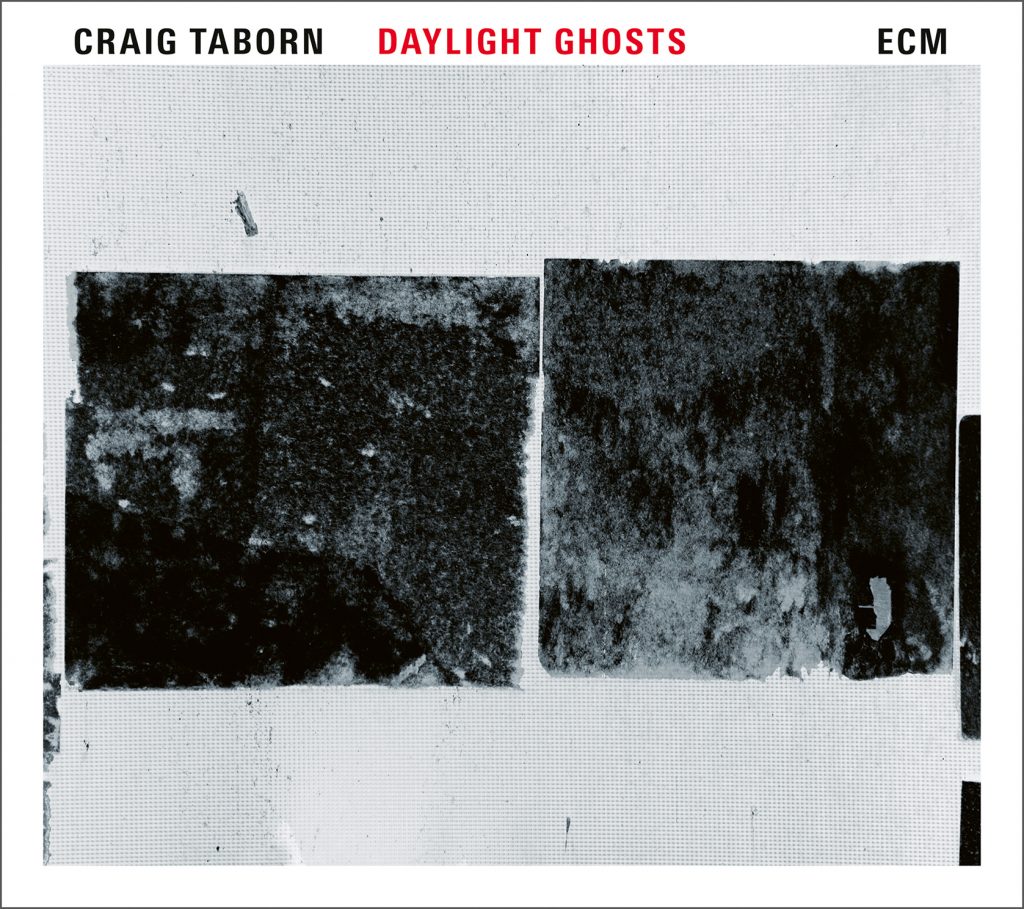
Craig Taborn: Daylight Ghosts (ECM 2527)

Daylight Ghosts

Craig Taborn
Daylight Ghosts

Craig Taborn piano, electronics
Chris Speed tenor saxophone, clarinet
Chris Lightcap double bass, guitar
Dave King drums, electronic percussion
Recorded May 2016 at Avatar Studios, New York
Engineer: James A. Farber
Assistant: Tim Marchiafava
Produced by Manfred Eicher
Release date: February 3, 2017

In the footsteps of two successful leader dates for ECM, pianist Craig Taborn rolls the die of paradigm once again and hits a solid four with Chris Speed on tenor saxophone and clarinet, Chris Lightcap on bass and guitar, and Dave King on drums and electronic percussion. Opener “The Shining One” is sure to delight fans of label mate Tim Berne, whose penchant for complex geometry is echoed here. Comparison aside, there’s a DNA helix all its own down which these musicians slide toward endings as abrupt as their beginnings. Speed navigates the bandleader’s genetic code as if it were his own back yard, while Lightcap and King engage in sequencing that feels at once parasitic and parthenogenetic.

“Abandoned Reminder” unravels its story from whispering electronics, as Taborn narrates a ballad-turned-trip down a stairway of psychological proportion. Such changes are indicative of an overall constitution, which by suggestion of an unusual fluidity activates proteins in underused listening muscles. The title track and “The Great Silence” are remarkable in this regard. Their enmeshment of soft virtue and hard truth is the quartet’s calling card. Like the arpeggios that thread both in their final phases, they treat predictability as a springboard for its own undoing.

Says Taborn of working with such widely accomplished musicians, “This music trades on transparency. I wanted all the elements to be crystalline, so that the layers of the music work like a prism.” Indeed, prismatic effects abound throughout“New Glory,” in which Taborn and Speed exchange unveiled conversation, and “Ancient.” The latter’s transition from bass monologue to ritual confluence shows a band working with patience and detail. As the parts, so the whole. Whether in the resonant piano-drums duet of “Subtle Living Equations” or the cosmic textures of “Phantom Ratio,” which floats Speed’s tenor on an ocean of nostalgic loops, the effect is consistently appropriate to the theme at hand. And while Taborn’s writing tends to pay homage to those themes at microscopic levels, his nod to Roscoe Mitchell’s “Jamaican Farewell” sees the jewel for the facets, and shines a methodical light of appreciation through a heart whose every beat is musical gospel. This is good news indeed.

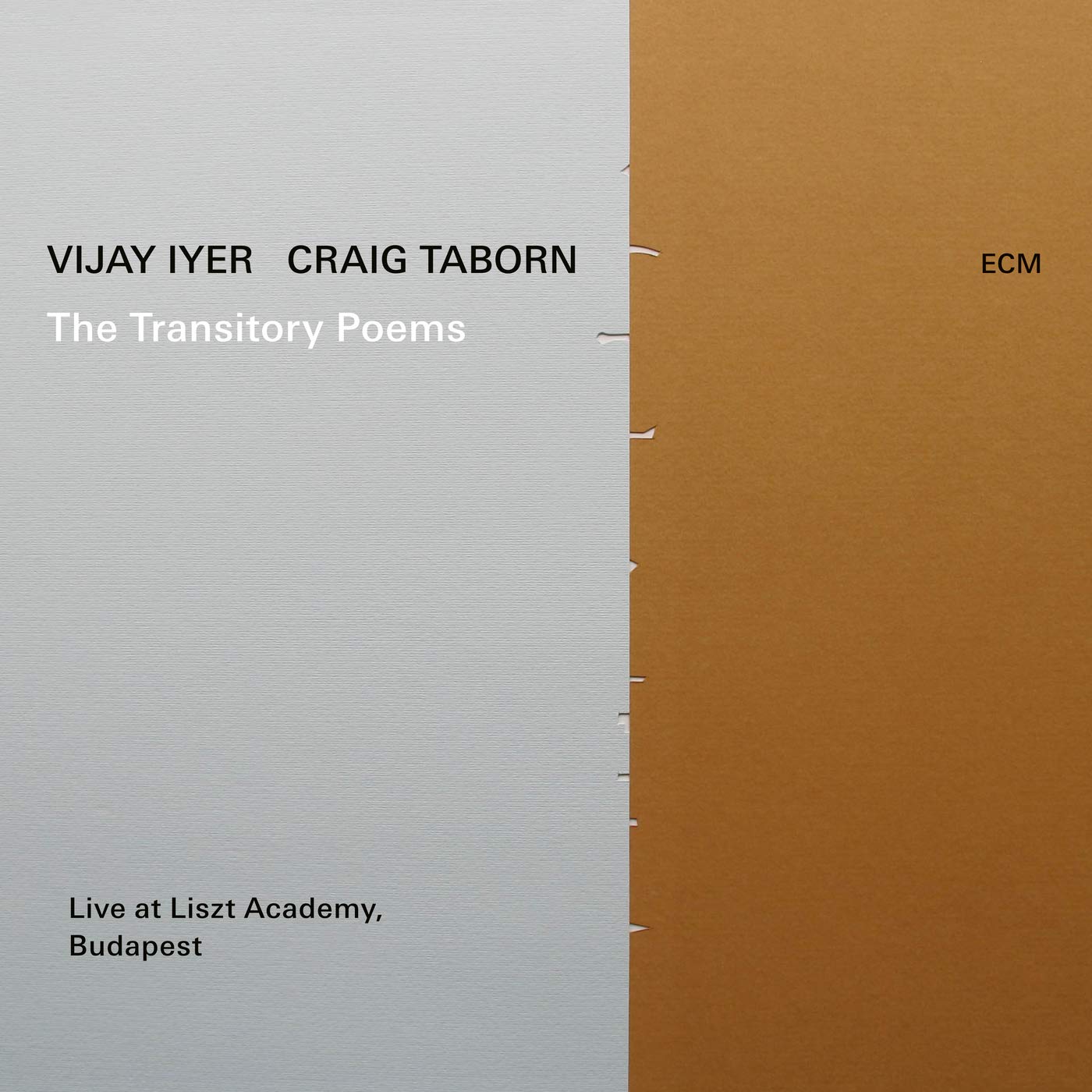
Vijay Iyer/Craig Taborn: The Transitory Poems (ECM 2644)

The Transitory Poems

The Transitory Poems

Vijay Iyer piano
Craig Taborn piano
Recorded live March 12, 2018
at the concert hall of the Franz Liszt Academy of Music, Budapest
Engineer: Stefano Amerio
Produced by Manfred Eicher
Release date: March 15, 2019

The duo of pianists Vijay Iyer and Craig Taborn, documented on this March 2018 live recording at Budapest’s Franz Liszt Academy of Music, came out of an involvement in Roscoe Mitchell’s Note Factory. In that context they balanced prewritten knotwork with improvisational unraveling and acted as likeminded catalysts for spontaneous composition.

The opening “Life Line (Seven Tensions)” bears an appropriate subtitle, which, by gentle force of suggestion, allows one to imagine the physiological give and take required to bring this music to fruition. Interplays between passages of both intense abstraction and synchronicity feel as much indicative of where Iyer and Taborn came from as where they are going. With actorly sense of space they mold the stage as inspirational substance. They move as if stationary, posing as if never settling for one meaning.

Iyer Taborn
(Photo credit: Monica Jane Frisell)

Although subsequent tracks have their distinctions, as a whole they form an album of immense coherence. This didn’t stop the musicians from hearing much of what they rendered as impromptu panegyrics for legends lost that same year. “Sensorium,” for Jack Whitten, evokes the artist’s complex inner worlds and fractal obsessions; “Clear Monolith,” for Muhal Richard Abrams, allows light to pass through its latticed notes; and “Luminous Brew,” for Cecil Taylor, boils highs and lows over a campfire until their ingredients are indistinguishable. But nowhere is the feeling of dedication so palpable as in Geri Allen’s “When Kabuya Dances,” which crystallizes themes hinted at in a preceding improvisation and leaves listeners suspended far above where they started.

Beyond assertions of technical skill, Iyer and Taborn are purveyors of the metaphysical, listening more than making. Whether in sporadic (“Kairòs”) or rhythmically-driven (“Shake Down”) dialects, they speak in a supremely translatable language. This, if anything, is what makes these transitory poems more than freely made: rather, they’re made free.

(This article originally appeared in the July 2019 issue of The New York City Jazz Record, a full PDF of which is available for download here.)

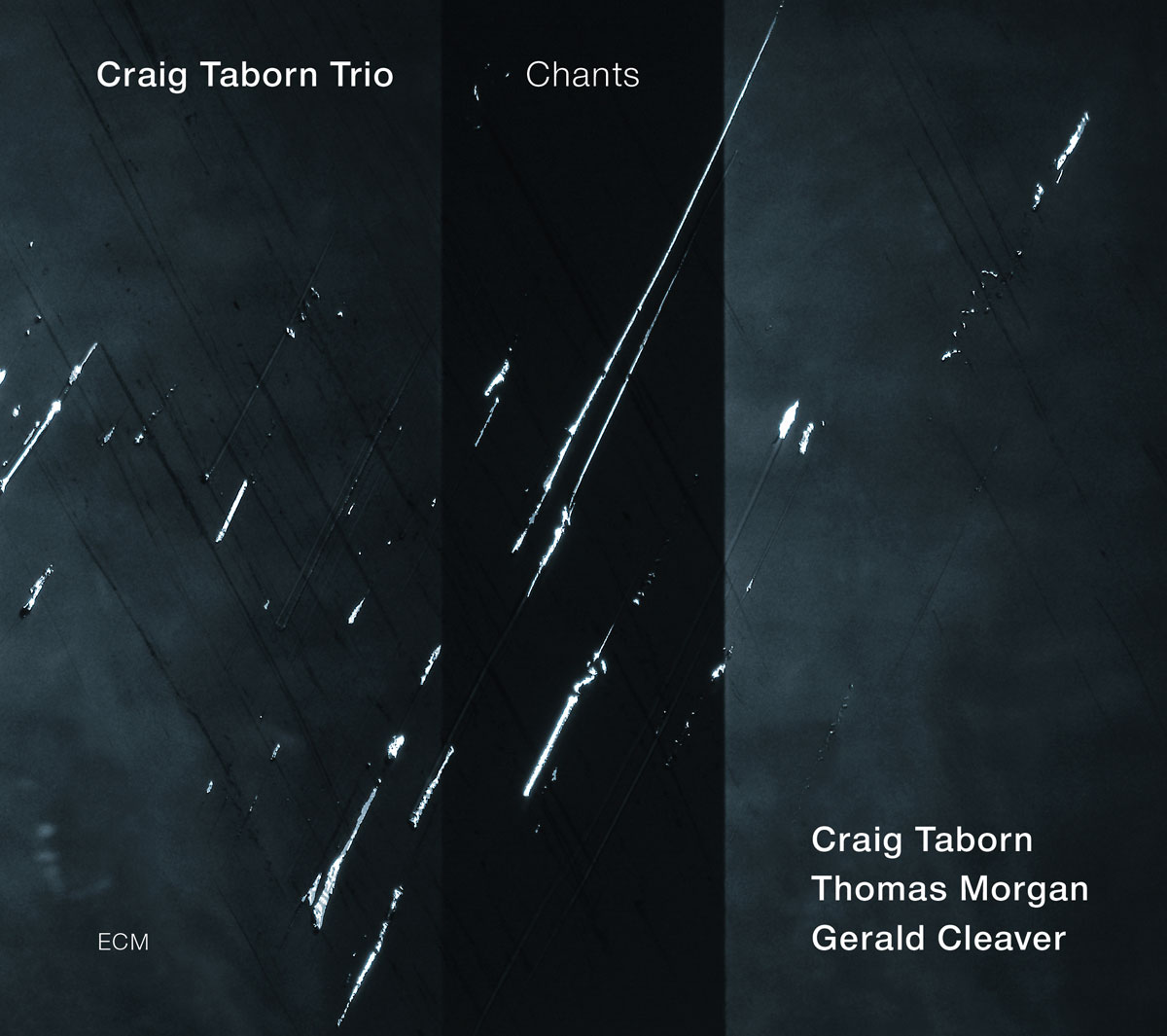
Craig Taborn Trio: Chants (ECM 2326)

Chants

Craig Taborn Trio
Chants

Craig Taborn piano
Thomas Morgan double bass
Gerald Cleaver drums
Recorded June 2012 at Avatar Studios, New York
Engineer: James A. Farber
Assistant engineer: Charlie Kramsky
Produced by Manfred Eicher

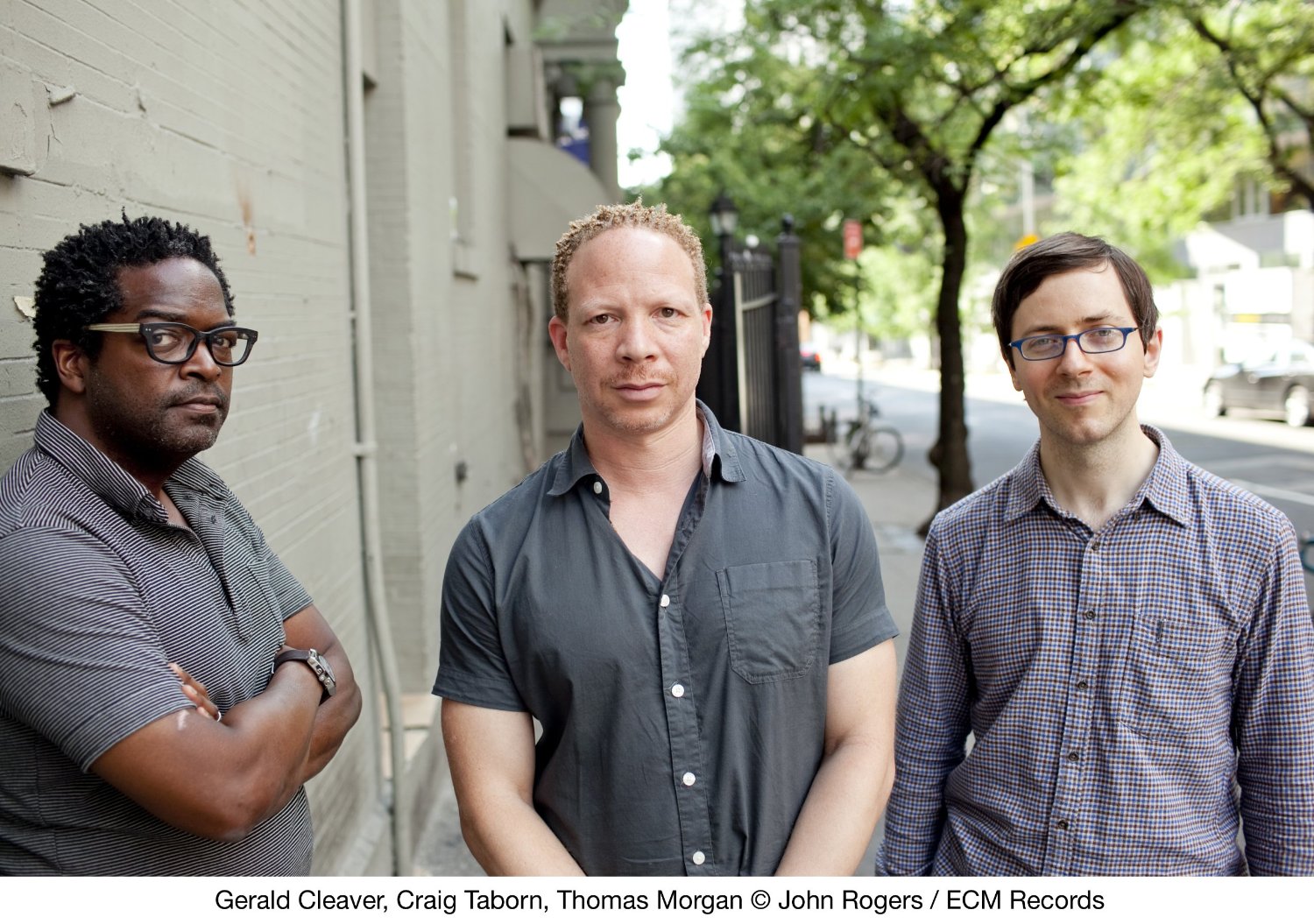
The Craig Taborn Trio is a metronome with a soul. For its debut release, Chants, the pianist’s fearless group carves a niche and fills it with so much creative spirit that no one but the listener can squeeze in for a spell. The album defines a repertoire, extracting from one of the most enviable rhythm sections in the business an elixir for surefire engagement. Bassist Thomas Morgan and drummer Gerald Cleaver know what Taborn is all about. They are never add-ons but are fully immersed atoms in his molecular goings on, nearly a decade in the forming. And if the syncopation of “Saints” is any indication, theirs is an aliveness of unity rare to hear. As in so many of the tracks that follow, there is a winding, slightly off-kilter feeling to its jaggedness. Taborn and Cleaver leave an especially consonant series of markings at the outset, each the half of a poker deck perfectly Farrowed to the tune of Morgan’s deal. The bassist works alone “In Chant,” enacting no mere solo per se but a living tendon between wholes. In those wholes contrasts abound. “Beat The Ground” evokes the blurred foliage of a running warrior’s peripheral vision. His weapons trickle down from the sky in care packages of godly insight, inspiring pulse-driven spirals into resonant fade. The feeling of resolution is as visceral as it is fragile. “Hot Blood,” on the other hand, is as cool as can be. It opens a city’s worth of brainwashed minds and, while flurried, keeps its inner flame in smooth focus.

Taborn Trio

From the tectonic instability of its intro, “All True Night / Future Perfect” congeals like so much stardust. Its evolving Spirograph is toothed with miniscule variations, which though unapparent to the naked eye scream to the naked ear. Like a dislocated joint these connections remain encased in the body proper, hanging in lieu of locomotion. “Cracking Hearts” opens with a scattering of cobwebs from Cleaver before the trio rummages through everything in its attic, upturning memories that were never theirs to begin with yet which ring familiarly. More important than artifacts are the “Silver Ghosts” who haunt the rafters. Theirs is a ponderous song, an ephemeral dotted line of footprints in the dark, conducted by the wings of a trapped and frightened bat. “Silver Days Or Love” clears out the windows, drawing pointillist glyphs by Taborn’s right hand over a steady imprinting of chords from his left. A strangely enchanting bass solo, host to a network of internal gatherings, gives soil to Taborn’s sprigs of blossom. Only when they “Speak The Name” do clouds begin to open their pores to the firmament’s pale blue love.

While the music of Chants is certainly profound, it is, more simply, found. It is as if it had been wandering for countless years in the corners of our minds, each motif a determined mouse waiting for just the right cheese to tantalize its palate. Taborn never lets the intensity of this indulgence overwhelm. He knows just when to turn down the dial, lest the circuit break and leave us altogether unreceptive to signals. His brilliance is all in the music. Rather than go from A to B, he is content going from Q to R, clothing himself in the orbits of another planetary system that operates by its own gravitational and chemical rules. The chant, then, becomes a de-normalizing impulse, a light in the telescope that renders us in our darkest hour strangers even to ourselves.

There is glory and praise in these movements, sacrifice and self-reflection, pockets of expectation filled to bursting with illusions. As in the surgical discoveries of Nik Bärtsch’s Ronin, geometry is paramount, the lifeblood of all orbit. If the Keith Jarrett Trio revitalized the standard, Taborn and his allies have set one.

(To hear samples of Chants, click here, or watch the promo video below.)

Craig Taborn: Avenging Angel (ECM 2207)

Avenging Angel

Craig Taborn
Avenging Angel

Craig Taborn piano
Recorded July 2010, Auditorio Radiotelevisione Svizzera, Lugano
Engineer: Stefano Amerio
Produced by Manfred Eicher

Avenging Angel marks Craig Taborn’s solo debut, this after a string of fine appearances on joints with Roscoe Mitchell, Evan Parker, Michael Formanek, and David Torn. Being an ardent Bill Laswell fan, however, my first encounter with the Minneapolis-born keyboardist came by way of his smooth electric piano stylings on Dub Chamber 3 (released 2000 on ROIR). Incidentally, that classic underground session also featured future ECM label mate Nils Petter Molvær on trumpet—perhaps a sign of things to come. The present album finds Taborn concentrating, as he has been in recent years, on the art of unaccompanied improvisation. The formula will sound familiar to anyone who has picked up a Keith Jarrett record in the last three decades, but the results, while likeminded, are starkly Taborn’s own. For whereas it is easy to read transcendence into Jarrett’s epic exegeses, Taborn wants us to dive into his instrument and nest in it for awhile. In his words, “This music is not about ‘transcending the piano’ as much as it is about working with what is possible within it.” Thus taking the dynamics of physical means, environment, and atmospheric context into account, he crafts a sound that appears structured yet which allows centuries of air to flow through its architecture.

Taborn
(Photo source: flickriver)

Like a tap on the shoulder from a shaded past, “The Broad Day King” introduces us to a watercolor-bleed of feeling. The effect is skeletal and tented by fingers of dawn. We can guess said king’s name. The music might even tell us. But ultimately his identity can be written only by hammers and strings, his reign as fragile as their tuning. If such titles mean anything to us, it is only because the Escherian landscape in which they are situated is so faithfully rendered. In the spontaneity of creation, Taborn locks us into the spirit not only of the elusive moment, but also of the many directions its ancestors have traveled to get here. We hear this in the sparkling eddies of “Glossolalia” and “Neverland,” and in child-like wonder of “Diamond Turning Dream,” which spins a bracelet of the former’s starlight.

This album is yet another benchmark for engineer Stefano Amerio, who posits Taborn’s intimate storytelling in a reverberant universe. The touch is just enough to spin an expansive backdrop while keeping the foreground crystal clear. This is truest in the title track, which dances uncannily at the edge of our firelight, and in “This Voice Says So.” The latter plays like a lullaby stretched into the slumbering pathos it inspires, making for one of the most beautiful tracks in ECM history. It is the illusion of stillness magnified, a glassine reflection, and all the deeper for its minimalism. And though Taborn does stir up the sediment, he is careful to end on the same delicacy with which the piece begins, ever attentive to the space(s) he inhabits. “True Life Near” is an example of the pianist’s uncanny ability to elicit tenderness from the often-sharp attack of his right hand. If any Jarrett parallels must be drawn, let them find purchase on this morsel of cinematic wonder. “Gift Horse / Over The Water” is a jauntier diptych with tight, 90-degree syncopations, and detailed riffs over a head-nodding ostinato. Its mechanical aspirations are more fully realized in “A Difficult Thing Said Simply,” while the bubbling “Spirit Hard Knock” exploits even more the capabilities of the studio’s Steinway D in epic waves. “Neither-Nor” is, as its title would seem to imply, the most “grammatical” of the set and has the quality of rainfall. Another highlight is “Forgetful,” a lost jazz standard trickling in from the other side of a dream, and which takes on some of the grandeur of that dream in its mellifluous resolution. “This Is How You Disappear” is a clever way to both say and realize fadeout. Drawing the curtain one fold at a time, until all that remains is the cover photograph’s sliver of backstage light, Taborn sets off a tender fuse with his finger roll, even as stars crash earthward, leaving only splashes of faraway nebulae to show for their sacrifice.

No matter how out of focus these images become, you can always count on Taborn to leave at least one focal point crisp. The focal point is paramount, for it invites us not only to listen but also to become. It is our hovel of transformation. As to what the listener might turn into, that’s as unpredictable as the paths his fingers take. If this angel avenges anything, it is the bane of expectation.

(To hear samples of Avenging Angel, click here.)