

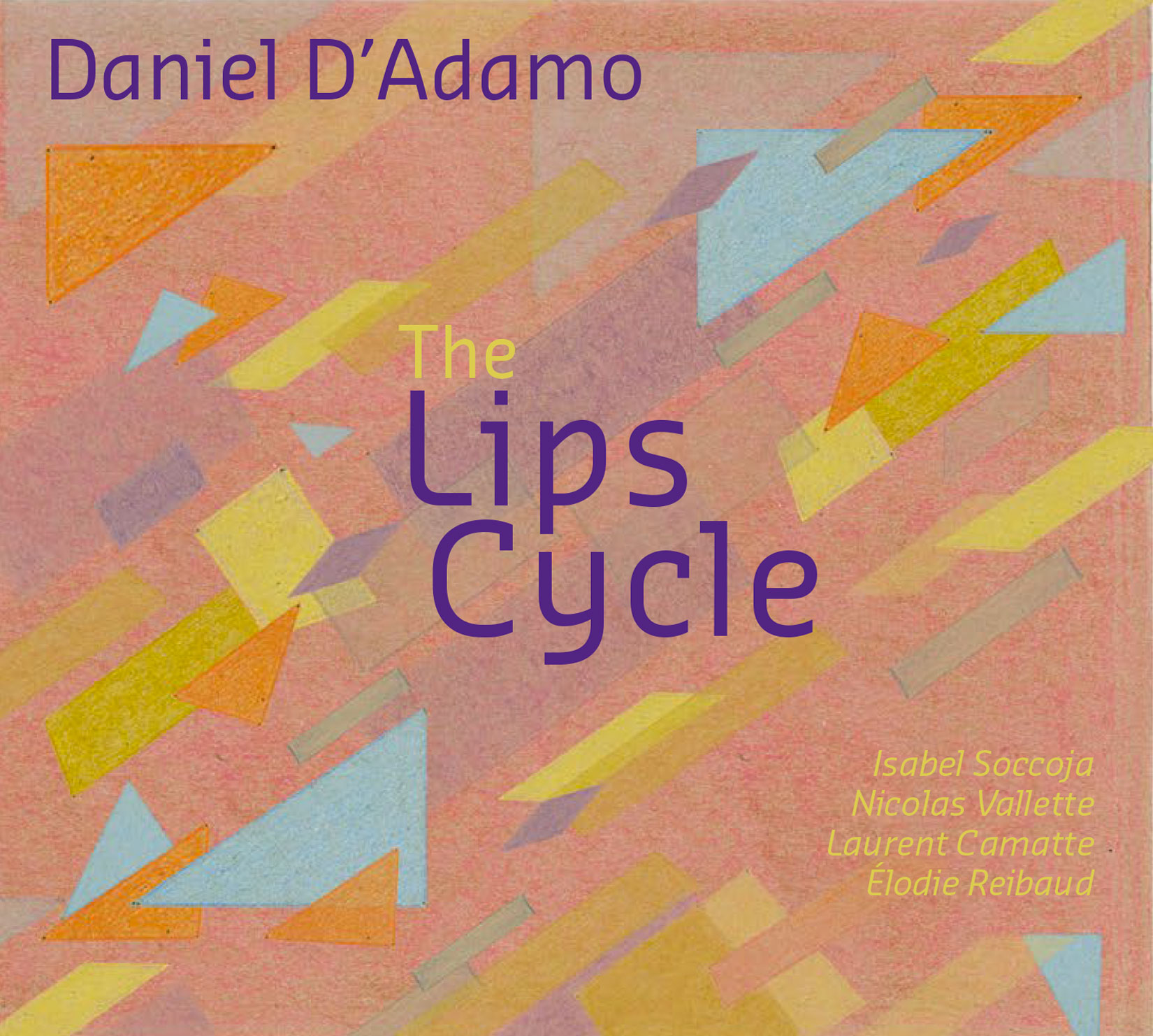
Isabel Soccoja voice
Nicolas Vallette flutes
Laurent Camatte viola
Élodie Reibaud harp
Recording: Daniel D’Adamo, Alexis Derouet and Maxime Lance (Césaré), Gérard de Haro, Jérôme Decque (Gmem), Vincent Carinola (ESM), Philippe Dao (GRM)
Mixing and mastering: Gérard de Haro, Nicolas Baillard (La Buissonne – 2019)
Production: Marc Thouvenot & La Buissonne
Artistic Direction: Pascale Berthelot
Release date: November 17, 2020
This album stands as a threshold document, both an ending and an aperture, tracing the emergence of a language that never stabilizes. The Lips Cycle is born from an inquiry that seems modest on its surface: What happens when speech is imagined but withheld, when the voice rehearses itself without crossing into audibility? During a period of isolation in São Paulo in 2010, Daniel D’Adamo turned inward, not toward silence but toward its hidden mechanics. Tongue grazing teeth, lips shaping absent vowels, breath circulating without destination. What emerged was not a void but a densely populated interior world, one smaller than phonemes and closer than words.
Listening becomes an ethical posture here, a sustained attention that must abandon expectation. These works unfold at a scale where meaning erodes faster than it can be grasped. The ear is asked to linger inside residues, murmurs, and half-gestures, where sound hovers between intention and disappearance. Sensuality arises not from excess but from proximity. The music leans close, breathes close, and insists on contact.
The cycle unfolds across works composed between 2010 and 2017 for voice, flute, harp, and electronics. Said electronics are not supplemental but anatomical, spun from the same material as the instrumental and vocal writing. They stretch physical effort into space, allowing sound to circulate, refract, and return altered. Spatialization becomes a way of thinking, a means of extending the performers beyond their own outlines. The listener is drawn into an immersive field where sound behaves like a tactile substance rather than a linear message.
Lips, your lips for mezzo-soprano and electronics opens the cycle by dwelling on the fragile perimeter of the voice. It studies what surrounds speech rather than speech itself. Inhalations splinter into texture, whispers fracture into particulate noise, and words cling desperately to coherence before slipping free. There is an almost ASMR-like intimacy to the listening experience, yet it is charged with volatility. Quiet never fully arrives. It is continually interrupted by a hovering, half-formed song that presses against audibility. The piece advances like a dream that cannot remain intact, gathering toward eruptions where fantasies flare and collapse, leaving behind delicate ruins of promise and ash.
With Keep your furies for mezzo-soprano, alto flute, and electronics, tactility builds. The alto flute enters not as accompaniment but as a second voice, equally bodily, equally vulnerable. Breath and metal converge until distinctions blur. The overlap between singer and instrument is so complete that only a sliver of separation remains. Sound seems to move through the body rather than around it, activating involuntary responses along the spine and scalp. Time behaves erratically here, like pages of a flip book animated in uneven bursts. Leaves become sounds, sounds become gestures, and gestures dissolve before they can settle.
Although Air lié for flute and electronics nominally removes the human voice, its presence lingers. Extended techniques, metallic inflections, and sustained resonances unfold according to their own internal logic. Breath persists, transposed into silver and duration. The piece’s ambient quality allows for a deeper enmeshment between ear and sound, a slow suspension in which spirals accumulate and tighten. One does not exit this space so much as become absorbed into its influence, gently erased as an observer.
Traum-Entelechiæ for mezzo-soprano, alto flute, viola, harp, and electronics reintroduces the voice into a thickened, almost alchemical texture. Convergences of tone function like temporary laboratories where language is subjected to stress and mutation. Texts drawn from Leibniz bring numerical rigor and philosophical speculation into collision with fragile vocal utterance. Questions of individuality, continuity, and becoming hover within the sound, never resolved. Even as the title gestures toward full realization, the music unfolds through asymptotic fragments. Moments of melodic clarity surface briefly, only to implode into breath and noise, as if coherence itself were an unstable state.
The emotional core of the cycle arrives with Fall, love letters fragments for mezzo-soprano, harp, and electronics, based on the correspondence between Virginia Woolf and Vita Sackville-West. Here, intimacy is not narrated but exhaled. Desire, ecstasy, and emotional turbulence emerge through wordless gestures that bypass articulation altogether. The harp and electronics cradle these eruptions with remarkable precision, allowing feeling to register without being named. It is love stripped of declaration, passion rendered as vibration and pulse.
Threaded between these works are three “Transitions,” brief passages that function as subliminal corridors of breath, clicking keys, and flickering tongues. They stitch the cycle together while dissolving any sense of stable orientation. One crosses from one state to another almost without noticing, already altered by the passage.
Placing this cycle in the lineage of works such as Berio’s Visage feels inevitable, yet these compositions speak in a quieter register. They do not confront language so much as destabilize it from within. What ultimately binds them is a sustained meditation on the fragility of the utterance. Language here is never secure. It trembles, erodes, and transforms under pressure. Words aspire to fix experience, but sound exposes their impermanence. In these pieces, speech is always in the process of becoming something else. Like those of us wielding it, it survives only by continually undoing itself.
 Between Sound and Space: ECM Records and Beyond