

Dominic Miller: Vagabond (ECM 2704)

Dominic Miller
Vagabond

Dominic Miller guitar
Jacob Karlzon piano, keyboard
Nicolas Fiszman bass
Ziv Ravitz drums
Recorded April 2021 at Studio La Buissonne, Pernes-les-Fontaines
Engineer: Gérard de Haro
Mastering: Nicolas Baillard
Cover photo: Fotini Potamia
Produced by Manfred Eicher
Release date: April 21, 2023

For his third ECM outing, guitarist Dominic Miller brings quiet ferocity and lyrical precision to this quartet setting with pianist Jacob Karlzon, bassist Nicolas Fiszman, and drummer Ziv Ravitz, opening our ears to newer and even deeper terrains across a set of eight original itineraries.

In a statement for the album’s press release, he says, “Thanks to the amazing singers I’ve worked with over the years, I see myself more as an instrumental songwriter. And as they do, I see it my mission to surround myself with the best musicians who understand the narratives in the ‘songs.’ I’m happy to have assembled the right lineup here with Vagabond.” And in “All Change,” we hear that ethos played out. The rhythm section opens itself to Miller’s acoustic timekeeping while the piano smoothes the waters to ensure this vessel sails uninterrupted until it reaches its first port of call. Miller’s overlay brings fresh intimacy, capturing frames of a stop-motion memory.

Across the cinematic horizon of “Cruel But Fair,” an underlying breath of synthesizer kindles the hearth of Miller’s acoustic. A collective atmosphere reigns supreme, each musician contributing to a scene as it curls into shape around people, places, and things. Such associations collaborate in the music as much as those assembled in the studio to articulate them. Miller himself points to southern France, which he has called home in recent years, for inspiration. Whereas “Vaugines” refers to a small village he has frequented on his walks, “Clandestin” is a hidden bar where stories abound. The latter’s interplay reveals the most space between instruments, allowing for an unguarded swagger. To my ears, it feels anything but covert.

Such is the ability of Vagabond to open its borders to our psychological refugees. For example, while “Open Heart” is easily interpreted as an image of generosity, to me, it evokes the darkly inward period I faced when my father suffered a nearly fatal heart attack in December of 2023 (the main reason why I’ve posted so little since then). All the more fitting, then, that Miller should include an ode to his own father, “Mi Viejo,” an unaccompanied offering of intimate magnitude.

The delicacy of this music is also its strength. A case in point is “Altea,” the airy underpinnings of which give the trio plenty of fertilizer to work into the soil. What grows from it is lush yet variegated enough to let those precious rays of sunlight through. Lastly, “Lone Waltz” moves from stasis to momentum. Like a boat chasing the setting sun, it finds solace in the waves.

If we started with the notion of having to get somewhere, we end without quite knowing where that might be.
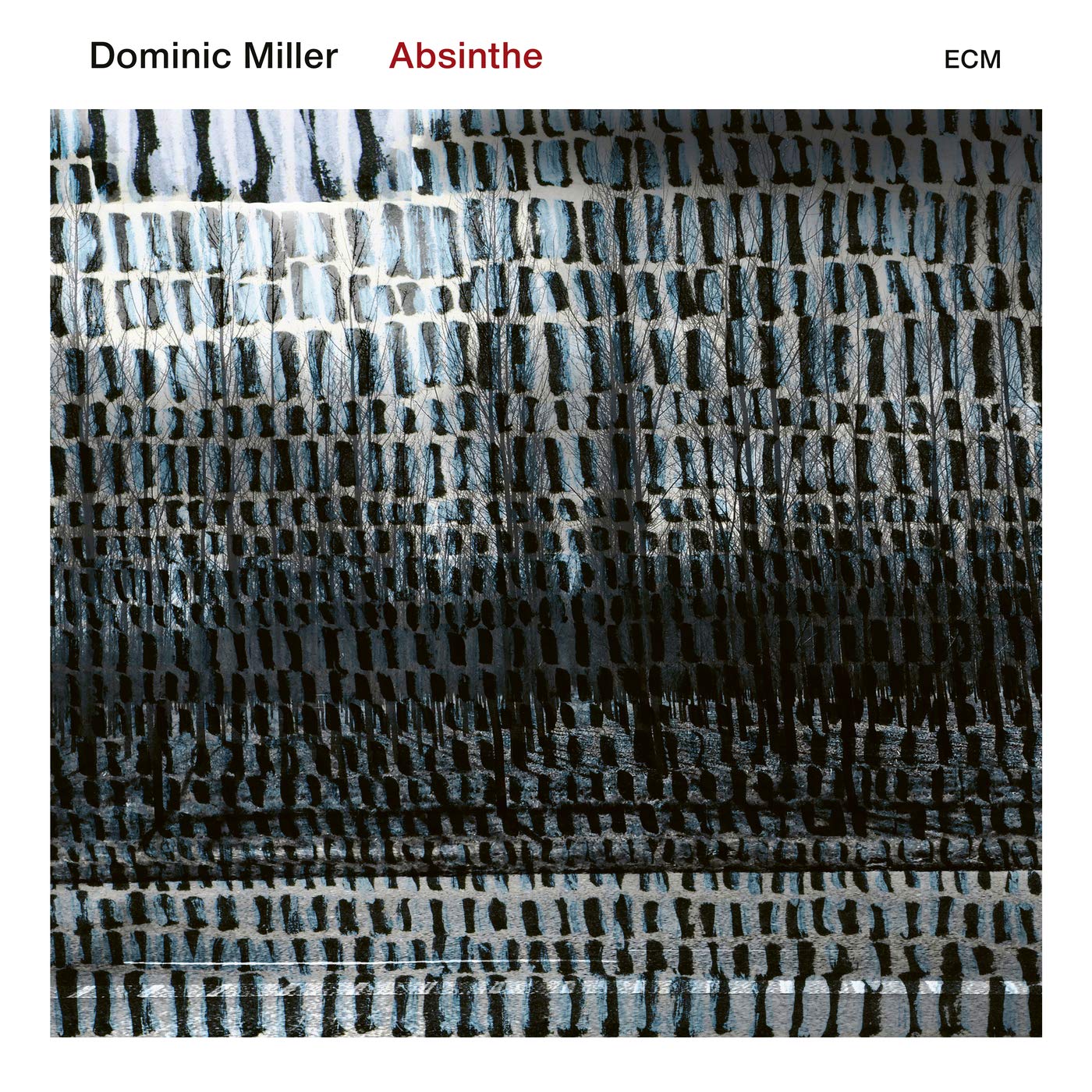
Dominic Miller: Absinthe (ECM 2614)


Absinthe

Dominic Miller
Absinthe

Dominic Miller guitar
Santiago Arias bandoneon
Mike Lindup keyboard
Nicolas Fiszman bass
Manu Katché drums
Recorded February 2018, Studios La Buissonne, Pernes-les-Fontaines
Engineers: Gérard de Haro and Nicolas Baillard
Produced by Manfred Eicher
Release date: March 1, 2019

The title of Absinthe, Dominic Miller’s follow-up to his 2017 ECM debut, Silent Light, harks to the early French Impressionists, whose all-in dedication to art is a philosophical touchpoint for the guitarist. To carry on that spirit, he could hardly have asked for a more eclectic yet integrated band. Bandoneon player Santiago Arias brings a sense of cross-continental shift that makes the world just a little smaller; keyboardist Mike Lindup adds a sometimes-surreal vibe that’s equal parts cry from the past and message from the future; bassist Nicolas Fiszman is the soil to Miller’s sunlight; and drummer Manu Katché, a remarkable impressionist in his own right, is time incarnate.

With such a massive scale to be reckoned with in theory, one might expect the results to be overpowering, when in practice the melodic, harmonic, and rhythmic content is so evenly distributed between pans that by the end of each tune we’re left on an even keel from where we began. This is nowhere so true as on the opening title track, which spins a steady downtempo groove from the filaments of Miller’s solo introduction. The way his bandmates shuttle through the greater loom of the album’s concept is as intuitive as the compositions yearning for consummation. A certain feeling of inward travel continues in all that follows.

The quiet locomotion of “Mixed Blessing” and is as progressive as the tender “Christiana” is regressive, the geometrically inflected “Étude” as inviting as the open-ended charm of “Ombu,” the melancholy “Ténèbres” as dark as the transparent “Saint Vincent” is bright. The latter bears dedication to the late Cameroonian guitarist Vincent Nguini, a longtime collaborator with Paul Simon and something of a mentor for Miller.Even without such biographical details, these stories write themselves, unhidden, in real time. Binding their pages are shorter pieces, including the piano-rich “Verveine” and the haunting “La Petite Reine.” Into these we are afforded only fleeting glimpses, personal tesseracts whose potential for transfiguration can only be expressed in song.

Absinthe Portrait
(Photo credit: Gildas Boclé)

All of which makes “Bicyle” quintessential in the present milieu. Its pedaling motion is more than a metaphor; it’s an actualization of life’s unstoppable flow. For there, woven between each spoke like a playing card, memories fade into new experiences, squinting into the glare of a setting sun as the world curls into slumber.

Dominic Miller: Silent Light (ECM 2518)

Silent Light

Dominic Miller
Silent Light

Dominic Miller guitar, electric bass
Miles Bould percussion, drums
Recorded March 2016 at Rainbow Studio, Oslo
Engineer: Jan Erik Kongshaug
Produced by Manfred Eicher
Release date: April 7, 2017

As guitarist Dominic Miller recalls in this CD’s liner notes, when approached by producer Manfred Eicher to make an album for ECM, he discussed various musicians and configurations before deciding to go solo. Having grown up in Argentina, Miller was indelibly influenced by Latin American sounds, and counts Egberto Gismonti’s Solo and Pat Metheny’s Offramp as watershed listening experiences. Since living in the UK and now in France, he has worked with Phil Collins, Paul Simon, and Sting, among others, all the while developing his own voice. As Sting himself writes in a supplementary note: “[W]henever Dominic plays the guitar he creates colour, a complete spectrum of emotions, sonic architecture built of resonance as well as silence, he lifts the spirit into higher realms, perhaps those realms where silence reigns.” And perhaps no other combination of location, timing, and circumstance could have produced something that so beautifully lives up to that assessment.

In thinking about the genesis of Silent Light, Miller turned to percussionist and longtime collaborator, Miles Bould, whose applications seem born of the guitar’s deepest imaginings. As it happened, the night before the recording, Bould learned that the great Brazilian percussionist and ECM veteran Nana Vasconcelos had just passed away, lending the session heartfelt poignancy. That said, there’s so much joy to be found that one would need to listen most attentively to find a single tear.

The strains of “What You Didn’t Say” delineate an opening portal, beyond which personal interactions float along waves of gentlest memory, barely detailed by percussion amid Miller’s speechless legibility. So begins a journey of concentric circles, each a band of influence along the surface of the composer’s life. From the Venezuelan flavor of “Urban Waltz” and laid-back precision of “Baden” (dedicated to Brazilian guitarist Baden Powell) to the Celtic folk-inspired “Angel” and early 20th-century French stylings of “Le Pont,” a red thread of respect runs unbroken and with clarity of purpose to a tender, solo rendition of Sting’s “Fields Of Gold.”

If anything further unites these pieces, it’s that they all seem to follow—rather than issue from—the guitar as if it were a compass attuned to melodic north. One feels this especially in “Water,” “En Passant,” and “Chaos Theory,” the latter of which navigates shimmering harmonies by the addition of bass and drums for a feeling that is decidedly crystalline, transparent, and honest. Like the recording as a whole, it is intimate without being invasive, allows no room for misinterpretation, and is as comforting as waking up knowing the only thing required of you is to listen…and to love.