Enrico Rava flugelhorn Francesco Bearzatti tenor saxophone Francesco Diodati guitar Giovanni Guidi piano Gabriele Evangelista double bass Enrico Morello drums Recorded live August 18, 2019 at Jazz Middelheim, Antwerp by VRT-Vlaamse Radio en Televisie Engineers: Peter Préal and Maarten Heynderickx Mastering: Christoph Stickel Cover design: Sascha Kleis Executive producer: Manfred Eicher Release date: October 29, 2021
Recorded live at Antwerp’s Jazz Middelheim festival in 2019, the aptly named Edizione Speciale brings flugelhorn maestro Enrico Rava to the stage with tenor saxophonist Francesco Bearzatti, guitarist Francesco Diodati, pianist Giovanni Guidi, bassist Gabriele Evangelista, and drummer Enrico Morello. That many of these musicians are Rava’s mentees is obvious given the level of communication achieved in this performance. As Rava notes in the album’s press release, trust is at the core of everything this band does.
Pure excitement ignites the night as “Infant” hits the air. Its maximalism leaps into the listener’s heart, especially through the stellar guitar work and the detail-oriented drumming. Guidi further energizes the congregation while Evangelista gilds the frame with strong patterns of recognition. Bearzatti, too, grabs a prime patch of spotlight to strut his stuff. After only a brief introductory statement, the bandleader recedes to let his entourage do the talking on this 13-minute juggernaut.
Michel Legrand’s “Once Upon A Summertime” and Rava’s “Theme For Jessica Tatum” make for solid company. Rava opens with the lyricism of classic cinema before Bearzatti paves the way for Guidi’s solo delicacies over a spirited rhythm section that harks to Rava’s second home of South America, where Brazilian vibes seep freshly through the mesh of time. After a round of solos, Bearzatti and Rava trading diary entries along the way, Evangelista puts a finer point on things.
The sprawling introduction of “Wild Dance” (from Rava’s 2015 record of the same name) leads to Diodati’s surreal monologue, which Rava turns into an intermittent conversation. Electronic abrasions add a new face to this repertoire. After a fearless morph into “The Fearless Five,” of which Evangelista’s bass is the wick to the candle, “Le Solite Cose” finds the horns charging into a sparkling take on “Diva” (also heard on Wild Dance). As Rava re-enters the picture, joy abounds and carries over into the Cuban tune “Quizás, Quizás, Quizás” (previously heard on Guidi’s This Is The Day). This one rolls off the proverbial tongue with ease. Its pianistic undercurrent gives rise to artful rhythming from Morello and an ecstatic round of input. With us as vessels, the music is assured of a home worthy of its robustness and love for life.
John Scofield electric guitar and looper Recorded August 2021 Top Story Studio, Katonah, NY Engineer: Tyler McDiarmid Mastering: Christoph Stickel Cover photo: Luciano Rossetti Executive producer: Manfred Eicher Release date: May 6, 2022
John Scofield’s latest for ECM features a set of solo guitar tunes backed by a looper, which he uses to establish progressions and contexts for his adroit picking. This long-awaited project, one that fans thought might never come, offers plenty of variety to meet that expectation. It all begins with a second-nature take on Keith Jarrett’s “Coral.” Launching into an improvisational spirit from the first breath and shifting into the melody only at the end, this interpretation features all of Scofield’s hallmarks: forthright expression, clear lines, and enough rough edges to guarantee authenticity. This is edible music.
Among all that follows, my ears are drawn immediately to Scofield’s originals. From the finely sculpted “Honest I Do” and the more whimsical “Since You Asked” to the emotionally charged “Mrs. Scofield’s Waltz,” he proves an uncanny ability to unravel moments of life into stories with beginnings, middles, and endings. The bluesy “Elder Dance” is a highlight. Scofield’s description says it all: “I picture older people (like me) doing a kind of lindy hop. I can picture it but I can’t do it.” This and the vibrant “Trance du Jour” make their recorded debut. Both are genuine pleasures to hear.
“It Could Happen to You” is the first among a handful of jazz standards. While recognizable from the start, it adds Scofield’s idiosyncratic touches, by turns fluid and angular. Even “Danny Boy” feels spontaneous in his brilliant hands, while the prison song “Junco Partner” bows its head in honor of the wrongfully incarcerated. Whereas “My Old Flame” and Buddy Holly’s “Not Fade Away” favor message over medium, others, like “There Will Never Be Another You,” add new levels of interest to the tried and true. We end with the Hank Williams classic, “You Win Again,” speaking in the language of experience.
Despite my appreciation for all that transpires here, this isn’t my favorite of ECM’s 2022 releases. Scofield is, of course, a master who could sound like no one but himself. And while I dig the easygoing, unrushed quality of the playing, I find relatively little to chew on in the standards. On the other hand, there’s plenty to enjoy in Scofield’s originals, which gift these ears with fresh, honest sounds. I just wish we’d been given nothing but, especially for a self-titled record from an artist whose contributions to the art of jazz are every bit as flavorful as the old chestnuts he has roasted here. Many will disagree with this assessment, so don’t let me discourage you from enjoying an album that might very well grow more than show.
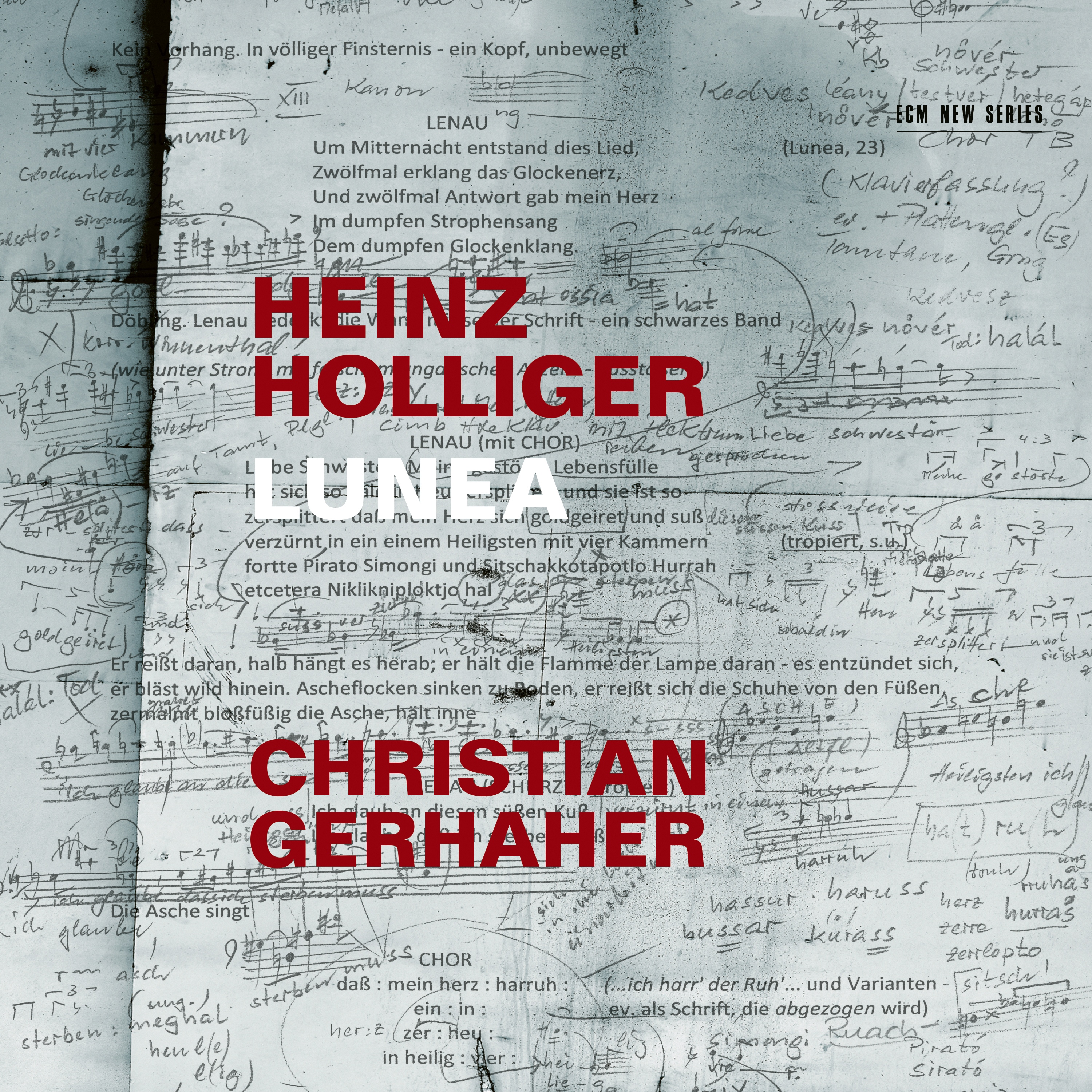
Christian Gerhaher baritone Julian Banse soprano Ivan Ludlow baritone Sarah Maria Sun soprano Annette Schönmüller soprano Philharmonia Zürich Basler Madrigalisten Heinz Holliger conductor Recorded live March 2018 Opernhaus Zürich Recording producer and editing: Andreas Werner Recording engineer: Stefan Hächler Assistant engineers: Alice Fischer and Philip Erdin Cover sketches by Heinz Holliger / photo by Thomas Wunsch Executive producer: Manfred Eicher Co-production of ECM Records/Opera Zurich/SRF 2 Kultur Release date: April 22, 2022
I am my own echo, but one eternally rigid and pinned down. An echo nailed to the rock.
Heinz Holliger’s Lunea, described by the Swiss composer as his “dream opera,” grew out of a song cycle of the same name for baritone and piano. By 2017, Holliger had reworked it into its present form for the stage. Based on the demise of Nikolaus Lenau (1802-1850), who scribbled down outbursts during his years in an asylum, Lunea anagrams his name as a way of illuminating his poetic psychosis, thus hinting at the linguistic fragmentations we will encounter. As noted by baritone Christian Gerhaher, who seems born to sing this role: “Holliger presents these attempts on the part of the stricken poet to record his indescribable yet exquisitely traversed suffering—frightful and vivid experiences incapable of being communicated to another being.” And yet, communicate he does through a characteristically exquisite ear for nuance.
Whether by instinct or design, all of the artists of Holliger’s incidental interest, from Friedrich Hölderlin to Robert Schumann, are bound by the tattered thread of mental illness. His willingness to give them a mouthpiece through the score, of which language is a key instrument, finds a willing accomplice in Händl Klaus, whose libretto contextualizes 23 “leaves” in a space without linear order. Holliger’s approach to the text is microscopic in spirit but grand in scope. And yet, as Roman Brotbeck observes, “[N]othing is blurred; everything is as clear as glass and laid out by Holliger with maximum lucidity.”
Holliger and Klaus pieced the opera together through fragments written on paper slips, glued with phrases (both musical and oral-motor) into shape. In doing so, they sought to resolve each sentence (or even word within it) through interpretation. If any plot can be discerned in all of this, it is embodied in the character of Lenau himself, whose cogent coterie of family members and acquaintances populates a bare environment like projections of his many sides. Lenau’s alter ego is Anton Xaver Schurz (1794-1859), a constant companion throughout his illness who also married his sister and published a nearly 800-page biography of Lenau in 1855. The women in Lenau’s life, including Sophie von Löwenthal (a platonic lover), Marie Behrends (his fiancée), and sister Therese, lend worldliness (if not also wordiness) to his isolation.
Holliger’s love for speech abounds, as when he incorporates the character of Justinus Kerner, a physician and close friend who, in 1850 (the year of Lenau’s death) began making what he called “klecksographs”—inkblot pictures mirrored by folding pieces of paper into symmetrical images. Following this, the opera is symmetrically arranged around the stroke Lenau experienced in September 29, 1844. Long before that, the opening speaks is as if through a layer of rice paper. Low reeds and an intoning chorus give way to Lenau’s amorous deteriorations. This is the asylum, a space in which the mind has free reign even as the body is contained. Such is the contradiction of operatic space: a stage that delineates mise-en-scène while opening our hearts to its inner flames. Holliger understands this in both the most traditional and postmodern sense.
For Lenau, “Man is a beachcomber at the sea of eternity,” and so might we call the instruments, among which the violin, cimbalom (Hungarian dulcimer), and bassoon move as characters in their own right. Each slices mortality at a different angle, offering us unrepeatable cross-sections of emotional sediment. As waves of utterances and choral echoes navigate the scrapheap of a broken mind, we are privy to glimpses of recovery and tension in kind. Some of the most profound moments are shared between Lenau and Sophie. Their wordless breathing in the Fourth Leaf palpitates the ears. And it is Sophie who, in Leaf Nine, brings the most hopeful beauties into focus. Such respite is brief and occasional, as in the skyward harmonies of the Sixth Leaf, whereas the most powerful interruptions (such as that by Sophie again in the Eleventh Leaf) make the morbid grays and charcoals of the opera’s fulcrum that much more morose.
In one key scene, played out in the Fourteenth Leaf, Lenau leaps from the window in desperation before bowing the violin in a cathartic dance of healing. What follows from here to the end is a reversion into childhood (Fifteenth Leaf) before solitary madness sets in. Turning as a revolving door from one state of mind to another, the chorus voices the multiplicity of his demise. The final part is a gravelly expression of death borders that burrows into the reptilian brain.
While Lunea is a chain of intimate fascinations as only Holliger can link, it is best appreciated with the booklet in hand, ready to absorb the fragments at hand and assemble them into your own whole. Its brilliance comes to life through the heartbeat of its concepts. Then again, the disorientation of not knowing where our ears might land next is appropriate enough when scrutinizing a mind that might never have demanded more. Hence the significance of Gerhaher being the only singer who doesn’t perform multiple rolls, at once emphasizing Lenau’s splintered cognizance and his insistence on maintaining an identity through it all. For a man who saw the moon as “a luminous, drifting tomb,” death was, perhaps, the only certainty.
Ferenc Snétberger guitar András Keller, Zsófia Környei violin Gábor Homoki viola László Fenyő violoncello Gyula Lázár double bass Concert recording, December 2018 Liszt Academy, Grand Hall, Budapest Engineers: Stefano Amerio and Gergely Lakatos Cover photo: Atilla Kleb Produced by Manfred Eicher Release date: February 12, 2021
After making his ECM debut with the live recording In Concert and the jazzier follow-up Titok, guitarist Ferenc Snétberger returns to the label with Hallgató. Recorded live in December of 2018, it positions his strings amid those of the Keller Quartett and Gyula Lázár on double bass. The focus this time is on Snétberger as a composer, with three of his works standing as pillars of the program. His Concerto for Guitar and Orchestra (1994/95; arr. 2008) spans three substantial movements. Subtitled “In Memory of My People” and written for the 50th anniversary of the end of the Holocaust, it balances precise notation with liberating cadenzas. “Hallgató” (a somewhat ambiguous word meaning “listener”) sets the scene with guitar alone before the quintet’s entrance, feeling out the landscape upon which we are about to walk with these fine musicians as our guides. “Emlékek” (memories) is our first waystation. Romantic yet devoid of excess, its nourishment fortifies us for the fancier footwork of “Tánc” (dance), in which the catharsis we have been seeking is realized, reminding us of what vibrancy feels like. Snétberger’s Rhapsody No. 1 for Guitar and Orchestra (2005; arr. 2008) is equally dynamic, if less angular. Like a figure sashaying between historical buildings, it navigates city streets with the nostalgia of experience on its shoulders. In the journey between them, we come across Your Smile for solo guitar, a timely song without words.
Works from other composers fill in the gaps with vital organs. Two songs from John Dowland (1563-1626) are the subject of astonishing arrangements by David Warin Solomons. “I saw my lady weep” and “Flow, my tears,” both from 1600, show the undying spirit of this music, the guitar adding a lute-like touch to the backdrop while strings weave their tapestry in its light. The latter tune, a duet for guitar and cello, speaks in an unmistakable nocturnal tongue. The program takes its deepest breaths in the String Quartet No. 8 in C minor of Dmitri Shostakovich (1906-1975). Written in 1960 for victims of fascism and war, its opening and closing Largos are played crosswise, lending a graceful urgency to their differences. The second movement, by contrast, is delicate without pulling the punches of its traumatic reveals, while the Allegretto dazzles with its rougher qualities. The Adagio for Strings by Samuel Barber (1910-1981), taken from the String Quartet, op. 11, of 1936, is also included, rendered with a vocal quality I’ve rarely heard.
All told, this is a superb program from world-class artists. More than the performances, however, Snétberger’s writing scintillates. Such cinema requires no camera and only the heart as a projection screen. What begins with a yearning for peace opens into dance-like wonder, but only briefly before lowering the head in slumber to chase resolutions behind closed eyes. Because, in the end, memories may be nothing more than dreams we haven’t yet forgotten.
Varty Manouelian violin Boris Allakhverdyan clarinet Michael Kaufman violoncello Steven Vanhauwaert piano Kim Kashkashian viola Tatevik Mokatsian piano Movses Pogossian violin Teng Li viola Karen Ouzounian violoncello Recorded January-April 2019 Evelyn and Mo Ostin Music Center of the UCLA Herb Alpert School of Music, Los Angeles Recording engineer: Benjamin Maas Cover photo: Jean-Christophe Béchet Mastering: Christoph Stickel Executive producer: Manfred Eicher Release date: November 6, 2020
Although “refined” has taken on elitist nuances over the years, Armenian composer Tigran Mansurian cuts to the root by following the true etymology of the word as a return to purity. In this all-chamber program, conceived as an 80th birthday gift by violinist Movses Pogossian and violist Kim Kashkashian, Mansurian’s combination of Armenian and European influences, sacred and secular alike, changes form as if viewed through a kaleidoscope turned in methodical wonder.
In the Agnus Dei of 2006, interpreted here by violinist Varty Manouelian, clarinetist Boris Allakhverdyan, cellist Michael Kaufman, and pianist Steven Vanhauwaert, one can almost feel his presence in the room. The simultaneous awareness of separation and overlap in the composing and the performing allows listeners to take the opening movement in many ways: as a mirror or opaque surface, liquid or solid, past or future. The clarinet is the glue that binds this scripture, the strings dialects, and the piano keys the pages they call home. The second movement indicates stirrings within, cradling dark exultation, while the third movement barely exceeds a whisper. As in the sonic architecture of Alexander Knaifel, the instruments humble themselves at the feet of the Spirit.
The Sonata da Chiesa (2015) bears a dedication to the priest and composer Komitas Vardapet (1869-1935), whose quiet legacy has permeated a range of previous ECM recordings, not least of all Mansurian’s own. In the hands of Kashkashian and pianist Tatevik Mokatsian, the first movement suspends itself before writhing with historical awareness. Kashkashian’s sincerity and Mokatsian’s energetic approach to even the most delicate gestures draws two lines of flight that gradually become one in the second movement. Like hope and reality, they are distant until something sacred finds commonality in them.
The title piece (2006-2007) is scored for two violins (Pogossian and Manouelian), violas (Kashkashian and Teng Li), and cellos (Karen Ouzounian and Kaufman). Being a meditation on Shostakovich’s String Quartet No. 13, the viola is of liturgical importance. Incredibly, the higher the tones, the darker the sky grows over its catharsis. Next are the String Trio (2008) and String Quartet No. 3 (1993). If Con anima was closer in mood to Shostakovich, the trio is closer in form, moving ever closer to the shaded drawl of its final movement, while the quartet assumes an inverted progression from subterranean fields to aboveground terrains. Finally, Die Tänzerin for violin and viola (2014) shines a light on Armenian folk dance, bringing Bartók to mind.
As convenient as the above comparisons may be, they do nothing to capture the atmosphere of this music. Mansurian, by self-characterization, creates a crossroads of speech and silence that cannot necessarily be articulated by either. Given the honesty and truth with which he fills his cup, not every question he poses demands an answer. Searching without finding becomes its own gift in a world hell-bent on exploiting destinations.
Harry Traksmann violin Leho Karin violoncello Marrit Gerretz-Traksmann piano Tanja Tetzlaff violoncello Signum Quartett Florian Donderer violin Annette Walther violin Xandi van Dijk viola Thomas Schmitz violoncello Recorded April 2019 at Sendesaal Bremen Engineer: Christophe Franke Cover photo: Thomas Wunsch Executive producer: Manfred Eicher Release date: November 13, 2020
Ye ask, and receive not, because ye ask amiss, that ye may consume it upon your lusts. –James 4:3
Since debuting on ECM’s New Series in 1996 with the inimitable Crystallisatio, the humanity of Erkki-Sven Tüür has revealed itself through score after score in search of a purer distillation of his uniquely “vectorial” approach to composition. With Lost Prayers, his first chamber-only program for the label, he may have found his clearest alloy yet in the grander scheme of elements that informs his far-reaching spirit. No stranger to meshing contradictory elements into coherent wholes without capitulating to monolithic dogma, striking a path between mathematical precision and organic flow, he taps into something familiar that allows us to bypass the pleasantries of getting-to-know-you conversation, going straight into dialogues of faith, reason, and love.
Violinist Harry Traksmann, cellist Leho Karin, and pianist Marrit Gerretz-Traksmann embrace Fata Morgana (2002) as a child in need of comfort. The opening violin arpeggios and piano chords over crunchy cello double stops work into a controlled frenzy, indicative of an inner turmoil such as only a fresher soul could lay bare. As molecules join and separate, time loses all shape. Refrains, each a return to self before disembodiment resumes, stand out for their subtlety. Leaping gestures are quickly sublimated by quicksand motifs, pulling the listener into subterranean spaces where notes cease to matter, giving way instead to textural authority. The ending tremors hint more at glory than physical compromise. And while something about this piece leaves me feeling homesick, the same musicians close with a sense of family in Lichttürme (2017), a veritable lighthouse in sound. The violin is the glassy lens through which its glow is magnified, the cello the tower housing it, and the piano a tickle of awareness in the sailor’s cerebral cortex.
Between those poles, violinist Florian Donderer and cellist Tanja Tetzlaff chart points of continuity between night and day in Synergie (2010) before the Signum Quartett’s sensitive rendition of the String Quartet No. 2 (2012), from which this album gets its name. Like a conversation between epochs, it shifts from empathetic and coherent to cross-wired and fragmentary, its answers only becoming clear when taken in the aggregate. At its loudest moments, the notecraft soars; at its quietest, it scuttles along the ground toward agitations of light.
Tüür’s music is never content with endings. It dwells not in our bodies but in the natural materials our bodies partake of, harvest, and transform. Even as the instruments dip themselves in a font of inspiration, the water’s surface has been sprinkled with the lycopodium of honest self-reflection, leaving them dry. This is Revelation as Genesis: the potter’s vessel of our century broken into pieces and refashioned in the image of revival.
Dino Saluzzi bandoneón Recorded February-October 2019 Saluzzi Music Studios, Buenos Aires Recording engineer: Néstor Diaz Cover photo: Lisa Franz Mastering: Christoph Stickel Produced by Manfred Eicher Release date: November 6, 2020
Whereas many of us who once painted with fingers as a child moved on to brushes, Dino Saluzzi seems to have ignored that transition. On Albores, an album born of reckoning, Saluzzi renders what Luján Baudino in his liner note calls an “inner landscape.”
“Adiós Maestro Kancheli” opens on a somber note by paying respects to the late Georgian composer, who passed away in 2019. And yet, what we are given is more than a tribute or homage; rather, it is an identity without personhood, a force that animates the spirit of bygone days. Such redemptions of memory are as integral to Saluzzi’s language as sunlight and rain are to crops. The levels of introspection so organically achieved on “Ausencias” and “Íntimo” are what only decades of artistic experience could elicit. Such power of restraint, he reminds us, is foreign to our younger selves. It is the method of a heart that knows only the scrape of life’s cuneiform.
One need only bathe in the waters of “Don Caye” (an ode to his father’s music) to know that if the bandoneón were a film camera, Saluzzi would be one of its greatest living auteurs. “Écuyère” reorients the lens on a larger scale. Its prosaic qualities illuminate characters whose motives, while ancient, feel as familiar as our skins. The same holds for “Ficción,” a more jagged mountain carved by patience. Like “La Cruz del Sur (2da cadencia),” it rises among the very Andes in which it was born.
Hope is most apparent in “Según me cuenta la vida – Milonga,” a language seeking a mouth through which to be spoken. What dances in one moment turns during the next into a forlorn gaze toward a horizon that could have been. And yet, the trajectory that has brought him here feels inevitable. As in the closing “Ofrenda – Tocata,” it has always been inside, waiting to be sung.
Despite its generally slow pacing, there is plenty of verve to discover throughout Albores. Saluzzi’s energy floats just out of grasp so that we are always seeking its next steps. It is also a meditation on the lung capacity of the bandoneón itself. It breathes for those who no longer breathe. It breathes for those who have yet to breathe. It breathes for all who continue to breathe. Hints of light between its buttons are enough to remind us that even as the sun sets where we stand, elsewhere, it is dawn.
András Schiff piano Jörg Widmann clarinet Recorded May 2018 Historischer Reistadel, Neumarkt Engineer: Stephan Schellmann Cover photo: Jan Jedlička Produced by Manfred Eicher Release date: October 2, 2020
In the opening gestures of the Sonata in E-flat major, op. 120/2 (1894), for clarinet and piano, it’s difficult not to feel the breath of life that moved its composer, Johannes Brahms (1833-1897), to such rapture in the latter years of his life. As the second of two such sonatas and his final chamber work, it is a testimony not only to Richard Mühlfeld, the master clarinetist of his day whom Brahms called “the nightingale of the orchestra,” but also to the self-effacement with which Brahms struggled throughout his creative life. And so, when considering the enduring interpretations here by pianist András Schiff and clarinetist Jörg Widmann, one must understand that without a love for every note, the bars between them would erode. Thus, Widmann gives colorations to the breath at every turn, while Schiff understands the role of the piano in Brahms’s chamber works as more than an accompaniment, giving it the fullness of expression it requires. The second movement, a rousing Allegro appassionato, is quintessential Brahms for its controlled drama and balance of fine motor skills, all tied together with a rustic charm. The final movement works patience into the virtue of exuberance.
The Sonata in f minor, op. 120/1 (1894), is even more dynamic. After a gradual first movement, the second unravels like paint from a brush, finding favor in the final trails of each stroke. The restrained Allegretto that follows sets up a rousing Vivace, the ebullience of which dazzles the senses. Given its symphonic textures, it’s no wonder the piece lent itself so gloriously to Luciano Berio’s orchestral transcription in 1986.
Between these giants of clarinet literature are Widmann’s five Intermezzi (2010) for piano. As tributes to both Schiff (to whom it is dedicated) and Brahms, they show a modern heart in love with the blood of tradition pumping through it. The central intermezzo, at 12 minutes, digs deepest into the spirit of this emotional transference. Throughout, we encounter waking moments in an otherwise dreamlike mise-en-scène. Nevertheless, clarity abounds.
Camerata Zürich Igor Karsko direction, lead violin Maïa Brami speaker Recorded September and November 2017 Radiostudio DRS, Zürich Engineer: Andreas Werner Cover photo: Nadia F. Romanini An ECM Production Release date: November 26, 2021
“When the heart speaks, the mind finds it indecent to object.” –Milan Kundera, The Unbearable Lightness of Being
Czech composer Leoš Janáček (1854-1928) penned his two-volume On an overgrown path between 1901 and 1908. While its significance in the pianistic pantheon is often eclipsed by canonical predecessors, its inventiveness is marked by nonorthodox shifts in harmony, each a full statement without the need to justify what precedes or follows. Given the music’s history and place in time, few would be up to the task of arranging it for string orchestra with equal fervor, but this is precisely what Daniel Rumler did in 2016 to luminous effect, breathing not new but old life into the lungs thereof.
As Thomas Meyer notes in the CD booklet, the title of On an overgrown path references a Moravian wedding song, said path signifying the new bride’s severance from a home to which she can never return. The result is a collection of what the composer called “distant reminiscences” of folk songs and practices. In pieces like “A blown-away leaf,” the underlying connectivity of the notes rises to the surface as treasure from past sediment. Given its basis on the rhythms of the Czech language, we can rightly think of these as “texts” across which editorial marks of prosody and poetry abound, shifting with lyrical abandon from elegy to triumph at the gesture of a bow. Dances (e.g., “Come with us!” and “They chattered like swallows”) testify to the power of memory to reside where it cannot be erased. The spiritual glimpses of “The Madonna of Frydek,” which paints in broad strokes yet with detailed awareness, lean into Janáček’s love for his daughter, Olga, who died in 1903.
Much of this music, however, is divided against itself. For instance, what begins as a frolic in “Words fail!” morphs into uncertain recollections and emotional vulnerabilities. The latter work their way through “Good night!” and “Unutterable anguish” with the wormlike glow of burning steel wool. The strings are especially able to draw out that inner turmoil with maximum acuity. Even the closing Allegro grasps a bouquet of fragmented selves, each a palimpsest of circumstance.
Between the cycle’s two books is a 10-part text by Maïa Brami, dedicated to Thomas Demenga, who was the director of the Camerata Zürich when the orchestral arrangement was being put together (and who suggested the writing of these texts). Brami describes the scene as follows:
“In the evening of his life, Leoš Janáček returns to his native forest. He does know it, but it is the last time. The composer is looking for Otto, the son of his muse, Kamila Stösslova, whom he loves passionately. The boy has wandered off into the woods. After years of passionate correspondence, the young woman finally accepted the first-name as an admission of shared love and came to visit him in his family home. When he met her at a spa in 1917, the artist was at his lowest ebb: he had not recovered from the death of his daughter Olga and his career was not taking off. Kamila, his ‘rose,’ his ‘red flower,’ will resurrect him.”
This panoply of yearnings and recollections (“God how I would love to hold on to the summer,” he cries, “I who waited for it all my life!”) unfolds like a biography in miniature, brilliantly capturing moving images of the composer’s childhood (“Deep down in my suitcase, a pot of honey from my father’s hives, heavy as my grief”), mortal anxieties, and the loves connecting the spaces between. Thus, the composer is able to dip his fingers into the font his creative inspiration. And as the end encroaches on him, he resigns to the fleeting nature of things.
The program is bookended by two kindred pieces. The Meditation on the Old Czech Chorale St. Wenceslas, op. 35a (1914) of Josef Suk (1874-1935) welcomes natural sonorities. Like tall grasses in a windswept landscape, it gives purpose to the elements by making known their otherwise invisible movements. The Notturno in B major, op. 40 (1875) by Antonín Dvořák (1841-1904) closes with grace, folding us into a river’s current in search of an oceanic afterlife.







 Between Sound and Space: ECM Records and Beyond