For the second year in a row, ECM commanded the stage at the New School’s Tishman Auditorium for Winter Jazzfest in New York City. Whereas 2016’s showcase spanned two nights, this year’s was a one-night event, and featured sets by the Michael Formanek Quartet (with Tim Berne, Craig Taborn, and Gerald Cleaver), Jakob Bro’s trio with Thomas Morgan and Joey Baron, two duos (Ravi Coltrane/David Virelles and Bill Frisell/Thomas Morgan), and a concluding performance by Nik Bärtsch’s Mobile. Click the concert photo below to read my full report.
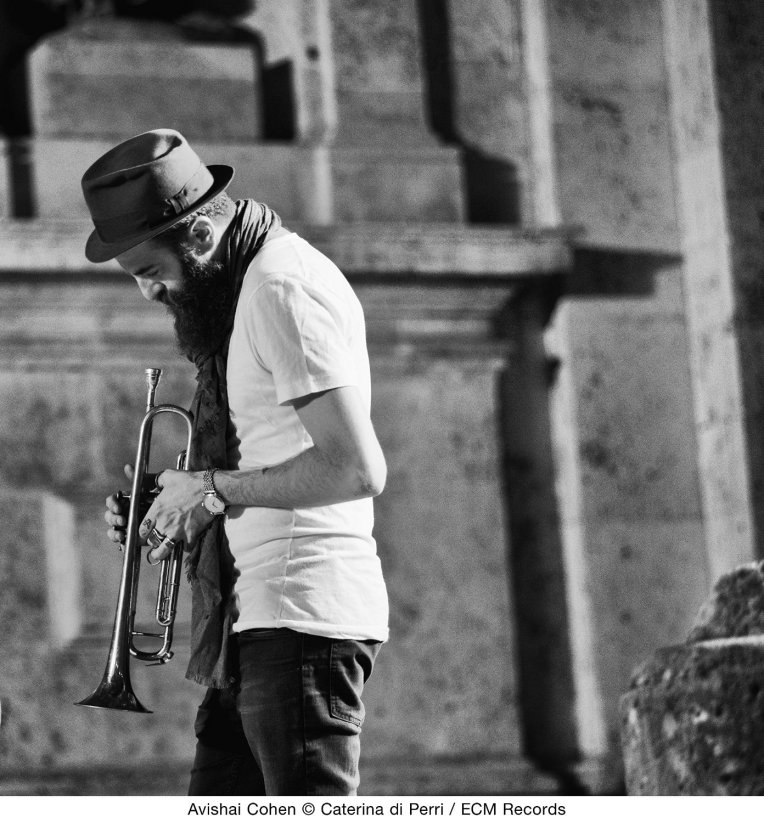
Avishai Cohen trumpet Bill McHenry tenor saxophone Yonathan Avishai piano Eric Revis double-bass Nasheet Waits drums
Recorded July 2015, Studios La Buissonne, Pernes-les-Fontaines
Engineers: Gérard de Haro and Nicolas Baillard
Produced by Manfred Eicher
U.S. release date: February 12, 2016
Following his appearance as sideman on Mark Turner’s Lathe of Heaven, Avishai Cohen makes his leader debut for ECM Records. Bearing dedication to his late father, Into The Silence teams the trumpeter with a fantastic band of his own that includes tenor saxophonist Bill McHenry, pianist Yonathan Avishai, bassist Eric Revis, and drummer Nasheet Waits. This effort marks the first time the band had, as such, stepped foot inside a studio, and the results hark back to the golden age of ECM in both texture and mood. From its spacious arranging and freely realized originals to its classical roots (the solo piano music of Rachmaninoff was a conscious inspiration) and cross-pollination of styles, Cohen’s musical identity speaks at once from without and within.
Through the six-sided prism of as many tunes, Cohen shines a light as only the darkness of mourning could yield. The muted lines of “Life And Death” feel as much celebratory as elegiac. Cohen thus asserts himself as more than a voice among the voiceless, as if the album’s titular silence were not the absence of sound but a personal choice to protect one’s dreams. Here, however, we are bathed in dreamlike qualities with such melodiousness that it’s all we can do to not imagine the many fates that must have convened to produce this patient bit of magic. Avishai’s pianism is another ripe fruit in the band’s gift basket. Morphing from barest comping to bluesy climatic shifts and sparkling tails, he is a comet in an already starry sky. The end of this opener, though a postludinal afterthought, is just as substantial as what comes before it.
“Dream Like A Child” only deepens the spell craft of its predecessor. Unmuted yet just as vulnerable, Cohen undoes the ribbon of this offering to reveal a melodic ocean just aching to crash on the listener’s shore. The pianism is majestic yet aptly proportioned, mirroring the underlying respectful altitude at every turn: just when you think it has gathered enough momentum to soar, it touches its feet to the earth. Though things do cohere in more groove-oriented ways as the rhythm section builds a higher and higher wall from which Cohen and McHenry must jump, there’s no doubt that the ground will hold its foundation through Waits’s textural reinforcements.
The title track expands on ECM’s evolving ethos of ritualistic jazz, as drums and microtonal harmonies in the piano interlock with downright spiritual patience. Again, the band flirts with groove but foregoes that sweetness for a cerebral savory. These strategies become more evident with repeat listens (for this is, indeed, an album you’ll want to return to time and again). Waits is an organic force here, moving from tumbling abstractions to tight snare rolls at the flick of a wrist, his plumage fully outstretched.
Somberness, however, is never far behind, and “Quiescence” bottles its fragrance like a master perfumer. Cohen’s trumpeting is the center of a vocal solar system, shining through planets forged in thematic space dust. Lengths of days and seasonal changes are determined by the gravitational pull of nostalgia, so that by the next track, “Behind The Broken Glass,” one knows that fragmentation is a universal law. Cohen proves that, in the wake of any emotional shattering, no effort of putting the pieces back together will produce a clean reflection, for it will always bear the scars of its undoing. The breadth of his inspirations has brought him to this humble (and humbling) realization in his career, and finds empathetic amplification in his bandmates that funnels in the solo piano reprise of “Life And Death” that ends the album’s journey.
Having seen this project with a different roster at the 2016 New York City Winter Jazzfest, I can attest to the raw, living power of its music. So much so that, following that experience, this studio date feels somewhat tame by comparison. So: see them in person if you can, but revel in the wonders of this “second best” all the same, for in them is a pilot light that ECM lit nearly five decades ago, and which continues to burn pure and warm despite the winds of change.
Pat Metheny guitars Jan Garbarek soprano saxophone Gary Burton vibraphone Scott Colley double bass Danny Gottlieb drums Paul McCandless English horn, soprano saxophone Klaus Graf alto saxophone Ernst Hutter euphonium Eberhard Weber bass (from tapes) Michael Gibbs arranger, conductor Ralf Schmid arranger Rainer Tempel arranger Libor Šíma arranger SWR Big Band Helge Sunde conductor
Concert organized and produced by Martin Mühleis, sagas productions
Recorded by SWR, January 2015, at Theaterhaus Stuttgart by Doris Hauser, Volker Neumann, and Boris Kellenbenz (technician)
Mixed at SWR Studio, Stuttgart, by Volker Neumann (engineer), Manfred Eicher, Eberhard Weber
Pat Metheny’s “Hommage” mixed in New York by Pete Karam
Mastering: Christoph Stickel at MSM Studios, Munich
An ECM Production in collaboration with SWR
Redaktion: Günther Huesmann
SWR Big Band Manager: Hans-Peter Zachary
U.S. release date: September 11, 2015
Bassist Eberhard Weber two-handedly defined a generation of sounds, resulting in some of the most iconic albums the ECM catalog has to offer. In recognition of his contributions to the arts of performance and recording, Weber received the Jazzpreis Baden-Württemberg lifetime achievement award on his 75th birthday, and was guest of honor at jubilee concerts held in January of 2015—proving that, despite the stroke that rendered him unable to play since 2007, Weber’s fire blazes on.
Among his illustrious torchbearers is guitarist Pat Metheny, who in a liner note for the album describes lasting indebtedness, having joined Weber on the classic Ring and Passengers (Weber also appeared on Metheny’s Watercolors). As one who has always made the most of technology to harmonious advantage, Metheny acknowledges the inspiration manifest “in the instruments that [Weber] had built to bring that sound into the air, crystallizing a sonic fingerprint that even all these years later remains as uniquely identifiable and fresh as it was on first hearing back then.” All of which makes it doubly celebration-worthy to see Metheny swimming again in ECM waters. His “Hommage” is, in fact, this disc’s centerpiece. A sprawling world unto itself, it includes its dedicatee as performer in the form of video footage of the improvising bassist projected onto a screen at stage rear, creating what the composer calls “my imagined virtual Eberhard.” The idea somewhat recalls the speech-to-melody experiments of composer Steve Reich, with whom Metheny has worked and whose influence can be felt here in certain passages throughout the half-hour-plus suite.
Germany’s SWR Big Band, backing a chain of venerable soloists, brings this and the other works on the program to a resurrected state, here supporting solos from the formidable Gary Burton (vibes), Scott Colley (bass), Danny Gottlieb (drums), and Metheny himself. The opening is everything that Weber’s music ever was and will be: verdant, atmospheric, and fully developed right out of the box. The videographic Weber is almost ghostly, but over time feels less like an avatar and more a viable player whose creativity shines with unquenchable force. Metheny navigates their virtual interactions deferentially at first before easing into fuller integration, while the band handles this transformation with grace at director Helge Sunde’s exacting touch. The latter’s consistency ensures that Burton’s soloing is both the vessel and the water keeping it afloat; that Colley’s bassing, while distinctly Weberian, also adds its own shades to the spectrum; that Gottlieb’s adornments feel like more than just that; that Metheny’s flights always have their shadow in full view; and that Weber’s archival reveries transcend the limits of space and time they’ve been allotted.
Before this, listeners are treated to a far more intimate introduction in Jan Garbarek’s “Résumé Variations.” Based on the album of the same name, this piece finds the saxophonist improvising in his cinematic, clarion way around prerecorded bass lines. The two instruments intertwine in a way that only years of collaboration could produce, as if two massive continents of time were coming together in the least destructive abduction imaginable.
On the other side of Metheny’s juggernaut is a string of artfully pruned evergreens. “Touch” evokes the golden age of Yellow Fields. Featuring solos by Burton and Ernst Hutter on euphonium, and arranged by Ralf Schmid, this timeless jewel floats on a bed of vibraphone, moving in breezy fashion across its landscapes with the redolence of an old film magically restored. Its reach is matched by “Maurizius,” here arranged by Michael Gibbs and breathing with all the power, and more, of the original. Sharing solo duties with Burton is Paul McCandless, who carries his soprano saxophone to distant shores in this quintessential turn from Later That Evening. The same soloists carry over into an arrangement of “Tübingen” by Rainer Tempel, whose sense of flow meshes sympathetically with Weber’s. McCandless and Burton weave a carpet of textures through a stirring and complex sound that is equal parts somberness and joy.
Two reimagined songs from Pendulum close out the program: “Notes After An Evening” and, available as an exclusive bonus track via digital download, “Street Scenes.” Both are masterfully arranged by Libor Šíma, who gives them a certain heft. Burton and McCandless reappear, with alto saxophonist Klaus Graf adding his nocturnal lines to “Notes.” McCandless’s English horn, by contrast, burns like the sun in “Scenes,” balancing out cooler blasts from the band at large with energetic forecasting.
Given that Weber will never play again, one can’t help but find something bittersweet about these performances, built as they are on a legacy that, while nominally retired, lives on, their poignancy like a pair of lips pursed to a candle flame—yet which, instead of puffing it out, contributes to its glow.
(Photo courtesy of ECM)
Be sure to check out the DVD of these performances, available from Jazzhaus, which I have reviewed here.
Muriel Cantoreggi viola Geneviève Strosser viola Jürg Dähler viola The Hilliard Ensemble David James countertenor Rogers Covey-Crump tenor Steven Harrold tenor Gordon Jones baritone
Recorded November 2010, Radio Studio DRS, Zürich
Engineer: Andreas Werner
Executive producer: Manfred Eicher
U.S. release date: November 6, 2015
To the eye, go, to the moist— hurricanes, hurricanes, from wherever, particle drift, the other, you know the one, we read it in the book, it was meaning. –Paul Celan, “Stretto”
Whether as composer, oboist, or conductor, Heinz Holliger never ceases to delight and surprise. His commitment to classical music has produced some of the most enduring documents on ECM’s New Series, including one of that imprint’s indisputable masterpieces, the Scardanelli-Zyklus. Here we have yet another turnaround, one that speaks with the open style in which Holliger has become so fluent. Featuring a host of accomplished interpreters—including the now-defunct Hilliard Ensemble—bringing to life a 21st-century cycle of works around the 14th-century French composer Guillaume de Machaut, the Machaut-Transkriptionen (2001-09) represent nearly a decade’s worth of thinking and rethinking through the past in a language of the future. Scored for an unusual combination of four voices and three violas, it weaves direct transcriptions of Machaut into Holliger’s idiosyncratic odes to the same.
This is one of those distinctively ECM projects, which, like Ricercar, unravels the avant-garde core of centuries-old music. The compact macramé, for example, that is Machaut’s hallmark is on full display in the program’s introductory Biaute qui toutes autre pere, wherein something more than ink and paper have convened to elicit vital sounds. If the feeling of this balladry is loving and sincere, even more so is Holliger’s enhancement of its rules in his own Ballade IV for three violins. More than ever before, Holliger has built his cathedral out of transparent stone, blacking out the windows, so that the sunlight might be its dominant form of expression. In this sense, Holliger is engaging with Machaut not as the target of an homage, but as the living force of an artist whose music breathes in the winds that shake his boughs. Use of untempered harmonics, transcribed note for note from the original, allows incidental commentary in this regard to seep through.
A second diptych, this time around Machaut’s Ballade XXVI: Donnez, Seigneur, transforms the gently sloping path of the original—in which countertenor David James at once renders the skin and the heart keeping it alive—into the wilder detours traced by the present recasting. And while the latter may seem more oblique in its structure, it also shares with its referent a clarity of expression. Both are neural mappings, very much alive in and beyond the confines of a single recorded performance. Even the wordless Hoquetus David of Machaut and Holliger’s responsory Triple Hoquet feel more like pieces of the same puzzle than distant cousins separated by time. Holliger gives us something of a granular synthesis of the former, an embodiment of Celan’s hurricane in the fullest sense.
A single voice retains the melody of Machaut’s Lay VII in a standalone arrangement, while guided improvisations flesh out its branches with unpredictable fruit. The Hilliards are best equipped to handle this flower without damaging a single petal. A beautiful piece that challenges not through its dissonances but through its consonances, as does its analogous In(ter)ventio a 3 und Plor- / Prol- / Or- atio for three violins, which from recitative beginnings morphs into a staggered prolation of time signatures, based on the Complainte of Machaut’s Remede de Fortune. That same piece lingers on in the final statement, in which it is combined with an “Epilogue” that unites voices and strings in quadrilateral fashion, distilled until only friction remains.
In a universe of countless musical systems, Holliger and his celestial body of work have always charted unprecedented orbits through the space-time continuum. Given the way in which he has refracted himself through Machaut, the sublimity of their intersection is clear, for both have stumbled on the fragility of human contact, tracing its origins just shy of rupture.
Anthony de Mare piano
All pieces were commissioned expressly for The Liaisons Project, Rachel Colbert and Anthony de Mare, Producers.
Producer for The Liaisons Project: Rachel Colbert
Recording producer and engineer: Judy Sherman
Additional engineer and editing assistant: Jeanne Velonis
Recorded 2010-2014 at the American Academy of Arts and Letters, New York, and Greenfield Recital Hall, Manhattan School of Music, New York.
Backing tracks for “Birds of Victorian England” engineered by Kevin Boutote
“Johanna In Space” backing track provided by Duncan Sheik
Mastering: Christoph Stickel and Steve Lake at MSM Studios, Munich
An ECM Production
Listen to that old piano roll play. When I hear that old piano roll play, I just gotta dance, And what I mean is dance with you.
In her exhaustive biography, Stephen Sondheim: A Life, Meryle Secrest shares the story of an adolescent Sondheim’s encounter with the 1945 film Hangover Square, and within it a piano concerto written by scorer Bernard Herrmann. The music’s bold mix of romanticism and Americana captured Sondheim’s imagination and was to become part of the origins of his intersections with the dramatic stage.
Sondheim has always composed at the keyboard, charting out his scores in great detail, to be orchestrated by (since 1970) esteemed collaborator Jonathan Tunick. Broadway has relied on this formula, which over the decades the duo funneled into surefire productions, but the project lovingly packaged in this three-disc collection from ECM takes Sondheimania to a new level through the intervention of rigorously trained note-smiths, each occupying a band along a spectrum of collaborations from a distance.
The roster of composers, who the behest of new music champion Anthony de Mare wrote new variations on the theme of Sondheim, reveals a depth and variety equaled by the songs they have re-imagined, as William Bolcom, Nico Mulhy, Steve Reich, David Rakowski, Eve Beglarian, Jason Robert Brown, Duncan Sheik, Eric Rockwell, Wynton Marsalis, Derek Bermel, Fred Hersch, Annie Gosfield, Jake Heggie, Kenjie Bunch, Ethan Iverson, Ricardo Lorenz, Paul Moravic, Frederic Rzewski, David Shire, John Musto, Mark-Anthony Turnage, Phil Kline, Bernadette Speach, Daniel Bernard Roumain, Andy Akiho, Ricky Ian Gordon, Nils Vigeland, Rodney Sharman, Gabriel Kahane, Thomas Newman, Jherek Bischoff, Mary Ellen Childs, Peter Golub, Tania Leon, and de Mare himself put a personal spin on the Sondheim songbook that is as true to life as it is to art.
Though Sondheim has historically been averse to being interviewed, in this collection we hear him speaking through the hearts of every composer who has felt his influential hand. In an album note, he himself describes these pieces not as “decorations” but “fantasias” of his songs. Indeed, Sondheim’s recognizable voice has been reworked with such fidelity—one original inspiring other originals to create new originals—that one need hardly peel away any layers of obfuscation to find him. Above all, however, it’s his scarcely rivaled gift for pastiche that resonates by virtue of de Mare’s encyclopedic flair.
According to Mark Eden Horowitz’s extensive liner text, the composers chose their songs based more on the lyrics and their stories than the melodies sung around them. And so, one can listen assured that de Mare’s consummate touch makes room on his metaphorical suitcase to display every sonic sticker of his travels. His dramatic, romping, emotional rollercoaster ride through A Funny Thing Happened on the Way to the Forum (1962), Anyone Can Whistle (1964), Company (1970), Follies (1971), A Little Night Music (1973), Pacific Overtures (1976), Sweeney Todd (1979), Merrily We Roll Along (1981), Sunday in the Park with George (1984), Into the Woods (1987), Assassins (1991), and Passion (1994) accordingly dwells as much on differences as similarities, bringing to fruition a “global” sound.
Not surprisingly, Sondheim’s masterpiece Sweeney Todd gets the most nods of the program, in addition to yielding a lion’s share of its highlights. One of those is Sheik’s “Johanna in Space.” This atmospheric gem opens with the chimes of a clock emulated on the piano and stretches itself over an electronic backdrop à la Tim Story. Todd’s ill-fated daughter is further subject of Brown’s “Birds of Victorian England,” which requires no small amount of heavy lifting from de Mare. As can be expected, Sweeney Todd engenders ample opportunity for over-the-top dynamics, epitomized in the spiraling density and fluent outcries of Bunch’s “The Demon Barber.” Other fine examples of the protagonist’s crushing pessimism abound, whether through the intimate knowledge of Newman’s “Not While I’m Around” or, in a satirical turn, Lorenz’s “The Worst [Empanadas] in London.” The latter requires a performer of de Mare’s chops to pull off the feel for rhythm and energy on which it subsists. De Mare welcomes the listener by shouting, “A customer!” as if in throwback to the speaking-singing pianist genre of which he was such a foundational proponent through his premiere of Rzewski’s De Profundis. It’s only natural, then, that Rzewski should have a piece included: the elegiac “I’m Still Here.” This and other selections from Follies, such as Wynton Marsalis’s Jelly Roll Morton-infused take on “That Old Piano Roll”, imply a bygone age with plenty of style to spare.
Company inspires a handful of homages as well, including Rakowski’s impressionistic “The Ladies Who Lunch,” through which Sondheim’s love for Ravel shines (as also in Bermel’s “Sorry/Grateful”); Rockwell’s tangible “You Could Drive a Person Crazy,” in which the composer “imagined a pianist trying desperately to catch the attention of rowdy patrons at a cabaret with as wide ranging a series of pastiches as possible”; and Roumain’s “Another Hundred People,” which invokes the troubled crooning of a Kurt Cobain or Thom Yorke.
A Little Night Music lifts its story from the Ingmar Bergman comedy Smiles of a Summer Night, and its comic touches are duly noticeable in Speach’s “In and Out of Love” (a personal album favorite), which shuffles the harmonies of “Send in the Clowns” (see also Iverson’s whimsical take on the same) into a balladic “Liaisons.”
Sunday in the Park gives us Muhly’s minimal yet expansive “Color and Light,” which embodies the pointillism that so fascinated the play’s subject, Georges Seurat. Muhly’s feel for the piano as a textural toolbox translates superbly. Reich’s more compact “Finishing the Hat” is scored for two pianos (de Mare multi-tracks himself) and links a brief yet persistent chain of chords. Sharman’s “Notes on ‘Beautiful,’” on the other hand, originally a duet between Seurat and his mother, no becomes a conversation between the living composer and his deceased mother. De Mare’s rendition of “Sunday in the Park – Passages (encore)” opens a lifeline to possibilities, and makes us feel connected to our own.
Shire’s “Love is in the Air” puts a delightful spin on the original opening number of A Funny Thing Happened on the Way to the Forum, underscoring de Mare’s abilities to evoke the past in a language of the future, while Bolcom’s “A Little Night Fughetta” references Anyone Can Whistle, pushing Bach through a jazzy filter of development. Pacific Overture is another of the less represented but no less effective source texts. Gosfield’s “A Bowler Hat” displays a meticulous feel for deconstruction, while Kline’s “Paraphrase (Someone in a Tree)” paints the first meeting between American and Japanese officials in 1853 with unexpected colors. Merrily We Roll Along gives us León’s “going…gone,” another remarkable highlight that, along with Akiho’s “Into the Woods” is perhaps the most technically demanding of the program. Hersch’s “No One is Alone” is another ode to Into the Woods, this one pentatonic and alliterative. And let me not neglect Beglarian, who pays tribute to Passion in her “Perpetual Happiness.” This striking piece is as real as the music gets on Liaisons, and builds its wings one feather at a time, until flight is achieved.
Doing justice to all of the composers and pieces represented here would be a futile, wordy exercise. Suffice it to say there isn’t a single sour note to be found, and as a whole the album demonstrates that, while Sondheim’s music may sometimes play hard to get, it will love you through and through if you let it, because that’s all it wants to do.
My latest review for All About Jazz is of pianist Anat Fort’s superb performance at the Rubin Museum of Art in New York City, where her trio, along with Italian reedman Gianluigi Trovesi, celebrated the release of her third ECM album, Birdwatching. Click the photo below to read on.
My latest review for All About Jazz is of a concert held by Nik Bärtsch’s Mobile at New York’s Rubin Museum of Art in celebration of the band’s first ECM album, Continuum. Click the photo below to read on.
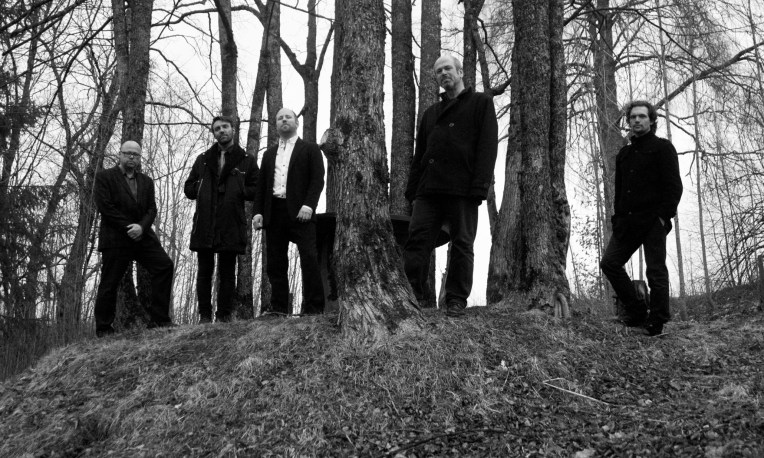
Nils Økland viola d’amore, Hardanger fiddle, violin, Rolf-Erik Nystrøm alto and baritone saxophones Sigbjørn Apeland harmonium Mats Eilertsen double bass Håkon Mørch Stene percussion, vibraphone
Recorded June 2012, Hoff Church Østre Toten, Norway
Engineer: Audun Strype
Executive producer: Manfred Eicher
U.S. release date: April 8, 2016
Since his 1996 solo debut, Blå Harding, Norwegian Hardanger fiddler Nils Økland has charted a range of melodic waters, always docking at the intersection of traditional and contemporary music. His relationship with ECM has produced a series of artistic statements, each more cohesive than the last. His first for the label was 2009’s Monograph, a solo album of great scope that led to 2011’s Lysøen, in duet with Sigbjørn Apeland. And now we have Kjølvatn, for which he has assembled a full band under his own name. Apeland rejoins the fray, here playing harmonium, along with saxophonist Rolf-Erik Nystrøm, bassist Mats Eilertsen, and percussionist Håkon Mørch Stene. Each has lived in that gray area between folk, jazz, and classical, and funnels his unique experiences into Økland’s sound-world like grains of sand through an hourglass.
Having worked with these musicians for years in some configuration or another (all except Nystrøm played on Bris, released in 2004 on Rune Grammofon), Økland revisits a trove of older material with special familiarity. A look at even a few of the tunes shows the breadth of his network. He wrote “Mali,” for instance, after attending a concert by Swedish rapper Timbuktu. The band’s profiles cohere evocatively in this opening piece, as in the album’s title track, a retroactive score for the 1933 Scottish silent film The Rugged Island. “Undergrunn” (Underground), too, feels quite integrated, arising as it did from a collaboration with the London Sinfonietta around folk motifs. Such diversity of origins suggests that Økland’s influences are as complex and fragmentary as life itself.
(Photo credit: Ellen Ane Eggen)
Økland employs a variety of open tunings on the album, each of which has its own special name. The “dark blue” tuning (D-D-A-D) is heard on the processional “Drev” (Drifted), wherein are bolded Stene’s percussive colors, and “Start” the so-called “troll tuning” (B-E-B-D#). In the latter, Økland combines ancient structures and modern minimalism, both of which he sees as relying on short motifs multiplied to form larger structures.
Økland has been increasingly inspired by the viola d’amore, which like his mainstay instrument has extra strings that vibrate sympathetically beneath the main four, and on tracks “Puls” and “Skugge” (Shadow) he draws a darker soul from this cousin. In the former piece, the heartbeat is evoked by Stene on kettledrum, while Eilertsen explores kindred frequencies. Over this, a flight from Økland’s bow touches the ocean with a wingtip in search of nesting territory.
Location matters a lot in Kjølvatn, which was recorded at the Hoff stone church in the countryside of Norway’s Oppland county. Økland’s go-to engineer, Audun Strype, captures the church’s resonant bounce, allowing the rougher, more organic aspects of the performance to exude clarity. One may hear this especially in “Fivreld” (Butterfly), an alluring piece of ambience in which the harmonium breathes like sunlight through foliage. Made for a ballet performance at Haugesund Theater in Økland’s hometown, it veritably dances.
Other references to Økland’s past are found in “Blå harding” and “Amstel.” Earlier versions of both appeared on the aforementioned debut. The first is something of a blues dedicated to his Hardanger fiddle teacher Sigbjørn Bernhoft Osa, while the second, which closes out the album, is greener, its organ-like harmonium reminding us of where we are.
Kjølvatn rarely bubbles beyond a simmer, but its flavors are all the purer for it. It’s a significant move in Økland’s career, and exemplifies an artist who, despite denying any underlying message, understands the value of careful construction. And in a way, that is its practice: to create art for its own sake, devoid of political baggage and free to roam in search of new and welcoming ears.
(See this review as it originally appeared in RootsWorld online magazine here.)
Márta and György Kurtág
In memoriam Haydée
Játékok – Games and Transcriptions for piano solo and four hands
Piano Recital
Cité de la musique, Paris
22 September 2012
Márta and György Kurtág piano
Filmed September 22, 2012 at Cité de la musique, Paris
Directed by Isabelle Foulard
An LGM Télévision production in association with Cité de la musique
Producer: Sabrina Iwanski
Executive producer: Pierre-Martin Juban
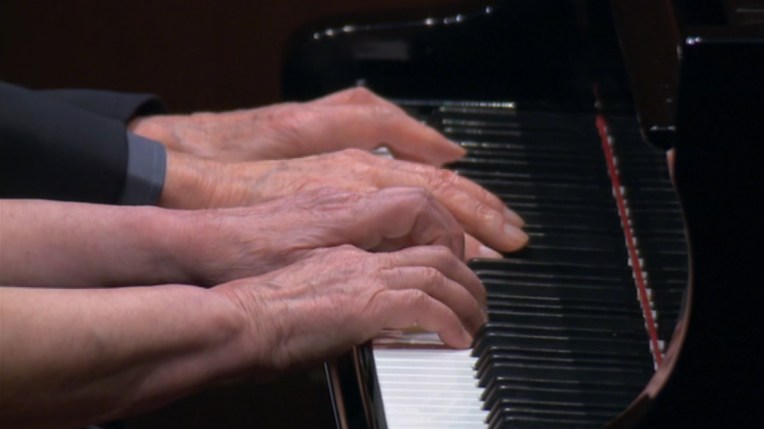
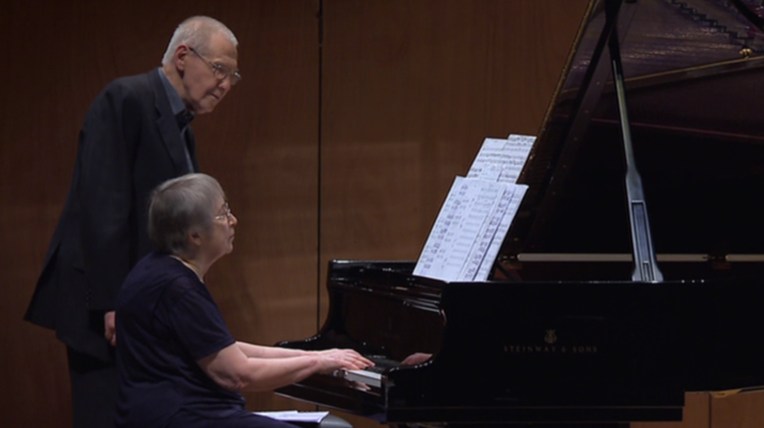
In September of 2012, Hungarian composer György Kurtág and his wife Márta gave a concert at Cité de la musique in Paris to honor the memory of a dear friend, musicologist Haydée Charbagi (1979-2008). Their program, as adventurous as it was delightful, combined piano transcriptions for two and four hands, exuding such intimacy that it’s a wonder the audience didn’t just melt away from all the love in the hall. For those not present, this DVD bears witness to the Kurtágs’ unbridled passion for each other and the music that passes between them. The program’s bulk is culled from György’s own Játékok (Games), an ever-growing miscellany of dedications to the living and dead alike. It’s also a tribute to classical roots on the whole, as indicated by the composer’s transcriptions of Bach chorales—each a towering trunk among his otherwise microscopic foliage.
There’s something dark yet wondrous about the first dissonances that creep from the stage. Saying hello with a farewell, György approaches the score as if it were a poem (such philosophies were, in fact, the subject of Charbagi’s thesis). And perhaps nothing so omnipresent as poetry could express either the compactness or vigor of each brushstroke. As observer, Márta stands like an appreciative statue before joining him at the keyboard. At times, she caresses him on the shoulder after he finishes a solo, an unspoken signal to connect the dots.
Those very points of light sparkle in pieces like Flowers we are…, which in conjunction with the pantheonic Baroque selections enables a poignant contradiction: namely, that Bach’s music eminently looks forward while György looks backward, leaving us in the middle like the binding of an open book. His own responsory is as much a reflection of the one to whom it is dedicated (Joannis Pilinszky) as the composer who vaulted the form.
With most at or under a minute, these concert selections are rife with inflection. There are moments of staggering beauty, especially in the Hommages, such as the Hommage à Christian Wolff, with its tip-toed notecraft, the resonant Hommage à Stravinsky – Bells, and the Hommage à Farkas Ferenc in its multiple incarnations, each more nuanced than the last and ideally suited to the composer’s greatest interpreter, Márta.
Campanule, as with so much of what transpires, expresses the pregnancy of emptiness, and the potential for healing amid broken motifs. This would seem to be the underlying message also of playful asides such as the fierce exchange of single notes that is Beatings – Quarelling and the kindred Furious Chorale. Another elliptical piece, Study to Pilinszky’s “Hölderlin,” gives musical interpretation of a poem written for Mr. Kurtág and reinforces the concert’s overarching theme, while the dramatic (Palmstroke) and the programmatic (Stubbunny and Tumble-bunny) trip over one another in search of continuity.
Director Isabelle Soulard focuses on these passages in close-cropped framings, allowing the tender lattice of Aus der Ferne, written for the 80th birthday of Alfred Schlee, and the confectionary first movement of Bach’s E-flat major Trio Sonata (BWV 525) to shine all the brighter among this crowd of lamentations. For if anything, György’s art is about remembrance—a point driven home by the three encores, all of which reiterate pieces featured in the main program: the Hommage à Stravinsky and two of the Bach arrangements. Were it not for programs and obsessive musical minds, we might not even notice the repetition, as life consists of nothing but.










 Between Sound and Space: ECM Records and Beyond