

Haden/Garbarek/Gismonti: Magico (ECM 1151)

ECM 1151

Charlie Haden
Jan Garbarek
Egberto Gismonti
Magico

Charlie Haden bass
Jan Garbarek saxophones
Egberto Gismonti guitars, piano
Recorded June 1979 at Talent Studio, Oslo
Engineer: Jan Erik Kongshaug
Produced by Manfred Eicher

Along with the work of CODONA, Magico is perhaps a forerunner in what would come to be known as “world music,” and a pinnacle among ECM’s fruitful productions of the 1970s. Although the talents assembled could hardly be more geographically disparate, their musical heartbeats trace the same calm graph across the EKG paper that is our appreciation. What appears a modest effort in number (the group gives us a humble quintet) plies massive depths in execution. The tracks “Bailarina” and “Silence” alone comprise more than half of the album’s duration. The former’s graceful arcs and burnished veneer sparkle with understated virtuosity, while the latter features some of the gentlest relays between Garbarek and Haden alongside Gismonti’s frothy pianism. The jangly guitar of the title track guides us confidently through Garbarek’s incisive overlay before Gismonti switches over to classical on through “Spor.” Haden’s unassuming posture yields its darkest colors here, drawing a thick arco line beneath our feet just as we are about to fall. Where the album began in a blur, with “Palhaço” it ends in rounded focus, rendered portrait-like in pastels of agreement.

A companion album to the later Folk Songs, this is an all too easily overlooked soundtrack to a beautiful life, brimming with passions of the quietest kind. Like its title, it is a little piece of wonder wrapped in an enigma too real to deny.

<< Keith Jarrett: Eyes Of The Heart (ECM 1150)
>> Jack DeJohnette: Special Edition (ECM 1152)
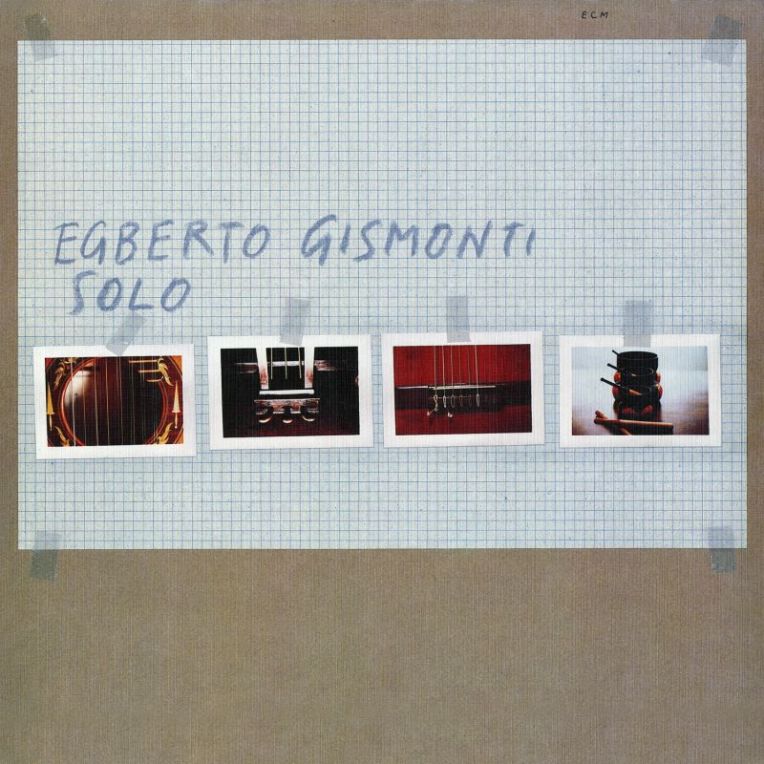
Egberto Gismonti: Solo (ECM 1136)

ECM 1136

Egberto Gismonti
Solo

Egberto Gismonti guitars, surdo, piano, cooking bells, voice
Recorded November 1978 at Talent Studio, Oslo
Engineer: Jan Erik Kongshaug
Produced by Manfred Eicher

The prolific output of Brazilian multi-instrumentalist Egberto Gismonti is only partially represented on ECM. Thankfully, what we do have on the label is among his most captivating work, and perhaps none more so than this adroit solo set from the late seventies. By the time he recorded Solo Gismonti had already honed his distinctions to a fine polish in smaller group settings, in particular with his longstanding partner, percussionist Nana Vasconcelos. Drawing from a wealth of inspirations ranging from Maurice Ravel and Django Reinhardt, Gismonti’s is an ever-morphing tapestry of melody and often modest virtuosity.

The sun rises on Solo through the 20-minute “Selva Amazonica, Pau Rolou,” by which Gismonti plants us into his fertile imagination. From that imagination we eventually depart with only the merest glimpses, despite the protracted track times. The opening suite is replete with resonant 8-string guitar and the floating charm of his wordless singing. Touches such as the latter add hints of remembrance, sealing a child’s proverbial innocence with an adult’s creative stamp. Across this steel-stringed landscape Gismonti imprints the tread of the surdo (a bass drum of African origin), then settles into a pre-dawn hymn against a wavering backdrop of cooking bells. A later track, “Salvador,” focuses these same energies into a single guitar, also tailed by a song to the skies. Two piano pieces along the way—“Ano Zero” and “Frevo”—showcase Gismonti’s melodic fragility in even more humbling terms. Through these, he works his augury by less persistent memories. The results fall barely shy of Keith Jarrett at his spirited best. Sunset arrives with the parabolic “Ciranda Nordestina.” After an introductory half-dream in bells, a gentle piano stains us with grand swaths of color, each an emotion in smoke. With every gemstone reaped from the earth, we pursue the rays of light passing through them to their cosmic ends.

As high as his group projects climb, I always prefer the earthiness of Gismonti alone. Perhaps the best place to start any musical journey is with a single guide at your side, and this role he seems more than willing to fulfill.

<< Jan Garbarek Group: Photo With… (ECM 1135)
>> Eberhard Weber: Fluid Rustle (ECM 1137)

Egberto Gismonti: Sol Do Meio Dia (ECM 1116)

ECM 1116

Egberto Gismonti
Sol Do Meio Dia

Egberto Gismonti guitars, piano, kalimba, percussion, flute, voice
Nana Vasconcelos berimbau, percussion
Ralph Towner guitar
Collin Walcott tabla
Jan Garbarek soprano saxophone
Recorded November 1977 at Talent Studio, Oslo
Engineer: Jan Erik Kongshaug
Produced by Manfred Eicher

Inspired by his time spent with the Xingu Indians of the Amazon, to whom the album is also dedicated, Sol Do Meio Dia (Midday Sun) is a consistently intriguing transitional album from multi-instrumentalist Egberto Gismonti. With him are percussionists Nana Vasconcelos and Collin Walcott and guitarist Ralph Towner, as well as Jan Garbarek on soprano saxophone for a brief spell. At this point in his career, Gismonti was beginning to fill in the porous sound of his 8-string guitar. To this end, Vasconcelos and Walcott flesh out much of the dizzying rhythmic space that defines his sound, while Towner’s 12-string laces the background with more explicit chording. Walcott traces magical circles in “Raga,” for which Gismonti engages us with nimble fingerwork on the guitar’s highest harmonics. Thus begins a chain of sporadic bursts acting in dialogue. With modest virtuosity, the musicians run hand-in-hand down this ecstatic path of music-making to an even more specific sound, this time marked by kalimba and thumb piano. Gismonti’s shrill flute and wordless chanting here recall the work of CODONA. “Coração” is a rich solo and, along with the album’s closer, is a perfect exposition of Gismonti’s notecraft. The disc finishes with a 25-minute suite. Garbarek makes his only appearance in the opening section, which glows with his mournful ululations. An inviting solo from Towner opens the ears to another fluted passage anchored by percussion and handclaps. One can feel the forest at such moments as if it were living and breathing all around us.

The combination of musicians is pure ECM and reflects the brilliant casting of producer Manfred Eicher. As airy as Sol Do Meio Dia sounds, it is also weighted with a certain nostalgia that is difficult to quantify. Like a memory, its actors are always out of focus even when their intentions ring clear. And in the end the intentions are what it’s all about.

<< Keith Jarrett: My Song (ECM 1115)
>> John Abercrombie: Characters (ECM 1117)

Egberto Gismonti: Dança Das Cabeças (ECM 1089)

ECM 1089

Egberto Gismonti
Dança Das Cabeças

Egberto Gismonti 8-string guitar, piano, wood flutes, voice
Nana Vasconcelos percussion, berimbau, corpo, voice
Recorded November 1976 at Talent Studio, Oslo
Engineer: Jan Erik Kongshaug
Produced by Manfred Eicher

Egberto Gismonti’s first ECM appearance is also his most understated. Dança das Cabeças (Dance of the Heads) was to be a solo album, due to the fact that the Brazilian government had inflated travel expenses for he and his band to the questionable figure of 7000 dollars a head. Gismonti was the only among them able to make the journey, but as fate would have it, he met Nana Vasconcelos quite by accident while in Norway to prepare for this recording. According to Alvaro Neder, when Vasconcelos asked him to describe the concept behind this project, Gismonti told him it was “the history of two boys wandering through a dense, humid forest, full of insects and animals, keeping a 180-feet distance from each other.” It was a history the two musicians shared without articulation, and Vasconcelos immediately agreed to join, thereby bringing another visionary into the label’s fold.

“It sounds just like a rain forest!” Perhaps you have heard this assessment being made in reference to many a New-Age album, sporting lush trees on its cover and layered within with preprogrammed synthesizers and wooden flutes. Dança, by contrast, is as far as one can get from the contrived exotica that haunt our commercial soundscapes. We are fully situated in the acoustic benefits of live musicianship, captured in all their immediacy in ECM’s standard-setting clarity. And so, while the birdlike sounds of Part I do indeed evoke a forest practically dripping with fecundity, it is populated with more than a few brightly colored animals. Like Marion Brown’s Afternoon Of A Georgia Faun, its sound is as deliberate as it is organic. From these canopied beginnings, we get some jangly strums from Gismonti’s guitar, slaloming between frenzied hand drums. Rhythms and melodies build to infectious heights, diving into our blood with every fluted moment. The musicians raise their cries, from which Gismonti spins a free-flowing grace, as if to trace lines of varying distance in a vast topographic map. Vasconcelos returns in all his fullness with drums, maracas, and shakers, while Gismonti’s fingers move on in their quiet persistence. Changes in syncopation and a few helpings of dissonant harmonies enact a skeleton dance of sorts, soaring resolutely into the music’s ritual heart. Gismonti’s classical training shines through in Part II, for which he puts his fingers to keys in a spacious and revelatory stroll through Keith Jarrett territory. From this heartwarming nostalgia, built in arcs with only the occasional angles, Gismonti morphs into a bellowed vocalise and storm of handclaps. He returns to the guitar before closing with another pianistic statement in improvised space.

This remains the Brazilian multi-instrumentalist’s most direct effort. In it, we find him without masks. It is the kind of music that makes one glad to be alive, a breath of clarity in polluted air. Essential for anyone who appreciates what music can bring to the heart, mind, and body.

<< Edward Vesala: Satu (ECM 1088)
>> Keith Jarrett: Staircase (ECM 1090/91)