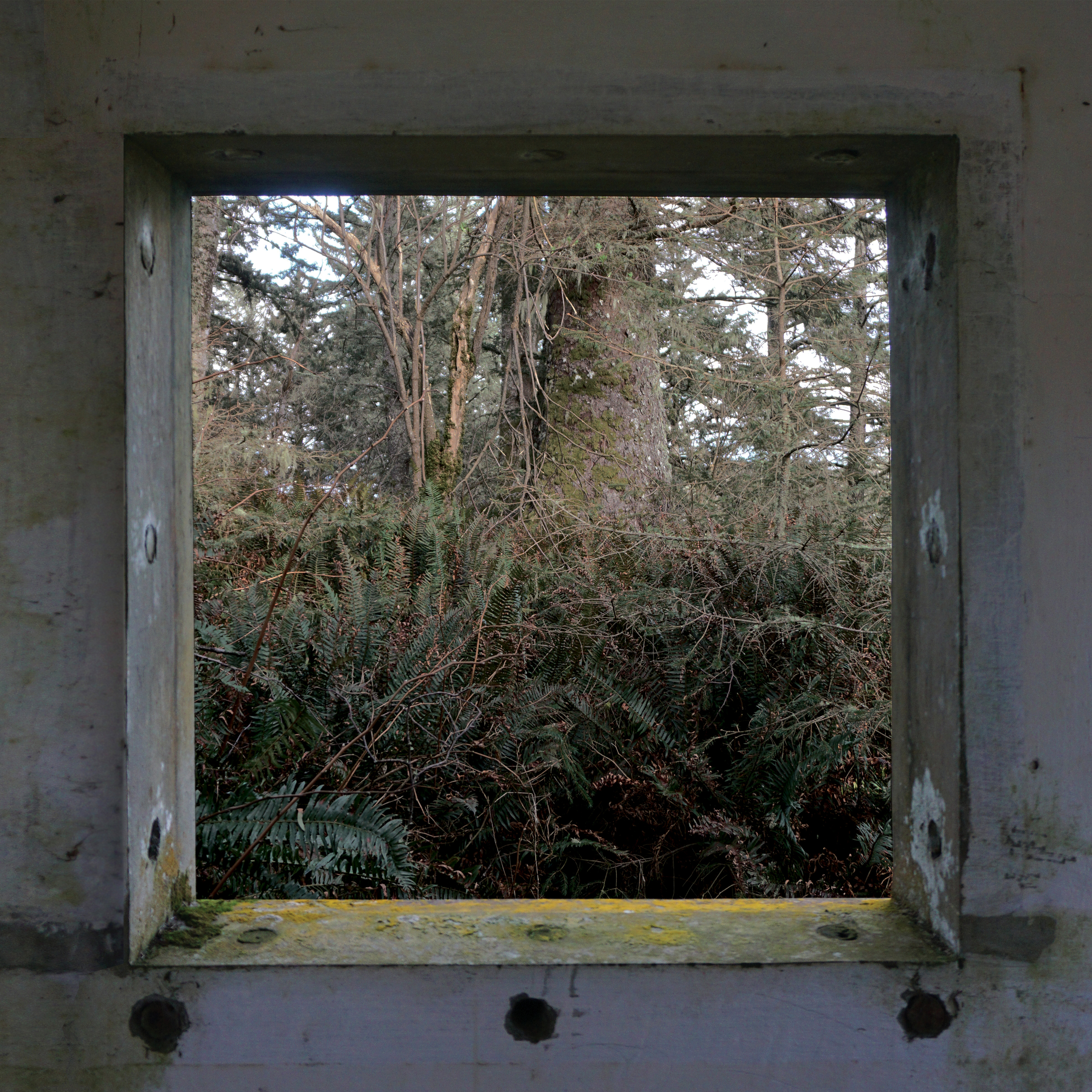
Sculptures, the third solo offering from Portland-based composer and multi-instrumentalist Derek Hunter Wilson, gathers, darkens, releases, and clears in intimate, elemental cycles. Framed as “an ode to the ancient and contested shorelines of the Pacific Northwest,” the album’s six pieces trace the quiet, uneven topography of grief after the passing of Wilson’s father. What first appears gentle soon reveals itself as something patient and transformative, a slow-burning catharsis shaped by recapitulation, erosion, and the fragile courage required to let go.
Built on looping foundations in collaboration with harpist Joshua Ward, the music resists linear time. It circles, returns, hesitates, then presses forward again, mirroring the way mourning rarely obeys a straight path. Piano and synthesizer drift together in mutual trust, one offering structure while the other dissolves it. The result is a softening of resistance, a quiet agreement with impermanence.
The patterns of “Fort Stevens” move with a tentative grace, unsure whether to hold fast to the present or recede into recollection. Synth tones float while the piano steps lightly beneath, each note placed with the care of someone afraid to disturb what remains. With “Battery 247,” the sound narrows its focus, carving out a space where healing can begin to take shape. Arpeggios flicker like distant lights, guiding rather than commanding. Mirabai Peart’s viola enters as a kind of interior voice, suggesting that sorrow, when held long enough, becomes a chamber rather than a wound. Within it, something tender begins to bloom. Hope arrives as a gradual reconfiguration, a blade that learns to soften into a petal. Peart’s presence deepens further in “Deception Pass,” where the music turns inward, almost translucent. Here, absence becomes palpable, filled with unsaid things refracted through stained glass, each color hinting at meanings that resist direct expression. There is a quiet tension in the way phrases unfold, as if the music were attempting to speak a language it has not yet fully learned.
“Salish Sea” expands outward, reaching into the unknown with a sense of fragile yearning. It evokes the act of listening for something just beyond perception. There is a childlike hope embedded in its repetitions, a belief that distance can be bridged if one just waits longs enough. In that bated suspension, the boundary between loss and continuation blurs. The question of whether anything persists after death is not answered, yet the act of asking becomes its own form of solace.
The descent into “Cape Disappointment” feels like a return to ground, though not in defeat. The music glows with a dim, steady light, reminiscent of a lighthouse seen through fog. Pianistic motifs rise and fall with a quiet insistence, illuminating the contours of the coast without betraying its mystery. By the time “Benson Beach” arrives, the album has shed much of its earlier tension. The waves that once pressed heavily now move in sync, their motion no longer threatening but restorative. Raymond Richards’ pedal steel glimmers across the surface like sunlight breaking through cloud cover, offering a sense of warmth that feels hard-won.
Throughout Sculptures, the cinematic quality of Wilson’s work invites listeners to populate its montage with their own memories. The album becomes a kind of shared terrain, where personal histories cross-pollinate. In this way, it transcends its origin, transforming individual grief into something collective, echoing beyond the boundaries of a single life. All of this suggests that mourning is not a detour from living but an integral part of it, a way of learning to see more clearly through the veil of impermanence. If anything endures, it may not be memory in its fixed form, but the capacity to feel deeply, to open oneself even in the face of absence. In that openness lies a quiet, unsettling truth. Perhaps what we call loss is not the disappearance of something, but a transformation of our relationship to it, an invitation to listen for what cannot be heard and to find meaning in the fleeting, luminous act of being present at all.

LP2 surfaces as memory: already in motion, already altered by time. It emerges from conditions set long before its contours became audible, shaped by residue and intention held in suspension. Vocalist Theo Bleckmann and electronic musician and producer Joseph Branciforte return to a shared language first articulated on 2019’s LP1, though “return” feels imprecise. What unfolds resembles a sustained act of listening.
The album opens in a state of half-awareness. Sound drifts forward without a fixed point of origin, part breath, part circuitry, voice and machine dissolving into one another before any roles can be assigned. Nothing announces itself. Instead, the ear is gently reoriented, adjusting to a space where boundaries have softened and distinctions lose urgency. Understanding gathers slowly, arriving through familiarity, through the sensation of being inside something that has been waiting.
This threshold was never intended. The opening fragment began as a technical aside, a moment caught incidentally and set aside. Heard on its own, it revealed an unexpected gravity. What might have been dismissed instead became a doorway that refused to close. Folding it back into earlier work no longer felt possible. From that insistence, LP2 quietly took form, bound to its predecessor through consequence.
Years removed from its initial capture, the album reads as an extended aftereffect. Its modest length disguises the precision of its attention. The exchange between Bleckmann’s mercurial voice and Branciforte’s powered architectures has grown increasingly permeable, unconcerned with hierarchy or authorship. Sound operates as shared terrain, a meeting place for intention, accident, and recollection.
Where LP1 favored immediacy, time is now allowed to fold inward. Improvisation remains central, guided by images, instructions, and gestures that never fully declare themselves. Layers are revisited and subtly reconfigured. At moments, structure briefly surfaces, a harmony aligning, a texture clarifying, before dissolving back into motion. What persists is the sensation of listening under pressure, of sound shaped by forces it cannot articulate.
Several longer works act as gravitational centers. In the opening piece, “1.13,” the voice strains toward release but remains suspended within a luminous enclosure. Light translates itself into sound, illuminating an abyss shaped by collective longing. Movement is tentative, nearly imperceptible, as if forward motion itself has grown uncertain. Falsetto phrases assert presence with quiet insistence, only to be repeatedly subsumed. The calm suggested on the surface carries an undercurrent of warning, a reminder that serenity and menace often coexist.
“11.15” unfolds as a contemplative space. Its pulse and interwoven voices, punctuated by gong-like resonances, suggest ritual, encouraging attention over destination. “7.21” permits deeper aporias. Here, Bleckmann elicits more palpable gestures, a vulnerability that feels unguarded and exposed. That tactility continues into “9.23,” where hymn-like passages orbit their own unraveling. The voice moves between grit and elevation, traversing emotional thresholds in compressed succession. Glockenspiel tones glimmer at the margins, offering fleeting points of orientation, reminders of impermanence.
Threaded throughout these pillars are shorter interludes that function as glitchy nervous tissue. They interrupt continuity, splintering the listening experience into moments of raw recall. These fragments feel unearthed, surfacing abruptly and vanishing just as quickly. Each prevents comfort from settling too fully. Among them, “10.17.13” leaves the most haunting imprint. Its click-driven pulse and premature dissipation suggest erosion in real time, the sound of something slipping beyond reach.
For all its beauty and atmosphere, LP2 carries a persistent shadow. It does not attempt to diagnose. Space is left open for reflection, trusting the listener to bring their own histories into the exchange. The album offers no tools, no instructions. It sings quietly toward the places where repair might begin, leaving discovery in our hands. What is reclaimed in this way carries a different weight. Recognition arrives slowly, shaped by attention, and whatever healing emerges feels earned, never bestowed.
“You that in far-off countries of the sky can dwell secure, look back upon me here; for I am weary of this frail world’s decay.” – Murasaki Shikibu, The Tale of Genji
What does it mean to commemorate a tragedy? Is remembrance an ethical imperative, a refusal to let past violence dissolve into abstraction, or an act of humility that acknowledges life as provisional, evaporating even as we reach for it and leaving only residue as memorial? These questions are not philosophical curiosities but preconditions, pressing upon us as inhabitants of a world in which catastrophe is no longer exceptional but recurrent. Whether we are welcomed into the social fabric or violently excised from it, erased until no thread remains to testify to our presence, we are left with unfinished desires and unlived lives. The future becomes an amputated limb, felt as absence, aching nonetheless.
Confronted with atrocity, the psyche’s first response is erasure. Memory folds inward, constructing architectures of absence meant to spare us endless replay. On an individual level, this forgetting can be merciful; on a collective scale, it is untenable. Trauma migrates and returns through architecture, sirens, televised repetition, and the language of fear that reshapes daily life. This is what renders trauma unspeakable: not silent, but overdetermined, burdened by language that buckles under its weight. To remember and retell is therefore not only historical fidelity but an attempt at psychic repair, a reaching toward coherence that acknowledges rupture as fundamental.
Trauma unfolds within a tension between denial and compulsion, between dissociation’s numbing fog and the violent clarity of reliving. Dissociation functions as a protective splitting, allowing the mind to survive what it cannot integrate. This explains why trauma narratives are fragmented, contradictory, and radically subjective and why they are so often pathologized, reduced to symptoms rather than recognized as meaning-making labor. Not only victims but witnesses are caught in this oscillation, raising the deeper question of how recurrence might be transformed into care, how involuntary return could become an act of tending rather than re-injury.
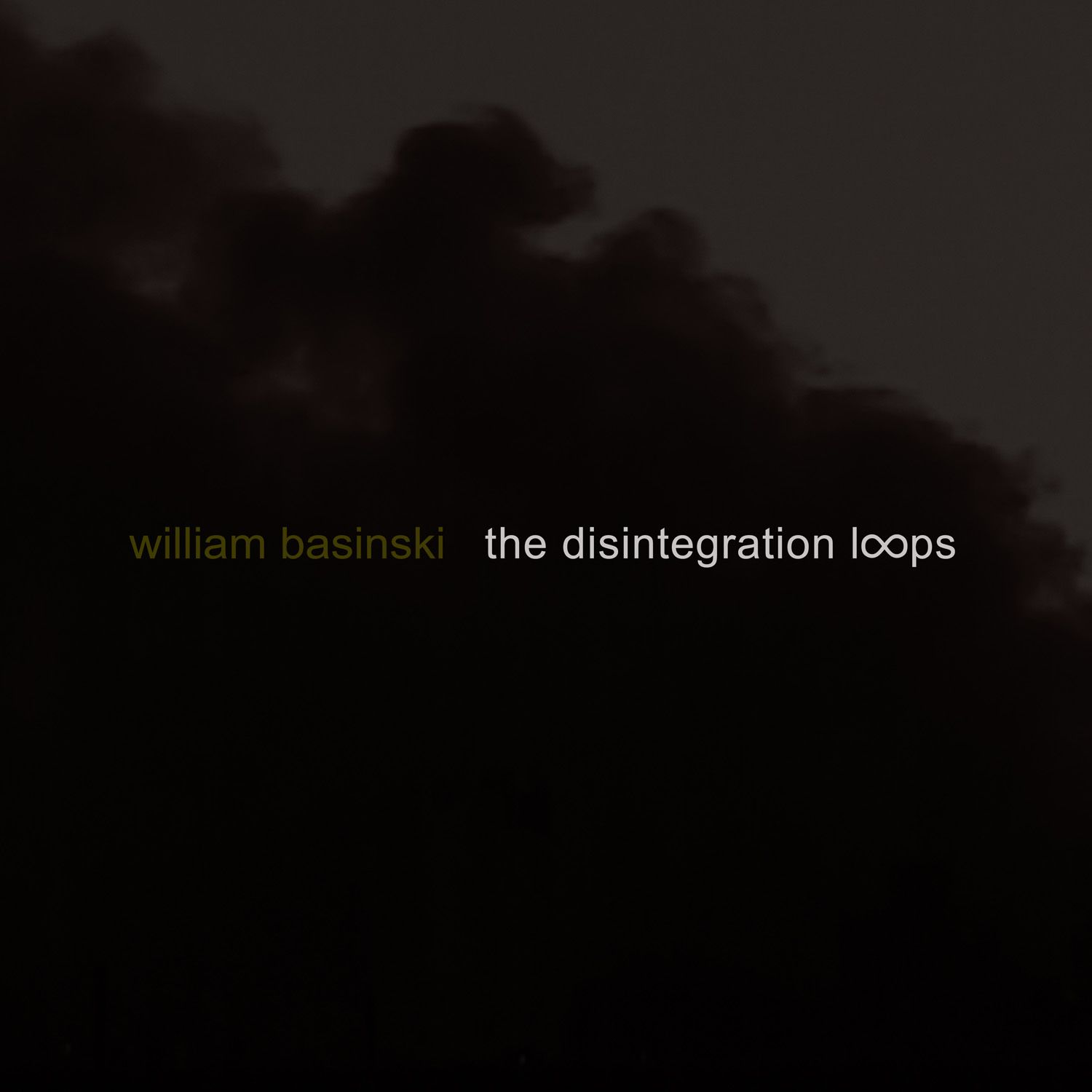
William Basinski never set out to address these concerns. Yet The Disintegration Loops does so with an intimacy and rigor that feels almost inevitable in retrospect.
In July of 2001, Basinski was transferring analog tape loops recorded in 1982 into digital format, hoping to preserve them. Instead, he discovered that the magnetic coating was deteriorating, each playback stripping away more and more material. The music began to die as it was being saved. Rather than intervene, Basinski listened, recording the collapse in real time. Two months later, on September 11, he played the first completed piece while watching the towers fall from his Brooklyn apartment. What began as an accident revealed itself to be an elegy, not by intention but by alignment.
This strictly limited box set, released by Temporary Residence Ltd in 2012, gathers the complete Disintegration Loops across four CDs, accompanied by a fifth disc of live orchestrations and a DVD documenting the smoke-filled aftermath as seen from Basinski’s window. Together, they form a durational encounter with loss understood as a process rather than an event.
The opening movement, Dlp 1.1, unfolds like a funereal hymn performed by a military band trapped within its own cycle of grief. Each iteration inches toward healing without ever arriving. Time behaves asymptotically, with consolation endlessly approached and never attained. The elegiac quality feels not ornamental but necessary, as though these sounds constitute the only response left to a collective brought to its knees. The loop does not simply repeat itself but erodes, its subtle alterations inviting the listener to shift attention and settle into new details even as the core remains recognizable. This mirrors aging itself. The self persists while the body thins, surfaces fray, and entropy asserts its claim. What gives the experience its gravity is its insistence that we remain alert to impermanence. Nothing here pretends to endure. At a certain point, a shadow passes through the sound, and meaning seems to gather beneath the rubble. In moments of shock, reality becomes elastic. Time slows, distance collapses, and language recoils. This music does not translate that condition. It inhabits it.
As the work moves into Dlp 2.1, an uneasy American pastoralism emerges. Layers hover and pulse, carrying a sensation felt more than heard, as if coursing beneath the skin. Reverie is encouraged, along with visions of a time when technology seemed less predatory, though perhaps it never truly was. The music floats without detaching, tethered to gravity even in its most gently transcendent moments. When the reverie fades, what remains is the recognition that transience is not an interruption of life but its substance. Kingdoms rise upon fantasies of permanence, and this loop dissolves them quietly, without spectacle. That dissolution deepens with Dlp 2.2, which scrapes against the wheel of time itself, one made of stone and lubricated by centuries of blood and tears. Ancestral bones grind into powder, feeding a morose mill powered by a river that is both divine and suffocating. Breath turns liquid. Motion continues without destination. Meaning churns rather than resolves. Handmade accents surface, distant horns and fragile drums, as if created for the purpose of breaking (and they do break). Smoke thickens. The air becomes uninhabitable for language. Without charity, we fragment into isolated links in a chain that once encircled the world and now corrodes in our hands. This is not a movement toward closure but an opening, a door already flung wide, revealing that love draws its intensity from fear and that vulnerability is the condition of connection.
With Dlp 3, the work enters the dark sublime at its deepest register. Creation becomes audible, revolving endlessly around itself. Childhood memories surface without invitation. Alternate selves walk beside us. The ground feels unstable, and to listen is to hang suspended by a thread woven from the detritus of one’s own body, shed hairs, discarded cells, forgotten versions of the self. A recursive recognition takes hold. I see myself watching myself. I know I have been here before. I turn away and glimpse you, mistaking myself for someone else, steadied only by the belief that the stars remain, waiting to guide us home. But what happens when home has been irrevocably altered, when the skyline smiles back with missing teeth, when the dream reveals itself as soot in the lungs and bodies rendered particulate? Hope does not vanish here. It circles, drawn by gravity, holding coherence together through sheer persistence. If you die before I do, I will live for both of us.
Dlp 4 sweeps the listener away. Flesh yields to sensation, and the mind consecrates surrender. Orientation dissolves as winds rake the plains, teasing demons from the soil. Dust ascends. Fear reveals how easily it can masquerade as intimacy when crisis arrives. Beauty persists, compressed into a single breath before being stolen away. Nothing can be restored, yet everything can be remembered. The music dies audibly. With Dlp 5, light breaks through with quiet authority, not blinding but decisive. Yesterday returns. Sun on skin. Promise in the air. The towers stand again, angelic in their familiarity, until realization arrives. This was always temporary.
Dlp 6 allows hope to return, tempered by grief. Understanding arrives too late to prevent harm, yet early enough to matter. Scars become inevitable. Memory and forgetting oscillate, exhausting but generative, and through this movement, defenses form not against the world, but against paralysis. The returns of Dlp 1.2 and Dlp 1.3 function less as reprises than as reckonings. One unfolds as an epilogue of the soul, where love remains possible though never redemptive, where no ecstasy compensates for loss and no reconciliation guarantees comprehension. The final return is granular and worn, a restoration undertaken with full knowledge of the cost and the conviction that the attempt itself was necessary.
Trauma does not reside solely in the event but in our tendency to become trapped within our responses to it. Healing requires transformation. This music functions as an unspoken reminder that something remains hidden yet shared, an existential tremor binding us together. The Disintegration Loops offers a reorientation, teaching us how to remain with what cannot be repaired. It refuses the fantasy of transcendence that would lift us cleanly out of history, asking instead that we stay within duration, accepting that meaning accumulates through attention rather than arriving through revelation.
What emerges from this sustained listening is a form of solidarity that does not announce itself. It does not rally or instruct. It gathers. Each listener becomes a vessel for the same slow erosion and fragile persistence. In this way, the work performs a quiet ethics, reminding us that survival is not an individual achievement but a shared condition, and that grief is most bearable when held in common, even across vast distances of time and experience. The loops bind us not by synchrony but by vulnerability, by the recognition that what breaks in one place reverberates elsewhere.
There is generosity in allowing decay to speak. By refusing to interrupt the tapes’ dissolution, Basinski grants the material world a kind of dignity, permitting it to complete its own sentence. This gesture extends toward us as well. We are permitted to falter, to lose coherence, to shed pieces of ourselves without forfeiting our worth. If there is hope here, it is not of renewal or return but of continuity without illusion, of carrying forward what remains even when it is fragile and incomplete. The loops end, but listening persists, in memory, in shared silence, in the altered way we attend to the world after the sound has faded. Something survives because it is carried.


 Between Sound and Space: ECM Records and Beyond