

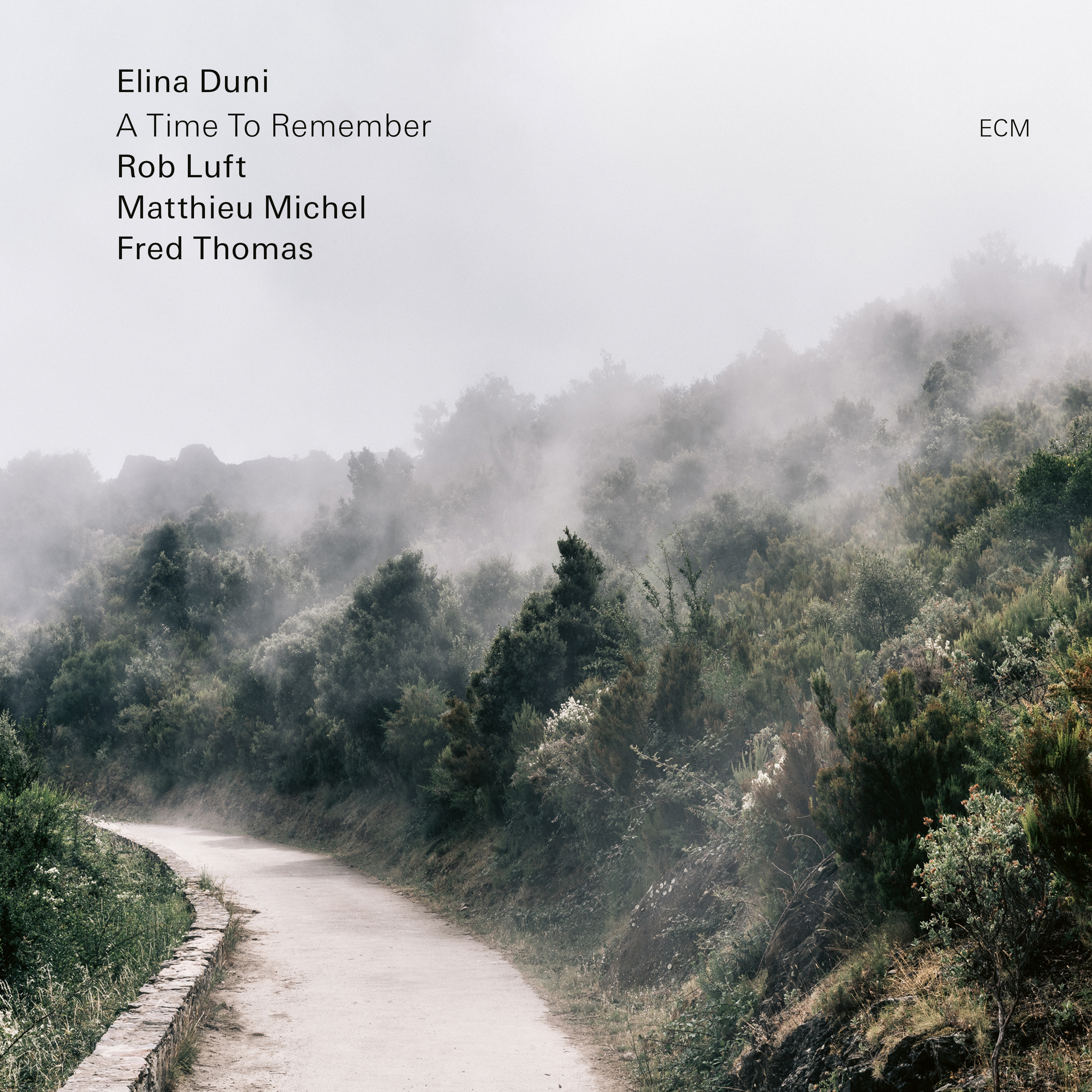
Elina Duni
A Time To Remember
Elina Duni voice
Rob Luft guitar
Matthieu Michel flugelhorn
Fred Thomas piano, drums
Recorded July 2022 at Studios La Buissonne, Pernes-les-Fontaines
Engineer: Gérard de Haro
Mastering: Nicolas Baillard
Cover photo: Nicolas Masson
Executive producer: Manfred Eicher
Release date: June 16, 2023
And I will face the sea
that will bathe the pebbles.
Caresses of water, wind and air.
And light. Immensity.
So begins A Time To Remember, the latest box of newly minted coins to be placed alongside the others that singer Elina Duni has contributed to the ECM treasury. The song, “Évasion” (Escape), with music by Duni and guitarist Rob Luft and lyrics by Belgian-Israeli poet Esther Granek, is a paean to the stripping of hearts and minds down to their barest elements. Admirers of 2020’s Lost Ships will find the band more cohesive than ever, four hedges whose shapes have expanded and intertwined into one larger formation. Multi-instrumentalist Fred Thomas contributes flowing pianism to the set’s opener, while Matthieu Michel adds a voice of his own through the flugelhorn, all of it cradling Duni’s journey from wave to wave, carrying eras of history compressed into every exhalation. On the next shore awaits “Hape Derën” (Open The Door), one of two Albanian traditionals on the program, the other being the enchanting “E Vogël” (Little One), in which Duni and Luft weave through the air as birds in flight. Thomas adds light drums and percussion to this scene of domestic comforts, while Duni’s voice is as delicate as rice paper, softening the glare of remembrance from beyond the pale. “Mora Testinë” (I Grabbed The Water Jar), a folksong from Kosovo, completes the ancestral triangle with whims of flirtation and potential romance, Luft’s guitar sailing crystalline waters, as Duni and Michel move forth in unison of theme and purpose.
Singer and guitarist are the primary creative forces behind the texts and composing, respectively. The title song is one of a quadriptych from their adoring collaboration. Recalling the great folkish ballads of the 1960s and 70s (I sense the fingerprints of Tim Buckley or even Dan Fogelberg), it finds collective purpose in its individualism, where the love one shares with another, soul to soul, stands as the only monument to a world where towers and altars and fallen into dust. Meanwhile, “Whispers Of Water” and “Sunderland” offer dreamier energies, the latter nestled in more quotidian surroundings:
Cars and spaces
Concrete erases my state of mind
But somehow
The heart is on rewind
This is the core of their navigation, where a split between the flesh and the environments it inhabits functions as its own safety net. Even the wordless “Dawn” transpires as a meditation, the meaning of which is never in doubt.
A curated smattering of touchpoints rounds out the story arc. Charlie Haden’s “First Song” finds the musicians in the most fragile mode, letting the innocence of Abbey Lincoln’s heartfelt lyrics blossom without getting in the way of their fragrance. Even Luft’s fuzzy electric works beneath the voice rather than through it. The Stephen Sondheim classic “Send In The Clowns” stands out as a surreal addition. To hear something so mainstream takes us out of body. Like “Put On Your Sunday Clothes” in the opening of the Disney/Pixar film WALL-E, it’s almost as if the world for which it was created is gone. Instead, it exists on its own terms, haunting outer space with echoes of a planet left to die. “Mallëngjimi” (Nostalgia), with music/lyrics by Rashid Krasniqi, expresses a kindred longing for an Albania that no longer exists. Even the unison of flugelhorn and voice, expanded by pianistic harmonies, can only be a closed circle. The standard “I’ll Be Seeing You” is another step out of time. It’s as if the Great American Songbook were an unfinished sentence on the tip of the cosmic tongue. Accompanied only by acoustic guitar, Duni’s voice recedes, forever unrequited.
Just as light and shadow need each other to survive but never fully comingle, each song on A Time To Remember gives shape to the rest. Their unity is born in contrast, taking shape as one of my top ECM albums of the decade.



 Between Sound and Space: ECM Records and Beyond