Heiner Goebbels
Walden
Ensemble Modern Orchestra
Peter Eötvös conductor
Bob Rutman voice
Recorded November 1998
at Philharmonie Köln and Alte Oper Frankfurt
Engineer: Udo Wüstendörfer
Recording engineer: Wolfgang Packeiser
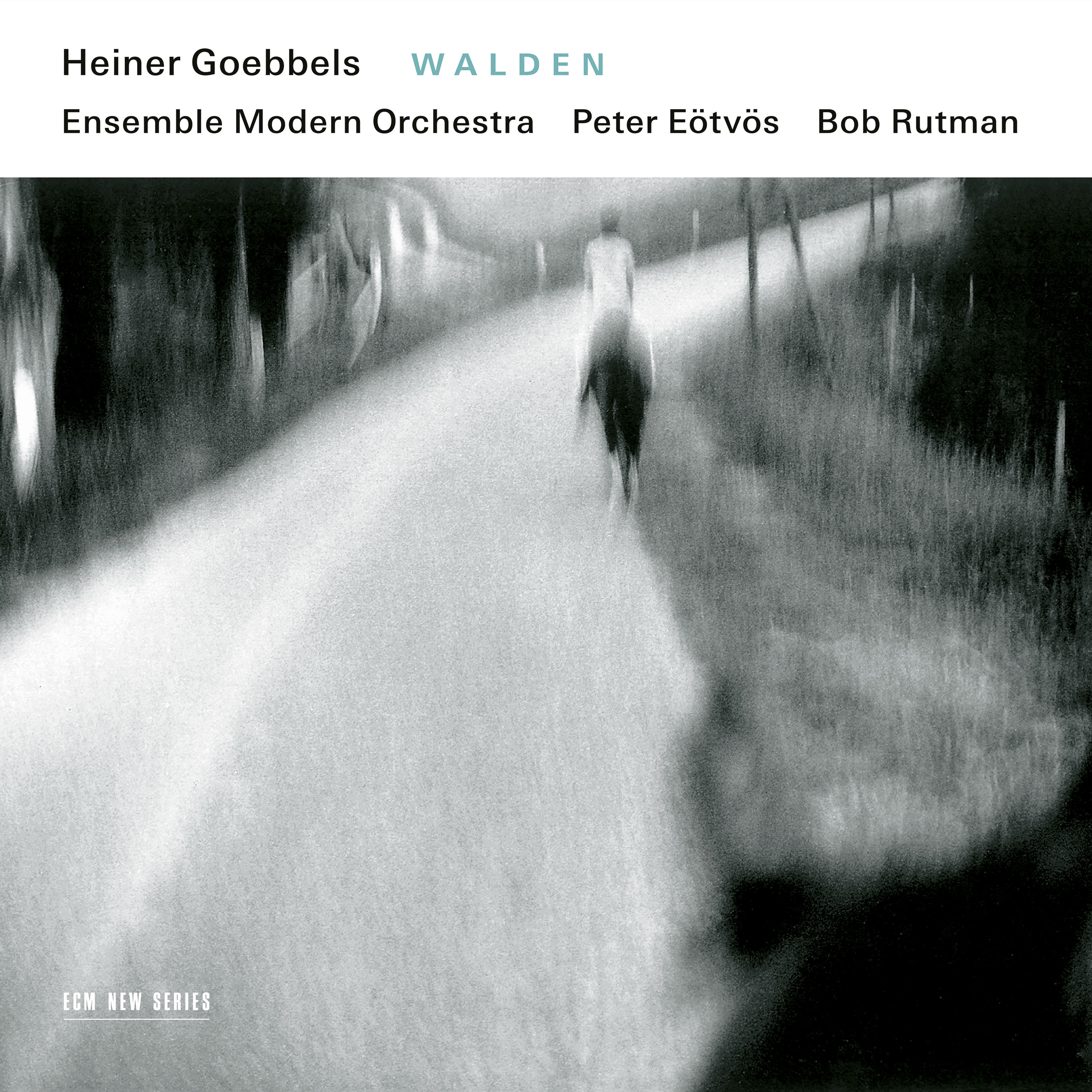
Cover photo: Gérald Minkoff
Executive producer: Manfred Eicher
Release date: June 6, 2026
A cabin can become a machine for myth. Once built, it gathers meanings faster than wind and rain can darken its boards. The small house Henry David Thoreau raised beside Walden Pond in 1845 no longer exists solely as a physical structure. It has become a subheading under the cultural imagination, a place to which each generation returns carrying its own fatigue. Yet its apparent simplicity conceals privileged contradictions and dependencies. Its solitude was never absolute, its wilderness never untouched. Walden Pond lay close to Concord. The railroad cut audibly across the surrounding landscape, and Thoreau’s retreat unfolded on land owned by Ralph Waldo Emerson. The woods were not another world but a temporary clearing inside this one.
That permeability matters because Walden exceeds both a hymn to nature and a manual for abandoning civilization. Its solitude is crossed as much by steam whistles as by birdsong, by axes and distant human voices. Thoreau withdraws from the town, yet the town continues to arrive acoustically. Its presence enters without knocking, carried through the air. John Cage, for whom Thoreau’s perception of the world became a lasting source of inspiration, recognized in this radical attentiveness a music preceding composition: “Thoreau was a great musician, not because he played the flute, but because he didn’t need to go to Boston to hear a symphony orchestra… His sensitivity to the sounds of nature was probably greater than that of most performing musicians…” The symphony is already taking place; the difficult art is learning how to receive it.
Heiner Goebbels’s Walden emerges from this expanded idea of music. The composer’s modest description of the work as a series of musical sketches inspired by Thoreau’s book is accurate only insofar as a map indicates a location while withholding the effects of erosion and the sensation of becoming lost in the undergrowth. Written in 1998, the score expands the orchestra around a speaker and unconventional instruments. Goebbels releases Thoreau’s ideas into a different millennium, in which the 19th-century woods reappear as a haunted acoustic terrain where memory tangles with machinery and imagination.
Despite Cage’s suggestion that Thoreau required no orchestra, Goebbels returns him to one. Its traditional borders have been loosened to include samplers and keyboards alongside electric guitars. The cimbalom rubs against didgeridoo; koto and harmonium sound against African percussion. Several of Bob Rutman’s steel cellos and bow chimes enlarge the metallic anatomy of the ensemble. Table guitars of Fred Frith’s design lie flat like workbenches for the manufacture of unfamiliar resonances. The daxophone, devised by Hans Reichel, draws creaks and cries from a length of wood, some of them nearly human. These instruments reshape the conventional body and change what it can imagine itself to be.
The Ensemble Modern Orchestra, under Peter Eötvös, accordingly becomes an acoustic habitat. Its openness mirrors the permeability of Thoreau’s cabin, an enclosure that never entirely excludes the surrounding landscape. Within this enlarged body, the contradiction of Waldenbecomes audible. Sampled rhythms and distorted percussion scatter hard metallic light through the orchestral canopy, while horns bend and wail as if carrying the nocturnal breath of a city from somewhere beyond the pond. Goebbels avoids a clean opposition between nature and civilization, allowing them to stain one another.
Rutman commands this unsettled landscape, reciting Thoreau with an oracular force that justifies amplification. His voice travels through the music rather than riding above it. At one moment it emerges like a human figure from fog; at another it hardens into sounding matter. He trades roles with instrument and environment until it becomes difficult to say who is speaking and what is being spoken through.
“Where I Lived, and What I Lived For (Simplify, Simplify!)” acts as a prelude, opening with drones drawn from metal and wood threaded with wire. They ferret out inner voices, which the older folktales understood far better than their modern Disneyfied counterparts. Those voices are inherently dark. The tangle of horns and multiphonics draws out an inward knowledge we fear to express openly: human thought naturally tilts negative. Thoreau’s asceticism reflects an awareness that we are filthy inside, as expressed by the sounds of rattling bottles and other detritus of life under the banner of technology, turned over and shaken until all our loose change falls out.
This slinks into the jazzier depths of “The House,” where Rutman’s narration, with its enchanting Herzogian lilt, breaks down the walls of the collective unconscious. A slinky guitar and restless trombone widen the emotional register, their exchange revealing Goebbels’s microscopic care for color.
In “The Ponds,” Goebbels entwines plugged and unplugged technology with a strange hopefulness. The croaking of giant toads and lyrical strings trade places with plucked piano innards and bending electric guitar. The water’s surface is frighteningly evoked like a distant, exotic thing, dirty in today’s parlance yet all the more alluring for its nostalgic whiff. As Rutman interacts with the amphibiousness of his own soul, splashed through the netting of Thoreau’s masticatable prose, we emerge worn and suspended in wonder.
Drop it! he then commands in “Reading,” a movement built on less imperative forms of communication. Atmospheric mystery and noir-ish smoke gather as the music saunters through city streets, recalling a vanished possibility before the trees threw down their arms and scooped our souls up ahead of the flood. Hammered dulcimer and slick drums reflect a social mirth that outlives them.
History has altered the charge of “The Ice List” (a title that resonates far differently in today’s sociopolitical climate), in which Thoreau describes the commercial ice harvesting operations on Walden Pond. His account of hundreds of laborers cutting and shipping thousands of tons of ice to the American South and India turns commerce into a meditation on human intellect and the enduring purity of nature. Goebbels adds touches of faraway climates to show us what places seem to those who have never actually been there. Through them, the colonial gaze embedded in that commerce gradually surfaces while the music retains its ambiguity.
At just under 14 minutes, “Spring” is the gargantuan epicenter of this slow-motion sonic earthquake. Theremin-like tones and floating dissonances introduce a flanged sample of 80s-esque rhythm guitar. Cymbals and horns house creepy-crawly things, turning the season into a cage yearning to open and unleash itself upon an unready world. That sardonic promise curdles in Rutman’s recollections of cold and hardship, as “Winter Visitors” gives its plectrum-centered language over to a mind ready for self-destruction. A Shostakovich-like string quartet rears its deformed head, letting mice of circumstance run through the corridors of our hearts.
In “The Beanfield,” which throws an oboe onto a heap of discarded shopping carts and other unwanted vehicles of commercialism, reading becomes the surest way to reckon with oneself, precisely the task Thoreau avoided at first during his stay. This music threatens to take us away from the flesh, as embodied by the drum machine. The final movement, “The White Pond,” presents a glassine mirror disturbed by little more than a breath exhaled in fitful sleep. The drone returns, and Rutman’s animalistic onomatopoeia offers the sole indication that human hands ever touched the ground on which we stand.
Recorded during the work’s November 1998 premiere performances at the Philharmonie Köln and Frankfurt’s Alte Oper, the album preserves its elusiveness as an event. Thoreau becomes a living disturbance in Goebbels’s hands, his text producing new forms long after its world has disappeared. Perhaps we return to the woods because distance sharpens buried frequencies. Goebbels leads us toward that imagined clearing, then fractures it beyond recognition, crowding it with pieces of the very civilization it was built to resist.
And so, American Transcendentalism acquires material weight, a heavy-laden basket filled with the unfinished stories that make up our lives.