

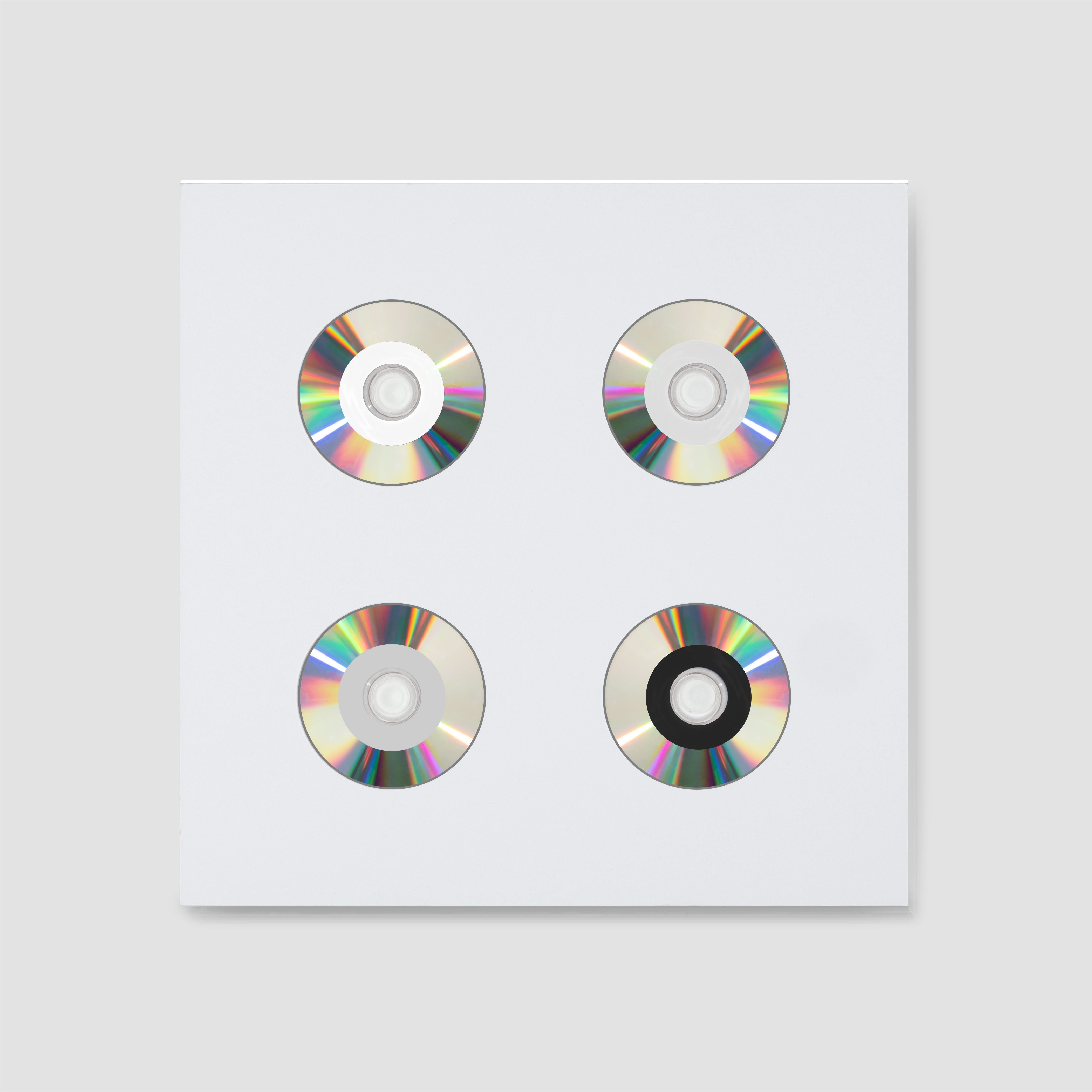
When entering ITERAE, we realize that it has already entered us. In this realm of post-glitch and digital bliss, an unsettling current draws us inward, threading its way through our attention until we no longer stand outside it. By the time orientation falters, we have already been absorbed into its matrix. This first collaboration between Joseph Branciforte and Jozef Dumoulin feels less like a beginning than a recognition, as though the music had been forming elsewhere long before it reached our ears. The eight-part work makes room for whatever meanings we bring to it, yet those meanings do not remain intact. They splinter, becoming granular, each shard holding its own quiet tremor.
Although the sounds are free-flowing and, for all intents and purposes, “abstract,” something organic guides their unfolding. There is a sense of inevitability that breathes through the music, as if each gesture were the continuation of an unseen process. Both performers have examined the inner workings of the Fender Rhodes with an intimacy that borders on anatomical devotion. Branciforte approaches from a cerebral vantage, tracing circuitry and signal, while Dumoulin leans into resonance and touch. Their shared immersion in improvisation suggests a practice that listens as much as it acts. Electroacoustic molecules begin to feel like carriers of a subtler vitality, and what emerges, though rooted in the present, carries a strange immunity to time.
With an instrument each at their disposal, they shape and process their sounds in distinct ways, allowing differences to coexist without friction. Branciforte’s live editing system introduces another dimension, folding moments back into themselves so that traces of what has just passed continue to sing within what is becoming. The effect is neither nostalgic nor recursive in a conventional sense. Memory behaves more like a living texture, constantly reabsorbed into the present. Across 70 minutes, a broader tapestry takes form, one that does not declare its structure outright yet reveals a continuity of reception. By the end, something in us aligns more closely with itself, though the nature of that alignment resists easy articulation.
What’s astonishingly heartfelt about this record is the unforced way in which it unfolds. Each shift of color, light, and texture feels intentional without ever seeming imposed. The music often takes on a visual quality, as though it were painting in slow motion across an inner field of perception. At certain points, the effect is hymnal, repetition carrying a quiet sense of ritual that feels open rather than doctrinal. Elsewhere, the atmosphere turns distinctly technological, articulating patterns that seem native to machines yet remain accessible to human feeling. While Branciforte and Dumoulin could easily construct overwhelming densities, their attention turns toward the interstices, the fine cracks where detail becomes a form of revelation.
Skips and starts establish a kind of pulse, though one that resists regularity. In the spaces where expectation wavers, something almost biological begins to stir, hovering between unease and resolution, never fully committing to either. As the sonic architecture takes on a more metallic sheen, a subtle shift occurs in its sensory character. There is a taste to it, faintly coppery, as if the sound itself were brushing against the elemental conditions from which life emerges. This grounding in the fundamental gives the less anchored passages a surprising sense of familiarity.
The continuity of the work remains one of its quiet marvels. Emotional currents, physical responses, and fragments of memory intertwine in ways that feel both intimate and expansive. The initial unsettlement does not disappear, yet it softens as the music offers points of illumination along the way. There is always a sense of contact, as though the sound remains attuned to our capacity to receive it. Nothing is pushed beyond reach, even when clarity seems just out of grasp.
When rhythms become more defined, they resemble presences moving alongside one another rather than structures imposed from above. Listening begins to feel like watching language dissolve into color, each shade carrying a meaning that cannot be translated back into words. Melodic gestures arise from the digital substrate as complete entities, already aware of their own contours. Direction loses its usual significance, and the distinction between forward and backward begins to blur.
Near the end, distortion enters with a subtle insistence, though it never threatens to overwhelm. Instead, it refines the material, drawing out a clarity that feels paradoxically linked to decay. Each iteration preserves a certain purity, suggesting an affection for entropy rather than a resistance to it.

