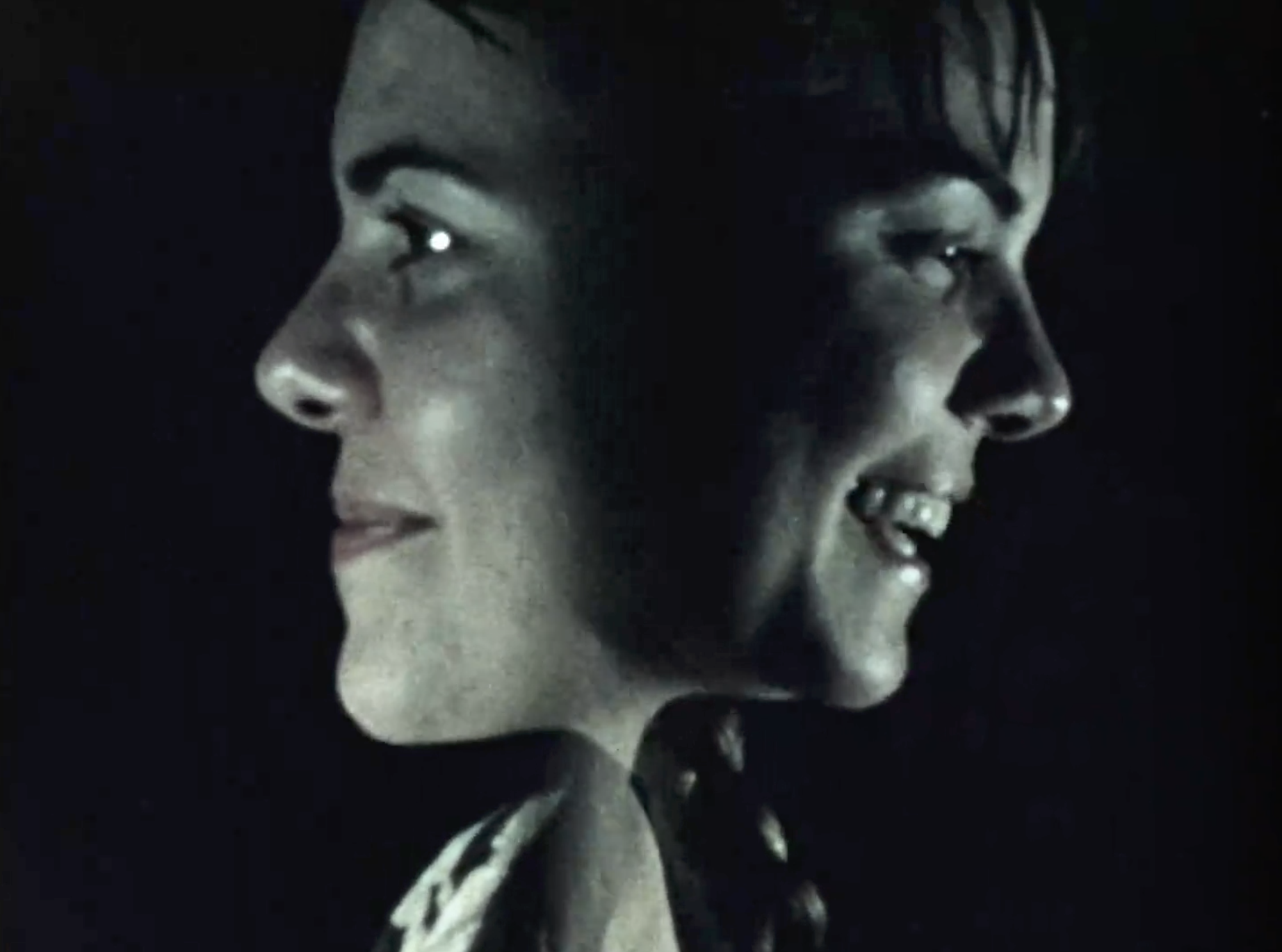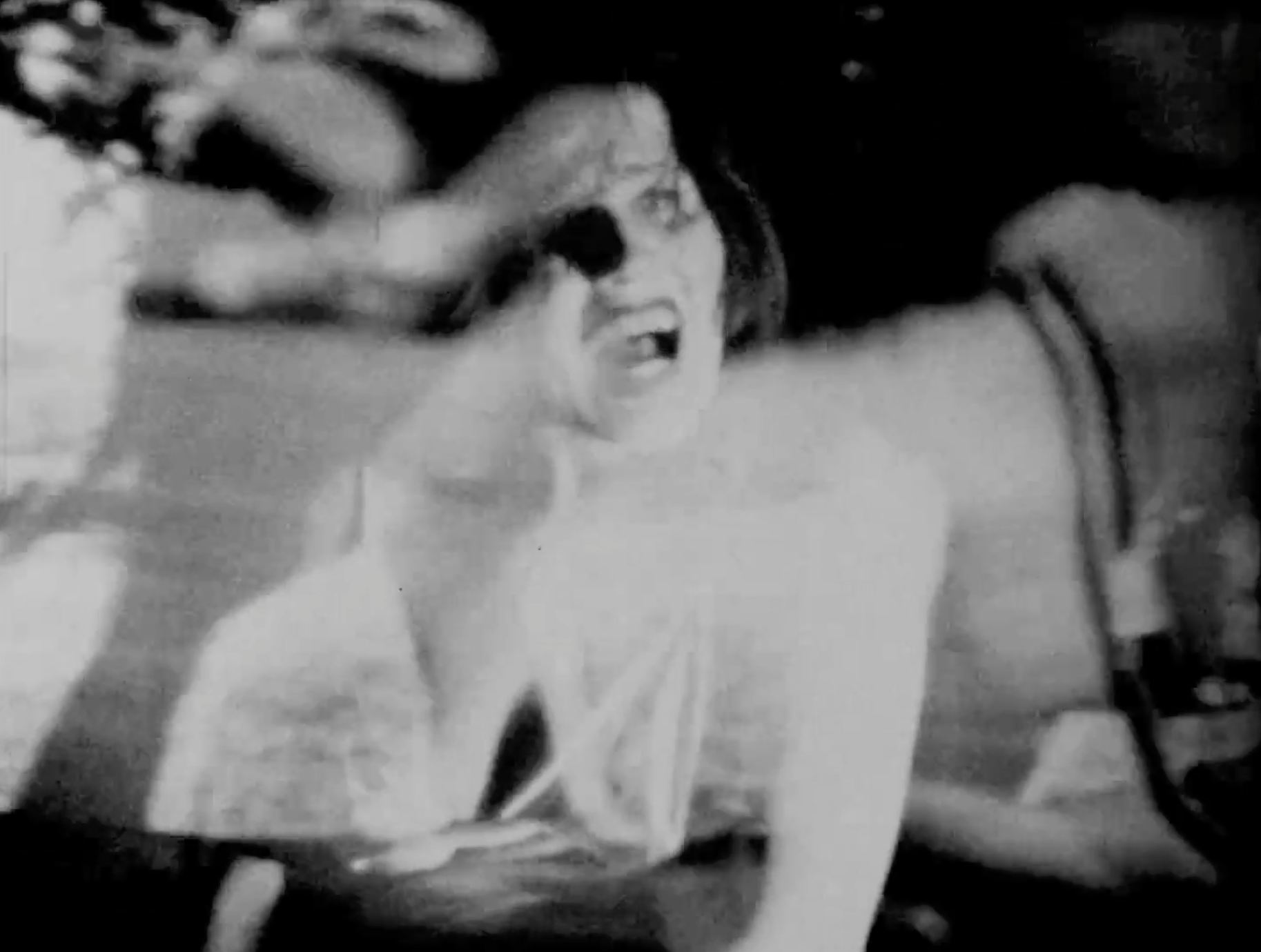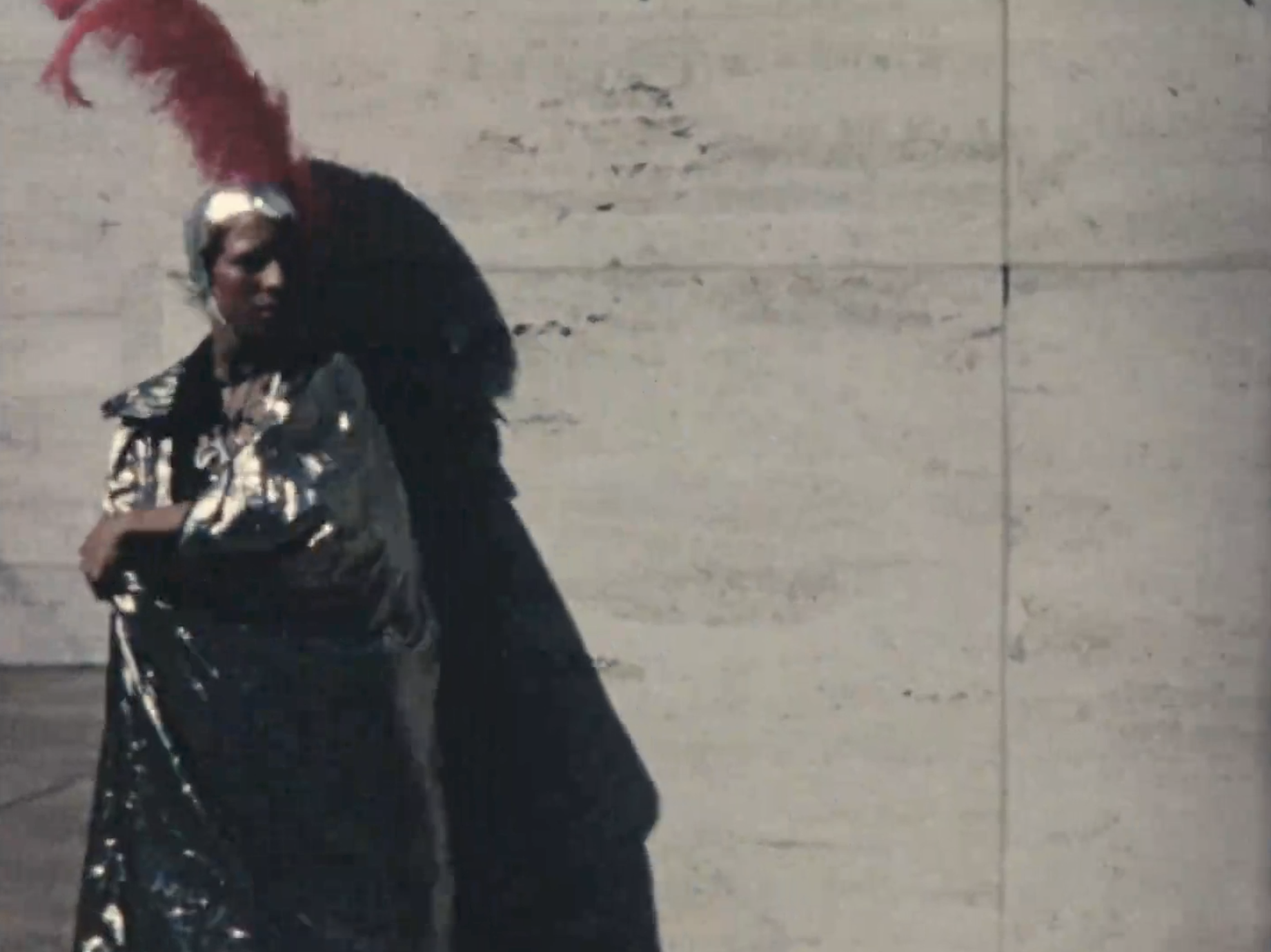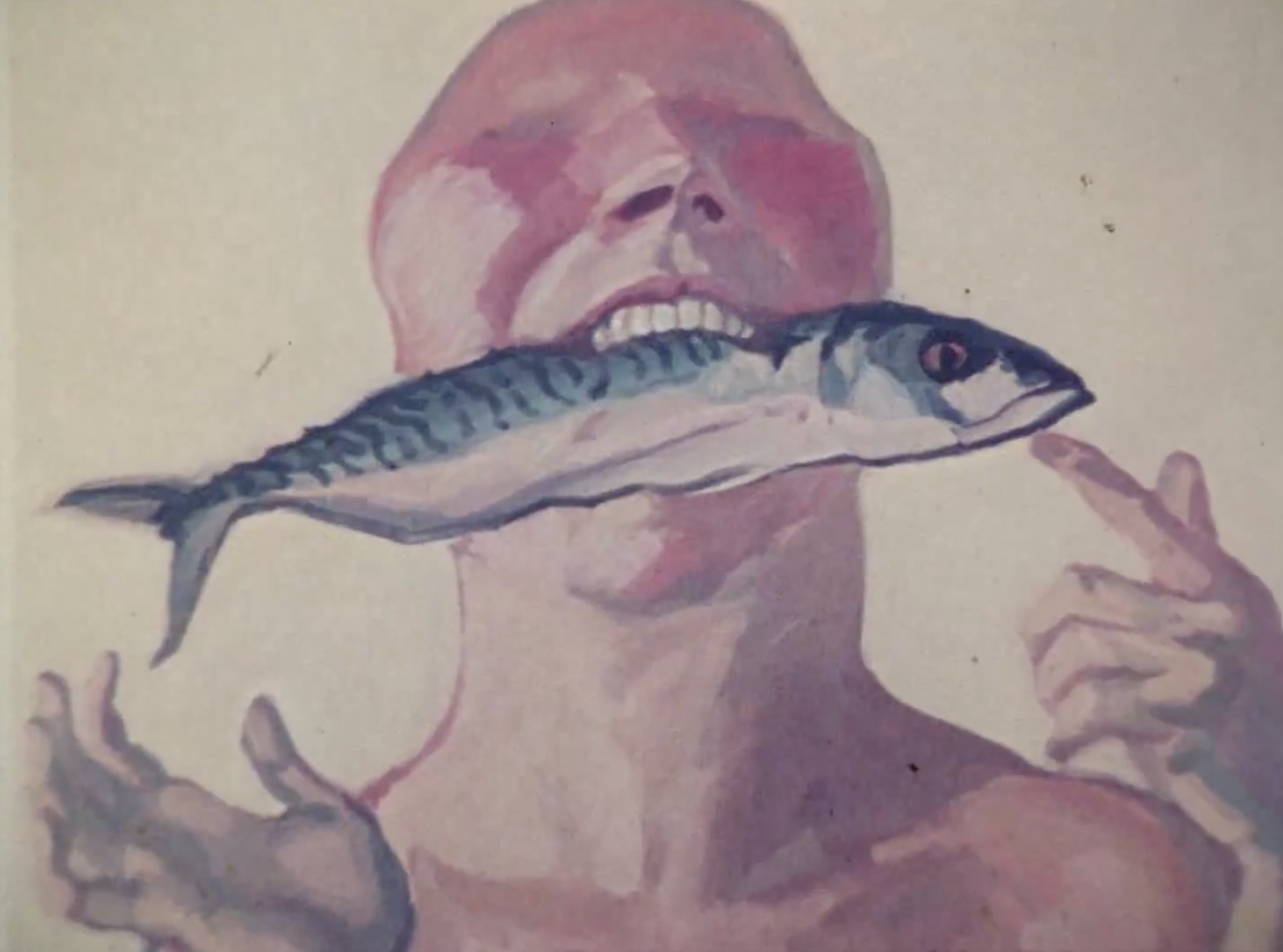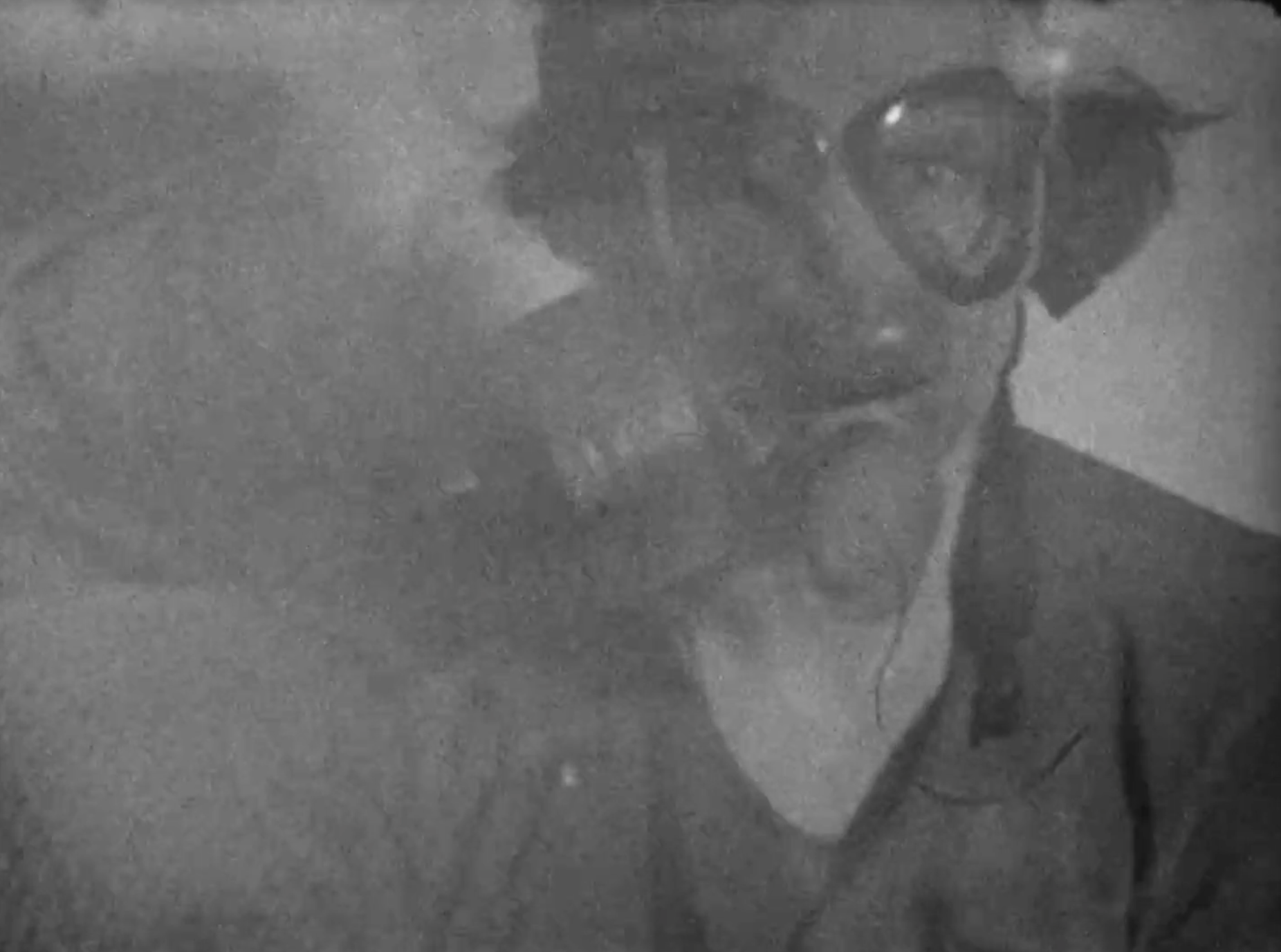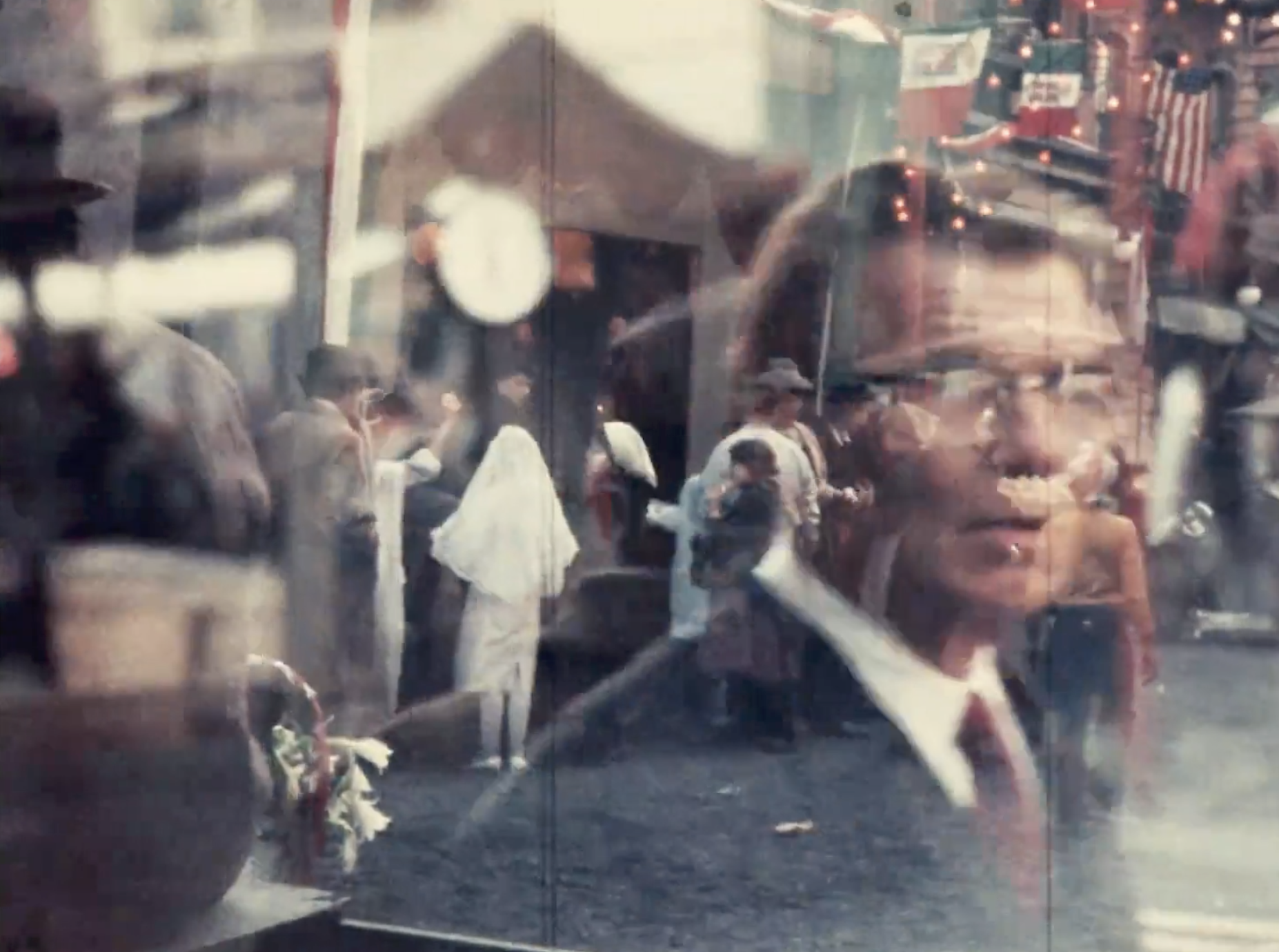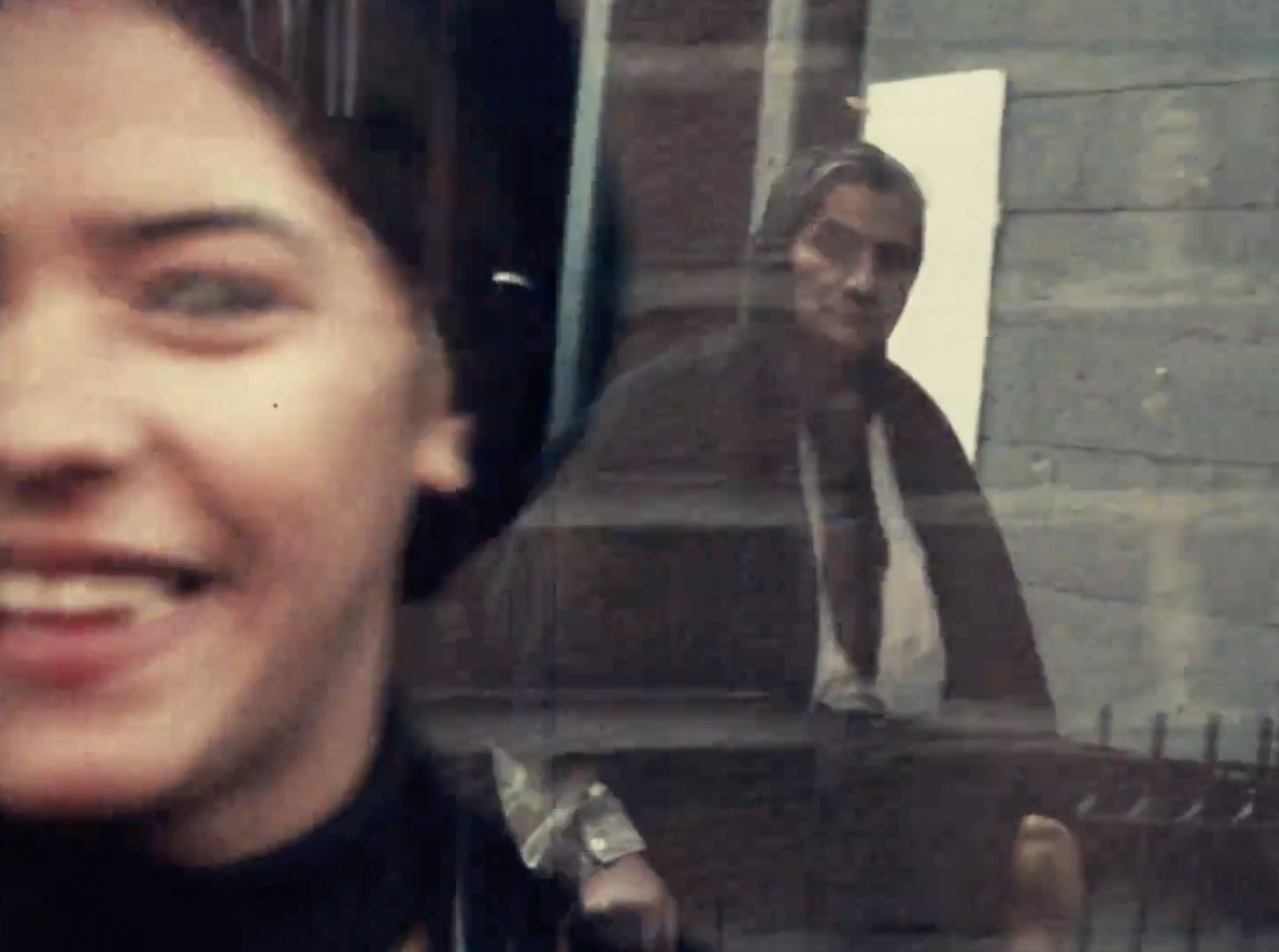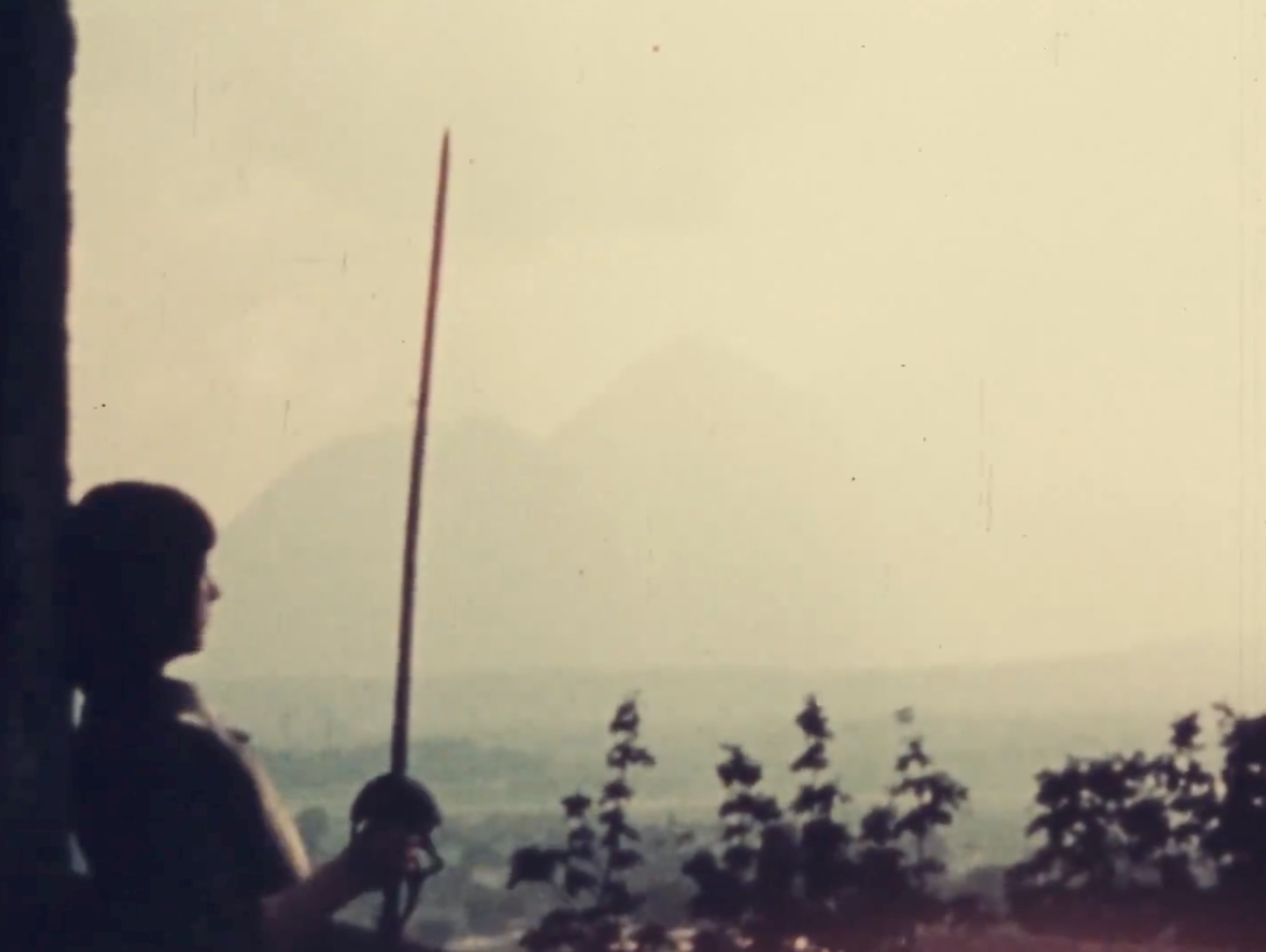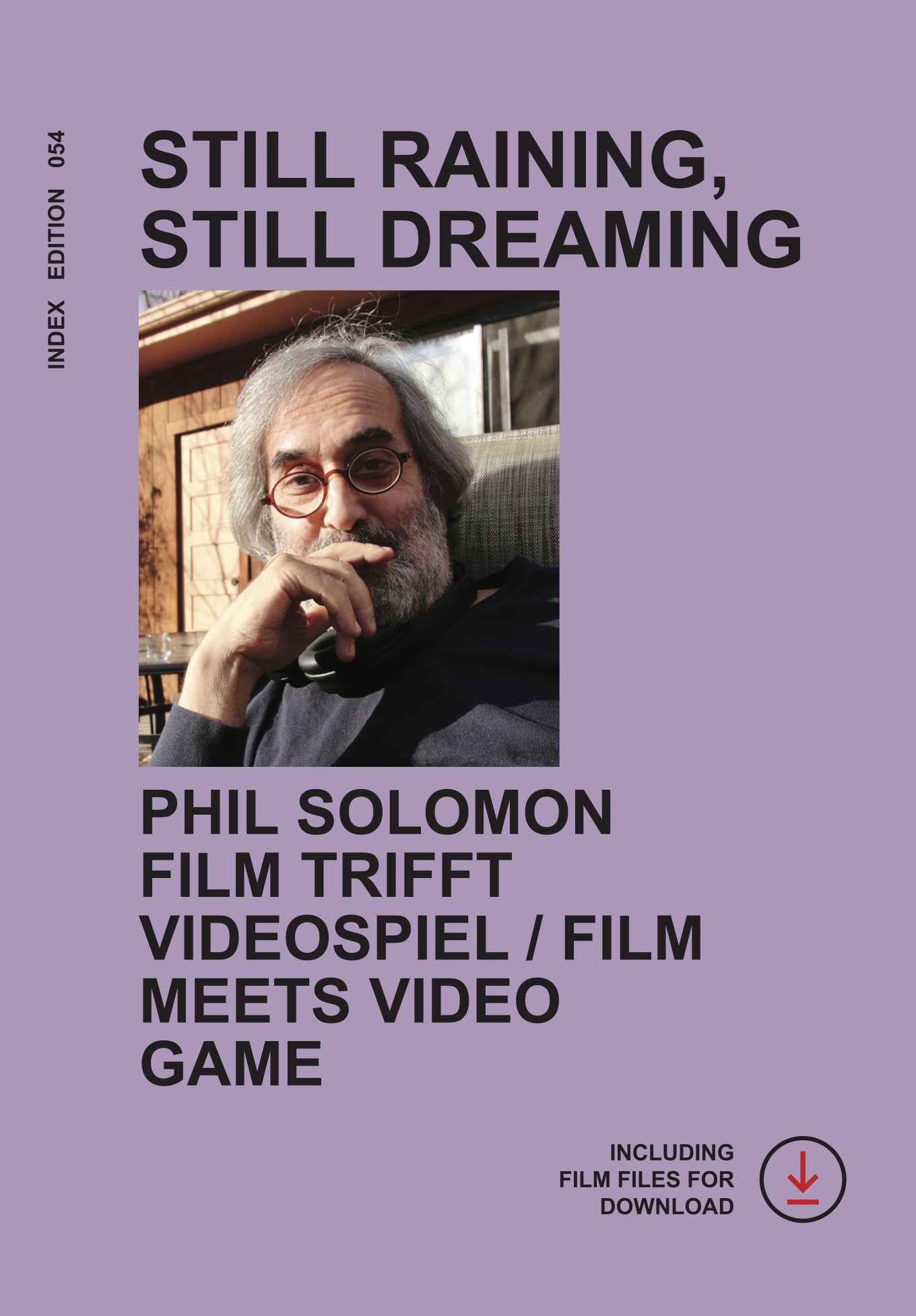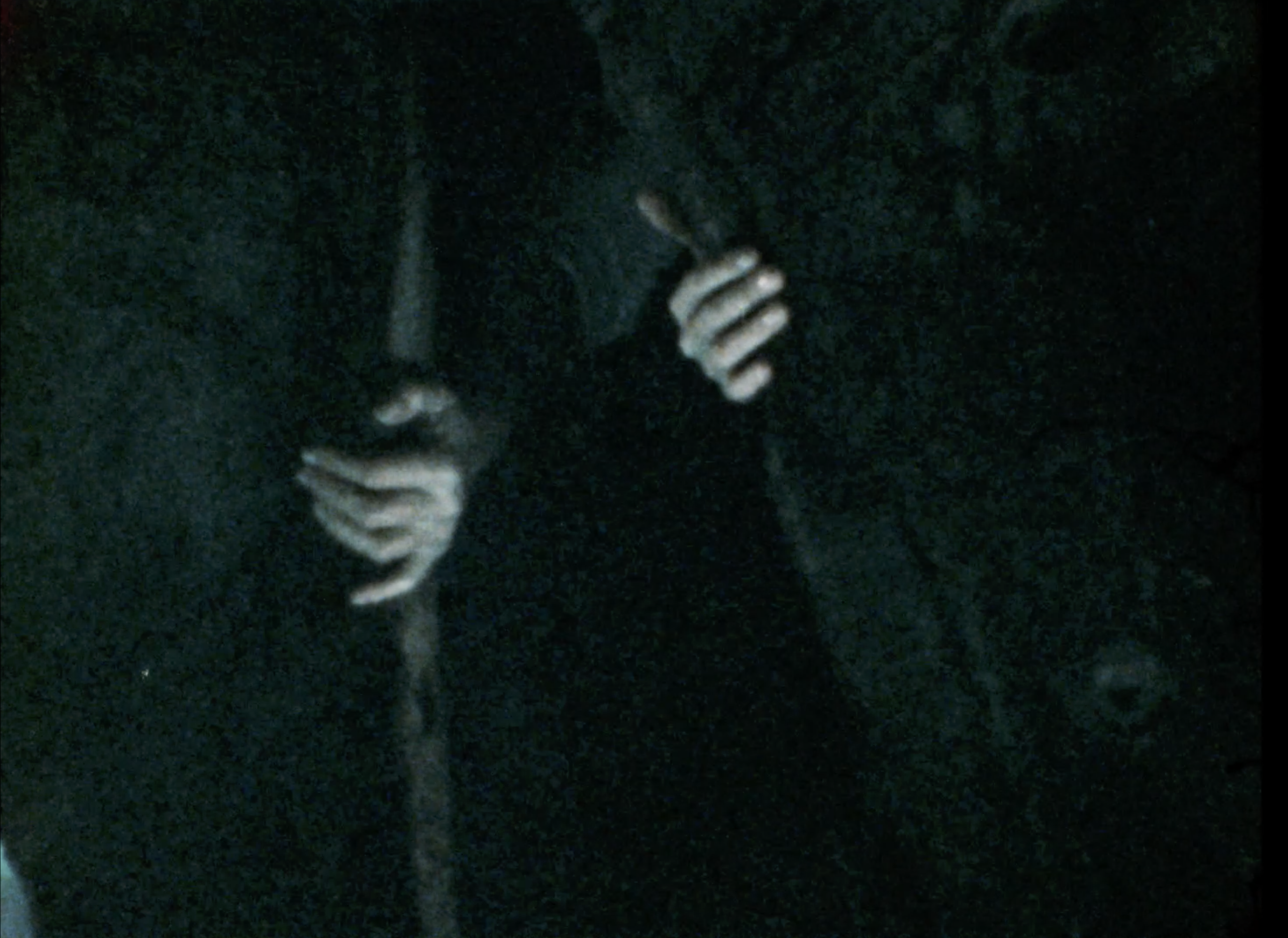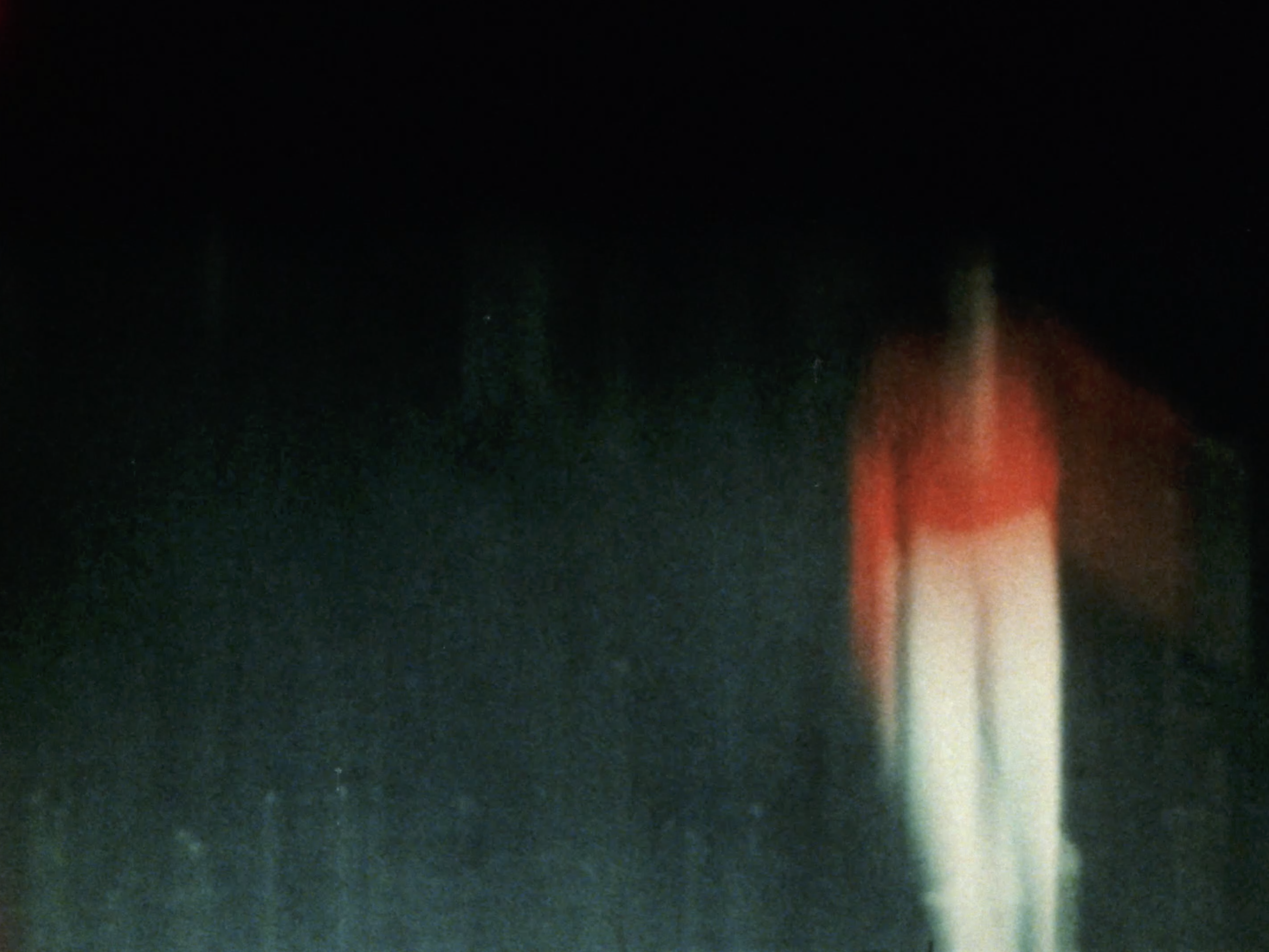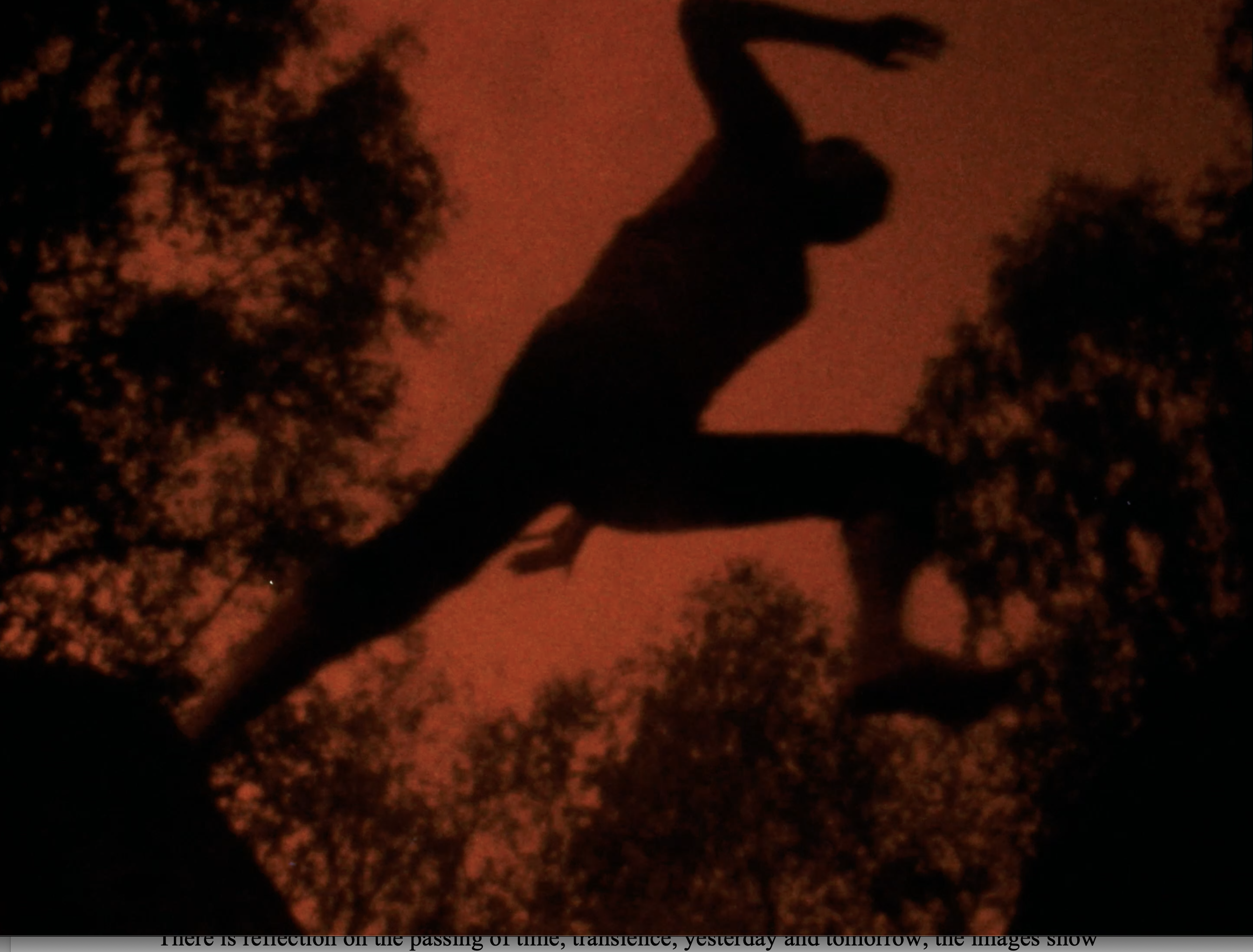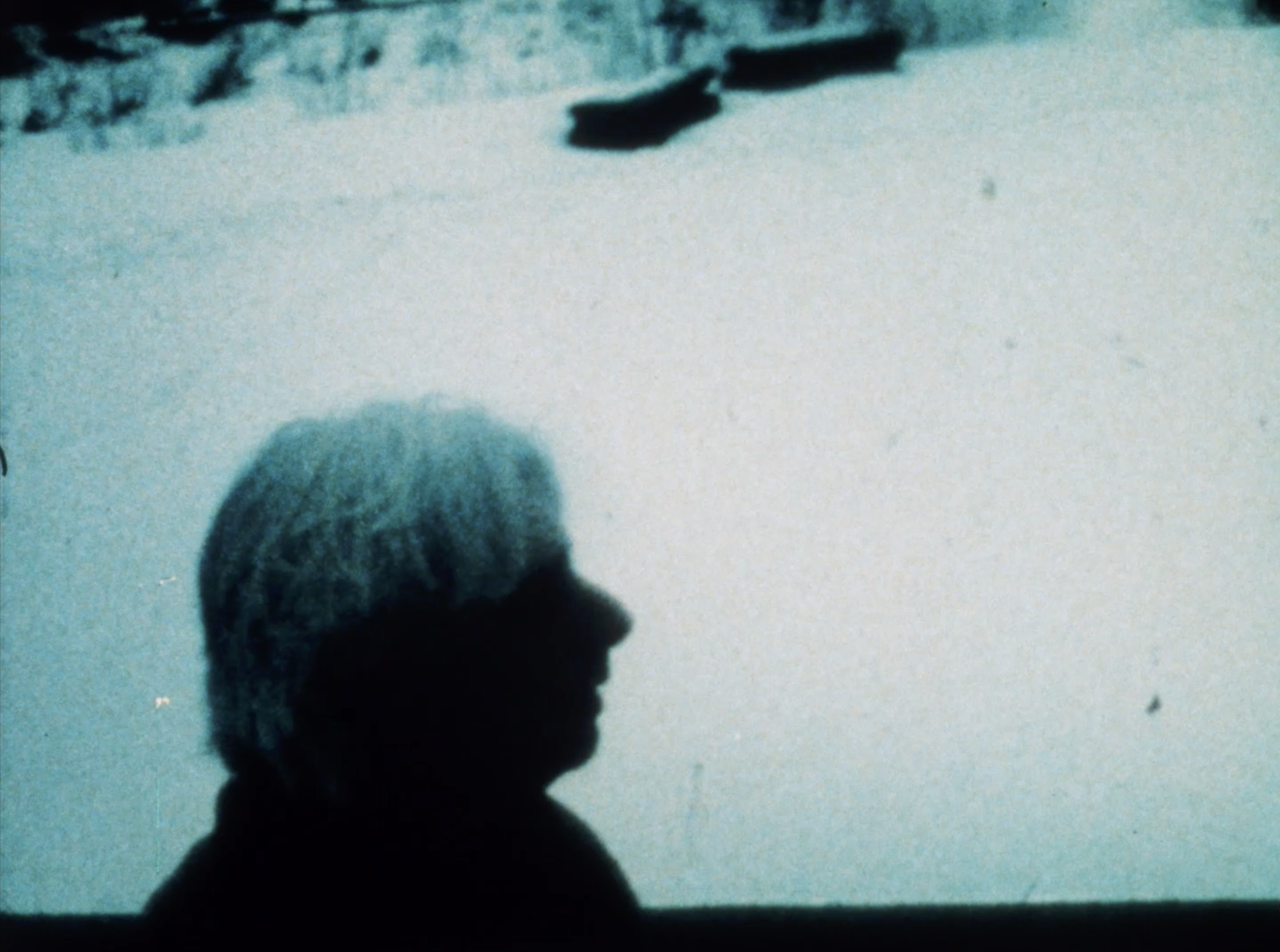
It is tempting, almost reflexive, to speak of an artist’s output as a body of work, as though its existence depends on assembly, arrangement, and, ultimately, externalization. Meanwhile, Phil Solomon’s cinema metabolizes audiovisuality at its most internal. His films are residues of contact, impressions left where perception has brushed against the world and recoiled. They seep from life, haunted by the fragile choreography between presence and disappearance.
Born in 1954, Solomon came of age artistically at SUNY Binghamton in the 1970s, studying under figures such as Ken Jacobs and Peter Kubelka, whose engagements with the materiality of film left an indelible mark. His own sensibility, however, slips beyond questions of influence. It pursues a kind of inverse archaeology, digging toward a vanishing point of the medium. Though often associated with found footage, even that term falters under scrutiny. As Eve Heller suggests, what he found remained inseparable from what had already been lost. His images carry the weight of retrieval, though never restoration. They arrive wounded, already slipping away.
This INDEX edition, gathering his final works, reveals a fascination with largely digital environments while remaining tethered to the tactile ghosts of celluloid. Solomon’s engagement with video games, particularly the Grand Theft Auto franchise, delineates sites of profound reorientation. These virtual landscapes, designed for velocity and spectacle, are slowed, hollowed, and made to mourn what he once called “the inevitable ineffable,” a phrase that captures a peculiar sort of alchemy. Seemingly disparate elements coalesce into something uncannily coherent, insofar as it exerts pressure toward a center that cannot be named.
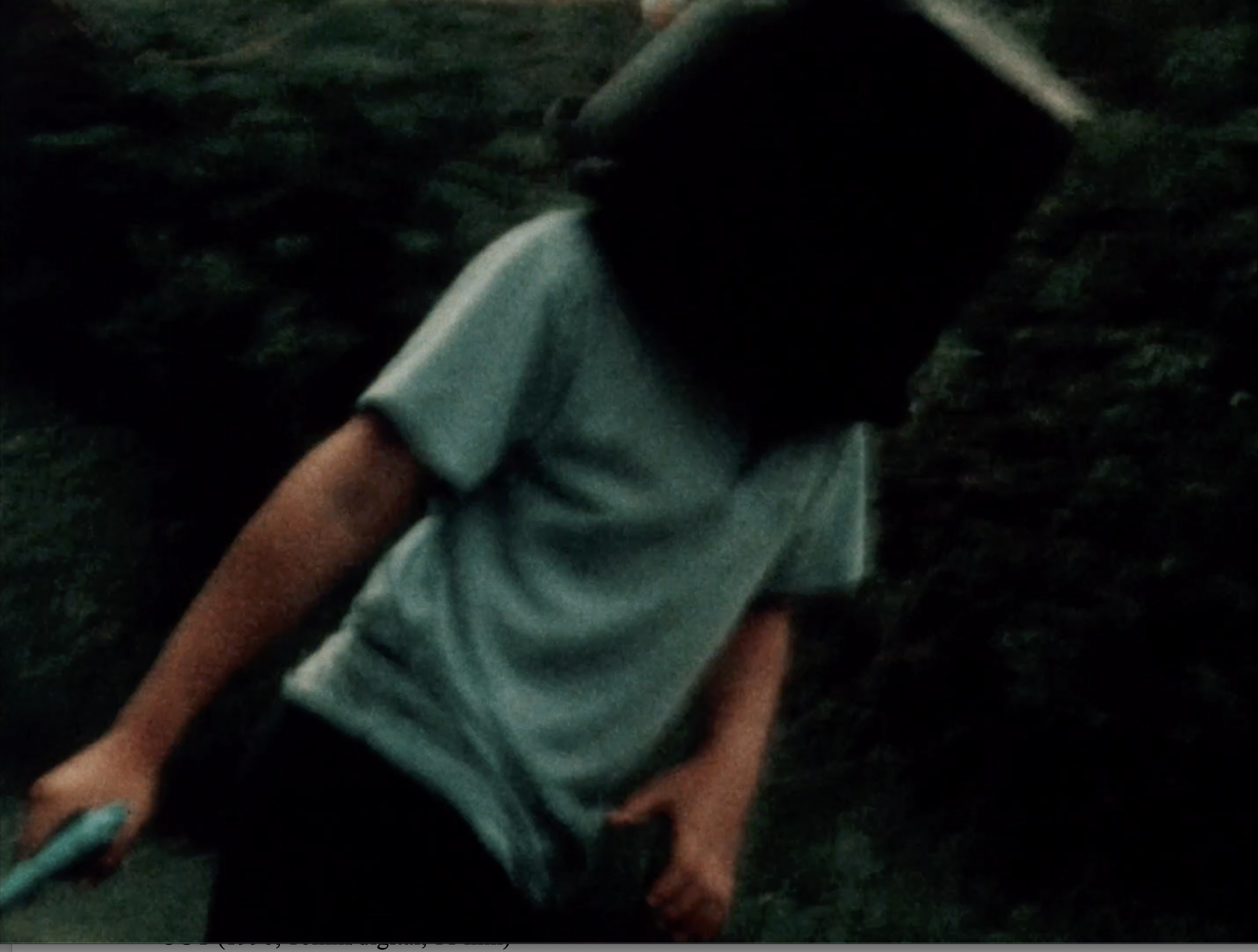
Crossroad (2005) inaugurates this phase with an unresolved chord. GTA’s protagonist, CJ, drifts through rain and foliage, accompanied by an impossibly floating bouquet of flowers devoid of recipient. Everything hums faintly around him. Thunder cracks. A train sounds in the distance. Nothing answers his movement. He runs, stops, waits, stretches his limbs as if testing the fact of his own existence. The environment offers only indifferent signals. A bird crosses the sky. A plane cuts overhead. These nods to continuity are almost cruel, reminders that life persists elsewhere, just beyond reach.
Solomon’s collaborator for this project was his dear friend Mark LaPore, who died suddenly shortly after its completion. What follows in In Memoriam (Mark LaPore) unfolds as an extended meditation, stretched across three works drawing deeper from the well they tapped in GTA. In Rehearsals for Retirement, the digital realm saturates with grief. Rain falls with unnatural persistence. Acts are interrupted, deferred, dissolved into blackness before they can resolve into purpose. A hearse glides through fields where wheat stalks pierce its interior, a glitch that reads less like error and more like revelation. The laws of nature bend, fracture, and rearrange themselves, yet death remains unaltered, immovable, the single constant in a system otherwise given to distortion.
Last Days in a Lonely Place expands this desolation outward, layering fragments of dialogue from Rebel Without a Causeagainst a world emptied of its inhabitants. The cosmos looms with indifferent permanence. A cinema marquee stands blank, awaiting spectators who will never return. Figures drift toward one another but never meet, their trajectories misaligned by forces that remain unseen. Machines operate without operators. Vehicles sink without resistance. The environment continues going through the motions, stripped of intention. Meaning has migrated elsewhere, leaving behind a mere scaffolding of function.
In Still Raining, Still Dreaming, Solomon turns his gaze toward the overlooked margins of the game’s architecture. Spaces designed to be passed through become sites of prolonged attention. A magician performs for no one. Pedestrians move without identity, their individuality folded into patterns without flesh. Sound drifts in and out of earshot, marking an internal logic that resists interpretation yet insists on affect. What players once bypassed in pursuit of action becomes, under Solomon’s eye, the true locus of experience.
John Powers writes that these works mourn not only LaPore but also the passing of film as a material form, the replacement of chemistry with code. Solomon’s digital skins nevertheless bear the scars of physical media, their anomalies echoing the traumatic memory of scratches and burns in bygone emulsion layers. An underlying inquiry remains: What does it mean to fend for oneself in a context already at odds with itself?
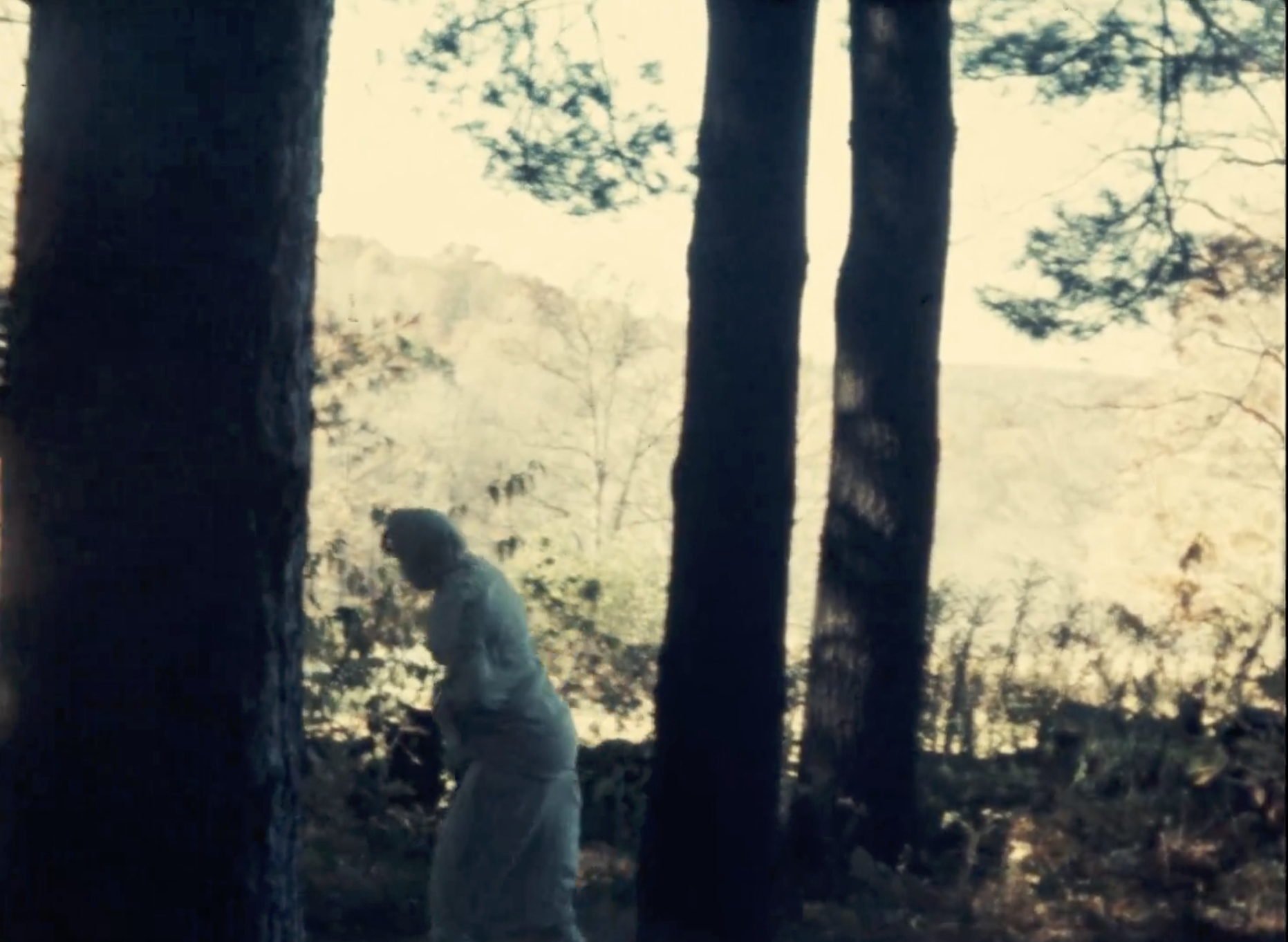
This question finds a different articulation in Psalm IV: Valley of the Shadow (2013), where Solomon turns to the Elder Scrolls universe of Skyrim, stripping away characters to leave behind a landscape without bloodshed. The voiceover, drawn from John Huston’s adaptation of James Joyce’s “The Dead,” drapes the eyes and ears in inexorable meditations. Snow falls. Mist gathers. A lone figure moves through a forest that seems to recede the more it is perceived. An icon whispering to itself, an object of contemplation that resists interpretation even as it invites it.
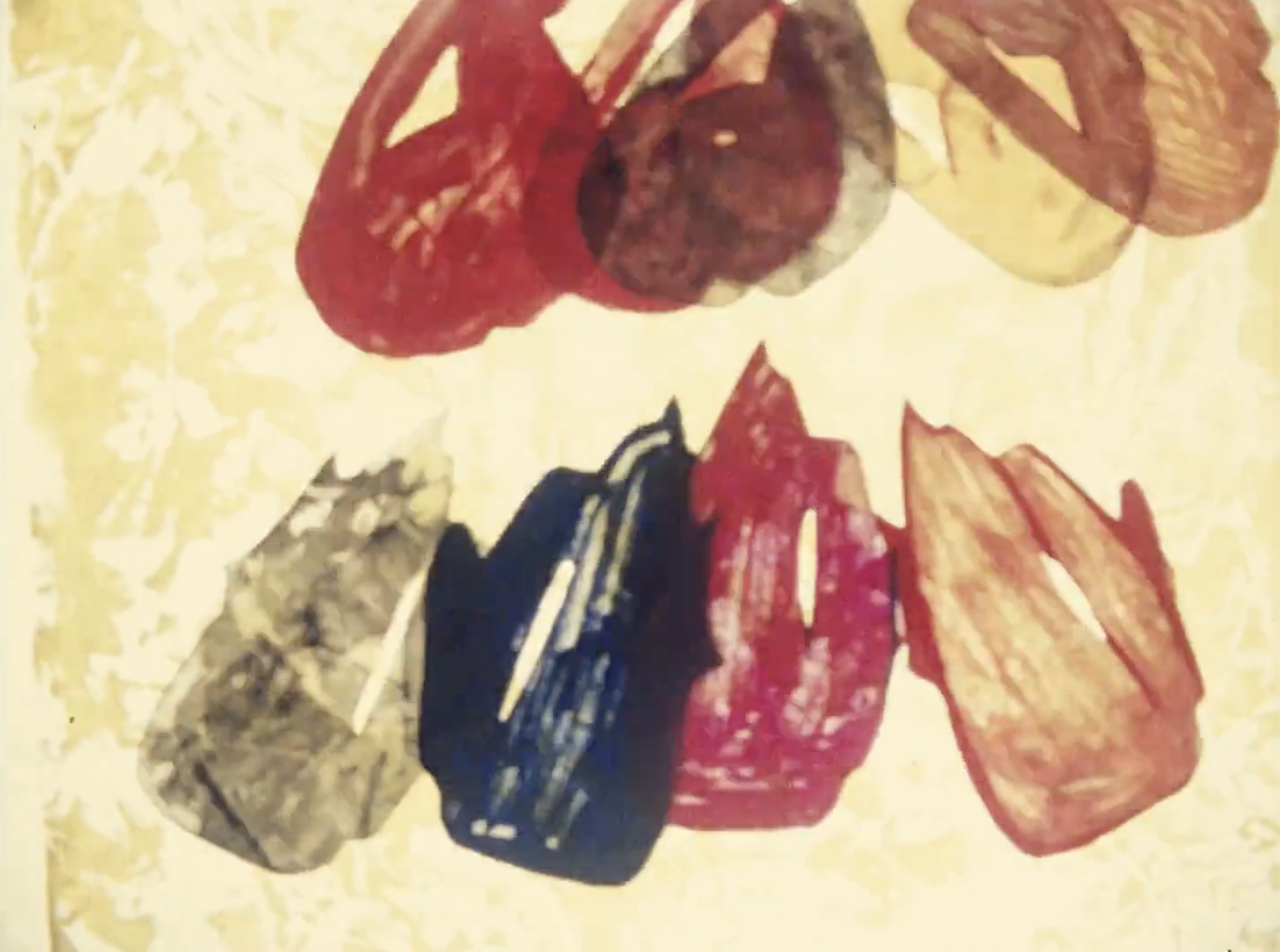
The Emblazoned Apparitions returns to analog processes, though not as a gesture of nostalgia. Here, a molecular transformation implodes, turning the familiar into abstraction (and vice versa). The tunnel motif recurs, suggestive of both passage and enclosure, a space that leads forward while folding inward. Film reveals itself as an artifact of entropy that documents what it records along with its own disintegration. Technology thus becomes inseparable from mortality, each frame a testament to impermanence.
Across these works, Solomon’s cinema resists containment. It offers no conventional narratives, yet it avoids pure abstraction. It occupies an unstable territory between states, hovering on the brink of recognition and dissolution. His legacy lies in a mode of attention, an insistence on lingering where others would move on, on dwelling within the unresolved.
To encounter these films is to be drawn into a space where time loosens its grip, where cause and effect give way to something more diffuse. In this sense, Solomon’s work persists as a kind of afterimage, a presence that remains even after the screen goes dark. Perhaps it resides there, in a space where seeing becomes indistinguishable from remembering, and remembering from forgetting, until even those distinctions dissolve into something more elemental, a flicker without origin, a trace without end.
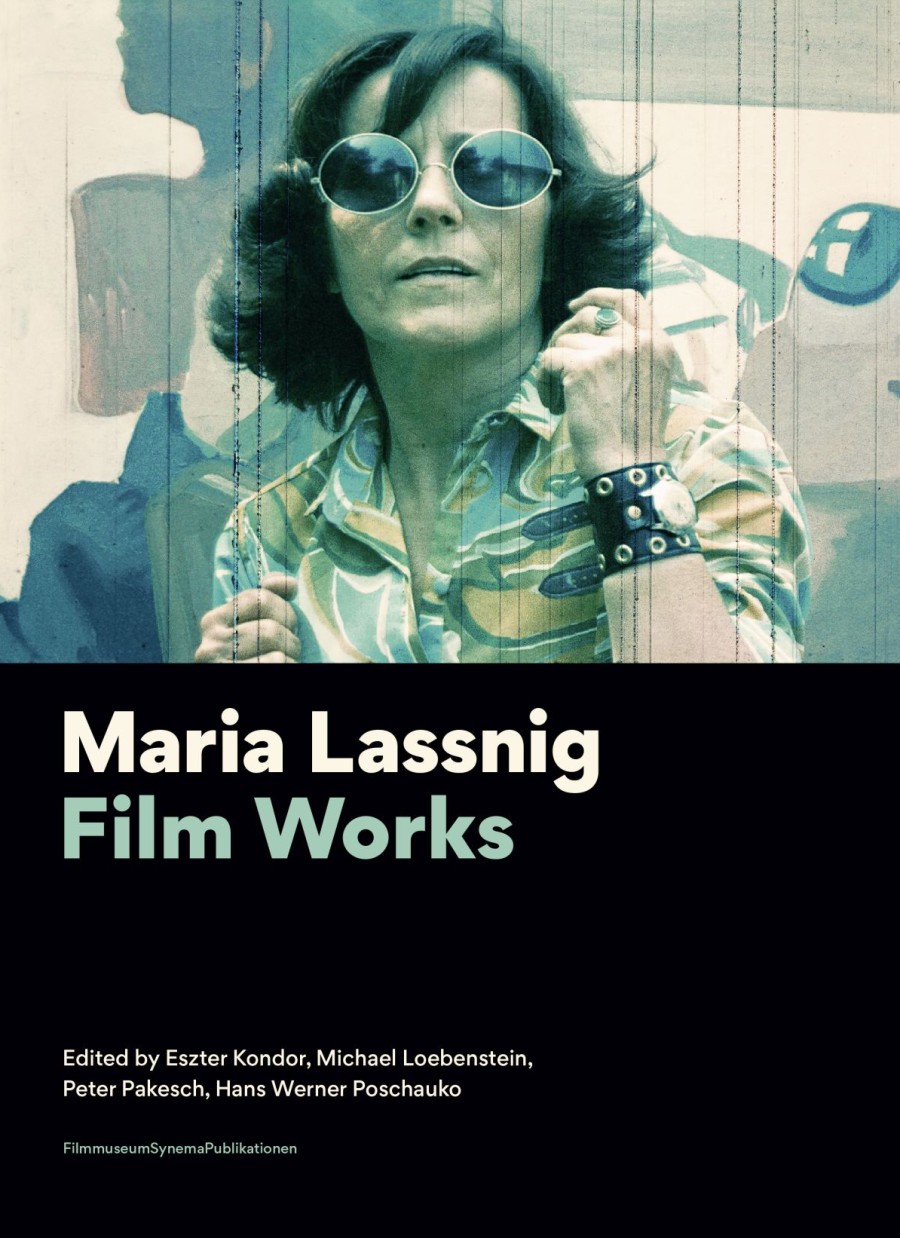
Across the canvas of Austrian avant-garde cinema, where names such as Kubelka and Kren have long been rendered in sharp, declarative strokes, the work of Moucle Blackout flickers with a quieter, though no less vibrant radiance. Her work breathes in a mirrored room, only to be released again in altered form. To encounter her oeuvre is to step into a field of delicate resistances, where form unsettles authority and vision unfolds through a patient, almost subterranean insistence.
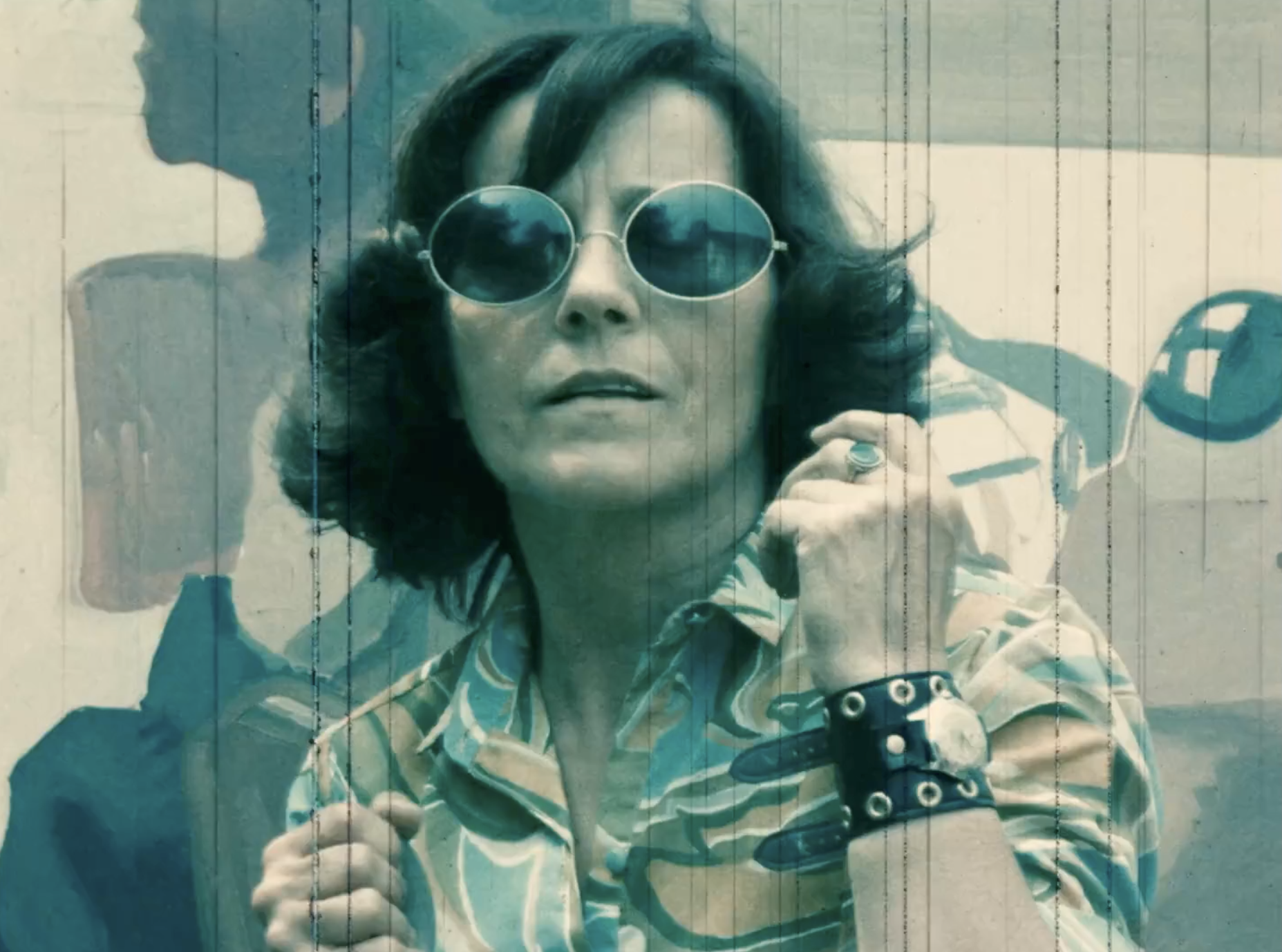
Born Christiane Engländer in 1935, she embarked on her creative self-examinations through sculpture and design. As Brigitta Burger-Utzer observes, she moved within the orbit of the Vienna Group during its formative years, witnessing a burgeoning experimental culture that, despite its radical aspirations, remained curiously closed to women. While the men gathered, wrote, filmed, and declared, she watched, listened, and absorbed.
That threshold, neither inside nor entirely outside, became fertile ground. Instead of echoing the gestures of her contemporaries, she cultivated another trajectory, one that slips between categories. Her studies at the IDHEC in Paris between 1957 and 1958 opened a corridor of possibility, while her chance encounter with Marc Adrian (whom she later married) introduced her to the tactile processes of making films by placing a camera in her hands, an act that now carries a faint mythic glow. From that moment, experimentation became atmosphere, and together they explored development, color manipulation, and the mutable chemistry of the image. As she later remarked in conversation with Michaela Grill and Isabella Reicher: “I enjoy filmmaking, and this pleasure becomes visible.”
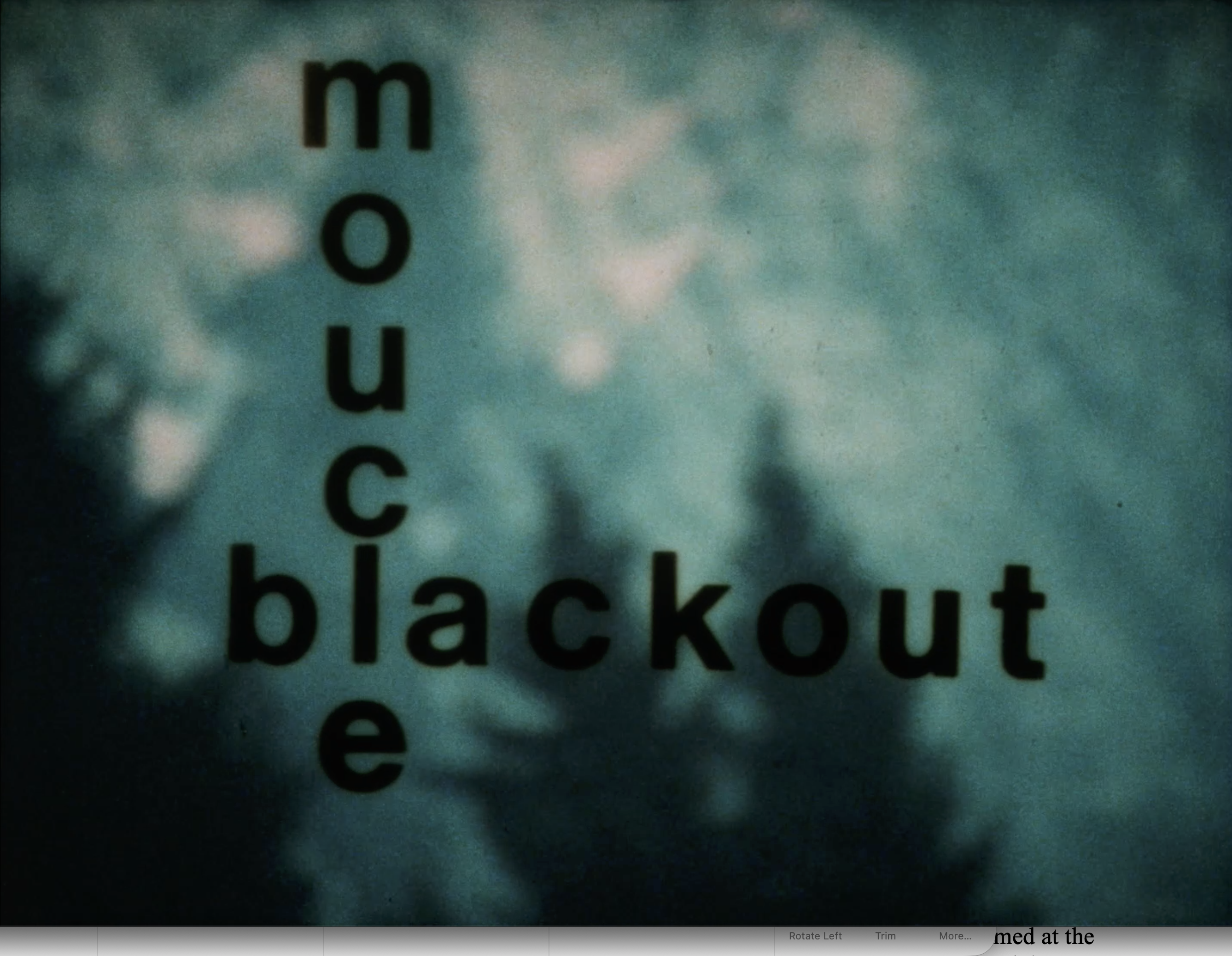
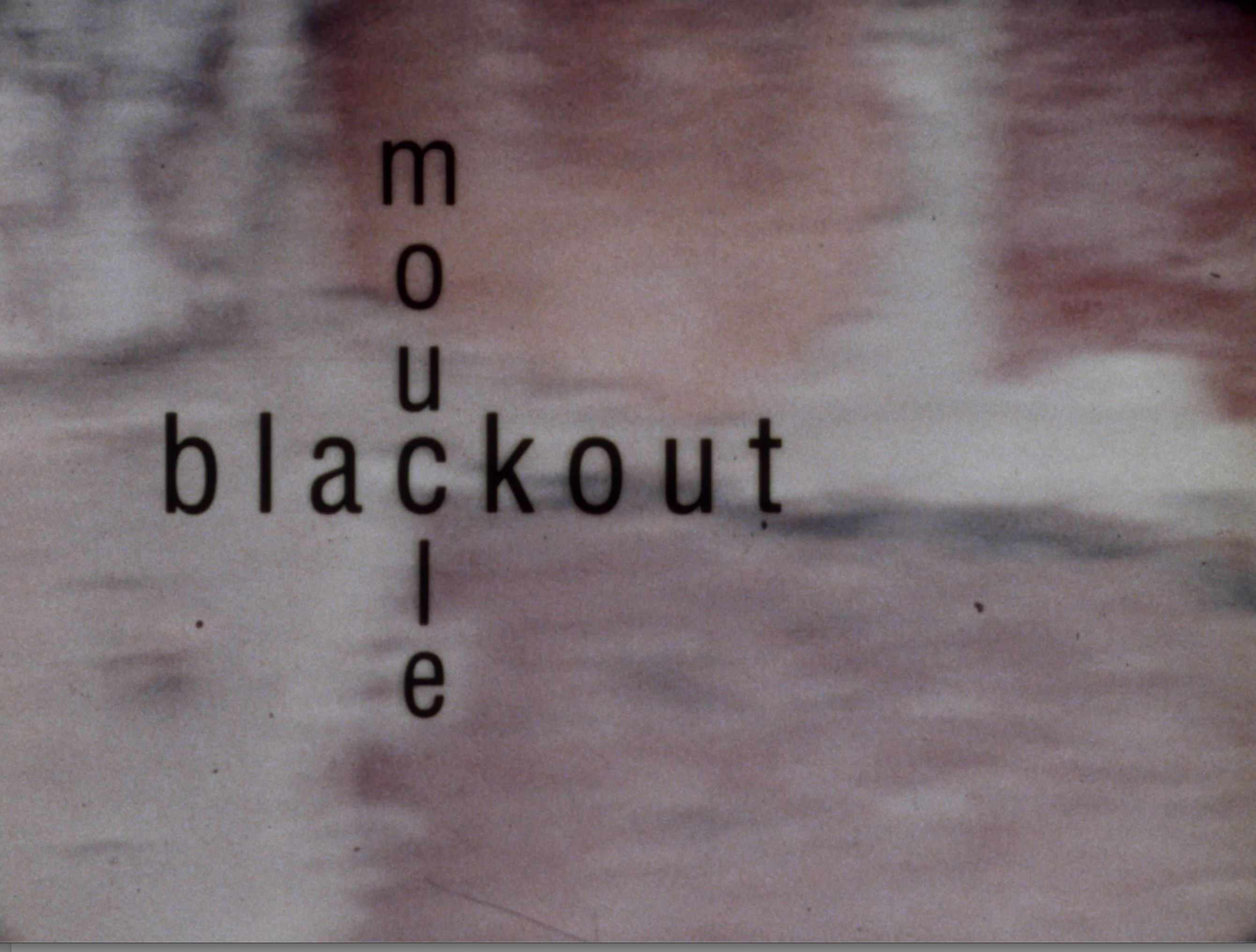
The name Moucle Blackout itself embodies that same playful opacity. “Muckl,” a childhood nickname, was combined with the enigmatic “Blackout” at Adrian’s suggestion into a conceptual eclipse. The moniker suggests a break in the flow of light. It also invites a loss of consciousness, as if meaning might shift under prolonged attention.
Thresholds, Absences, Openings
Her earliest independent films have been lost, a disappearance that feels less accidental than symptomatic. The marginalization of women within international avant-garde histories leaves behind many such absences that echo louder than presence. What remains begins, officially, with Walk in from 1969.
Blackout has long resisted the notion of meaning as a finished object. “I wanted the films to remain open to interpretation, but not too easy to decipher,” she explains. “It is not about serving the audience things ready made.” The viewer dwells at risk of uncertain, entering a building under construction where the floor may shift beneath each step.
Her filmography, though concise, unfolds across a spectrum of forms. Structural rigor dissolves into moments of chromatic delirium. Color pulses with interior life. Elsewhere, fragments of bourgeois ritual appear as rehearsed performances, their naturalness gently undone. Her palette is one of perceptual instruments, recalibrating not only what is seen but the conditions under which seeing becomes possible.
Arindam Sen suggests that Blackout’s work invites a rethinking of history itself, less as a sequence of monumental gestures than as an accumulation of small, deliberate acts. Each project becomes a step, quiet yet exacting, within a trajectory that often remains obscured. Recognition arrived late. Only in 2014, at the age of 79, did she receive a retrospective in Villach, a gathering of decades that had persisted without spectacle.
To place Moucle Blackout alongside figures such as VALIE EXPORT opens a dialogue between distinct strategies. Whereas EXPORT confronts with immediacy, Blackout allows the image to tremble until its surface betrays its instability.
Her work resides in intervals. Between frames. Between disciplines. Between recognition and obscurity. Photography, collage, object-making, dance: all is fair game. Each medium becomes a site where perception is tested.
Filmic Apertures
1. Walk in (1969, 16mm/digital, 5 min)
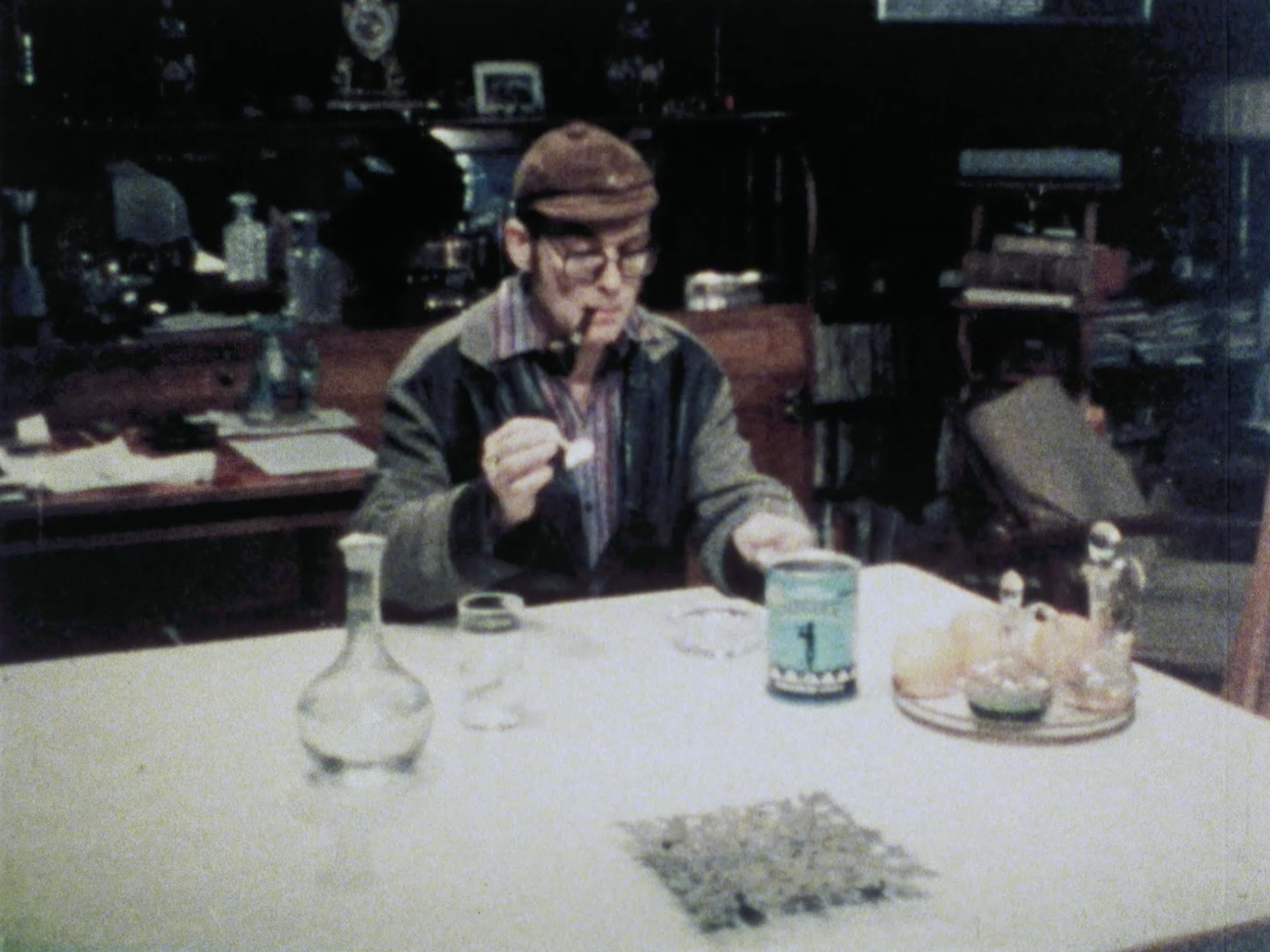
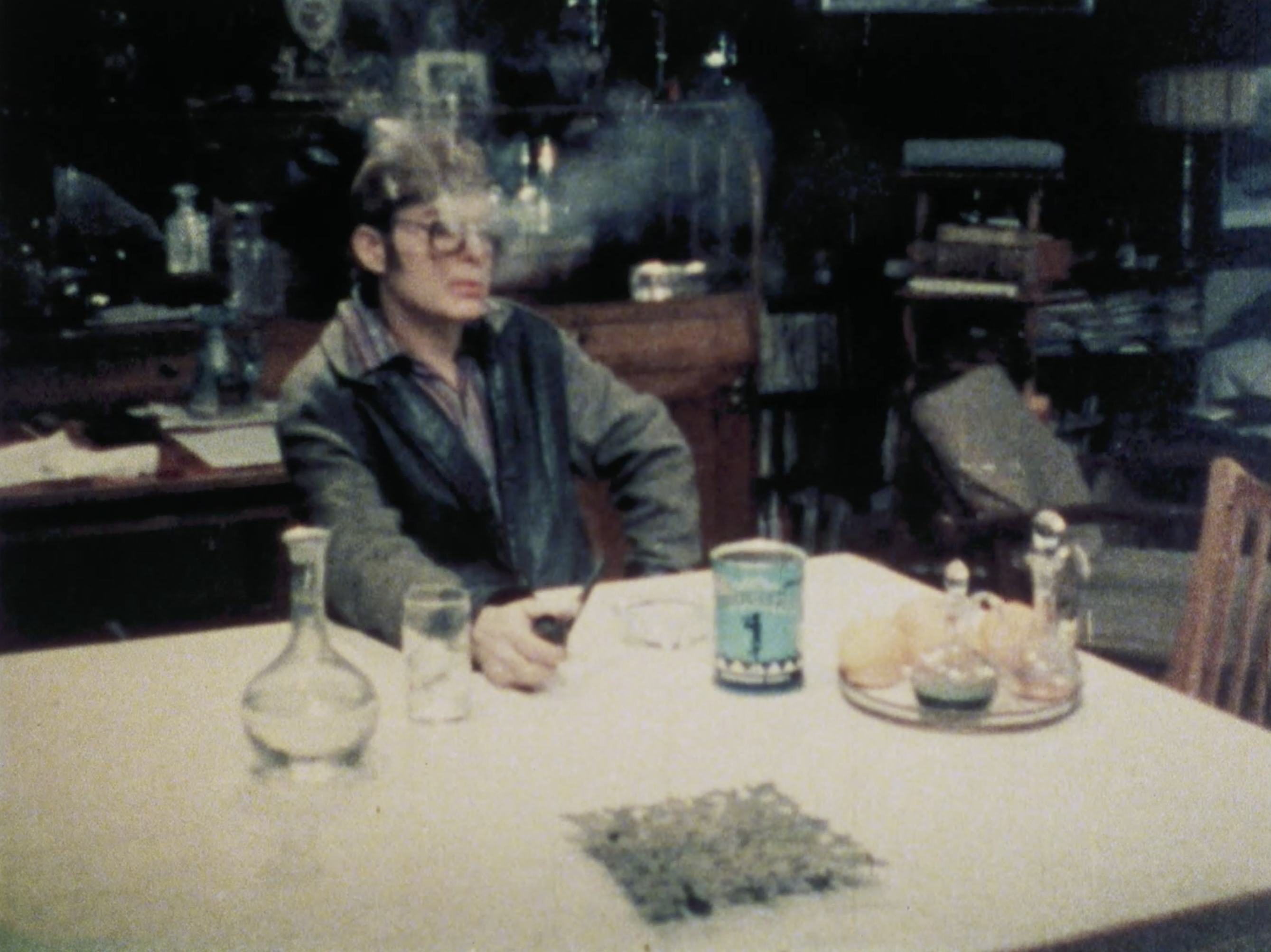
Although this is a structural film, it also functions as Blackout’s critical response to structural film, a gesture that flirts with imitation yet resolves into something more internally corrosive. The canonical language of repetition is taken up only to be bent inward, its apparent neutrality revealed as a mechanism capable of entrapment. From Marc Adrian’s entrance into their shared apartment to his measured sitting, the careful filling of a pipe, and the slow ignition of smoke, each action arrives with the promise of ordinary continuity. That promise dissolves almost immediately. The gesture fractures, breaks apart, and multiplies itself into rhythmic segments that refuse to align into forward motion. Seven hundred twenty frames are shuffled into a temporal labyrinth, where progression loses its footing and begins to circle itself.
The duplication process leaves visible scars across the filmstrip. Scratches cling like residue from a failed attempt at preservation, as though the act of repetition itself had worn down the material. Adrian appears caught between intention and interruption, his small domestic ritual transformed into a loop that cannot conclude. What might have been an act of unwinding instead becomes a tightening coil, a choreography of deferred release. Blackout’s notion of “the impression of manic behavior” lingers, though it feels less like mania than a quiet suffocation. The accompanying music hovers delicately, never resolving into comfort, its presence amplifying the unease.
2. Die Geburt der Venus / The Birth of Venus (1970-72, 35mm/digital, 5 min)
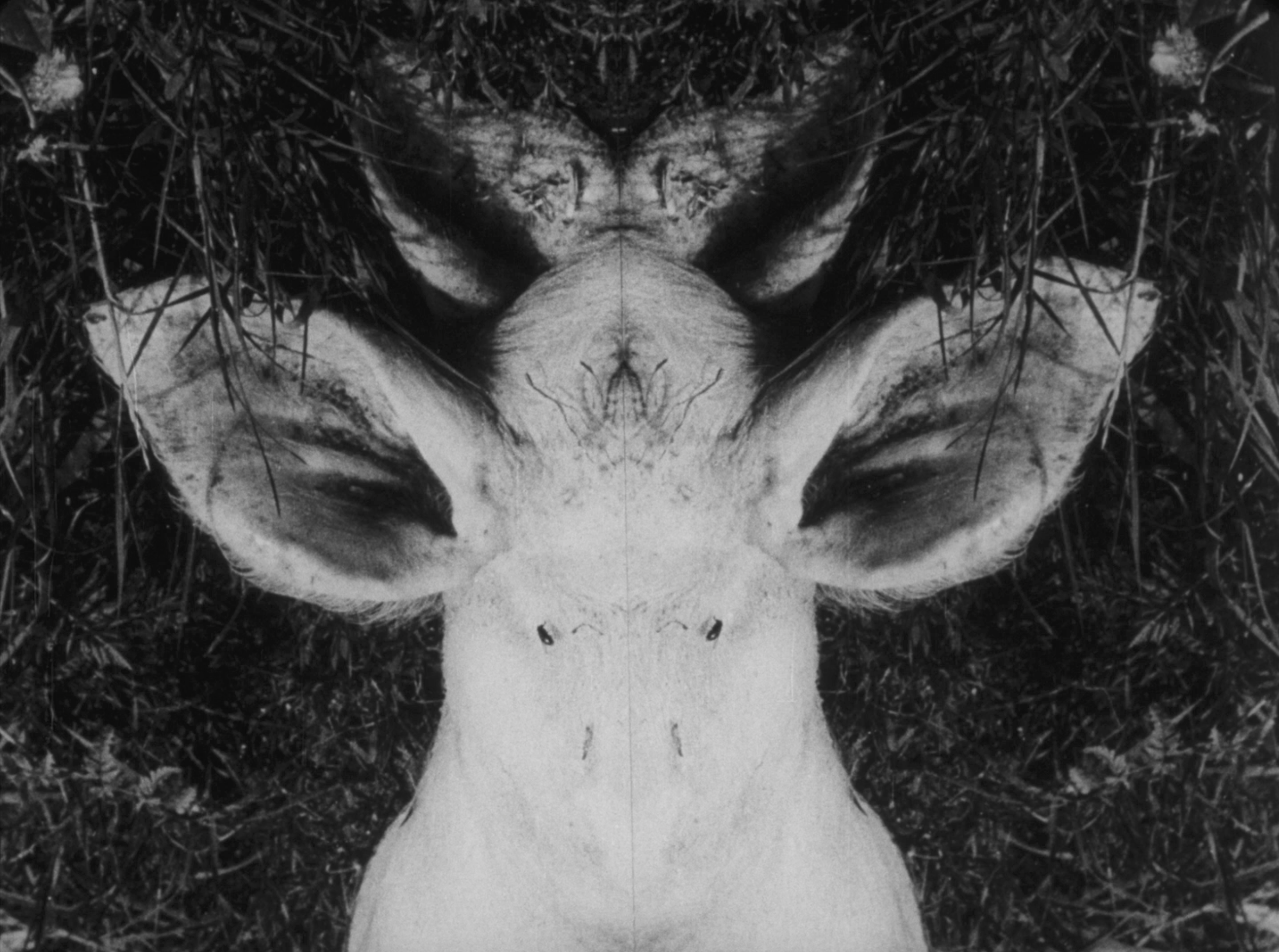
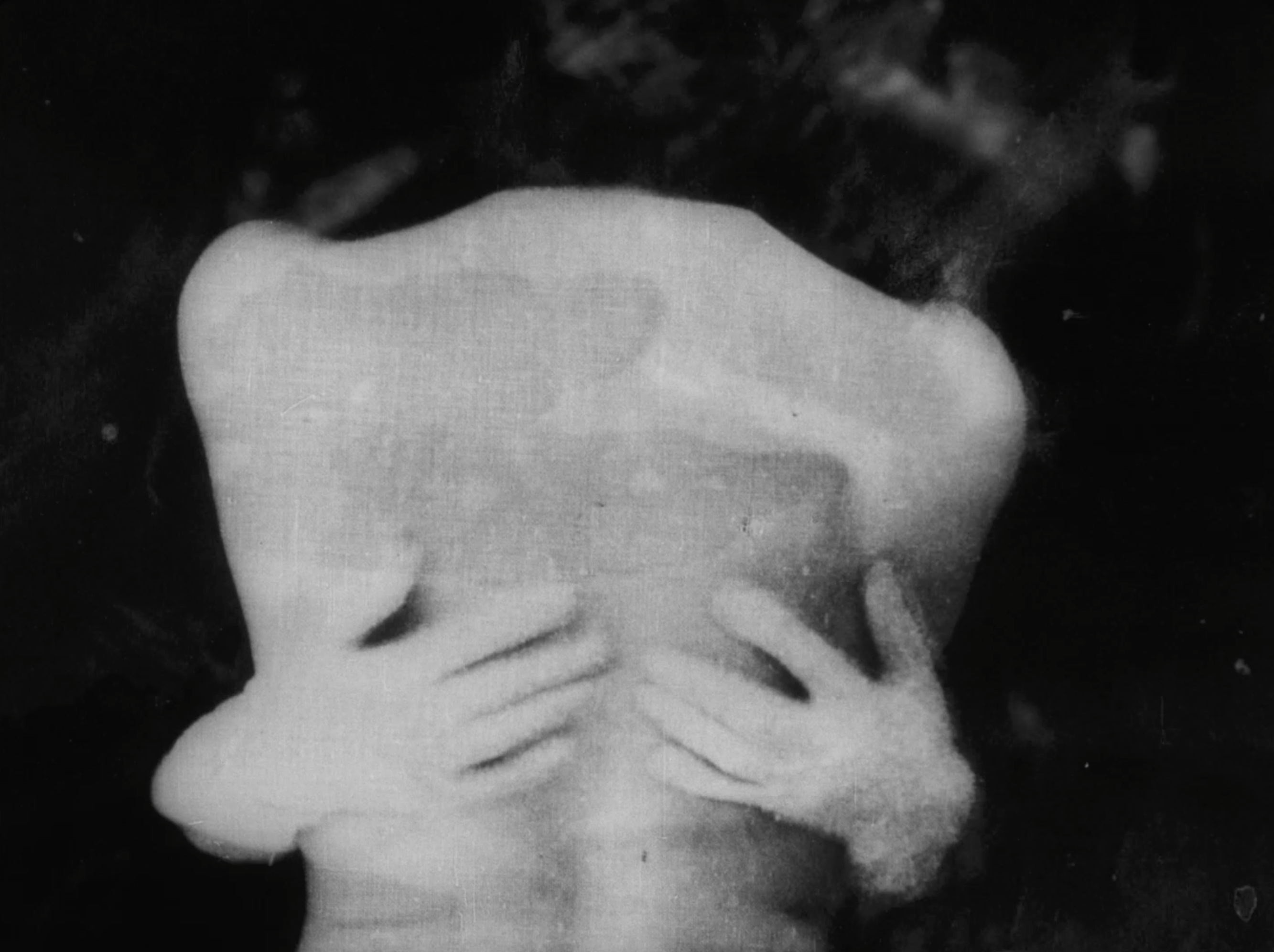
Here, the titular birth opens onto a charged terrain where pleasure and violence occupy the same visual field without settling into hierarchy. Photographs of exuberant sexuality among friends are interwoven with the stark presence of a pig carcass discovered on a roadside, a juxtaposition that resists easy symbolic closure. Flesh appears in multiple registers, one animated by desire and agency, the other reduced to inert matter, abandoned and exposed. Through motion montage, the images slide symmetrically across a central axis, mirroring themselves into shifting patterns that hover between abstraction and recognition. The repetition produces a visual grammar that both unifies and destabilizes, suggesting correspondences that remain perpetually unsettled.
The pig emerges as a mutable figure, at times evoking victimhood, at times broadcasting pure form, while the human bodies retain a sense of volition that resists reduction. Songs by The Beatles weave throughout, their presence feeling less like accompaniment than revelation. “Tell Me What You See,” “Happiness Is a Warm Gun,” “Why Don’t We Do It in the Road?” circulate throughout, each track inflecting the visual play with shifting tonalities in a field where liberation and vulnerability remain entangled.
3. Stoned Vienna (1976-79, 16mm/digital, 20 min)
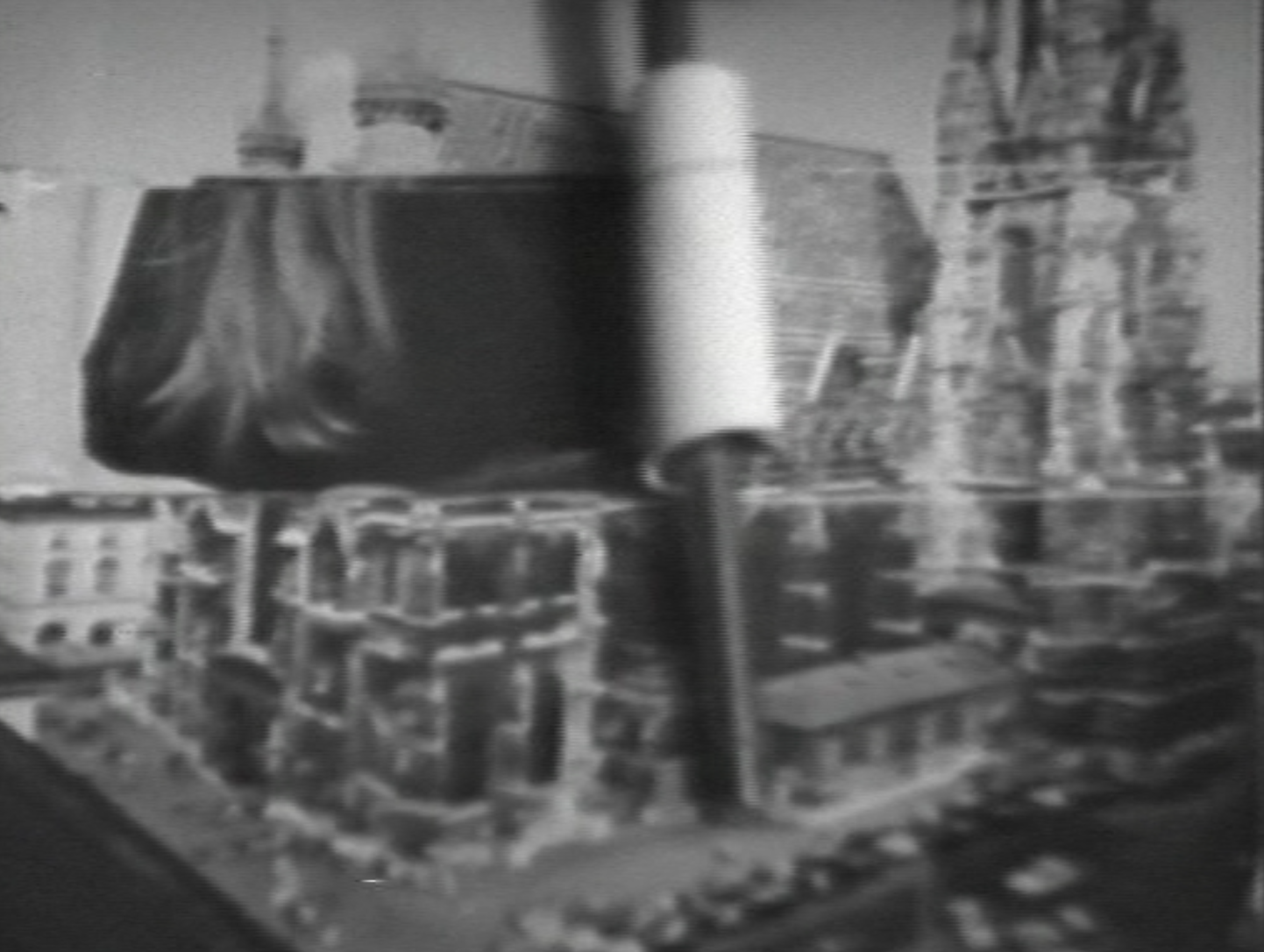
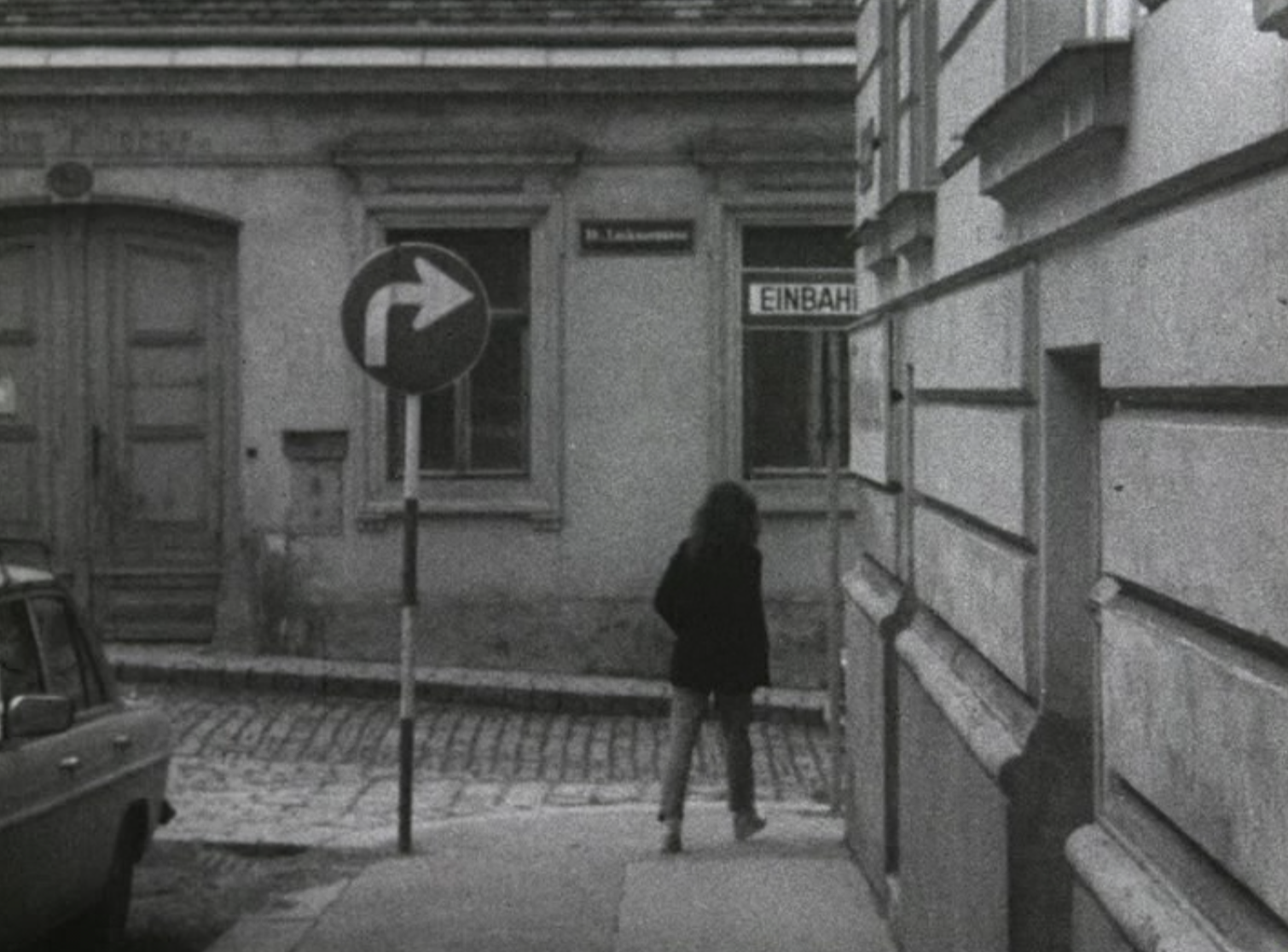
Stoned Vienna unfolds as a portrait of a city caught between preservation and disintegration, its surfaces layered with histories that refuse to settle into coherence. Emerging alongside Ernst Schmidt jr.’s Wienfilm 1896-1976 (see INDEX 044), it echoes another cinematic project while maintaining its own distinct pulse, as though two parallel observations had briefly intersected without fully merging. Vienna appears at once monumental and fragile, its historical architecture standing beside modern interventions that already seem fatigued, their promise of progress tinged with obsolescence.
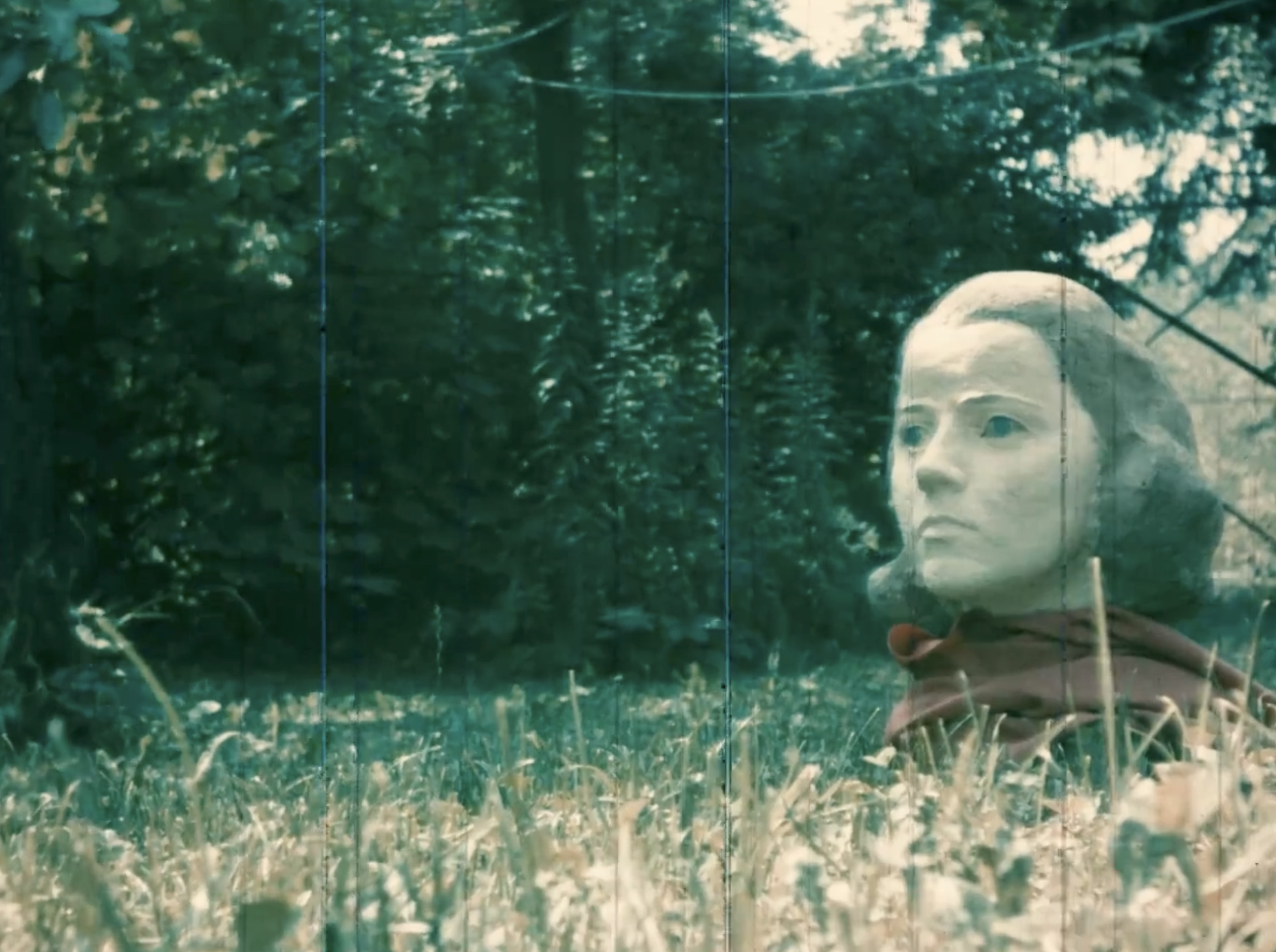
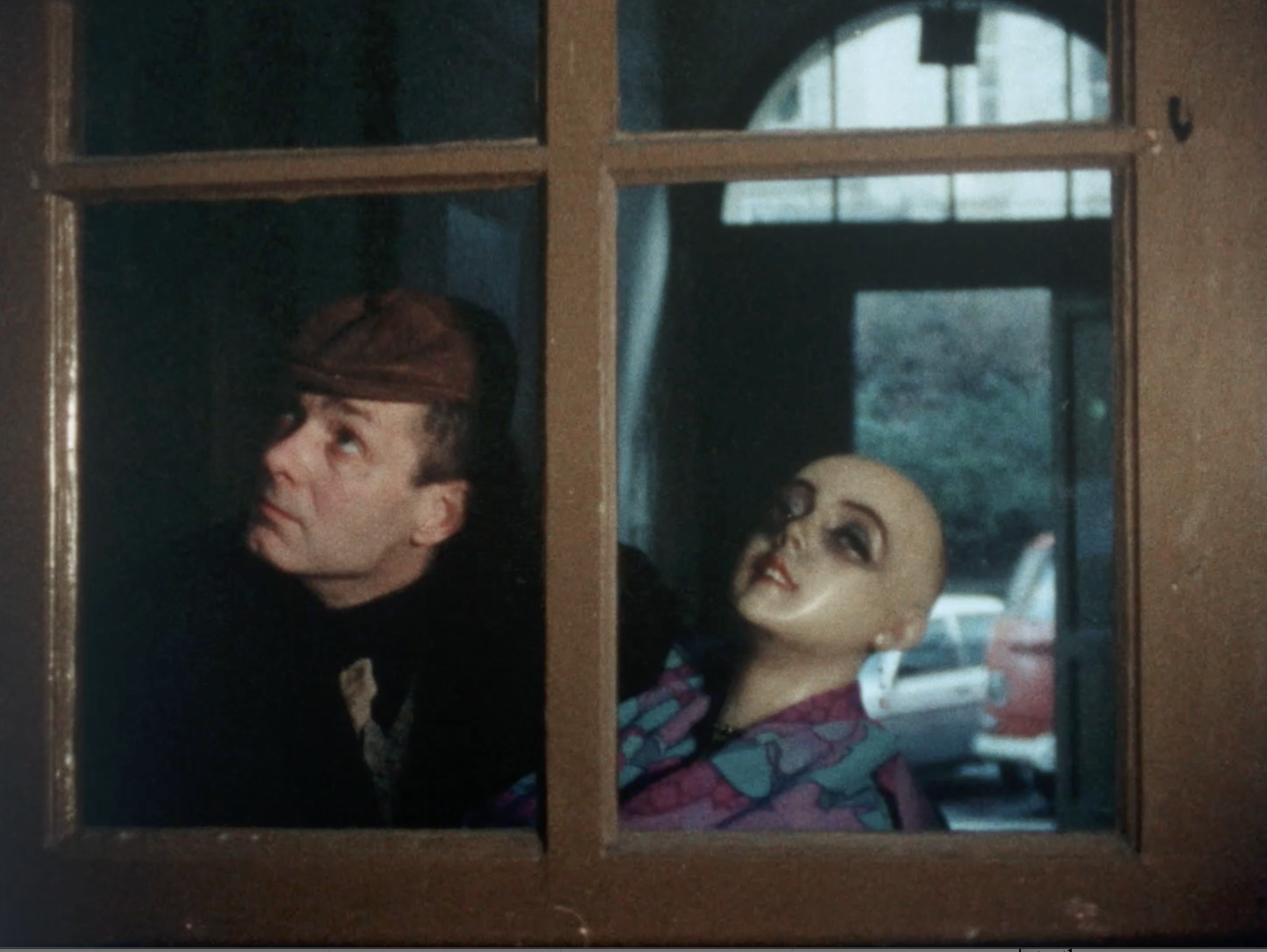
A wax doll named Dolly occupies this landscape, a figure that condenses the city’s condition into a single uncanny presence. She is handled, displayed, and displaced as a surrogate for a Vienna that is both preserved and manipulated. Double exposures have their say, negative and positive collapsing into one another until the city itself becomes a shifting surface. Male comportment hovers between care and absurdity. Apartment blocks scroll past in relentless succession, their repetition suggesting a form of urban anonymity that absorbs individuality into pattern.
The burial of Dolly within the debris of demolished buildings introduces a subdued violence. The soundtrack invokes anxious rhythms, shaker and organ weaving a sonic texture that offsets things further. Then the color palette shifts abruptly, erupting into garish, almost radioactive tones. The editing accelerates, its resulting friction vibrating with a special agitation. When the man kisses Dolly, the gesture lands with a hollow resonance, an attempt at connection that collapses into artifice. Vienna remains suspended between beauty and decay, its identity perpetually rewritten by forces that cannot fully erase what came before.
4. o.k. (1987, 16mm/digital, 5 min)
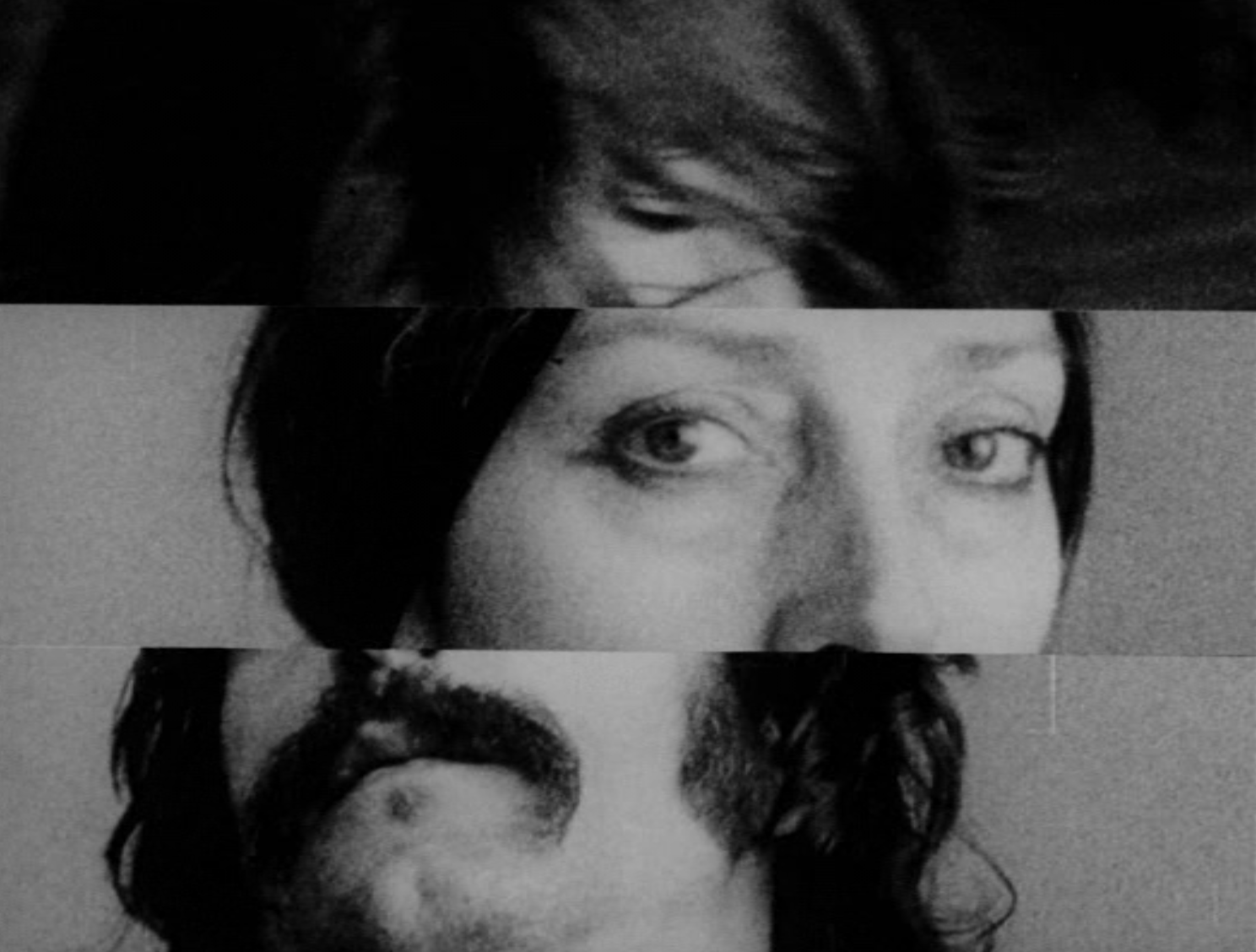
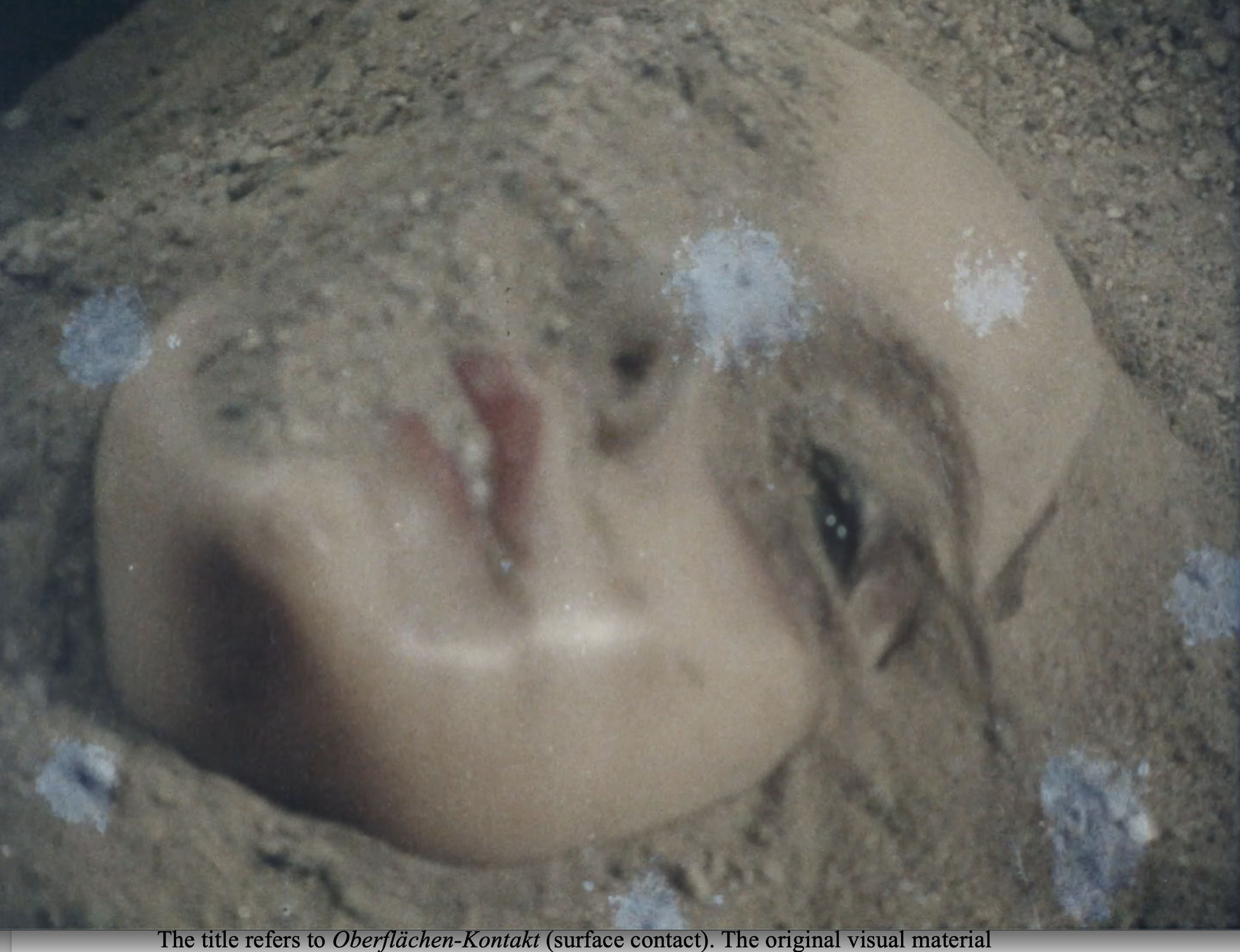
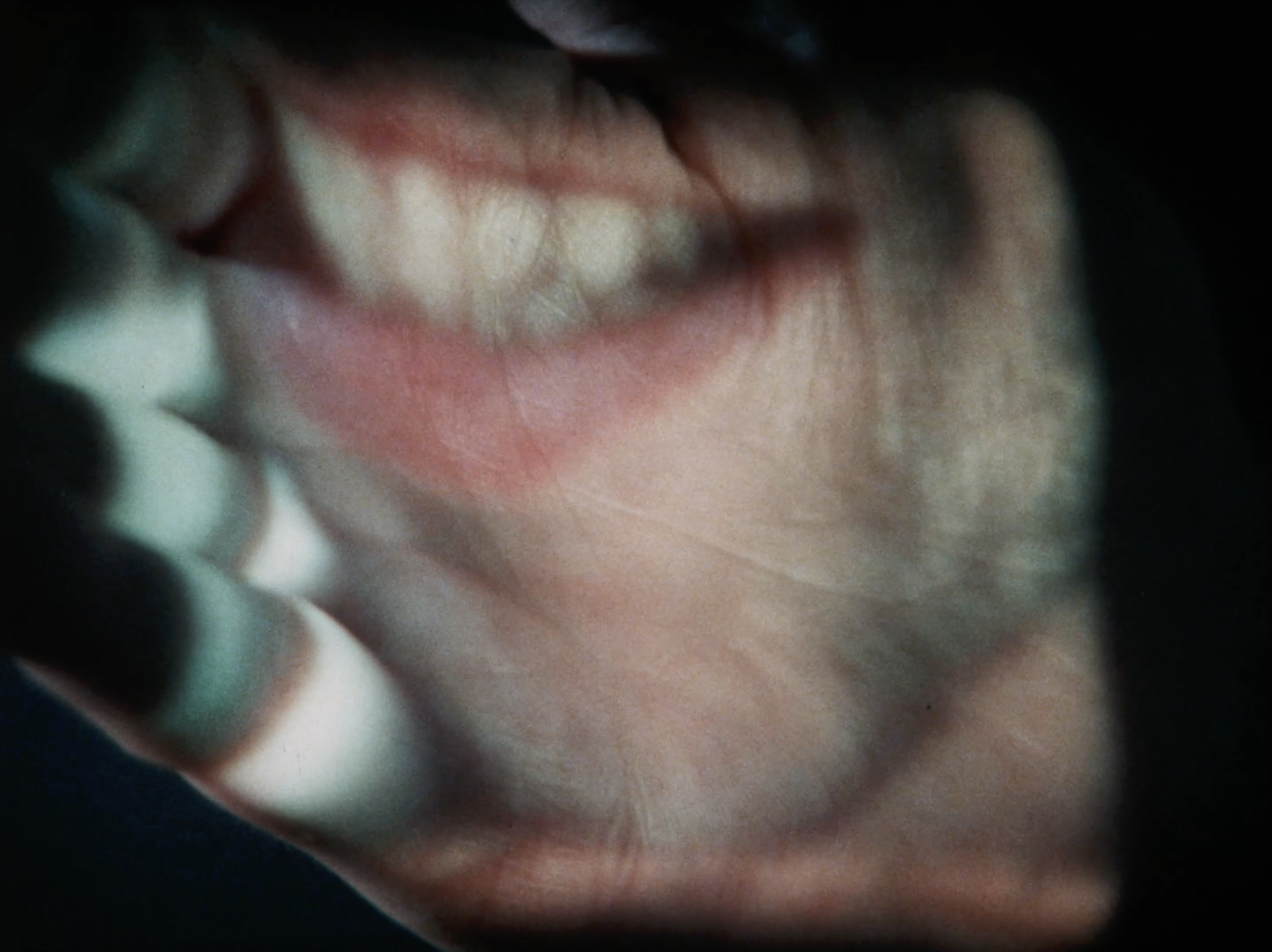
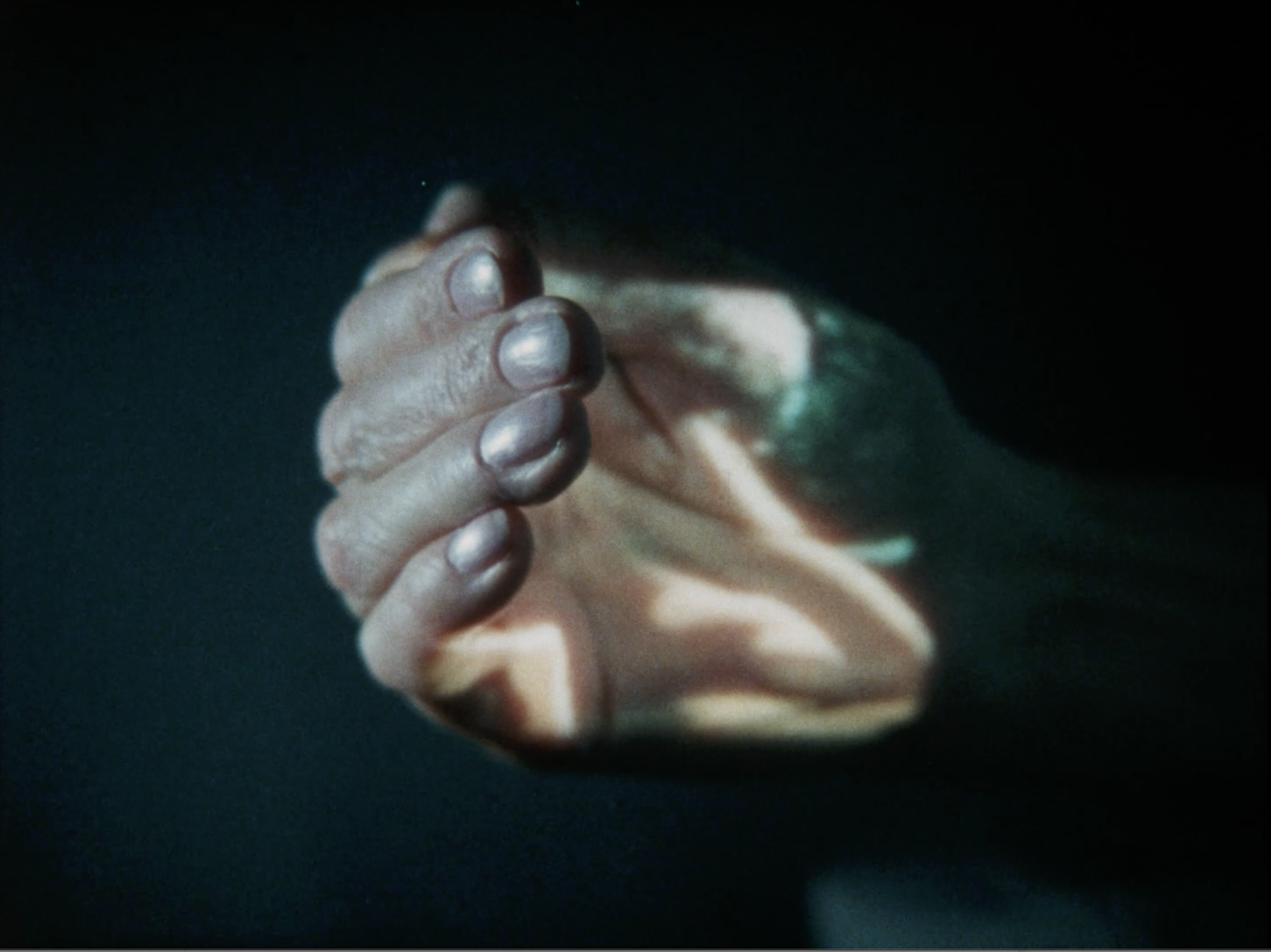
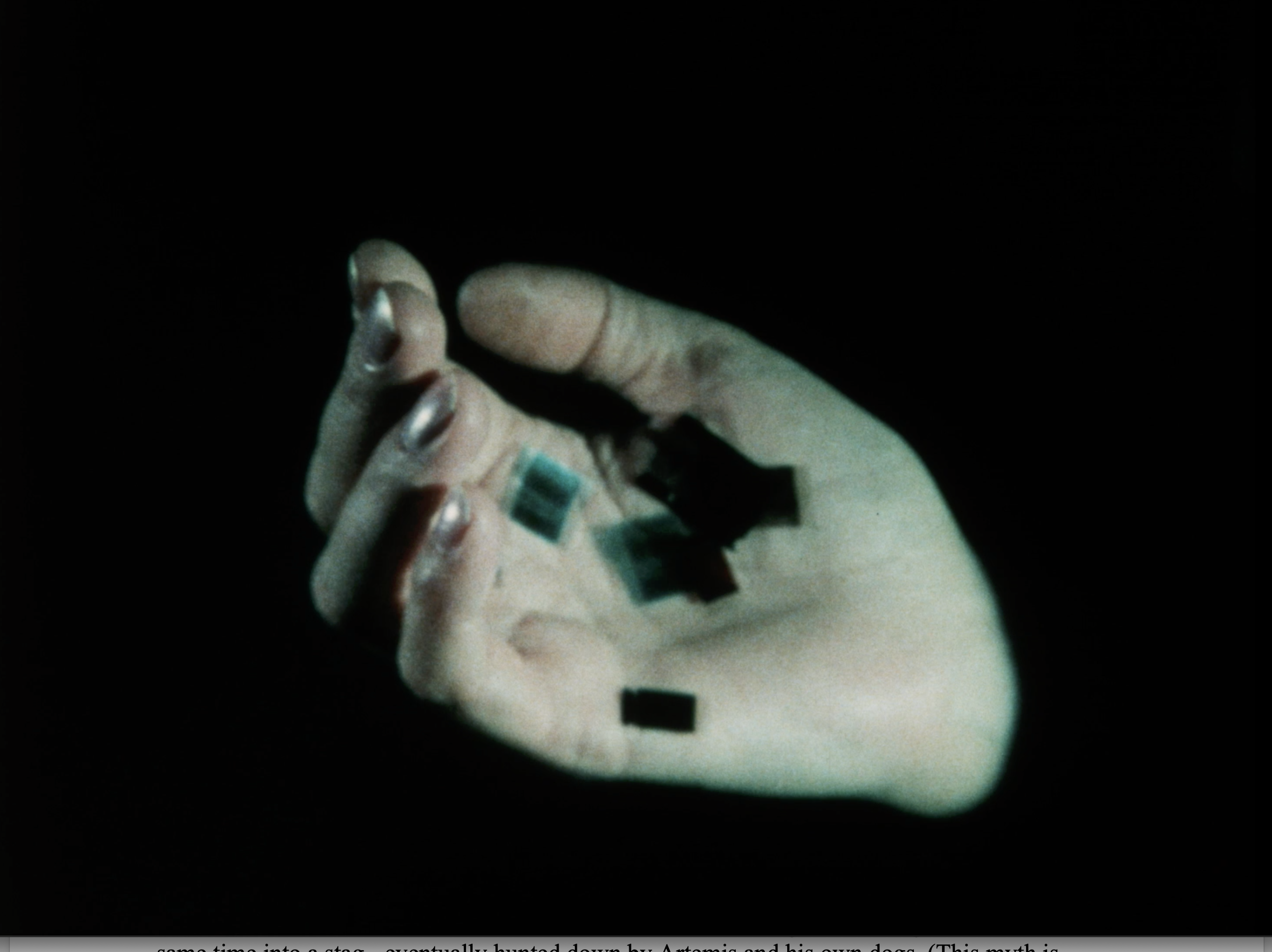
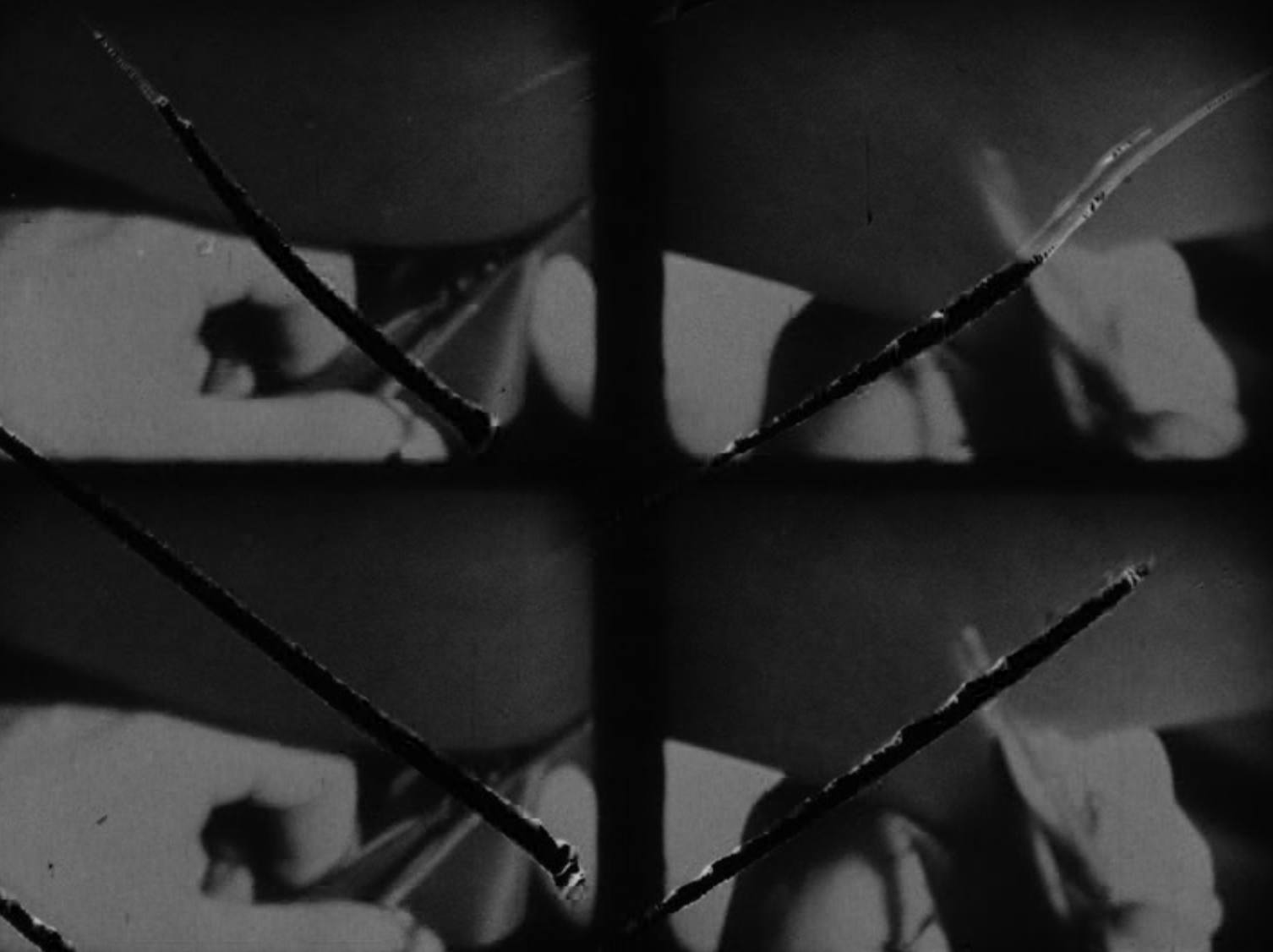
In o.k., perception is folded back onto its own conditions of existence, drawing attention to the fragile interface between projection and surface. The title’s reference to Oberflächen-Kontakt (Surface Contact) anchors the work in a palpable reality, even as it destabilizes any simple notion of contact. Footage originally captured on Super-8 is re-projected onto Blackout’s hand, then re-filmed in 16mm, creating a layered structure in which each iteration transforms what came before. The hand becomes both support and participant, its contours shaping the image even as the image redefines the hand.
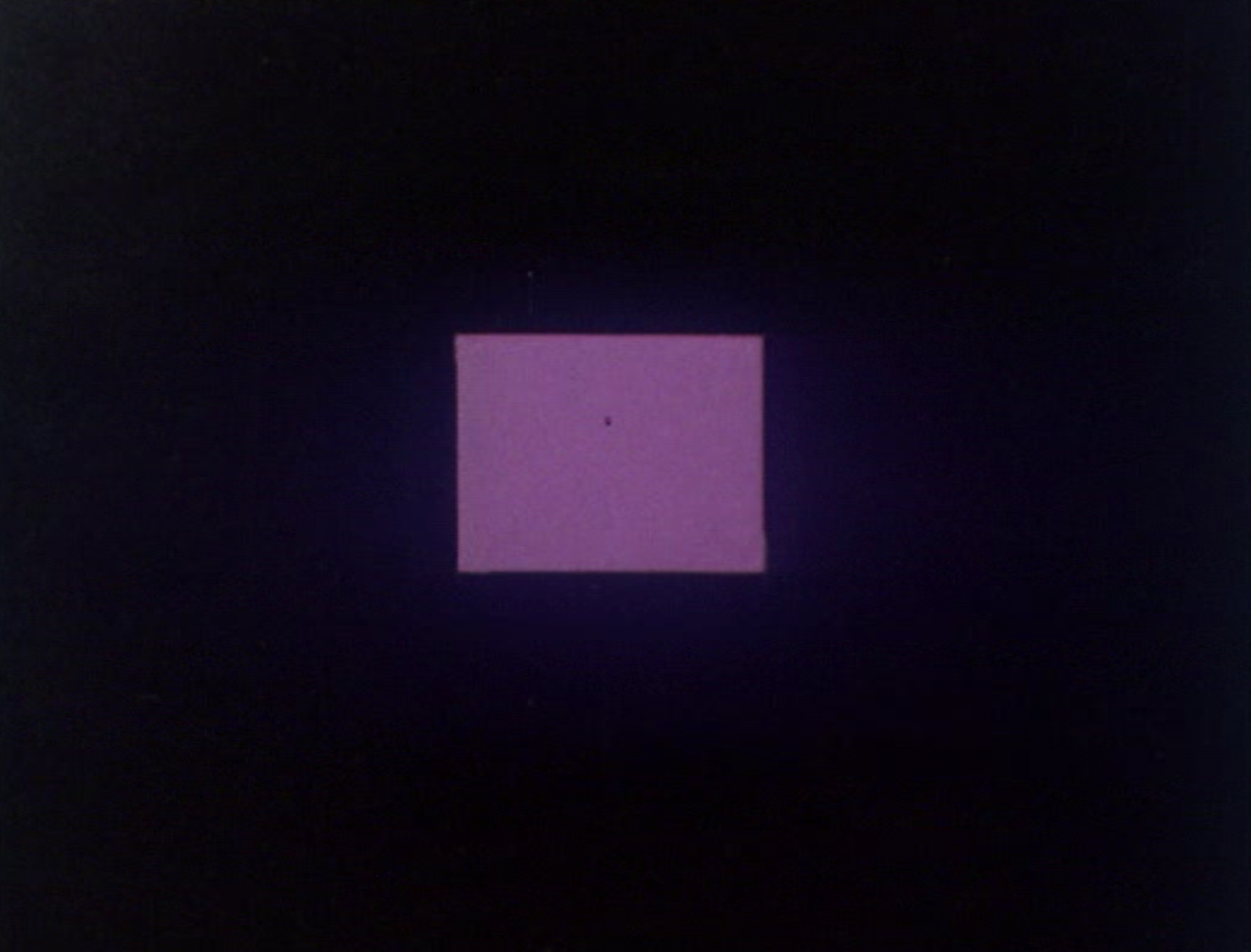
This recursive process generates a sense of temporal slippage, as though remembering itself in real time while simultaneously forgetting its origin. Water moving over stones, a man eating, the sudden appearance of a bee: these fragments circulate without coalescing into narrative, their repetition producing a kind of haunted continuity. Bruckner’s symphonism erupts subcutaneously, lending the sequence a gravity that feels disproportionate to its ephemerality.
As the hand closes and opens again, revealing physical fragments of film, the illusion of permanence proves itself to be dependent on surfaces that can never fully stabilize it. What remains is an awareness of cinema as an act of holding and releasing, a temporary convergence of light, matter, and perception that resists any claim to lasting solidity.
5. Der Galaktische Nordpol liegt im Haar der Berenice / The Galactic North Pole Lies in the Hair of Berenice (1992, 16mm/digital, 14 min)
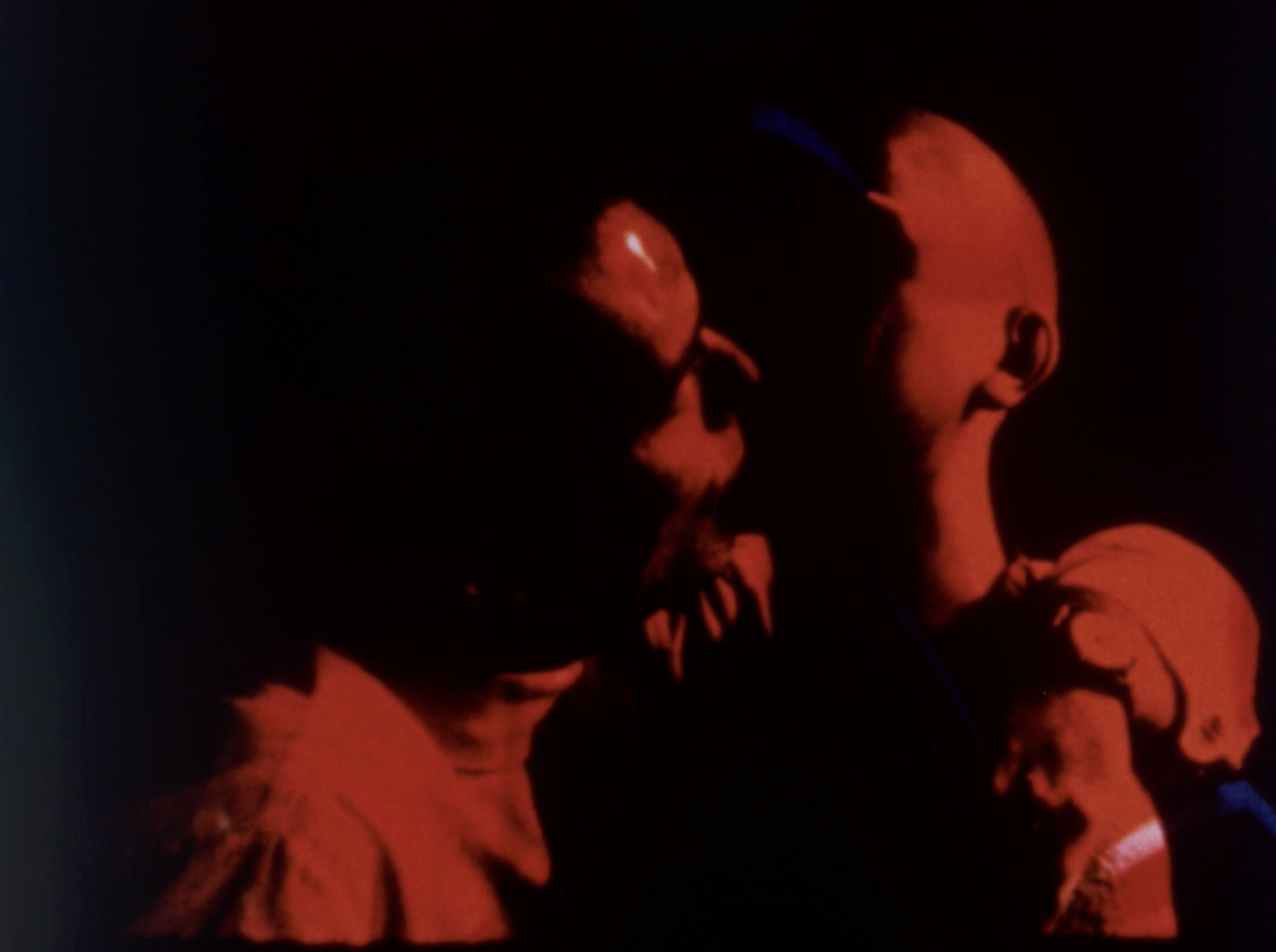
This work unfolds like a myth refracted through unstable time, where narrative threads intertwine without resolving into a single trajectory. The story of Berenice II of Egypt, who sacrifices her hair to ensure her husband’s safe return, drifts alongside the fate of Actaeon, whose desire leads to his transformation into prey. These figures move as volatile chemicals, their actions filtered through layers of dissolves and double exposures.
Acts of survival—eating, drinking, sex, and violence—accumulate into a sequence that oscillates between preservation and destruction. The body emerges as both agent and site of vulnerability, caught within cycles that cannot be easily disentangled. A star map flickers intermittently, suggesting a cosmic dimension that reframes the narrative as something both intimate and vast. The transformation of Berenice’s hair into a constellation lingers as a gesture suspended between offering and relic, a trace that resists disappearance even as it becomes abstract.
Images of decay, a rotting meal, blood, and moments of penetration interrupt the flow, grounding the myth in a fiercely material reality that refuses transcendence. A red beast appears, then recedes, its presence marking a threshold between recognizable form and something more elusive. Everyday fragments surface unexpectedly, seeking to exceed the frame’s containments in disorientation, where the underworld awaits its fleshly meal.
6. Loss (1998, 16mm/digital, 12 min)
Loss gathers its materials from disparate geographies, weaving together home movies from the Canadian wilderness with documents from Australia and Europe into a meditation on mourning that unfolds without overt declaration. Landscapes stretch outward, even as they are shaped by the weight of memory that presses inward from all sides.
The suggestion of a mother losing her child emerges not as a singular event but as a continuous undercurrent. The footage acquires a strange inflection of agency, as if it were the viewer who had been summoned rather than the other way around. Recurrent motifs, including a stone wall and fragments of play, return with subtle variations, their circularity nevertheless buckling against closure.
Peter Mudie’s voice introduces language into the visual field, describing it as “silence interrupted by language.” The montage begins to move in reverse, time folding back upon itself in an attempt to retrace what has been lost. This reversal does not restore what is gone. Instead, it reveals the persistence of absence.
7. Neue Wege bricht neue Welt aus / New Paths Breaks New World Out (1996, 16mm/digital, 11 min)
This collaboration with Karin Schöffauer unfolds as a dialogue that never fully aligns, each element maintaining a degree of autonomy. Its opening situates the viewer within a space of exhaustion and self-doubt, a final push into an undefined void undertaken with a sense of misalignment, as though the timing itself were already off.
Flashes of physical exertion, of bodies engaged in sport, refinement, and displays of vitality, circulate alongside a textual voice that distances itself from corporeal pleasure, describing a terrain that feels hopeless and illuminating. The body becomes a site of contradiction, celebrated and estranged simultaneously.
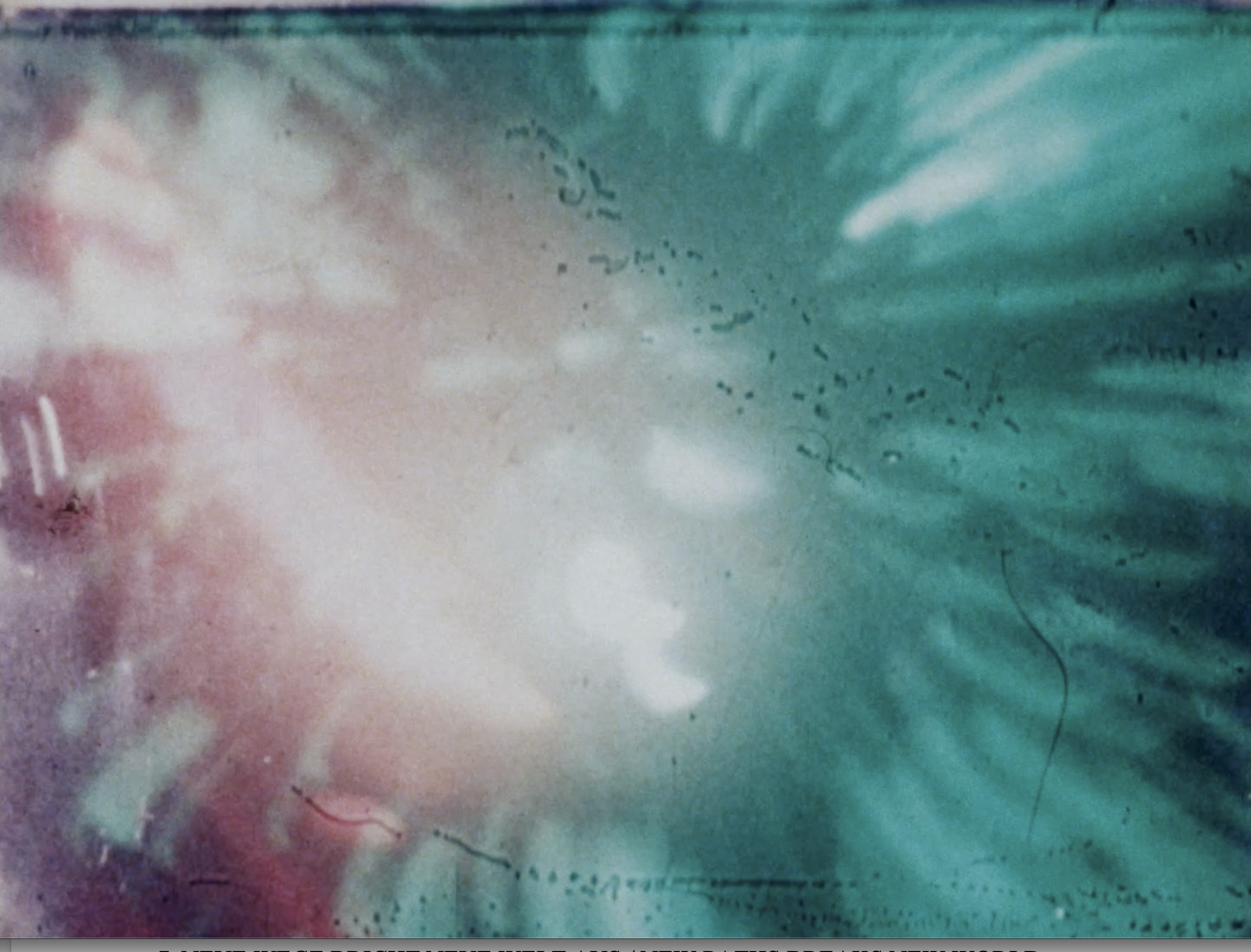
“With fade-ins, darling, I am at the cinema, wallpapering the breaks,” the text declares, introducing a notion of cinema as both construction and concealment. The appearance of an empty sanatorium intensifies this atmosphere, its vacancy suggesting a waiting that may never be fulfilled.
Afterimage, Residue, Name
To watch these films in one go is to encounter the living questions they continue to nurse. What does it mean to look without mastery? How does repetition alter power? Where does pleasure reside in the act of making? Such questions are afterimages in and of themselves.
And then there is the name.
Moucle.
Blackout.
Letters recur.
The “l” overlaps.
The “c” overlaps.
Small intersections suggest identity folding into itself, as though the name were a loop akin to her cinematic imagination. Not one name, in fact, but two. Not one form, but an overlap. A self intersecting with itself in the space between light and its disappearance.
A blackout that reveals rather than obscures, exposing the fragile architecture through which vision becomes inescapable.
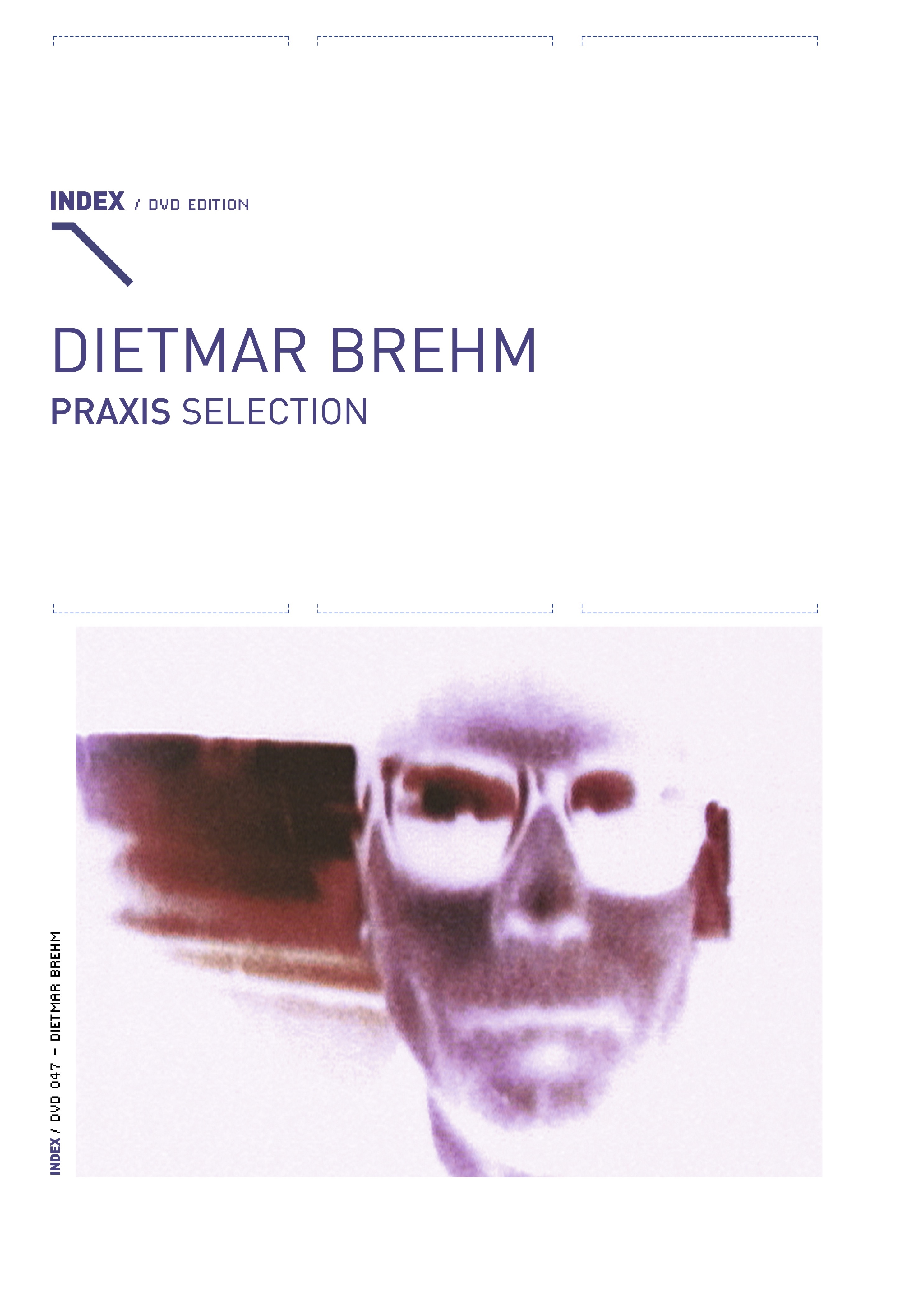
PRAXIS SELECTION feels less like a compilation than an ongoing physiological test, an attempt to discover what images can endure before collapsing into pure sensation. Drawn from the sprawling PRAXIS cycle (2007-2015), these forty pieces, of which the below only touches upon highlights, operate as a catalogue of intensities that never buy into logic. As Stefan Grissemann astutely observes, Dietmar Brehm’s “secular icons irritate precisely because they never reveal their aim, often not even disclosing what is happening in and to them.” They do not point toward meaning so much as enact its very possibility, stripping “praxis” of any political or ideological inheritance in favor of naked dissociation.
Brehm moves from erotic to clinical, from diaristic to abstract, yet each mode is a membrane that can be pierced, stretched, or contaminated. The digital clarity of the later entries is abraded by bumped microphones and the sounds of equipment being dragged, as if the assembler were refusing the illusion of being “hands off.” Even the concluding glyphs that begin to appear are cryptic enough to obscure what precedes them. As our vision is heightened, impaired, and rerouted, we are left caught in the performative residue of it all.
1000 Blitze
A few distortions of reality serve as anchors for the larger constellation. 1000 Blitze (1000 Bolts) turns lightning into a vascular network, an illuminated anatomy of perception that overwhelms the sensorium. Vision feels compromised yet somehow more acute, as if the eye were seeing its own interior. Himmel (Sky) distills the world into a single fly drifting in an impossible blue expanse while rain murmurs in the soundtrack. The insect is reduced to an atmospheric event, a coherence of sentience within a monolithic field. Here, Brehm demonstrates how minimal stimuli can trigger an almost cosmic alertness.
Übung
This shift from the microscopic to the elemental reappears in Übung (Exercise), where a figure is thrust toward the camera, lit as if by an emergency sign from within. Strobes slide across sweat and skin until the figure becomes particulate, edging toward ash. Schwarzensee repeats the experience through landscape: bands of colored water glide past while the creak of a rowboat grounds the abstraction in human effort.
Basis pH
The domestic sphere proves no safer. Vollmund (Full Moon) frames eggs frying, cigarettes burning, Coke bottles bending, and a child’s cheerful “Let’s go,” all glimpsed through a circular aperture that turns the mundane into a pupil of surveillance. In Basis pH, the application of makeup is a study in exposure rather than beautification, as if each gesture were removing a layer of self-protection rather than adding one. It’s the private act as uncertain confession.
Berlin
Brehm’s engagement with pornography punctuates at regular intervals but refuses eroticism. Peng Peng links desire to violation by intercutting voyeuristic gazes with surgical imagery, whereas Berlin and Paris tint fleshly negatives green or red-blue until their physics appear industrial.
Röntgen
Self-portraiture assumes the identity of a malfunction. Chesterfield shows Brehm flickering beside a car while a metronome hammers machinically. In Charles, a drained, remorse-free face is doubled by a twin that never quite aligns, enacting a moral vacancy. Röntgen (X-Ray) meshes screaming vocals with inverted faces and vehicles in a radiographic exorcism. Such pieces insist that identity is not a stable referent but an affectation that appears only when stressed, inverted, or pulled apart.
Sonne Halt
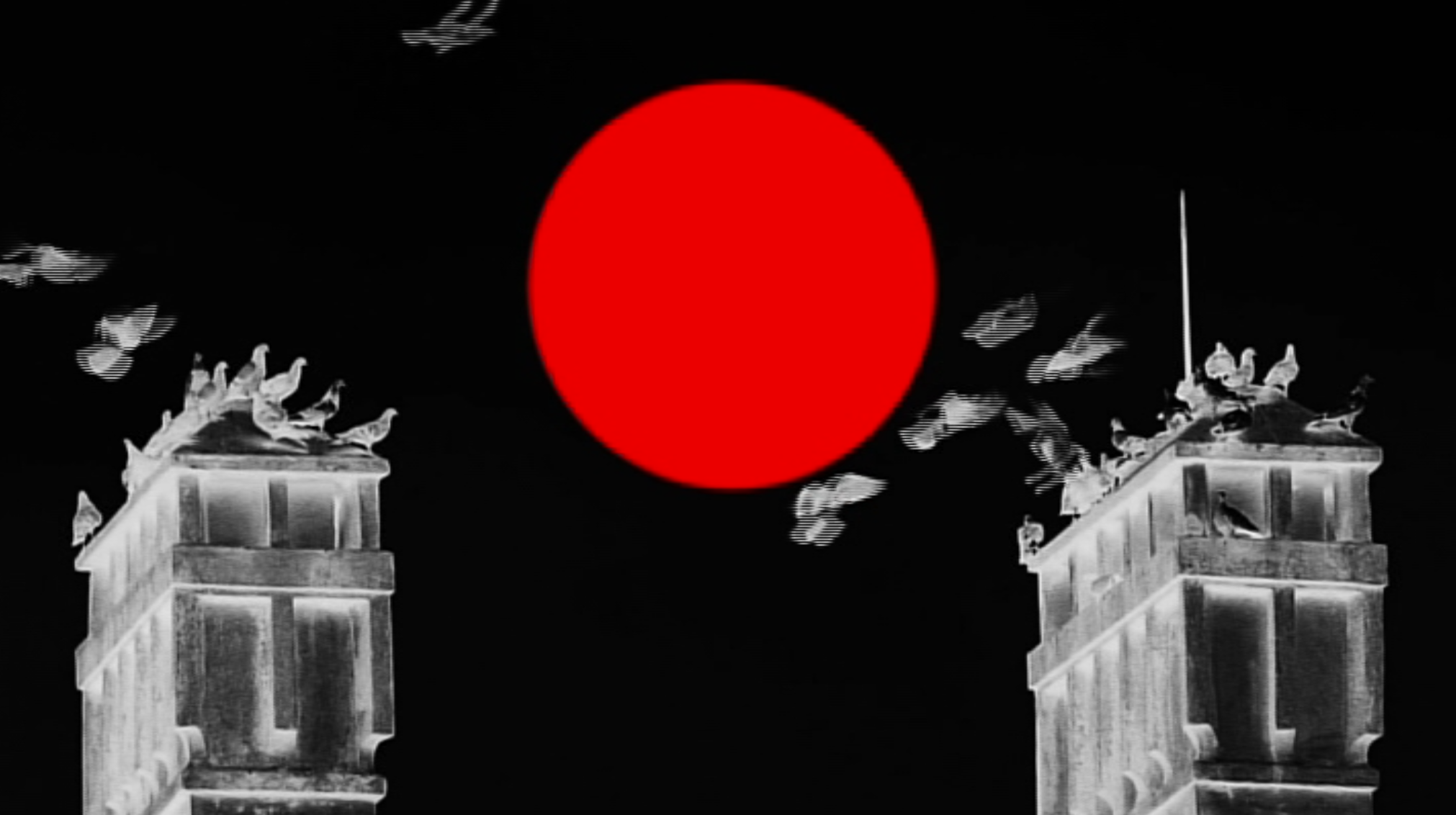
As chronology grows, so does the gentility of Brehm’s touch. Licht (Light) is a standout in this regard: a hand caresses a lampshade again and again in a manner so tender that it borders on obsession. Sonne Halt (Sun Stop) freezes the sun between two towers as a red circle that pins luminosity to the board of life without extinguishing it. Cocktail shifts into a reflective register as Brehm diverts focus to his layered image, jazz sketching itself in the background.
Oxford
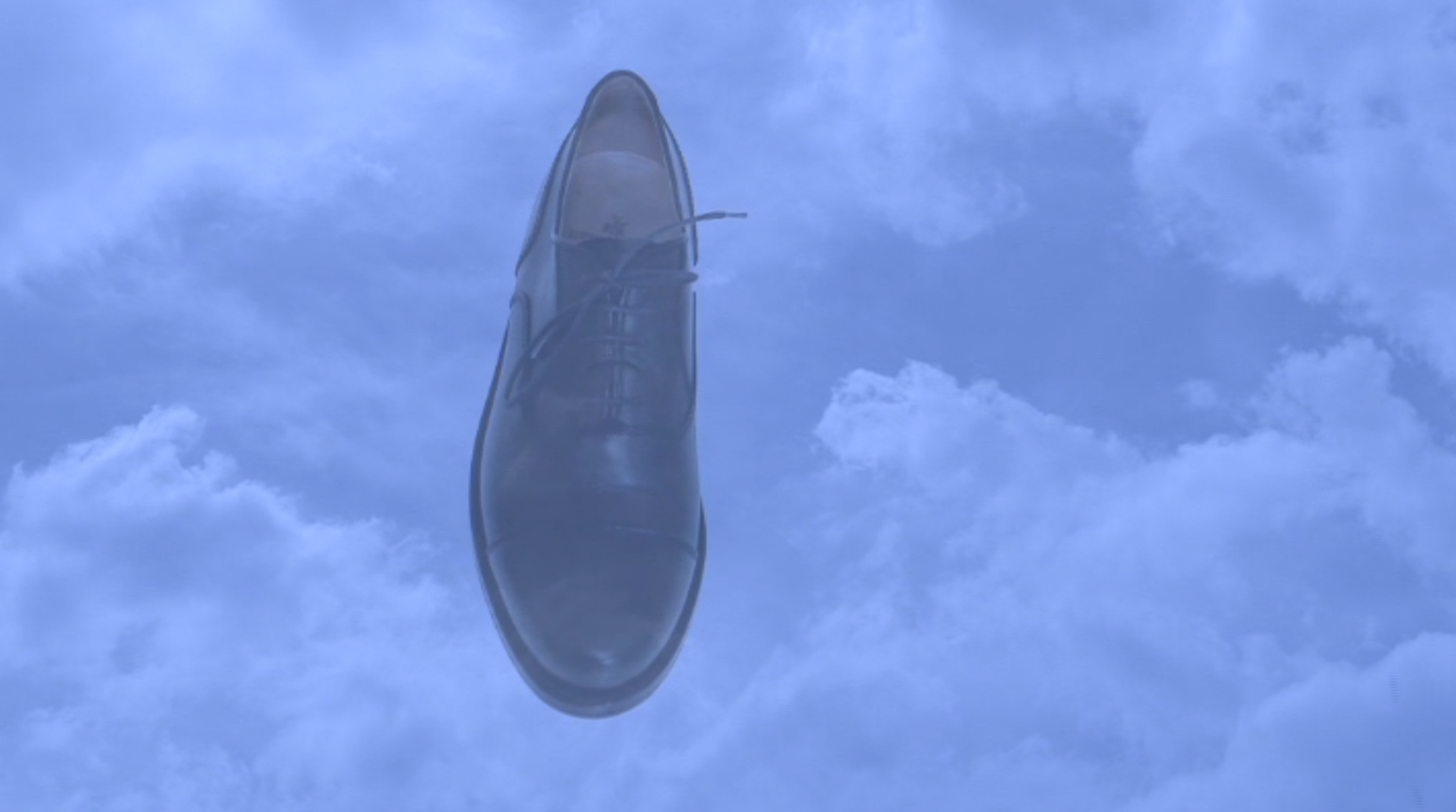
The selection concludes with uncanny simplicity. Oxford holds a pair of dress shoes against the firmament. Walking on air? Hello Mabuse converts a simple handshake into a bureaucratic nightmare, framed by ominous clocks. And Rolle returns to repetition as ritual, walking toward and away from the camera near a bale of hay until the act becomes a mantra.
Throughout PRAXIS, Brehm interrogates the image’s ability to signify anything beyond material agitation. The cumulative effect is fiercely corporeal, working directly into the viewer’s nervous system. Along the way, we learn how recognition and estrangement can collapse into each other, how ordinary objects can become alien through intensity, and how a soul caught in the act of looking cannot help but feel implicated in what it sees. What remains is a kind of hyper-alive exhaustion. Brehm exposes the vitality of the photographic trace even as he acknowledges the slow death embedded in every act of viewing. These fragments do not cohere, yet their incoherence is the point. Are we really so different?
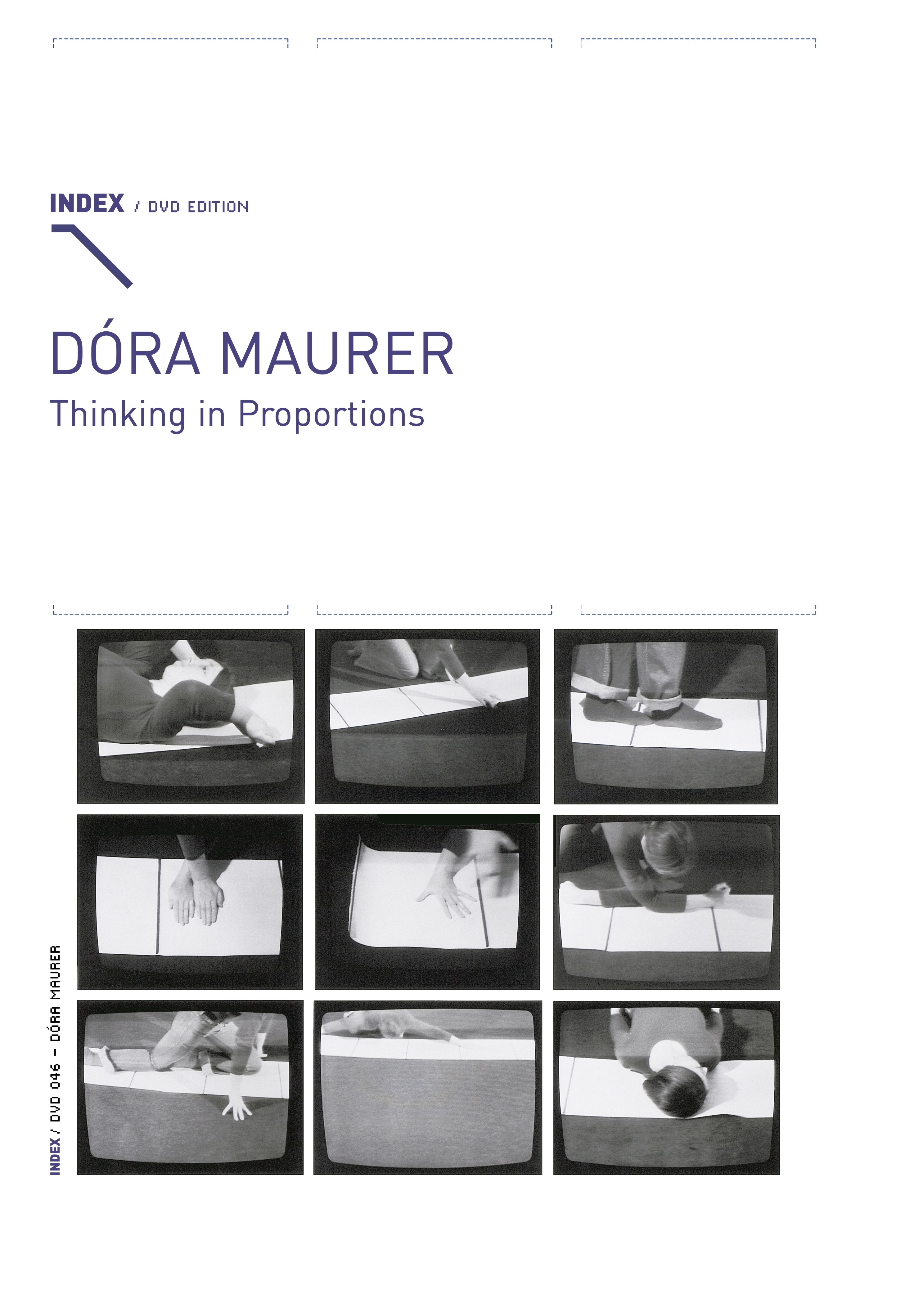
Thinking in Proportions hums with the integrity of a mind that treats perception itself as material. The mind in question is that of Dóra Maurer. Born in Budapest and trained as a printmaker, she did not enter moving pictures through story or representation but through process—the lifeblood of spatial relations. She describes her works as “displacements,” and each indeed alters the coordinates of seeing by measured degrees, thought revealing itself as something with weight and texture. Her structural rigor never hardens into rigidity. Instead, she builds systems in which freedom accumulates quietly, like breath made visible in winter. The viewer begins to sense that Maurer is a grammarian of matter whose proportions anchor themselves to the world with both scientific precision and metaphysical resonance.
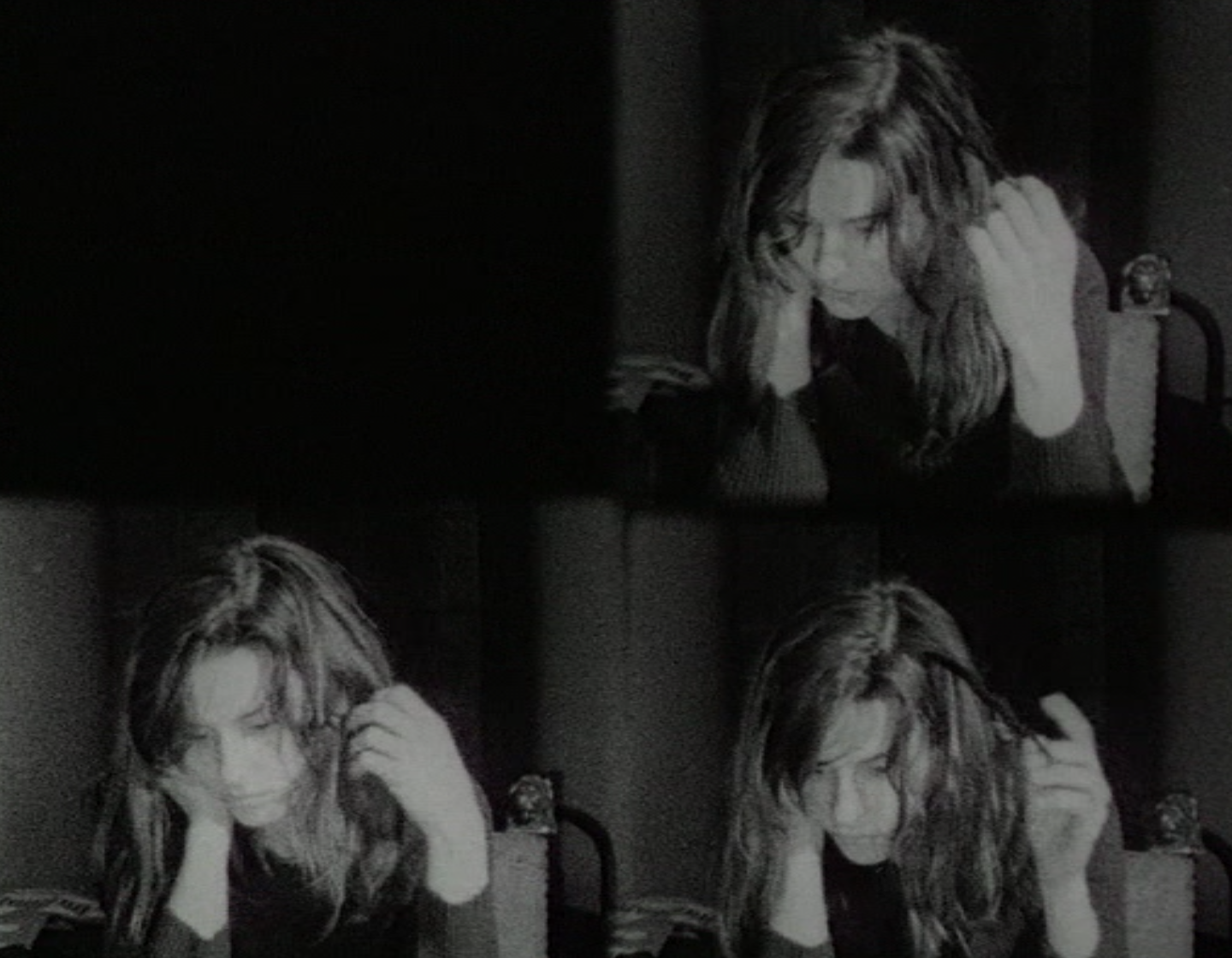
Learned Spontaneous Movements (1973) introduces this tension between rule and release through four takes of small gestures performed as Maurer reads: hair twirled, lips bitten, fingers moved toward the mouth in tiny cycles of self-soothing. Variations accumulate with the logic of an étude. The voiceover in an untranslated language becomes a ghost-signal whose meaning is withheld but whose cadence settles into the room. As takes multiply, comprehension erodes until only rhythm remains in unconscious behavioral patterning.
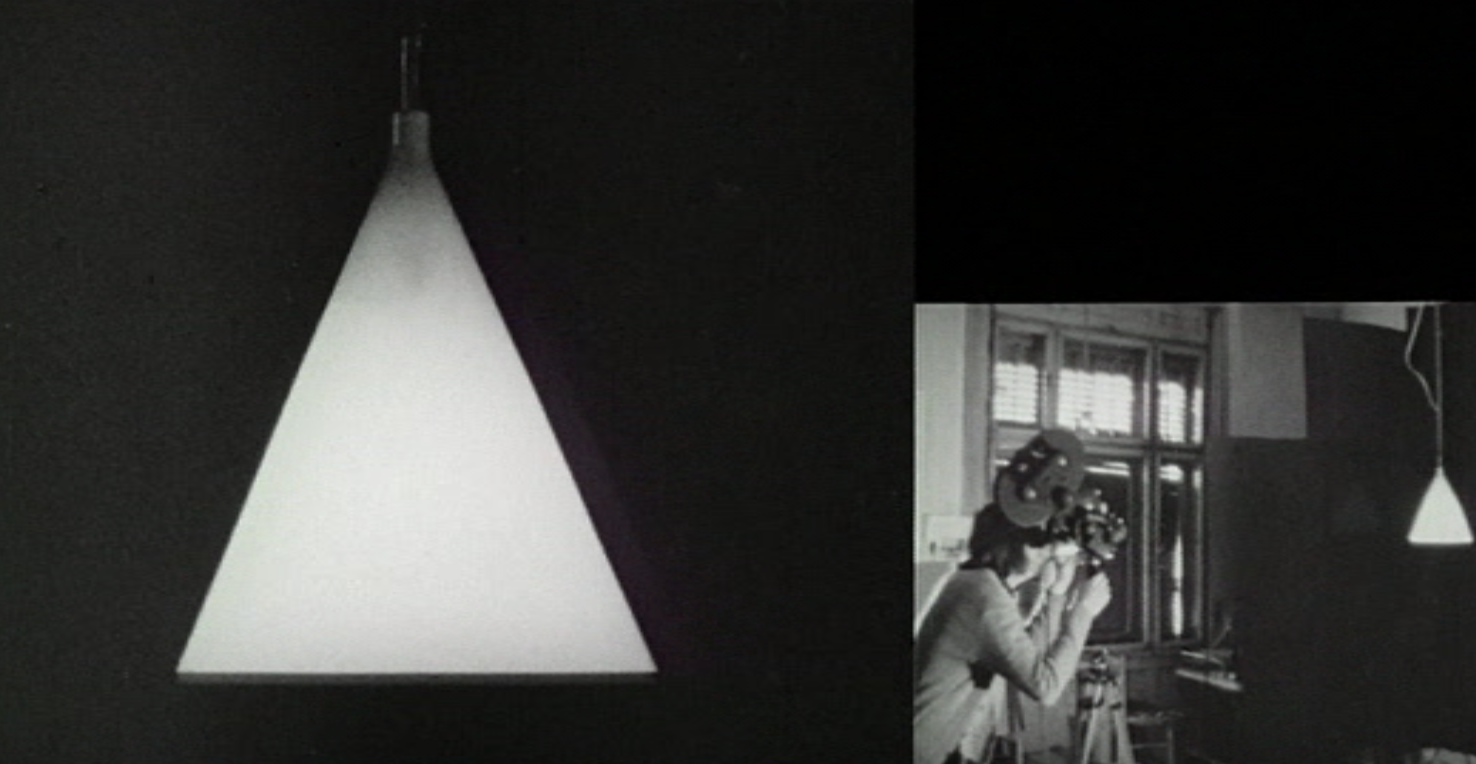
Relative Swingings (1973/75) is a mesmerizing exploration of a conical lamp swinging in space and recorded through a split-screen setup that reveals both the object and the mechanism filming it. Maurer exposes the infrastructure of perception, letting the camera that films the camera act as a kind of auxiliary consciousness. Mechanical grinding aligns with the lamp’s pendular arc. And then, a quiet miracle occurs as the object takes on a cosmic significance. The pleasure of watching it feels as if a thought had been suspended in the air and allowed to make its own skeleton visible.
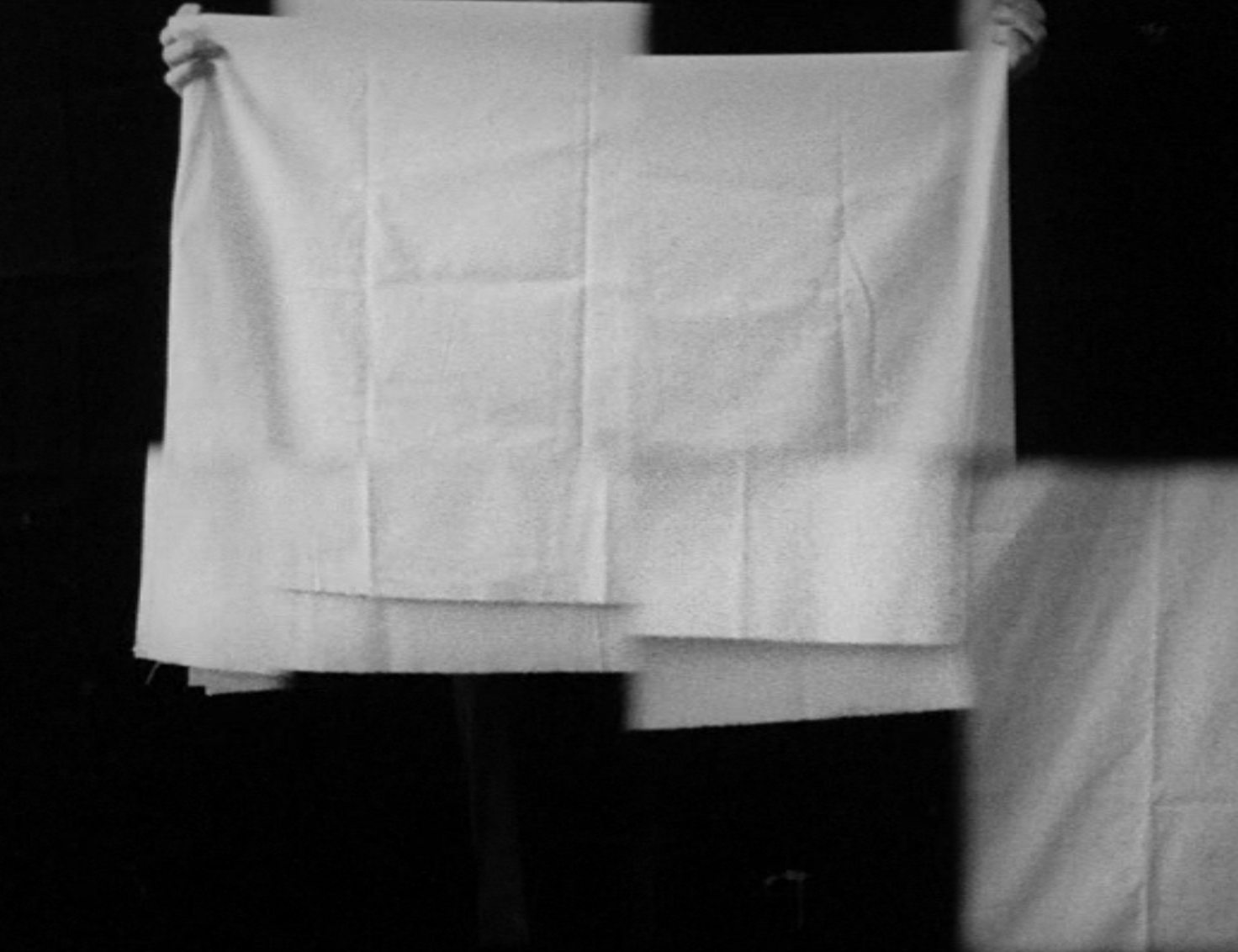
Timing (1973-80) brings us closer to the body. A plain linen sheet becomes a screen, an object, and a problem. It is folded and unfolded while mirrored projections track its shifting geometry. The absence of sound lays bare the concentration at work, turning domestic labor into a contemplative action. The sheet’s creases are diagrams of invisible forces that echo contractions of memory, landscape, and skin.
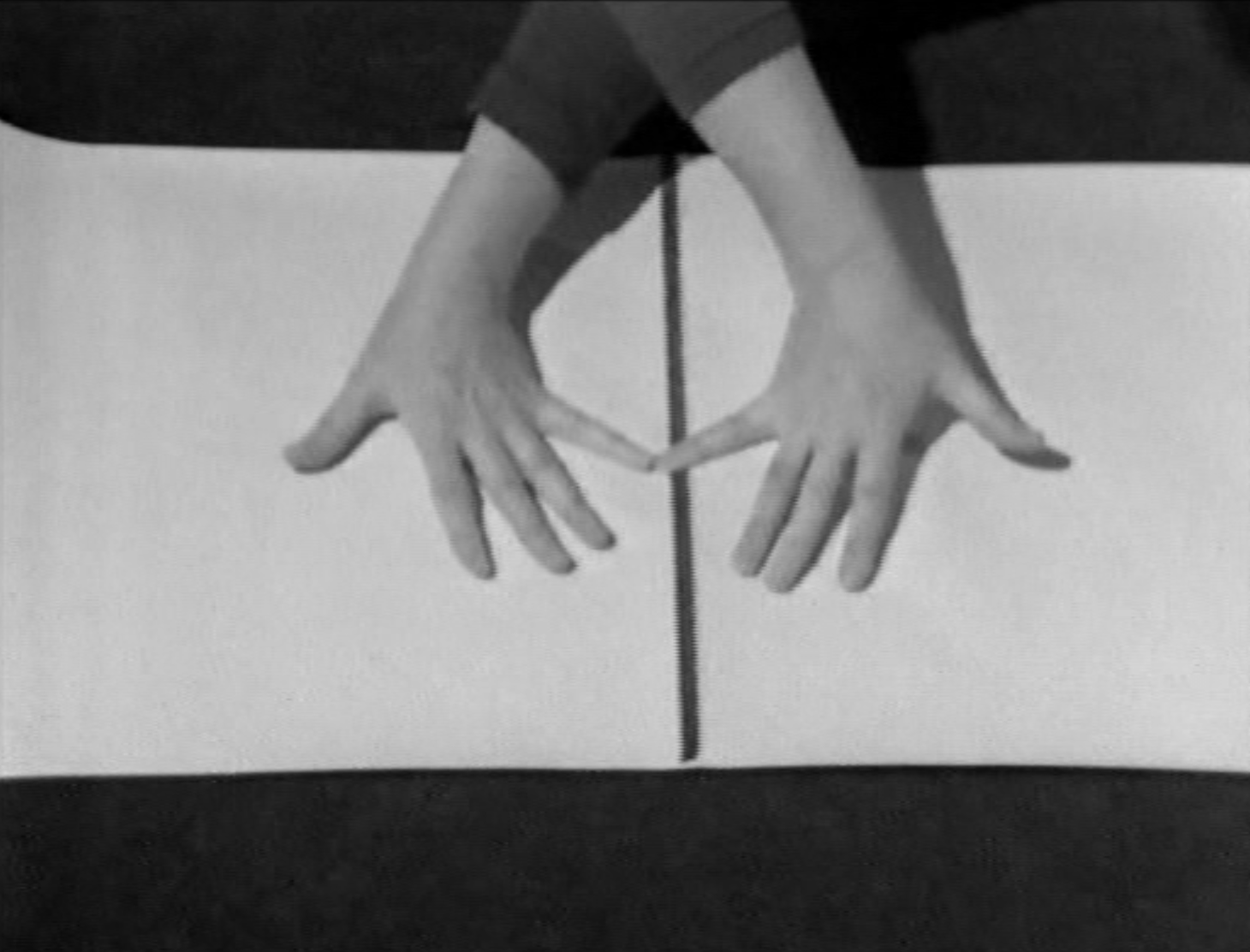
Proportions (1979), Maurer’s first piece made with video, is intimate in its austerity. She uses a long roll of paper to measure her arms, legs, head, and torso, thus charting the room and the world around her. She walks with her hands, rolls her head across the paper, and marks every change of course through profound self-calibration. The message is undeniable: without us to insist on their significance, metrics would fall apart like so many atoms.
With Triolets (1980), she achieves a crystalline balance between three focal lengths, three subjects, and three sung tones that assume ceremonial force. Bodies and objects split and converge in a ritual of repetition that liberates rather than confines. The voices, sung in quiet invocation, lend the work an air of secular liturgy. It is among the cycle’s most resonant pieces, a sustained articulation of harmony born from constraint.
Kalah (1980) transforms an ancient Arabic board game into a synesthetic machine. Colored squares pulse with tones, evoking early video graphics or elemental sound scores. It appears playful on the surface, yet behind the game’s syncopation lies the proportional logic that threads through Maurer’s practice writ large. Strategy is now an acoustic and chromatic event.
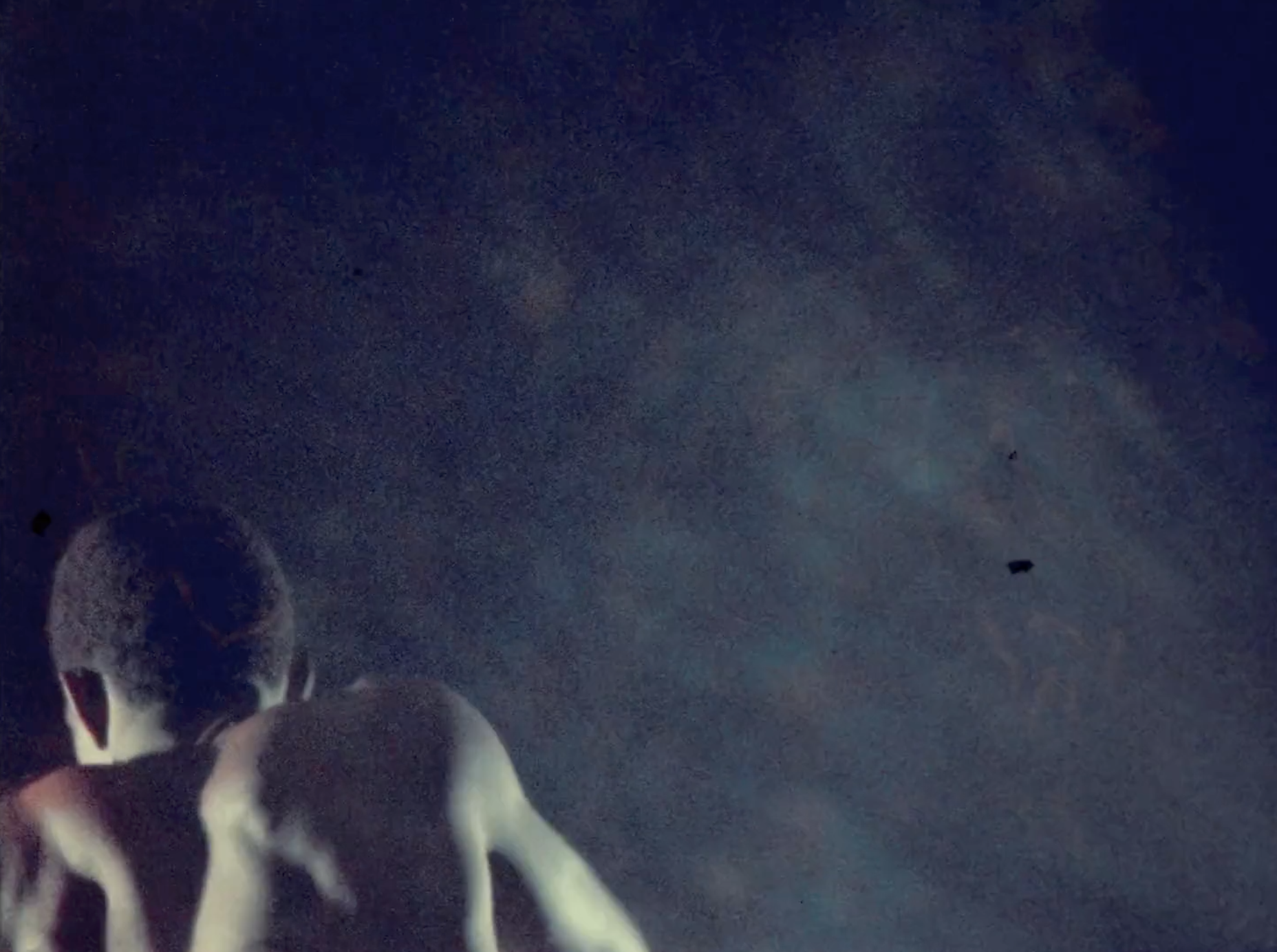
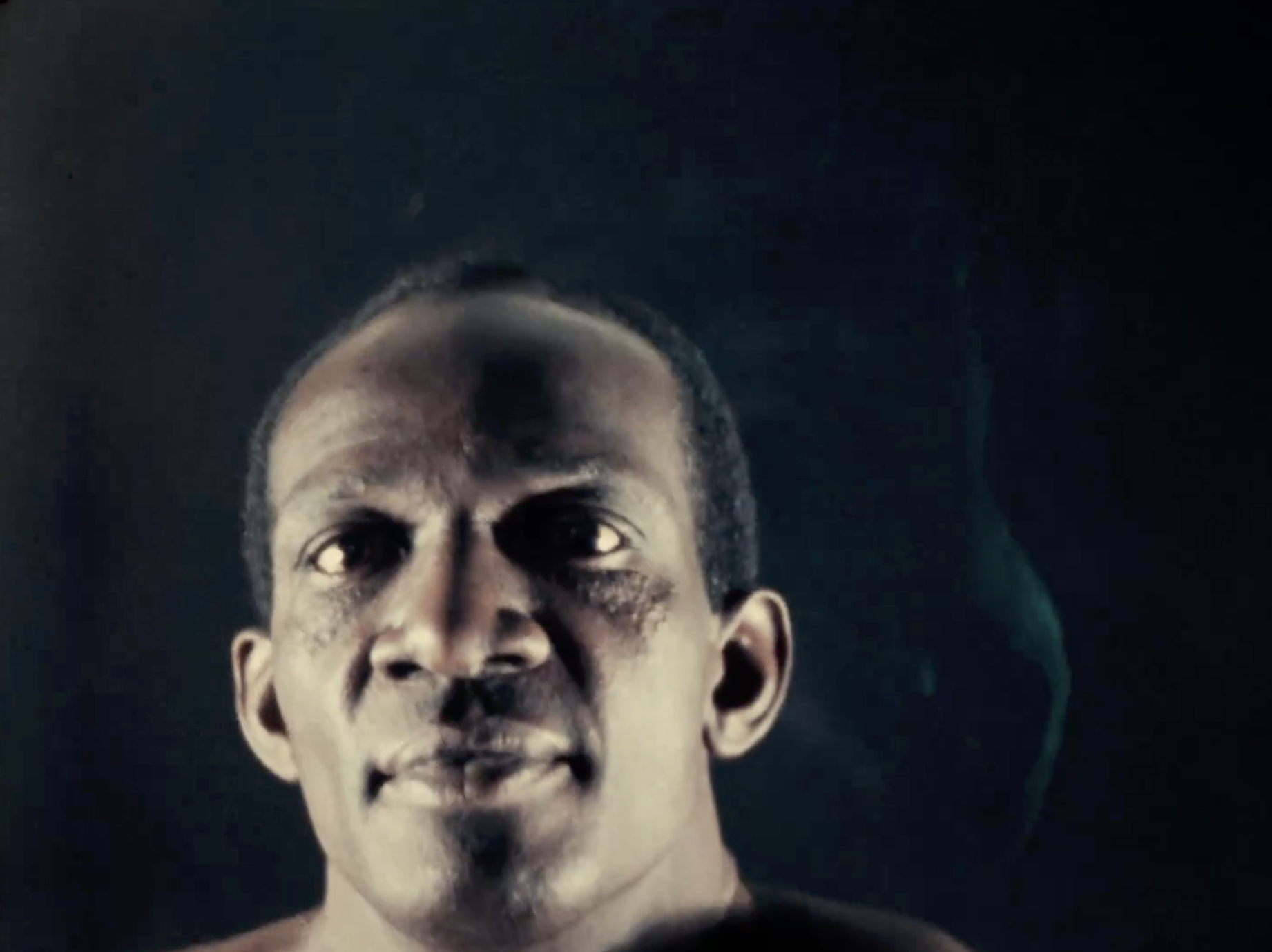
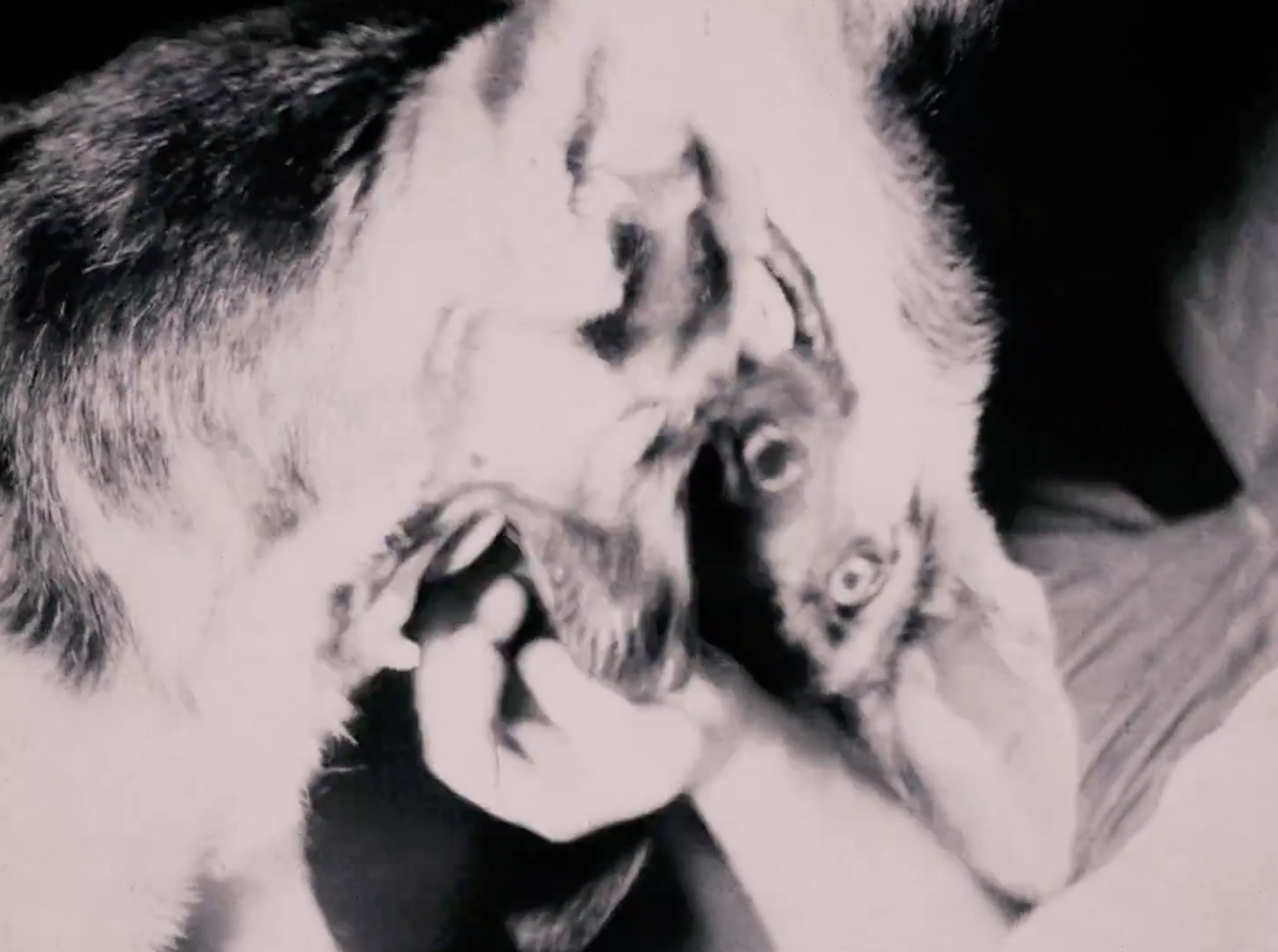
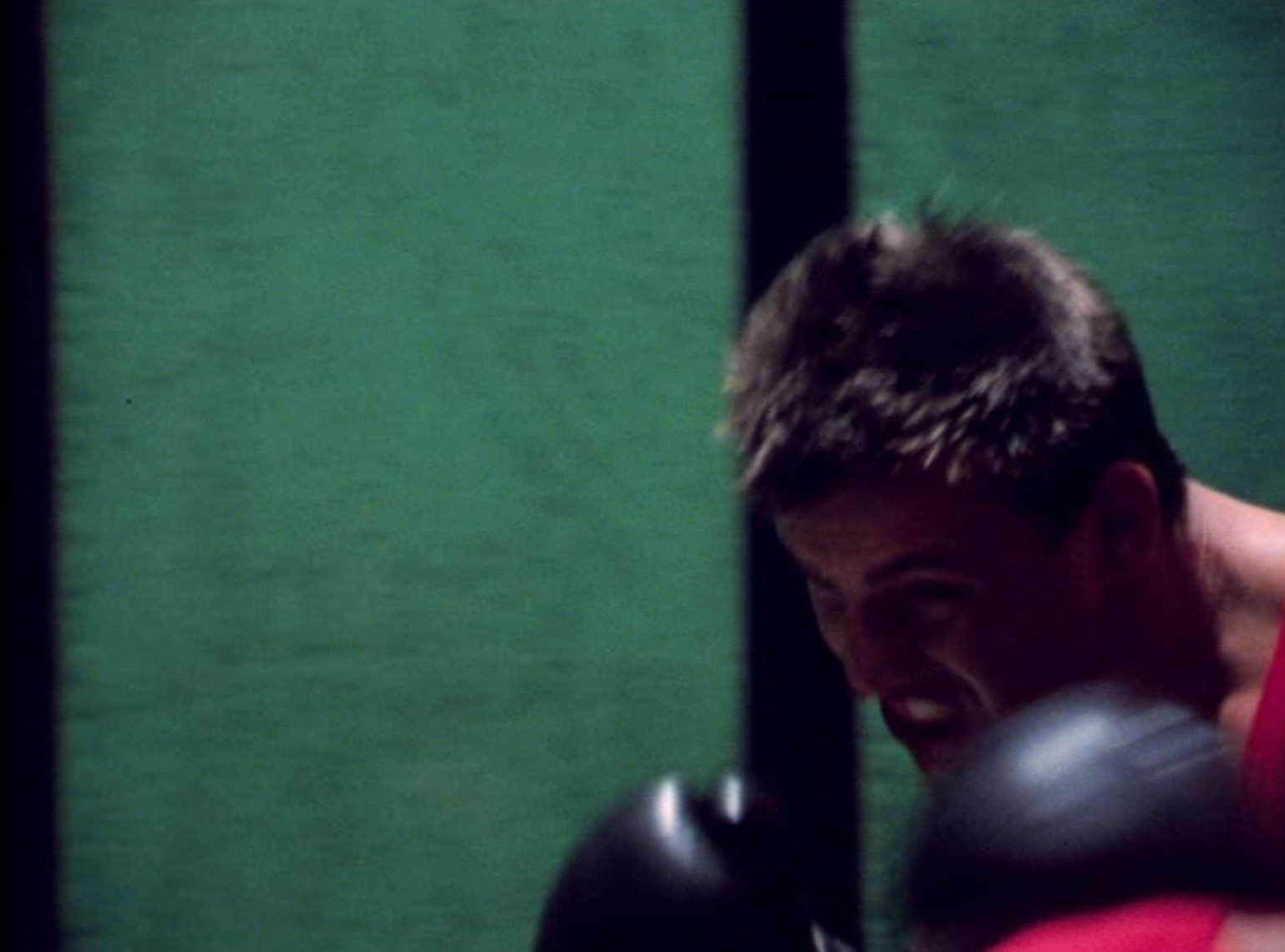
The Inter-Images trilogy (1989/90) stretches into mediation. Part 1, “Retardation,” shows a face glimpsed through rectangles that flicker like shuttered windows, each opening accompanied by electronic tones. Part 2, “Streams of Balance,” follows a nearly nude male dancer in a dark, overhead-lit space, mapping equilibrium with anatomical poise. Part 3, “Anti-Zoetrope,” places two men boxing within a cylindrical enclosure viewed through vertical slits, slowing violent motion into sculptural intervals.
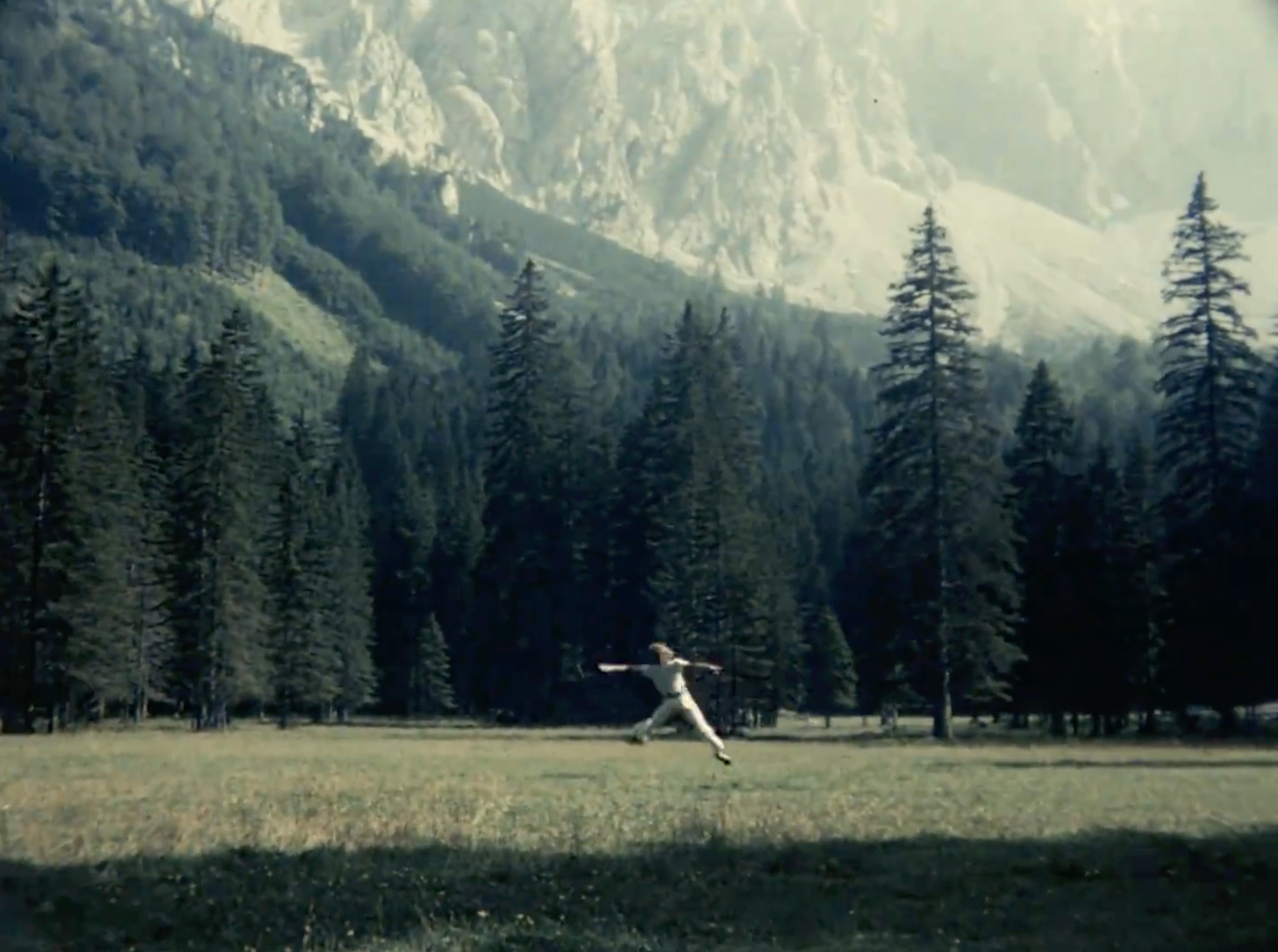
The bonus piece, Space Painting, Project Buchberg (1982/83), anchors her cinematic and painterly intelligence. She moves through an outdoor environment as if drawing from it, painting with air and light while allowing landscape, stone, and shadow to render the action in a whispered manifesto. Art is not imposed upon space but coaxed from it, uncovered through engagement rather than declaration.
Throughout this artfully curated program, Maurer returns again and again to the idea that seeing is a disciplined act, a negotiation between structure and sensation. She seeks not to depict the world but to reorganize it proportion by proportion so that the viewer can relearn how to treat the eyes not as windows but as crucibles for the everyday.
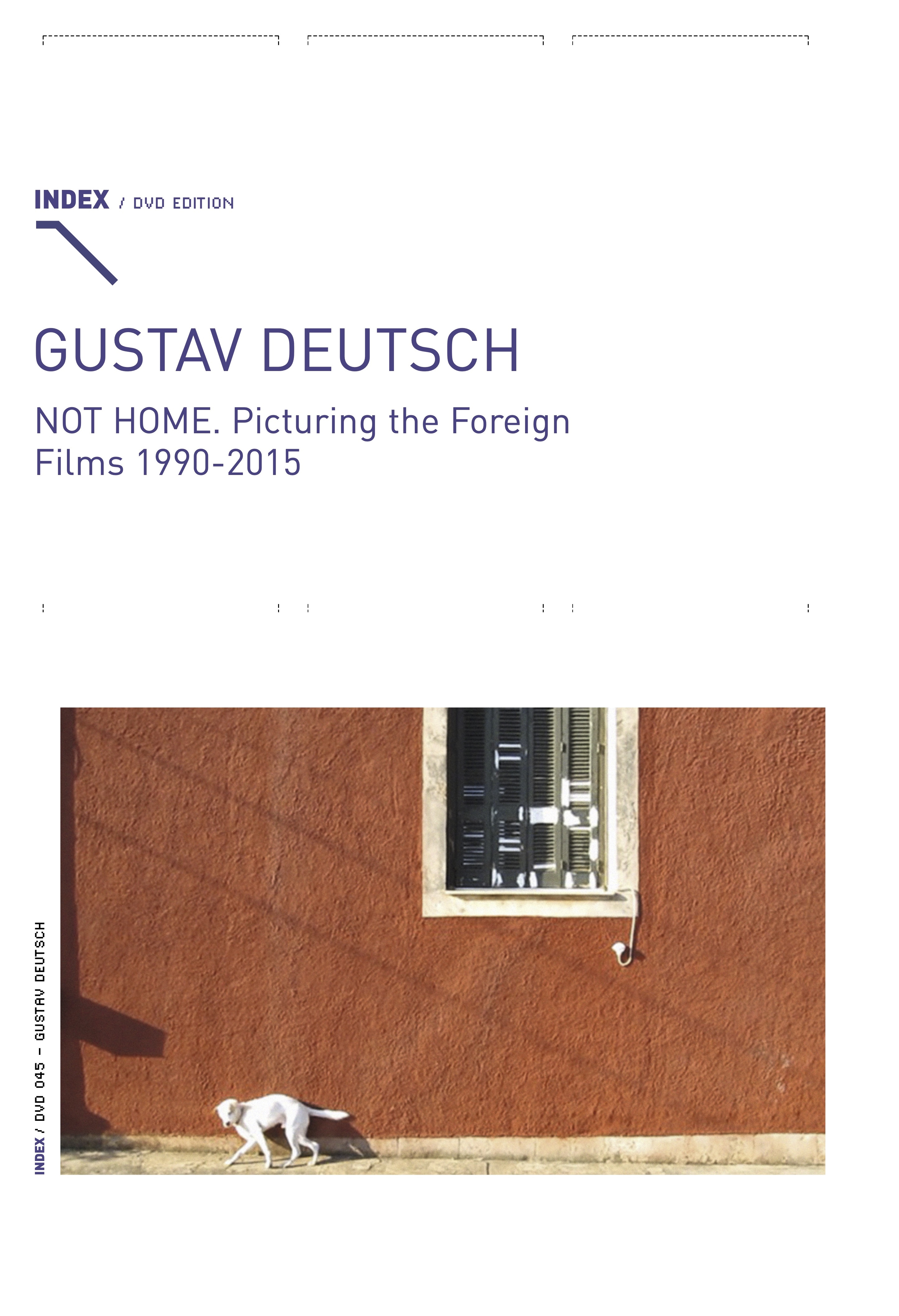
Behind the films collected on NOT HOME lies an inquiry into the act of seeing, shaped by the unsettling realization that vision is never objective or neutral. To witness the world through images one did not make is to inherit the desires, omissions, and vulnerabilities of subjective strangers. Having long worked as a cartographer of found memory, Gustav Deutsch finds himself in the more elusive position of a traveler who never arrives, someone perpetually foreign even in the intimacy of his own gaze. What does it mean to be the custodian of other people’s looking, and what is revealed when the world is glimpsed through perspectives that cannot be fully assimilated?
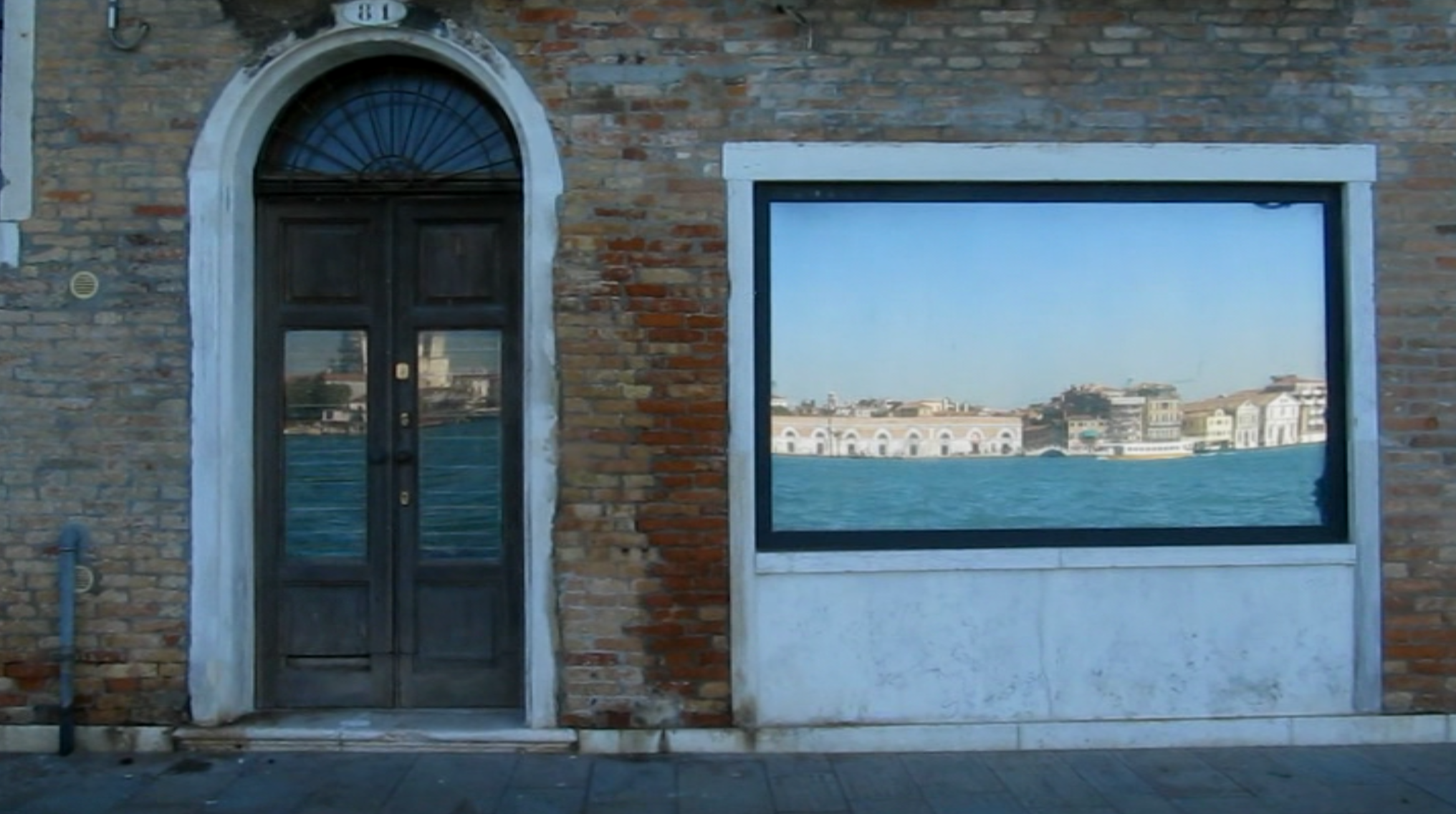
Adria – Holiday Films 1954-68 (School of Seeing I) lays track by presenting postwar tourist films as if they were relics of some vanished civilization. Its structure moves from still shots to views from vehicles to montages in motion, a transition from the fixed monumentality of place to the restlessness of those attempting to inhabit it. Signs, oceans, bridges, cars, beaches, and faces gather into a quiet taxonomy of yearning. These fragments carry an ache, as if time had already begun erasing them during the very moment of their recording. The Venice passage becomes a kind of primal scene: a man serenades us on the rising waters, yet we hear nothing. Expression survives only as the ghost of a gesture. Those cradled in frame are almost certainly gone, their vitality preserved in an archive that cares nothing for mortality. Deutsch teases out this paradox—that these films were meant to enshrine happiness yet now mirror the fragility of all that once felt permanent—with painful clarity.
Eyewitnesses in Foreign Countries (1993), made with Moroccan filmmaker Mostafa Tabbou, turns Deutsch into a documented outsider. Six hundred shots, each lasting three seconds, alternate between Figuig and Vienna in a steady, metronomic rhythm. Deutsch’s astonishment at the desert’s elemental force contrasts with Tabbou’s measured attention to the textures of European daily life. The exchange is not symmetrical, the time limit suggesting a fragile equality at best. Deutsch cannot entirely escape the exoticizing pull of unfamiliar territory, while Tabbou renders Vienna without spectacle, letting human detail eclipse architectural bravado.
Notes and Sketches I (2005-15) extends this sensitivity across a decade of small observations. Thirty-one pocket films made with digital cameras and mobile phones emerge as devotional gestures spared from the erosion of ordinary time. The lazy Susan sequence in a restaurant becomes a center of gravity around which an entire perceptual world turns. Plates glide, voices hum, the table rotates, and from this dance an unexpected sanity arises. Sound plays an equal role in these pieces. Spaces speak their own grammar, and Deutsch listens carefully, letting ambient noise shape the contours of each entry. Geography dissolves; what remains is an atlas of attentiveness. These sketches reveal how the unguarded instant often contains more truth than the composed event. They show how perception, when freed from the demand to explain, allows the world to declare its own quiet coherences.
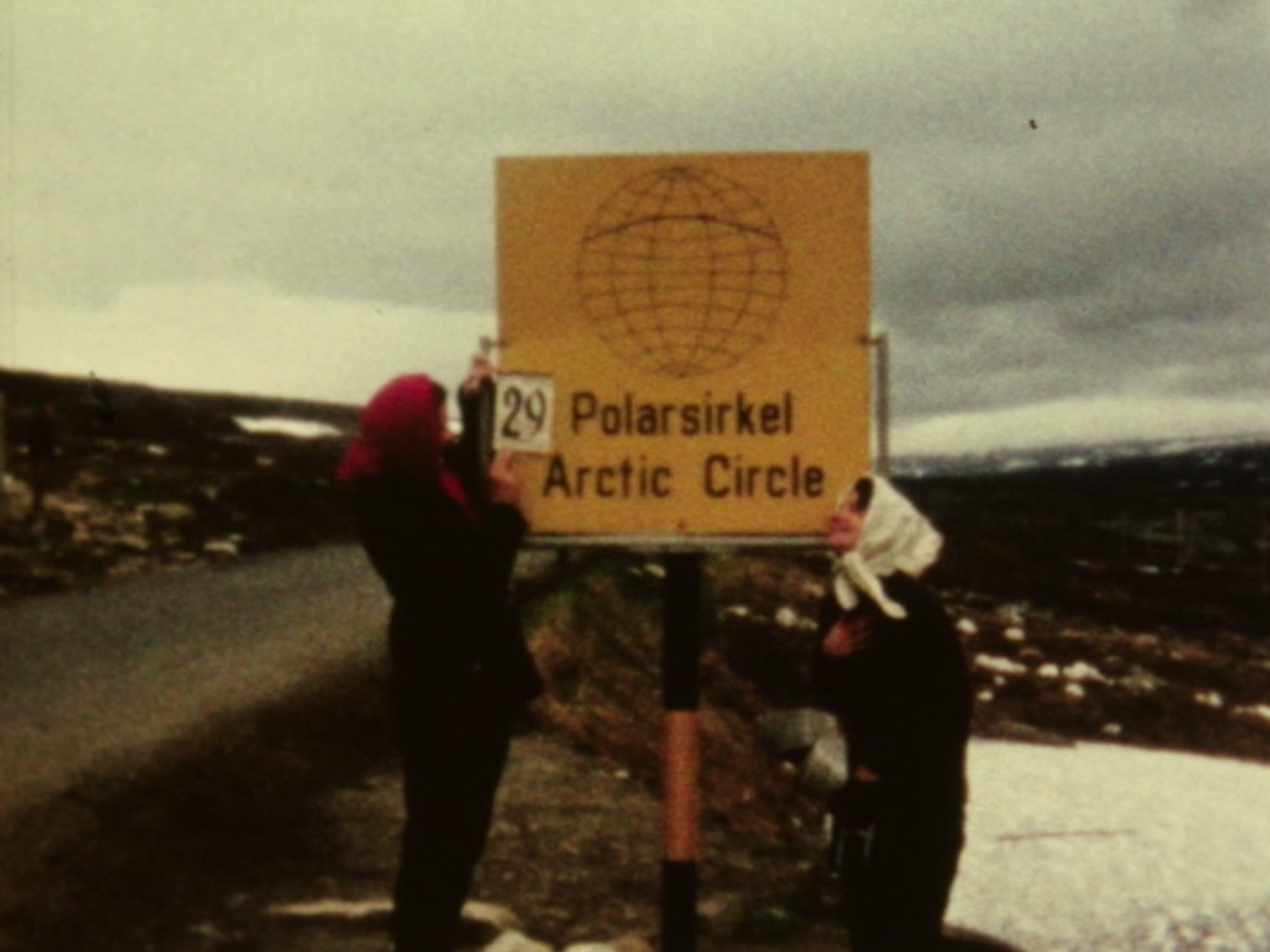
The bonus film, Sat., 29th of June / Arctic Circle (1990), operates as an early crystallization of the larger project. Four travelers pause at the titular location, pose with numbers, and mark their presence as if the boundary they have crossed holds metaphysical weight. Their actions, unconsciously choreographed, are as sincere as they are awkward, unaware that decades later they will be observed as part of an experiment in temporal distance. What they enact is the desire to extract meaning from place, to position one’s own frailty against the indifference of all terrain.
Across these works, Deutsch drifts between ethnographer and wanderer, historian and poet. He gathers glimpses rather than conclusions, tracing the shape of experience without feigning to contain it. And so, the foreign is never simply elsewhere. It appears whenever an image survives the life that produced it. It appears whenever we see ourselves reflected in the gaze of someone we have never met. And it appears whenever the world, in its fleeting instants, reveals that regard is always cyclical.
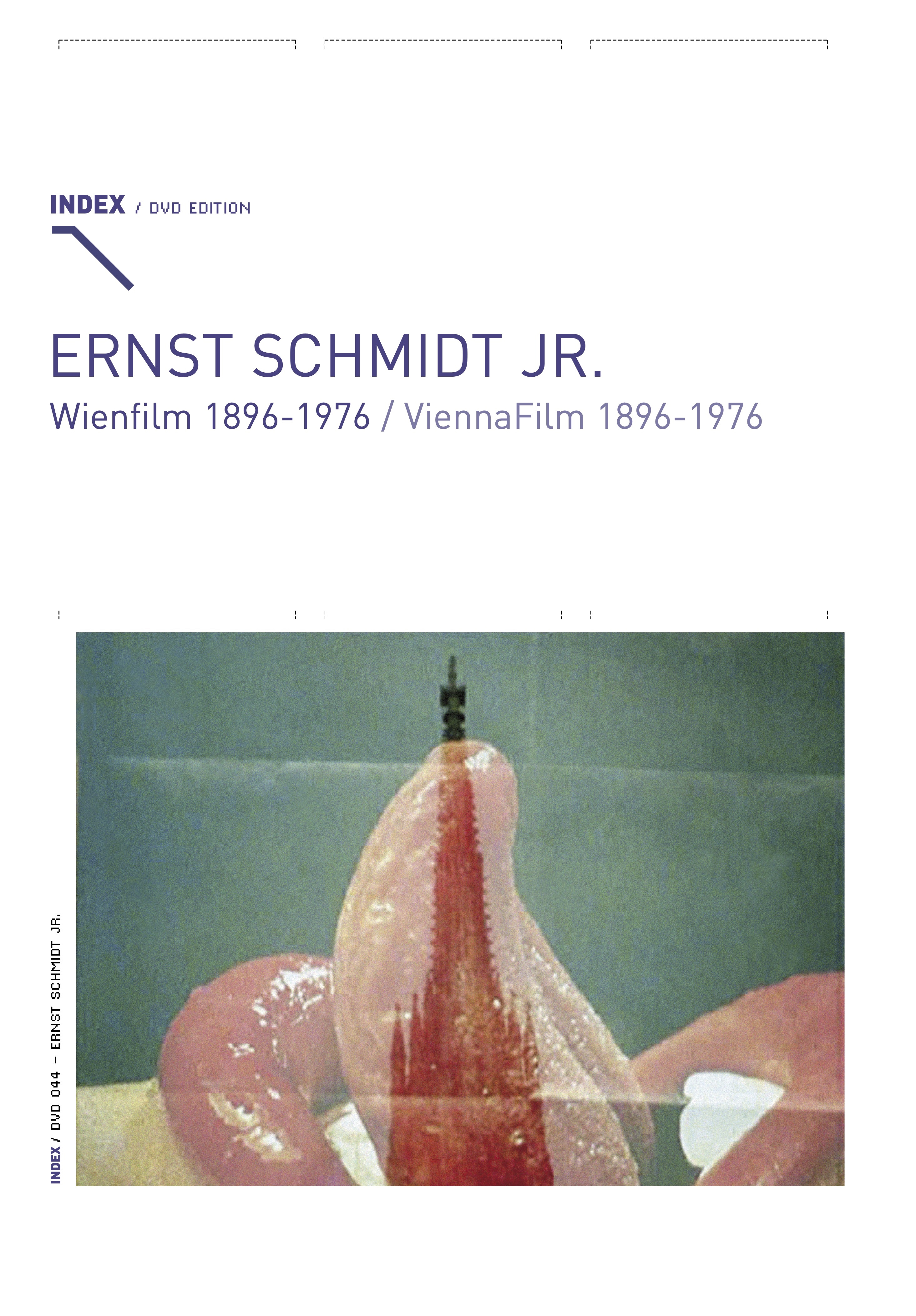
Ernst Schmidt Jr.’s Wienfilm 1896-1976 opens its subject the way a cadaver is splayed on a coroner’s table. It does not search for a beating heart but for the conditions that make Vienna both itself and something estranged from itself. Montage is now a diagnostic tool, less a method of assembling meaning than of measuring how it buckles under the weight of mortality. The filmmaker himself calls it “a collage of diverse materials aimed at conveying a distanced image of Vienna,” and this distance is the guiding principle: no seduction, no civic hagiography, only a long, unsettling look at a city that contradicts its own self-image at every turn. The result is almost two hours of historical consciousness unfurling at the pace of a slow-motion sea change.
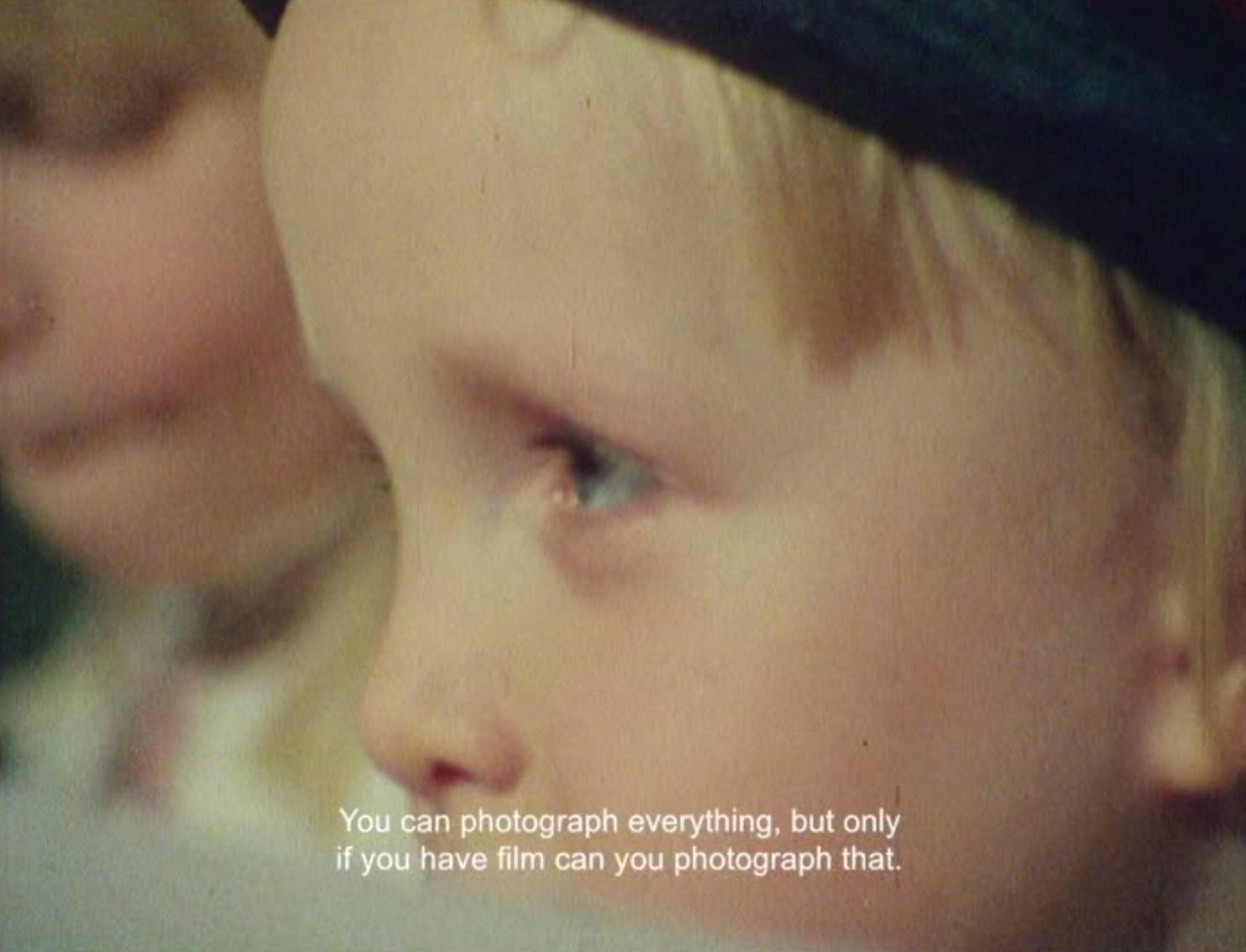
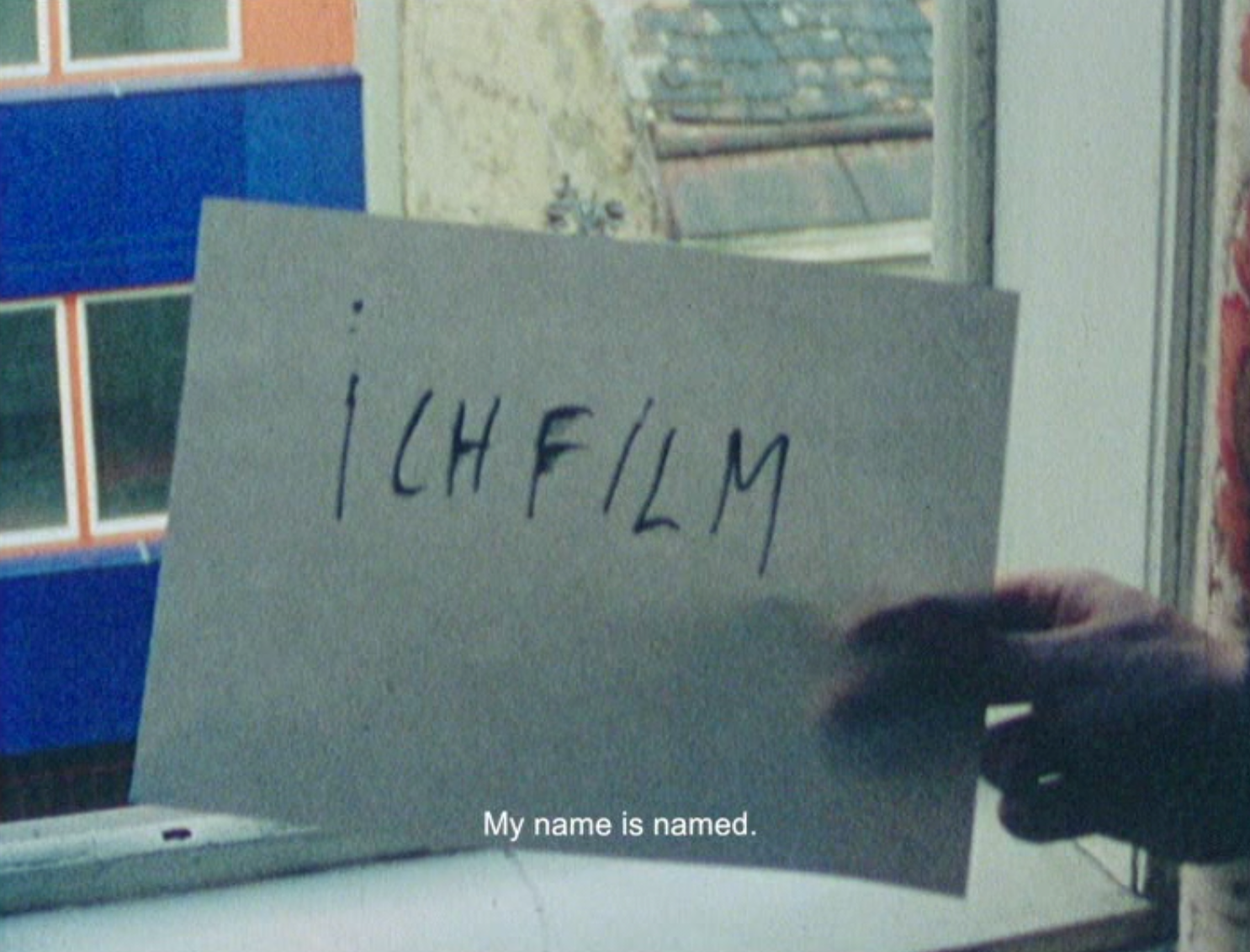
The project begins innocently enough. Two little girls draw and talk about photography, as if the film were briefly pausing to consider the act of looking before descending into its century-long excavation. Soon, Schmidt Jr. sends his camera wandering into the streets to locate the letters of his name. Thus, identity is something to be scavenged rather than inherited, pulled from signage, storefronts, and neglected typography. The artist reconstructs himself through urban residue, establishing an implicit kinship between detritus and personal (re)formation. Lumière footage from 1896 reminds us that Vienna’s filmed life began in the same mood of wonder that swept Europe. Yet here the vintage images register as a faint alarm, the first entries in an archive that will come to record both innocence and catastrophe, albeit in disproportionate amounts.
A montage of women walking follows, accompanied by a syrupy song about femininity. The sequence drifts uneasily between admiration and objectification, as if the soundtrack were trying to smooth over the very wounds it denies. And that’s when a Nazi parade cuts into frame, 1938 charging forth without commentary or warning. The simple adjacency of images does the work of showing how the bootmarks of the past can never be lifted from the present’s pavement. Peter Weibel appears interviewing passersby about who “owns” Vienna, a question that exposes civic pride as well as civic vacancy. Abandoned buildings and shuttered shops stand as ruins. Joe Berger’s remark, “You can be Viennese all over the world…just not in Vienna,” functions as a darkly comic proposition about belonging, exile, and the contradictory nature of borders.
When Chaplin arrives, mass adoration floods the screen. The crowds reveal a collective fervor that cinema alone seems able to provoke. Ecstatic public unity collides with the kitschy cheer of Wienerlieder, whose supposed affection grows sinister when paired with footage of marching columns, rubble, or muted political assemblies. Such sentimentality takes on a narcotic charge, a way of drowning out the psychic noise of its unresolved history. Freud drifts through as a spectral reference, less a person than a reminder that Vienna’s self-knowledge has always been bound to its neuroses. Dogmatic speeches rise and fall, promising clarity yet delivering only the musical rest of rhetoric. Actionists erupt briefly, warping from within. Ordinary people cross streets, ride trams, and enter buildings, each carrying a share of a saga that exceeds them.
As Wienfilm 1896-1976 nears its end, it no longer behaves like a documentary. It becomes a séance of stone. Schmidt Jr. summons imperial afterimages, post-war silences, and self-mythologizing refrains, letting their intercourse give way to an apparition built from incompatible truths. What remains is a portrait assembled from fragments that resist composition, vibrating with the discomfort of witnessing too much yet understanding too little. A city is not something to be summarized but confronted, piece by tactile piece, in all of its charm and violence, until a composite sketch is revealed that no one can fully bear to recognize as their own.
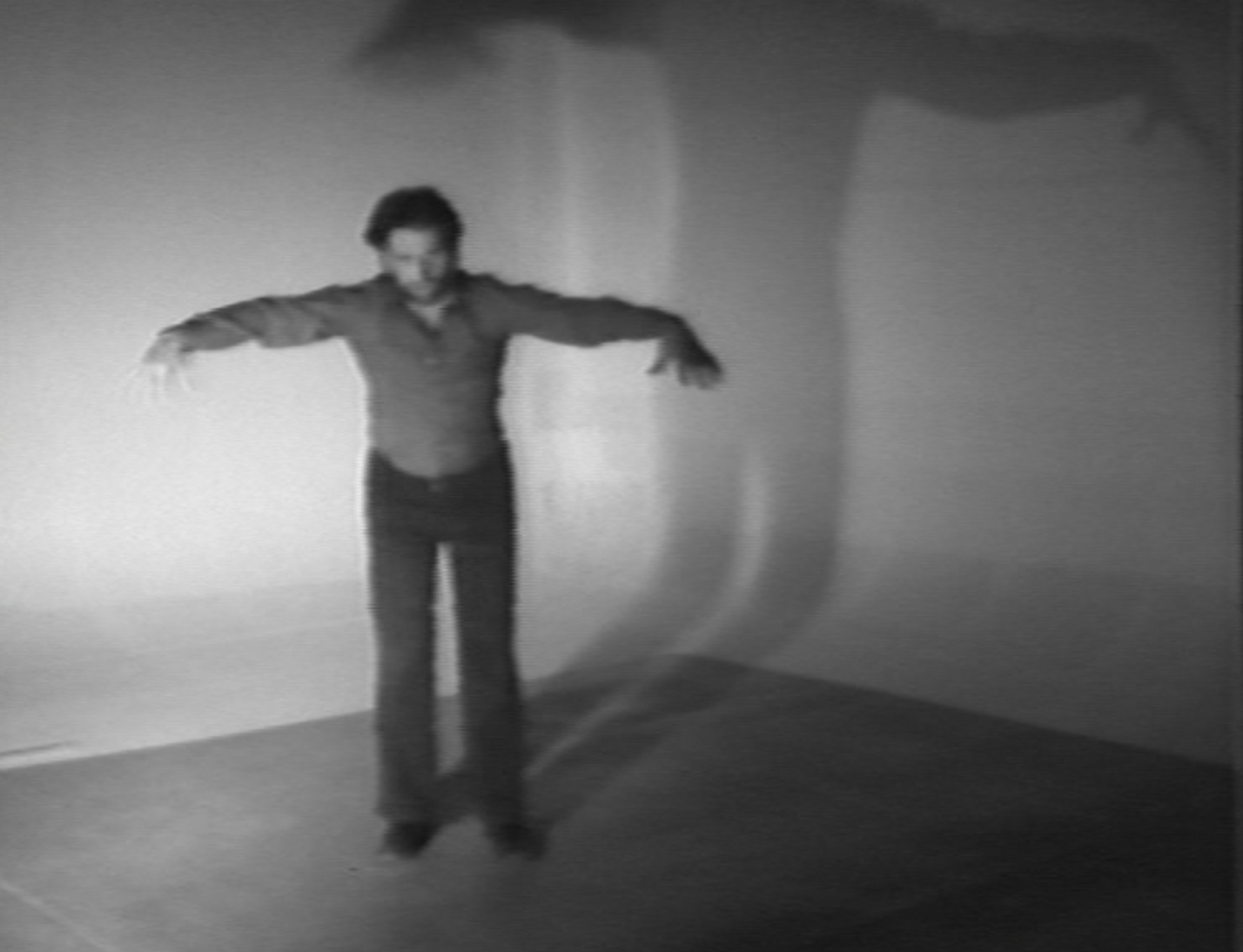
Peter Weibel’s Körperaktionen (Bodyworks) reveal him as the Actionist who refused the Actionists’ mythology. While others pushed inward toward abjection and self-wounding, Weibel turned outward toward media, politics, semiotics, and the body as a site where power writes its own grammar. His gestures are never self-contained eruptions. They are conceptual irritants that question whether an “action” is an event, an inscription, a perceptual trap, or an estrangement from social order. The body becomes the primary medium not because it grants access to primal truth but because it is the site where systems fray at the seams.
Lüstern
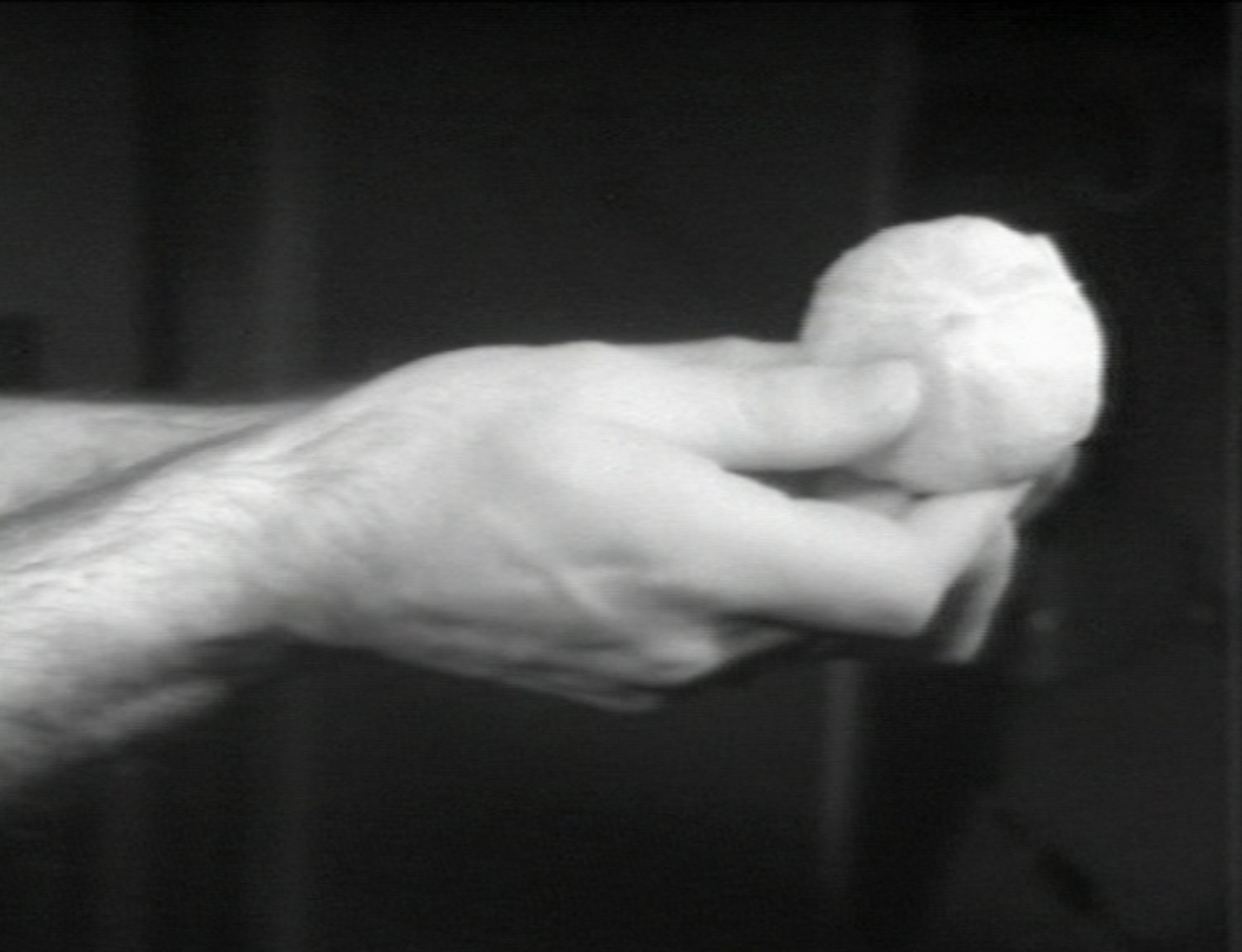
This appetite for estrangement is already present in Fingerprint (1968), which uses the film strip to produce sound, image, and a forensic poetics of identity. A print is an index of presence, a bureaucratic marker, a residue of control, and, finally, a reminder that the flesh leaves traces, whether we like it or not. Nüstern (Nostrils) and Lüstern (Lascivious) (both from 1969) push the close-up toward distortion until isolated members appear as media property rather than human attributes. A magnified nose, an eroticized massage revealed as nothing more than an orange, both dismantle the consumer industry’s habit of slicing us into marketable zones of sensation.
Das Recht mit Füßen treten
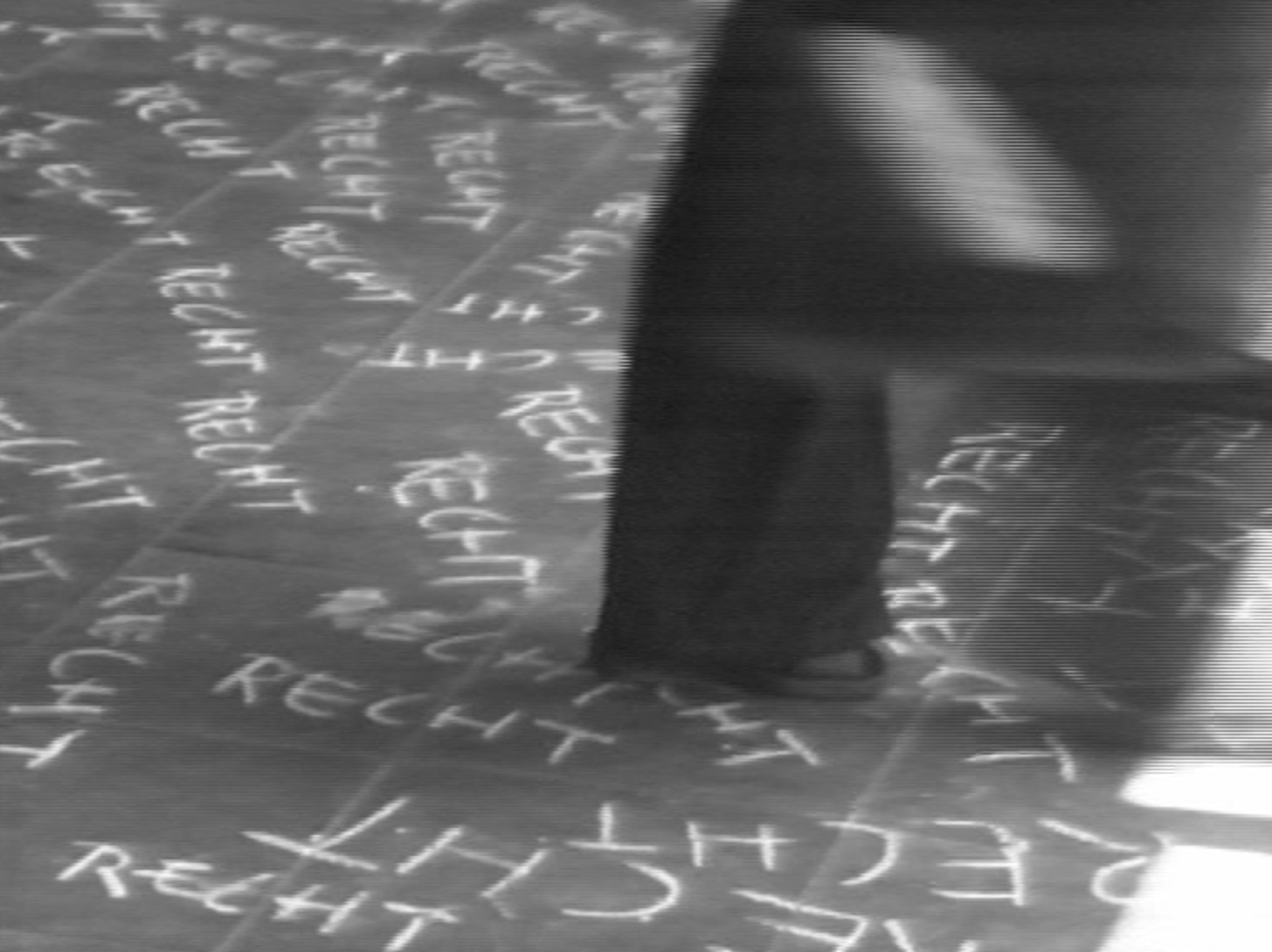
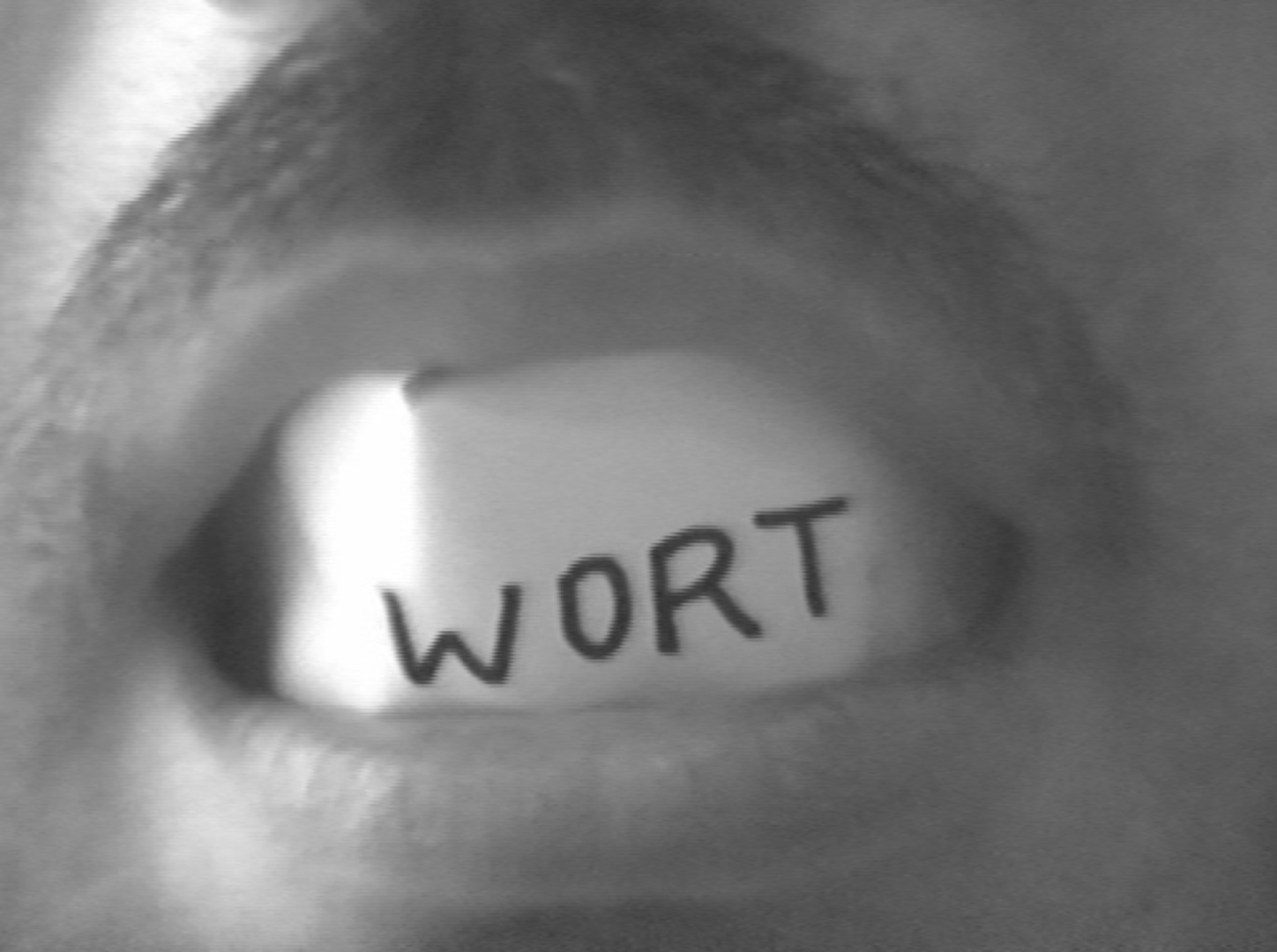
The Text films from 1974—Augentexte, Mundtext, Stirntext—literalize the notion that the body speaks. Yet the speech is stuttering, mechanical, self-consuming. The eye blinks words, the mouth utters “SCHEISSE” before swallowing it, the forehead writes until it throbs. Language contaminates skin and vice versa. In Das Recht mit Füßen treten (Trampling on Rights, 1967/68), museum visitors step on the word “recht” scattered across the floor in an unwitting political gait. Here, the act belongs to the public, hinting at what is perhaps Weibel’s most radical proposition: spectators are never neutral. Lösung der Phantasie (Solution of Fantasy, 1972) examines hair as a philosophical emblem, elegant when attached to the head and repulsive when shed, offering a small but potent meditation on beauty and decay sharing the same root.
Fluidum und Eigentum: Körperverhältnisse als Eigentumsmaße
Weibel often condenses his motifs of interest into crystalline forms. Wie hat sich aus den Fischen die Mathematik entwickelt? (How Did Mathematics Evolve From the Fish?, 1971) is a self-styled visual haiku centered on a typewritten iteration of “hand,” zooming until the word mutates into a pure visual pattern. Fluidum und Eigentum: Körperverhältnisse als Eigentumsmaße (Fluidum and Property: Body Relations as Measure of Property, 1971/72) examines the idea of property by asking at what scale ownership collapses: bread, chair, room, shadow. Each item passes through the body’s orbit of affordance and discards the illusion that possession is stable.
Kokain(e)
Such explorations of symbolic order continue in Grüß Gott (1967/72), where Weibel and Susanne Widl casually eat pretzel letters forming the titular greeting, turning Austrian piety into edible farce. Kokain(e) (1972) reveals a pornographic image hidden beneath a can of fish printed with St. Stephen’s Cathedral, suggesting that sacred and obscene imagery differ only by their packaging. His reconstruction of Duchamp’s Stoppages-étalon (1970/71) reenacts the dropping of a thread to show that randomness, not symmetry, is the geometry of modernity. Vulkanologie der Emotionen (Vulcanology of the Emotions, 1971/73) arranges bodily poses as geological layers of feeling, while whale-like moans push the human voice toward prelinguistic depths.
Venus im Pelz
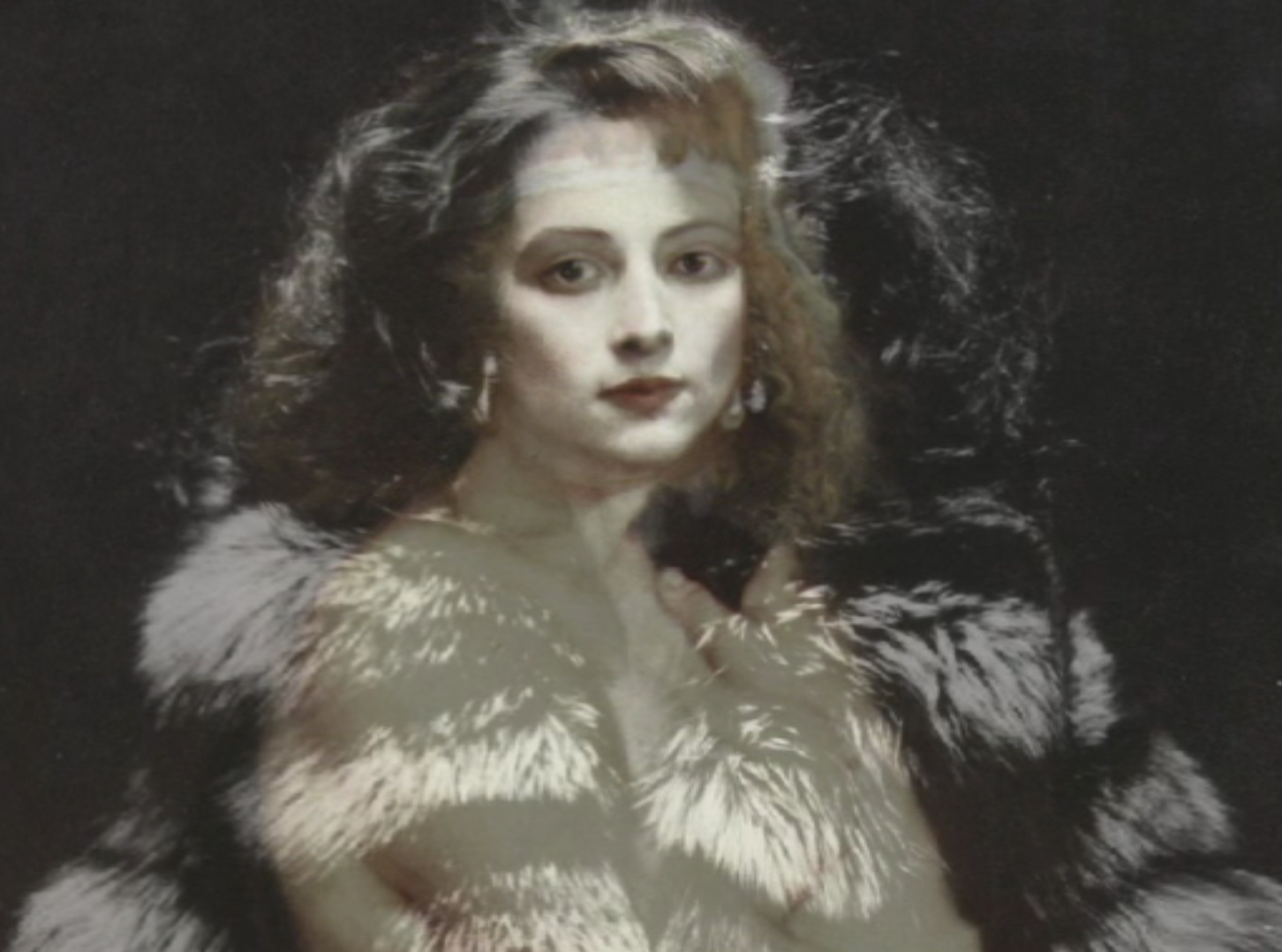
Weibel’s inquiry into the politics of looking continues in Aktbesprechung oder Inverses Selbstporträt (Discussion of the Nude or Inverse Self-Portrait, 1975/76), which reverses the male gaze by showing male nudes through women’s descriptions. The men become mirrors without agency, their vulnerability revealed through shifting reactions. Switcher Sex (1972) overlays body parts into unstable configurations, turning gender into an assemblage that resists coherence. Venus im Pelz (Venus in Furs, 2003) uses morphing technology to blend centuries of painted Venuses into a single monstrous continuum, exposing the canon as an endlessly repeated, idealized submission. Vers und Vernunft (Rhyme and Reason, 1978) stages Weibel and Widl in a cage of television screens, grunting and breathing themselves into exhaustion until reason gives way to an animal rhythm. Zeitblut – Blutglocke (Timeblood – Bloodbell, 1972/79/83) completes this arc by spilling his own blood on national television. Through this action, every Austrian home was simultaneously filled with his life essence, as if the media had become a circulatory system carrying his interiority into the public domain.
Kunst und Revolution: Brandrede
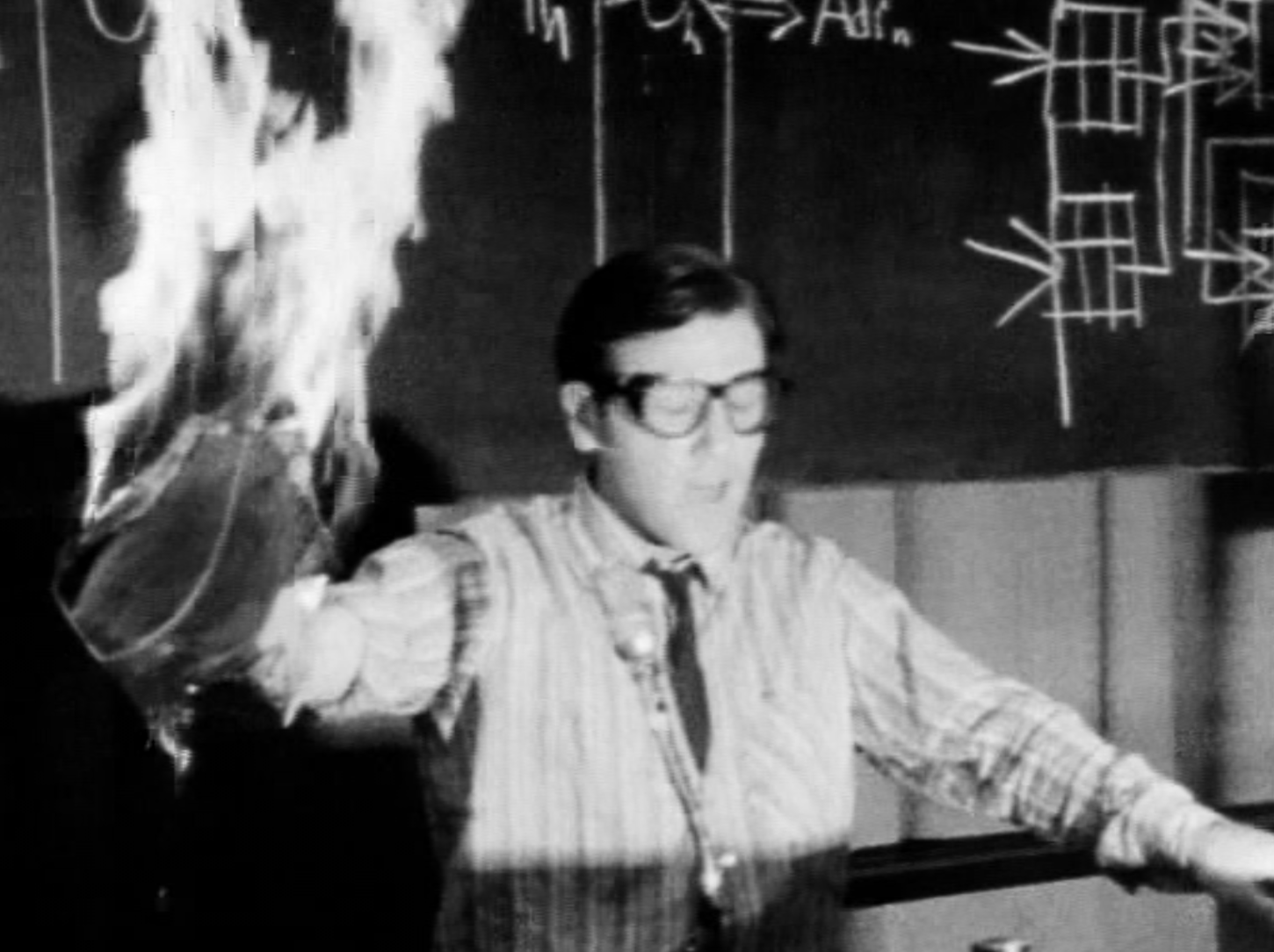
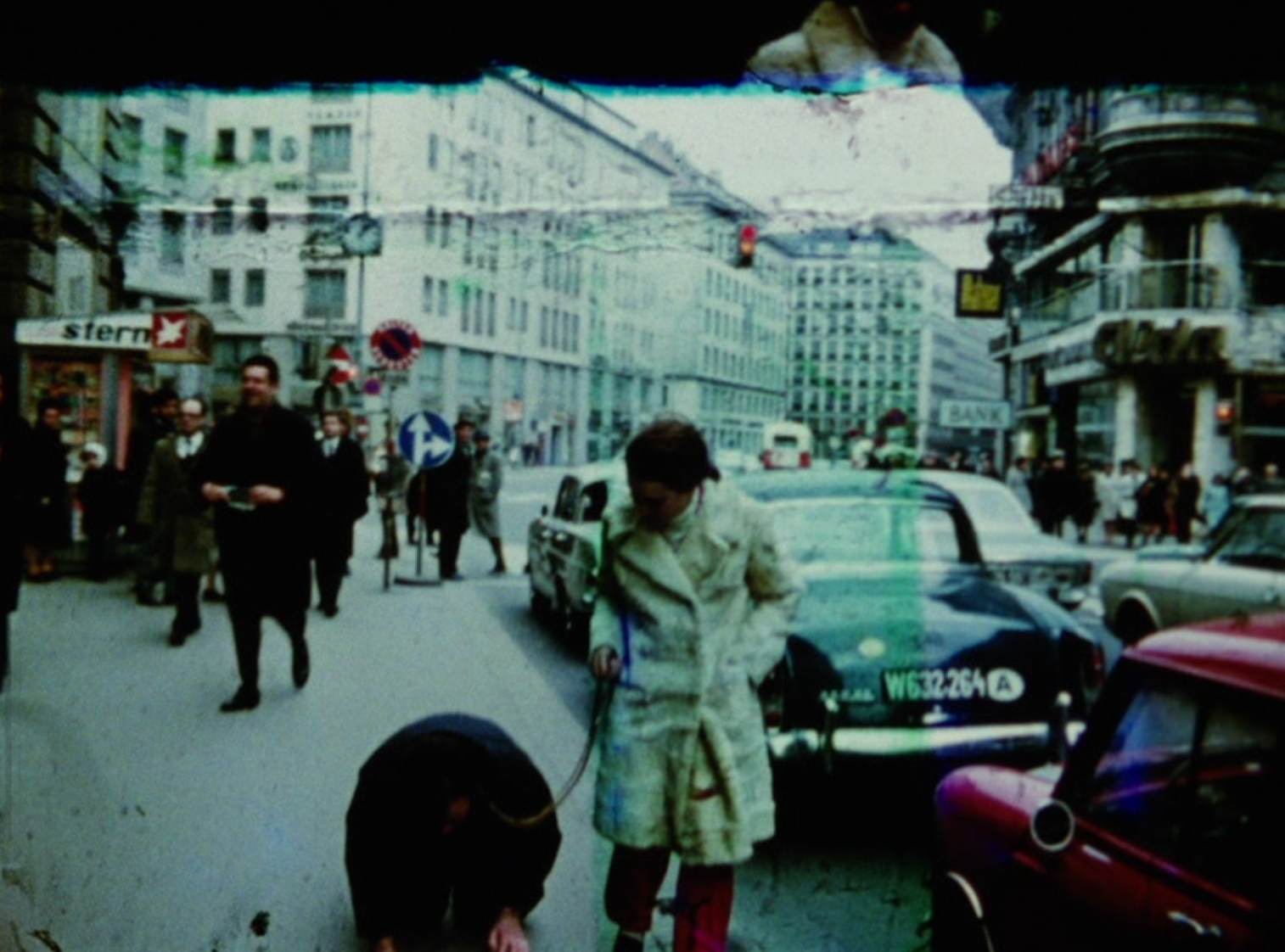
Three films by Ernst Schmidt Jr., previously seen on INDEX 042, are also included among the selections curated on this DVD. Kunst und Revolution: Brandrede (Art and Revolution: Incendiary Speech, 1968) documents Weibel’s speech from his infamous June 7, 1968, performance at the University of Vienna. With one hand aflame, he quotes Lenin and Chernyshevsky in a powerful deconstruction of rhetoric. “The goal of the speech action,” he recalls, “was to inflame consciousness, to pass the flame of revolution and freedom to its listeners, and it was realized in the form of a body action.” Denkakt (1967) captures Weibel thinking aloud until the medium truncates his thought, proving that technological limits mediate cognition itself: “[F]ilmmaking meaning nothing other than the production, derivation of figures, events according to the possibilities of the formation film, for example with celluloid or the movie auditorium, screen, spectators.” The notorious Aus der Mappe der Hundigkeit (From the Portfolio of Doggedness, 1968/69), in which VALIE EXPORT walks Weibel as one would a dog, literalizes power inversion and makes the male body the site of disciplinary display. The title is a play on Aus der Mappe der Menschlichkeit (From the Portfolio of Humanity), a leaflet once distributed weekly by the Red Cross.
Across these projects, Weibel does not use the self to enact mysticism or sacrifice. He treats it as a contested field where authority, machinery, desire, and perception collide, and where every decision reveals the infrastructures attempting to constrict it. His Actions expose that the body, even in the absence of a camera, is already mediated by the lens of the human eye and that the screen is not a recording device but a palimpsest for sociopolitical fictions. Over decades, Weibel has pursued nothing less than a decolonization of the sensorium. He invites us to notice what we have been trained to ignore, to feel what we anesthetize, and to recognize how deeply the rules of visibility are written into these bags of bones we imagine as our own.
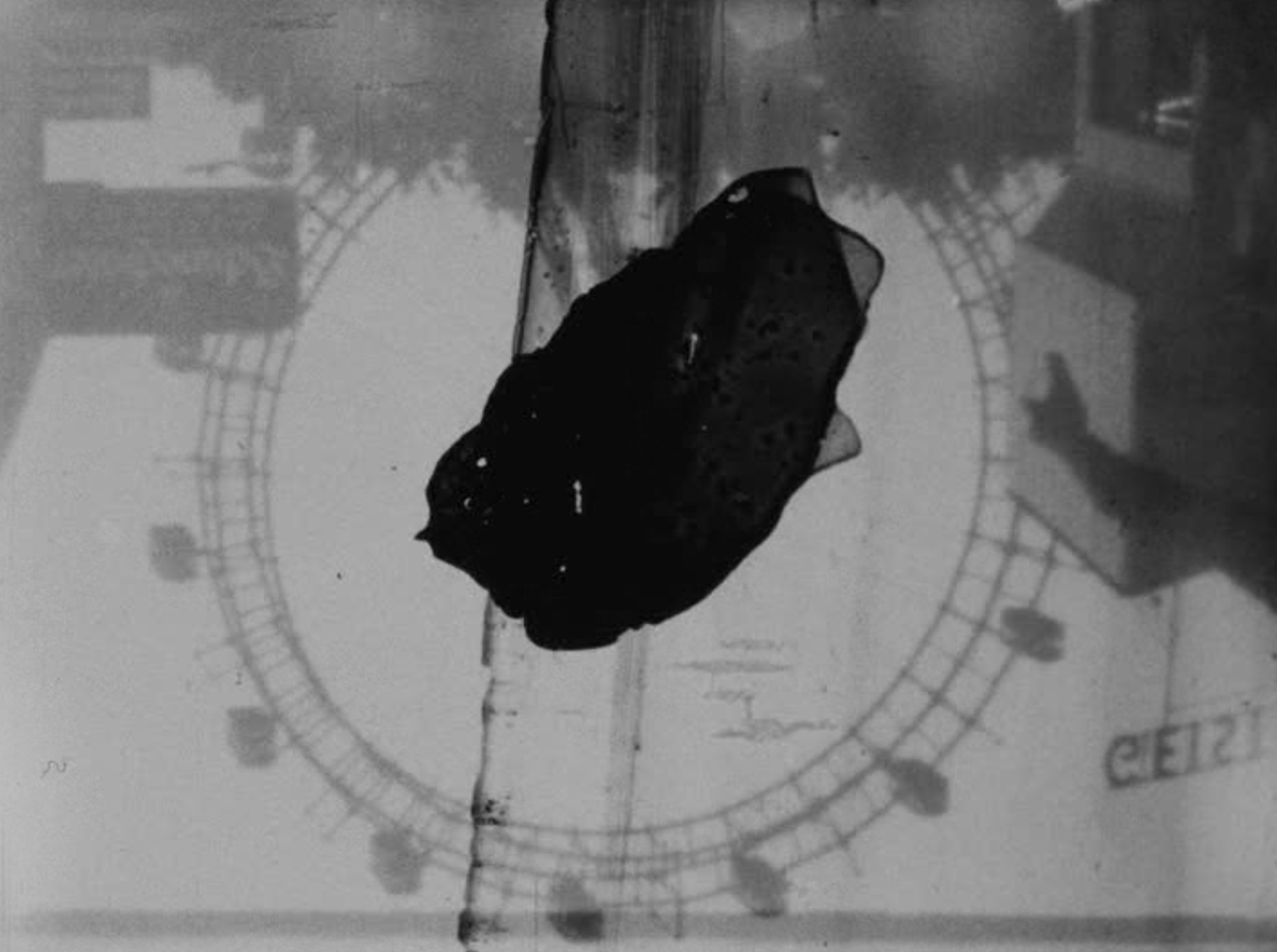
Ernst Schmidt Jr. belongs to the incendiary second wave of the Austrian avant-garde that Peter Tscherkassky, in his liner notes, associates with transgression. By the same token, the force of Schmidt Jr.’s creations does not stem from crossing limits so much as eroding that very stubborn notion. His images resist symbolism at every turn. Rocks, scraps of emulsion, a curtain’s twitch, faces caught between expressions, even the jitter of spliced frames: all insist on their own existence before they signify anything at all. They become the raw elements of a practice that stitches itself together and tears itself apart in the same motion, revealing a paradox that has been the lifeblood of cinema since its inception. We try to liken filmmaking to cutting or pasting, to analogize its ruptures and assemblages to familiar actions, yet nothing quite matches the peculiar self-becoming of the strip itself. Celluloid behaves as if it possesses impulses of its own, and Schmidt Jr. is one of the few who ever allowed it to behave accordingly.
Steine
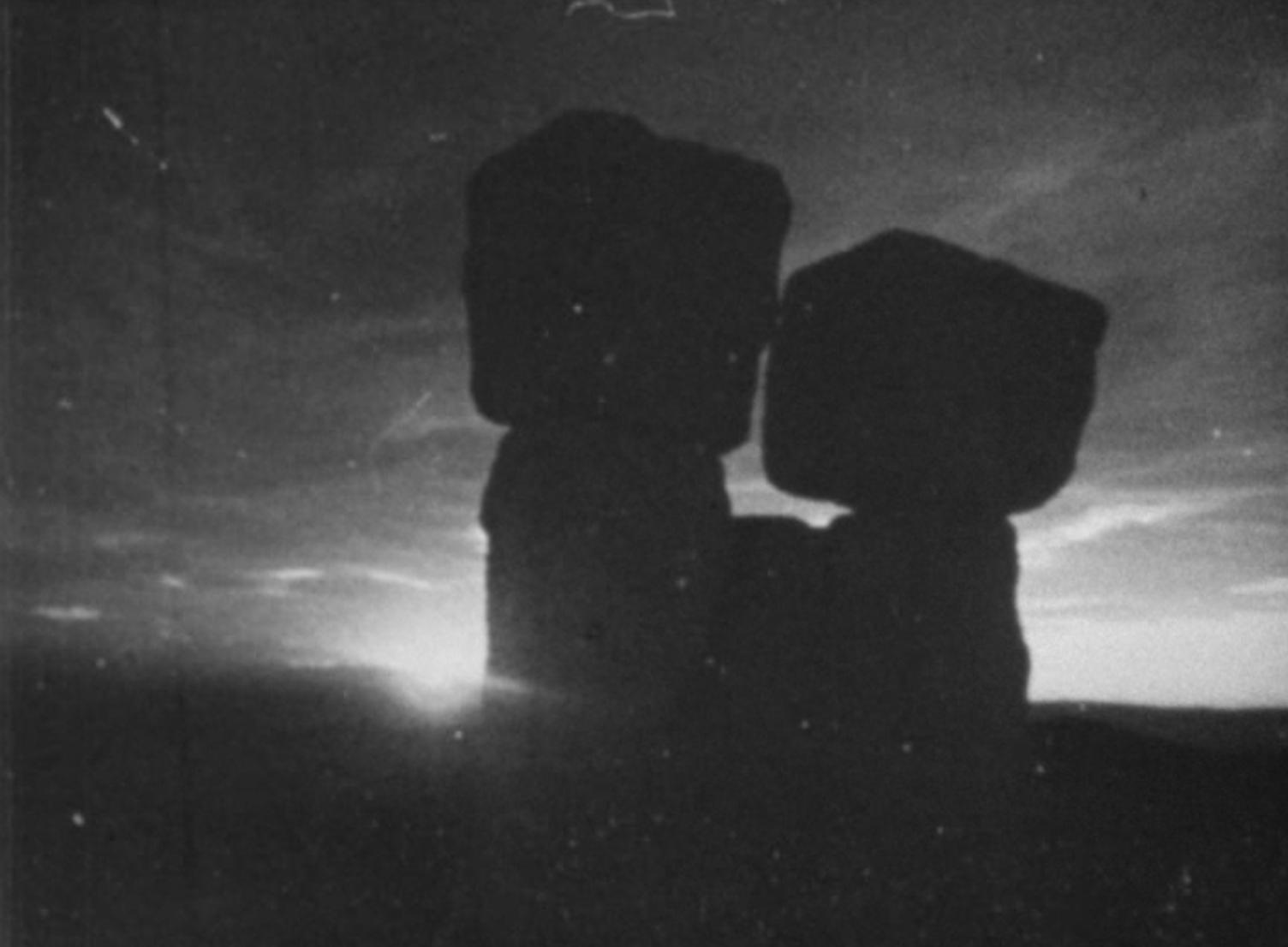
This sensibility is clear in Steine (Stones, 1964/65), ostensibly a documentary on sculptors in St. Margarethen but more accurately a study of the negotiation between labor and matter. The jazz score by Dieter Glawischnig and Ewald Oberleitner syncs with the staccato rhythms of chisels, while texts by Gunter Falk and Harald Seuter counterbalance the bemused commentary of passersby. A visitor admits that anyone capable of making something from stone “can’t be normal,” seemingly unaware that shaping stone is not domination over but a surrender to a material whose history predates the sculptor. Schmidt Jr.’s camera lunges, drifts, and waits until the quarry becomes a primordial studio where sculpture resembles an act of listening. Superimpositions remind us that stone contains layers and sediments, ghosts of earlier states in a syncopated duet between imagination and the ancestral depth of matter.
Schnippschnapp
This principle expands in the 20 Aktions- und Destruktionsfilme 1965-1979 (20 Action and Destruction Films, 1965–1979), which treat attention, dismantling, and impulse as structural devices. Ja/Nein (Yes/No, 1968) positions a theater curtain as protagonist, converting a transitional object into an enigmatic presence that behaves independently of spectatorship. Weiß (White, 1968) reduces cinema to flickering circles that hang in midair as portals leading nowhere. Prost (Cheers, 1968) invites participation by challenging viewers to shout “Cheers!” when a line touches the frame, only to reveal how futile synchronized response becomes when the apparatus refuses cooperation. In Rotweißrot (Red-white-red, 1967), the Austrian flag is rendered as pure abstraction, perhaps the most honest way to depict an emblem too often leveraged for false unity. Schnippschnapp (Snip, 1968), made with Peter Weibel, uses scissors to slice the reel until the strip begins consuming itself, culminating in the absurd reduction of paper to its smallest fragment.
Eine Subgeschichte des Films
Reduction continues in Filmisches Alphabet (Film Alphabet, 1971), which compresses the entire medium into twenty-six frames, each a letter that becomes a cipher of visual genesis. Burgtheater (Imperial Theatre, 1970) drains sketches from a commemorative book of their theatrical grandeur, leaving them to hover between documentation and exorcism. Gesammelt von Wendy (Collected by Wendy, 1978/79) quietly records the debris of a party—photographs, stray video fragments, traces of interaction—until social life appears as an archaeology of residual presence. Yet Eine Subgeschichte des Films (A Subhistory of Film, 1974) may be Schmidt Jr.’s most spectral construction. Drawing images from the 1300-page encyclopedia of the same name by Schmidt Jr. and Hans Scheugl, it arranges them as an apparition. Moving through its catalogue feels like wandering a museum where history refuses to settle.
Gertrude Stein…
His portrait works sustain this sense of volatility. Denkakt (The Act of Thinking, 1968) captures Peter Weibel thinking aloud, treating thought itself as an unstable field. Mein Bergräbnis ein Erlebnis (My Funeral an Experience, 1977) and 12 Uhr Mittags (High Noon, 1977) modulate tempo and expression until faces mutate into shifting topographies. The Merry Widow (1977) converts expression into something uncanny and grotesque. Sara Suranyi’s features flutter into new registers, showing how emotion never coalesces into a fixed state. Gertrude Stein hätte Chaplin gerne in einem Film gesehn, in dem dieser nichts anderes zu tun hätte, als eine Straße entlang und dann um eine Ecke zu gehen, darauf die nächste Ecke zu umwandern und so weiter von Ecke zu Ecke (Gertrude Stein would have liked to have seen Chaplin in a film where he would have nothing other to do than walk on the street and then go around a corner, and then around the next corner, etc. from corner to corner, 1979) literalizes Stein’s fascination with repetitive motion as a woman walks corner to corner until a staircase interrupts her circuit.
Einszweidrei
Schmidt Jr.’s more extreme explorations, including N (1978), which documents Hermann Nitsch’s actions, and Kunst & Revolution (Art & Revolution, 1968), plunge into spaces where ritual, violence, and provocation collide. The latter film features a group Action by Otto Mühl, Günter Brus, Peter Weibel, and Oswald Wiener, plus a disguised stranger for good measure. Their taboo interactions, performed on an Austrian national flag on June 7, 1968, at the University of Vienna, would lead to three arrests and the ousting of the Viennese Actions from the city. Bodybuilding (1965/66) and Einszweidrei (Onetwothree, 1965-68) inhabit the Actionist milieu with both fascination and critique, letting the body become instrument and message while Dixieland music and dissonant voices form a carnival of collapse. (VALIE EXPORT walking Weibel like a dog is an especially memorable highlight.) These are not documents but exposures, the camera registering cultural nerve endings without mediation.
Filmreste
In Filmreste (Film Scraps, 1966), his philosophy condenses into a single gesture: scraps arranged into a mosaic where smears, gospel phrases, bumper cars, lovers, city fragments, and bursts of color create a vitality that feels mischievous and irreducible. With this film, says Tscherkassky, “Schmidt Jr. reduces the base and emulsion of film to its status as material, film as a physical object.” Farbfilm (Color Film, 1967) names colors over blinking fields of hue yet never finds “blue,” as if the spectrum itself were resisting resolution.
Across these works, Schmidt Jr. remains focused on matter, vibration, interruption, and impulse. Representation defers to sheer presence. Accidents, ruptures, and material insistence generate the energy that drives the images. In treating the medium at its most elemental, he confirms a deep avant-garde intuition: that cinema is not a window onto the world but a substance within it and that its vitality is inseparable from the matter of which it is composed.
Norbert Pfaffenbichler’s Notes on Film approaches moving images as a palimpsest, a surface carrying its past as half-erased inscriptions waiting to be pressed into new shapes. His practice is less a restoration than an exposure of fault lines. By reorganizing and reprocessing inherited material, he forces it into states where certainty dissolves, each fragment a visual equation caught and interrupted in the act of solving itself. The archive becomes a reservoir of dormant energies, coaxed out with a mixture of severity and play, always attentive to how a single gesture or sonic abrasion can convert the familiar into a cognitive riddle. Under his hand, the storytelling apparatus mutates into a thinking machine.
notes on film 01 else (2002), the first entry in the cycle, recalibrates a scene from Paul Czinner’s Fräulein Else (1929) as a drifting hypothesis sustained by new additions. The woman in question, repeatedly summoned into a perpetual screen test, becomes less a character than a set of possible identities seeking traction on surfaces that cannot stabilize her. The word IF migrates along the frame’s lower edge, assembling and dispersing itself with a logic too unstable to resolve, yet too insistent to ignore. Wolfgang Frisch’s score stretches the material into a hypnotic trance where syntax becomes sensation. Lines rising and falling resemble a nervous system diagram or the first hesitant scratches of a manifesto that refuses to speak through fleshly instruments. One feels caught inside a conditional mood: If this happens, what follows? If she exists, then who am I? The result is a thought experiment that dramatizes the contingency of meaning itself.
The most chilling configuration appears in Conference (Notes on Film 05) (2011), which assembles 65 portrayals of Adolf Hitler. Pfaffenbichler arranges them as if they were a group of singers rehearsing a single monstrous chorale, each voice tuned to a different frequency of delusion, rage, or parody. The moustache becomes a floating glyph emptied of significance through repetition, a marker of historical exhaustion and cultural overexposure. Udo Kier’s fevered performance in Schlingensief’s 100 Jahre Adolf Hitler shares oxygen with Mel Brooks’s mockery and Chaplin’s trembling poise. Pfaffenbichler maps their common repertoire: the violent doorway entrance, the serpentine regard of subordinates, the thunder from the balcony. Sound forms a coarse landscape of distorted peaks. At one point, “Hitler” sits in a theater watching himself, an abyss that curls back into paranoia until the image-world appears implicated in the very fantasies it attempts to critique. What remains is static, as though representation itself had been scorched.
INTERMEZZO (Notes on Film 04) (2012) lights the fuse of early slapstick and detonates it from within. Pfaffenbichler extracts Chaplin’s escalator tumble from The Floorwalker (1916) and reshapes it into a high-voltage rock montage. Frisch’s guitar tears through the field while the fall is mirrored and refracted into a cascading collapse of gravitational logic. The stumble becomes an endlessly recomposed event in spacetime, a pattern slipping into abstraction, recombining itself, and falling again. The gag dissolves into pure kinesis.
A Messenger from the Shadows (Notes on Film 06A / Monologue 01) (2012) expands this logic into a full-scale resurrection of Lon Chaney. Drawing from all 46 extant features, Pfaffenbichler constructs a temporal chimera in which The Man of a Thousand Faces confronts his own proliferating identities. The result moves with the feverish drift of a nightmare: Chaney gazing at a building’s façade as shadows creep across it; hands emerging from nowhere to deliver warnings; characters dialing telephones that connect to alternate versions of the same man. Orientalist disguises, phantom wounds, and grotesque prosthetics recur as though lost inside a self-made labyrinth. Rain and smoke invade the frame until the building burns, the figures collapse, and only a lone spotlight remains, illuminating emptiness where onlookers should be.
The bonus piece, 36 (2001), made with Lotte Schreiber, pares moving images down to patterns and sequences derived from the titular number. Its structural rigor anticipates the methods that follow: repetition as revelation, mathematics as atmosphere, the image as a system generating its own permutations.
Across the cycle, Pfaffenbichler demonstrates that the moving image is never simply hereditary. In being reactivated, it takes on shades of the era in which it now awakens from its coma. His pieces interrogate the archive until it confesses what it never intended to reveal. In the end, what forms is less a conclusion than a faint pressure in thought, a configuration that hovers without settling into shape. No image quite arrives; no pattern fully claims itself. Instead, an unnamed interval opens where perception senses its own scaffolding and begins to loosen it. Within this interval, meaning is neither lost nor found but suspended, waiting for a consciousness willing to meet it without expectation, to inhabit a space where recognition has not yet begun.