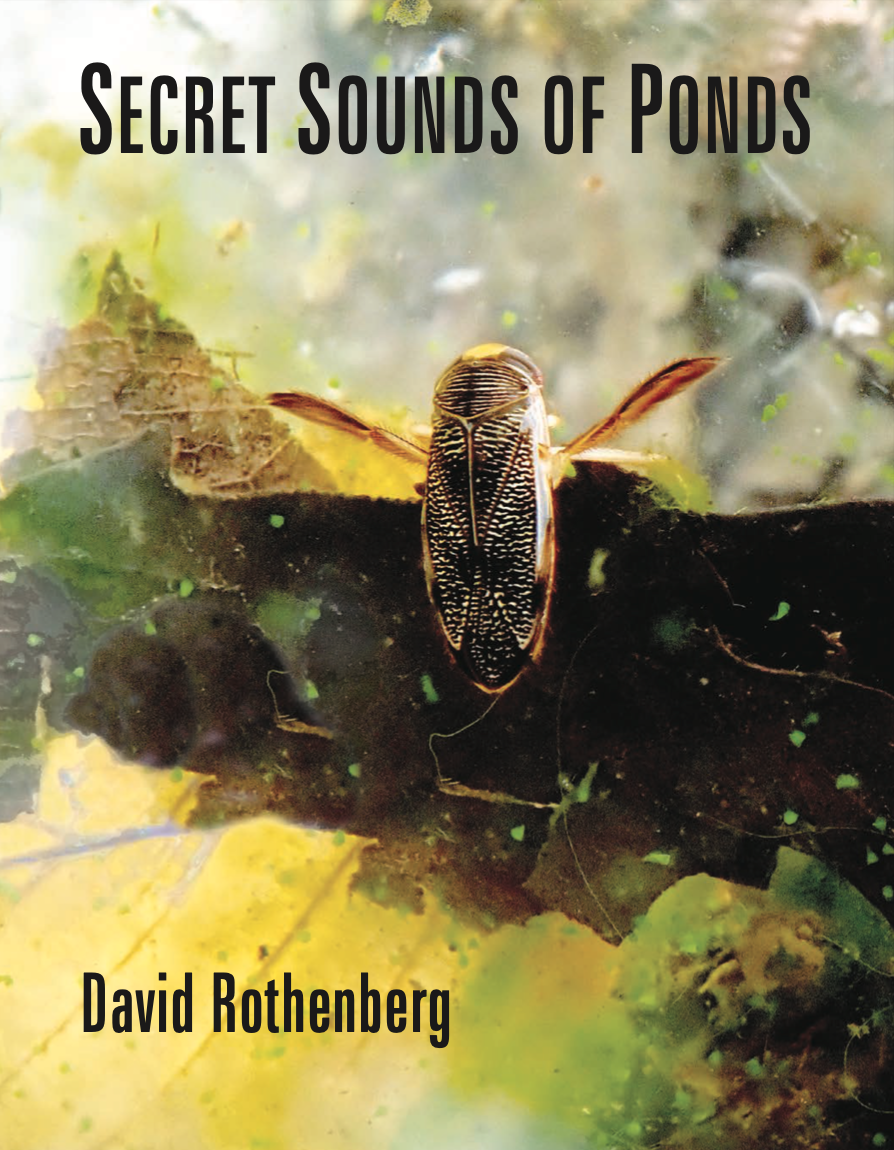
David Rothenberg: Secret Sounds of Ponds (Book Review)

“The pond is the teacher, underwater lies the source.”
–David Rothenberg

Near the apartment complex I once called home, before I migrated to my present dwelling, a pond would awaken each night in amphibious utterances. Frogs, crickets, and invisible choir members released a polyphony of chirrups and croaks that spilled into the humid dark. It was alluring enough that I found myself inventing post-meridian errands just to step outside and listen. I remember how the air trembled with that sound, neither wild nor domestic, a liminal language that both invited and eluded comprehension. I never tried to categorize it then; it was enough to be absorbed. What struck me most was its irregularity, a music without time signatures, and yet, the longer I listened, the more I could discern the soloists from within, the deliberate from the accidental. What I did not realize, however, was that this was only the surface of a deeper, secret orchestra playing just beneath my feet.

It was during the stillness of the pandemic that musician, philosopher, educator, and animal collaborator David Rothenberg turned his own attention downward. He found that ponds, those apparently placid mirrors of sky and branch, are paradoxical entities: tranquil to the eye, yet pulsing with invisible sound. Above the water, a hush. Below, a thicket of sonic life. But how does one hear through liquid? Rothenberg, already attuned to the songs of whales, found his usual instruments inadequate. He commissioned a hydrophone capable not merely of recording but of touching sound, translating the tactile shimmer of aquatic vibration into something audible. In doing so, he discovered not merely a pond but a pulse, a murmuring node within the living organism of the planet. In this submerged language, he recognized that the world itself is always breathing, whispering, and improvising at the edge of consciousness. The recordings discussed and contextualized in Secret Sounds of Ponds feel like a revelation, a form of listening that brushes the hair of the mind, a continuous and organic ASMR channel that one can tune into and out of at will.

Yet the music is not only animal. The flora, too, contribute their delicate speech: plants releasing oxygen bubbles as miniature offerings, each a syllable in an ancient conversation. “The plants keep time,” Rothenberg notes, “and the beasts carry a tune.” One hears this and realizes how naïve our auditory hierarchies have been. We’ve long believed that sound belongs to the realm of motion, of bodies and breath. Yet here are rooted beings, singing through photosynthesis, metronomes of life itself.

Rothenberg reminds us that “even in this century where everything seems possible, morphable, changeable, hearable, findable at a moment’s thought, there are still sounds around us… immediate sounds that we still don’t know.” If we are ignorant of our surroundings, perhaps we are equally ignorant of our origins. We imagine that knowing where we are going requires understanding where we’ve come from, yet Rothenberg suggests the opposite: that both the departure and destination are wrapped in the same sonic fog. Thus, we meet the limits of our perception and the possibility that such limits are spiritual. The indistinguishable becomes indistinguishably beautiful. Insect, fish, turtle, plant: all’s fair in love and pond life.

This mode of listening is not a science but a humility. It compels us to ask impossible questions. If technology must translate these frequencies for us, were we ever meant to hear them? When we call this music, do we consecrate or colonize it? Is it communion or interference? Somewhere, I imagine, John Cage laughs from the beyond, his silence perforated by the croak of a frog.

“For all the millions of hours we have spent together with animals,” Rothenberg observes, “we still cannot speak with them.” The task, then, is not to translate but to collaborate, to become co-musicians in a score that predates our language. Sound may have no intention, no recipient, and yet we crave both. We are instruments yearning for meaning, resonating for a moment before fading into the dissonance of time. Listening, as Rothenberg reminds us, “reveals things alive before we can claim them.” This is the ethical heart of the project: listening not to possess but to participate. Without that transformation, we remain voyeurs; with it, we become apprentices in the grammar of existence, learning not to compose but to decompose, to take apart what our words have wrongly fused.

I think here of Bashō’s immortal haiku, in D.T. Suzuki’s translation:

Into the ancient pond
A frog jumps
Water’s sound!

It is easy to romanticize this image, to see it as a vignette of simplicity. Yet the poem’s true profundity lies in its inversion: the pond, not the frog, is the voice; the frog merely the activator, the finger on the cosmic key. That the frog is jumping into a pond is never in doubt, yet translators have long struggled to articulate that final sound—“splash,” “plop,” “water-note,” “kerplunk”—but perhaps that indeterminacy is the point. The sound eludes capture because it was never meant to be caught. Like Rothenberg’s recordings, made accessible via QR codes throughout the book or online in album form as Secret Songs of Ponds, it dwells in the space between articulation and silence, between perception and being.

Hence the human impulse to name: to label every ripple and rustle—scratching, blipping, bubbling, warbling—as if taxonomy were intimacy. Rothenberg resists that impulse by layering his own clarinet into the watery mix, joining a chorus rather than leading it. His collaborations with Ilgın Deniz Akseloğlu, whose deconstructive poetry conjures an invented language of resonance rather than reference, push this further. Her contributions hover like dreams, vocal fragments rising from the mire of the unconscious. Listening to “I Still Don’t Get How Distance Works,” one feels time dissolving; her voice becomes an echo of the pond itself, diffused and omnipresent.

In other tracks, Rothenberg’s clarinet drifts like an inquisitive creature among the bubbles and squeaks—curious, reverent, never dominant. I am reminded of Ornette Coleman’s philosophy of sound as motion through possibility: music as exploration, not arrival. Elsewhere, the pond alone is permitted to speak, recalling early electronic composers like Ilhan Mimaroglu, who inverted futurism into introspection, aiming their microphones inward to locate the primordial hum within us all.

Most of all, I think of Akifumi Nakajima, a.k.a. Aube, whose sonic investigations of fire, air, blood, and brain waves sought the inner pulse of matter itself. To engage with Secret Sounds of Ponds is to place a stethoscope against the earth’s waterlogged chest and hear it crackle. Rothenberg confesses, “I don’t play with the pond, but the pond plays with me.” That inversion, again, is key. The artist becomes the instrument, the listener the medium. This is not music about nature; it is nature using us to make itself known.

There is a sacred vertigo in such encounters. What begins as fascination turns toward reverence, even dread, as one senses the immensity of what vibrates beneath the apparent stillness of the world. Ponds, like temples, are mirrors of our incomprehension. They draw us inward until we see that to listen is to surrender.

And so, whenever I pass a pond now, I find myself wondering not merely what lives there, but where it came from. Science offers its explanations of erosion, accumulation, and equilibrium, but the heart refuses to hear them. The mind insists on something older, more mysterious: that the earth itself opened a small mouth to breathe, and we, by accident or grace, happened to hear it.

Unfamiliar Listening: A Brief Introduction to Experimental Field Recordings

For many, the term “field recording” evokes the greatest hits of natural sounds: ocean waves, rain, and birdsong. Indeed, one of the earliest field recordings dates to 1889, when an eight-year-old Ludwig Koch wax-cylindered the song of a white-rumped shama. In more recent history, anyone of reading age in the heyday of National Geographic may remember Roger Payne’s Songs of the Humpback Whale, inserted as a flexi disc in a collectible 1979 issue. Ten million copies of it were printed—more than any album ever produced in a single run. Payne’s classic and others like it endure for their scientific value, serving as springboards for studies of language and the potential for interspecies communication. They also spawned a robust environmental movement at a time when modernity was threatening to divorce humanity from nature. By the same token, microphones can get too close to their subjects, as in Hans Lichtenecker’s “archive of endangered races,” which documented descendants of the very peoples his comrades slaughtered in German Southwest Africa (what is now Namibia). Even the most benign anthropological motivations have fallen under retrospective scrutiny.

I will not be reviewing such projects here. Instead, I wish to examine—and, I hope, bring fresh ears to—a visceral stream of experimental field recordings. While tracing the origins of such an amorphous category can be difficult, an indisputable pioneer is Jeph Jerman, whose seminal work tops the list below. Kindred visionaries in this sphere of influence include Francisco López, Alan Lamb, and John Tulchin. I highlight their endeavors, subjective as my favorites among them are, in the interest of expanding their embrace of sameness through difference.

These recordings constitute a form of sonic travel to worlds at once internal and distant. Some are spliced and collaged within compositional frameworks in tandem with electronic and acoustic instruments, others manipulated beyond recognition, and still others presented as they are—but always with an aesthetic in mind, even if that aesthetic is simply to let sounds “happen.” Their significance cannot be overstated—not because they represent an overarching artistic ethos but precisely because they shun that motivation in favor of genuinely borderless spaces. It’s not often we can listen to a corpus of sounds without transfusing the blood of our politics and ideologies into it. Here, we can. Such comfort means more than ever in a world on its knees, wondering whether the healing will begin.

Jeph Jerman: Early Recordings ’81-’85

Also known by the moniker Hands To, Jeph Jerman first set out with his cheap cassette deck in the 1980s to document the act of listening while questioning its practices and apparatuses. What continues to fascinate about his recordings is how raw and curated they feel. And while some of his most unadulterated work (e.g., Beach Tree and Birds, 2001, A Pyrrhic Victory) is woefully difficult to track down, this compilation of early recordings is a grounded place to start. Lo-fi swaths of mostly industrial settings (e.g., “Metal Fabricating Shop, Colorado Springs”) reveal an unimaginable depth in the mundane.

Alan Lamb: Archival Recordings: Primal Image/Beauty

In 1976, Australian biomedical research scientist Alan Lamb first discovered the abandoned stretch of telephone wires that would define his artistic endeavors to come. Dubbed the Faraway Wind Organ, this massive vibrating skeleton loosed eerie songs at the touch of an air current, echoing since his childhood into a mature desire to record them. That he did, often for hours at a time, assembling choice passages into this otherworldly diptych. Whether whispering the mantras of uninhabited terrain or choiring like a Glenn Branca symphony, these requiems step out of time and ooze their way into the bloodstream.

Maggi Payne: Ping/Pong: Beyond The Pail

Maggi Payne is a venerated composer and multimedia artist whose output has largely focused on electro-acoustic constructions. Her field recordings of “dry ice, space transmissions, BART trains, and poor plumbing” congregated to astounding effect on 2010’s Arctic Winds, but 2003’s Ping/Pong: Beyond The Pail preserved another level of intimacy. Its two 30-minute tracks, recorded in a galvanized steel pail, offer complementary experiences of rainfall through the intermediary of the album’s eponymous vessel. The first catches the rain openly, while the second inverts the pail for a drum-like effect, sealing us in a metallic chamber without excuse for distraction.

John Tulchin: Location Recordings

This collection’s first track, “Fire Alarm From A Distance (Winter Park, FL.),” is indicative of John Tulchin’s questing spirit. It’s also one of the most haunting field recordings in readily available form and an entry into an album unlike any other. The pragmatic titles—“Metal Structure In The Desert (Dead Horse Ranch, AZ.),” “Log Partially Submerged In Water (Seattle, WA.),” etc.— only deepen the possibilities of interpreting them. Somehow, knowing what we are hearing makes it clear how much we miss. Thankfully, we have Tulchin to fill in those gaps with heartfelt portraits of time incarnate.

Quiet American: Plumbing And Irrigation Of South Asia

Quiet American, an homage to the novel by Graham Greene, is the sound manipulation project of San Francisco Bay Area artist Aaron Ximm. Plumbing And Irrigation Of South Asia is at once exactly what it sounds like and something else entirely. Nominally, it is a vast collection of field recordings of various community fixtures, such as a drainage pipe in Madikeri (India), a water pump in Khulna (Bangladesh), and a toilet in Kathmandu (Nepal). Other locations include Vietnam, Burma, Laos, and China. Beyond that, it is an unassuming travelogue filtered through the mesh of a respectful phonographic memory.

Jgrzinich: Insular Regions

John Grzinich is a sculptor combining found sounds and instruments of his own design. For this 2005 release, he gathered personal impressions of Mooste, a rural Estonian village. Insular Regions is among the more tactile albums in this guide’s category of interest. Its resonant intersections of wood, wind, and wire feel like a portal into another dimension. And yet, we are constantly reminded of their fleshly purview, which Grzinich sees no reason to hide. What we hear is what we get, even when we know it has been transformed through technology, because every electrical circuit runs on our conductivity.

Loren Chasse: Synthesis of Neglected Places

Loren Chasse is a humble public school teacher in San Francisco who seems never to have lost that childlike wonder for the world around him. Synthesis of Neglected Places was originally produced as a cassette in 1998 by the Unique Ancient Tavern label. Over the course of eight parts, it lives out every moment in the full knowledge that the act of recording will change its genetic makeup. As Chasse’s most crepuscular album, it speaks in tongues of light and shadow in equal measure, drawing out tasteful keyboard touches as if from within.

Loren Chasse: The Air In The Sand

Loren Chasse leaves behind precious recollections of experiences you never knew you had. That such dreamlike qualities are elicited from unabashed reality sets his work apart. The Air In The Sand shares the spirit of 2002’s Hedge of Nerves, which meshed the crackle of vinyl with sounds of the elements, expanding that aesthetic to welcome wider-reaching absorptions. By revealing the natural in the artificial and vice versa, he pays deference to the molecules common to all matter, guiding them in chorus even as they lead him in kind to voices hibernating until they can be amplified.

Click on the sub-cover titles below to see my reviews of other vital albums in this loosely allied genre.

Francisco López: Addy En El País De Las Frutas Y Los Chunches

Eric La Casa: The Stones Of The Threshold

Collin Olan: Rec01

David Dunn: The Sound of Light in the Trees

Lionel Marchetti: Portrait d’un glacier

John Hudak: Pond

Koura: Shisō

MNortham: Molt And Anecdote

Seth Nehil: Uva

Murmer: Eyes Like A Fish

Jonathan Coleclough/Murmer: Husk

Jgrzinich/Seth Nehil: Confluence

Search Ensembles: Prescient/Legend

Prescient:Legend

With Prescient/Legend, producer and sound artist Dale Lloyd deepens his Search Ensembles project excavation after breaking ground with its 2015 self-titled debut on Lloyd’s and/OAR label. Although released 2019 on the either/OAR sibling imprint, this follow-up was culled from recordings made between 1986 and 2018 by a range of field recordists and instrumental artists, including Alan Courtis, Cedric Peyronnet, Cyril Herry, Eric Lanzillotta, Jani Hirvonen, Jon Tulchin, Mark Reynolds, Michael Northam, Mike Hallenbeck, Phil Legard, and Slavek Kwi. Lloyd sifted through their previously unreleased archives, forging timeless relationships in reassembly, while also inviting new material to be added through a variety of instruments.

“Search Ensembles started as an archaeological dig in the audio sense,” says Lloyd of the project. “I’d always wanted to do a project that revisited this planet’s history, but in a sense beyond anything we’ve learned in our school textbooks. It’s similar to something I started in early 90s called Lucid, for which we intentionally ‘weathered’ or ‘aged’ the recordings to give them an older aesthetic. That’s one of the motivating factors for digging into past recordings with so-called less-than-perfect sound quality. It felt compatible at all levels.”

Search Ensembles renders each of its sources, both organic and manufactured, as instruments in a compositional array. The result is a catalyst for elemental reactions. As far as choosing material that felt appropriate, Lloyd notes that coincidences of opportunity played an important role in shaping what emerged. “It was partially a happenstance thing. Some of the material, for instance, was gradual—things I had heard over time and which felt both appropriate and available.” Beyond that, he points to a relatively new interest in library production music as a tangible influence. Such recordings are forgotten time capsules, and hold in their nostrils the fragrances of ancient civilizations. In that sense, what we have here is nothing short of a patient awakening of buried melodies and textures after millennial slumber. In keeping with the metaphor—indeed, treating it as more than such—the album lays out artifacts still clinging to dust. Each is a village unto itself, spoken in the language of a place that no longer exists.

What follows is this listener’s own field notes, taken while surveying the album’s discoveries and calibrated by ears undeterred by temptation of silence…

1
As natural causes bubble to surface of perception, each works symbiotically with the other in a conversation so internal that it slips through the other side into an external manifesto. Tones at once distant yet so ingrained in the skin that you cannot help but be wounded by them coil around one another, searching for ideas as if they were physical traces left by immaterial souls.

2
Heartbeats and hints of thunder are kindred spirits. Their children are our ancestors, whose messages make paper of our brain tissue when we dream. Worthy only of being imbibed like plants crushed in stone and brewed into a tea of knowledge, they grow for the purpose of being snipped at the source. The crickets nestling around them are not messengers of the night, but remnants of the day speaking in tongues of sunrise.

3
Birds flock behind closed eyes, touching the liminal covering of reality with their wingtips but always returning to the percussion of flesh, metal, and bone.

4
A perpetual shushing of impulses by mothers whose evening chorus filters out the purest components of twilight. Voices are implied by the horizon’s arching back, flush with starlight as a lotus to pond’s surface. What was once implied becomes doctrinal, yearning to bring distances together: a Big Bang in reverse to the first pinprick of creation.

5
That same calling echoes here as dotted lines surround areas of conquering. Like frightened children wielding chalk on a blacktop, they reveal themselves in a tentative cartography, as predictive as it is unknowable.

6
The insects arrive with songs in their thoraxes, hidden until the final sting ejects their souls into death. They wander as if to wonder, hoping for the sky to fill in their broken choices with the possibility of a new hive, only to watch it die with roll of a farm machine intent only on destruction.

7
Splashes of water eject molecules of death, giving way to imaginary towers whose resonant chambers are the beginnings of life.

8
The printing press of the night leaves its mantras visible in the sky above, while the ground below thrives with pre-cultivation memories. A synthesizer is aurora to the flute’s borealis, reaching in for warmth and finding a talisman that is cool to the touch.

9
Static made biological: a song of conception, fertile in its detail. In the background: the cry of a mother yet to be born.

10
Overtones are undercurrents of faith, each dripping with reason until only truth is left in its evaporated wake.

Throughout this album, things hidden in the recesses of our collective past are being reckoned with sonically. More than that, they are turned in the hands until their sharpest points become rounded. A roof over solace, a library of parthenogenetic design whose shelves are as layered as the rock from which they were unearthed. “We’re documenting cultural activity,” Lloyd observes, “something that hasn’t been documented in any other way or is far less known to us.” More than unknown, I would venture to say that what we stumble upon here is a culture that does not exist except by the grace of those fortunate enough to give it three dimensions in the listening.

(For ordering information and to hear a sample, click here.)