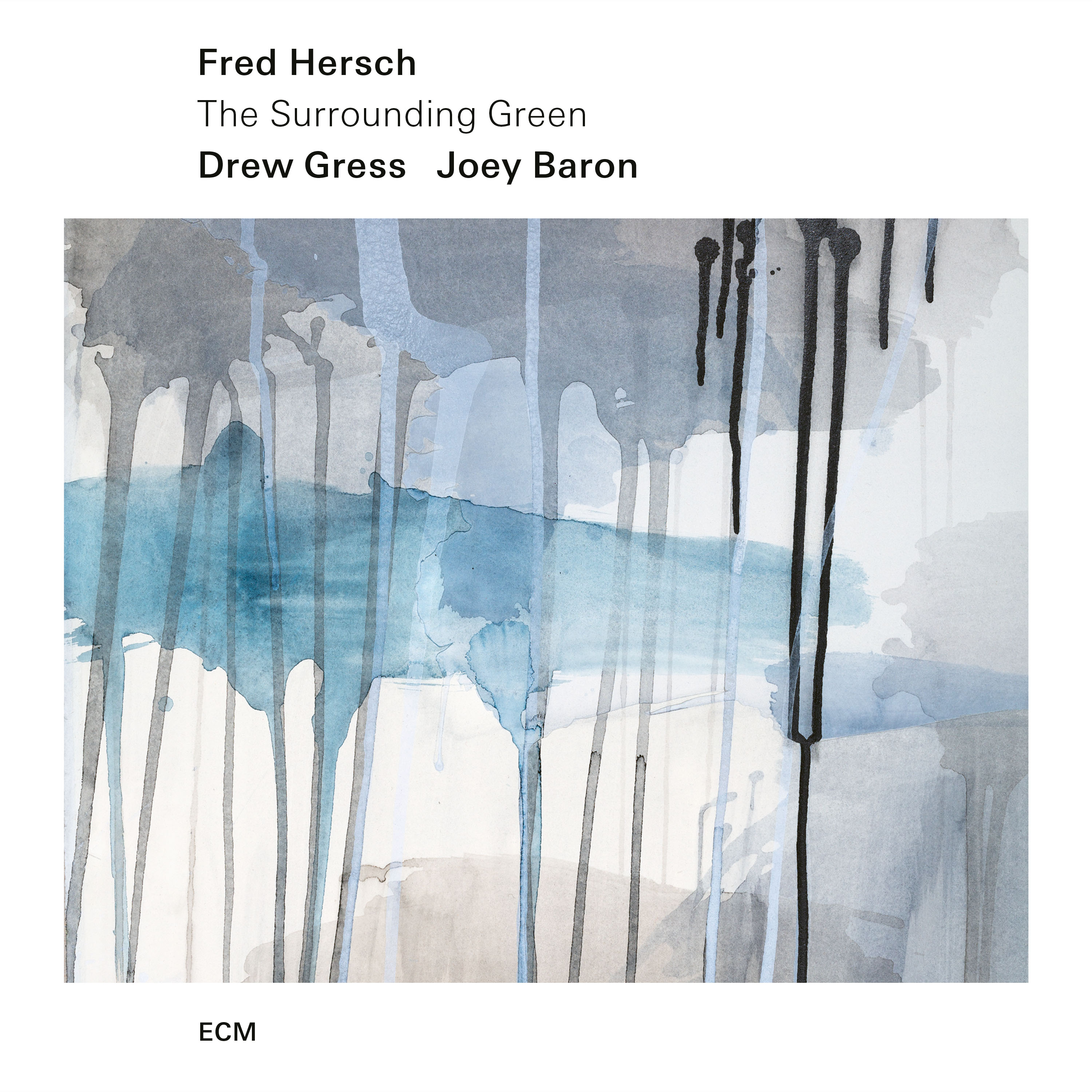
Fred Hersch: The Surrounding Green (ECM 2836)

Fred Hersch
The Surrounding Green

Fred Hersch piano
Drew Gress double bass
Joey Baron drums
Recorded May 2024
Auditorio Stelio Molo RSI, Lugano
Engineer: Stefano Amerio
Cover: Andreas Kocks
Produced by Manfred Eicher
Release date: June 27, 2025

Pianist Fred Hersch’s ECM journey, brief as it has been so far, already feels like a lifetime in its emotional scope. Beginning in duet with legendary trumpeter Enrico Rava, followed by a solo album, he now returns to Lugano’s Auditorio Stelio Molo RSI for a trio session with bassist Drew Gress and drummer Joey Baron. Despite having played with either musician in various contexts for decades, this is their first studio album as a trio, and the result has all the makings of a classic—not by mere virtue of its talented assembly (which is reason enough to rejoice) but also for the easy confidence of its touch.

Hersch contributes three tunes to the proceedings, of which “Plainsong” is our port of entry. Its introductory lines are so nostalgic, you’d be forgiven for thinking you grew up with them. As the variegated spectrum of autumn gives way to winter, Hersch rides a slow-motion wave in search of warmer shelter, which he finds in the title track. The breadth of Hersch’s melodic sensibilities is breathtaking here, hinting at faraway places while remaining intimate. And in the Latin-tinged beauty of “Anticipation,” the piano dances in midair without a worry to weigh it down.

That Hersch’s writing holds its own alongside “Law Years” is a wonder in and of itself. Ornette Coleman’s untanglings contrast with the measured melancholy of the bandleader with an even freer charge. In addition to the geometrically astute interplay from Gress and Baron, what impresses is the amount of space Hersch folds into his soloing, which, despite being a mighty stream of consciousness, allows for plenty of pauses, breaths, and exploratory surprises.

“First Song” by Charlie Haden feels like an inevitable choice. It opens with a solo from Gress, melting into Hersch’s lines like butter before Baron’s brushes baste that flavor in one stroke at a time. Egberto Gismonti’s “Palhaço” is another, and one that ECM aficionados will recognize from the Magico trio sessions and a smattering of Carmo recordings. Its childlike whimsy speaks through rainlike washes of chords from the keys. But it is in the Gershwin brothers’ “Embraceable You” that the band finds the biggest depths to plumb. With a light touch but deep roots, Hersch unlocks a powerful energy that one must fight to escape.

One thing that distinguishes Hersch in the world of jazz piano is his way with endings. Having the destination written in his heart, he is that rare magician who, even after telling us how the trick is done, still leaves us astonished.
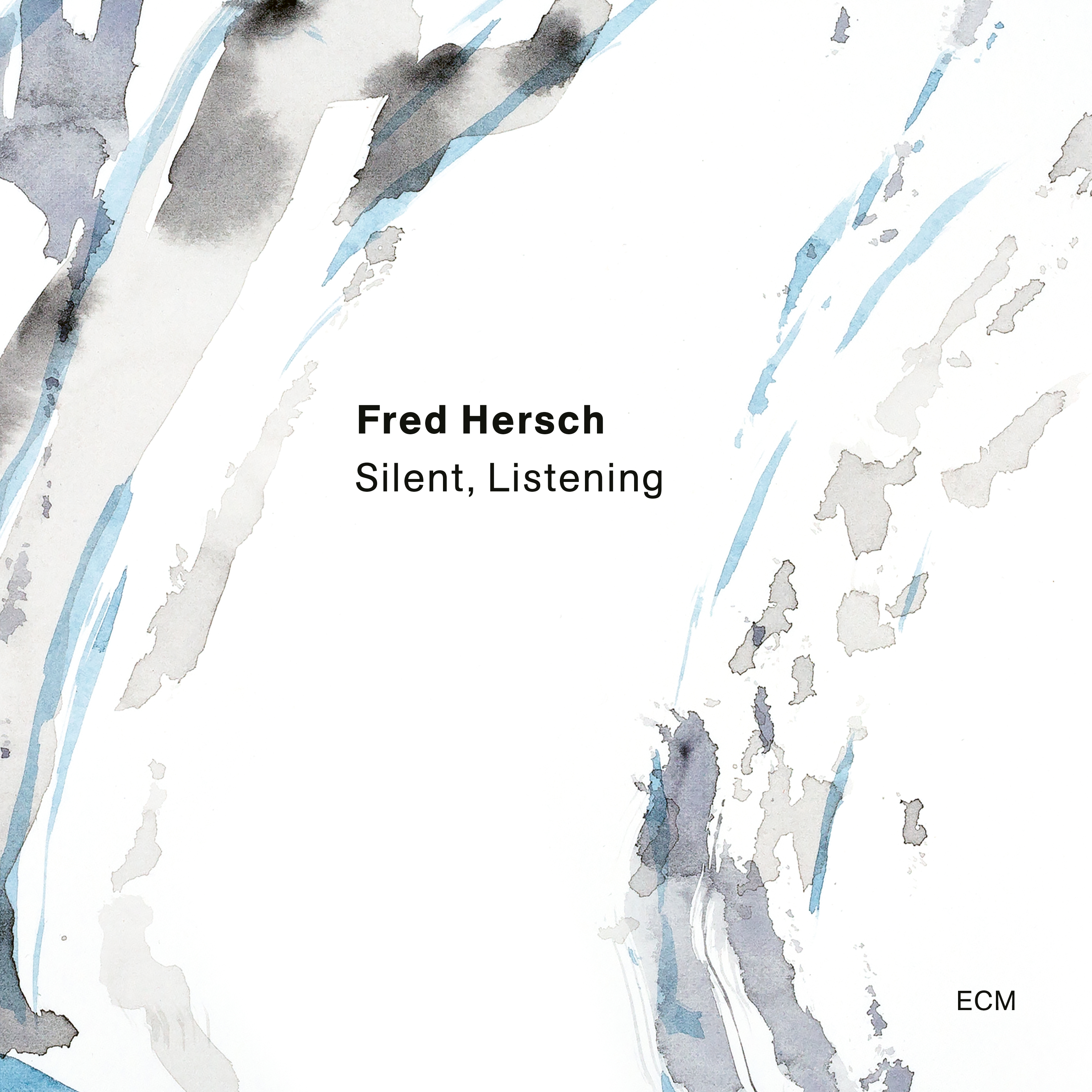
Fred Hersch: Silent, Listening (ECM 2799)

Fred Hersch
Silent, Listening

Fred Hersch piano
Recorded May 2023 at Auditorio Stelio Molo RSI, Lugano
Engineer: Stefano Amerio
Cover: Andreas Kocks
Produced by Manfred Eicher
Release date: April 19, 2024

“I don’t use ideas. Every time I have an idea, it’s too limiting and usually turns out to be a disappointment. But I haven’t run out of curiosity.”
—Robert Rauschenberg

After making his ECM debut with trumpeter Enrico Rava on 2022’s The Song Is You, pianist Fred Hersch releases his first solo album for the label. Pleased with the feel of recording at Lugano’s Auditorio Stelio Molo RSI and the piano on which he played that spontaneous session, he felt committed to the idea of returning to the same space and instrument. In the album’s EPK, Hersch speaks of the title as connoting not listening silently but rather a mode of patience from which music grows of its own accord, as is immediately palpable in “Star-Crossed Lovers.” Through the keyhole of this Billy Strayhorn/Duke Ellington classic, we glimpse a realm only articulable in notecraft such as this. Hersch’s sense of touch is profoundly ahead of so many other players, his feeling for melodic form (not just prettiness for the sake of it) giving flesh to every bone.

After such a suspension, the abstractions of “Night Tide Light” set the stage for a swath of freely improvised and original music. They break the spell without ever removing its base components, distilling them into a new tincture for creative souls. Upon drinking it, the mystical aura of “Akrasia” pulls away the proverbial veil to reveal a not-so-proverbial landscape populated by memories knowable only to the listener. As starlight weaves through dampened strings, we are shown new constellations in our image. As the story goes, Hersch brought his sheet music for this original composition, which he realized was on the floor after the recording started, so he just played the beginning and went from there. “Aeon” is one of a few titles taken from the oeuvre of painter Robert Rauschenberg and speaks more to the transcendence at play here. “Volon” is another, working dissonance into a grammar all its own.

The title track is pure transcendence. Improvised without preparation, its feeling is never stable. It wavers between weightless highs and gravid lows—the very qualities of life itself. “Starlight” is perhaps the most descriptive title for the album. It flirts with Debussy’s Clair de Lune before veering off along its own paths, always keeping a toe in the former’s shadow. Distant fires, whispering of a destructive power that looks beautiful from afar, burn quietly. “Little Song,” originally written for the duo project with Rava, receives its premiere here. It’s a tune that bends itself in three dimensions to the listener’s ear, needing nothing but its heartbeat as accompaniment.

“The Wind” (Russ Freeman) is a first take that flows as if it were the tenth. There is something nostalgic about its contours, a certain magic of the past that permeates so many of ECM’s past solo piano gems, including Keith Jarrett’s The Melody At Night, With You and Paul Bley’s Solo in Mondsee. Similarly, this must be heard from beginning to end to be appreciated fully. Hersch lets the sounds go wherever they must, never forcing the keys where they will not bend. It ends with a rustling of leaves, a stirring of the soul, and a baptism of moonlight. The standard “Softly, As In A Morning Sunrise” is a nod to Hersch’s self-professed hero, Sonny Rollins, whereas “Winter Of My Discontent” is an inspiration to itself. Like James Joyce at his most accessible, this is modernism given a fine mesh through which to steep its tea. Thus, the predetermined is not a seed but a base layer for something humane to be built on top. The taller it gets, the more it reacts to the wind, never toppling but gracing the clouds with its teetering metronome.

Enrico Rava/Fred Hersch: The Song Is You (ECM 2746)

Enrico Rava
Fred Hersch
The Song Is You

Enrico Rava flugelhorn
Fred Hersch piano
Recorded November 2021
Auditorio Stelio Molo RSI, Lugano
Engineer: Stefano Amerio
Cover: Fidel Sclavo
Produced by Manfred Eicher
Release date: September 9, 2022

Pianist Fred Hersch makes his ECM debut in intimately grand fashion with maestro Enrico Rava on flugelhorn. Their meeting at Lugano’s Auditorio Stelio Molo RSI yields some of the most effortless jazz you’ll likely hear this year. Hersch’s opening embrace eases us into Antônio Carlos Jobim’s “Retrato em Branco e Preto” as if the set could open no other way, fanning expository poetry in place of lantern flame. An old-town quality prevails, navigating cobblestone streets on tiptoe yet never losing its footing.

Contrary to immediate expectation, this is followed by a free improvisation, which tempers the familiar with new shades of meaning. George Bassman’s “I’m Getting Sentimental Over You” gets a delicate and rhythmically endearing treatment, while the title track by Jerome Kern is enigmatically transformed into a crystalline snowdrift of memory. Thelonious Monk’s “Misterioso” walks a fine line between dream and reality, giving way to artful abstractions that reveal two minds with lifetimes more to say, as do the originals that precede it. Whereas “Child’s Song” (Hersch) conveys innocence with a nostalgic, summery feel that harks to yesteryears, “The Trial” (Rava) renders an entanglement of spiral staircases and other modern architectural details. All of this leaves Hersch alone with “’Round Midnight,” floating into the promise of a new day, uncertain though it may be.

These musicians achieve the extraordinary by sounding like one unit without sacrificing their voices. They dance as few know how, unfolding a love letter one page at a time until only a wax seal seems appropriate to protect its contents from the sun’s bleaching touch.

Fred Hersch review for The NYC Jazz Record

the-ballad-of-fred-hersch

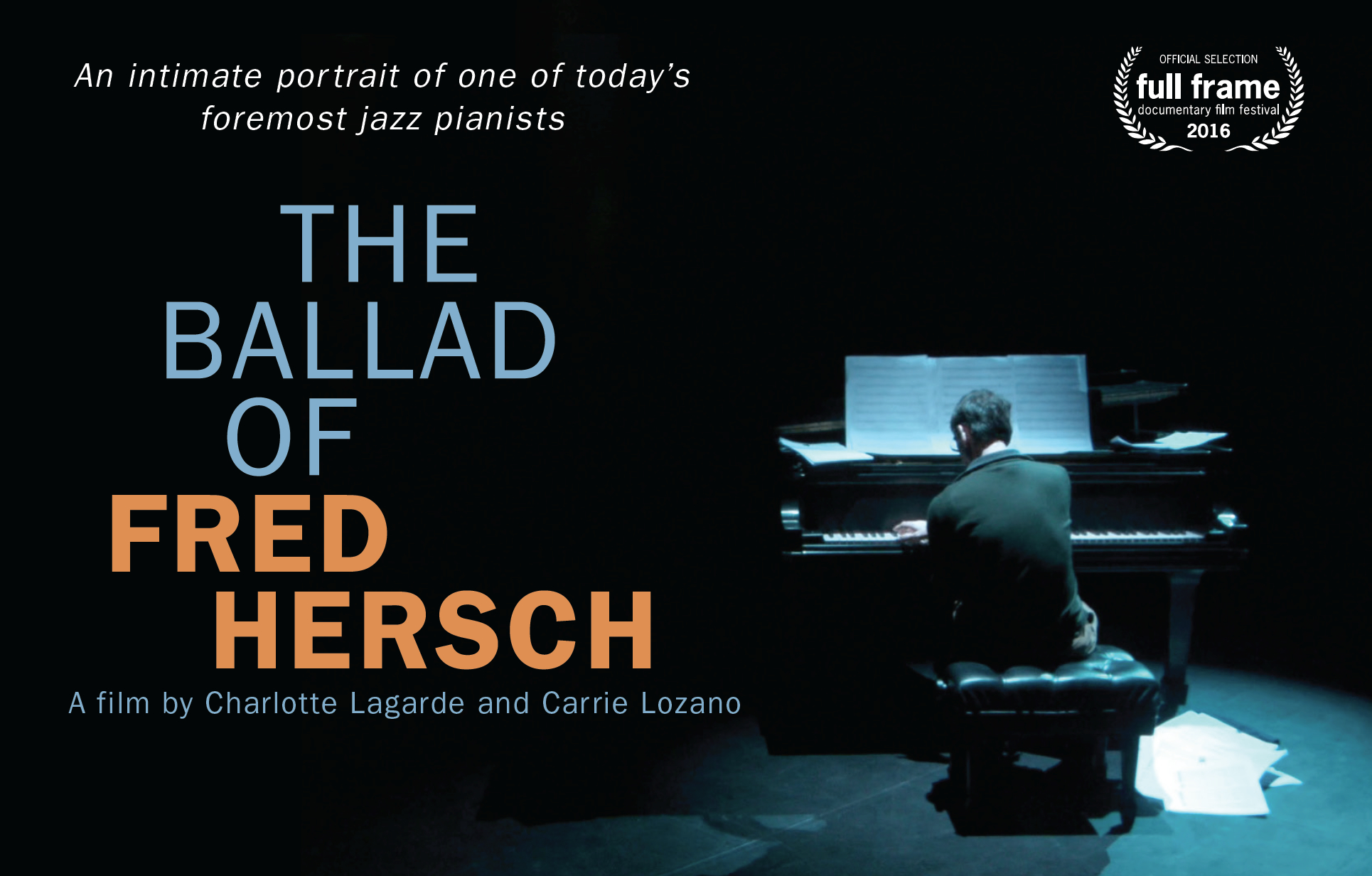
An intimate portrait of a pianist and composer at the height of his career, produced and directed by Charlotte Lagarde and Carrie Lozano, this documentary polishes facets of Hersch’s life that may be less obvious to casual fans. Viewers are introduced to Hersch as he descends the stairs of New York’s Jazz Standard to set up for a performance. From a web of starts, stops and stolen glances, the sound of a musician who now stands among the giants of jazz piano takes shape.

In the words of music critic David Hadju, one of a handful of advocates interviewed, “Fred’s music is borderless” and the film shows that characterization extending further to his personality. As one who embodies the art of improvisation outside the cage of performance, Hersch is invested in the outcomes of jazz beyond boundaries. It’s there in his organic mosaic of traditions and influences, in his willingness to work with a variety of musicians and in his activism as an HIV-positive gay man. The latter point, largely yet respectfully stressed throughout, is vital to understanding his music’s river-like qualities, which constitute nothing less than an ode-in-progress to life itself.

Nowhere is this so boldly expressed than in his My Coma Dreams, the preparations for and premiere of which dominate this documentary’s second half. Inspired by a series of vivid dreams Hersch experienced after an infection forced him into a coma in 2008, this multimedia work employs speech, video projection and live musicians to tell the story of his recovery. As pianist Jason Moran points out, however, more important than Hersch’s brush with death are the ways in which this magnum opus underscores his historical importance as a torchbearer of jazz’ reckoning with hardship. It’s a message underscored by his biography, which the filmmakers uncover through interviews with his mother Florette Hoffheimer and partner Scott Morgan, but also by his tireless mission to treat music as reality over fantasy. Hersch is keen on acknowledging the specificity of any given performance as an event and hopes that listeners may do the same in return.

((This article originally appeared in the January 2017 issue of The New York City Jazz Record, of which a full PDF is available here.)