
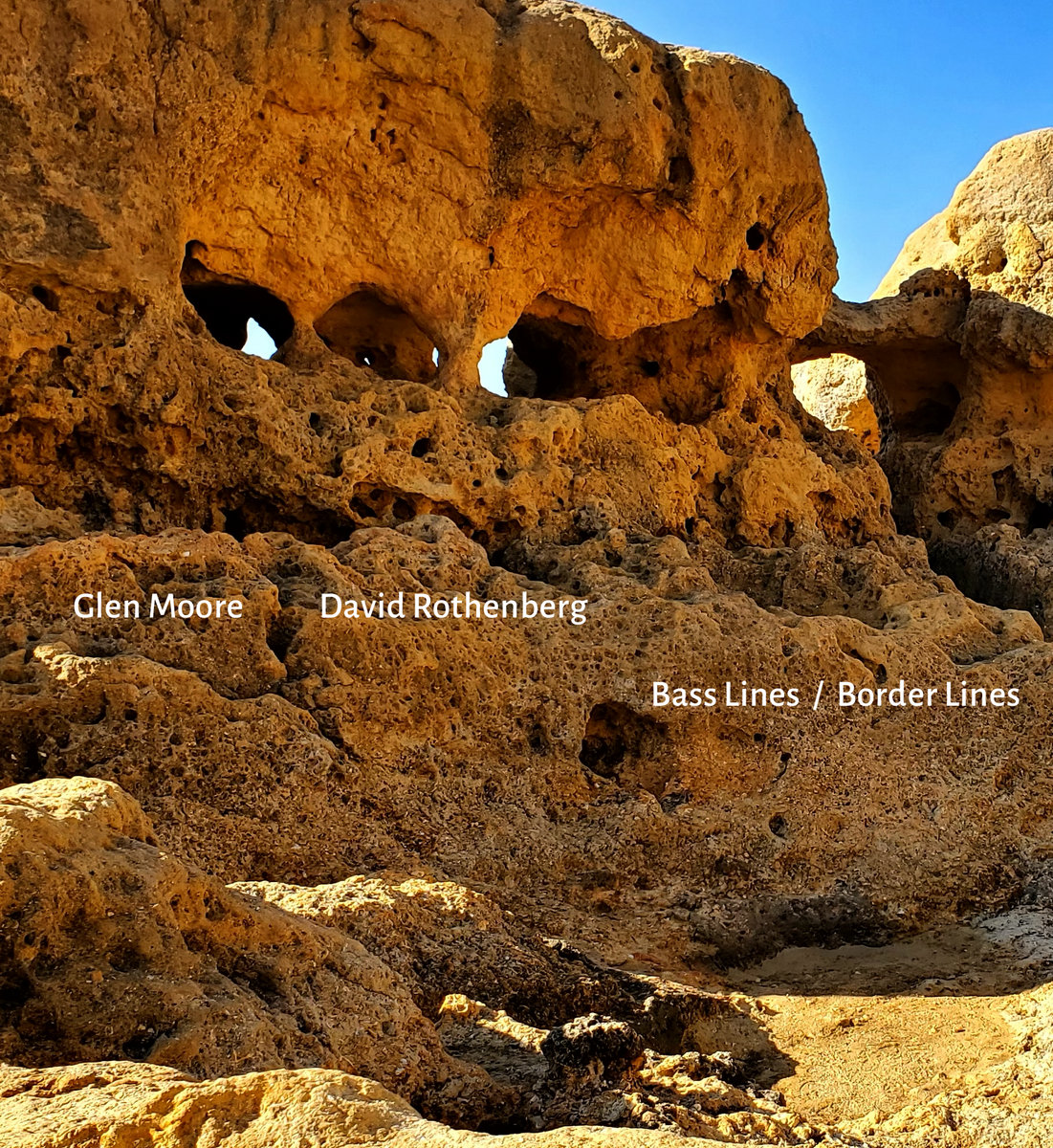
Glen Moore and David Rothenberg: Bass Lines / Border Lines

David Rothenberg lists whales among his contributions to Bass Lines / Border Lines, an arresting credit for a record made in the Dance Hall in Arivaca, Arizona, near the U.S.–Mexico border. The opening piece, “Jaguar through the Wall,” puts that border in the path of an animal with its own reasons for crossing. By the 17-minute finale, “Lives of the Desert Whales,” a humpback has joined Rothenberg and bassist Glen Moore. Rothenberg was 18 when he spent a summer studying with Oregon, the group Moore cofounded with Ralph Towner, to whose memory the album is dedicated. He had been listening to Moore for decades by the time of this recording, and in an interview he mentions how closely a humpback’s song can resemble a bowed double bass. With Moore in the room, the resemblance is just as intriguing the other way around, and you start to wonder how much ocean a bass can hold.

The jaguar is already in motion when we arrive, and the immediacy of the playing gives us no time to craft arbitrary expectations for the improvisatory wonders about to ensue. Upright bass and bass clarinet are griots of subterranean (if not submarine) proportions, versed in whatever passes between a root and the rock it spends its life prying open. Moore’s slides and Rothenberg’s reptilian dances make for a gorgeous pairing, their lines doubling back across ground that each has opened for the other. Beneath the bubbling surface is a deep sense of structure, audible in how much time the players give a delicate passage to find its footing. Their mastery has everything to do with the way they listen, and you can hear it when one catches the tail of the other’s phrase and lets it go.

The arco strains and harmonically infused glissandi of “Coati Mundi” bring us into more crystalline territories, into caves hewn by the slow drip of mineral. The navigation is both external and internal, concerned with the contact of feet to earth even as it works through crevices in search of a softer place. The restraint here is striking, each slip of pitch exposing another translucent layer in what had seemed an indivisible darkness. The title track opens with a superbly articulated bass solo, and the release is so consummate that even Moore seems to have been overtaken by it. Rothenberg’s monologue rides the wave of a backgrounded reverb, charting a passage through time as a physical substance to be felt with the soles of the feet. When an echo lays another floor beneath a word that has just touched down, you can almost feel the ankle adjust.

As the duo comes together, grittier doctrines take shape only to be sliced by the blade of “Your Final America,” which brings cross-sections of the heart into focus. I hear a whisper pitched directly into the ear of an ungracious automaton whose instincts are wired for profit and exploitation. There’s an unnerving intimacy to the address, as though an apparatus of extraction might be persuaded to grow a conscience if someone spoke into it gently enough. Whatever tenderness our storytellers can recover from the encounter, they carry forward in the form of pollen, which has always depended on being taken somewhere it had no means of reaching on its own. Even the whimsically titled “A Lizard War” is a delicate conflict, one that creates as much as it destroys. Its scrapings and postures are part of a mutual language in which each contributor is an equal force, and what survives the scuffle is the possibility of succumbing just as quickly to the next encounter.

In “Lives of the Desert Whales,” the humpback’s song emerges as an organic sonic child and, in the same breath, a parent shepherding the space-time continuum through its own coming of age. The growling compass the musicians have been carrying through the desert now swings toward a creature for whom any line on a map must seem a remarkably provincial invention. The lines Moore and Rothenberg have been drawing all along are measured in breath and in the length of a bow stroke or finger strum. I imagine a fossil hunter lifting a human cochlea from an Arizona outcrop and cataloguing it as the shell of an extinct marine animal. There would be a certain justice in the error, for the most intimate thing that fossil could reveal about our species would be the shape of what once lived inside us without ever becoming ours.

Larry Karush/Glen Moore: May 24, 1976 (JAPO 60014)

May 24, 1976

Larry Karush
Glen Moore
May 24, 1976

Larry Karush piano
Glen Moore bass, violin
Recorded May 1976 at Talent Studios, Oslo
Engineer: Jan Erik Kongshaug
Produced by Manfred Eicher

Bassist and Oregon cofounder Glen Moore joins pianist Larry Karush (who can be found lurking elsewhere on ECM as part of Steve Reich’s ensembles) in a fascinating encounter recorded on the titular date for the JAPO label. Perhaps because the two had already nurtured a deep synergy, what might have been a straight-up duo project instead turned into a spacious and variegated statement. Karush serves up four memorable solo portions, including opener “Untitled.” Balancing cloudy textures with sudden intakes of breath, it leaves only ash to tell of the fire that once burned there. “Transit Boogie,” on the other hand, is a forward-moving piece of ragtime nostalgia that delights in interlocking parts. “Vicissitudes” and “Pamela: At The Hawk’s Well” round out the solo ventures with introspections and intense descriptiveness. Moore’s single lone contribution is “Flagolet,” an overdubbed piece for bowed basses that grinds and twists its own sonic licorice.

“Duet,” the first in a handful of the same, marries these two uncompromising talents in such intuitive ways you’d swear they were separated at birth. Moore’s resonant bassing swims, keens, and prophesies at horsehair’s touch. Like a pinwheel tickled by the fringe of an incoming storm, his energies flourish in a whirl of colors. “Country” finds the bassist leaving deep pizzicato footprints along Karush’s sandy trail. The bluesy serration of this emerging path arcs beautifully into the late-night atmosphere of “Abstinence.” This masterful exchange of air and water finds likeminded release in “Triads,” which concludes with pointillist reflections at the keyboard from behind a David Darling-like gauze. The session’s crowning jewel, however, is “Violin Suite,” which places a smaller bow in Moore’s hands. Its flip-flopping of scratching and melodic itching makes for a sparkling field of contrast that pairs well with the Pifarély/Couturier vintage of Poros.

Sitting at a cerebral interstice between categories, Karush and Moore cover their cardinal bases and then some, leaving us in the end with one of the most wondrous JAPO sessions, period.

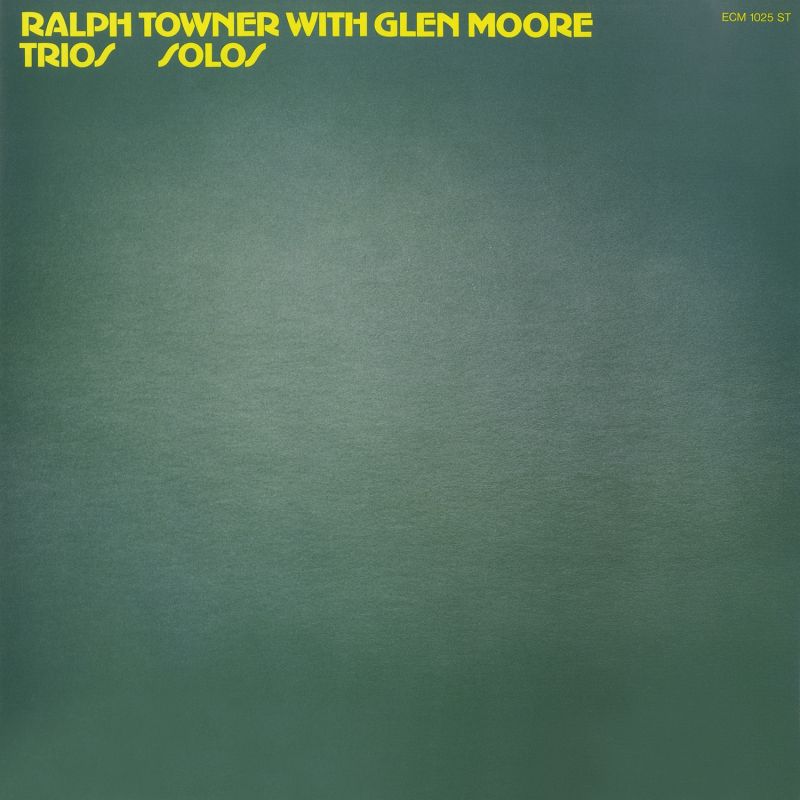
Ralph Towner with Glen Moore: Trios/Solos (ECM 1025)

ECM 1025

Ralph Towner with Glen Moore
Trios/Solos

Ralph Towner guitar, piano
Glen Moore bass
Paul McCandless oboe
Collin Walcott tabla
Recorded November 27/28, 1972 at Sound Ideas Studio, New York City
Engineer: George Klabin
Produced by Manfred Eicher

Essentially an Oregon album under a different name, Trios/Solos consists mainly of Ralph Towner originals culled from the group’s Vanguard sessions. The opening “Brujo” is anchored by Towner’s twelve mighty strings and the late Collin Walcott’s tabla stylings, leaving a winding crevice through which Glen Moore works his whimsical bass. “Noctuary” features Paul McCandless on oboe, soaring loosely through the Towner/Moore fulcrum before the trio ties itself into a tightly improvised not. The Bill Evans tune “Re: Person I Knew” stands out in a gorgeous rendition. Towner doubles on piano and 12-string—laying down a sound that would soon crystallize into his classic ECM album Solstice—as Moore lurks in the background. “Raven’s Wood” continues the same configuration, only this time with nylon, darkening its pastoral modality with nocturnal visions.

Despite the intimate wonders of these trios, the album’s titular solos abound with some of its most focused and furthest-reaching moments. Moore’s “A Belt Of Asteroids” is a curious one at that. Seeming at first out of place in its present company, it carefully peels open the album’s outer layers with every twang. The remainders feature Towner doing what he does best. Take the compact “Suite: 3×12,” a carefully thought out composition in which his palpable picking and love for harmonics shines through at every turn, not to mention his consistently progressive energy. The last of the three movements is more aggressive in its attack and wound around a precise rhythmic core. “Winter Light” is heavily steeped in 6-string nostalgia, lonely but content in its solitude. “1×12” is, by contrast, a run along a blazing trail. Lastly, we have “Reach Me, Friend,” a snapshot of expectation that breathes with audible resolve.

As the driving force behind the album, Towner’s technique is mellifluous as usual, forging an aerial sound that constantly surveys the untouched lakes shimmering below like mirrors in the brilliance of his execution. Despite the lush performances throughout, the imagery is all so viscerally sere. And while there is no danger in what we see, there remains a threat unseen, lingering just beyond the horizon, quelled only by the arrival of the morning sun.

<< Gary Burton/Chick Corea: Crystal Silence (ECM 1024)
>> Stanley Cowell Trio: Illusion Suite (ECM 1026)