
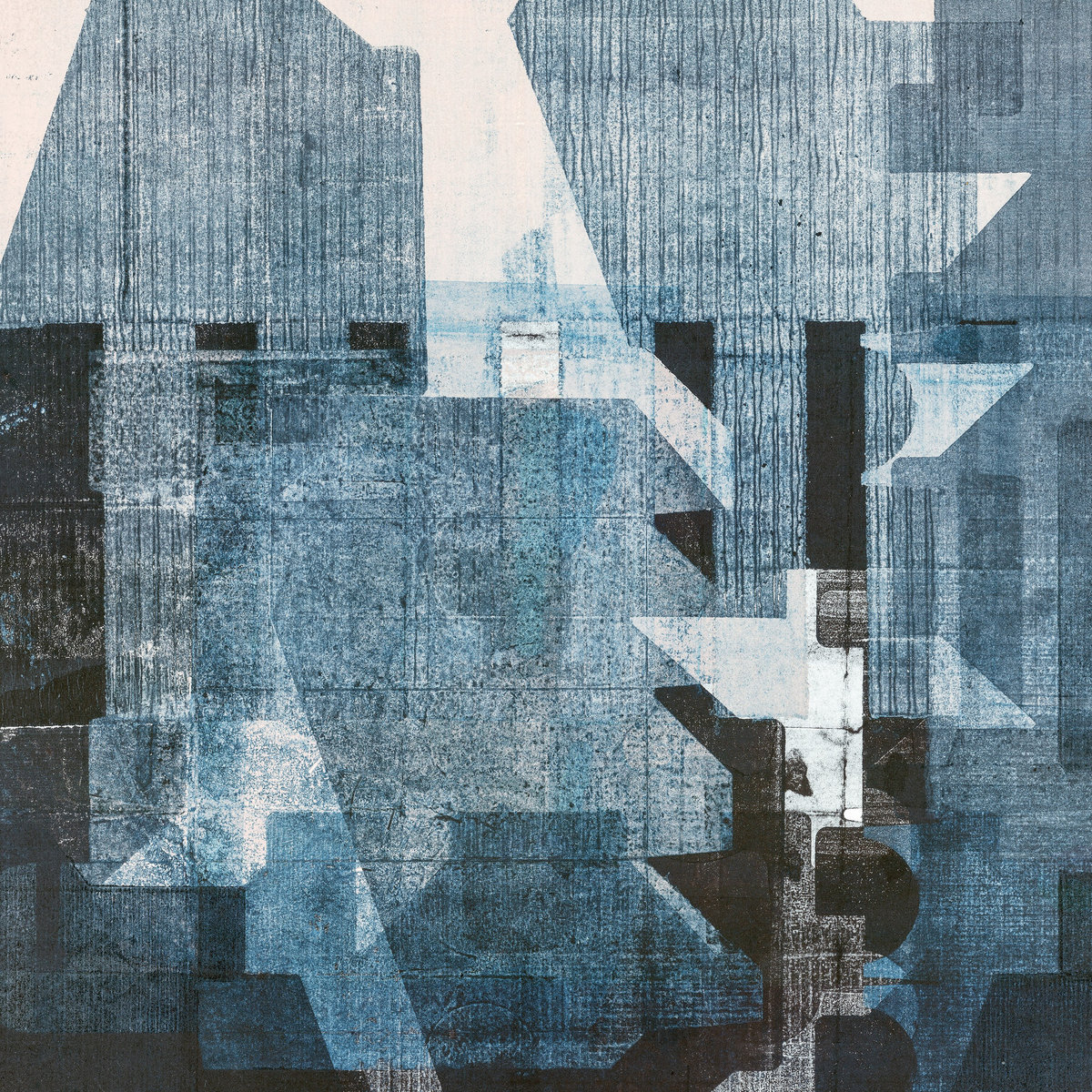
On Trappings of Sleep, the latest release from former ECM producer Sun Chung’s Red Hook imprint, every musical phrase bears record of an intercepted confidence. Caroline Davis’s alto saxophone and electronics extend the body into that disruption, while Grey Mcmurray’s guitar illuminates the intervening dark. Qasim Naqvi approaches the drums with an alertness that makes even the smallest quiver consequential. Together, they suggest an observatory of reflection. Recorded in Brooklyn in May 2025, the album gathers compositions by each participant, giving their instinctive rapport a written framework that remains open to the discoveries of performance. Across this Red Hook Records release, the ear adjusts to unfamiliar magnitudes, discovering that a barely sustained tone can occupy an enormous expanse. The invitation is to listen beyond the point at which recognition usually permits us to stop.
The fascination of “Three” begins in its agitated details, which draw us toward something whose dimensions remain uncertain. Davis brings a palpable warmth to the emerging forms, allowing the alto’s physical character to persist amid the electronic shimmer. Her playing keeps a human presence within reach, however strange the surrounding coordinates become. A related restlessness inhabits “Joust,” where the guitar’s fractured gestures and the drums’ shifting footing make the encounter more volatile. Davis cuts her own path through their activity, her lines retaining an elusive quality even at their most incisive. That roughness makes the album’s beauty feel provisional, keeping the dark alive with possible disruptions. These musicians can expose an unstable surface while making us want to approach it, trusting curiosity to carry us across.
Another scale of movement becomes perceptible in the title track, where recurring guitar figures make the passing seconds unusually tangible. As the ear grows familiar with their contours, Davis discloses variations of feeling within the repetitions, and Naqvi’s restraint allows their weight to register. When writing the liner notes for this album, I described its human current in these terms: “Connection appears as a vibration that cannot be possessed.” Here, that thought acquires the delicacy of light arriving at a lens, its journey briefly gathered into an image. “Pulse” approaches the question of duration through Mcmurray’s guitar delays, giving an earlier gesture another life within the ensemble’s unfolding present. Davis and Naqvi attend to those continuations with care, accommodating sounds whose beginnings already belong to the past. An almost vertiginous depth opens between the initial articulation and its persistence, as the musicians respond to what is still arriving. Repetition acquires a peculiar poignancy here, allowing an echo to carry something of the tenderness we reserve for a departing voice.
Such temporal distances find a spatial counterpart in the relationships surrounding Davis’s melodic presence. “Out of the Way of It” brings her into close alignment with Mcmurray, their unisons giving the ear a slender means of orientation as Naqvi keeps motion supple beneath them. The longer perspective of “Mono Lake” leaves the saxophone more exposed, its inflections coming into focus within the sparer accompaniment. Following a phrase becomes an encounter with the effort of sustaining it, the instrument’s warmth made more affecting by the quiet around its edges. Mcmurray and Naqvi offer support with enough restraint to preserve the solitude of Davis’s line, and that balance rewards sustained attention. We hear how a musician can remain alone within a thought while being accompanied through its consequences. The observatory has discovered something familiar at an impossible remove, and the familiar has acquired the strangeness of being seen through fresh eyes.
The aperture narrows further in “The Toy,” until a melody seems capable of containing all the distance through which we have been listening. The tune has an openness that Davis inhabits without reserve, and Mcmurray’s replies shade its directness with an ache that remains difficult to name. Naqvi attends to that vulnerability through the delicacy of his interventions, keeping the surrounding activity close to the song’s emotional center. Something private has come within range, and the musicians preserve its fragility throughout the encounter. The recording’s wider expanses make this nearness especially affecting, since we have grown accustomed to searching for signs at the edge of perception. Even a modest melodic gesture now reaches us with the force of personal address, bringing the remote directly into the hands.
That address becomes more elusive in “Say It,” where Davis lets the edges of an utterance blur and the ensemble sustains the feeling left hanging around it. An incomplete statement can reveal how much of communication depends on another person’s attention, and the music gives that dependence an audible form. “Media Training” extends the inquiry into the uneasy business of presenting oneself for an audience, its title bringing a public gaze into this otherwise intimate encounter. The performance draws vitality from the friction between expression and the shapes through which expression becomes recognizable. We hear the players negotiating that friction without settling into a fixed representation of themselves, preserving the subtle departures through which a living voice escapes its portrait.
The album’s title leaves us hovering over the uncertain border between surrender and vigilance, where the mind’s loosened grip can sharpen the ear. Its vision moves by changes of focus, finding immensity within the interval between one musician’s decision and another’s response. For all the reach of its electronic extensions, the recording stays close to the bodies making it possible, preserving the sense that someone has risked a little of themselves in sending a sound outward. Listening supplies the other end of that exposure, and the task feels more absorbing as our own surroundings recede into realms we had mistaken for emptiness.

