

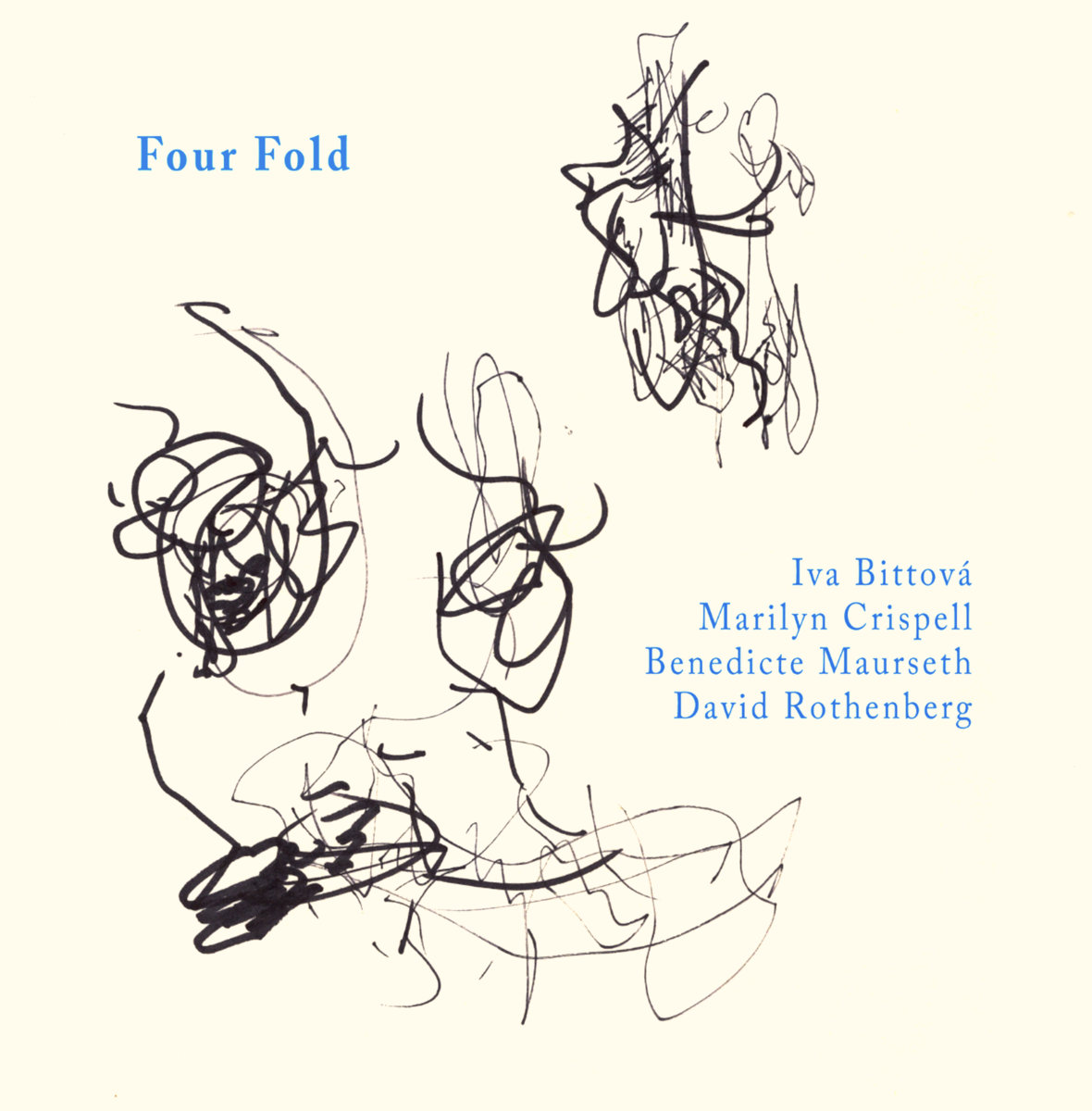
An important aesthetic principle in ikebana, the Japanese art of flower arranging, is known as ma: the interval, the pause that holds all gestures in balance. This recording lives within that interval. Each sound is a petal in still air, its meaning found not in arrival but in suspension.
The album’s story begins at Banlieues Bleues in Paris, 2018. There, pianist Marilyn Crispell, Hardanger fiddle player Benedicte Maurseth, and reedist David Rothenberg gathered to explore the early birdsong transcriptions of Olivier Messiaen. In these notations, the wildness of the natural world first touched paper before it was tamed by harmony. A year later, Iva Bittová was added to the mix, her voice bridging word and weather.
Together, the quartet steps into the fragile terrain between music and its memory. What emerges, through years of subsequent reflection and patient shaping, feels less composed than revealed: a series of conversations with the unseen.
The first notes are a line drawn thin. Piano and clarinet trace its contour, a horizon trembling at the edge of being. From within that tremor, a voice unfurls, and the world begins its slow Folding. The fiddle answers from another time, its tone flecked with age and dust. The players seem to move by intuition, mapping silence the way birds adapt to wind: by feel, not by sight. What takes shape is not melody but the suggestion of one, a phrase on the verge of being spoken.
From the residue of that stillness, Ashlight begins to appear, pale and flickering, illumination born of what has burned away. Maurseth’s bow draws the dawn into being while Crispell drops her chords into water. Each tone contains its own echo. It neither advances nor repeats but hovers, luminous and uncertain, as if listening for its own reflection. Gradually, the instruments find each other in motion. Piano, fiddle, and bass clarinet circle in slow orbit, their lines folding inward and out again like geological strata. Hence Syncline, the meeting of two curves beneath the surface. Their rhythm is not one of time but of breath, a tide sensed more than counted. When Bittová enters, she brings something remembered rather than sung, a folk melody that the earth itself might hum when no one is listening.
In the wake of that convergence comes a retreat into intimacy. Fingers pluck at strings, keys whisper, tones barely formed—what the group calls Know No No, a study in almost-saying. Here, we behold a spiderweb of gestures catching the small debris of thought. A faint rustle passes through: the shimmer of Ruffle, where light and water trade reflections. The bow glides near silence, and the piano answers in small ripples, as if repeating the same idea in a different language. One senses communication without intention, like wind tracing reeds. And then, a sudden brightness opens the room, the solemn turning toward play.
The music leans into Anticline, the upward curve that follows a descent. Rothenberg’s clarinet teases, while Bittová answers in bursts of speech remembered from a dream. The ascetic finds her smile; the ritual learns to dance. It is here that the human reenters the sacred through joy. The air thickens again as if preparing for transformation. Out of the mix rise real-world signatures in Magpie, Moth. Rothenberg weaves them into the ensemble as if greeting long-lost kin. His bass clarinet decodes the nocturnal death’s head hawk moth, his seljefløyte joins the Australian magpie’s bright cry in an ecology of listening. The others respond in turn: piano breathing like wind through branches, Bittová’s voice flickering between the human and the elemental. For a moment, it is impossible to tell what is performed and what simply exists.
Out of this communion comes darkness. Crispell’s piano turns inward, each chord heavy and deliberate, the sound of thought imploding in sequence. Maurseth’s fiddle flashes briefly, a line of copper in shadow, and the piece known as Crinkle unfolds as an elegy for what has been touched and passed through. Here, absence finds its form, but the descent softens. From the quiet grows a song that seems to belong to no one, a Soft Fall through the air. Bittová sings as though speaking to the trees; the others move with her, their tones fragile as breath. There is no drama, only continuity, the sense that nature has momentarily found its human voice. The later pieces exist on the border of dissolution.
In Opposite of Time, the instruments scrape, sigh, and wander, seeking an equilibrium beyond rhythm, beyond structure. Here, the quartet listens not to one another but through one another. What follows is both release and return. The clarinet exhales, the piano sends a faint shimmer into the distance, and the fiddle carries us outward into Unfolding, a final gesture that feels less like an ending than an opening. A tune dissolves into the horizon, its players into the air.
When the last vibration fades, it becomes clear that this project was never about birds, nor about interpretation, but about presence: the act of being still enough to hear the world think. It is a study in attention, how breath becomes tone, how tone becomes silence, how silence, when held long enough, begins to sing.
Four Fold is currently available digitally on Bandcamp and will be on all streaming sites as of November 21, 2025.

 Between Sound and Space: ECM Records and Beyond