Keith Jarrett: Belonging (ECM 1050)

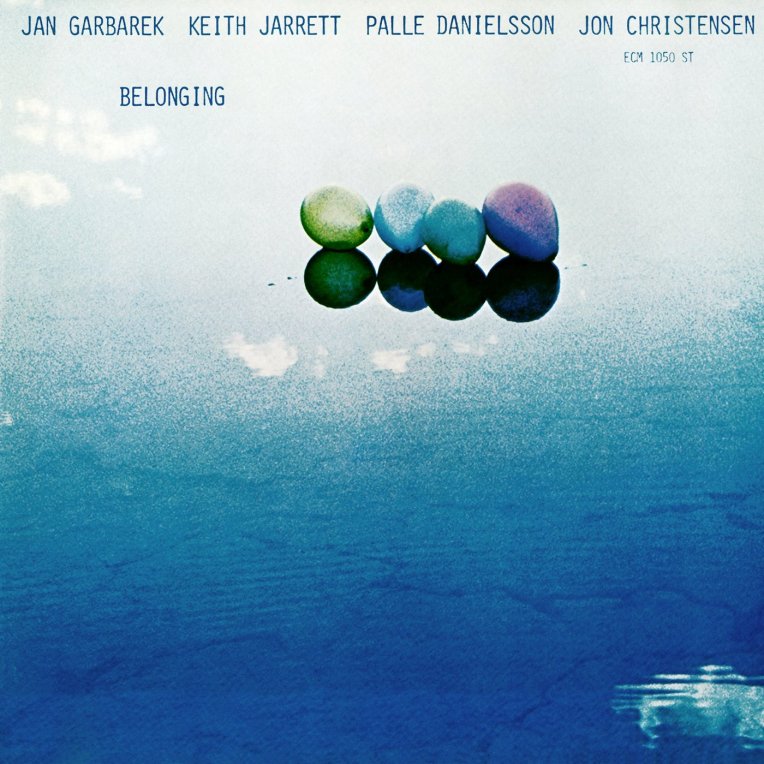
ECM 1050

Keith Jarrett
Belonging

Keith Jarrett piano
Jan Garbarek tenor and soprano saxophones
Palle Danielsson bass
Jon Christensen drums
Recorded April 24 and 25, 1974 at Arne Bendiksen Studio, Oslo
Engineer: Jan Erik Kongshaug
Produced by Manfred Eicher

From beginning to end we are treated to a mélange of moods in this, the first effort from Keith Jarrett and his European quartet. Compositionally astute and clearly the work of steadied hands, Belonging finds each musician in fine form. Whether it is Garbarek’s punctilious doubling in the buoyant “Spiral Dance,” Danielsson’s mellifluous bass solo in “Blossom,” or Christensen’s rollicking snare in “The Windup,” everyone gets their moment in the spotlight. Jarrett’s fingerwork is, of course, superb throughout, but it is the energy underlying his playing—the very spirit of his pianism—that really seems to drive things forward. The album is zigzagged, fading adeptly from head-shaking abandon to heavy darkness from one cut to the next. Ballads make up the longest passages on Belonging and seem to turn ever inward within the confines of their own emotional borders. For the most part, sax and piano are explicitly unified, as if trekking on either side of the same divide, although sometimes they seem to look in opposite directions, as if involved in a long-running debate, unsure of whether reconciliation can be had in the throes of so much dialogue. Jarrett’s jilted approach is well suited to these down-tempo moments while the bass gently asserts its tremulous presence in the background. Garbarek’s sudden entrances weave a dense stratosphere of brassy elegance. “’Long As You Know You’re Living Yours” is pure Jarrett and provides Garbarek with plenty of space to run amok with his screeching serenade. The title cut is another ballad, this one of a different shade than the rest; not an alleyway, but a brief lapse into self-pity. As the album’s center, it also encapsulates a core theme: this music evokes a past from which one cannot escape or, more positively, simply a sense of belonging as the title would imply, the inescapability of one’s roots in place and time. Overall, this is an essential example of what ECM can do when it throws a handful of singular talents into a studio.

<< Keith Jarrett: Luminessence (ECM 1049)
>> The Gary Burton Quintet with Eberhard Weber: Ring (ECM 1051)

Ralph Towner: Solstice (ECM 1060)

ECM 1060

Ralph Towner
Solstice

Ralph Towner 12-string and classical guitars, piano
Jan Garbarek tenor and soprano saxophones, flute
Eberhard Weber bass, cello
Jon Christensen drums, percussion
Recorded December 1974 at Arne Bendiksen Studio, Oslo
Engineer: Jan Erik Kongshaug
Produced by Manfred Eicher

This is arguably the first recording to fully flesh out the aural expanse for which ECM has come to be known. Although I am well aware of the immense groundswell of musical activity that was the 1970s, certainly an album like this was a refreshing and altogether mind-altering experience for those fortunate enough to be young musical explorers at the time. Featuring a lineup of musicians who would go on to weave ECM’s significance into the fabric of time, Solstice is a tour de force of musicianship, writing, arrangement, and recording.

Each track is brimming with life and features the sensitive application of a variety of instrumental combinations and studio savvy. “Oceanus” showcases Garbarek in his prime, soaring with an unbridled emotional register. As always, Towner’s 12-string speaks in 360 degrees. Superb drumming from Christensen complements lush melodic lines from Weber, who stretches a melodic cello into infinity while his bass arises like the conical aftereffect of a water droplet. “Visitation” clouds this ardor in a nocturnal vision filled with laughing spirits. “Drifting Petals” is a slow progression, a timid look out onto a dusty plain where the promise of freedom looms larger than the possibility of danger. But then an elder’s advice rings in our ears and pushes us onward. Feet move of their volition and pull us into the ever-receding horizon as the first drops of a squall streak across our foreheads. Towner proves again that his piano musings are not to be taken lightly, as they make for one of the most evocative tracks on the album. A transcendental 12-string solo (with gentle dimensional support from Weber) opens “Nimbus,” soon blossoming into a flourish of flutes, drums, and a bowed bass that cries with the grating fluidity of a sarangi. Garbarek’s sax joins in the fray and lets loose its harmonious fire. The deftly overdubbed flutes return, spreading their wings for a few moments before fluttering off into the distance. “Winter Solstice,” “Piscean Dance,” and “Red and Black” comprise a triptych of duets: the first for classical guitar and sax, the second a prime jam for 12-string and drums, and the third for 12-string and bass. “Sand” ends our cosmic journey with one of Garbarek’s deepest meditations for sax set to the strangely compelling ululations of Christensen’s flexatone lolling about in the background.

Melodically robust while structurally yielding, this is an album to be treasured and is a must-listen for anyone desiring to know what ECM is all about. An astounding meeting of musical minds if there ever was one.

<< Arild Andersen: Clouds In My Head (ECM 1059)
>> Abercrombie/Holland/DeJohnnette: Gateway (ECM 1061)

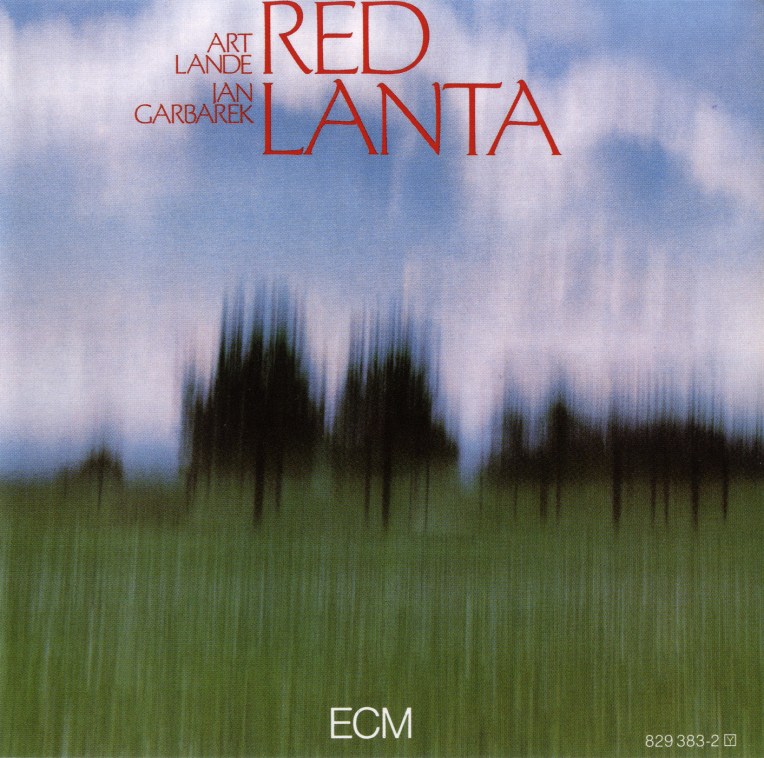
Art Lande/Jan Garbarek: Red Lanta (ECM 1038)

ECM 1038

Red Lanta

Art Lande piano
Jan Garbarek flutes, soprano and bass saxophones
Recorded November 19 and 20, 1973 at Arne Bendiksen Studio, Oslo
Engineer: Jan Erik Kongshaug
Produced by Manfred Eicher

Normally, I eschew from making the kind of comparison I am about to make, but here it goes: What do you get when you take Edvard Grieg, throw in a little jazz, some improvisatory flair, a touch of abstraction, and blend until smooth? Why, the delightful record that is Red Lanta, of course.

While a set of pieces for piano paired with either flute or reed may not sound like everyone’s cup of tea, for those who like tea this should do the trick just fine. Constructed around the compositional talents of Art Lande, the music seems to cry for larger arrangements, but still sounds beautiful as it is represented here. The atmosphere is verdant and open, as blearily pastoral as its cover. The playing is top-notch throughout, though the tracks featuring Garbarek’s flute playing stand out for me, especially “Waltz for A” and, of course, the eclectically beautiful 11-minute “Awakening, Midweek.” The combination is superb and perfectly embodies ECM’s penchant for recording jazz with a chamber music sensibility. A piano-only medley in the second half serves as a nice breather from the intense reed work before plunging us into the galactic final act.

This is diurnal music of the highest order and is suitable both for deep listening and as the soundtrack for any leisurely activity. Garbarek is all a-glitter in as coaxing a performance as I have ever heard from him. Certainly not one to be missed if “mellow” is your preferred mode of operation.

<< Keith Jarrett: Solo Concerts Bremen/Lausanne (ECM 1035-37)
>> Dave Liebman: Lookout Farm (ECM 1039)

Manu Katché: Neighbourhood (ECM 1896)

Manu Katché
Neighbourhood

Jan Garbarek saxophones
Tomasz Stanko trumpet
Marcin Wasilewski piano
Slawomir Kurkiewicz double-bass
Manu Katché drums, percussion
Recorded March and November 2004, Rainbow Studio, Oslo
Engineer: Jan Erik Kongshaug
Produced by Manfred Eicher

Neighbourhood is an astounding, if subdued, meeting of minds. Like other ECM projects of its ilk, this congregation feels as if it arose out of a fundamental and inescapable desire to create music for the sheer enjoyment of it. There is no showing off here. This is laid back, burnished, melt-in-your-mouth jazz perfect for a quiet evening or a rainy afternoon. That being said, this is a far cry from what might elsewhere derogatorily pass for “smooth.” In spite of its overall delicacy the album is not without solid grooves (how can we not bob our heads to the piano-driven ride that is “Number One” or to the swinging horns of “Take Off And Land”?), effectively concise solos (cf. Garbarek’s gorgeous outburst in “Good Influence” and titillating turns from Wasilewski and Stanko in “Lovely Walk”), and enough stellar moments overall to turn any depressing day into a blissful mental excursion. The ensemble plays us out beautifully with “Rose.”

As the brainchild of Manu Katché and producer Manfred Eicher, Neighbourhood is essentially a rhythmic enterprise. Katché’s percussion work provides the crowning motifs to which his compatriots are each a shining jewel. Multiple listenings reveal new nuances of texture and interaction every time. A very fine but impermeable thread connects these musicians and Katché never dominates, waiting in the wings as his motifs take shape of their own volition. The title of the sixth cut says it all: “No Rush.” Take your time with this one and it will reward you greatly. Just press PLAY and you’re there.