

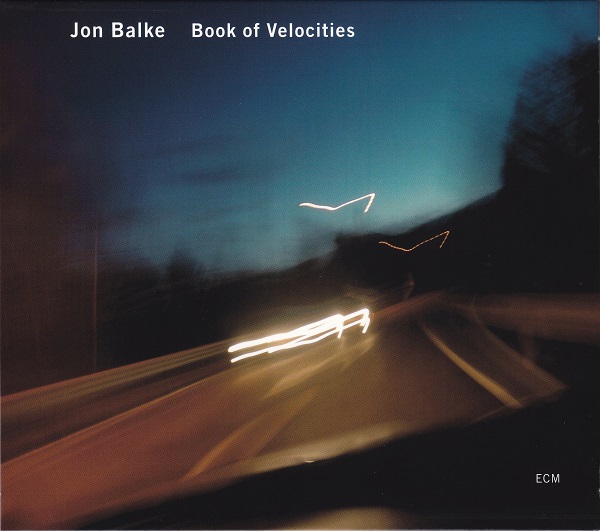
Jon Balke: Book of Velocities (ECM 2010)

Book of Velocities

Jon Balke
Book of Velocities

Jon Balke piano
Recorded September 2006 at Radio Studio DRS, Zürich
Engineer: Markus Heiland
Produced by Manfred Eicher

“We believe that mere movement is life, and that the more velocity it has, the more it expresses vitality.”
–Rabindranath Tagore

Tagore’s statement harbors an implicit question: Does vitality necessarily correlate with velocity? Wittingly or not, Jon Balke would seem to have an answer in this unique album. After a series of memorable appearances on ECM as sideman and group leader (notably, in the latter vein, with his Magnetic North Orchestra), we at last find the Norwegian pianist unaccompanied. The title alone is enough to place the music in a modern tradition of fragmentary collections: Bartók’s Mikrokosmos and Kurtág’s Játékok come most immediately to mind. Yet listening to what Balke has done with both form and instrument, one quickly realizes the profundity of his crafting.

Divided into four Chapters and an Epilogue, Book of Velocities extricates the finer implications of its elements—improvised and composed alike—via thorough examination of the piano itself. By way of introduction, “Giada” flutters between plucked piano strings and dotted punctuations at the keyboard proper. The descriptive cast of “Scintilla” that follows sets the stage for a procession of dreamlike actors, each a cipher for something elemental and transfigured. Other examples in this regard include “Single Line” and “Double Line,” “Gum Bounce,” and the nail-scratched mysteries of “Finger Bass,” the latter droning in Gurdjieff-like meditation.

Many pieces, like the penultimate “Sonance,” exert an organic influence of exhale and inhale, of speech and pause. Indeed, the deepest moments are those least audible, as in the non-invasive contact of “Resilience,” in which one finds the piano’s fantasy life made real. The bodily nature of the music thus shines at carefully selected moments of expression. Whether in the substrate of its own becoming or in the opacity of its outer skin, Balke’s language refashions grammar through every contour. In this respect, the poignant “Drape Hanger” is among the more precious turns of phrase and foreshadows the photorealism of “Scrim Stand,” undulating in real time.

The mirrors of this disc are more than reflective; they are embodied, a dance between beauty and blues. Slowly and surely, Balke turns paths of teardrops into channels of blood flow. This is his art distilled in a crucible of origins until pure feeling remains. It transcends the need for means and returns to the sky whence it came.

Jon Balke & Magnetic North Orchestra: Diverted Travels (ECM 1886)

Diverted Travels

Jon Balke & Magnetic North Orchestra
Diverted Travels

Magnetic North Orchestra
Per Jørgensen trumpet, vocals
Fredrik Lundin bass flute, saxophones
Jon Balke piano and keyboards
Bjarte Eike violin
Peter Spissky violin
Thomas Pitt bass violin
Helge Andreas Norbakken percussion
Ingar Zach percussion
Recorded September and November 2003 at La Buissonne Studios, Pernes-Les-Fontaines and Rainbow Studio, Oslo
Engineers: Gérard de Haro and Jan Erik Kongshaug
Mixed at Rainbow Studio by Jon Balke, Manfred Eicher, and Jan Erik Kongshaug
Produced by Jon Balke and Manfred Eicher

For his third Magnetic North Orchestra release (following Further and Kyanos), pianist Jon Balke pools together a new band of Scandinavian talent under the same name in the project’s most focused iteration to date. With only trumpeter Per Jørgensen retained from the original lineup, the overall effect is that of a watchmaker and his apprentices turned composers. Such attention to detail has always been part and parcel of Balke’s recognizable approach, but nowhere more so than in the facets of Diverted Travels, where it manifests in shorter pieces, a few of which hover on either side of the one-minute fence. The reconfigured roster reveals itself in the album’s wealth of intimate sub-combinations. The breathy horns and electric piano of “Sink,” for instance, turn ice into water and set a climatic precedent for its companions.

“Machinery” sets the clockwork beat to which the band tunes its heart. The chamber aesthetic so vital to Balke’s aural psyche sings with vibrancy here. Indications of his encounters with West African music are already apparent, clarifying themselves in such pieces as “Nutating,” “In Patches,” and “River,” in which the pulse becomes the melody. The latter’s muted trumpet is especially organic and foils the waterwheel motions of its backing with genuine augury. “Climb” is another energizing walkabout with all the makings of a nervous breakdown yet with none of the weak spots. Agitations darken into a lullaby beneath a giant eyelid closing to reveal the starlit canopy of its inner surface.

“Columns” boasts the unmistakable vocal stylings of Jørgensen, whose tense histrionics slalom like an aria from a lost Michael Mantler opera through spokes of arid strings. The trumpeter reveals further mysteries in “Deep,” working his craft through the prism of saxophonist Fredrik Lundin amid a smattering of percussion. Likewise, the mysterious “Downslope” is an album highlight. Rendering molecules of horns within a sul ponticello fringe, it turns air into breath and breath into bodies, footsteps audible on the plains as they balance a hunter’s lance atop the scalp of the setting sun. In the shadow of this piece is “The Drive,” a drone of stunning capacity.

At nearly seven minutes, “And On” is the longest selection, a storm that utilizes the full force of the MNO to evoke changes in atmospheric pressure. Balke’s pianism is wondrously compact, running tighter and tighter circles until it expends itself with jouissance. How else to deal with this than by “Falling,” which brings together the three violinists and Jørgensen’s recorder-like throat in ashen harmony, signing off this love letter to cloudy skies with a taste of antiquity.

Jon Balke & Magnetic North Orchestra: Kyanos (ECM 1822)

Kyanos

Jon Balke & Magnetic North Orchestra
Kyanos

Magnetic North Orchestra
Per Jørgensen trumpet
Morten Halle saxophones, flute
Arve Henriksen trumpet
Svante Henryson cello
Jon Balke piano, keyboards
Anders Jormin double-bass
Audun Kleive drums, percussion
Recorded November 2001 at Rainbow Studio, Oslo
Engineer: Jan Erik Kongshaug
Produced by Jon Balke and Manfred Eicher

For Kyanos, Jon Balke continues the journey begun on Further with an assembly of likeminded label mates—among them trumpeters Per Jørgensen and Arve Henriksen, bassist Anders Jormin, and drummer Audun Kleive—under the moniker Magnetic North Orchestra to ply the glaciers of the Norwegian pianist’s nostalgic compositional approach. Many permutations of the album’s title (which means “blue” in Greek) find purchase in the album’s intimate geography. “Mutatio,” for one, unpacks the depressing implications of the color, trading piano-heavy gestures with soft punctuations from the MNO, each a hope sidestepped in favor of seclusion. “Katabolic” tells the same story but reverses the formula, fronting Jørgensen and Henriksen against intermittent swells of synth. “In vitro” seems to speak in the language of the color itself, as if it were an entire species with specific taxonomic histories and genetic signatures.

Balke’s introduction to opener “Phanai” is the most evocative of them all, dancing like sunlight between tree branches. Sudden intakes betray a drama waiting to leap out into the wider world, finding instead the slow entry of percussion and brass. The feeling is one of a giant sleepwalking through forest as if it were underbrush. Balke and Jormin’s rhythmically savvy interplay bleeds contrast. With insectile harmonics and trembling heart, Jormin bounces along the inner walls of “Zygotos” with a string of genetic possibilities while the surface around him glows to the horns’ intervals, though nowhere no delicate as in “Ganglion,” a masterful conversation between Balke, Jormin, and Kleive that is the most microscopic portion of the set. Haunting accents from flutist Morten Halle and cellist Svante Henryson indicate a world much farther away, a place where the eddying winds cease only for the fearless.

The second half of Kyanos consists of miniatures in more ways than one. The intimate details of “Plica” and “Nano”—mostly percussive expressions and dream-tracings—intensify the magnification. Clicks on piano strings and sibilant fluting designate especially fruitful cells of intent. “Karyon” is the album’s truest groove and packs huge emotion into barest gestures. Its evolution from blind wandering to keen-eyed flight reaches its peak in the form of Jørgensen’s unique vocal edge. Henryson duets enigmatically with Jormin in the concluding “Apsis.”

A prevalence of biological imagery in the song names characterizes this album as a mapping of bodily spaces, thus clarifying the ultimate nuance of blue: namely, as the stain beneath a cover slide. The title track is the most concentrated solution to be found on this laboratory bench, enhancing as it does the emotional details of everything around it. Just turn up the volume as you would a focus knob, and it will all become clear.

Jon Balke w/Magnetic North Orchestra: Further (ECM 1517)

Jon Balke
Magnetic North Orchestra
Further

Jens Petter Antonsen lead trumpet
Per Jørgensen trumpet, vocals
Morten Halle alto saxophone
Tore Brunborg tenor and soprano saxophones
Gertrud Økland violin
Trond Villa viola
Jonas Franke-Blom cello
Jon Balke piano, keyboards
Anders Jormin bass
Marilyn Mazur percussion
Audun Kleive drums
Recorded June 1993 at Rainbow Studio, Oslo
Engineer: Jan Erik Kongshaug
Produced by Manfred Eicher

Although Norwegian pianist/composer Jon Balke has effectively been with ECM since almost the very beginning, having appeared—at the tender age of 19, no less—with Arild Andersen’s early quartet on Clouds In My Head (1975), it wasn’t until the early 1990s that he broke out on his own with such distinct albums as Nonsentration and this fine follow-up. Further is not only a title, but also a mantra that has dictated his career hence through the mouthpiece of his Magnetic North Orchestra, debuting here. The incantation in horn-speak that is “Departure” welcomes us into a signature sound familiar to Balke aficionados: intimate pockets of detail, pianistic swirls, and robust horns that follow wherever he leads (or is led). Yet despite the 10-piece ensemble behind him, which includes such trailblazers as percussionist Marilyn Mazur and trumpeter Per Jørgensen, Balke finds plenty of room to breathe in arrangements as sparse as they are fruitful. His arcing lines, kissed by the sunlight and molten gold of Tore Brunborg’s reeds, take comfort in their surroundings. “Horizontal Song,” for one, languishes, letting cares fall like maple seeds propellering to the ground—prelude to Balke’s low-flying improvisations. Seemingly born to guide, he flushes through lovely chromatic spreads (“Shaded Place”) and groovy touches (“Moving Carpet”) with an easy charm, painting a children’s book of mythical beasts and cautious heroes.

For my money, the Jørgensen/Brunborg/Mazur nexus is where it’s really at on this date. The trumpet’s spaciousness in “Eastern Forest” and tenor’s limber rolls in “Taraf” evoke seasonal changes and unforgettable memories. Jørgensen flexes his vocal cords in “Changing Song” amid Mazur’s alluring, humid atmospheres, leaving the pointillist wonders of “Wooden Voices” to return us to the brassy fold of “Arrival.”

Balke is an artist whose music hides as much as it reveals, and Further is one way to get closer.

<< Bobo Stenson Trio: Reflections (ECM 1516)
>> Eberhard Weber: Pendulum (ECM 1518)

Jon Balke w/Oslo 13: Nonsentration (ECM 1445)


Jon Balke
Oslo 13
Nonsentration

Per Jørgensen trumpet
Nils Petter Molvær trumpet
Torbjørn Sunde trombone
Morten Halle alto saxophone
Tore Brunborg tenor saxophone
Arne Frang tenor saxophone
Audun Kleive drums
Jon Christensen drums, percussion
Finn Sletten percussion
Miki N´Doye percussion
Jon Balke keyboards
Recorded September 1990 at Rainbow Studio, Oslo
Engineer: Jan Erik Kongshaug
Produced by Jon Balke

With the number of musicians assembled on Arild Andersen band veteran Jon Balke’s first ECM album as leader, one might expect a big sound. What we get is a subtle and artfully arranged set of 10 originals. Take “Circling The Square,” for example, an easy album highpoint, which with quiet percussion and horns lays down a runway for trumpeter Per Jørgensen’s electronically enhanced flight. Other joyful landing strips can be found in “Stop” (which features some splashes of engagement from Balke at last and superb tenor work from Tore Brunborg) and “Nord.” The album begins in a solemn mood, however, and seems to never to let go of those darker threads no matter how energetic the playing gets. These tender underpinnings are given more overt exposure in tunes like the montuno-flavored “Blic” and the smooth outro that is “Construction Stop.”

One can hardly pass a comb through this session without singling out “The Laws Of Freedom.” With a minimal and open sense of play from Balke over the subtlest of drones one can imagine, this breathtaking journey into a piano’s beating heart turns reverberation into cloud and spirit, and presses between them footsteps of air. One of the most beautiful tracks in the entire ECM catalogue and reason enough to own this album.

Although not an entirely consistent effort, behind the clever title of Nonsentration lies an honest set, one to put on in the background and listen to closely by turns.

<< Garbarek/Vitous/Erskine: StAR (ECM 1444)
>> Tamia/Pierre Favre: Solitudes (ECM 1446)