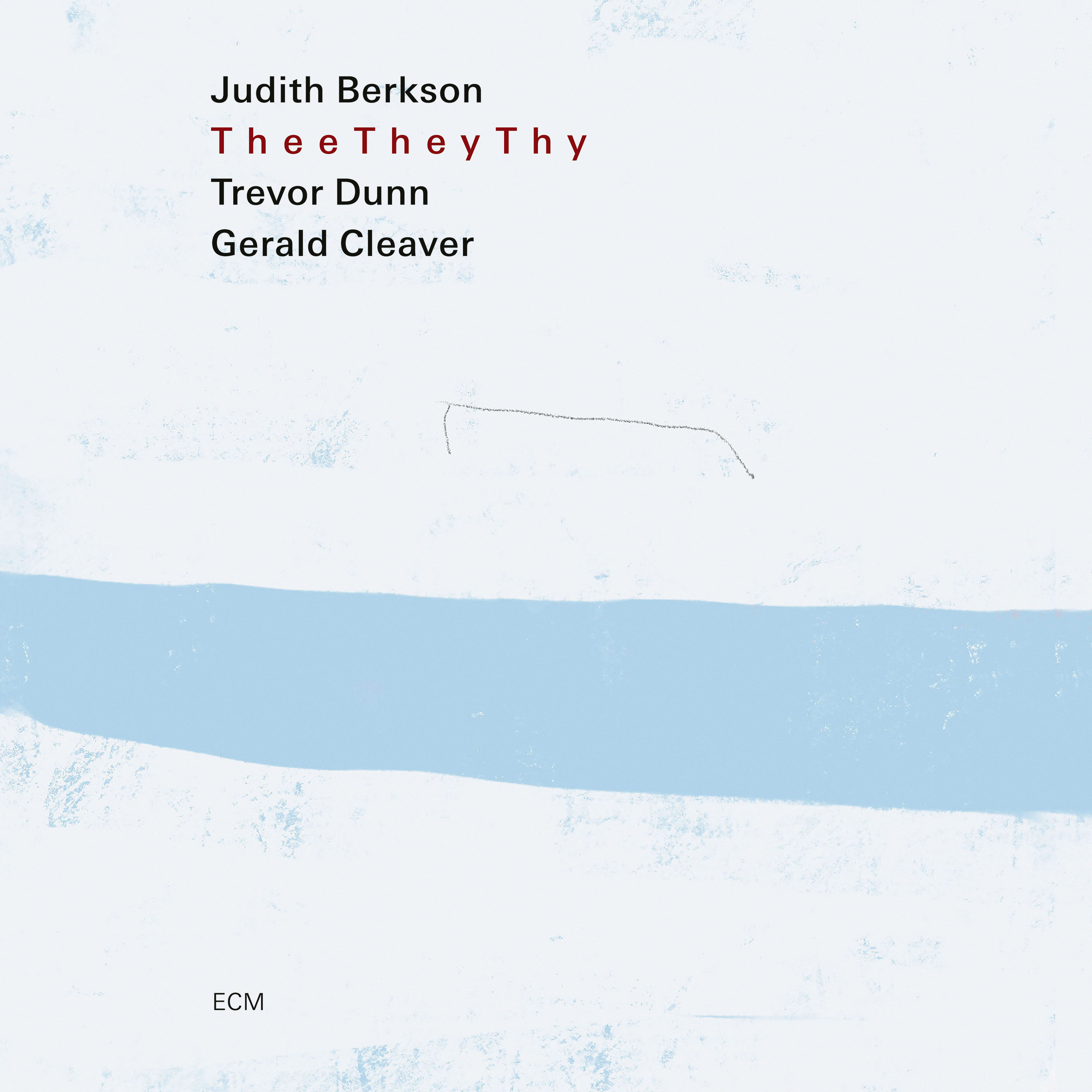
Judith Berkson
Thee They Thy
Judith Berkson voice, piano
Trevor Dunn double bass
Gerald Cleaver drums
Recorded July 2021
Oktaven Audio Studio
Mount Vernon, NY
Engineer: Ryan Streber
Cover: Fidel Sclavo
Mastering: Christoph Stickel
Album produced by Manfred Eicher
Release date: April 24, 2026
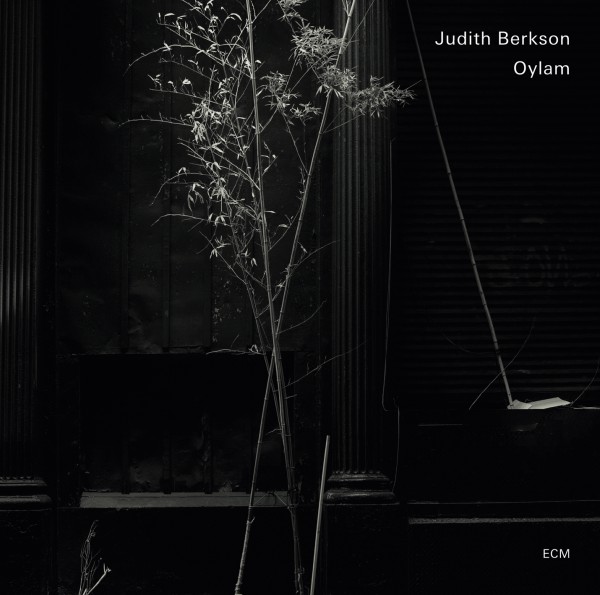
Mezzo-soprano, pianist, composer, and improviser Judith Berkson returns to ECM with a compelling new trio project. Conceptual art, liturgical inquiry, chamber abstraction, and jazz formalism: each arrives carrying its own gravity, yet none bends submissively toward a central identity. To call Berkson “multifaceted” feels insufficient, flat in a way her music refuses to be. These practices do not orbit a core. They are neighboring rooms illuminated at different hours of the day. If her 2010 solo album Oylam fashioned a private syntax from fractured song, Thee They Thy inhabits the classical jazz trio format as though entering an ancestral home whose walls still remember fire. Longtime associate Gerald Cleaver joins on drums, alongside new recruit, bassist Trevor Dunn, making his ECM debut with the calm authority of someone stepping into a river already moving beneath his feet.
The album opens with “Slow,” a through-composed prelude that reveals itself with the cold shimmer of arithmetic carved into glass. Beneath its measured surfaces lies an unguarded study of human behavior and the invisible fissures where our most sacred opportunities collapse under the weight of hesitation. Berkson’s voice enters neither as narrator nor confessor. Rather, it touches every object it describes without claiming ownership of any of them. Her words retain an open voltage, charged enough to bring interpretation to its knees. Dissonances bloom at the edges of the arrangement as bruises darkening beneath pale skin, while the trio advances through the piece with the patience of astronomers mapping a dying star.
Then comes “V’shamru,” and the atmosphere pivots completely, as though the record has opened a hidden window inside itself. Berkson’s original cantorial song tears through the stale fabric of expectation, allowing something ancient and inward to cross our eyeline unscathed. Her voice recedes slightly into shadow, gathering resonance from depths untouched by performance instinct. The modal pianism moves tidally, lifting and withdrawing with ritual precision, while Dunn’s arco bass offers a second pair of lungs. For a fleeting instant, one hears an accidental ghost of Chopin’s “Minute Waltz,” though the resemblance dissolves just as quickly into stranger territory, somewhere between prayer and mirage. The words orient the music without pinning it down. Easts and wests gather around the instruments’ norths and souths, forming a compass that points nowhere stable, nowhere singular.
“Torque” returns the listener to geometric terrain. Berkson’s note choices leap and contort like ladders folding back into themselves, each rung briefly becoming a horizon before disappearing. Built around improvisations on 12-tone rows, the piece visualizes cognition in motion, thought discovering fresh corridors while the walls rearrange themselves. Cleaver’s drumming behaves almost tectonically here, creating subtle pressures beneath the trio’s surface language, while Dunn anchors the abstraction with a presence that feels carved from volcanic stone.
“Dust” follows with startling restraint. Based on 19th-century harmonic language yet rendered through a minimalist lens, it carries the quiet devastation of an emptied ballroom after the candles have consumed themselves. Every chord seems suspended in the air a moment too long, as though uncertain whether to continue existing. Berkson understands silence as a living material. She places it beside sound the way a painter leaves bare canvas exposed, permitting absence to complete the image.
“Cleav,” the lone non-Berkson composition, offers Gerald Cleaver a solitary expanse in which rhythm becomes autobiography. His solo drumming circles through traditions without settling permanently inside any of them. Earth tones dominate the piece. One hears soil breaking beneath rain, wood splintering under pressure, iron cooling after contact with flame. The piece possesses a rare humility. Nothing seeks transcendence. Everything seeks honesty. Even at its most expansive, the performance maintains the intimacy of someone speaking quietly to themselves in a dark field.
“Notice,” with its insistent refrain, is the album’s pulse point, while the scat-inspired title track reveals Berkson at her most untethered. Her vocalizations fracture syntax into pure muscular expression. Aphasia becomes a kind of integrity here, a refusal to allow meaning the comfort of fixed borders. Beneath her, the rhythm section creates a living lattice around the piano, supporting angular phrases as they skip and recoil through chains of miniature ascensions.
“Amerika” arrives as a vast instrumental plain of shifting sands and mirage heat. Without voice, the trio communicates through contour alone, and the silence left by absent lyrics becomes strangely eloquent. Dunn contributes one of the record’s most tender passages during his solo. The music evokes impressions without illustrating them directly. Empty highways at dusk. Electrical hum beneath motel signage. The loneliness of fluorescent light.
Voice and text return in “Slowly Walk Into It,” freely improvised alongside Berkson’s piano. The result resembles an anthem for unseen presences, the peripheral shadows trailing human life with patient hunger. Her singing here feels startlingly mortal. Words emerge half-formed, carrying the fragility of thoughts overheard inside dreams. Lastly, in “Sated,” stepwise motions drift through the scales while the vocal lines hover weightlessly above them, neither ascending nor descending so much as evaporating.
Throughout the album, Berkson never conceals her vulnerabilities. She wears them openly, transforming fracture into protection, uncertainty into method. Many singers pursue purity as though it were evidence of transcendence. Berkson seeks the sound of a soul rubbing against its own limitations.
And then there is the title. Three pronouns orbiting one another without grammatical completion, each gesturing toward identity while dissolving certainty around who speaks and who is spoken to. The sequence feels devotional and fragmented at once, intimate enough for liturgy, unstable enough for philosophy. Perhaps Berkson understands personhood itself as a kind of unfinished chord, forever shifting between self, other, and the unnamed force binding both together. Language spends centuries attempting to stabilize the human experience through categories and declarations. Music witnesses how quickly those structures soften in the presence of feeling. By the album’s end, Thee They Thy resembles a doorway left slightly open in the middle of the night, revealing nothing clearly, yet altering the entire shape of the darkness around it.