
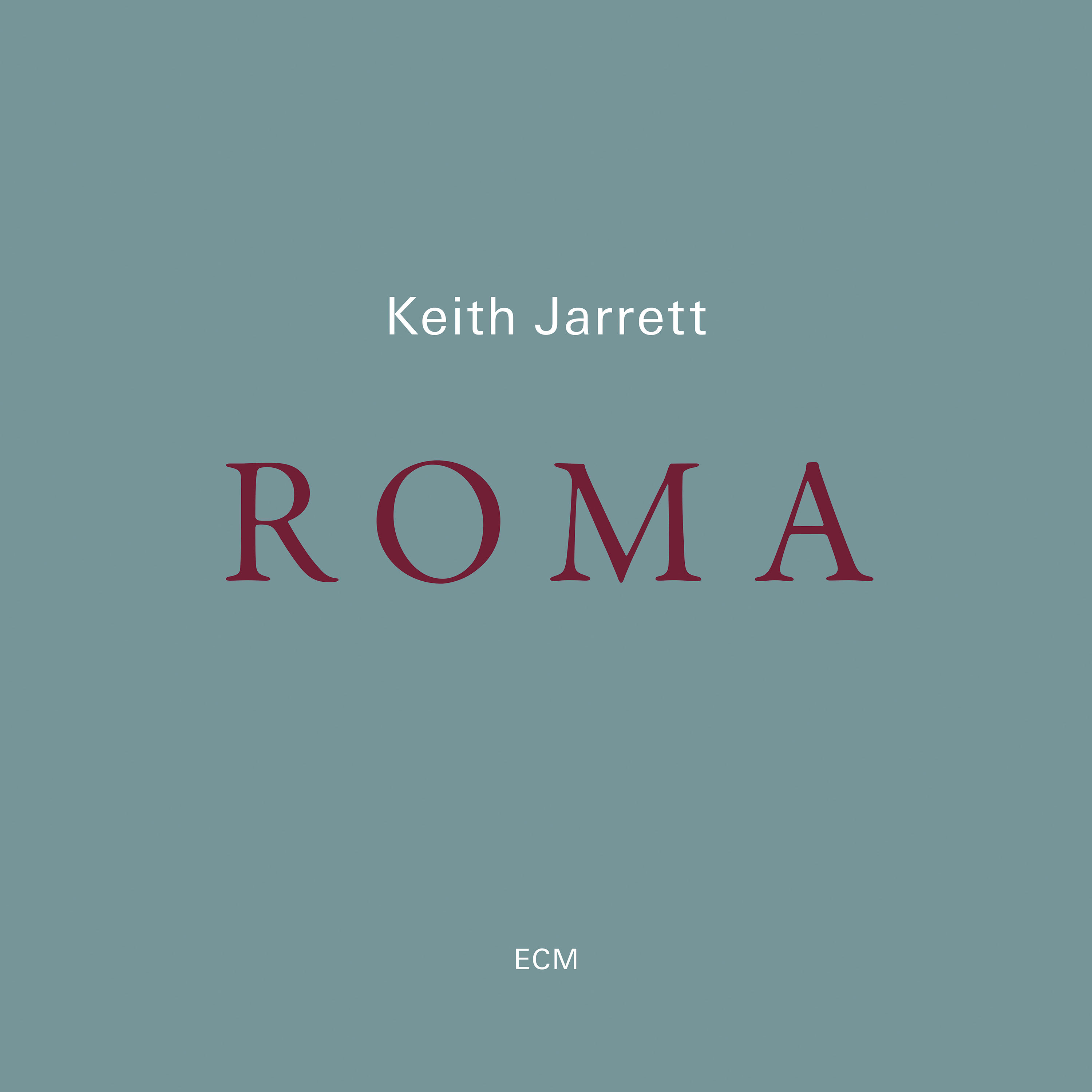
Keith Jarrett
Roma
Keith Jarrett piano
Recorded live July 12, 2016
at Sala Santa Cecilia,
Auditorium Parco della Musica, Roma
Producer: Keith Jarrett
Engineer: Martin Pearson
Design: Sascha Kleis
Executive producer: Manfred Eicher
Release date: November 6, 2026
Keith Jarrett’s Roma fills the last space in ECM’s portrait of his final European solo tour. Recorded at Rome’s Santa Cecilia Hall on July 12, 2016, it joins the Budapest, Bordeaux, Vienna, and Munich concerts in documenting five evenings across thirteen days. Within that brief span, the pianist found enough room to remake his relationship with the keyboard at every stop. Here, dense chromatic lines give melody something to push against, each emerging theme revealing an opening that could scarcely have been imagined a moment before. Listening, we feel our way along with him.
“Part I” brings its fragmentary existence into frame with the force of a seemingly impossible proof. Working through various equations in real time, Jarrett seeks a single number the notes can agree on, challenging himself in the process of becoming. The feeling is gnarled, even uncomfortable, yet the free atonality remains heartfelt. Its tensions carry the awkward sincerity of a body attempting to describe itself from inside its own bloodstream. As complexities mount and detours clamor for equal value, ten fingers become exponential explorers, now a hundred, now ten thousand, until the arithmetic threatens to consume the hands that set it moving. Consensus eventually reveals itself, though by then its beauty has become suspect. We have grown accustomed to the chaos, discovered a pulse within its abrasions. Resolution arrives bearing an almost indecent neatness, a signature affixed to something whose identity was richest while it remained illegible.
The growling bass line grounding “Part II” gives the left hand a shadow to inhabit while the right answers with brighter dance moves. Their balance is astonishing, maintained even as complex polyrhythms slowly entangle them. Independence becomes a means of intimacy, distinct intentions occupying the same nervous system. A more estranged conversation awaits in the deconstructed elegy of “Part III,” where the left hand plods forward and the right seems to play its theme backward. Time folds at their meeting point, permitting the briefest harmonious union. Within the sparser architecture of “Part IV,” this divided consciousness contracts. Its stop-and-start modality speaks with the hesitancy of someone remembering a room that has been removed from the house. The gaps preserve its dimensions, giving absence a floor beneath its feet.
That absence allows the sunlight of nostalgia to enter the gospel of “Part V,” carrying its song as a wound after war. Uplift remains ephemeral, a light in the window lit for one necessary moment and extinguished before it can become an object of worship. Such tenderness knows what prolonged exposure might demand of a fragile thing. From this small illumination, the heavenly cast of “Part VI” rises with epic, cinematic sensibilities. Expansive arpeggios supply their own means of ascent; the music seems to be flight itself, inventing altitude from the pressure of a fingertip. Gravity becomes a proposition the body can entertain without accepting, its argument suspended somewhere beneath our hearing.
A balladic return to earth gives “Part VII” its emotional reach. Jarrett speaks tenderly, without a shred of self-interest, gathering flowers for the yearning listener from a field whose acreage changes with every breath. The bouquet is delicate enough to preserve the distance between its stems. When “Part VIII” gathers that earthbound feeling into a skyward trajectory, its acuity of observation becomes almost unbearable. Jarrett is an observer of places that must be articulated in the moment of witnessing them, before their veracity is ruined by the artifice of recall. These central improvisations may form one of the most magnificent stretches in his archive. Their comforts retain the gravity of the thicker psychospiritual territory he has worked through to reach them. Even the most open melody carries that buried resistance, an underground correspondence whose pages have become translucent.
The blues of “Part IX” grants Jarrett license to let his voice out freely. His exuberance has a rough grain, and the tight entanglements of the left hand keep the romp tethered to the concert’s deeper concerns. Joy acquires traction through the very knots that might have impeded it. Where this earthy momentum presses against the keyboard, “Part X” loosens the instrument into a cascading wonder. Its sparkling highs and subterranean lows exchange density until the piano seems capable of evaporating through its own roots. Those roots rumble with a need to be heard.
The restraint of “Over the Rainbow” gathers these vibrations into a melody heard anew. Jarrett’s clever harmonies deepen its vulnerability, and what he holds back becomes an active presence, protecting the song so that its purpose might not be bruised. “It’s a Lonesome Old Town” extends that care, keeping its tongue behind a glass cage to protect the implied lyrics. The cage is strangely permeable, reaching us without claiming to know what we have lost. Both encores appeared in Munich 2016, yet here their poignancy feels concentrated beyond the scale of ordinary memory. The world has been distilled into a thimble and administered drop by drop to the tongue of time. What receives this medicine seems older than the mouth, an ache that preceded its own capacity for expression.
Something darker courses through this recording, its courting of shadow lending the passages of glory the urgency of a reprieve. The piano is palpably present, its own resonance meeting that of the hall until the room seems to acquire a second ribcage. The exchange suggests a strange form of labor by building a dwelling for something we could never possess. Every note has the capacity to annex silence, yet these hands repeatedly leave a portion unclaimed. The music’s deepest generosity may reside there, in making room for an existence that owes us nothing.

