

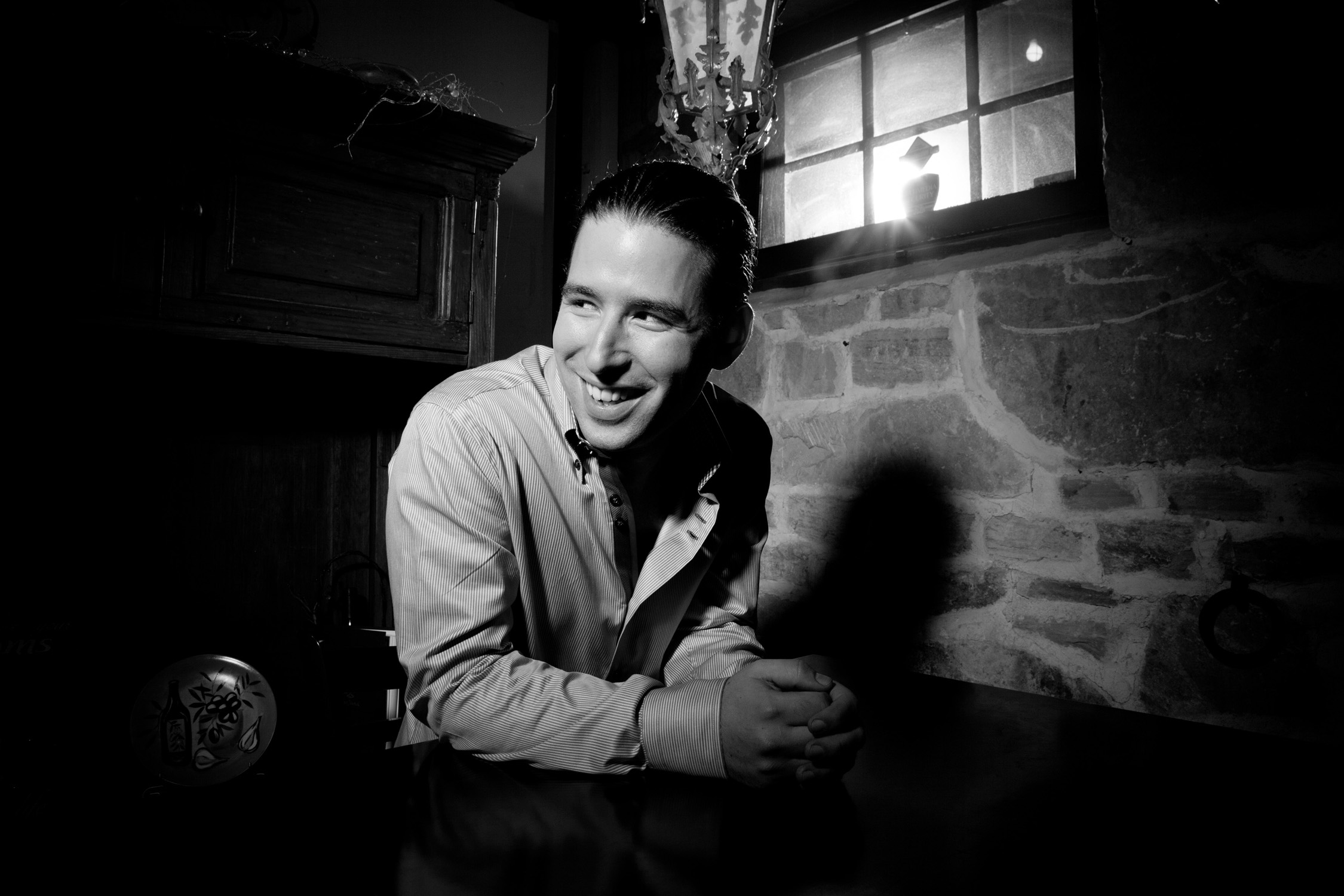
Alfredo Rodríguez
February 7, 2014
Barnes Hall, Cornell University
8:00 pm
After hearing pianist-composer Alfredo Rodríguez in the close quarters of Barnes Hall last Friday night, one could only feign surprise to know that he began his musical education as a percussionist before switching to piano at age 10. Whether through clipped breathing, clicks of the tongue or stamping of the feet, his awareness of the beat was front and center. This was surely one of many aspects of his craft that caught the ear of producer Quincy Jones, with whom he collaborated on his recent sophomore album, The Invasion Parade. We might further reflect on his Cuban heritage, which is to his playing as the moon is to night. Yet, if these biographical details meant anything, they were only as valid as the intrigue of his performance, which was, in a word, dynamic.
Rodríguez left no doubts about his roots, starting the program as he did with an idiosyncratic take on “Venga la Esperanza” by Cuba’s left-wing darling, Silvio Rodríguez. As he wove from somber beginnings a tapestry of increasing complexity, it was clear that Keith Jarrett has had a huge impact on Rodríguez, who cites the pianist’s legendary The Köln Concert as a life-changing influence. The more he played, the deeper his contrasts and densities became. The effect was such that when the occasional snippet of recognizable melody broke surface, we were reminded that at the root of it all was something worldly. Rodríguez followed up with an original composition, “El Güije.” Balancing dark undercurrents in the left hand with the sparkle of his right, the piece’s borderline-aggressive textures gave way to windswept dreamscapes at the turn of a weather vane.
The staggered raindrops of “Quizás, Quizás, Quizás” introduced a triptych of classic tunes rounded out by “Veinte años” and Ernesto Lecuona’s rousing “Gitanerías.” In them, elements of Messiaen, Bartók, and folk songs showed the full range of Rodríguez’s palette. His highs, always translucent, shone with special care. That said, he never stayed pretty for too long, if only to better appreciate the occasional moment of beauty we were allotted.
As is often the case with younger jazz musicians, Rodríguez emoted with blatant passion and tended toward passages of controlled chaos before finding purchase in his themes. Departures felt more like interjections, if not outright explosions, than variations. His tongue-in-cheek take on “Guantanamera,” for example, was a tour de force in technique, invention, and surprise. He approached this deathless tune from within—literally—by hitting the strings inside the piano before migrating to the keyboard proper. The result was a mélange of interpretations, more sketchbook than painting—which is precisely where he deviated from Jarrett.
Although Jarrett’s adlibs come pouring out of him sounding like fully formed compositions, Rodríguez allowed himself the indulgence of thinking out loud with relatively little interest in transition, stacking cell upon cell of distortion. Something of a curse for many improvisers that smoothes itself out over decades into seamless art, one senses in Rodríguez a “say-no-to-the-flow” attitude that suits him just fine. The result is neither more nor less conducive to the concertgoer’s listening pleasure, but is a methodological difference that requires sharp attention from both sides of the front row. He is an honest player, through and through.
None of this is to imply that that the concert was devoid of lyricism. As if to prove this, Rodríguez encored with an aching rendition of Ernesto Duarte’s “Cómo Fué.” As tender as tender can be, its somber farewell closed the circle, opening another of fond memory in its place.
(See this article as it originally appeared in The Cornell Daily Sun.)
 Between Sound and Space: ECM Records and Beyond