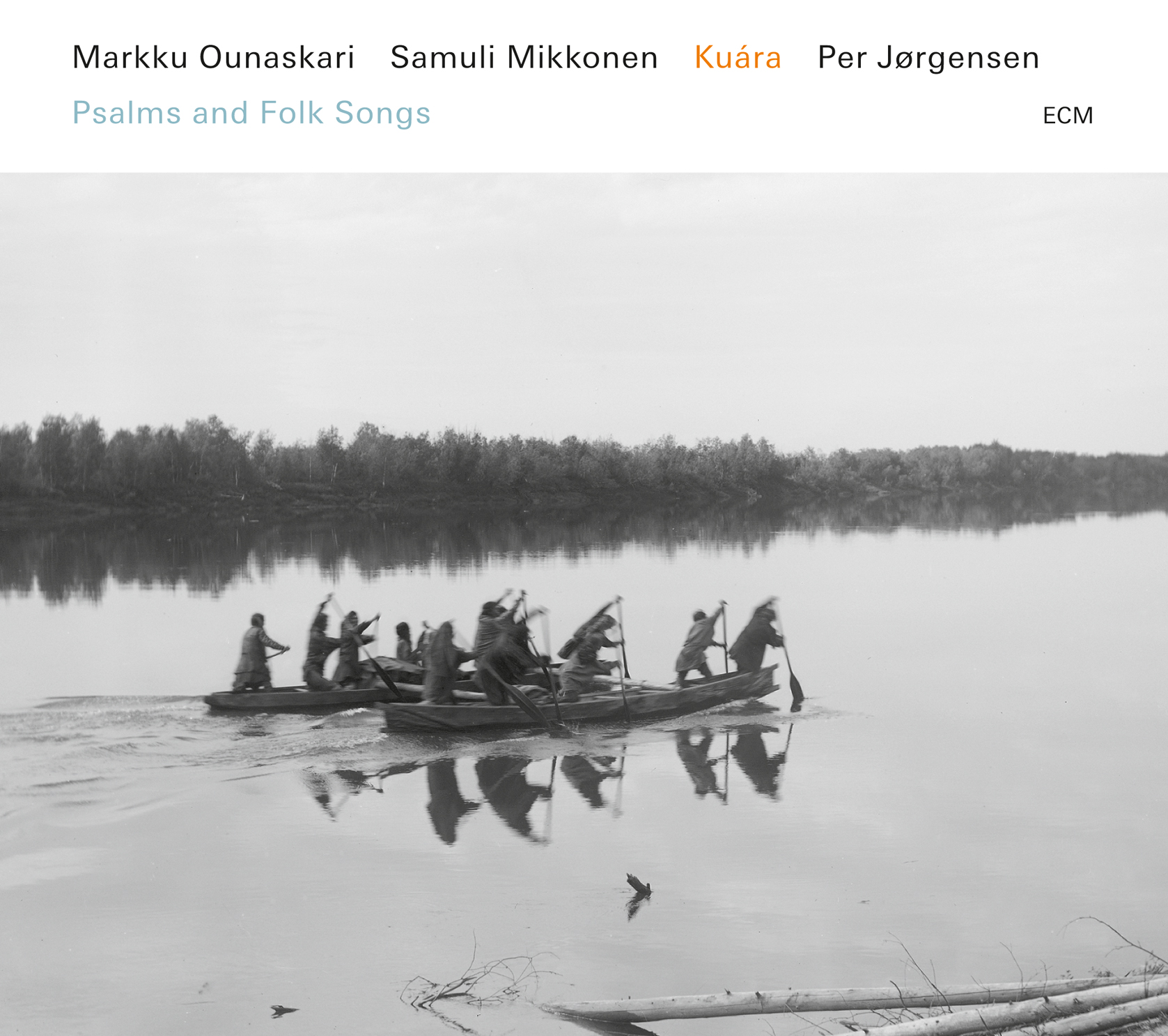
Kuára
Markku Ounaskari drums
Samuli Mikkonen piano
Per Jørgensen trumpet, voice
Recorded May 2009
The Republic of Karelia is a pocket of land nestled between Finland and Russia. It was ceded to the Soviet Union via the Moscow Peace Treaty of 1940, resulting in the forced relocation of over 400,000 Karelians—essentially the entire population—into Finland. Since then, Finno-Ugric folksongs have become for them a powerful nostalgic tool, looking back on the homeland while tinged with the grief of inhabiting another. Primary among these is the itkuvirsi, or lament, whereby Karelians are able to bridge past and present, forging new identities in the process. Enter Kuára, an album of kindred spirit that is as much homage to contested borders as it is a look toward a self-determinable future.
Recent ECM listeners may recognize the name of Markku Ounaskari, the Finnish percussionist who, providing nascent but vital details for Sinikka Langeland’s recent Starflowers, so impressed Manfred Eicher that the label’s producer asked him to lead his own project. Drawing on Russian psalms and the folksongs of Finland’s displaced Karelian, Udmurtian, and Vepsian populations, the resulting Kuára is, in Ounaskari’s poetic estimation, “like a journey through the night.” Already widely known in Finnish jazz circles, Ounaskari gained notoriety for his folk-inspired work with the group Piirpauke. Up-and-coming pianist Samuli Mikkonen and Per Jørgensen (a familiar label name through projects with Jon Balke, Michael Mantler, and Miki N’Doye) round out the trio of this intensely focused program. Jørgensen paves a steady avenue through the others’ winding streets, and provides the most halcyon evocations of the album’s source material. Mikkonen would seem the perfect foil in this regard. Once described as “the most Finnish-sounding pianist of his generation,” he clearly recognizes the locality of musical language. A transnational reach has led him from the neutral zones of the Anders Jormin Trio, with whom he regularly plays, to the aleatoric battlegrounds of John Zorn’s formidable Cobra. Says Ounaskari, “Both of us, Samuli and I, are very interested in folk music of the different Finnish related Ugri-cultures and tribes that are living, at the present, in Russian territory,” referring to the many Finnish Karelians who, after perestroika, have reversed their tracks in search of roots.
Karelians share linguistic lineage with Finnish and a valuation of the pagan mysticism that informs their heritage. The latter may have been quelled by Christianization, but many of its practices hold fast. As such, they lend themselves well to the equally mystical art of improvisation, situated as they are among the ghosts of communism. And so, when Eicher suggested including Orthodox Russian psalms as a counterbalance, the idea resonated well with Ounaskari, who is of paternal Russian heritage. It was an opportunity to draw a line of Slavic continuity between the sacred and the secular, enlarging the scope of both in the process.
The group’s acoustic focus is a refreshing shadow in the light of popular electronic augmentations: three generations of musicians coalescing into one poignant sound, a new direction drawn from ruins. The album’s title means “sound” in Udmurtian, and clues us in to its central aesthetic: namely, the word made life. Thus do we get a refracted triptych in the form of three “Introits,” each a strand of connective tissue animating a languidly beating heart. We begin, however, with “Polychronion,” a Slavonic liturgical chant birthed in the piano’s gaping cavity. Mikkonen hits the lowest strings within, reenacting a mythological birth into discernible chords. Brushed drums and soulful trumpet emerge into visibility: a holy figure rising to its feet, every fold of its vestments captured in fluid detail. “Tuuin Tuuin” introduces the album’s first Karelian turn. Its beautifully articulated theme springs from the surrounding waters like a fish in slow motion. Jørgensen wrenches from his instrument a mournful animal cry against a spate of hand percussion, at times doubling the lead piano line with an unsteady, almost mocking keen.
Traditionally, the singer or musician’s take on a Karelian song text has always been more important than the replication of a standard. The music is resuscitated upon the lips of each practitioner, who adds new ideas and adornments. The parallels to jazz are obvious, and make for a smooth transition into the present arrangements. “Aallot” (“Waves”) invokes its eponymous motions with controlled abandon, lifting its voices through the snare’s roiling foam, while the Udmurtian “Soldat Keljangúr” features Jørgensen’s wordless vocalese and skyward cries. Even “Psalm CXXI” which consummates the album’s dip into Orthodoxy, locates itself on land: I will lift up mine eyes unto the hills.
In “Sjuan Mad’” one hears the Jørgensen that has inspired a generation of trumpeters, Nils Petter Molvær not least of all. His popped expulsions of breath are shaped by a gentle mute into an outward spiral of thematic ascendency. More doublings of the piano set aloft the latter into its own gorgeous flights of fancy. It is also a short piece, showing the group at its concentrated best. The final “Sjuan Gúr,” with its funereal drums, sets forth like a vessel into darkening waters. Jørgensen’s ecstatic cries once more cut to the bone, bearing rounded fangs against the exposed nape of lost time. The music breathes with as much inauguration as finality, working its slow passage through the marrow of a lumbering deity, whose footfalls raise mountains.
A smattering of originals rounds out the program. “The Gipsy’s Stone” draws airy pianistic lines between pointillist percussion, while “Mountain Of Sorrow” abides by an altogether different gravity, made all the more palpable for the elusive playing that turns it into focus.
Jazz has always been a music of diaspora and self-preservation. Hence, its passage to the Baltic states, where it has fused into the current project. In this respect, Kuára is the genre at its most contemplative. It is an album as poignant as it is enigmatic, an intimately realized mosaic rendered with due ceremony. For a project grounded in displacement, it comes across as markedly apolitical, a soothing burst of cool air in an otherwise heated world. These are not the “imaginary communities” of postmodernism, but the familiar and the stable topographies of private continents. A recording like this is a sobering reminder that, at some level at least, all music is fusion—be it of the intention of the performer with the location in which she/he is situated; of the blending of disparate styles; or simply of the indeterminacies that any place inculcates upon the music or performance at hand. Despite the arbitrary divisions we human beings impose upon each other and our works in the name of misguided notions of superiority, imperial expansion, and economic ascendancy, we can be sure the music that animates them will always follow less prescriptive paths. To merge onto one of them, we need only slip this disc into our player of choice.
[Author’s note: This review was first published by RootsWorld online magazine, and may be viewed in its original form here, where you can also hear a sample track.]


 Between Sound and Space: ECM Records and Beyond