

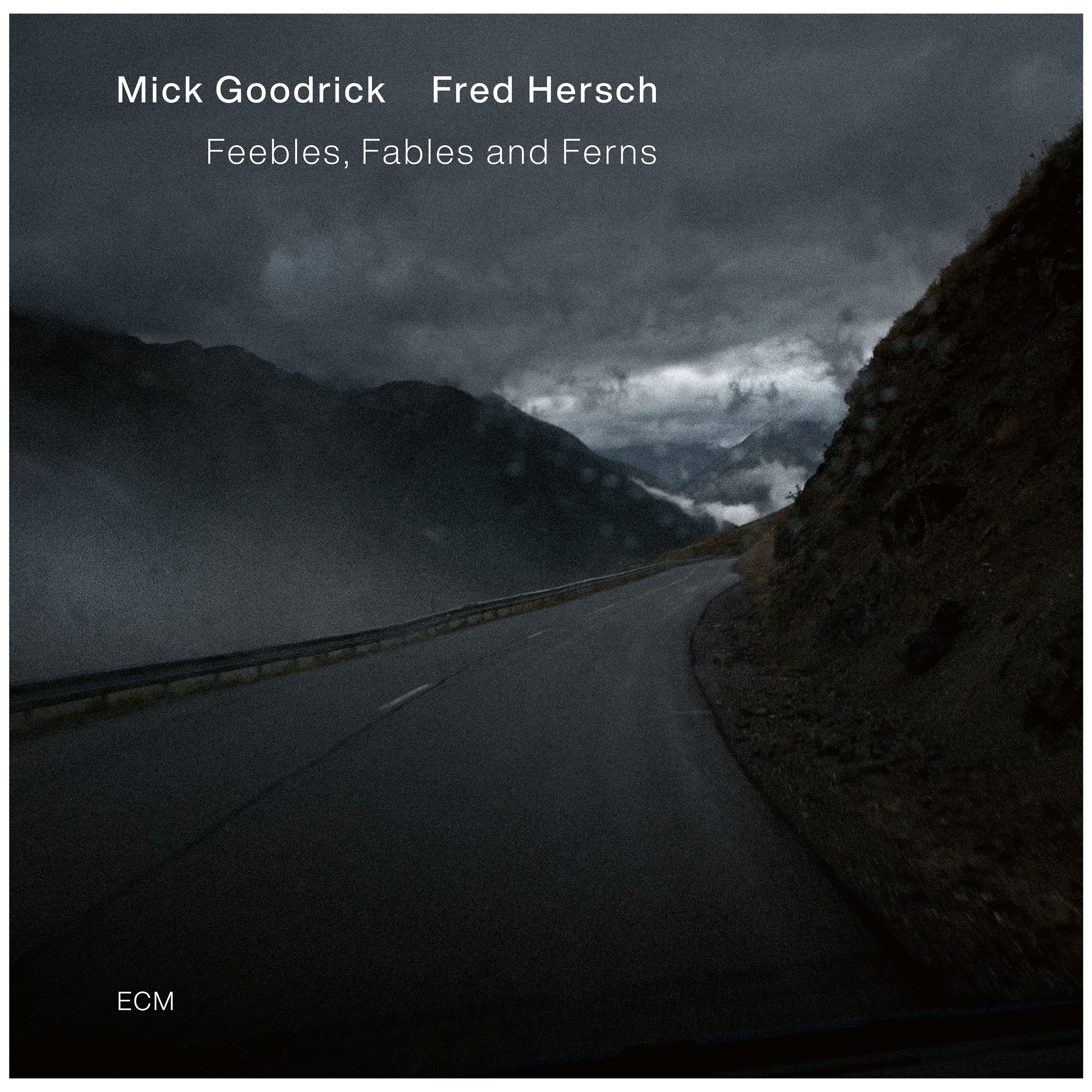
Mick Goodrick/Fred Hersch: Feebles, Fables and Ferns (ECM 2876)

Mick Goodrick/Fred Hersch
Feebles, Fables and Ferns

Mick Goodrick guitar
Fred Hersch piano
Recorded August 1988 at Classic Sound Studio, NYC
Engineer: A. T. Michael MacDonald
Remixed 2025 by Chris Allen
Original recording produced by Fred Hersch
Cover photo: Jean-Guy Lathuilière
An ECM Production
Release date: June 19, 2026

Recorded at Fred Hersch’s New York studio in August 1988, Feebles, Fables and Ferns documents the only recorded meeting between Hersch and guitarist Mick Goodrick, then fellow fixtures of Boston’s jazz community. Historical circumstance provides the frame, yet the deeper distinction resides in the remarkable ease of their exchange. The session carries almost none of the dust normally associated with an archival recovery. Its present tense remains intact, sealed within every pause and sudden melodic turn. Both musicians develop ideas in real time without crowding the music or steering it toward predetermined conclusions. Their attentiveness suggests a shared space in which each voice can enter fully while leaving the other unclaimed. Goodrick, an influential teacher whose sparse discography never adequately reflected his stature, is especially compelling. His quietly inventive improvising reveals why Julian Lage, Pat Metheny, Wolfgang Muthspiel, and so many other guitarists have regarded him so highly. He seems able to bend a phrase around the interior of a thought, decorating its walls without obscuring their mystery.

That rapport animates a lively program of originals, standards, and one open improvisation. Goodrick’s title composition, first heard on 1979’s In Pas(s)ing, emerges here as a compact study in interlocking lines. Hersch and Goodrick’s melodic phrases remain tight yet fluid, while rhythmically astute changes seem to discover their destination only upon reaching it.

“Falling Grace,” one of two Steve Swallow tunes in the set, brings a livelier angle to that exchange. Retaining its composer’s crooked smile, it folds playfulness into sardonic self-awareness while maintaining considerable lyrical poise. Hersch answers that wit with buoyant precision, while Goodrick phrases across it from oblique vantage points, tugging at the seams without tearing the fabric. Swallow’s “Amazing” later enters through Goodrick’s “Away 10,” moving through dimly illuminated memories that appear to recognize us before we recognize them. What was laid down casually in a studio nearly four decades ago has acquired meanings unavailable to its creators, proving that music can continue thinking after its makers have left the room. Time has not merely preserved these performances but has collaborated with them.

Within that expanding temporal space, “Five Excursions” unfolds as a surreal yet welcoming chain of improvisations. Its tentative beginnings resemble a constellation being plotted by instruments uncertain of the sky behind them. A few pinpointed tones establish provisional coordinates, after which the music opens into interlocking geometries. Hersch and Goodrick appear to reverse-engineer causes for effects already hovering in the air. Silence becomes a working material rather than an interruption, allowing each idea to cast a longer shadow.

As Johnny Green’s “Out of Nowhere” blossoms into the foreground, the album enters a region of crystalline wit evocative of Chick Corea’s ECM classics. Clever syncopation and deft motivic interchange make the performance feel perpetually on the verge of levitation. Hersch rearranges the tune’s internal gravity while Goodrick sends bright phrases skimming along its altered surface, each musician alert to the comic potential inside sophistication.

Hersch’s “Heartsong” draws the session toward a more openly radiant center. The composition pumps richness through its chambers, yet its emotional amplitude remains governed by a profound introversion. Goodrick understands how much the tune contains and resists the temptation to excavate everything at once. Even during his fastest lines, every note retains a private place in the larger design. Hersch, for his part, stays within reach, grounding uplift in touch and harmonic clarity.

Mal Waldron’s “Soul Eyes,” originally written with John Coltrane’s sound in mind, offers a final field of inquiry for instruments far removed from that conception. Guitar and piano open from within, allowing secrets to emerge as subtle alterations of perspective. Goodrick homes in on details that another improviser might treat as mere filler. Minute changes in the harmonic terrain acquire enormous consequence beneath his attention, with a bent inflection or delayed resolution suddenly becoming the axis around which the piece turns. Hersch’s lyricism operates simultaneously inside the drama and beyond its frame. He inhabits the melody while quietly altering the conditions under which it can be understood.

Feebles, Fables and Ferns stands as an unusually intimate portrait of two restless musical minds meeting on equal terms. Its archival unearthing offers more than access to a lost session; it returns a form of attention that now feels almost radical. Hersch and Goodrick listen without attempting to absorb one another, preserving difference as the very substance of communion. Their duetting gradually becomes a demonstration that freedom can deepen when another consciousness is fully present.
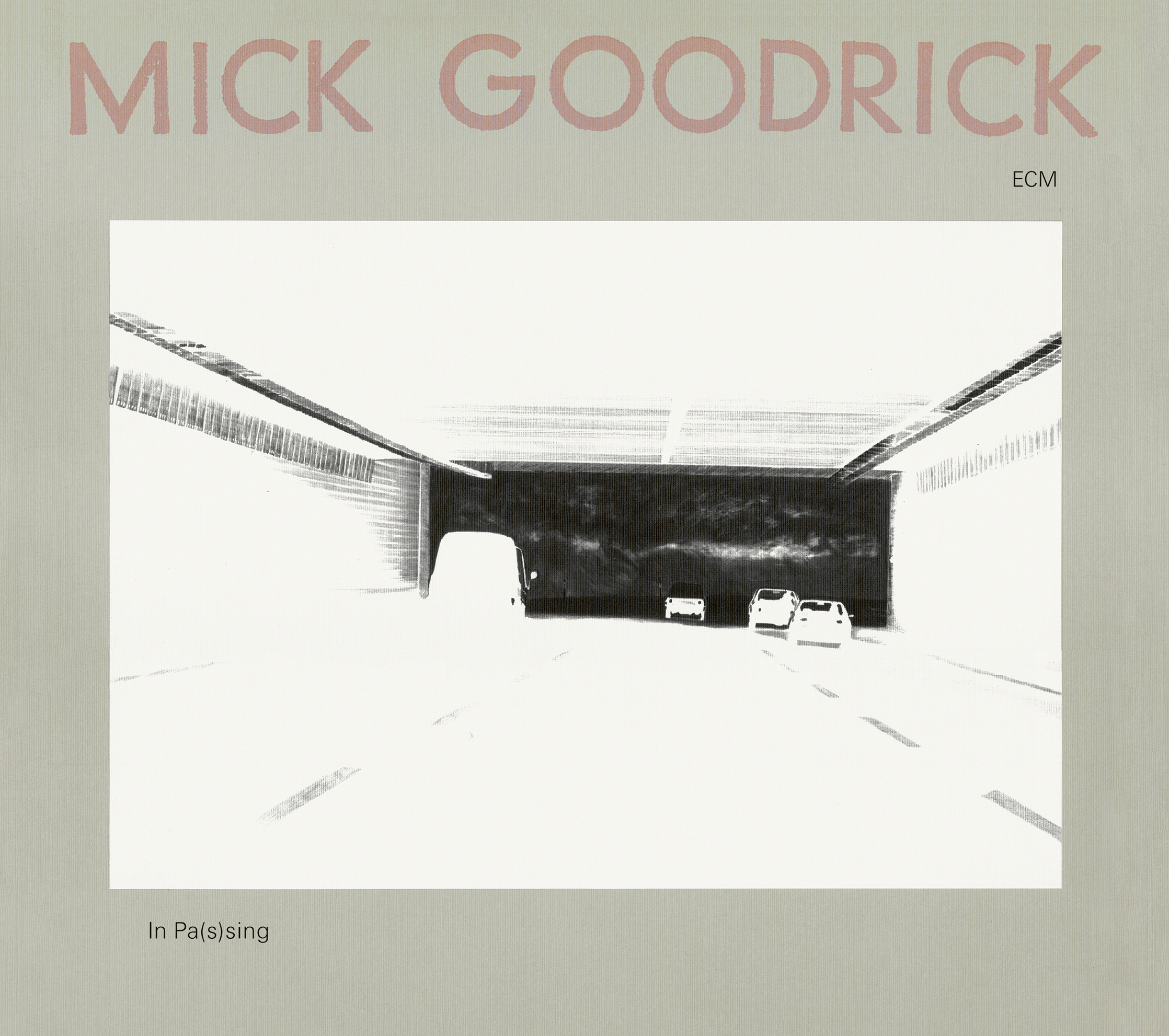
Mick Goodrick: In Pas(s)ing (ECM 1139)

1139 X

Mick Goodrick
In Pas(s)ing

Mick Goodrick guitar
John Surman soprano and baritone saxophones, bass clarinet
Eddie Gomez bass
Jack DeJohnette drums
Recorded November 1978 at Talent Studio, Oslo
Engineer: Jan Erik Kongshaug
Produced by Manfred Eicher

After guesting on three Gary Burton collaborations (The New Quartet, Ring, and Dreams So Real), guitarist Mick Goodrick broke out with his first album as leader—and what better place than ECM to open his art to its fullest, for this would be his last recording for the label. In Pas(s)ing consists entirely of Goodrick originals, save for the collectively improvised title cut, giving us an unassuming view of the thoroughly sanded figures that are his themes.

“Feebles, Fables And Ferns” is morning and dusk, a crepuscular confection wrapped in drums (DeJohnette), bass (Gomez), and tenor sax (Surman), and all tied with Goodrick’s sonic filaments. The latter’s airy, John Abercrombie-like tone is pensive and glows like embers. The bass is shallowly miked, making it seem an extension of the guitar. Its player often vocally anticipates his supporting lines, as in the lovely solo granted passage here. Surman’s equally mellifluous sound rolls off the tongue like a poem. “In The Tavern Of Ruin” continues the lush quartet sound, only this time with a brittle edge. Surman leads a slow procession of hooded figures before his soprano trails into Goodrick’s darkening clouds. Distant cries seize us as Surman again wraps his cosmic fabric around our ears. This makes “Summer Band Camp,” the album’s shortest track, all the brighter in its nostalgia. Surman smiles through his sound, as do all gathered, gently kissing the art into which they have grown. Gomez’s doublings add a chorused, rhythmic aphasia that foreshadows an ecstatic close. A tender bass clarinet lacquers “Pedalpusher” with molasses, sealing in an array of tactful changes which do nothing to obscure the phenomenal bass work therein. In closing, we find ourselves “In Passing,” which throbs with yielding yet intense sentiment. DeJohnette stitches a fine seam here, even as Surman cuts his thematic restraints in favor of more visceral forms of communication.

Goodrick’s elasticity throughout is a comforting presence, while Surman shines in what amounts to a starring role. These energies, buoyed by a plastic rhythm section, coalesce into what is easily one of my favorite ECM releases.

<< Paul Motian Trio: Le Voyage (ECM 1138)
>> Gary Burton/Chick Corea: Duet (ECM 1140)

Gary Burton: The New Quartet (ECM 1030)

1030 X

Gary Burton
The New Quartet

Gary Burton vibraphone
Mick Goodrick guitar
Abraham Laboriel bass
Harry Blazer drums
Recorded March 5/6, 1973 at Aengus Studios, Fayville, Massachusetts
Engineer: John Nagy
Produced by Manfred Eicher

One needs only to catch the first few licks of “Open Your Eyes, You Can Fly” to know this album represents an era that can never be recaptured. Burton does wonders with the Chick Corea tune, lifting its upbeat soul to the greatest heights of creative pleasure. One can almost taste the freshness of his sound, the sheer newness of vision and synergy of musicianship ingrained into every moment of this phenomenal record. This was another early disc that managed to fall under my radar until I sought to review it. Burton is always a supreme joy to listen to, and with this, his second ECM appearance, he certainly made a profound statement. Burton himself contributes one composition, the enchanting “Brownout,” which takes full advantage of the rhythmic precision of his backing trio for a deft volley of restraint and abandon. Two Gordon Beck tunes provide the most robust flavors in this thickening stew, balancing the smooth full-ensemble nosh of “Tying Up Loose Ends” with the infectious full course of blistering key changes and nimble flair that is “Mallet Man,” the album’s centerpiece. The ballads are haunting and moody. “Coral” (Keith Jarrett) proves just how soulful vibes can be, while “Olhos De Gato” (Carla Bley), with its seedy undercurrent and humid climate, slinks like its namesake, stalking the edges of the night. Two Mike Gibbs tunes, “Four Or Less” and “Nonsequence,” round out the set on a more playful note, making dramatic use of pauses and a wider variety of textures.

Gary Burton is synonymous with the vibes. And while I had long been one of countless admirers of his technical and melodic acuity, this album was nothing short of a revelation for me. The technique is flawless all around and glistens with Burton’s Midas touch. He contacts his instrument like fingers walking up a spine, never missing a single nerve along the way. Yet one cannot commend this album without also praising Goodrick’s phenomenal guitar work, Laboriel’s quick-witted ornaments, Blazer’s unrelenting dedication to the moment, and the astounding unity the ensemble as a whole manages to uphold. The overall balance comes across as joyously democratic, and all with a fresh-off-the-boat sound that surprises at every turn. There isn’t a single errant note, gesture, or idea to be found on The New Quartet. From start to finish, an inimitable achievement.

<< Garbarek/Andersen/Vesala: Triptykon (ECM 1029)
>> Terje Rypdal: What Comes After (ECM 1031)

The Gary Burton Quintet with Eberhard Weber: Ring (ECM 1051)

1051 X

Gary Burton Quintet
with Eberhard Weber
Ring

Gary Burton vibraharp
Mick Goodrick guitar
Pat Metheny guitars
Steve Swallow bass guitar
Bob Moses percussion
Eberhard Weber bass
Recorded July 23 and 24, 1974 at Tonstudio Bauer, Ludwigsburg
Engineer: Martin Wieland
Produced by Manfred Eicher

Before I get into this review, I’d like to take a moment to share my process:

As a busy grad student, listening to music for pleasure has become an increasingly difficult luxury to sustain with any regularity. In addition to my undying adoration for ECM, one major part of my motivation for starting this blog was a desire to reinvigorate my listening life. To that end, I have taken to giving one album per night my undivided attention as I go to sleep. I keep a digital voice recorder by my bed and speak whatever impressions come to mind. I then transcribe these comments the following morning and pare them down to something coherent. Any of my regular readers will notice that my review production has slowed down as of late. This is due to the fact that I have been preparing for my M.A. thesis defense and am heavily sleep-deprived as a result. Even so, I have attempted to listen when I can and continue with my audio review logs. Due to the aforementioned sleep deprivation, however, fatigue has begun to take its toll on my cognizance. This became especially apparent as I was recording my review for Ring. It began benignly enough with my usual laudatory ramblings, but as I sat down the following morning to transcribe, I realized that I had almost no recollection of the second half of what I had said, having uttered it in a stupor of half-sleep. I have since removed the odder bits, but would like to share a few verbatim examples for your (and my) amusement:

One almost feels or gets the sense of joy, for in that concept of joy there are also children…. There are clouds and unwashed apples and trees floating in the sky…. Next year it will be different, somehow pleased by the authorities while people such as I will be behind bars…

Whether or not these comments impart any deep insight into the music at hand might very well be arbitrary. Still, I cannot imagine having said such things without some sort of provocation. This experience makes me question what kind of background noise I must be filtering out before coming up with anything at all intelligible. Thank you for indulging this tangent and, for what it’s worth, here’s my highly filtered version:

Gary Burton is in a class all his own. On the vibraharp he is pliant yet unbreakable with a certain flair for the understatedly powerful. Among the present company, he is perfectly at ease. No one tries to overpower him, and despite his melodic dominance he never looms for too long, receding into as many shadows as he casts. There’s not a single pretentious note to be heard; the flow between and within tracks barters its way across smooth waters. This is a nocturnal album all the way.

In the opening “Mevlevia,” flanged guitar provides a yielding current of sound upon which Burton and Weber are able to lie back and drift. “Unfinished Sympathy” is more than just a clever play on words, but is also a gorgeous vehicle for Goodrick’s rolling solos. Its structure is built around a recurring guitar motif, which indeed feels unfinished as it circles around a flower it can never pollinate. It is a short and sweet diversion into a vaguely grasped thought. “Tunnel Of Love” is a languid journey toward something that is apprently fated but which is actually uncertain. A warm bass solo arises from the murky surface that surrounds us, threading our path with its own braided thread. A lilting guitar in the background plucks steady notes from the air, balancing them atop slowly rolling spheres. “Intrude” begins with a drum solo that flitters like a dragonfly skirting the edge of its known domain. A certain jouissance works its way from the outside in before petering out into the last few drops of cymbal, at which point the ensemble kicks in with a six-stringed groove tugged along by bass and the now recumbent drums. The delicacy from before is implicitly maintained, even as the static builds in charge, at last defused by a premature spark. “Silent Spring” feels like the most composed piece in this set, and in that sense it refuses to take its own simple pleasures for granted. The bass flickers its way into recognition like a blown-out candle in reverse, telling what it knows to be untrue, a musical fabrication in disguise. “The Colors of Chloë” produces another superb bass solo in the midst of a first-rate groove, which seems to climb up and down stairs before settling on the black and the white of its own private chessboard.

In short: listen to this album and love it.

<< Keith Jarrett: Belonging (ECM 1050)
>> Steve Kuhn: Trance (ECM 1052)