

Charlie Rauh: Simply, Patiently, Quietly (Book Review)

It would be easy to say that guitarist, composer, and producer Charlie Rauh charts a territory all his own. But to fall into that cliché would risk eliding the tender graces that have fueled his endeavors from the beginning. He averts his eyes from the road less traveled, setting his heart instead on that still bearing the footprints of ancestors related either by blood or artistic heritage. Whether tuning his guitar like a microscope to the poetry of Phillis Wheatley or Anne and Emily Brontë or flipping it around like a telescope in the warmth of such albums as Viriditas and Hiraeth, he never lets go of the human condition as a central concern.

This debut musical treatise bears the subtitle “An Approach to Creating Intentional Music.” And yet, what is so refreshing about the narrative offered in these pages is that you need not be a musician, intentional or otherwise, to benefit from its insights. Central among them is that we tend to back down from the passion projects we hold dear in our youth. As time tempers these into rote platitudes (“hobbies at best, hidden out of embarrassment at worst,” he notes in the Foreword), we treat their recession as inevitable. This is, perhaps, one reason why literary works and all the paratextual experiences they entail have been integral to his oeuvre for so long. In that sense, he is as much a translator as a composer.

In the first section, “Simply,” he reflects on his time studying improvisation with jazz pianist Connie Crothers. Instead of bowing to the (relatively recent) convention that tells us simplicity is a bad thing, he embraces it as “a pure distillation of identifiable quality” that allows complexity to breathe. I cannot help but liken it to a line drawing of a wing versus a massive Baroque painting filled with saints and cherubim. The burden of proof on the creator of the former is deeper in the sense that every line speaks nakedly on the page, whereas in the latter, the margin for self-indulgence is greater yet more easily concealed. What Rauh realized at a key turning point in his growth as a musician was that complicating matters with business wasn’t the end goal. It was tapping into the childlike curiosity that such veneers, fragile as they are, do a surprisingly good job of hiding. This does not mean that one must “devolve” but that one must be willing to be vulnerable. And when we are vulnerable, we confront the question of who we are in spite of ourselves.

“Patiently” brings us into the spiritual weeds, through which every glimpse of sunshine becomes a tether to hope. More than that, it is the ultimate expression of love (think, for example, of the long-suffering God who stays his hand so that we might learn from our mistakes). And so, patience is not about proving your limits of tolerance but about faith as the evidence of things unseen. As Rauh humbly admits, “This is easier said than done, and despite my best wishes, I cannot claim that I am fully in tune with the concept as it applies to my life.” Amen, and amen.

Patience, too, is a mode of healing. It is the promise of strength fulfilled and renewed through the perseverance of the human (and animal) spirit. By tempering our fears, it gives room to stretch out our egos and cut them into millions of pieces. On the practical side, patience makes it “not only acceptable but optimal to leave spaces in your workflow.” Without those spaces, we lose sight of ourselves and what we are capable of. The moment we say we have arrived is probably when we need to check our assurance at the door and start singing again for its own sake.

The book’s third act, “Quietly,” is where the soul comes most readily into play. That said, quietude isn’t some mystical state of being in which one achieves unity with the universe but rather a recognition that the melodies of our lives need volition to seek one another out. And that is where the youthful essence from which we have distanced ourselves must be fished from within. Children are nothing if not intentional, and such clarity of expression is where we get our profoundest ideas. To be silent is to see ourselves no longer through the filters of camera lenses and computer screens but rather in the naked truth of the proverbial mirror. In so doing, we realize just how noisy we are inside.

I am reminded of an anecdote involving John Cage, who stepped into an anechoic chamber with the intention of experiencing true silence, only to discover that the faint sounds of his circulating blood and nervous system rendered that concept moot. This experience happened to be the inspiration behind his infamous composition 4’33”, for which the performer sits quietly in front of a piano for the titular duration without playing a single note. In hindsight, what was so disturbing about the piece’s premiere wasn’t necessarily that Cage was poking fun at the academy or even philosophically questioning the very definition of music; it was the fact that the performer ceased to matter. Thus, to experience 4’33” live is to be flooded with all sorts of internal voices. In wrestling with this same tension, Rauh concludes that the result of quiet music isn’t boredom or relaxation but power. It also tests our mettle as listeners and clues us in on the creed of patience. “When the rest falls away,” he observes, “all that is left is all we can give.”

No review of this superbly rendered meta-statement would be complete without mentioning the contributions of his sister, Christina Rauh Fishburne, whose illustrations are the glue that binds. By turns whimsical and contemplative, they work in counterpoint to the text without ever intruding. One in particular, which appears on page 24, speaks to the nostalgia of this reader/viewer. Its depiction of curiosity, stripped of all the baggage that adults bring to this impulse, teeters on the edge of interpretation. It is also the first of a sequence of images that home in on key aspects of the words preceding them.

Whether in the domestic comforts of a life without clear and present dangers or in the wider view of time and its inevitable entropy, Fishburne’s ability to pull out memories we never knew we had is a blessing and a comfort. As a segue into the scores included herein, they are denizens of a time capsule that is itself the curio of another time capsule. Of said scores, the musically inclined among us get access to a swath of moods. From lullabies to choral settings, they offer plenty of soil in which to plant and water seeds of communion, assuring us that we can rest our heads on pillows of wonder every night, knowing there is only more to come when day breaks.

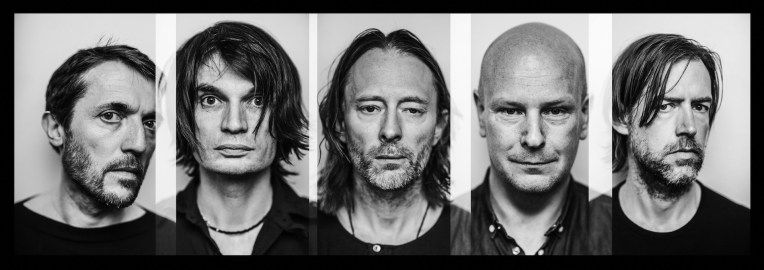
Radiohead: A Moon Shaped Pool

A Moon Shaped Pool

To experience A Moon Shaped Pool, the ninth studio effort from Radiohead, is to find treasure in a garbage can. It’s a beautiful rarity in an ugly world that appears when you least expect it. The album’s title alone indicates the contradictory forces swirling within its 53 minutes. Listeners cannot imagine such a pool because, from a terrestrial POV, the moon has no definite shape. It appears differently to us night by night, and even at its fullest shows no more than half of itself. Still, these musicians are up to the task of degaussing their waters in accordance with the phases, cupping hands to receive the wisdoms dripping from Thom Yorke’s mouth. Said pool is as amorphous as his singing, which ranges from waxing clarity to waning enunciation—not one in which to dive headfirst, but to ease into as a hot spring.

If the staccato pulse of “Burn The Witch” tells us anything about what we’re getting ourselves into, it’s that the Radiohead soundscape consists of consistencies. Where songs like this one stay crunchy even in milk, others were born to flop around, boneless and insecure. The witch hunt, for its part, is a red cross of medium and message. The tactility of guitarist Jonny Greenwood’s arrangement ensures that things remain three-dimensional from start to finish. The feel of keratin on woven gut and metal turns this musical inquisition into a flashing light in the neighboring village that never goes away. You stare and wonder into whose hands the mirror cuts, but no change of angle gets you any closer to discerning a face. The slackness of Yorke’s delivery belongs to the furniture of everyday life, where not every contour need be known in order to enjoy its function. The dust gathering beneath it is the ash of a dead messenger swept into anonymity by the broom of overlord politics. The fireplace roars, spottily as in the song’s video, trailing messages in the darkening sky, each a comet falling upward into extinction.

When Yorke paints the scene as “a low flying panic attack,” he hints not at faith but a watchful eye buried up to its pupil in denials of equality. The echoing chorus is a thing of such attraction that the flames begin to feel like your safest haven from oppression.

Electronic reverie and rounded pianism introduce the warmth of execution that butters “Daydreaming.” Yorke extends his body toward the blurry pessimisms of being fed upon and tasted. Boards of Canada-esque distortions yearn for a childhood in which the allergies of springtime actually meant something because they confirmed the platitude of staying indoors. Backward voices and strings snore like beasts grabbing handfuls of their own skin amid nightmares of wasting away.

The accompanying video is a revelation for revealing nothing. Its forced temporal adjacencies of spatially disconnected places leave much to be desired, for desire is its only valid emotion. In such context, dreamers can only be enablers, and at their center Yorke folds as the line “Half of my life” plays backward in the final laydown, very much aware that all of this is greater than the sum of our admirations.

And in your life, there comes a darkness
There’s a spacecraft blocking out the sky

These opening lines of “Decks Dark” reveal a technological anxiety, half-quelled. Atmospheric blotting is a prediction of sunset, a faro-shuffled existence painstakingly restored to new deck order. Yes: decks not only of ships, but also of pasteboards—hearts and diamonds printed in the blood of expectation; spades and clubs in ashes of war.

The song further emphasizes a lingual idiosyncrasy, by which Yorke’s esses emerge as barest alveolar contacts. And it is a song about language:

Your face in the glass, in the glass
It was just a laugh, just a laugh
It’s whatever you say it is
Split infinitive

The presence of choir, however, reduces potential roars to whispers.

All of which explains the acoustic matrix of “Desert Island Disk.” Obsessions with interface magnify the necessity of human language, and so the band must unplug them for hope of capturing them. This dust bowl is shaped in the studio, in post-production, in the very circuitry of the air. It is an affirmation of repetition as the locus classicus of psychological attachments. The feeling of ritual is out of sight, but blasts its Morse code across the windowpanes of the ears.

Waking, waking up from shutdown
From a thousand years of sleep

So pining, Yorke succeeds in delivering a murder ballad where no one gets killed.

A wall stands between you and the destination you seek. It is “Ful Stop.” Peruse all you want for the missing el, but it will always tap you on the shoulder before disappearing. The laser blaster of ambiguity fires a few test rounds in order to gauge the thickness of communication, so that when Yorke exhales he knows exactly how to absorb the fumes on the uptake. He gives it to us straight (“Truth will mess you up”), compressing a coal of the stomach until it is a diamond of the mind.

Like the indefinable moon, “Glass Eyes” concerns artificial organs through which not even light may pass. A skipping beat and arcade progression give this song uplift, so that by the end Yorke has split into multiple voices. His falsetto is a bird on a wire, riding the shared border of floating and falling. “I feel this love turn cold,” he laments, never wanting to close his eyes until he is sure that others are gone from view.

Hence the return of panic, by now a leitmotif, in the self-pleasuring “Identikit,” which names a forensic tool used to draw composite portraits of criminals from a bank of predetermined features. It is connective tissue between fault and compliance. And as Yorke intones, “Broken hearts make it rain,” we think of monetary downpours imparting false images of who we are.

radiohead-photo-alex-lake
(Photo credit: Alex Lake)

The shared continuums of life are those we most abhor: our ability to slaughter, our want for personal gain, and our need to be remembered. Such are the conditions of a fashionable life, also running themes of “The Numbers.” A Jacob’s ladder of strings and strums captures the essence of adolescence in this prickly pear, shaken from its branch by daughters of ruin destined to become mothers of rebuilding, and by whose laughter the gas masks of subjugation will one day be fogged beyond use.

We call upon the people
People have this power
The numbers don’t decide

That this song was once known as “Silent Spring” is no surprise. Its well runs deep and its waters are thick with unuttered promises. And if we walk away from it thinking the system to be a lie, then we have fallen victim to that very thing. Such reminders of our constitutions are vital to holding this album in.

Like the Amnesiac sharpening that is “Knives Out,” “Present Tense” sings from a higher plane. Warped yet utterly literate, this bossa for supernovas thatches protection around the here and now, as if the very term were an abomination to evidences airbrushed between pulpits and podiums. The scrape of fingers on guitar strings is like the licking of a lion’s tongue across our collective backside: it grooms the hairs in perfect correlation but callouses the skin in the process. “It’s like a weapon” says Yorke of distance, which inters its social messages in fears of disability.

An electronica-oriented spin of the wheel lands on “Tinker Tailor Soldier Sailor Rich Man Poor Man Beggar Man Thief,” where at last the internal vocation of thought is given an external wage. You hope for balance between animal behaviors, only to find predatory favor in an indigenism gone awry.

All the holes at once are coming alive, set free
Out of sight and out of mind, lonely
And they pray

Or is it “prey”? For will not all teeth know the stain of blood eventually? If resonance equals proximity, then Radiohead is an abandoned cathedral. And in its reliquary: “True Love Waits,” a macramé of pianos drifting into summer. The lyrics are a skeleton rocked in a glass case until it spins flesh and begins to cry. Yet the love Yorke professes exists in a haunted attic, where he opens a box containing the final words, “Don’t leave.” But leave we must if we are ever to approach this music again, holding a suicide note written in a temporal hand.

The alphabetized song list represents the arbitrariness of order and the systematic breakdown of communication into its consensus parts. More than a critique, it is a critique of critique, a hammer taken to one’s own reflection in honor of the fragment. The interruption of time by space, then, is far more traumatic than the reverse, for at least in the former’s violence one can be sure of having lived. Otherwise, the meanings of all works and adorations grow sour. Day jobs turn into night sweats, and dreams take on a visceral truth. Darkness is common to both, exclusive to its self-imagining, and holds your hand down the mountain path. At its end: a match. And you are the kindling.

2014 in review

Some stats from WordPress regarding between sound and space for 2014. I had 240,000 views (nearly 800,000 to date). I wrote 120,000 words (700,000 to date). My busiest day was April 17, with 1251 views. My most popular reviews were diverse, including a 2011 piece on actor Bruno Ganz’s spoken word recordings for ECM. Other popular posts were my reviews of François Couturier’s Un jour si blanc and Ghazal’s The Rain.

I’m particularly grateful to Nate Chinen at The New York Times for including David Virelles’s Mbókò on his Top Albums of 2014 list, and for kindly linking to my review of said album. I’m also deeply honored to have had a blog post quoted in Ellen Johnson’s Jazz Child: A Portrait of Sheila Jordan. Seeing my words in print was an intense validation of what I do here.

In 2015, I plan to reach my goal of reviewing every ECM and ECM New Series album ever released. It’s been a five-year journey, and I am humbled by all who have followed me this far.

A few side notes:

  • Over at All About Jazz, for whom I’ve been writing with greater frequency as I approach the goal of this blog, my most popular article was a critical analysis of the film Whiplash.
  • For RootsWorld online magazine I was proudest of my piece on Marc Sinan’s Hasretim – Journey to Anatolia.
  • And finally I was grateful for the opportunity to expound my love for ECM New Series in an extended piece for Sequenza 21 celebrating the imprint’s 30th anniversary.

Above all, I feel blessed to be surrounded by so much significant music and to be able to squeeze in the time between academic and family commitments to share my passion with others in kind. Thank you for reading, and never stop listening.