
For out of black minutes of madness ever more radiant,
The patient one wakes on the petrified threshold,
And is ardently clasped by cool blue and the gleaming decline of
the autumn,
The silent house and the legends of the forest,
Measure and law and the moonlit paths of the departed.
–Georg Trakl
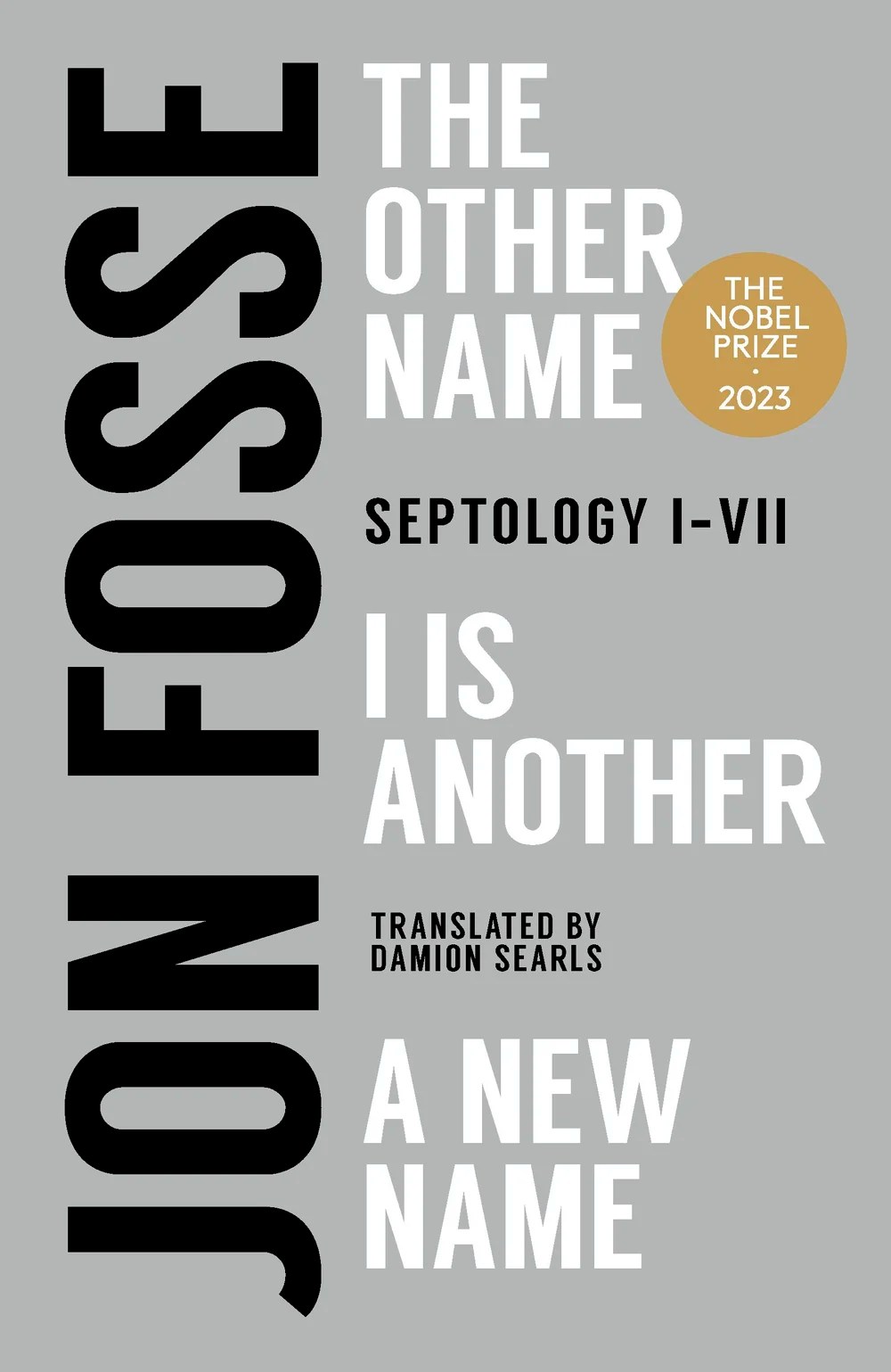
A blank canvas seems to contain every possible image until the first stroke starts taking them away, so begins our story with a picture that cannot quite be settled, two painted lines, one brown and one purple, crossing upon a canvas, making a modest, wounded geometry whose light appears to originate somewhere beyond the pigment, while outside, on the western coast of Norway, the daylight contracts toward Christmas, and an aging painter named Asle stands looking at what he has made, though the more he looks the less securely the picture belongs to him, and this is the threshold of Jon Fosse’s Septology, a seven-part novel published in three volumes, The Other Name, I Is Another, and A New Name, translated by Damion Searls, in which Fosse, the Norwegian writer awarded the Nobel Prize in Literature in 2023, gives us a single week in the life of a widowed, sober, solitary Catholic painter, yet a life entire within that week, beginning on a Monday in Advent and unfolding without a conventional full stop, a formal audacity that might demand admiration before granting pleasure but whose effect is almost disarmingly intimate, for I rarely felt imprisoned by the absence of periods, instead drawn into the velocity of someone thinking, a consciousness whose turns and retracings have not submitted to the editorial tyranny of retrospect, and one keeps reading because each thought opens another room, while the rooms have a troubling habit of opening onto the same darkness, each part beginning with the same astonishment, “And I see myself standing,” before ending in prayer, while between those gestures the conceit of chronology gives way to chambers of time without dependable walls, Asle living in his house in Dylgja, driving to Bjørgvin, visiting the gallery that sells his work, cooking for his neighbor Åsleik, considering an invitation to Christmas dinner, all the while his present being entered by lives that have already ended, for his wife, Ales, is dead and not dead, her absence factual, her presence no less persuasive, familiar objects opening suddenly into conversations with her, Asle speaking to her daily without pretending that speech will bring her back, their names exchanging almost the same letters, Asle and Ales suggesting a minute orthographical disturbance, a rearrangement through which a living man discovers he can never quite separate his name from that of the person he mourns, until even the novel’s tense seems to migrate with them, for yesterday has not receded into evidence but reaches forward and alters the pressure of every ordinary noun in the room, while in one recollection Ales becomes “the sky over everything in the world,” a wonderfully excessive image whose tenderness contains a threat, for if the beloved is everywhere, grief can scarcely find a place to put its feet, which returns us to the intersecting strokes of the opening picture, a cross being a place where two directions remain distinct yet touch, where the surface bears the mark of an event it cannot reverse, and Asle knows that a painting’s potential cannot be summoned through beauty alone, since Asle thinks that “a good picture needs something bad in it in order to shine the way it should, it needs darkness in it,” a proposition refusing the sentimental consolation that suffering automatically improves art, darkness being neither decoration nor an ethical entitlement to beauty but the resistance against which light becomes perceptible, though the picture remains answerable to whatever pain has entered it, the painter himself tormented by images lodged inside him, including his “innermost picture,” his work an attempt to release them into material form without reducing their mystery, paint fusing with canvas as he has fused with painting, and here his account of the image approaches a theology of embodiment, the painted surface inhabited by a spirit made of matter and soul together, so that the picture says something while refusing to say it, its speech impossible to paraphrase, just as there is no sentence in which grief can finally be deposited and left behind, which may be why memory returns Asle to a childhood of startling chromatic precision, to his sister Alida seeing a brown rowboat where he sees an abundance of different browns, objecting to the single word that erases them, her way of seeing providing the boundary against which his own perceptions emerge, his painterly vocation becoming an apprenticeship to colors the available vocabulary cannot hold, while the playground preserves a freedom of expression before the prohibitions of adult life harden into posture, and yet Alida, too, has disappeared into death, Asle’s mind storing the person and her absence in the same image, so the greater the fidelity of recollection the less certain it becomes whether remembering protects someone from oblivion or renews the fact that she cannot return, the novel’s repetitions performing the same experiment on its reader, each recurrence shifting the angle of incidence, until what seemed familiar acquires another hue, as though a remembered color had been mixed in darkness and returned to us altered, and then there is the other Asle, the Namesake, a doppelgänger of almost identical appearance who also paints and whose drinking has carried him into physical collapse, the men having first met through Sigve, an acquaintance from the narrator’s youth, their resemblance unbearable because it threatens to make identity an error of recognition, so that the narrator insists “if he and The Namesake look exactly the same then their souls, their spirits, can’t be as similar as their appearance,” a claim with a trembling logic, since outward sameness must conceal inward difference or the very idea of a singular life begins to fail, yet Fosse continually exposes that confidence to doubt, both men inhabiting ordered rooms whose neatness scarcely contains the disorder within, both carrying images that will not release them, both having known the devastation of alcohol, though one has stopped imbibing while the other cannot, his shaking body desperate for a drink that might briefly arrest its own rebellion, an apparatus of separation estranged from its agency, until the narrator finds the Namesake collapsed in the snow and takes him to the hospital, and this becomes the novel’s most urgent act of rescue, although what it rescues remains uncertain, the doubling tempting us toward a ready moral allegory, one man saved by love and faith, the other destroyed by addiction, yet Fosse’s art is better than that accounting, the other Asle neither a discarded draft of the narrator nor evidence of his triumph, especially when the narrator imagines dragging the other’s pain along with him only to correct himself, “share his pain, share his suffering,” the correction ethically enormous, for pain is neither luggage to be transferred nor property one may confiscate in the name of compassion, and to share it is to stand close without becoming the person whose body endures it, while the Namesake longs to disappear, that desire making the resemblance more frightening, since disappearance is also what the sober Asle’s dead have enacted, the question of who a person might have been had one decision, one drink, one intervention gone differently, a question Fosse makes physical without granting the false mercy of an answer, difference persisting even at the point of almost perfect likeness, and against this hall of doubles stands Åsleik, the neighboring fisherman whose habitual visits and obstinate speech supply the book with wonderfully undignified comedy, since Asle can think he has never much liked him only to conclude, almost in the same breath, that this is why he does, calling him a fool and then recognizing a wisdom beyond the sophistication of his own thoughts, that uncorrected movement allowing friendship its irritations and thought its refusal to reach a stable verdict, so when Åsleik wonders whether there is anything he has not already told Asle, the question becomes at once a joke about repetition and a miniature theory of the novel, what we say again need not be the same thing because the hearer has meanwhile changed, each man seeming to know what the other conceals while choosing not to expose it, and such tact is its own grace, an evening of eggs, bacon, and onions becoming unexpectedly delicious, and the kitchen does not suspend metaphysics, it discloses how existence can arrive with the intensity of revelation while announcing nothing grander than a good meal shared, even as the week’s paintings and conversations draw Asle deeper into the religious problem occupying him since adolescence, when he rejected the authority of Norway’s established church, later entering Catholicism through his life with Ales yet resisting doctrinal certainties, including the exclusion of the unbaptized from salvation, his faith less a collection of positions than a sustained pressure upon the limits of language, for with his phrase for God, “He doesn’t exist, He is,” Asle moves the divine from the category of beings available for inspection toward the condition under which being becomes possible, an echo of apophatic theology, with its conviction that God recedes from every predicate designed to contain Him, even if this risks rendering the divine invulnerable to argument, particularly when Asle supposes the very word God proves God’s reality, a proposition hardly satisfying logical scrutiny yet revealing a mind for which language has become both bridge and obstruction, the hunger for an answer and the wound opened by asking, while the tension between grace and truth grows especially acute around Christ, for Ales tells Asle that God’s power is found in powerlessness, in the crucified body unable to free itself from the nails, while Asle considers a God whose self-imposed limits belong to omnipotence, whose great silence is interrupted when the Word enters history, and this theology leads back to the canvas, incarnation becoming a form entering a world unable entirely to contain it, color interrupting blankness, stillness made visible through disturbance, truth insisting upon separateness, upon the finality of a breath that stops, upon the impossibility of another person’s suffering becoming our own, whereas grace arrives without overturning those conditions, asking what relation might remain when possession is no longer possible, though perhaps grace is merely the beautiful name given to our refusal to surrender the dead, a question Fosse leaves active as his painter speaks with Ales without cancelling her death, the novel’s Christian imagination most convincing where faith remains vulnerable to the contrary evidence of the body, and somewhere in the middle of this week, in Part V, a remembered trivial exchange in an art supply shop begins to radiate strange consequence, the Namesake complaining that the store never seems to have white paint, even wondering whether it refuses to stock any, white, the substance easiest to take for granted, becoming scarce, which opens a useful physical paradox, since white light contains the visible spectrum together while white pigment appears white by scattering light rather than by mixing every paint color into one, Fosse’s painter moving between incompatible forms of fullness, the untouched canvas seemingly complete in its whiteness until the first mark reveals a purity merely waiting for interruption, a blank canvas can be rolled away and stored, but a painted canvas carries the history of its wounds, the missing white, amid innumerable colors without names, suggesting the impossibility of gathering everything into a single unbroken presence, the imagined color of reconciliation that no shop can reliably sell, and as the book’s epigraph from Revelation promises, “To him that overcometh will I give to eat of the hidden manna, and will give him a white stone, and in the stone a new name written, which no man knoweth saving he that receiveth,” thus altering the problem of doubling, since the two Asles share a name but perhaps any name given publicly is only an approximate address, a provisional utterance unable to exhaust the soul it designates, the other Asle’s struggle resisting the division of lives into successful and failed, just as Asle and Ales might be less two separate names than an alphabet still rearranging itself under the pressure of love, yet Revelation’s private name carries its own disquiet, since a name nobody else can know threatens to efface the social and historical person recognized through the names of loved ones, mystical union becoming a temptation to erase difference, from which Fosse repeatedly returns us to the stubbornly particular body, shaking, eating, waiting, aging, crossing a stretch of water to reach another person, while the approach of Christmas offers no simple resolution, obliging the narrator to confront the possible extinction of someone whose existence seemed to repeat his own, other figures receding into death, the painter meanwhile experiencing a change stranger than any vision as the need to paint begins leaving him, “I feel sure in my whole body that I have no desire to paint anymore,” he thinks, having spent a lifetime expelling images whose accumulation felt unbearable, now sensing they might gather into one stillness without requiring external form, though to read this as a neat ascension from art to God would reduce paintings to preliminary exercises for a more perfect silence, overlooking how the book itself depends upon the work of making, how art has permitted pain to become visible and shareable, and only then can Asle imagine relinquishing its necessity, an exhaustion we should not prematurely baptize as serenity, since it might be liberation or the symptom of a life preparing to close, until at last Asle accepts Åsleik’s invitation and travels by boat toward the Christmas gathering at his sister Guro’s home, crossing the water to return to what he has most fiercely withheld from himself, Ales’s final breath, the doctor’s announcement that she has gone to rest with God, a recollection that cannot give her back but allows the irreversibility of loss to enter the same consciousness that has insisted upon her continued presence, and at the house he offers a painting, enters a room to rest, encounters Guro’s invitation to intimacy, declining because he remains inwardly married to Ales, a scene resisting easy piety, since whether such fidelity is a magnificent continuity of love or the last enclosure grief has built around him remains uncertain, as does whether the beloved can remain present without making the survivor unavailable to everyone living, Fosse neither mocking the attachment nor guaranteeing its innocence, and the Christmas meal waits elsewhere while Asle withdraws into the most crowded solitude imaginable, attended by memory, desire, remorse, prayer, the final prayer repeating the novel’s movement toward a threshold it refuses to cross in the expected grammatical way, Asle reciting the Hail Mary and seeing a blue radiance burst into his forehead, perhaps dying, perhaps granted a mystical perception resembling death only from outside, the distinction suspended exactly where the reader wants confirmation in a full stop, the missing words making the ending more articulate than any completed explanation, Asle reaching the appointed hour while language cannot pronounce what it has approached for hundreds of pages, the all-engulfing white unavailable in the art shop returning as a possible image of wholeness but arriving in blue, the shade of a final, untranslatable experience, Trakl’s “cool blue” and his threshold of the departed trembling open here, seven days having passed while every now contains an eternity no calendar can measure, so the supposed extravagance of a novel made from one sentence eventually feels exact, even if this review does not, since Fosse does not abolish endings so much as make us inhabit their postponement, the form asking what truth can accomplish when its customary instruments of completion are withdrawn, what grace might mean if it cannot restore the dead or guarantee the salvation of those still suffering, Ales remaining dead, the Namesake’s anguish not undone by resemblance, the canvas still marked, even the promised new name arriving as a secret beyond verification by ordinary speech, yet something persisting in the space opened by these failures of possession, an attentiveness refusing to make a person identical with his worst moment or most visible form, Advent naming the coming of a presence into history while Septology imagines the reciprocal event, history becoming susceptible to what it cannot name, its last words stopping before death can be spoken, life in that interruption seeming neither concluded nor redeemed so much as held, for an impossible instant, in the white interval between a breath and the withheld mortis nostrae, in the silence allowing the prayer to remain forever nunc et in hora

