


Oliver Ressler occupies a distinctive position in the landscape of contemporary political media art. With training rooted in the traditions of installation and documentary, his practice evolved during the late 1990s when he frequently embedded topical interviews into gallery spaces. Since 2000, however, Ressler has increasingly produced standalone videos that are lean, incisive, and structurally committed to the voices of their protagonists. Ressler’s method could be described as anti-journalistic. By refusing the conventions of neutral framing and by eliminating off-camera prompting or commentary, he foregrounds the subject’s perspective with uncompromising clarity. The result sidesteps reportage as a form of amnesia. Instead, he occupies that liminal space between art and activism, where aesthetic form amplifies political content, and political content reshapes aesthetic form.
His work aligns with the maxim from Michael Hardt and Antonio Negri’s Empire: “Disobedience to authority is one of the most natural and healthy acts.” This ethos is not merely quoted but lived through the polyphony of activists Ressler records. His videos become platforms for articulating dissent not as a reaction but as a constitutive practice. In this vital release, INDEX presents two such works from 2002. Each dissects the evolving tactics of grassroots activism in early 21st-century Europe, examining how the state responds to peaceful, creative, and resolutely anti-imperialist forms of protest.
This is what democracy looks like! revisits the events of July 1, 2001, in Salzburg, when demonstrators protesting the World Economic Forum faced the systematic denial of free speech. Six participants, interviewed a few weeks after the protests, recall the day’s events in detail. Their testimonies reconstruct a climate in which high-level economic negotiations, made behind closed doors by billion-dollar corporations, were shielded from public scrutiny by an increasingly militarized police presence.
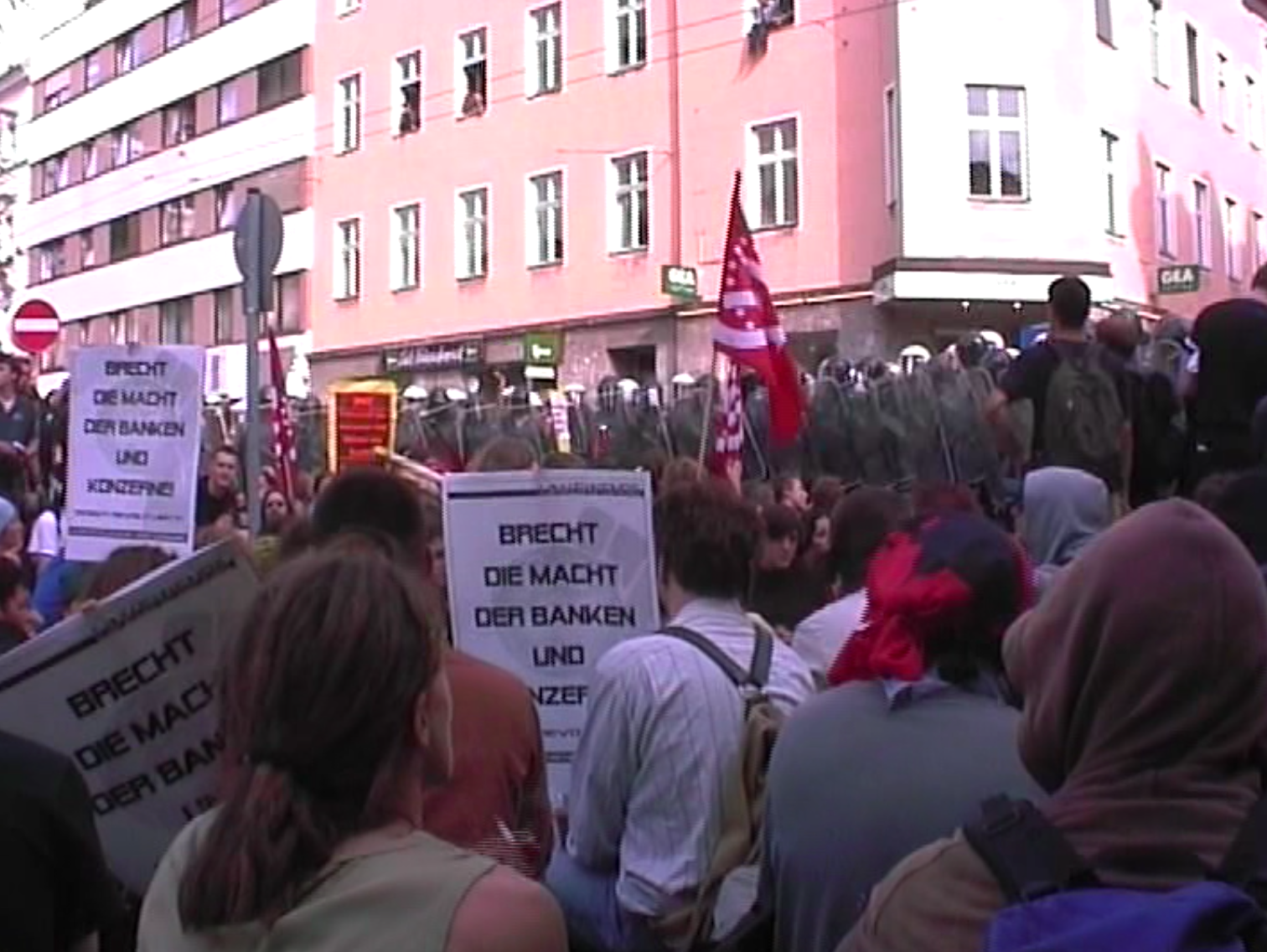
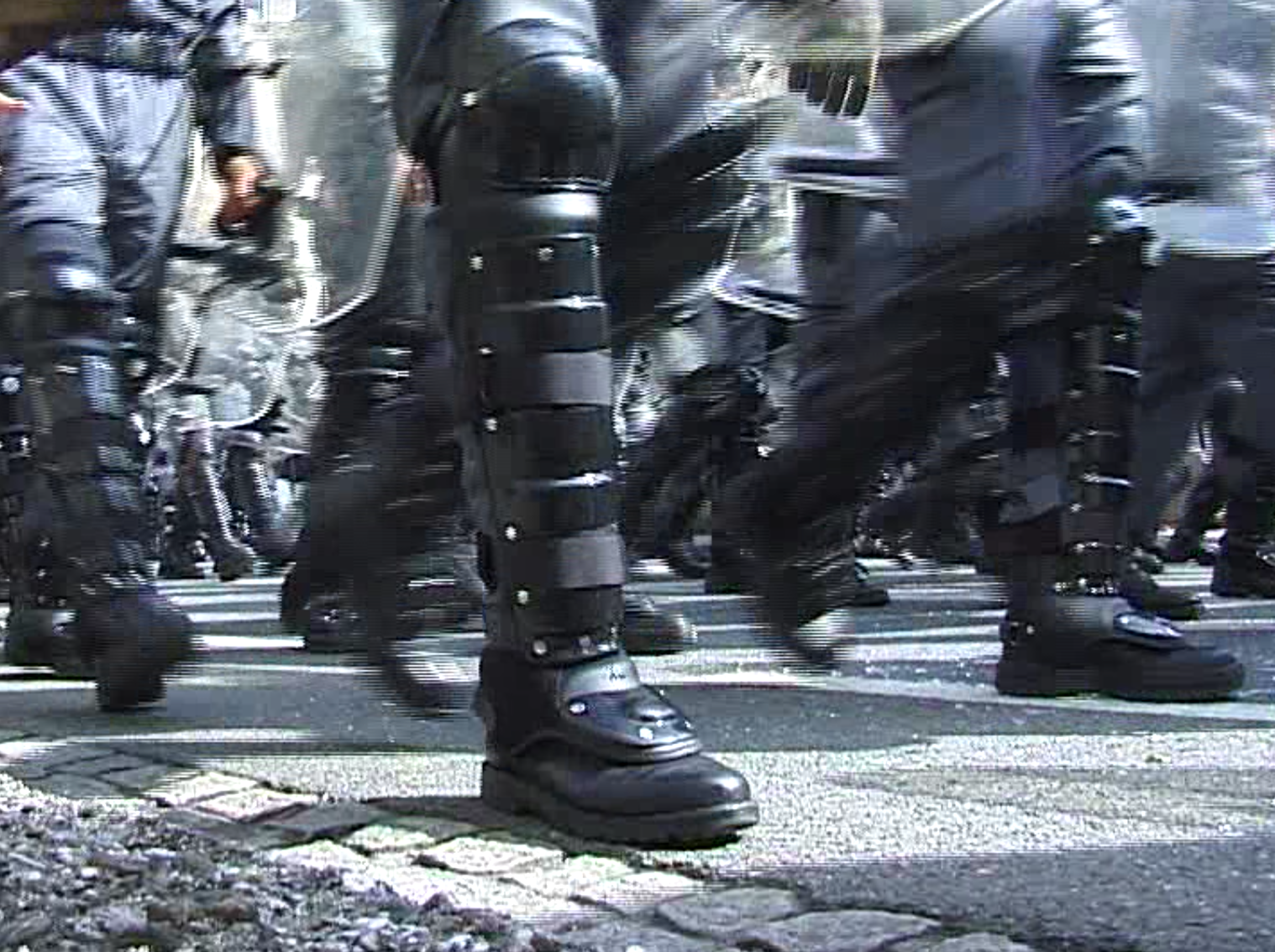
The protestors describe being surrounded without warning by police blockades, passports seized, bags searched, and bodies detained without charge. Their accounts resonate with anti-imperialist analysis, as the consolidation of global wealth into fewer hands is mirrored by the consolidation of state power into police enforcement.
Ressler’s framing is deceptively simple: a static camera, an unobtrusive background, and long, uninterrupted speech. Such minimalism elevates the protestors from mere subjects to theorists of their own experience. The viewer encounters partisan reflection as lived thought rather than expert commentary.

The testimonies reveal a pattern of nonviolence met with state violence. Peaceful demonstrators are treated as disruptive threats less for what they do than for what they represent: a democratization of dissent. In this sense, Ressler delineates not only the radicalization of police brutality but the dialectical relationship between state sovereignty and pacifist protest.
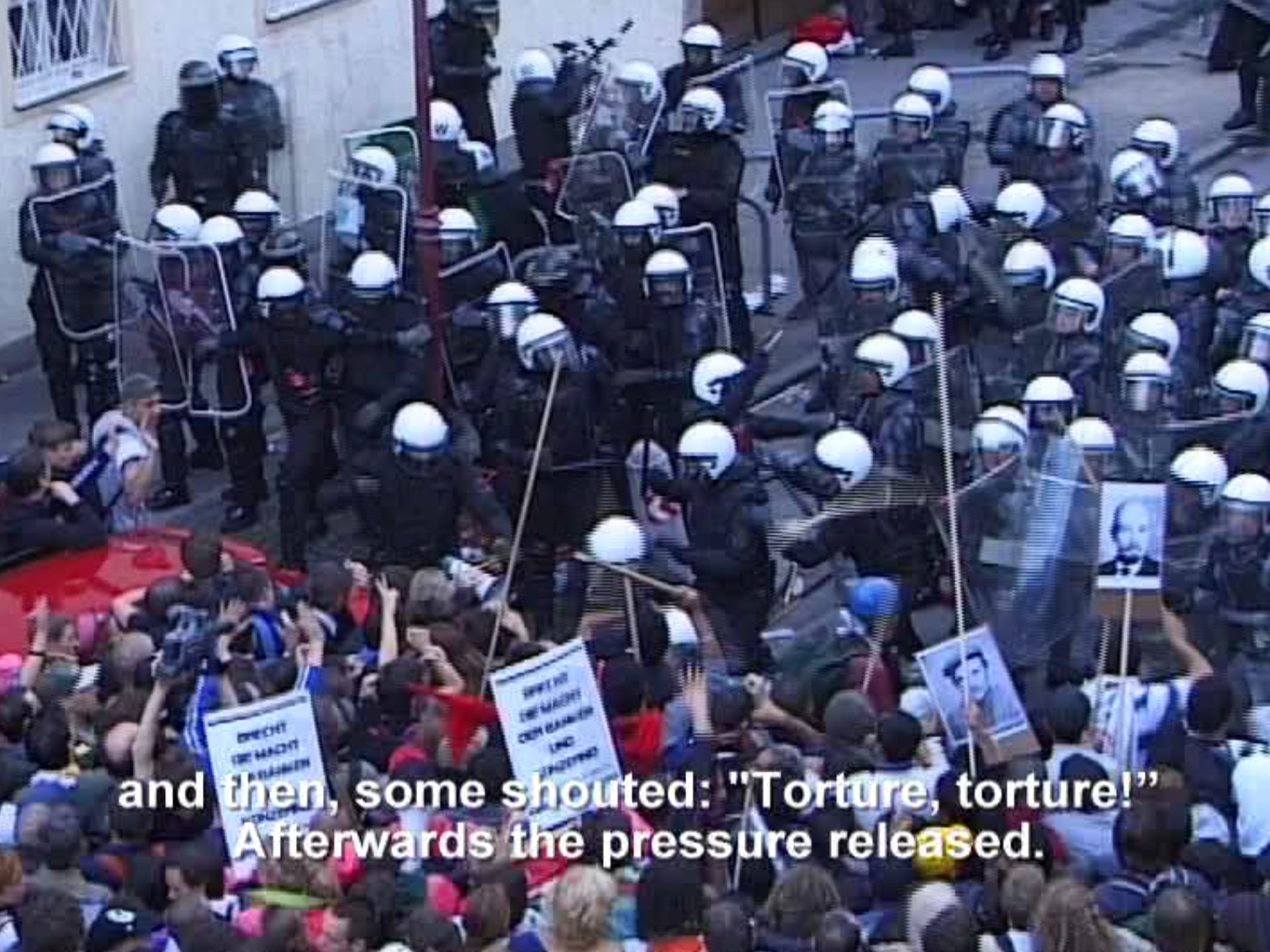
The video ends on a note of unexpected accountability: the head of police being fined for unlawful detention, and protestors receiving 200 DM in compensation for personal injury. Ressler resists narrative triumphalism, but this detail underscores the juridical cracks where the arm of supremacy can still be challenged.
Disobbedienti examines the emergence of new activist formations responding to increasingly hostile state tactics. The title refers to I Disobbedienti, a network of Italian activist groups whose lineage traces back to the Tute Bianche (White Overalls), the iconic movement that demonstrated against the G8 summit in Genoa in July 2001. The Tute Bianche were recognizable for their white protective uniforms that symbolized equality and rendered their bodies at once vulnerable and fortified. Their transformation into the Disobbedienti marked a strategic shift as they shed that armor to blend into crowds. Thus, they adopted more flexible, guerrilla-style actions while remaining fundamentally committed to nonviolence.

Ressler and co-director Dario Azzellini interview members of these groups, revealing activism rooted in leftist traditions: young communists and socialists, labor organizers, proponents of immigrant rights and living wages, and advocates of gender equality. Their philosophy resonates with the Zapatistas in serving as a node of political resistance without separating themselves from the broader social fabric.
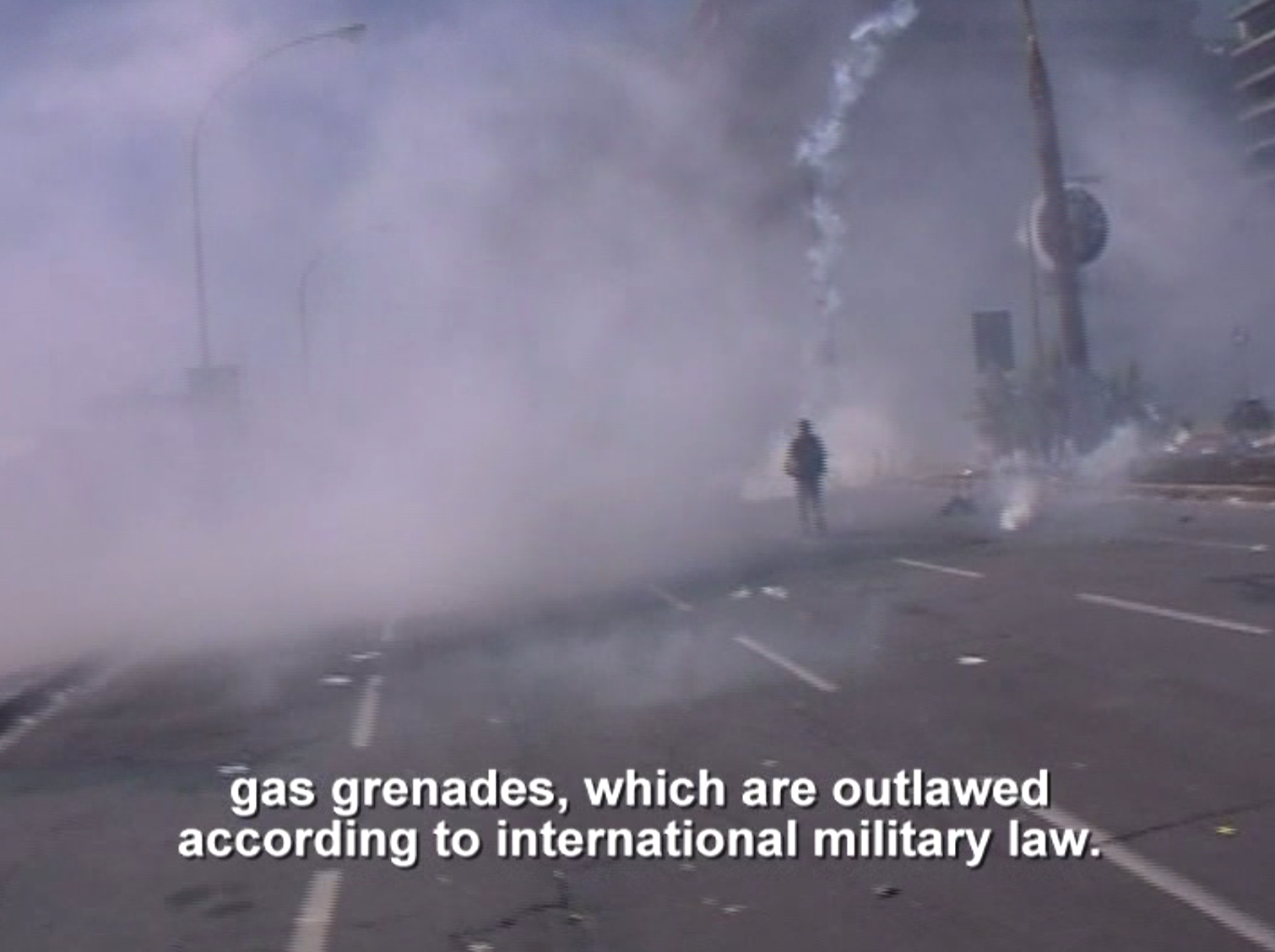
The Disobbedienti deployed the “technology of imperialism” against itself, using protective gear, communication networks, and media-savvy strategies to expose systemic abuses. Their efforts spanned cities across Italy, including Bologna and Rome, culminating in an extraordinary dismantling of a detention center in Via Mattei before it even opened. They declared the site a “camp against humanity,” turning the rhetoric of security back upon its perpetrators. The camera captures a “movement of movements,” a coalition not unified by ideology alone but by the shared practice of social disobedience. Their activism is embodied, distributed, and adaptive. It challenges not just policy but the very architecture of obedience.
Taken together, this loose diptych marks a transitional moment in European protest culture, when globalization’s mechanisms grew increasingly opaque and states responded to pacifism with unprecedented force. Ressler’s documents reject the conventions of objective journalism, demonstrating instead that neutrality often masks systemic violence. By centering activists’ voices, he asserts that political knowledge emerges from participation, not from distance.
These works illustrate how democracy, far from being a stable institutional genre, is a contested process shaped by those who would dare to contravene it. Democracy looks like confrontation, like testimony, like refusal. It is the rebuilding of political subjectivity under conditions designed to suppress it. In capable hands, video marks a site of counter-hegemonic discourse, a tool for reclaiming public space from the closure of neoliberal governance.
Who gets to define democracy? Who gets to speak within it? And what forms of resistance must emerge when the answers are no longer shared? Ressler’s work suggests that the future of political art lies not in representing dissent, but in creating spaces where dissent can speak for itself, lest we take it upon ourselves to answer such questions in place of those whose voices must first be heard.
 Between Sound and Space: ECM Records and Beyond